Landmarks, A Remarkable Anthology of Poetry and Prose in Translation (Book Acquired, 11.15.2013)

20131208-095949.jpg

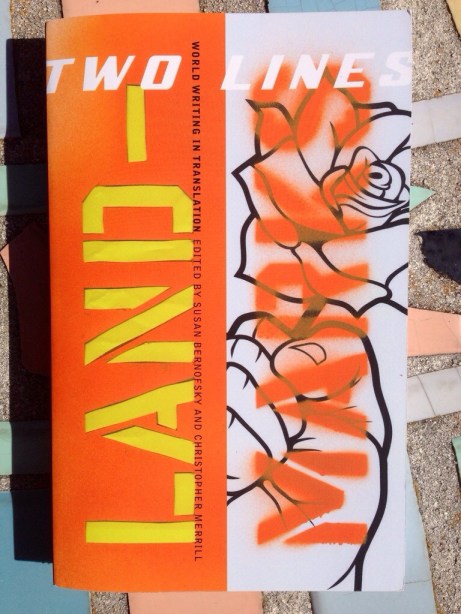
Landmarks, newish from Two Lines Press, collects poetry and prose in English translation. The collection features over a dozen languages and includes a special selection on the Arab Spring. I snacked on this book over the past few weeks, reading it at random whenever a nook of free time presented itself. There are still a few selections I haven’t gotten to yet, but most of what’s collected here is superb, thanks to editors Susan Bernofsky (who you probably know from her Robert Walser translations) and Christopher Merrill.

Two Lines’ blurb:

The premiere anthology of international literature returns for its 20th anniversary with stellar new prose and poetry, headlined by a collection of writing dedicated to the Arab Spring.

Coedited by leading German translator Susan Bernofsky and celebrated poet and translator Christopher Merrill, Landmarks gives us never-before-seen work from over 20 nations. Lauded Argentine author Juan Jose Saer, widely considered the heir to Jorge Luis Borges, transforms a photo of Earth from space into a tense, alcohol-fueled meditation on emptiness. Scholastique Mukasonga’s heartbreaking story ponders how so many of her fellow Rwandans could participate in a bloody genocide. And the Soviet absurdist Daniil Kharms is found among the volume’s many poets, alongside Yehuda Amichai—widely considered Israel’s greatest modern bard—and the up-and-coming Brazilian Ana Martins Marques.

In a special section of vital new work from the Middle East, ten writers provide an artist’s insight into the momentous events of the 2010 Arab Spring. Iraqi poet Naseer Hassan reveals haunting, everyday images from his nation. Ali Al Jallawi, twice imprisoned for critiquing of Bahrain’s political regime, ponders his relationship to God. And in Egyptian writer Mona Elnamoury’s surrealist story, images of torture and terror give way to a spectacular dream beneath the folds of an otherworldly quilt.

A truly a global education, Landmarks continues two proud decades of exploring the riches of world literature and making connections between the abundance of amazing work being produced around the world.

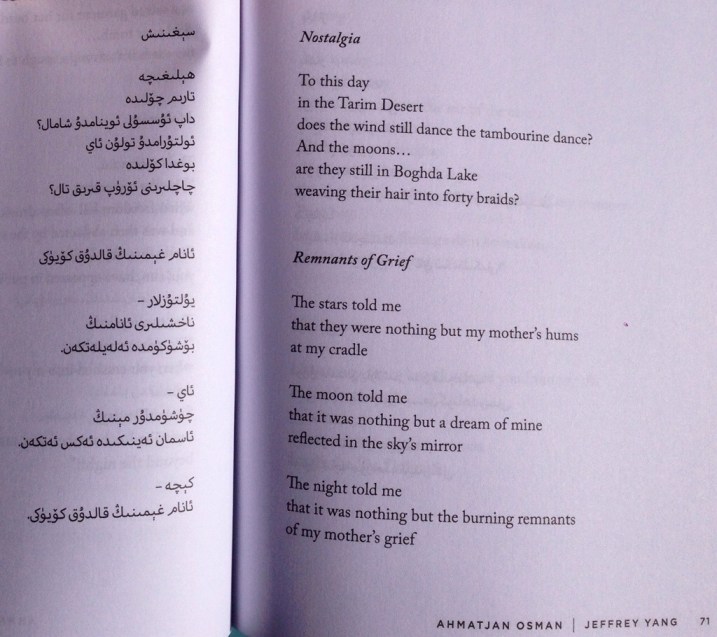
Maybe the best feature of Landmarks is the rich insight it offers into translation. Each selection is prefaced with an introduction that offers context for the writer and the conditions of the writing, as well as the translation process itself.  The poems are printed in two languages as well—the original on the left, the translation on the right. (Prose selections only feature the first page of original language printed alongside the translation). Being able to see the form and contours of the poem next to its translation is fascinating. Even if the poem was composed in an alphabet utterly foreign to me, being able to see it in its original form still offers a sense of its rhythm. Great stuff.

Two from Ahmatjan Osman, translated from Uyghur by Jeffrey Yang:
20131208-100003.jpg

“Fire Dreams” — Carl Sandburg

“Fire Dreams” by Carl Sandburg

(Written to be read aloud, if so be, Thanksgiving Day)

I remember here by the fire,
In the flickering reds and saffrons,
They came in a ramshackle tub,
Pilgrims in tall hats,
Pilgrims of iron jaws,
Drifting by weeks on beaten seas,
And the random chapters say
They were glad and sang to God.

And so
Since the iron-jawed men sat down
And said, “Thanks, O God,”
For life and soup and a little less
Than a hobo handout to-day,
Since gray winds blew gray patterns of sleet on Plymouth Rock,
Since the iron-jawed men sang “Thanks, O God,”
You and I, O Child of the West,
Remember more than ever
November and the hunter’s moon,
November and the yellow-spotted hills.

And so
In the name of the iron-jawed men
I will stand up and say yes till the finish is come and gone.
God of all broken hearts, empty hands, sleeping soldiers,
God of all star-flung beaches of night sky,
I and my love-child stand up together to-day and sing: “Thanks, O God.”

More Tom Clark (Books Acquired, 11.16.2013)

20131123-125447.jpg

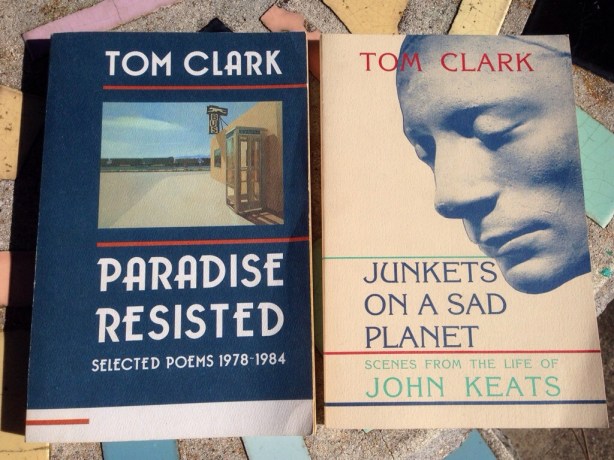
Last week I picked up more Tom Clark books. Devouring these things. I lied to myself that I was buying Paradise Resisted for a friend (I didn’t give it to him; I did give him a copy of Blood Meridian though). Junkets on a Sad Planet is a Very Strange Book.

A poem from Paradise:

20131123-125456.jpg

“Briar Rose (Sleeping Beauty)” — Anne Sexton

“Briar Rose (Sleeping Beauty)” by Anne Sexton

Consider
a girl who keeps slipping off,
arms limp as old carrots,
into the hypnotist’s trance,
into a spirit world
speaking with the gift of tongues.
She is stuck in the time machine,
suddenly two years old sucking her thumb,
as inward as a snail,
learning to talk again.
She’s on a voyage.
She is swimming further and further back,
up like a salmon,
struggling into her mother’s pocketbook.
Little doll child,
come here to Papa.
Sit on my knee.
I have kisses for the back of your neck.
A penny for your thoughts, Princess.
I will hunt them like an emerald.

Come be my snooky
and I will give you a root.
That kind of voyage,
rank as a honeysuckle.
Once
a king had a christening
for his daughter Briar Rose
and because he had only twelve gold plates
he asked only twelve fairies
to the grand event.
The thirteenth fairy,
her fingers as long and thing as straws,
her eyes burnt by cigarettes,
her uterus an empty teacup,
arrived with an evil gift.
She made this prophecy:
The princess shall prick herself
on a spinning wheel in her fifteenth year
and then fall down dead.
Kaputt!
The court fell silent.
The king looked like Munch’s Scream
Fairies’ prophecies,
in times like those,
held water.
However the twelfth fairy
had a certain kind of eraser
and thus she mitigated the curse
changing that death
into a hundred-year sleep. Continue reading ““Briar Rose (Sleeping Beauty)” — Anne Sexton”