World of Pains and Troubles (John Keats)

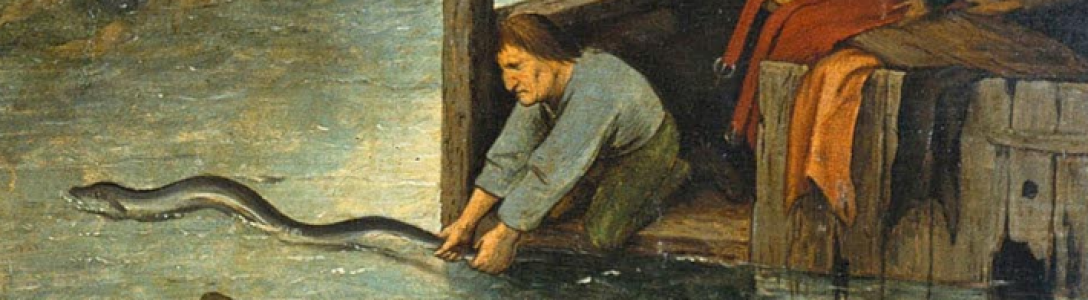
—The common cognomen of this world among the misguided and superstitious is ‘a vale of tears’ from which we are to be redeemed by a certain arbitrary interposition of God and taken to Heaven–What a little circumscribed straightened notion! call the world if you Please ‘The vale of Soul-making’ Then you will find out the use of the world (I am speaking now in the highest terms for human nature admitting it to be immortal which I will here take for granted for the purpose of showing a thought which has struck me concerning it) I say “Soul making” Soul as distinguished from an Intelligence– There may be intelligences or sparks of the divinity in millions–but they are not Souls till they acquire identities, till each one is personally itself. Intelligences are atoms of perception–they know and they see and they are pure, in short they are God–how then are Souls to be made? How then are these sparks which are God to have identity given them–so as ever to possess a bliss peculiar to each ones individual existence? How, but by the medium of a world like this? This point I sincerely wish to consider because I think it a grander system of salvation than the chrystain religion–or rather it is a system of Spirit-creation–This is effected by three grand materials acting the one upon the other for a series of years–These Materials are the Intelligence–the human heart (as distinguished from intelligence or Mind) and the World or Elemental space suited for the proper action of Mind and Heart on each other for the purpose of forming the Soul or Intelligence destined to possess the sense of Identity. I can scarcely express what I but dimly perceive–and yet I think I perceive it–that you may judge the more clearly I will put it in the most homely form possible–I will call the world a School instituted for the purpose of teaching little children to read–I will call the Child able to read, the Soul made from that school and its hornbook. Do you not see how necessary a World of Pains and troubles is to school an Intelligence and make it a soul? A Place where the heart must feel and suffer in a thousand diverse ways! Not merely is the Heart a Hornbook, it is the Minds Bible, it is the Minds experience, it is the teat from which the Mind or intelligence sucks its identity–As various as the Lives of Men are–so various become their Souls, and thus does God make individual beings, Souls, Identical Souls of the sparks of his own essence–“

—From a letter John Keats wrote to his brother George, dated April 21, 1810. (More excerpts from Keats’s letters with commentary).

Meet Me in the Park — Norman Bluhm and Frank O’Hara

“Why I Am Not a Painter” — Frank O’Hara

“Why I Am Not a Painter” by Frank O’Hara

I am not a painter, I am a poet.
Why? I think I would rather be
a painter, but I am not. Well,

for instance, Mike Goldberg
is starting a painting. I drop in.
“Sit down and have a drink” he
says. I drink; we drink. I look
up. “You have SARDINES in it.”
“Yes, it needed something there.”
“Oh.” I go and the days go by
and I drop in again. The painting
is going on, and I go, and the days
go by. I drop in. The painting is
finished. “Where’s SARDINES?”
All that’s left is just
letters, “It was too much,” Mike says.

But me? One day I am thinking of
a color: orange. I write a line
about orange. Pretty soon it is a
whole page of words, not lines.
Then another page. There should be
so much more, not of orange, of
words, of how terrible orange is
and life. Days go by. It is even in
prose, I am a real poet. My poem
is finished and I haven’t mentioned
orange yet. It’s twelve poems, I call
it ORANGES. And one day in a gallery
I see Mike’s painting, called SARDINES.


“The Unknown Citizen” — W.H. Auden

“The Unknown Citizen” by W.H. Auden—

(To JS/07 M 378
This Marble Monument
Is Erected by the State)

He was found by the Bureau of Statistics to be
One against whom there was no official complaint,
And all the reports on his conduct agree
That, in the modern sense of an old-fashioned word, he was a
saint,
For in everything he did he served the Greater Community.
Except for the War till the day he retired
He worked in a factory and never got fired,
But satisfied his employers, Fudge Motors Inc.
Yet he wasn’t a scab or odd in his views,
For his Union reports that he paid his dues,
(Our report on his Union shows it was sound)
And our Social Psychology workers found
That he was popular with his mates and liked a drink.
The Press are convinced that he bought a paper every day
And that his reactions to advertisements were normal in every way.
Policies taken out in his name prove that he was fully insured,
And his Health-card shows he was once in a hospital but left it cured.
Both Producers Research and High-Grade Living declare
He was fully sensible to the advantages of the Instalment Plan
And had everything necessary to the Modern Man,
A phonograph, a radio, a car and a frigidaire.
Our researchers into Public Opinion are content
That he held the proper opinions for the time of year;
When there was peace, he was for peace: when there was war, he went.
He was married and added five children to the population,
Which our Eugenist says was the right number for a parent of his
generation.
And our teachers report that he never interfered with their
education.
Was he free? Was he happy? The question is absurd:
Had anything been wrong, we should certainly have heard.


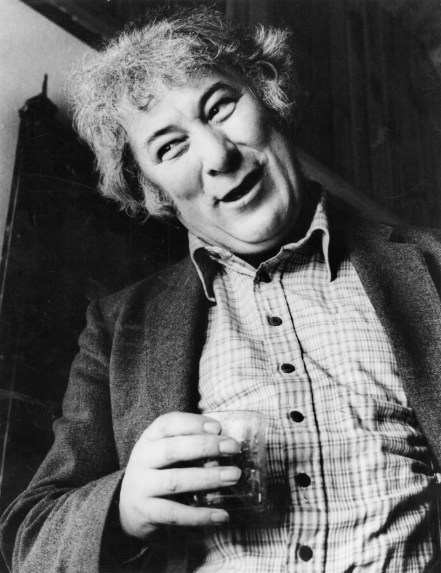
RIP Seamus Heaney

gm655_01

RIP Seamus Heaney, 1939-2013

“Funeral Rites”

I shouldered a kind of manhood
stepping in to lift the coffins
of dead relations.
They had been laid out

in tainted rooms,
their eyelids glistening,
their dough-white hands
shackled in rosary beads.

Their puffed knuckles
had unwrinkled, the nails
were darkened, the wrists
obediently sloped.

The dulse-brown shroud,
the quilted satin cribs:
I knelt courteously
admiting it all

as wax melted down
and veined the candles,
the flames hovering
to the women hovering
behind me.
And always, in a corner,
the coffin lid,
its nail-heads dressed

with little gleaming crosses.
Dear soapstone masks,
kissing their igloo brows
had to suffice

before the nails were sunk
and the black glacier
of each funeral
pushed away.

II

Now as news comes in
of each neighbourly murder
we pine for ceremony,
customary rhythms:

the temperate footsteps
of a cortège, winding past
each blinded home.
I would restore

the great chambers of Boyne,
prepare a sepulchre
under the cupmarked stones.
Out of side-streets and bye-roads

purring family cars
nose into line,
the whole country tunes
to the muffled drumming

of ten thousand engines.
Somnambulant women,
left behind, move
through emptied kitchens

imagining our slow triumph
towards the mounds.
Quiet as a serpent
in its grassy boulevard

the procession drags its tail
out of the Gap of the North
as its head already enters
the megalithic doorway.

III

When they have put the stone
back in its mouth
we will drive north again
past Strang and Carling fjords

the cud of memory
allayed for once, arbitration
of the feud placated,
imagining those under the hill

disposed like Gunnar
who lay beautiful
inside his burial mound,
though dead by violence

and unavenged.
men said that he was chanting
verses about honour
and that four lights burned

in corners of the chamber:
which opened then, as he turned
with a joyful face
to look at the moon.

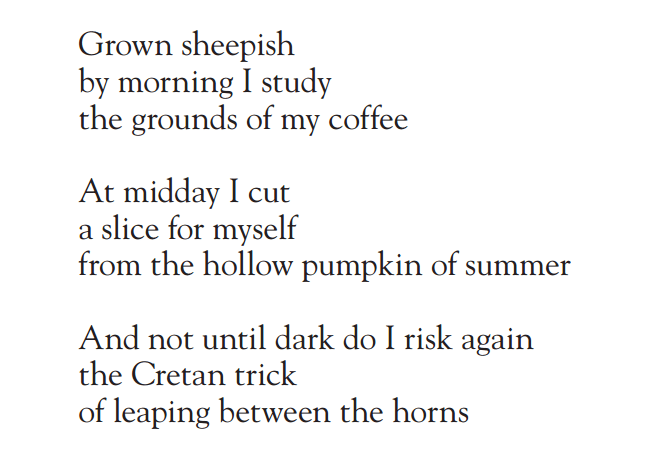
W.G. Sebald Poem-Fragment

Capture

“Lines” — John Keats

Capture

“For the Love of Dying” — Malcolm Lowry

ml

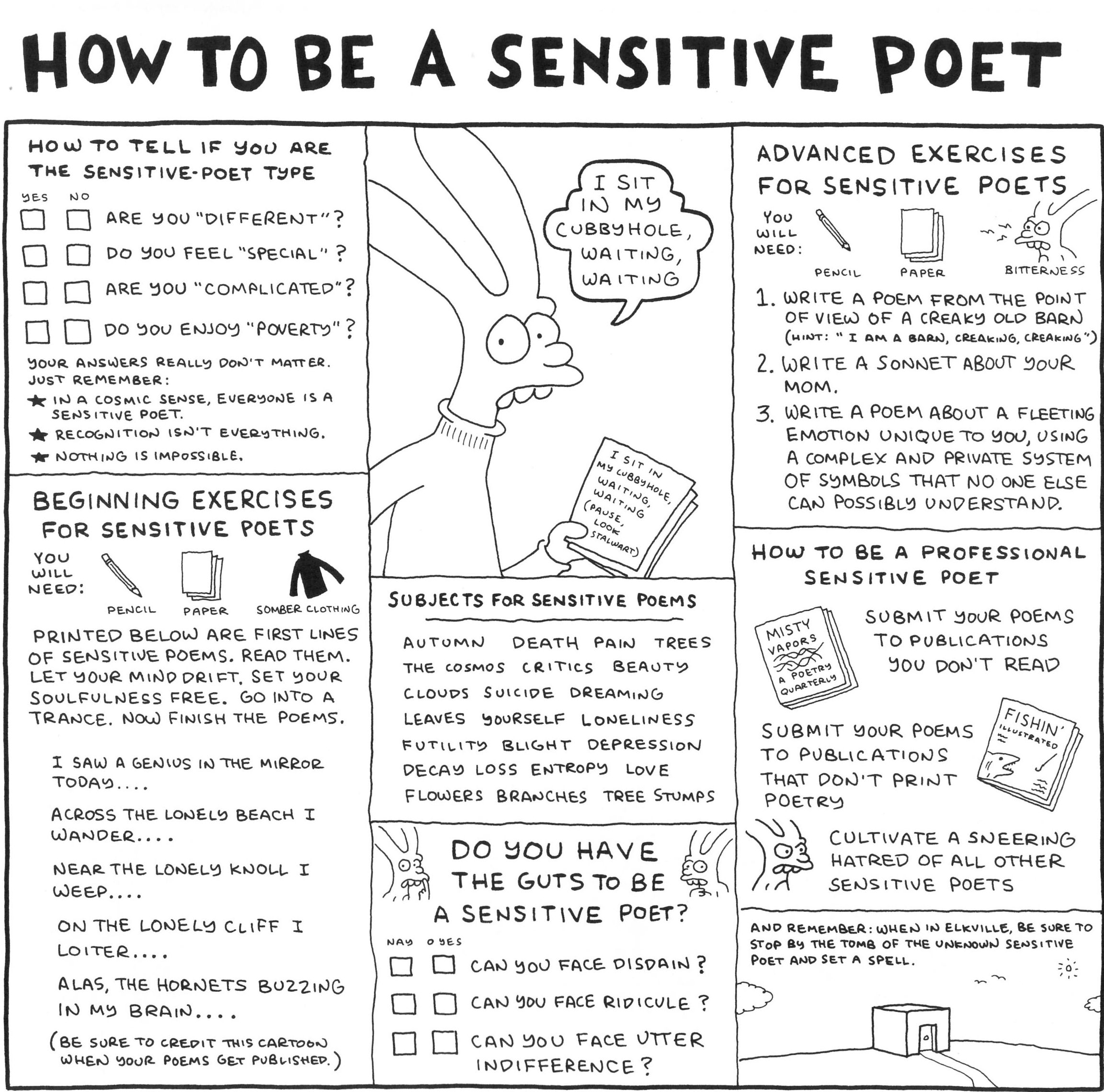
How to Be a Sensitive Poet (Life in Hell)

Sensitive Poet

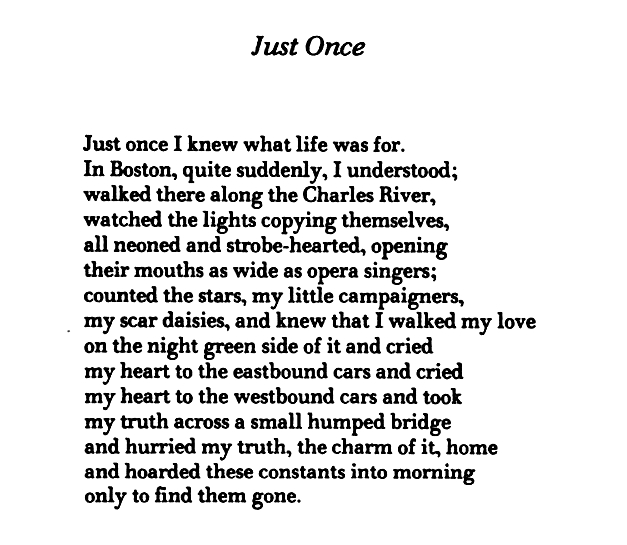
“Just Once” — Anne Sexton

as

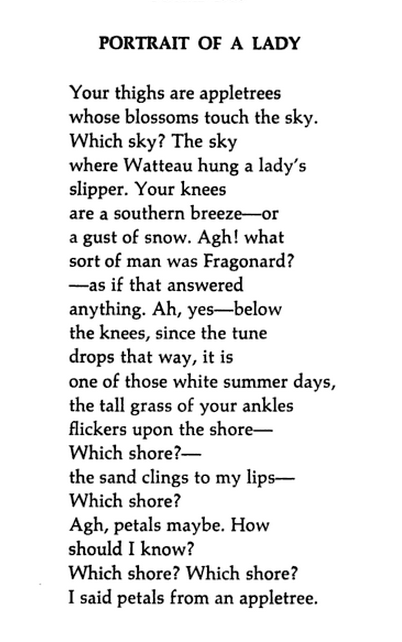
“Portrait of a Lady” — William Carlos Williams

wcw

“Foreigner” – Olga Broumas

House
Two floors
Down is stove
Down is bath kitchen music
Down is stove and the stack of logs
Up is bed and the climate the tropical
Down is desk next to stove
Around and around floors windows uncurtained
Outside is snow
Unmarked northern profound white snow
Up small woman alone
Icicles
Naked

“Heat” — Denis Johnson

“Heat” by Denis Johnson—

Here in the electric dusk your naked lover

tips the glass high and the ice cubes fall against her teeth.

It’s beautiful Susan, her hair sticky with gin,

Our Lady of Wet Glass-Rings on the Album Cover,

streaming with hatred in the heat

as the record falls and the snake-band chords begin

to break like terrible news from the Rolling Stones,

and such a last light—full of spheres and zones.

August,

you’re just an erotic hallucination,

just so much feverishly produced kazoo music,

are you serious?—this large oven impersonating night,

this exhaustion mutilated to resemble passion,

the bogus moon of tenderness and magic

you hold out to each prisoner like a cup of light?

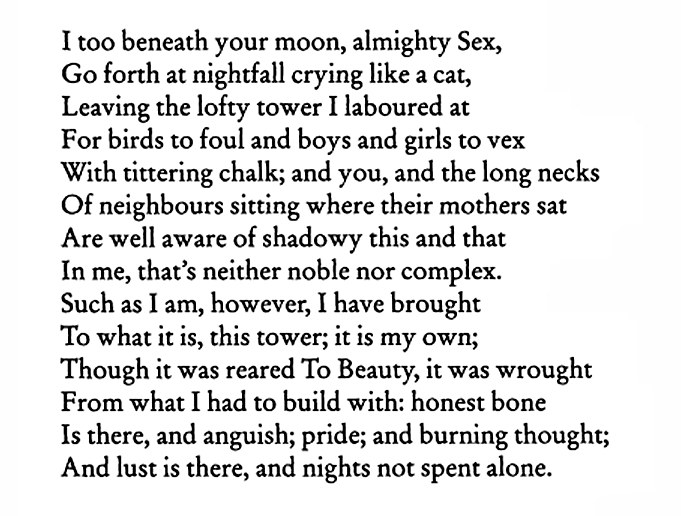
“I too beneath your moon, almighty Sex” — Edna St. Vincent Millay

esvm

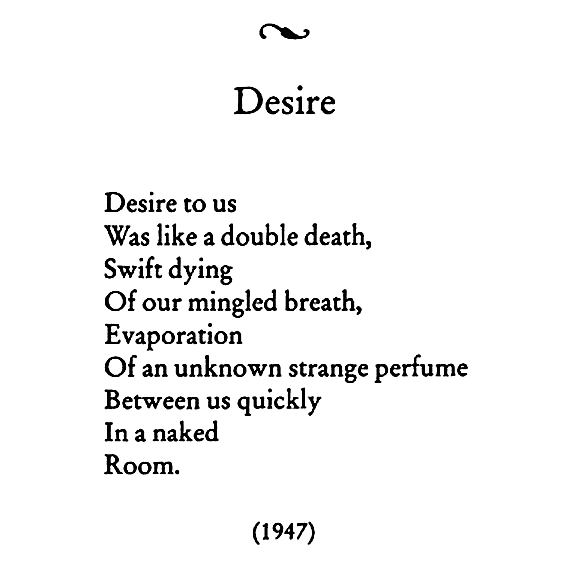
“Desire” — Langston Hughes

desire

“The Apparition” — John Donne

jd

I confess (Sappho)

confess