Jason Schwartz Interviewed at 3:am Magazine

3:am Magazine has published an interview with novelist Jason Schwartz. Schwartz’s latest, John the Posthumous, is my favorite book of 2013.  In the interview, Jason Lucarelli talks with Schwartz about John the Posthumous, his experiences with Gordon Lish, and teaching writing. The final answer of the interview though is my favorite moment—it reads like a wonderful and bizarre microfiction. Here it is, sans context:

This comes to mind: long ago, in New York, I taught middle school for a year. Rough and tumble sort of place. Lots of mischief, and no textbooks, as these had all been lost or destroyed or thrown out into a courtyard, where—I may be revising the memory slightly—there was a great pile of books, a pile nearly one story high. So it was upon the teacher to scratch out lessons on the blackboard. This was transcription, the transcription of many items, all these chapters from the absent books. And once this had been accomplished, once the blackboard had been covered with words, first thing in the morning, it was upon the teacher to guard the blackboard all day. So what to do when the fistfight breaks out? You know how people gather around. The teacher now fears the press of bodies, and the tendency of bodies to smudge, or even erase, words. Stop the fight or protect the blackboard? This seemed to me, at the time, the central educational dilemma. If you’re lucky, the fracas is close by, and you might arrange things accordingly—one hand here and one hand there, finding yourself in various complicated postures. I never managed that to successful effect. And perhaps all this explains why, in the old country, contortionists were always thought the best schoolteachers. Anyway, Mr. O’Riley’s room has been set afire in the meantime, or Mrs. Wilson has been trampled in the stairwell. The day would pass in that fashion, and then I would go home and write about postage stamps and Judas Iscariot.


Read/Listen to JG Ballard’s “The Assassination of John Fitzgerald Kennedy Considered as a Downhill Motor Race”

Author’s note. The assassination of President Kennedy on November 22, 1963, raised many questions, not all of which were answered by the Report of the Warren Commission. It is suggested that a less conventional view of the events of that grim day may provide a more satisfactory explanation. Alfred Jarry’s “The Crucifixion Considered as an Uphill Bicycle Race” gives us a useful lead.

Oswald was the starter.

From his window above the track he opened the race by firing the starting gun. It is believed that the first shot was not properly heard by all the drivers. In the following confusion, Oswald fired the gun two more times, but the race was already underway.

Kennedy got off to a bad start.

There was a governor in his car and its speed remained constant at about fifteen miles an hour. However, shortly afterwards, when the governor had been put out of action, the car accelerated rapidly, and continued at high speed along the remainder of the course.

Read the rest of JG Ballard’s short story “The Assassination of John Fitzgerald Kennedy Considered as a Downhill Motor Race” (and the Jarry text)or let Miette read it to you.

“The Blind Pensioners at Quinze Vingt,” A Philosophical Digression by Voltaire

“The Blind Pensioners at Quinze Vingt” by Voltaire

A SHORT DIGRESSION.—When the hospital of the Quinze Vingt was first founded, the pensioners were all equal, and their little affairs were concluded upon by a majority of votes. They distinguished perfectly by the touch between copper and silver coin; they never mistook the wine of Brie for that of Burgundy. Their sense of smelling was finer than that of their neighbors who had the use of two eyes. They reasoned very well on the four senses; that is, they knew everything they were permitted to know, and they lived as peaceably and as happily as blind people could be supposed to do. But unfortunately one of their professors pretended to have clear ideas in respect to the sense of seeing, he drew attention; he intrigued; he formed enthusiasts; and at last he was acknowledged chief of the community. He pretended to be a judge of colors, and everything was lost.

This dictator of the Quinze Vingt chose at first a little council, by the assistance of which he got possession of all the alms. On this account, no person had the resolution to oppose him. He decreed, that all the inhabitants of the Quinze Vingt were clothed in white. The blind pensioners believed him; and nothing was to be heard but their talk of white garments, though, in fact, they possessed not one of that color. All their acquaintance laughed at them. They made their complaints to the dictator, who received them very ill; he rebuked them as innovators, freethinkers, rebels, who had suffered themselves to be seduced by the errors of those who had eyes, and who presumed to doubt that their chief was infallible. This contention gave rise to two parties.

To appease the tumult, the dictator issued a decree, importing that all their vestments were red. There was not one vestment of that color in the Quinze Vingt. The poor men were laughed at more than ever. Complaints were again made by the community. The dictator rushed furiously in; and the other blind men were as much enraged. They fought a long time; and peace was not restored until the members of the Quinze Vingt were permitted to suspend their judgments in regard to the color of their dress.

A deaf man, reading this little history, allowed that these people, being blind, were to blame in pretending to judge of colors; but he remained steady to his own opinion, that those persons who were deaf were the only proper judges of music.

Invisible Bust of Voltaire — Salvador Dali

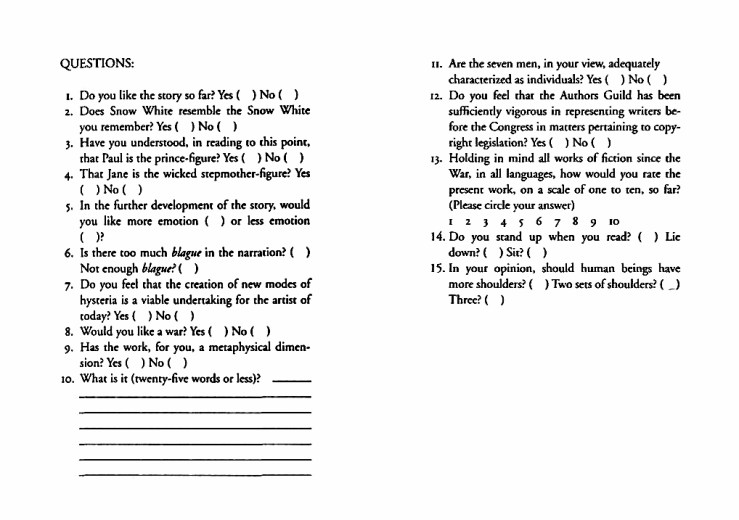
Questions (Donald Barthelme’s Snow White)

questions

“Briar Rose” — The Brothers Grimm

“Briar Rose” by The Brothers Grimm

(English translation by Edgar Taylor and Marian Edwardes)

A king and queen once upon a time reigned in a country a great way off, where there were in those days fairies. Now this king and queen had plenty of money, and plenty of fine clothes to wear, and plenty of good things to eat and drink, and a coach to ride out in every day: but though they had been married many years they had no children, and this grieved them very much indeed. But one day as the queen was walking by the side of the river, at the bottom of the garden, she saw a poor little fish, that had thrown itself out of the water, and lay gasping and nearly dead on the bank. Then the queen took pity on the little fish, and threw it back again into the river; and before it swam away it lifted its head out of the water and said, ‘I know what your wish is, and it shall be fulfilled, in return for your kindness to me—you will soon have a daughter.’ What the little fish had foretold soon came to pass; and the queen had a little girl, so very beautiful that the king could not cease looking on it for joy, and said he would hold a great feast and make merry, and show the child to all the land. So he asked his kinsmen, and nobles, and friends, and neighbours. But the queen said, ‘I will have the fairies also, that they might be kind and good to our little daughter.’ Now there were thirteen fairies in the kingdom; but as the king and queen had only twelve golden dishes for them to eat out of, they were forced to leave one of the fairies without asking her. So twelve fairies came, each with a high red cap on her head, and red shoes with high heels on her feet, and a long white wand in her hand: and after the feast was over they gathered round in a ring and gave all their best gifts to the little princess. One gave her goodness, another beauty, another riches, and so on till she had all that was good in the world.

Just as eleven of them had done blessing her, a great noise was heard in the courtyard, and word was brought that the thirteenth fairy was come, with a black cap on her head, and black shoes on her feet, and a broomstick in her hand: and presently up she came into the dining-hall. Now, as she had not been asked to the feast she was very angry, and scolded the king and queen very much, and set to work to take her revenge. So she cried out, ‘The king’s daughter shall, in her fifteenth year, be wounded by a spindle, and fall down dead.’ Then the twelfth of the friendly fairies, who had not yet given her gift, came forward, and said that the evil wish must be fulfilled, but that she could soften its mischief; so her gift was, that the king’s daughter, when the spindle wounded her, should not really die, but should only fall asleep for a hundred years.

However, the king hoped still to save his dear child altogether from the threatened evil; so he ordered that all the spindles in the kingdom should be bought up and burnt. But all the gifts of the first eleven fairies were in the meantime fulfilled; for the princess was so beautiful, and well behaved, and good, and wise, that everyone who knew her loved her.

It happened that, on the very day she was fifteen years old, the king and queen were not at home, and she was left alone in the palace. So she roved about by herself, and looked at all the rooms and chambers, till at last she came to an old tower, to which there was a narrow staircase ending with a little door. In the door there was a golden key, and when she turned it the door sprang open, and there sat an old lady spinning away very busily. ‘Why, how now, good mother,’ said the princess; ‘what are you doing there?’ ‘Spinning,’ said the old lady, and nodded her head, humming a tune, while buzz! went the wheel. ‘How prettily that little thing turns round!’ said the princess, and took the spindle and began to try and spin. But scarcely had she touched it, before the fairy’s prophecy was fulfilled; the spindle wounded her, and she fell down lifeless on the ground.

However, she was not dead, but had only fallen into a deep sleep; and the king and the queen, who had just come home, and all their court, fell asleep too; and the horses slept in the stables, and the dogs in the court, the pigeons on the house-top, and the very flies slept upon the walls. Even the fire on the hearth left off blazing, and went to sleep; the jack stopped, and the spit that was turning about with a goose upon it for the king’s dinner stood still; and the cook, who was at that moment pulling the kitchen-boy by the hair to give him a box on the ear for something he had done amiss, let him go, and both fell asleep; the butler, who was slyly tasting the ale, fell asleep with the jug at his lips: and thus everything stood still, and slept soundly.

A large hedge of thorns soon grew round the palace, and every year it became higher and thicker; till at last the old palace was surrounded and hidden, so that not even the roof or the chimneys could be seen. But there went a report through all the land of the beautiful sleeping Briar Rose (for so the king’s daughter was called): so that, from time to time, several kings’ sons came, and tried to break through the thicket into the palace. This, however, none of them could ever do; for the thorns and bushes laid hold of them, as it were with hands; and there they stuck fast, and died wretchedly.

After many, many years there came a king’s son into that land: and an old man told him the story of the thicket of thorns; and how a beautiful palace stood behind it, and how a wonderful princess, called Briar Rose, lay in it asleep, with all her court. He told, too, how he had heard from his grandfather that many, many princes had come, and had tried to break through the thicket, but that they had all stuck fast in it, and died. Then the young prince said, ‘All this shall not frighten me; I will go and see this Briar Rose.’ The old man tried to hinder him, but he was bent upon going.

Now that very day the hundred years were ended; and as the prince came to the thicket he saw nothing but beautiful flowering shrubs, through which he went with ease, and they shut in after him as thick as ever. Then he came at last to the palace, and there in the court lay the dogs asleep; and the horses were standing in the stables; and on the roof sat the pigeons fast asleep, with their heads under their wings. And when he came into the palace, the flies were sleeping on the walls; the spit was standing still; the butler had the jug of ale at his lips, going to drink a draught; the maid sat with a fowl in her lap ready to be plucked; and the cook in the kitchen was still holding up her hand, as if she was going to beat the boy.

Then he went on still farther, and all was so still that he could hear every breath he drew; till at last he came to the old tower, and opened the door of the little room in which Briar Rose was; and there she lay, fast asleep on a couch by the window. She looked so beautiful that he could not take his eyes off her, so he stooped down and gave her a kiss. But the moment he kissed her she opened her eyes and awoke, and smiled upon him; and they went out together; and soon the king and queen also awoke, and all the court, and gazed on each other with great wonder. And the horses shook themselves, and the dogs jumped up and barked; the pigeons took their heads from under their wings, and looked about and flew into the fields; the flies on the walls buzzed again; the fire in the kitchen blazed up; round went the jack, and round went the spit, with the goose for the king’s dinner upon it; the butler finished his draught of ale; the maid went on plucking the fowl; and the cook gave the boy the box on his ear.

And then the prince and Briar Rose were married, and the wedding feast was given; and they lived happily together all their lives long.


“Briar Rose (Sleeping Beauty)” — Anne Sexton

“Briar Rose (Sleeping Beauty)” by Anne Sexton

Consider
a girl who keeps slipping off,
arms limp as old carrots,
into the hypnotist’s trance,
into a spirit world
speaking with the gift of tongues.
She is stuck in the time machine,
suddenly two years old sucking her thumb,
as inward as a snail,
learning to talk again.
She’s on a voyage.
She is swimming further and further back,
up like a salmon,
struggling into her mother’s pocketbook.
Little doll child,
come here to Papa.
Sit on my knee.
I have kisses for the back of your neck.
A penny for your thoughts, Princess.
I will hunt them like an emerald.

Come be my snooky
and I will give you a root.
That kind of voyage,
rank as a honeysuckle.
Once
a king had a christening
for his daughter Briar Rose
and because he had only twelve gold plates
he asked only twelve fairies
to the grand event.
The thirteenth fairy,
her fingers as long and thing as straws,
her eyes burnt by cigarettes,
her uterus an empty teacup,
arrived with an evil gift.
She made this prophecy:
The princess shall prick herself
on a spinning wheel in her fifteenth year
and then fall down dead.
Kaputt!
The court fell silent.
The king looked like Munch’s Scream
Fairies’ prophecies,
in times like those,
held water.
However the twelfth fairy
had a certain kind of eraser
and thus she mitigated the curse
changing that death
into a hundred-year sleep. Continue reading ““Briar Rose (Sleeping Beauty)” — Anne Sexton”

Cloudstreet (Book Acquired, 11.12.2013)

20131118-162531.jpg

Tim Winton’s Cloudstreet. Publisher’s blurb:

After two separate catastrophes, two very different families leave the country for the bright lights of Perth. The Lambs are industrious, united, and—until God seems to turn His back on their boy Fish—religious. The Pickleses are gamblers, boozers, fractious, and unlikely landlords.

Change, hardship, and the war force them to swallow their dignity and share a great, breathing, shuddering house called Cloudstreet. Over the next twenty years, they struggle and strive, laugh and curse, come apart and pull together under the same roof, and try as they can to make their lives.

Winner of the Miles Franklin Award and recognized as one of the greatest works of Australian literature, Cloudstreet is Tim Winton’s sprawling, comic epic about luck and love, fortitude and forgiveness, and the magic of the everyday.

Wrinkle in the groin (David Barthelme)

Henry walked home with his suit in a plastic bag. He had been washing the buildings. But something was stirring in him, a wrinkle in the groin. He was carrying his bucket too, and his ropes. But the wrinkle in his groin was monstrous. “Now it is necessary to court her, and win her, and put on this clean suit, and cut my various nails, and drink something that will kill the millions of germs in my mouth, and say something flattering, and be witty and bonny, and hale and kinky, and pay her a thousand dollars, all just to ease this wrinkle in the groin. It seems a high price.” Henry let his mind stray to his groin. Then he let his mind stray to her groin. Do girls have groins? The wrinkle was still there. “The remedy of Origen. That is still open to one. That door, at least, has not been shut.”

From Donald Barthelme’s novel Snow White.


“Time and Again” — Rainer Maria Rilke

time

“Hairs Wanted” — Flann O’Brien

hairs

RIP Doris Lessing

doris_lessing

RIP Doris Lessing, 1919-2013.

Snow White’s Education (Donald Barthelme)

BEAVER COLLEGE is where she got her education. She studied Modern Woman, Her Privileges and Responsibilities: the nature and nurture of women and what they stand for, in evolution and in history, including householding, upbringing, peace-keeping, healing and devotion, and how these contribute to the rehumanizing of today’s world. Then she studied Classical Guitar I, utilizing the methods and techniques of Sor, Tarrega, Segovia, etc. Then she studied English Romantic Poets II: Shelley, Byron, Keats. Then she studied Theoretical Foundations of Psychology: mind, consciousness, unconscious mind, personality, the self, interpersonal relations, psychosexual norms, social games, groups, adjustment, conflict, authority, individuation, integration and mental health. Then she studied Oil Painting I bringing to the first class as instructed Cadmium Yellow Light, Cadmium Yellow Medium, Cadmium Red Light, Alizarin Crimson, Ultramarine Blue, Cobalt Blue, Viridian, Ivory Black, Raw Umber, Yellow Ochre, Burnt Sienna, White. Then she studied Personal Resources I and II: self-evaluation, developing the courage to respond to the environment, opening and using the mind, individual experience, training, the use of time, mature redefinition of goals, action projects. Then she studied Realism and Idealism in the Contemporary Italian Novel: Palazzeschi, Brancati, Bilenchi, Pratolini, Moravia, Pavese, Levi, Silone, Berto, Cassola, Ginzburg, Malaparte, Mapalarte, Calvino, Gadda, Bassani, Landolfi. Then she studied —

From Donald Barthelme’s novel Snow White.

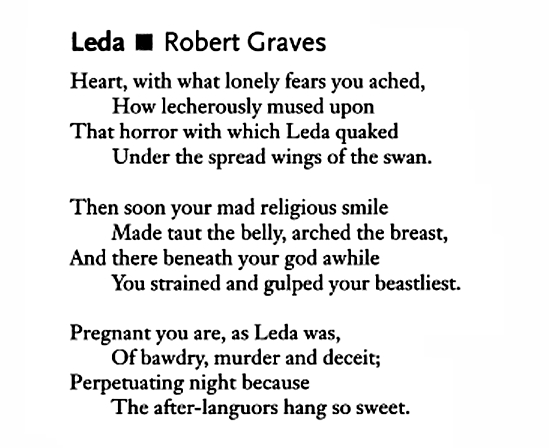
“Leda” — Robert Graves

leda

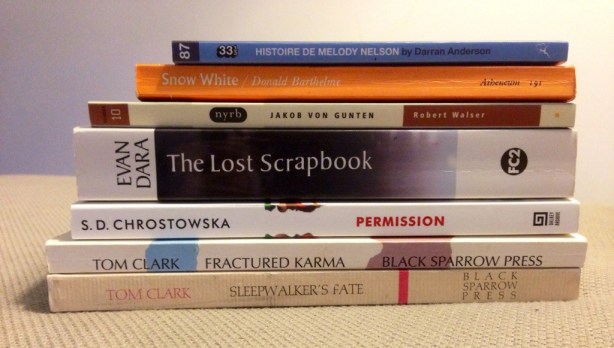
Books I’ve been reading these past few weeks

20131115-165229.jpg

I am reading too many books.

I am hoping to write about a few of these before the month is over, starting with Chrostowska’s Permission (my review is long overdue).

I’m about fifty pages shy of finishing Evan Dara’s The Lost Scrapbook; the book has been a revelation, one of those “How-the-hell-didn’t-I-know-about-this-already-?” deals. I’ll lazily compare it to Gaddis’s J R and DFW’s Infinite Jest.

I fell into rereading Snow White after working through several dozen of Barthelme’s short stories again. He’s probably the best.

Also the best is Tom Clark, whose poetry also falls into that “How-the-hell-didn’t-I-know-about-this-already-?” spectrum.

Quick thought on the beginning of Walser’s Jakob von Gunten: Seems part of a little mini-genre that includes Barthelme’s “Me and Miss Mandible” and Gombrowicz’s Ferdydurke.

Sorry for the lazy blogging. I will try to do better.


“I looked like this horrible Elizabethan courtier” | William Vollmann, Cross-Dresser

14zVOLLMAN4-articleLarge

Mr. Vollmann is 54, heterosexual and married with a daughter in high school. He began cross-dressing seriously about five years ago. Sometimes he transforms himself into a woman as part of a strange vision quest, aided by drugs or alcohol, to mind-meld with a female character in a book he’s writing. Other times it’s just because he likes the “smooth and slippery” feel of women’s lingerie.

From another profile on William T. Vollmann, this time in The New York Times. The profile centers around Vollmann’s latest book, The Book of Dolores.

You may recall Vollmann’s previous adventures in cross-dressing.


“An article on fire, on smoke” and Other Ideas from Nathaniel Hawthorne’s Note-Books

  1. An article on fire, on smoke. Diseases of the mind and soul,–even more common than bodily diseases.
  2. Tarleton, of the Revolution, is said to have been one of the two handsomest men in Europe,–the Prince of Wales, afterwards George IV., being the other. Some authorities, however, have represented him as ungainly in person and rough in manners. Tarleton was originally bred for the law, but quitted law for the army early in life. He was son to a mayor of Liverpool, born in 1754, of ancient family. He wrote his own memoirs after returning from America. Afterwards in Parliament. Never afterwards distinguished in arms. Created baronet in 1818, and died childless in 1833. Thought he was not sufficiently honored among more modern heroes. Lost part of his right hand in battle of Guilford Court House. A man of pleasure in England.
  3. It would be a good idea for a painter to paint a picture of a great actor, representing him in several different characters of one scene,–Iago and Othello, for instance.
  4. A description of a young lady who had formerly been insane, and now felt the approach of a new fit of madness. She had been out to ride, had exerted herself much, and had been very vivacious. On her return, she sat down in a thoughtful and despondent attitude, looking very sad, but one of the loveliest objects that ever were seen. The family spoke to her, but she made no answer, nor took the least notice; but still sat like a statue in her chair,–a statue of melancholy and beauty. At last they led her away to her chamber.
  5. Observation. The effect of morning sunshine on the wet grass, on sloping and swelling land, between the spectator and the sun at some distance, as across a lawn. It diffused a dim brilliancy over the whole surface of the field. The mists, slow-rising farther off, part resting on the earth, the remainder of the column already ascending so high that you doubt whether to call it a fog or a cloud.

Notations from Nathaniel Hawthorne’s American Note-Books.