Mythologies–Roland Barthes

“Myth is a language”–Roland Barthes

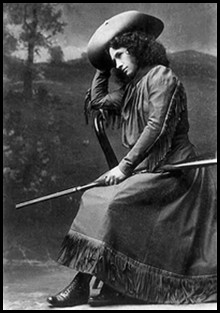
Everyone should own a copy of Roland BarthesMythologies. Published over 50 years ago, the book seems more relevant than ever. Barthes wields his sense of ironic humor like a scalpel, dissecting the ideological abuse of the post-war spectacle society. In this collection of short essays, Barthes examines the ways in which societies create, use and mediate myths–particularly the way that the “elite,” monied crust of society create new myths–whole systems of myths, really–to control cultural perceptions of “reality.” Barthes uses the language and tools of linguistics in his meditations to examine the malleable space between the signifier and the signified.  Barthes analyzes a range of disparate topics: amateur wrestling, plastic, advertisements for milk and wine, the face of Greta Garbo, children’s toys, and modern film’s conception of the ancient Roman haircut are all considered in relation to how these “everyday” things support the dominant cultural/economic ideology. The methods put forth in  Mythologies are certainly a precursor to what we now call popular culture studies; Barthes is certainly one of the first writers I can think of to dissect mass-mediated, popular culture. And even though it was published half a century ago, Barthes’ keenly ironic style and short-essay format comes across as thoroughly contemporary.

In the final essay of the collection, “Myth Today,” Barthes warns us that the myths we uphold to protect our culture can ultimately destroy the culture. What are the contemporary myth-systems of the United States? What ideology do these myths uphold? Do these myths hold the potential to harm the culture of our great country?

Ontology 101


gunsncuties_24.jpg


clipboard.jpg


 chicks-with-guns-0.png

zpage292.gif

barbietargetb72.jpg


baby.jpg


amy76.jpg


ao_assise.jpg


herkids0557.jpg

ripleynewtgrp2.jpg

0325-05.jpg

Ways of Seeing

In Ways of Seeing, John Berger riffs off of Walter Benjamin’s famous essay, “The Work of Art in the Age of Mechanical Reproduction,” calling into question how and why images are used and disseminated; in particular, Berger discusses capitalism, the female body, and “fine art.” The internet is clearly the next step in a series of progressions of how information is transmitted, and has been held up as a bastion of information democracy. The personal computer has revolutionized how we view, read, and create images and documents.

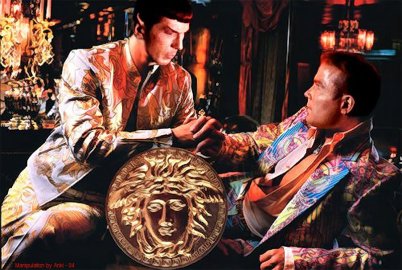
Look at the following images. What authority, if any, is present in each image? Who authors the picture? How do history, original context, and cultural paradigms play into how the viewer “reads” the image? What questions do these images provoke?

friends-and-lovers-anki.jpg


dscn1172.JPG

Ontology 101: Ways of Seeing

“The relation between what we see and what we know is never settled.”

This quote from the cover/first page of John Berger’s Ways of Seeing addresses one of the problems that ontology seeks to solve. If you were an art major, art history major, or English major, chances are high that you’ve encountered this book before. Berger’s collection of essays–some are completely made of images–questions the way that we see–and consequently name–things (I’m happy with this oh-so vague term). I think that this book is an essential starting point in freeing up one’s ideological framework such that one can question why one values what one thinks one values. Berger’s work has seemingly unlimited applications, from gender studies to economics to linguistics, but I’m primarily interested in how Ways of Seeing–originally published in the early 70s to compliment a BBC series–can be read against a media that didn’t exist when the book was published, namely, the internet.

I suggest diving into Ways of Seeing in any order that strikes your fancy (or for extra fun, abandon order completely). Later in the week I’ll post a few specific questions for discussion, but for now, try to keep in mind the dramatic ways that media–and the ways that we interface with media–have changed since the book’s publication over 30 years ago.

Every Book Art Garfunkel Has Read over the Past 38 Years

Because you demanded it! We’ve all been dying to know what Art Garfunkel’s been reading over the past 38 years: luckily, when he wasn’t busy starring in Nic Roeg films or walking across America, Art was thoughtful enough to record a list of every book he’s ever read. Link via the AVClub Blog, who always do such a great job digging up such treasure.

Ontology 101: Today’s Class is Cancelled

Today’s class is cancelled. Celebrate!

Ontology 101: So What and Who Cares?

Hopefully you’ve had time to sift through and absorb some of the primer. So and well so now you’re probably saying to yourself: “Okay sure, Aristotle, fabulous, Occam’s razor, I’m down, cogito ergo sum, fine, I get it, but so what?”

“So what?” and “Who cares?” are the most fundamental questions in any intellectual pursuit. Asking difficult questions doesn’t necessarily put food on the table or make us more attractive to the opposite sex or give us ten extra years of life.

So what do we gain when we ask: “What is?” and “What is it to exist?” and “What is real?”

Watch the following clip of Deepak Chopra on The Colbert Report. What is Chopra’s ontological position? What applications (political, social, cultural, etc) might his position entail?

Ontology 101: Introduction, Reading List, and Primer

Yes–now you too can better understand the way we conceptualize all that exists–from the comfort of your own home! It’s simple, free, and best of all, it’s fun! Biblioklept’s Ontology 101 is a course designed for working professionals who wish to approach the logic and philosophy of ontology, but don’t want to get bogged down in stodgy applications like taxonomy or geography. The different texts that comprise Biblioklept’s Ontology 101 course are contemporary, entertaining, highly visual, and applicable to modern social discourse.

Prerequisites: working knowledge of basic internet use. Adult level English language literacy. A few spare hours a week. A relatively open mind. A library card would be helpful. You’ll need a DVD player or VCR. If you can’t meet these requirements, you will need Biblioklept’s permission to join the class (you may have Biblioklept’s permission to join the class).

Credit hours: unfortunately, at this time Biblioklept remains an unaccredited (but nonetheless cherished) institution. However, all those who take the course are permitted a sense of smug self-satisfaction, a sharpened awareness of true irony, and existential crises galore.

Readings:

Week 1: Introduction, course overview, primer (below)

Week 2: Ways of Seeing, John Berger. Bertrand Russell overview.

Week 3: Mythologies, Roland Barthes. Baruch Spinoza overview.

Week 4: Persepolis, Marjane Satrapi, Understanding Comics, Scott McCloud. Martin Heidegger overview.

Week 5: Viewing–Rear Window, Alfred Hitchcock. Primer: Laura Mulvey’s theory of “the gaze” (forthcoming). “Feminist Cinema and Visual Pain,” John Haber. Gilles Deleuze overview.

Week 6: Viewing–various TV commercials. “Visual Semiotics and the Production of Meaning in Advertising”. Mythologies (Roland Barthes) revisited. Michel Foucault overview.

Week 7:  Viewing: Blade Runner (Ridley Scott). “Johnny Mnemonic,” William Gibson. “Simulacra and Simulations,” Jeanne Baudrillard. Georg Wilhelm Friedrich Hegel overview.

Week 8: Viewing: A Scanner Darkly (Richard Linklater). “We Can Remember It for You Wholesale,” Philip K. Dick. “The Second Coming of Philip K. Dick,” Frank Rose. Existentialism overview.

Week 9: Selections from Lost in the Funhouse, John Barth. Selections from Girl with Curious Hair, David Foster Wallace. Postmodernism overview.

Week 10: Excerpts from The Gay Science, Friedrich Nietzsche. Course summary and evaluation (primer revisited).

Primer: Before beginning John Berger’s Ways of Seeing, you’ll need a little background info about the history of philosophy. Biblioklept encourages you to go beyond the narrow confines of the following primer, but some of the ideas/thinkers presented here are essential building blocks for what will follow.

What is ontology? What better way to start an unaccredited online course from a flaky blog than to use Wikipedia as a beginning point! At the end of the course, we’ll revisit Wiki’s page and see if we can help it out–that would be meeting the true spirit of this endeavor. After you’ve perused the free encyclopedia that anyone can edit, treat yourself to SUNY’s own primer to ontology (follow the link “History of Ontology” at the top of the page to the “History of Ontology” link at the bottom of the page), which will make you like, at least ten times smarter.

Read up on Aristotle (follow the link “History of Ontology” at the top of the page to the “Aristotle” link). As far as we know, Aristotle seems to have initiated philosophical thinking. 

Are you familiar with Occam’s Razor? If not, read on!

Surely you’ve come across Descartes’ ridiculous proof of existence–cogito ergo sum–but it couldn’t hurt to brush up on why you may actually exist.

Once you’ve perused the above, no doubt you’ll be primed for all kinds of mad knowledge. Feel free to post comments and questions, or to email me at biblioklept.ed@gmail.com. And if you’re a real go-getter, get a jump start on next week’s assignment, Ways of Seeing.

The New Year

In the Chinese zodiac, 2007 is the Year of the Pig (or the Year of the Boar if you prefer). Persons born in the Year of the Pig are honest and straightforward, patient and caring. Some famous pigs include David Letterman, Henry Ford, Jack Ruby, Tupac Shakur, and The Ultimate Warrior.

The Year of the Pig, the Chinese New Year, begins on February 18th. The Hebrew calendar begins with Rosh Hashana, which won’t happen until September 13th-14th of 2007 (or 5768, if you prefer).  The Islamic New Year begins on January 20th–it will be the year 1428.

Even within the Gregorian calendar that we now use, the actual date of the new year has changed. The first day of the year has been celebrated on Christmas Day, Easter, and March 25th, Annunciation (celebrating the New Year on January 1st is known as Circumcision Style–I suggest googling this term for more info). The date seems arbitrary (although I don’t think arbitrary is the right word: read the history of different calendars here), but no matter: celebrating the end of one year and the beginning of another is vital. We reflect, assess, and plan anew. We toast our past triumphs and errors, and look forward to a fresh start. We make resolutions; we resolve to do the impossible (or at least improbable) on this day. We all get a chance at new life–if we choose to take it, that is, for it is always an option to cynically reject the possibility inherent in a new year. But just as we can reject Our Own Personal New Year on January 1st, we can just as easily embrace a new start on January 2nd, or January 3rd, or April 1st, or June 8th. A New Year is always accessible, if one so chooses. 

William Gibson

Just out of high school, I had a mild obsession with William Gibson’s so-called cyberpunk novels. The first and most famous of these is Neuromancer, an incredibly prescient book that the Wachowski Bros. shamelessly ripped off in The Matrix. Neuromancer is the first in “The Sprawl” trilogy; Count Zero and Mona Lisa Overdrive followed. I borrowed and never returned Neuromancer from Tilford; a few years ago I lent it, along with Burning Chrome, Gibson’s collection of short stories, to a student who in turn never returned them. I read Count Zero and Mona Lisa Overdrive at the same time as my college roommate Jordan. I don’t know who has these books now.

In 1990 Gibson co-authored a book called The Difference Engine with Bruce Sterling. The Difference Engine posits a Victorian England where computers have already been created and are in use. The novel explores the consequences of a technological revolution coming a 100 years early. This book launched what is sometimes called the “steampunk” genre. After TDE, Gibson spent the 90s writing three novels often referred to as “The Bridge” trilogy: the first, Virtual Light, was pretty good (it had a really cool idea about “organic computers”); the second, Idoru, was pretty bad, really; the last, All Tomorrow’s Parties, was downright awful (I couldn’t finish it–I was embarrassed for one of my favorite authors!) At the beginning of the new millenium, technology had caught up to Gibson’s cyberpunk visions, making some of the details of his Bridge trilogy seem outdated or just plain hokey.

I knew our time together was up when I passed on a $4 copy of 2003’s Pattern Recognition at Barnes & Noble a few years ago. Despite his fiction taking a dip, Gibson’s blog, as well as his essays (often published in Wired magazine–check out what is probably his most famous piece, “Disneyland with the Death Penalty”) remain relevant and entertaining. Maybe his forthcoming novel, Spook Country, will prove more entertaining; until then, at least we have the Sprawl Trilogy.

(Check out more William Gibson covers at this gallery)   

Merry Christmas

We here at The Biblioklept wish all of our dear readers a very merry Christmas. As our special gift to you, enjoy this fine performance by the late, great James Brown.

Grandad’s Eggnog

Hopefully everyone is happy and with loved ones and friends during these holidays–and what better way to show love and fellowship than sharing a draught of delicious eggnog (alternately, the sad and solitary can drown their lonely sorrows in this high-alcohol, high-calorie treat). This is an old recipe; I remember my cousin and I stealing sips of this nog during my grandparents’ Christmas parties.

You will need:

A bottle of fine bourbon

A bottle of fine rum

A liqueur of your choice (this is optional; coffee, cream, or amaretto all add a nice touch)

A gallon of vanilla ice cream (substitute frozen yoghurt if you’re concerned about calories)

A carton of store-bought eggnog (alternately, you can make your own eggnog from eggs, milk, and sugar, although it’s a genuine pain in the ass and no one will ever know the difference, unless you go around pointing it out to them, which will make you look like an asshole, and you don’t want to look like an asshole, do you?)

Nutmeg, cinnamon, mace, clove (Use whole spices! Any of your favorite holiday spices will do, but I consider these four essential)

To make a one gallon pitcher of eggnog:

Put about 6 cups of ice cream in the pitcher. Add some cinnamon sticks and cloves; grate some nutmeg and mace into the pitcher. Add 4 cups of the store-bought eggnog, stir mixture. Add about 3 and 1/2 cups of bourbon, 1 1/2 cups of rum, and liqueur (about 1/2 a cup will do) to taste; add more spices. Stir vigorously; cover and allow to set in the freezer for at least 12 hours before serving. Stir vigorously before serving.

To make your guests happy, I suggest serving the nog with both liquor and ice cream at hand; this way those inclined may add either as their taste dictates. (Note for heavy drinkers: if your intention is to get smashed, stop drinking the eggnog after two cups and begin drinking the bourbon straight! The high levels of cream and sugar in this nog will almost guarantee a hangover–don’t overdo it!)


Praise Yaweh

This is what the holy holidays are all about: praising the lord, keeping the faith, practicing good works, and dancing to sweet tunes, all set to special effects that would make the “When Doves Cry” video blush (if a music video could indeed blush).

Watch Rev. Alecia groove the transcendental with crazy neck moves and wicked jazz hands–without even having to get out of her swivel chair! Thanks to Mike Gersten for the vid.

Links, Lists, Liars, Laziness

So I have a number of beefs with the end of the year albums and singles lists at Pitchfork and The AV Club, which I will get to momentarily, but a few things first:

Check out the new audioplayer (“Audioklept” on the sidebar) that WordPress has kindly made accessible. I’ll try to update it regularly with awesome-to-moderately awesome tuneage. Now playing: the sweetly saturated sonic screams of Emperor X: the true indie rock.

Ricotta Park has had a makeover. The site looks great, and it looks like Nick will start posting regularly again. Check it out.

Some of the most enjoyable reading I’ve done lately comes from The New York Times Magazine Year in Ideas, via Tomorrowland. Highly recommended!

You can now easily access the marvelous adventures of Dr. Van Keudejep in one place, courtesy of Troglodyte Mignon. Very nice.

 Dr. Van Keudejap 's interrupted suicide - He lived happily ever after, thanks to the tiny troglodyte. - art by troglodyte mignon

Dr. Van Keudejap ’s interrupted suicide – He lived happily ever after, thanks to the tiny troglodyte.

On to the lists. For the past few days, Got to be  a Chocolate Jesus has been counting down the year’s best albums. I’m in accord with most of his top five, posted today:  TV on the Radio, The Fiery Furnaces, Destroyer, and Joanna Newsom, all faves of mine made the cut, as did The Mountain Goats, a  band I’ve never really listened to. If you were to swap out The Mountain Goats with Bonnie ‘Prince’ Billy’s fantastic comeback LP, The Letting Go, I think that would be my top five.

So yes and well now my beefs: first up, like many of you (I’m guessing), I hate hate hate Pitchfork; nonetheless, I visit those jerks daily, as I have for the past seven or eight years. This is the site that gave a “0.0” to The Flaming Lips’ aural odyssey Zaireeka without even listening to it. My major beef with P-fork is that The Fiery Furnaces’ Bitter Tea wasn’t recognized at all; neither did their Top 100 tracks of 2006 find room for Neko Case’s “Star Witness,” which was the best song of 2006. Sure, there were plenty of places where we intersected, but on the whole, their list reaffirms my belief that, in addition to being hacks, these guys have no taste (I blame the editor–some of P-fork’s writers, like Dominique Leone and Drew Daniel have true talent).

Now, The Onion’s AV Club really let me down–generally I love these guys: they’re way less pretentious than most of the music and media blogs, and they tend to have a critical approach fashioned more in the tradition of Creem or classic Rolling Stone. However, they chose The Hold Steady’s Boys and Girls in America–a completely overrated, derivative, and ultimately boring piece of trash–as album of the year. Furthermore, The Decemberists–a band repeatedly given the undeserved descriptor “literary”–also cracked their top ten. Defenders of these loathsome bands usually say that the haters “don’t get” the “meta-cool” of The Hold Steady or the “hyperliterate” Decemberists: they’re wrong: there’s nothing to get: these bands are boring. Just because somebody calls bullshit on something you like doesn’t mean that they “don’t get” it–in the case of the aforementioned hacks, I totally “get it”: these bands lack originality and talent.

Now, on to an artist that I truly “don’t get.” The Liars’ Drum’s Not Dead topped many year end lists, and plenty of my friends loved this album. I didn’t hear what the fuss was about, although I’ll certainly give it a second shot. Maybe it’ll click (that’s how it went down with TV on the Radio). Any fans out there who “get it” and who are willing to explain it?


Mary Timony-Hapi Holidaze

What is Christmas without creepy pagan vampire rock and arbitrary misspellings? Enjoy “Hapi Holidaze” by The Mary Timony Band.

Download “Hapi Holidaze” (mp3)
from “Kill Rock Stars Winter Holiday Album”
Various Artists
Kill Rock Stars

In the Shadow of No Towers–Art Spiegelman

Art Spiegelman’s Maus, released as a graphic novel over twenty years ago, did more to legitimize the comic as an art form than any other work I can think of. It won a Pullitzer Prize Special Award in 1992 (the Pullitzer committee found it hard to classify…perhaps they didn’t want to admit that they were giving a prestigious award to a comic book!), and today Maus is a standard on many college English syllabi.

After Maus, Spiegelman worked for The New Yorker for over ten years, quitting in early 2002 after the September 11th attacks to work on a series of broadsheets entitled In the Shadow of No Towers. These broadsheets were collected in 2004 in an unwieldy 15″ x 10″ book.

spiegelman_02_550×637.jpg

Spiegelman lived in downtown Manhattan, right by the towers; his daughter attended school a few blocks away. He saw the towers collapse in person, fleeing for his life with his family. Spiegelman attempts to capture this raw, unmediated, and very personal experience in In the Shadow of No Towers (Sonic Youth’s 2002 album Murray Street works to the same end–only much more abstractly): the narrative is discontiguous, fluctuating from bitter satire to earnest inquiry. Spiegelman’s choice of the broadsheet as his medium (the broadsheets were published monthly by different newspapers as Spiegelman produced them) is tremendously affective: just like the 9/11 attacks, the broadsheets are larger than life, hard to grasp, hyperbolically resisting easy, singular readings. Spiegelman balances bitter attacks against the conformist mentality spurred by the Bush administration with pathos and humor; In the Shadow of No Towers recalls the good-natured satire of broadsheet comics from a hundred years ago, bittersweetening the content. The 2004 collection wisely contextualizes Spiegelman’s work by reprinting broadsheets of “The Yellow Kid” and “The Katzenjammer Kids.”

Like Maus, In the Shadow of No Towers is a fascinating exploration of how disaster confronts and transforms identity. And reflecting its heinous subject, In the Shadow of No Towers ends without concluding: as the foolish Iraq war begins, Spiegelman can no longer shape any meaning or sense from his work. This isn’t a graphic novel–don’t look for a cohesive narrative structure here; instead, In the Shadow of No Towers explores the loose ends, the detritus, the psychic remnants of disaster.

Leisure Town

lt_top.jpg

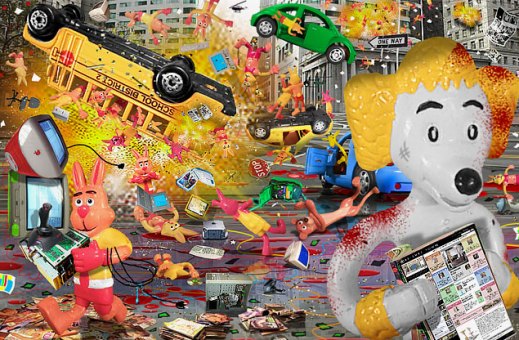
Tristan Farnon’s hilarious webcomic Leisure Town plays ludicrously with distinctly American tropes of sex and violence, resulting in some of the most mean-spirited humor this side of Peter Bagge or Robert Crumb.

Populated with psychopathic plastic animals and dope-smoking astronauts, Leisure Town is a world plagued by school shootings and AIDS jokes, misogynists and cubicle drones. Farnon’s ugly sense of humor might be hard for some to swallow–or even understand–but his work addresses the stochastic cruelty inherent in a commodified culture, a culture where people only have value as faceless automatons, as lumps of flesh to be detonated. Enter at your own risk.

tristanfarnon161.jpg