
, . – . . , : — — – . , , , , – , . , . – , . . . , , . , , , , . , , , , , , ; . : , , . , , , , . , ; , ‘ – . , . , , ; , . , , ; , , , , . , ‘ . , . , , , . , . ; ; , , , — — ; – , . . . — — – . – , . , ” . ” , , , , . , ; – , – , . , , . , , – . , ; , ; , . , . , , . , , , . , , , ‘ , — — — — ; — — , , — — ‘ , . . , , , , , , , . , , , , , , – . , ; . , . , , , . . , ‘ , . , , , . , , , . ; – ; , , ; , , . , , ‘ , , , , — — , , , , . , , , , , , , , , , . , , ; , ‘ ; , ; , ( ) , , , , ; , ‘ , , , . ; . , — — — — , , , ? ” , , ” , ” – . ; , , ! ” — — . ” , , ” . ” , — — , , , ! . , , . — — — — . , , . ” – . , . , , , , . , , , , , , – . — — . , , . , ; , , , ; . , . , , , . . , , , : — — . , , . , , . , , ‘ . – , . , , – , ‘ , . , , , , , , , – , . , , , , ; , ; , , . , ; , , . , . – . . ; . , , , , . , ; . , , , . , ‘ . – , , , . , . . – ; . , , , . . . – , , , , . , , , – , . , , , , , , , , , , , ; , . , — — — — , , . ‘ ‘ , . . ‘ , ‘ ; . . , , . , , . , , , . , . , . , – – . , , . , , . , — — , , , — — . , , — — — — . , – , . . , — — ” , , . ” — — , – — — ‘ . . , . , , , , . — — , , ! . , , , , . – , , . , . – , , , . – , – , , , , . , , , . , , , . , , . . , . . , – – . , . , , . , , ‘ , . , , , . , , . . , , , . , , , . , . , , , , , , . , , , , , . , — — , . , , , , , , , ” . ” , . , . . , ” . ” ” , ” , , . ” ? – ? — — , ” . ” , ” . . ; . . , , ; , , . , – – . , , . , . ? . , . , . , , ‘ . . , . , , , . , , , . ” ! , . ” , . ” ? ” . ” , , ” . ” . ” — — . ” , ” , . , . , , . ” ? ” ” . ” , , . , . . ” . , . . . ? ? ! ” ” , ” – . , ; ; ; , , . ” , , — — ? ” . : . , . , , , , . , , . ” , ” , ” ? ? ” ” , , ” , , ” . ” ” , ” , ” ? ” ” . ” ( , , ‘ , – . , , ‘ ‘ . ) ” , ” , , ” ? ” ” , , ‘ , ” . ” , ” , , ” . ” . . . . , , ; , , . ( ‘ ) , ‘ . , . , . . ; . . . ‘ , , ‘ , . , – , . , , – , ; , ; ; ; , – . – . – , . ? , . ? . , , . . . , ; , , . , , . ! , ; ; . . . , , , . . – . ; , , . . . , . . , : ” , ” , ” , . ” ” . ” ” ? ? ” . – , , — — ” , , ‘ . , ? ” , . , , . ” ? ” ; ” ‘ , ! ” , . , , ‘ . ” , , ” , ” . , ? ? ” ” , , . , , . . ” ” , ” , ” — — . ” ” , ” ; ” — — – . , . ? ” ” , . , – , , ” ; ” , . ” , . . . . ” , ” , ” ; , ‘ ? ( , ) . ” ” . ” ” ? ” ” . ” , . . , ? — — ? , , ? ” ! ” . ” , ” . . ” , ” . , , , . ” , . ” ” , ” , . ” , , ” , – , . . , – , , . ? , , , , ; ( ) ; , , ; , ; , — — , . , . , , ( ) , , , . , — — ; — — , , . . . , , . , , , ‘ . , , , , , , , . , , ” , ” ; , , — — . , . , – , . , . . . . , , , , . ; , . , ; ; , , , , , , , — — . , , , . , , – , , – , , , . . , , , , . , , , . , , . ? , . . ? — — ? , , . . , ; . , ; , . , , . . , ; . , , , , , , . , . , ; , ; , , ; – . , , , ‘ . , ! ; , ! . , – ; . , – , , . ; — — ! . , – . . ! . , , – ; , , , , ; , . — — , , — — , . . ‘ , , . ‘ , . , , ; , , , . , . , , . , . , . , ‘ . . ; , — — , ; , , ; ; , , ; ; , ; , , ; , . , — — ? — — , , , , , , – , – . , , ; , . ; , , . , , ; , , . . . , . , . . ; ; , . . , – . , . , ; — — , , . , ( ) , , ; , , , , . , , , , . . ” , ” , . . ” , ” , , ” ; — — . ” . ” , , ? ” ” . ” ” ? ” ” . ” ” ? . ” , , , , . ” , ? ” , , , . ” , ” , . , . , , . . , , , , . , , : ” , ; , , . – : , : — — , . ” ” , ” . – , . ‘ , . . ” , ? ” — — ” ‘ , , , ” — — ” ‘ ; ‘ , ! , , , ? ” . ” . , ” , ” ‘ . ” , ” ” . . ? . , , , . ” , , ” , ” , , , . ” ” , ” , . ” , , , ” , , , . ” , ? ” ” , ” , . ” ‘ , , ” — — ” ‘ . ” ” , ? — — . . , , , — — ” ” , ” , ” . ” ” , , . ” – , , . . . , , , . . – . , . ” , ? ? ” , ” ? ” ” . ” ” ? ” ” , ” . , . , . . . ; . , , . , , , , , , – . . , , . . ‘ , . , . , . , . , , . ” ! ” ; ” — — — — ? ” ” , ” , . , . — — — — . ? : ? , , , . . , , . , , . , . . , . , ‘ . , , . , . ” , , ” , ” . , . ” , , ! . , ; , , , ” ; ; ; ; . ” ” , ” , . ” . ” . ‘ . , – . . ” , ” , ” ; – ; . — — ? ” . . ” , ” . — — ” , , — — — — , , . ; – . , . – , , . ” ; , . , . . , . . , , , , . . — — — — ; . , . , , , , — — . , . . — — . — — . ‘ ; , , , ‘ . , , . . , , . , ; . . – , . ” ‘ ‘ , ” . ” ‘ ? — — ! ” , ” . ” , . , – . , , , , . , – . , . . . . . . , ; . : . , , , , — — ” ; . ” . . , , , ; , , , . ” ! ” . , , , , , , – . ; ; ; , , — — . ? , , ? , , . , , , . – . . . . ” , ” , , , ” . , . . , — — , . . , ” , , ” , ” , . . ” , , ? ” , . ” , ” , . ” ? ? ? ? ” . ” ? ? ? ? – ? , , ? ” . . . ; , , , — — . , , , . , , — — , , , ; — — , . , . ? , : ” , . ” , . , — — . ‘ , ‘ , ‘ , ‘ , ‘ ; , ‘ . – , , , , – , . , , . , ! , ‘ ; , , . , . , , , , , . . – ‘ ; , , ; ; ; – . ? ? . , , ” , ” ” . ” , . , , – , . , , , ; ; ; , . , ; . . ; , , – . , . , . , , , . , , ; , . , , . , , ; , , ( ‘ ) . , , . , . ? , , . . – , , ; ; ; ; ( ) , , : , ; . , . , , , . , . , ; , . ? , . ? ? , . , ; , . ? , , , , — — ? ? , , . , . ? , . ; , . , . ! , ? ? — — , ? ! , , ? , , . . : . : , . . , . ; ; , . , : ” ; . , , . , . ” , . , , , . , , . ; , . , . – , — — — — . ” – , ; — — – , ; , ” . , , — — — — . , , . , , , . . . , , . — — – . , . ” , ” , , ” . ; ; ; . ” ” , , ” , , , ” , , — — , . ” ” ‘ , ? ” ” . . ; . ” ” , — — , . ” , ; , . , , , . , . ” ‘ — — , ” , . ” , , , ” , , . — — – . ” , , ; . — — ” , ” , , , . ; ; ; , . ” , , . — — . : — — , . ( ) , , , ( ‘ ) , . , . ” , ? ” . ” , ” . ‘ , . ” , ” , ” , ? ” . ” . , . ? – ? ” ” ; . ” ” – ? ” ” . , ; . ” ” , ” , ” ! ” ” , ” , . ” – ‘ ? . ” ” ; , , . ” . . ” , ? . ” ” , . ” ” , , — — ? ” ” . . . . ” ” , ” , , . ” , — — — — — — — — ! ” , . , , — — . ” , ” , , ” — — , — — ? , , . ” ” : . ” ; , , – , . , , , , . – ; ; . , , , , ; , . . , , . . , . , , , . . ; . ‘ , ; , , . , , , , , . ; , , , . , , . , , . , , . , — — . , , – . . , , , – . , , , , , . ” ! ” ” , ” , , — — ” . ” ” , , ” , . ” , . . , . , , . ” ” , ” , , . , – , , , — — ” ? ” ” . ” ” ? , , ‘ . ” ” ? ” , . ” – . , . ” ” ? ” , . . ” , ” , – ‘ ( ) . ” ; . . ” ” , ? ” – , . , ; – , . ” , . ; . ” ” , , , ” – , . ” , ; — — — — , — — ‘ — — . . , , . ‘ ? ” ” – , ” , . ” ; . ” , – . ” ‘ ? ” – , . ” ‘ , ? ” ” , ” , . ” ? ? , , ; – , . ‘ ‘ — — ‘ , . ? ” , . , , , ” – . ‘ ? ” ” , . . . . . ” , , ; . ” , ” , ” ‘ . ” . ” ? ” . ” — — . ‘ . ” . . , , . . . , , , , , – , , . , , , , . . ; ; , ; . . , . – . ” . ‘ – , ? ? ” ” , ” , . ” ! — — ‘ , ? ” ” , ” . * * * * * * * * . ‘ . , , , , ‘ , , , . , ‘ . , ; , . , , ; . : , . , . ! ? , , ? – . : — — , , ; – : — — , ; ; ; . , . ! !
Donald Barthelme’s Sixty Stories in reverse, Part VIII

I am rereading Donald Barthelme’s Sixty Stories, starting with the sixtieth story and working my way to the first and writing about it.
Previous entries:
This post covers stories 18-13.
18. “The Phantom of the Opera’s Friend” (City Life, 1970)
Barthelme’s goof on Gaston Leroux’s serialized title of the same name is a mix of sweet and mean. The narrator wonders to himself about midway through, “Why must I have him for a friend? I wanted a friend with whom one could be seen abroad.” He quickly elects though to “put these unworthy reflections behind me,” and then the narration gives way to a metatextual moment:
Gaston Leroux was tired of writing The Phantom of the Opera. He replaced his pen in its penholder. “I can always work on The Phantom of the Opera later-in the fall, perhaps. Right now I feel like writing The Secret of the Yellow Room.” Gaston Leroux took the manuscript of The Phantom of the Opera and put it on a shelf in the closet. Then, seating himself once more at his desk, he drew toward him a clean sheet of foolscap At the top he wrote the words, The Secret of the Yellow Room.
“The Phantom of the Opera’s Friend” lines up with Barthelme’s other experimental forays into nineteenth-century novels, but it’s less successful than “Eugénie Grandet” or “Views of My Father Weeping” or “The Dolt.” It does have a lovely conclusion though:
But when I call for the Phantom on Thursday, at the appointed hour, he is not there.
What vexation!
Am I not slightly relieved?
Can it be that he doesn’t like me?
I sit down on the curb, outside the Opera. People passing look at me. I will wait here for a hundred years. Or until the hot meat of romance is cooled by the dull gravy of common sense once more.
17. “On Angels” (City Life, 1970)
A pastiche of essay, fiction, found material, and even poetry, “On Angels” begins with a fundamentally postmodern position:
The death of God left the angels in a strange position. They were overtaken suddenly by a fundamental question. One can attempt to imagine the moment. How did they look at the instant the question invaded them, flooding the angelic consciousness, taking hold with terrifying force? The question was,”What are angels?”
16. “Paraguay” (City Life, 1970)
“Creative misunderstanding is crucial,” we’re told at one point in “Paraguay.” These eruptions lead to the “Creation of new categories of anxiety which must be bandaged” — another kind of art. “Paraguay” is a strange sci-fi fable about art and creation and imagination, a story that constantly defers all available referents in favor of creating “new categories of anxiety.” Consider this early paragraph:
Where Paraguay Is
Thus I found myself in a strange country. This Paraguay is not the Paraguay that exists on our maps. It is not to be found on the continent, South America; it is not a political subdivision of that continent, with a population of 2, 161,000 and a capital city named Asuncion. This Paraguay exists elsewhere. Now, moving toward the first of the “silver cities, ” I was tired but also elated and alert. Flights of white meat moved through the sky overhead in the direction of the dim piles of buildings.
Flights of white meat. Dim piles of buildings.
Great stuff.
15. “Views of My Father Weeping” (City Life, 1970)
Barthelme’s oeuvre is oedipal, both in form and content, a thematic obsession best realized in his novel The Dead Father, but a theme that nevertheless haunts (haunts is not the right verb; Barthelme’s oedipal dead father is a playful mournful ironic ghost—but let’s fall on haunts for now)—nevertheless haunts (he writes again) Barthelme’s fiction proper. “Views of My Father Weeping” is a father-haunted tale—haunted by Barthelme’s own father, the modernist architect, Donald Barthelme Sr., as well as a host of literary fathers (of varying shades of modernism)—Dostoevsky, Freud, Tolstoy, and so on. The plot at first appears to be another goof on hoary nineteenth-century tropes, but Barthelme wads the material into a ball of anxiety dream nightmare stuff worthy of another dead modernist father—Kafka. I’ve neglected to summarize the plot: An aristocrat’s stagecoach runs down the narrator’s father (who may or may not have been drunk at the time). The narrator attempts to solve the case and come up with a crumb of justice. My only quibble with the tale is its failure to resolve — the final paragraph, after a devastating twist, reads simply “Etc.” — I suppose the joke is ahead of its time, but it also feels like our author reached his exhaustion before his plot did.
14. “The Indian Uprising” (Unspeakable Practices, Unnatural Acts, 1968)
If someone asked me, Hey Ed, this Don Barthelme fellow, what should I read first? —which no one ever has and likely no one ever will — I would offer up “The Indian Uprising.”
The story is a formally-challenging success, an experiment that Barthelme pulls off perhaps in spite of himself (some of the other pieces in Unspeakable Practices, Unnatural Acts are beautiful misfires). In his biography of Barthelme Hiding Man, Tracy Daugherty devotes several pages to describing the agon between Barthelme and the story’s original editors in The New Yorker, Roger Angell (who advocated for Barthelme) and William Shawn (who fought Barthelme tooth and nail over commas specifically and syntax in general).
“The Indian Uprising” is a dizzying paste-up of urban American life in the troubled 1960s. This setting is transposed to a mythical Manifest Destiny Westworld, a genocidal project that can be understood as a blackly surreal reading of the Vietnam War. It’s an ugly business. The story’s final paragraph begins with this sentence:
We killed a great many in the south suddenly with helicopters and rockets but we found that those we had killed were children and more came from the north and from the east and from other places where there are children preparing to live.
The imperial project is an infanticidal project.
“The Indian Uprising” is larded with markers of culture. The first paragraph ends with this little descriptor: “The table held apples, books, long-playing record.” The table is the central metaphor of the story—or one of the metaphors, I guess (“central” is an unfit adjective). The narrator has made the table with his own hands from a hollow core door, a symbol perhaps of the American Dream.
The Dream is a nightmare though. “The Indian Uprising” is punctuated by two torture scenes, both of which resonate just as strongly a half century after its publication. Here is the first, a waterboarding adventure:
We interrogated the captured Comanche. Two of us forced his head back while another poured water into his nostrils. His body jerked, he choked and wept…And I sat there getting drunker and drunker and more in love and more in love.
The second scene is an ugly repetition:
We attached wires to the testicles of the captured Comanche. And I sat there getting drunker and drunker and more in love and more in love.
What is the narrator drunk on here? Torture? Pain? Power? And what is the object of his love? Power? Pain? Language?
The power and pain of language overflows in “The Indian Uprising,” challenging the reader to make meaning from waves of images. Barthelme, ever-beholden to the Modernist fathers and mothers, shows a bit of his Gertrude Stein stuff shot through with William Carlos Williams’ dictum, No ideas but in things. Those things:
Red men in waves like people scattering in a square startled by something tragic or a sudden, loud noise accumulated against the barricades we had made of window dummies, silk, thoughtfully planned job descriptions (including scales for the orderly progress of other colors), wine in demijohns, and robes. I analyzed the composition of the barricade nearest me and found two ashtrays, ceramic, one dark brown and one dark brown with an orange blur at the lip; a tin frying pan; two-liter bottles of red wine; threequarter-liter bottles of Black & White, aquavit, cognac, vodka, gin, Fad #6 sherry; a hollow-core door in birch veneer on black wrought-iron legs; a blanket, red-orange with faint blue stripes; a red pillow and a blue pillow; a woven straw wastebasket; two glass jars for flowers; corkscrews and can openers; two plates and two cups, ceramic, dark brown; a yellow-and-purple poster; a Yugoslavian carved flute, wood, dark brown; and other items. I decided I knew nothing.
I decided I knew nothing.
Marvelous stuff.

13. “See the Moon?” (Unspeakable Practices, Unnatural Acts, 1968)
“Yes I know it’s shatteringly ingenuous,” says the narrator of “See the Moon?,” but I wanted to be a painter.”
Why does the narrator (surely a version of Barthelme) want to be a painter?
They get away with murder in my view; Mr. X. on the Times agrees with me. You don’t know how I envy them. They can pick up a Baby Ruth wrapper on the street, glue it to the canvas (in the right place, of course, there’s that), and lo! people crowd about and cry, “A real Baby Ruth wrapper, by God; what could be realer than that!” Fantastic metaphysical advantage. You hate them, if you’re ambitious.
The narrator pieces together bits and bytes and things and souvenirs, tacking them to a wall: “Fragments are the only forms I trust.”
The statement “Fragments are the only forms I trust” sounds like an aesthetic mission statement from DB, but our DB ultimately rejected it in an interview with Jerome Klinkowitz:

And yet “See the Moon?” is clearly a pastiche of Barthelme biography rendered in Pop Art pastings, non sequitur, and cheap funny jokes. It’s also tinged with the notes of melancholy and regret that will heavily flavor Barthelme’s later work. Perhaps as I read backward the material will lighten.
Summary thoughts: Everything here is good and much is great. “The Indian Uprising” is essential, and “See the Moon?” and “Views of My Father Weeping” are definitely Greatest Hits. “Paraguay” seems like a perfect Barthelme gateway drug, and “On Angels” is a fun sad jam. Even the weakest piece here, “The Phantom of the Opera’s Friend,” is pretty good.
Going forward (in reverse): Our penultimate episode is chock full of pieces from 1968’s Unspeakable Practices, Unnatural Acts, including classics “Robert Kennedy Saved from Drowning” and “Game.”
The Acrobat Schulz V — Albert Birkle

The Acrobat Schulz V, 1921 by Albert Birkle (1900-1986 )
Autumn Scenery — He Duoling

Autumn Scenery, 1988 by He Duoling (b. 1948)
Boring Dolls — Jeanne Mammen

Boring Dolls, 1929 by Jeanne Mammen (1890-1976)
I’m Supposed to Be Fun — Rae Klein
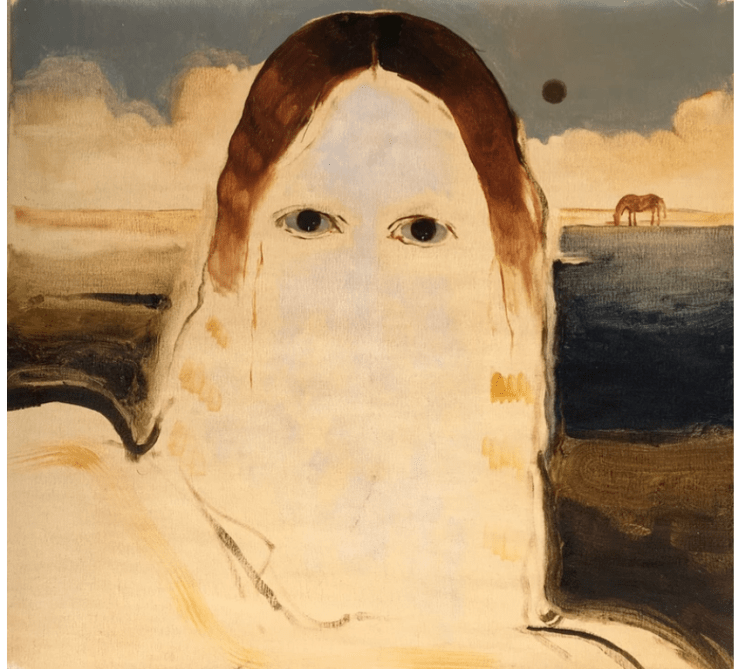
I’m Supposed to Be Fun, 2021 by Rae Klein (b. 1995)
The Raft — Adrian Ghenie

The Raft, 2019 by Adrian Ghenie (b. 1977)
I wanted to be a painter | Fragments are the only forms I trust (Donald Barthelme)
You’ve noticed the wall? I pin things on it, souvenirs. There is the red hat, there the book of instructions for the Ant Farm And this is a traffic ticket written on a saint’s day (which saint? I don’t remember) in 1 954 just outside a fat little town (which town? I don’t remember) in Ohio by a cop who asked me what I did. I said I wrote poppycock for the president of a university, true then.
You can see how far I’ve come. Lunar hostility studies aren’t for everyone.
It’s my hope that these . . souvenirs . . will someday merge, blur–cohere is the word, maybe-into something meaningful. A grand word, meaningful. What do I look for? A work of art, I’ll not accept anything less Yes I know it’s shatteringly ingenuous but I wanted to be a painter. They get away with murder in my view; Mr. X. on the Times agrees with me. You don’t know how I envy them They can pick up a Baby Ruth wrapper on the street, glue it to the canvas (in the right place, of course, there’s that), and lot people crowd about and cry, “A real Baby Ruth wrapper, by God; what could be realer than that!” Fantastic metaphysical advantage. You hate them, if you’re ambitious.
The Ant Farm instructions are a souvenir of Sylvia. The red hat came from Cardinal Y. We’re friends, in a way.
I wanted to be one, when I was young, a painter. But I couldn’t stand stretching the canvas. Does things to the fingernails. And that’s the first place people look.
Fragments are the only forms I trust.
From “See the Moon?” by Donald Barthelme.
Pierre Senges’ Ahab (Sequels) (Book acquired, mid-September 2021)
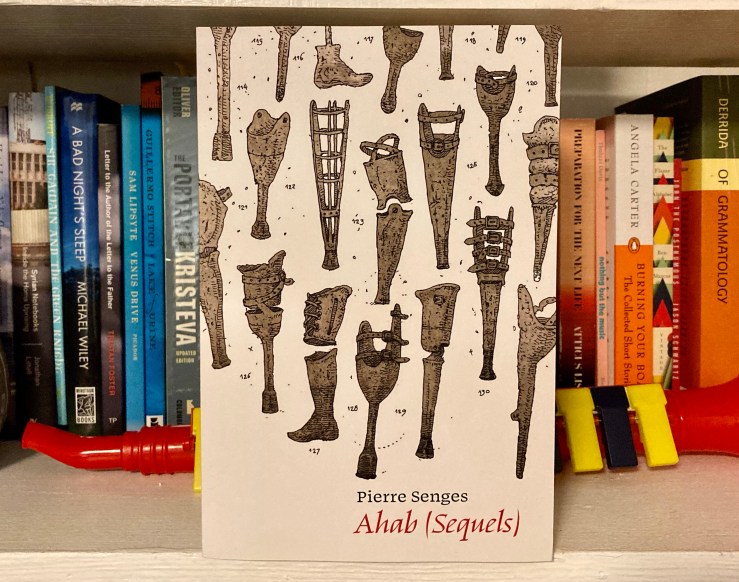
Ahab (Sequels) is the latest English-language translation of a Pierre Senges novel—and. Again, the translation is by Jacob Siefring (who’s brought us couple of Senges’ marvelous oddities) and Tegan Raleigh and is published by the good people at Contra Mundum. Their blurb:
The reader will find here the true aftermath of the adventures of Ahab, self-described captain, survivor of his last fight against a giant fish. We will see how this retiree with a wooden leg tried to sell his whale story to the highest bidder — in the form of a Broadway musical, then a Hollywood script. Along the way, we will encounter Cole Porter and his chorus girls, but also Cary Grant, Orson Welles, Joseph von Sternberg and Scott Fitzgerald, drowned in his alcohol, as well as a host of producers, shady to varying degrees. We will remember the passage of young Ahab embarking at seventeen for London in the hope of playing Shakespeare there, and the circumstances which presided over the meeting of the librettist Da Ponte with Herman Melville in 1838. We will learn, ultimately, the best way to make the Manhattan cocktail a success and with what tenacity the indestructible Moby Dick seeks revenge on his nemesis.
At 550 pages, Ahab, like Moby-Dick, is a big boy, but I’m looking forward to digging in.
The Neophyte (First Experience of the Monastery) — Gustave Doré
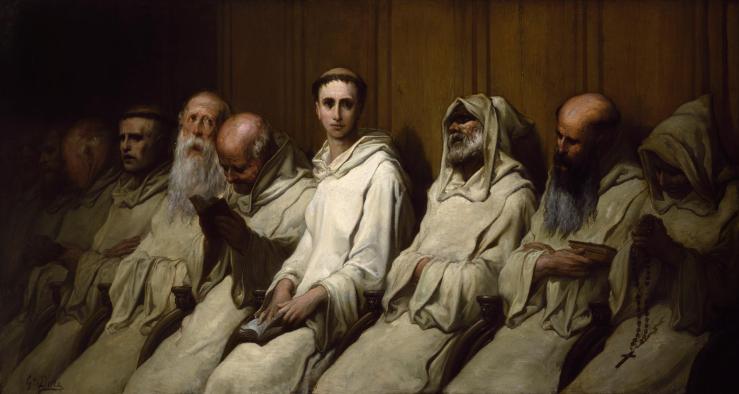
The Neophyte (First Experience of the Monastery), 1868 by Gustave Doré (1832-1883)
The Flea — Graham Sutherland
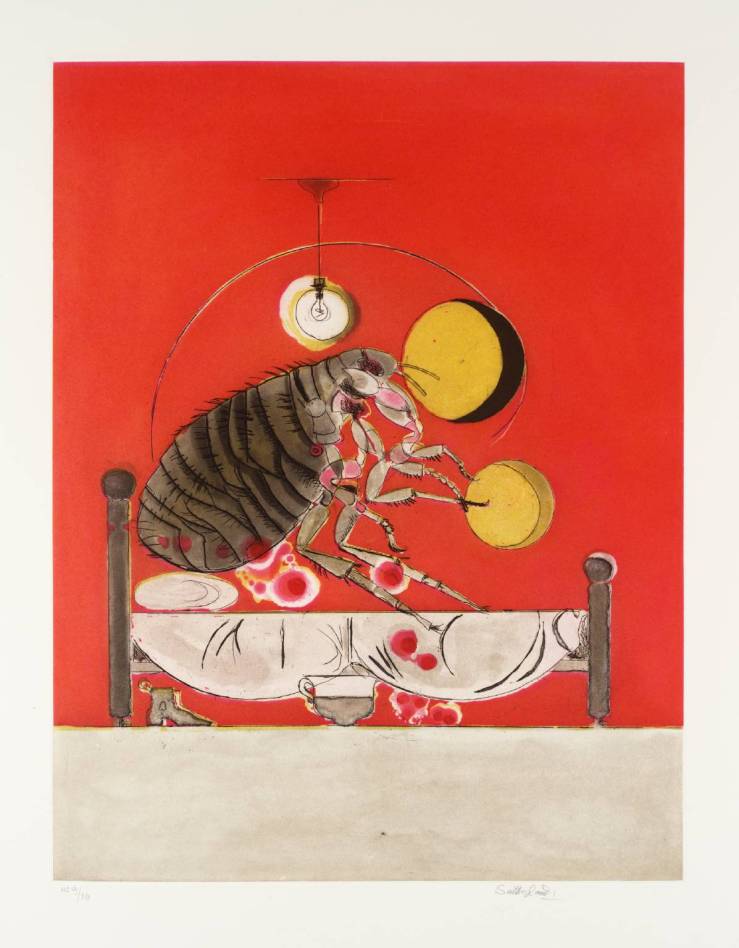
The Flea, 1979 by Graham Sutherland (1903-1980)
Riposte — Boris Taslitzky
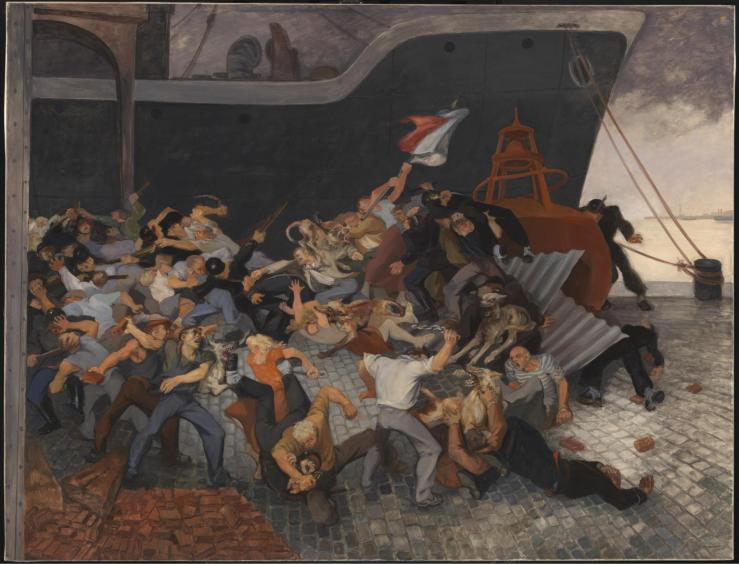
Riposte, 1951 by Boris Taslitzky (1911-2005)
Lovers in a Graveyard — George Warner Allen

Lovers in a Graveyard by George Warner Allen (1916–1988)
Barthelme/Delany/Rivera Garza (Books acquired, 24 Sept. 2021)
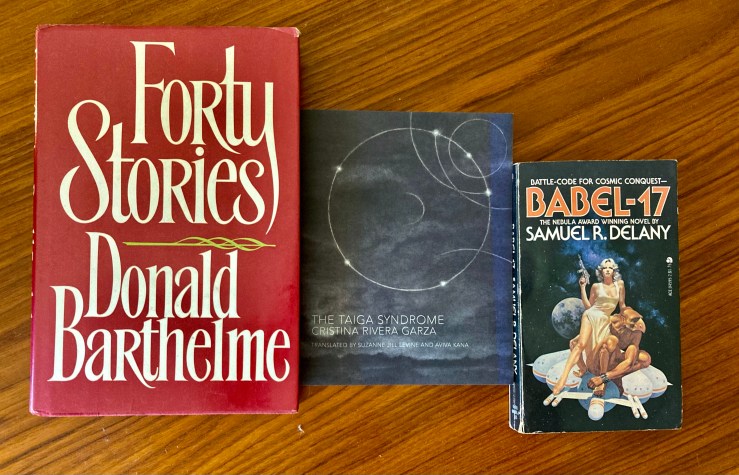
For a few months I’ve been slowly unloading boxes from my grandmother’s old house at my beloved used bookstore, browsing a bit, and coming back with books I don’t need.
Last Friday I found a hardback first edition of Barthelme’s Forty Stories, which is cool (it’s much more handsome and plain than the paperback Penguin Contemporary Fiction edition I have). I’ve been re-reading Barthelme’s Sixty Stories and writing blog posts about them that no one reads for a few weeks now.
I also picked up Cristina Rivera Garza’s novel The Taiga Syndrome, in translation by Suzanne Jill Levine and Aviva Kana. Here’s publisher Dorothy’s blurb:
A fairy tale run amok, The Taiga Syndrome follows an unnamed Ex-Detective as she searches for a couple who has fled to the far reaches of the earth. A betrayed husband is convinced by a brief telegram that his second ex-wife wants him to track her down—that she wants to be found. He hires the Ex-Detective, who sets out with a translator into a snowy, hostile forest where strange things happen and translation betrays both sense and one’s senses. Tales of Hansel and Gretel and Little Red Riding Hood haunt the Ex-Detective’s quest into a territory overrun with the primitive excesses of Capitalism—accumulation and expulsion, corruption and cruelty—though the lessons of her journey are more experiential than moral: that just as love can fly away, sometimes unloving flies away as well. That sometimes leaving everything behind is the only thing left to do.
I picked up Samuel R. Delany’s novel Babel-17 too, maybe in part of a continued attempt to get into his stuff, despite stall outs, shrugs, and, Hey, that was okays, and maybe just because of this cover:
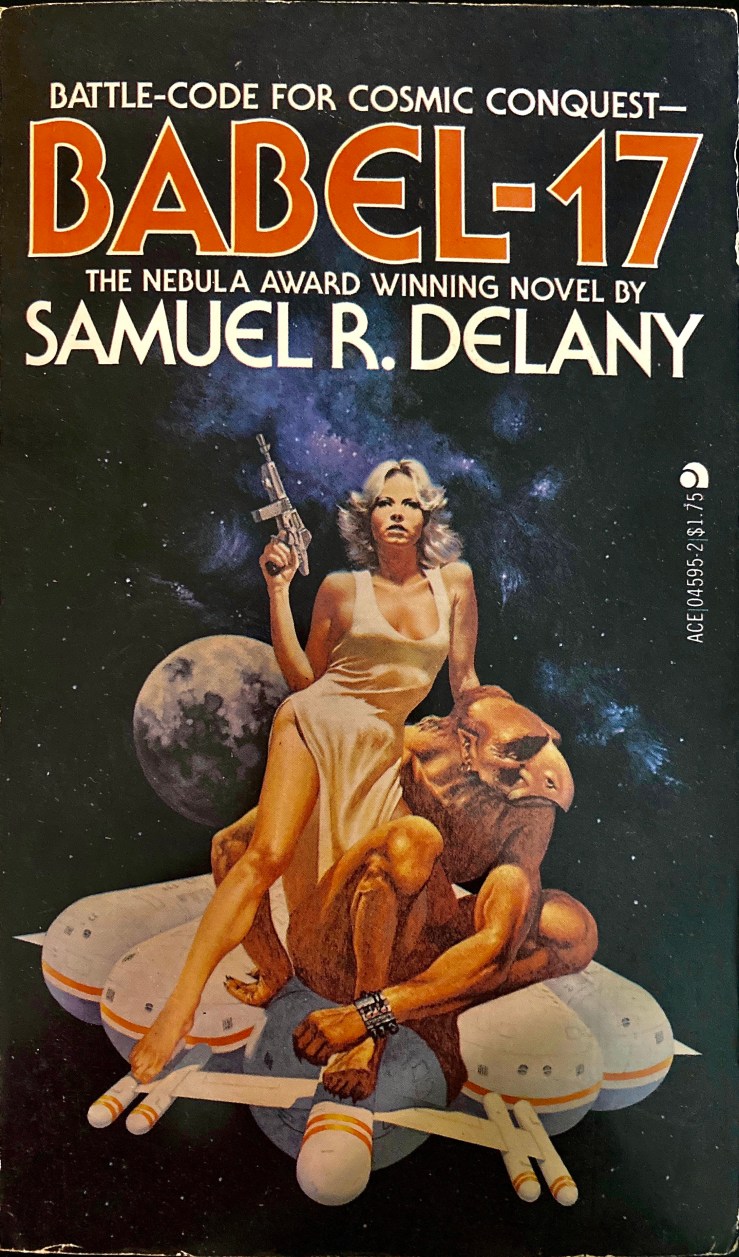
The book’s Wikipedia entry notes that, “Rush drummer and lyricist Neil Peart noted that Babel-17 was one of his early literary influences, and was an important part of the crafting of the band’s hugely successful 2112 album.”
Well there you go.
Fish House Door — John Frederick Peto

Fish House Door, 1905 by John Frederick Peto (1854-1907)
Donald Barthelme’s Sixty Stories in reverse, Part VII

I am rereading Donald Barthelme’s Sixty Stories, starting with the sixtieth story and working my way to the first and writing about it.
Previous entries:
This post covers stories 24-19.
24. “Critique de la Vie Quotidienne” (Sadness, 1972)
A cruel cruel story bristling with venomous punchlines, “Critique de la Vie Quotidienne” takes its title from Marxist philosopher Henri Lefebvre’s 1947 book of the same name. The story is a caustic satire of quotidian domesticity, showing the dissolution of a marriage through the perspective of an alcoholic narrator who very much resembles Barthelme. It begins ugly:
While I read the Journal of Sensory Deprivation, Wanda, my former wife, read Elle. Elle was an incitement to revolt to one who had majored in French in college and now had nothing much to do with herself except take care of a child and look out of the window.
And continues ugly:
Our evenings lacked promise. The world in the evening seems fraught with the absence of promise, if you are a married man. There is nothing to do but go home and drink your nine drinks and forget about it.
There’s a deep anger and contempt toward domesticity that Barthelme’s narrator sustains throughout the story while also pulling the rhetorical trick of quickly retreating into the second-person you, a conceit that never fully absolves the narrator from his intrinsic horribleness:
Slumped there in your favorite chair, with your nine drinks lined up on the side table in soldierly array, and your hand never far from them, and your other hand holding on to the plump belly of the overfed child, and perhaps rocking a bit, if the chair is a rocking chair as mine was in those days, then it is true that a tine tendril of contempt – strike that, content – might curl up from the storehouse where the world’s content is kept, and reach into your softened brain and take hold there, persuading you that this, at last, is the fruit of all your labors, which you’d been wondering about in some such terms as, “Where is the fruit?”
The narrator quickly divides himself from the you, the horrible man who cannot live the quotidian life:
…you look, as I say, to your wife, as the cocktail hour fades, there being only two drinks left of the nine (and you have sworn a mighty oath never to take more than nine before supper, because of what it does to you), and inquire in the calmest tones available what is for supper and would she like to take a flying fuck at the moon for visiting this outrageous child upon you.
Ultimately, “Quotidienne” is too mean and ugly (borderline misogynistic, perhaps); it lacks the kernel of heart that beats in Barthelme’s best satires.
23. “The Glass Mountain” (City Life, 1970)
Look, it might take you ten minutes to read it, so read it.
The story is a list numbered to one hundred. Most of the numbered points are a solitary sentence, with exceptions coming from a handful of citations Barthelme includes.
“The Glass Mountain” fits neatly into City Life. It’s a city story transported into the realm of the mock-heroic. With the aid of two plumber’s friends (plunger, you might call them), the narrator (a mock hero) climbs the titular mountain, which “stands at the corner of Thirteenth Street and Eighth Avenue.” It’s a skyscraper, of course:
7. I had strapped climbing irons to my feet and each hand grasped sturdy plumber’s friend.
8. I was 200 feet up.
9. The wind was bitter.
10. My acquaintances had gathered at the bottom of the mountain to offer encouragement.
11. “Shithead.”
12. “Asshole.”
13. Everyone in the city knows about the glass mountain.
His “acquaintances” continue to berate him as he climbs (“24. “Dumb motherfucker.” / 25. I was new in the neighborhood.”)
As he climbs, the heroic arc swells, enriched by a riff on symbolism and signs, which is the story’s main theme. And yet at the end, Barthelme’s “hero” rejects symbolism the minute it transubstantiates into sign:
97. I approached the symbol, with its layers of meaning, but when I touched it, it changed into only a beautiful princess.
98. I threw the beautiful princess headfirst down the mountain to my acquaintances.
99. Who could be relied upon to deal with her.
The mob rules.
22. “The Policemen’s Ball” (City Life, 1970)
In his Barthelme biography Hiding Man, Tracy Daugherty links “The Policeman’s Ball” to the eruptions and disruptions of May ’68:
In Don’s story, Horace, a policeman with the “crack of authority” in his voice, takes his girlfriend Margot to a policemen’s ball, hoping she will surrender to his force–the “force of the force.” At the balll, she is drawn to a fireman named Vercingetorix. Finally, though, she returns home with Horace and gives him what he wants…All the while, the “horrors lurk outside Horace’s apartment…The story’s smirk at authority is clear. The names Horace and Vercingetorix come to us from Roman history. Vercingetorix was a Gallic rebel noted for building barricades to thwart Roman soldiers. Shortly after vanquishing Vercingetorix, Caesar was assassinated. Horace, an irreverent poet and satirist, fell under Brutus’s sway, and joined him in a hopeless attempt to establish a republic.
The historical referents–to a decadent empire and rebellions against it–make Don’s story, in the context of the May Days, an extended utopian slogan, as playful, sly, and funny as much of the graffiti in the Latin Quarter.
(A version of) Vercingetorix shows up in “City Life” (in City Life).
I think “The Policemen’s Ball” is more relevant than ever, as we (who is we?) contest against the force of the force.
(Hear Barthelme read the story here.)
21. “The Falling Dog” (City Life, 1970)
Another story about writing a story—and again, Barthelme displaces the creative act to fine art—and again (in reverse), he chooses a sculptor as his artist. The sculptor achieved a thin bare fame with his YAWNING MAN statues, but when a dog falls on him, he finds new inspiration. (And puns. Lots of lots of puns.)
(I keep thinking about another Don here, although it’s in no way related—Don DeLillo’s Running Dog (1978) and Don DeLillo’s Falling Man (2007).)
(doG is God backwards—can you even fucking believe?)
20. “Kierkegaard Unfair to Schlegel” (City Life, 1970)
There’s a tension that runs throughout much of Barthelme’s short fiction: professed leftist idealism set against the writer’s urbane bourgeoisie (or bourgeoisie-proximal) reality as an arbiter and curator of Modernist culture. Barthelme’s aesthetic describes technological postwar American culture–often through a mythological lens, often through the spectacle of both pop art and Pop Art (which becomes American mythology in his writing). His satires, pastiches, and parodies set a funhouse mirror up to America’s hypermediated massculture reality. At the same time, Barthelme’s stories tend to eschew direct action, direct engagement with the realities of the age his stories (not so much document but) describe: the Civil Rights movement, the Vietnam War, and other social inequalities. A passage in the Q&A story “Kierkegaard Unfair to Schlegel” shows Barthelme perhaps a bit defensive about these elisions:
Q: You’re not political?
A: I’m extremely political in a way that does no good to anybody.
Q: You don’t participate?
A: I participate. I make demands, sign newspaper advertisements, vote. I make small campaign contributions to the candidate of my choice and turn my irony against the others.
Here, we get Barthelme declaring the political scope of his literature: it is an irony against the others. Much of the story is given over to the answerer’s summary and analysis of Kierkegaard’s The Concept of Irony, followed by a defense of Friedrich Schlegel’s novel Lucinde, which Kierkegaard regards as a moral failure because it does not instruct its readers how to live. The answerer says Kierkegaard fails to attend to the novel’s “objecthood” — its aesthetics. At the end he remains ambivalent: Kierkegaard is both fair and not fair to Schlegel:
…What is interesting is my making the statement that I think Kierkegaard is unfair to Schlegel. And that the whole thing is a damned shame! Because that is not what I think at all. We have to do here with my own irony. Because of course Kierkegaard . was “fair” to Schlegel. In making a statement to the contrary I am attempting to… I might have several purposes-simply being provocative, for example. But mostly I am trying to annihilate Kierkegaard in order to deal with his disapproval.
Q: Of Schlegel?
A: Of me.
(There’s also a deep strain of horniness to the story that I will not comment on at this time.)
19. “City Life” (City Life, 1970)
The title story of Barthelme’s 1970 collection is a weird, oblique love letter to a version of NYC. The Houston-native seems to finally earn his New Yorker stripes. It’s an unusually long story, rich with meanings that I won’t bother to plumb here, because I’ve had a long day, and I doubt anyone is actually reading this (I can live in doubt). The basic plot of “City Life” is the whole Virgin Birth thing, with the city-as-father—which is par for Barthelme’s oedipal course. It has some wonderful passages, including this one.
Summary thoughts: “City Life” and “Kierkegaard Unfair to Schlegel” strike me as seminal Barthelme texts, but neither make a good starting point to his fiction. “Critique de la Vie Quotidienne,” the story in this batch from Sadness is sad, mean stuff, and also likely relatable for any dad who’s ever wanted to hop in his car and go out for a pack of cigarettes or a carton of milk or whatever your deadbeat idiom is. “The Falling Dog” is okay. Both “The Policemen’s Ball” and “The Glass Mountain” would make nice starting places for anyone interested in Barthelme’s stuff.
Going forward (in reverse): A few more from City Life and then we crack into what might be Barthelme’s best collection, 1968’s Unspeakable Practices, Unnatural Acts.
Watch the trailer for Licorice Pizza, Paul Thomas Anderson’s latest film
Licorice Pizza will be in theaters around Thanksgiving.
 Biblioklept