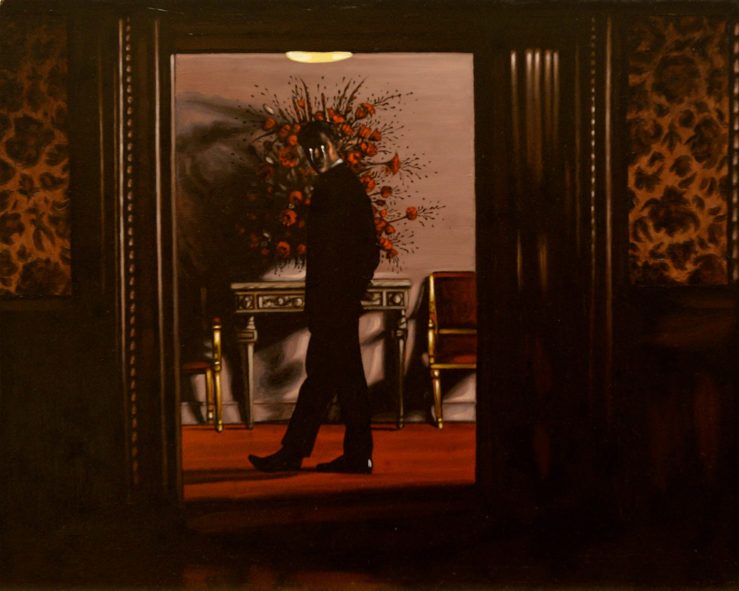
Is there a word opposite of déjà vu? (Lucia Berlin)

No one else was outside, and I was too depressed to call anybody to come see the unbelievable sunset. Is there a word opposite of déjà vu? Or a word to describe how I saw my whole future flash before my eyes? I saw that I’d stay at the Albuquerque National Bank and Bernie would get his doctorate and keep on painting bad paintings and making muddy pottery and would get tenure. We would have two daughters and one would a dentist and the other a cocaine addict. Well, of course I didn’t know all that, but I saw how things would be hard. And I knew that years and years from then Bernie would probably leave me for one of his students and I’d be devastated but then would go back to school and when I was fifty I’d finally do things I wanted to do, but I would be tired.

From Lucia Berlin’s short story “Lead Street, Albuquerque.” Collected in Evening in Paradise.

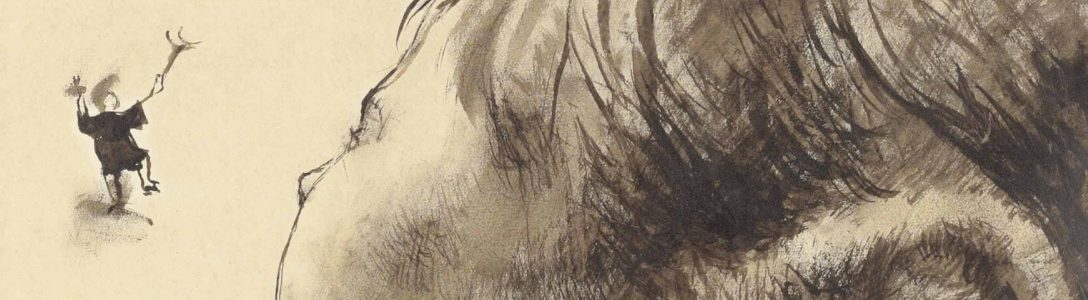
Untitled (Gallery) — Kerry James Marshall

kjm-untitled-gallery-2016-120770

Untitled (Gallery), 2016 by Kerry James Marshall (b. 1955)

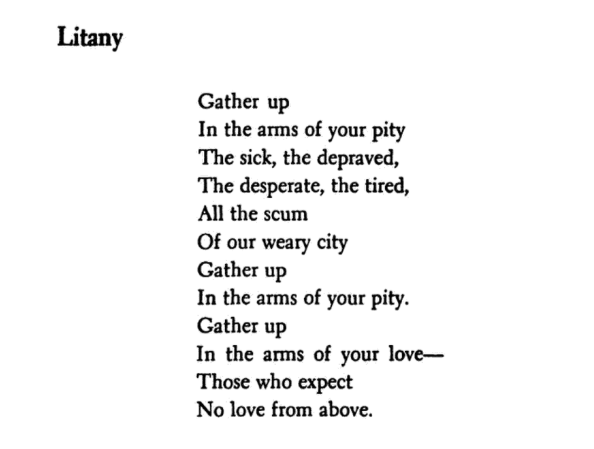
“Litany” — Langston Hughes

Screenshot 2019-02-01 at 3.44.18 PM

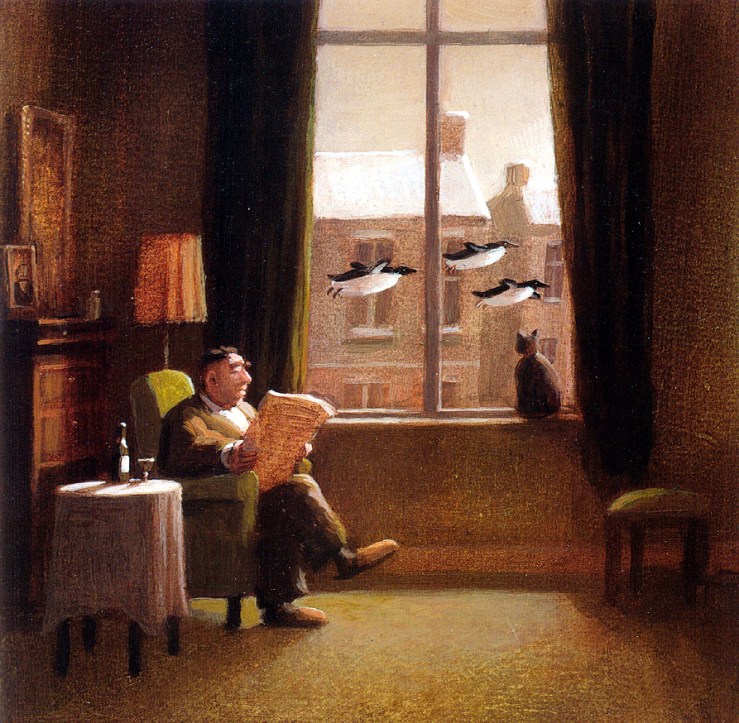
February — Michael Sowa

February by Michael Sowa (b. 1945)

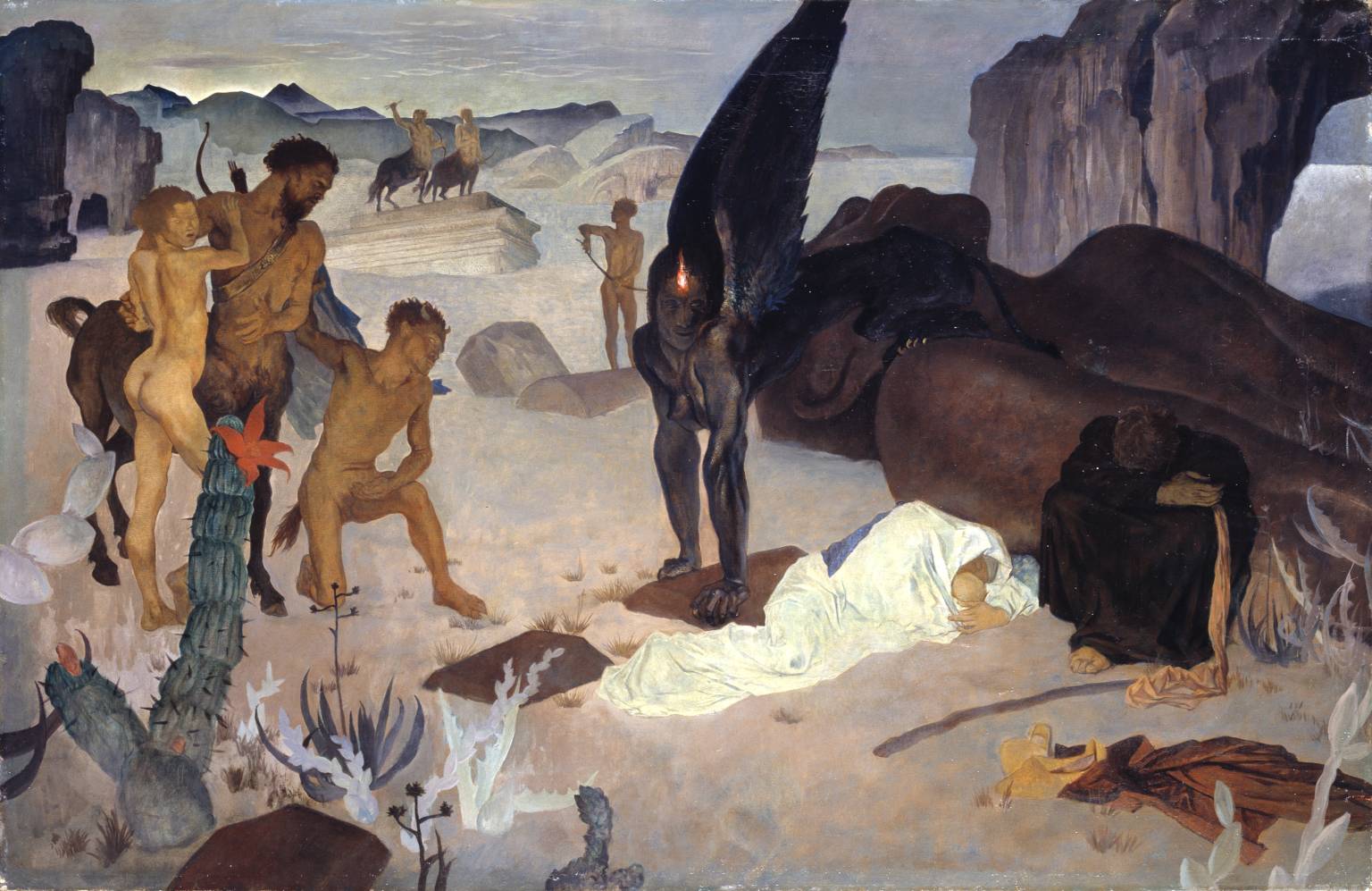
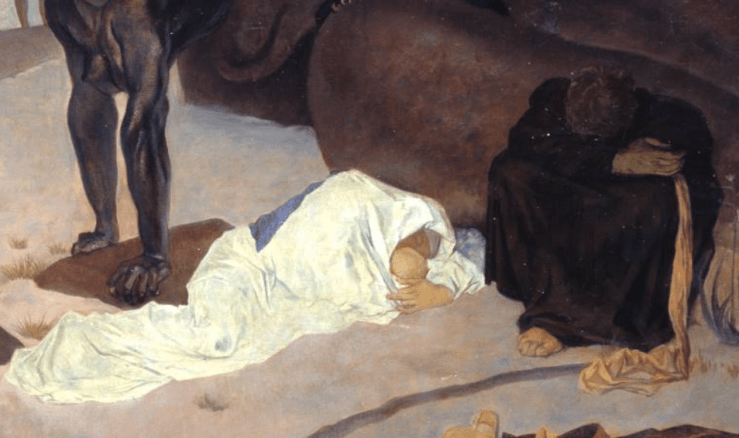
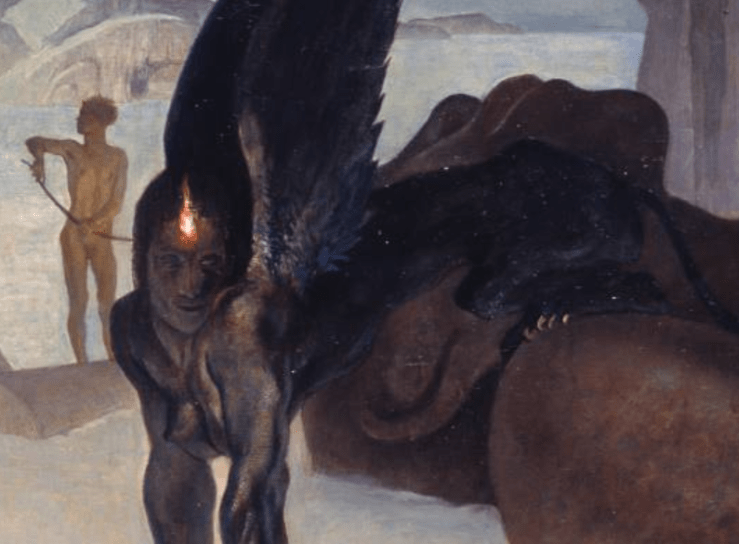
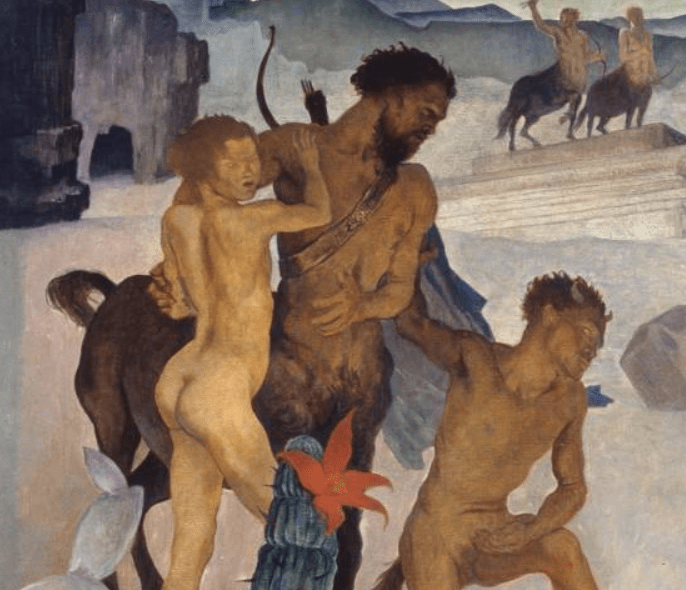
Repose on the Flight into Egypt — Glyn Warren Philpot 

Repose on the Flight into Egypt 1922 by Glyn Warren Philpot 1884-1937screenshot2019-01-31at4.27.05pmscreenshot2019-01-31at4.26.49pmscreenshot2019-01-31at4.26.36pm

Repose on the Flight into Egypt, 1922 by Glyn Warren Philpot (1884 – 1937)

O, mighty, divinely delimited wisdom of walls, boundaries! | From Yevgeny Zamyatin’s novel We

Now I’d reached the second of them, the curving road that runs along the base of the Green Wall. From out of the boundless green ocean beyond the Wall a savage wave of roots, flowers, branches, leaves rushed at me, rose up on its hindquarters, would have swamped me, would have turned me, a man, that most delicate and precise of mechanisms, into …

But fortunately, between me and the wild green ocean was the glass of the Wall. O, mighty, divinely delimited wisdom of walls, boundaries! It is perhaps the most magnificent of all inventions. Man ceased to be a wild animal only when he built that first wall. Man ceased to be a wild man only when we built the Green Wall, only when, by means of that Wall, we isolated our perfect machine world from the irrational, ugly world of trees, birds, and animals….

Through the glass, dim and foggy, the blunt muzzle of some beast looked at me, its yellow eyes insistently repeating one and the same thought, incomprehensible to me. We looked each other in the eye for a long time—through those shafts connecting the surface world to that other beneath the surface. And then a little thought wormed its way into my head: “And what if yellow-eyes, in his stupid, dirty pile of leaves, in his uncalculated life, is happier than us?”

I waved my hand, the yellow eyes blinked, backed off, vanished in the foliage. Pathetic creature! How ridiculous—him happier than us! Happier than me—that could be, all right. But then I’m simply an exception, I’m sick.


From Yevgeny Zamyatin’s 1921 novel We. English translation by Clarence Brown.

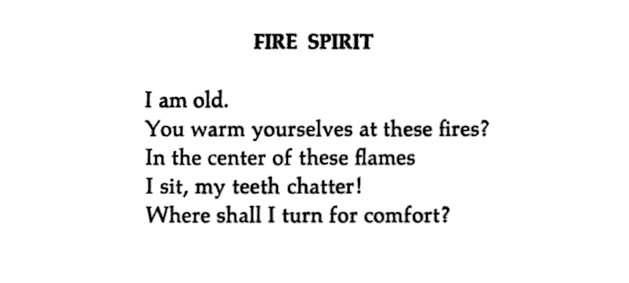
“Fire Spirit” — William Carlos Williams

wcw

Trash and Trashcan — Neil Jenney

xa_ezm_4qxn2_2340x1316

Trash and Trashcan, 1970 by Neil Jenney (b. 1945)

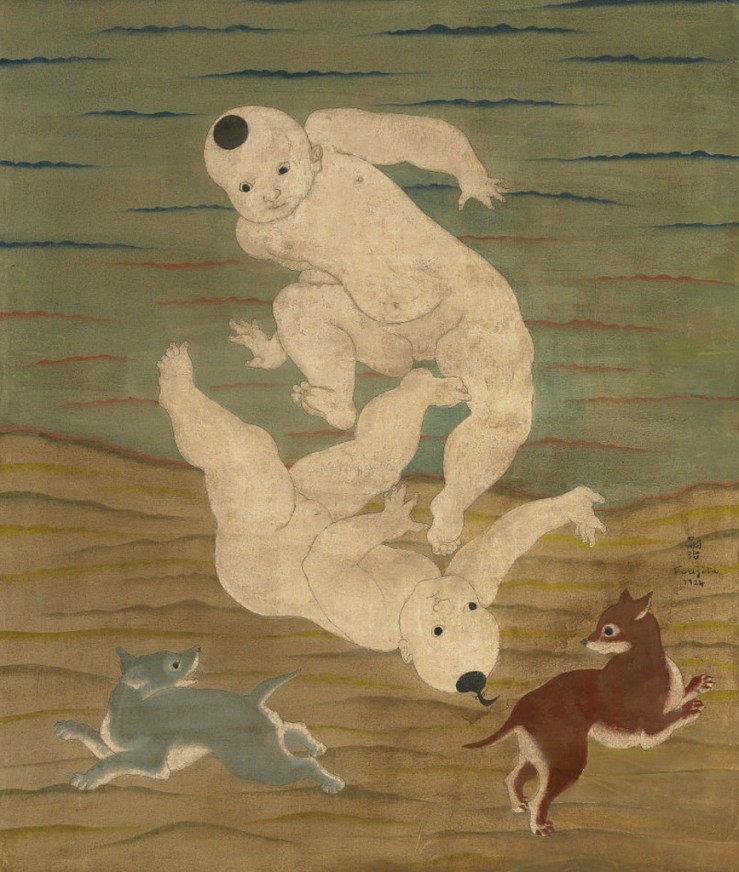
The Children — Tsuguharu Foujita

7336685170_190f3de1d1_b

The Children, 1924 by Tsuguharu Foujita (1886–1968)

Art abides (William Gaddis)

Otherwise I scarcely know what to say to your request for help on ‘more background’ first, I think, and I am not being facetious when I plead not that it’s so long since I wrote it but that [following a strikeover] (I’ve been typing all day and getting a little bleary) so long since I read it. If I named a single influence it would certainly be TS Eliot who still takes my breath away as he did then (and as a fair number of his lines sprinkled through the book might attest). Regarding any ‘message’, perhaps that art abides and the artist is its tool and victim but despite that it is the only enterprise worth embracing in the attempt to justify life; that art executed without love is bad (false) art but such love is not easy to come by. There was a corollary there too with God (perfection, gold) and the driving impossibility of grasping it because of our finite condition but that attempt being all we have to justify this finite condition (page 689 at the top I suppose is the key to the book if there is such). And in taking it down just now to look for this reference I read a few pages at random and must confess found them quite entertaining. I suppose if there has been one immense frustration with the book’s often grudging acceptance it has been how few people seemed able to permit themselves, despite its so-called ‘erudition’, to simply enjoy it.

From Letters of William Gaddis, edited by Steven Moore. Excerpted from a 1972 reply to Jeanne G. Howes, a student at Case Western Reserve University who wrote a thesis on The Recognitions.

Waiting for a Chance — Tetsuya Ishida

kisdg-oa5cmv_2340x1316

Waiting for a Chance, 1999 — Tetsuya Ishida (1973-2005)

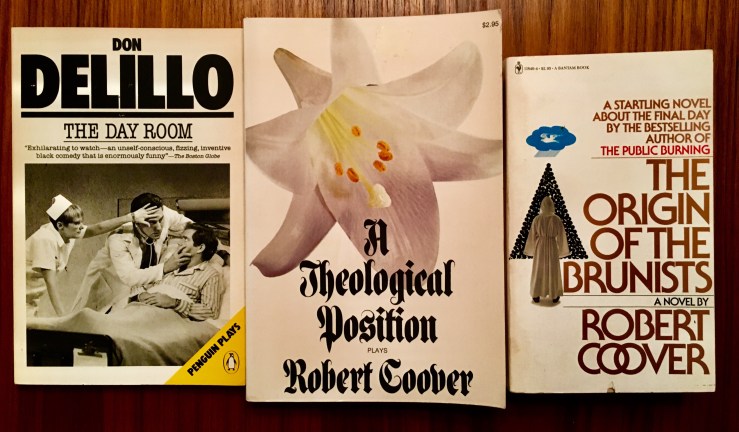
Two by Robert Coover and one by Don DeLillo (Books acquired—a few plays, unexpectedly—26 Jan. 2019)

img_2140

On Friday night we watched the first Hunger Games film with our daughter, who had finished the book this week. The movie isn’t that great, as I argued when I saw it seven years ago in the theater, but she seemed to like it, although she said she would have “done a lot of things differently.” She asked me to pick up the second book for her when I got a chance, and Not at the library, I want to own it, etc. So I figured that I’d use that as an excuse to browse my favorite used bookstore, so conveniently located 1.1 miles away (I swear I didn’t move into this neighborhood because of its proximity).

I went for a walk, got bitten rather viciously by a medium-sized dog, cleaned and dressed the wound, and went to browse books.

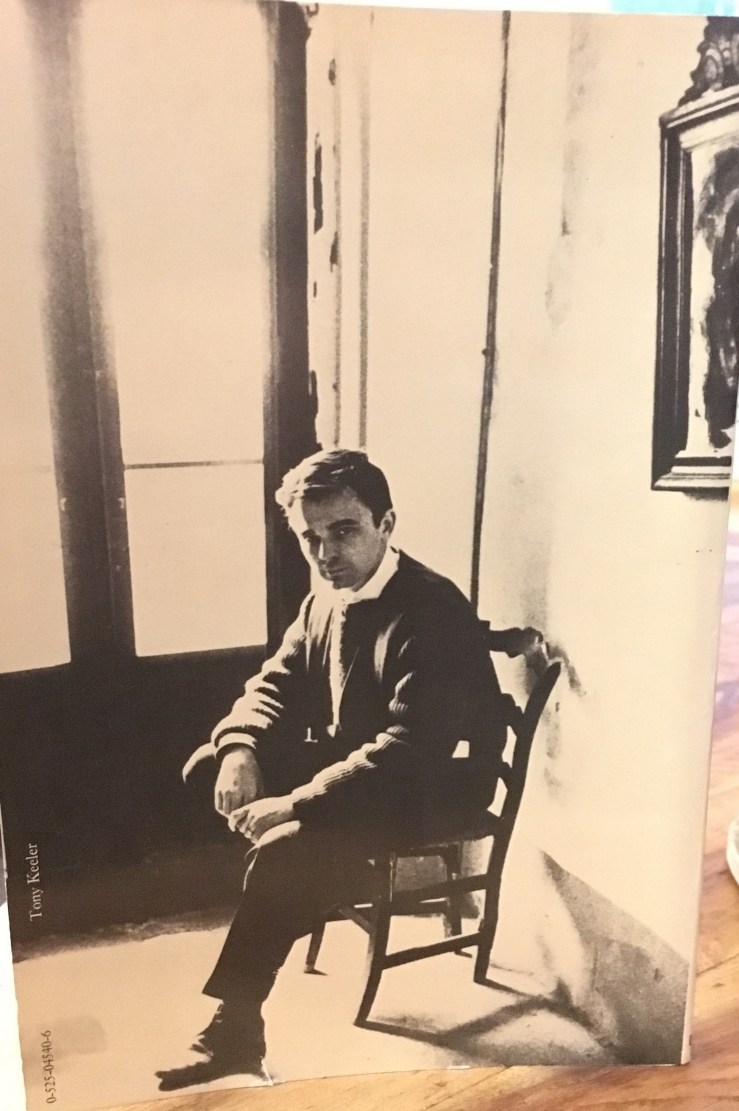
There are over two million books in this bookstore, a lot of them not really organized. While I usual mull around general fiction, literary criticism, art and art history, sci-fi, fantasy, and a section called “literary fiction,” I like to mix it up by going into areas I don’t know as well. Strolling through stack after stack in the drama section, an outward-turned collection of plays by Robert Coover caught my eye. I’d never heard of A Theological Position, but the cover and a few minutes browsing the four plays collected here—including one called Rip Awake, about Rip Van Winkle, which especially interested me—sealed the deal. That was before I turned the book over and saw this magnificent author photo, where a young Coover looks a bit like Jacques Derrida, in lieu of a tired blurb—

img_2142

A column over I spied a copy of Don DeLillo’s play The Day Room, 1986 joint I’d never heard of. The Penguin Plays edition with a black and white cover of a production recalled to me the four years of theater and drama I took in high school—we had plenty of these in the drama room, plays by Eugene O’Neil, Arthur Miller, Sam Shepard, etc. I was like the only one interested in these; it took me until the end of my sophomore year to realize that most of the drama kids were interested in fucking musicals and not literary drama. I probably belonged with the art kids but whatever.

I went and picked up the second Hunger Games book, and then browsed sci-fi a bit, hoping to find some more by the Strugatsky brothers or David Ohle’s Motorman, but not that day, friends! I also wanted to get a copy of Octavia Butler’s Parable of the Sower—and there were several—but they were all in these ridiculously well-kempt respectable and utterly literary cover editions that I can’t get down with. I’m sure I’ll find something I can live with sometime this year, but in the meantime, turning a corner, I found a massmarket paperback copy of Robert Coover’s novel The Origin of the Brunists, a novel I’ve been meaning to read for almost twenty years now. So.


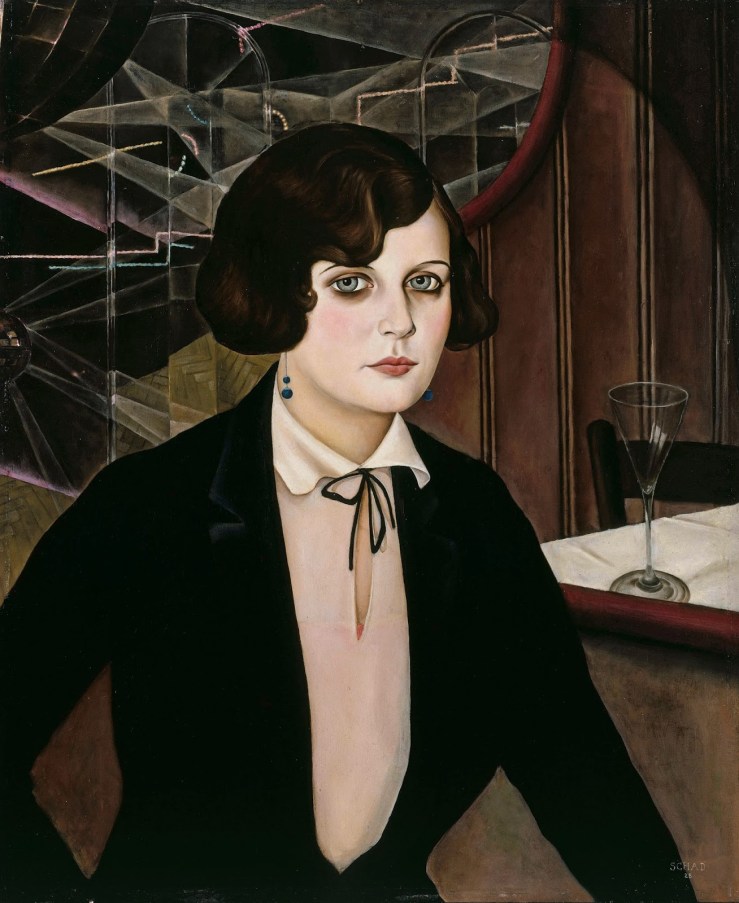
Lotte — Christian Schad

af5c635bae10f0c8657a06484d150516

Lotte, 1927 by Christian Schad (1894-1982)

Escaping the Candy Jail with My Good Eye Closed 2 — Drew Simpson

4

Escaping the Candy Jail with My Good Eye Closed 2, 2016 by Drew Simpson

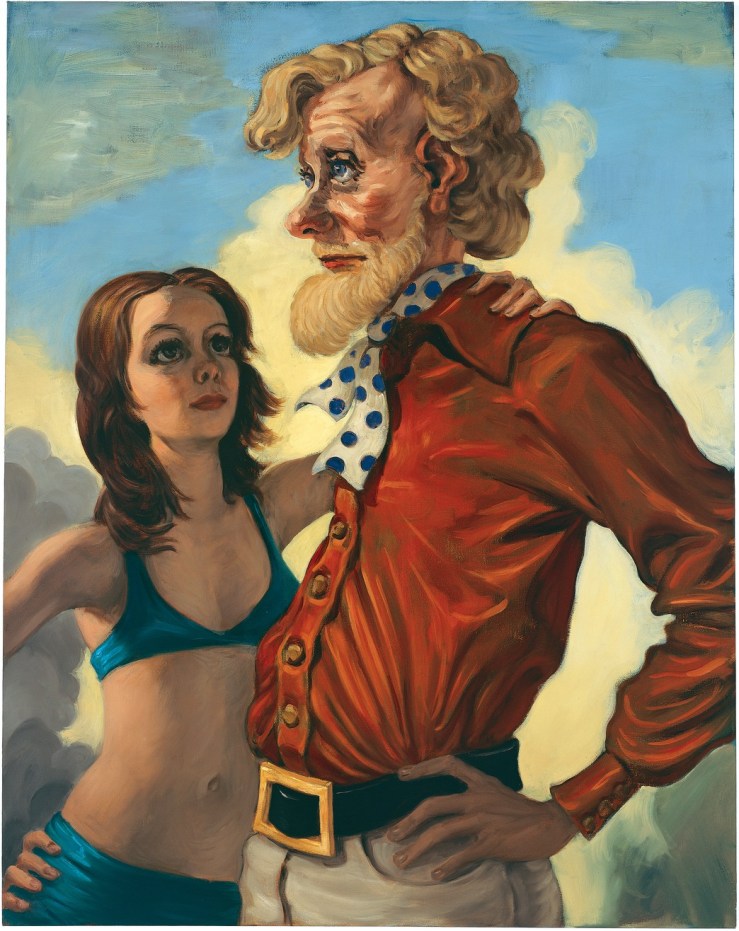
The Neverending Story — John Currin

pen2dwmygtm3_2340x1316

The Neverending Story, 1994 by John Currin (b. 1962)

Read “Crabs on the Island,” sixties Soviet sci-fi by Anatoly Dneprov

“Crabs on the Island”

by

Anatoly Denprov


“Hey, you there! Be careful!” shouted Cookling at the sailors who, standing up to their waists in the water, were trying to drag a small wooden case along the gunwale of the boat. It was the last of ten crates the engineer had brought to the island.

“Phew! Isn’t it hot! Like a furnace,” he groaned, wiping his thick red neck with a bandana handkerchief. Then he pulled off his sweat-soaked shirt and threw it on the sand. “Take your things off, Bud; there’s no civilization here.”

Dejectedly I watched the light schooner rocking gently on the waves at a distance of a mile or so from the shore. It would come back for us in three weeks’ time. “Why the devil did we have to come to this sun-hell with your machines?” I demanded of Cookling as I undressed. “With a sun like this we’ll be peeling like cucumbers tomorrow.”

“Never mind. The sun will come in useful. Incidentally, it’s exactly noon, and it’s just above our heads.”

“It’s always like that at the equator,” I muttered, not taking my eyes off the “Dove”. “All the geography books tell you that.”

The sailors had come over to us and were standing in silence before the engineer. Unhurriedly he put his hand in his trouser pocket and took out a wad of notes.

“Is that enough?” he asked, giving them several. One of them nodded.

“In that case you can return to the ship. Remind Captain Gale we shall expect him in twenty days’ time.”

Then Cookling turned to me. “Let’s get busy, Bud,” he said. “I’m impatient to begin.” I stared at him.

“To tell you the truth, I don’t know why we’ve come here. I understand that it may not have been convenient at the Admiralty for you to tell me about it. But I think you can now.”

Cookling grimaced and looked down at the sand.

“Of course I can. I would have told you all about it even then but there was no time.”

I felt he was lying, but said nothing. Cookling stood rubbing his purple neck with his greasy palm. He always did that when he was going to tell a lie, I knew, and now that was quite sufficient for me.

“You see, Bud, we’re going to perform an interesting experiment to test the theories of that. . . what’s his name. . .?” He hesitated and looked searchingly at me.

“That English scientist. Damn it, I’ve clean forgotten his name. No, I’ve got it— Charles Darwin.”

I went over to him and put my hand on his bare shoulder. Continue reading “Read “Crabs on the Island,” sixties Soviet sci-fi by Anatoly Dneprov”

Super Saian George with Trojan Horse — Mu Pan

trojan_horse_fb

Super Saian George With Trojan Horse, 2018 by Mu Pan (b. 1976)