Blog about John Berryman’s Dream Song 265 (“I don’t know one damned butterfly from another”)

Hey.

Hey look. Look, hey.

This is a bait and switch. The bait was a promise in the title of the post for a Blog about John Berryman’s Dream Song 265, “I don’t know one damned butterfly from another.” Hey, I’m sorry, but the switch is that I have nothing to add here—I mean what could I add here?—-like what hey I want to say, is, just read Berryman’s poem—-

I don’t know one damned butterfly from another
my ignorance of the stars is formidable,
also of dogs & ferns
except that around my house one destroys the other
When I reckon up my real ignorance, pal,
I mumble “many returns”—

next time it will be nature & Thoreau
this time is Baudelaire if one had the skill
and even those problems O
At the mysterious urging of the body or Poe
reeled I with chance, insubordinate & a killer
O formal & elaborate I choose you

but I love too the spare, the hit-or-miss,
the mad, I sometimes can’t    always tell them apart
As we fall apart, will you let me hear?
That would be good, that would be halfway to bliss
You said will you answer back? I cross my heart
& hope to die but not this year.

Hey, okay. I encourage you to quit now, or better yet, reread our boy Berryman. But I’ll add a little, even though I said I wouldn’t.

I don’t know one damned butterfly from another

—but I think you know about beautiful fragile transmuting things

my ignorance of the stars is formidable,

—same

also of dogs & ferns

–I know a bit about dogs; less about ferns

except that around my house one destroys the other

–I hope it’s the dogs destroying the ferns if I have to pick a side, although I’m not unsympathetic to ferns.

When I reckon up my real ignorance, pal,
I mumble “many returns”—

–This is a great rhyme. I feel like I’m the speaker’s pal here too—maybe it’s all the wine I’ve put down my fat throat, but I feel like I get what he’s doing here. I have some fat real ignorance my ownself.

next time it will be nature & Thoreau

–Oh give us a Transcendentalist vamp Johnny! (Or is it Henry?)

this time is Baudelaire if one had the skill

–Oh if one had the skill oh (I think you have the skill Johnny Henry)

and even those problems O

–Oh Oh O Ho oH O hO

At the mysterious urging of the body or Poe

–I’m reminded here of Dream Song 384 where Henry digs up his dead suicide father’s corpse from the grave: “I’d like to scrabble till I got right down / away down under the grass / and ax the casket open ha to see / just how he’s taking it, which he sought so hard / we’ll tear apart the mouldering grave clothes ha.” The manic ha is more indebted to Poe though than any grave openings or casket axings.

reeled I with chance, insubordinate & a killer
O formal & elaborate I choose you

–Hey but this is about Berryman’s art, his poetry, always his fucking poetry. Formal and elaborate? Out here choosing?

but I love too the spare, the hit-or-miss,

–Oh hey me too. I mean that’s my jam too Henry John.

the mad, I sometimes can’t always tell them apart

–I can’t either.

As we fall apart, will you let me hear?
That would be good, that would be halfway to bliss

–I think we’d all like to be let to hear.

You said will you answer back? I cross my heart
& hope to die but not this year.

-Not this year
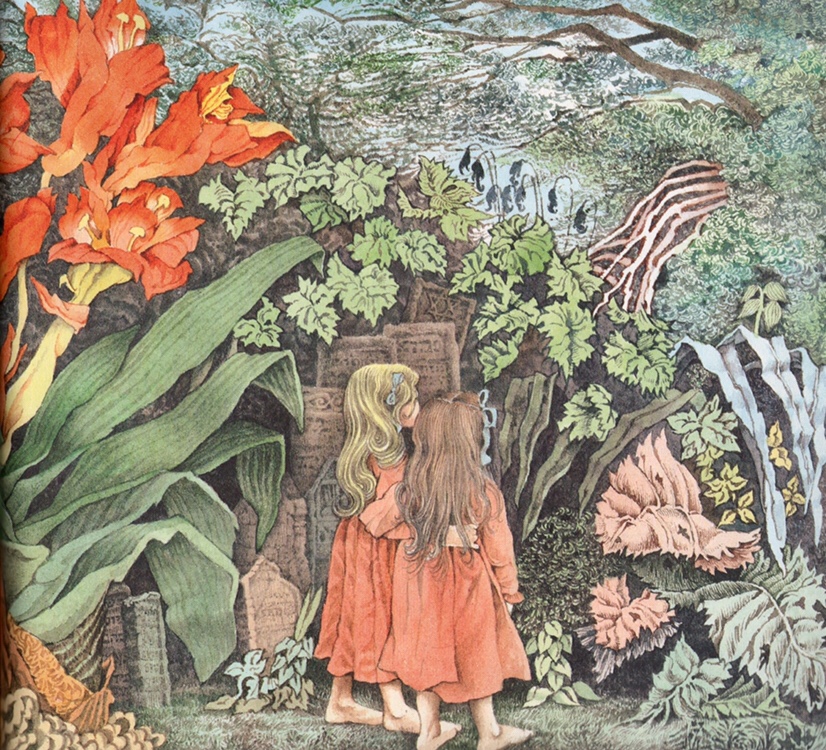
 

Another Little Girl Was Standing Beside Her — Maurice Sendak

img_9540

From Maurice Sendak’s retelling of Wilhelm Grimm’s Dear Mili.

Spa — Axel Krause

krause-kurbad2c-20152c-70x100cm2c-occ88l-auf-leinwand

Screenshot 2018-04-19 at 3.47.37 PM

Screenshot 2018-04-19 at 3.47.10 PM

Spa, 2015 by Axel Krause (b. 1958)

Blog about the American Arcadia (or Arcadian America?) scene in Nathaniel Hawthorne’s novel The Blithedale Romance

img_9535

I am glad I reread Nathaniel Hawthorne’s 1852 novel for many reasons. One of those reasons is because I had completely forgotten to remember a marvelous scene near the end of the novel, in Ch. XXV — “The Masqueraders.” This episode happens near the end of the chapter. Hawthorne’s stand-in Miles Coverdale has decided to return to Blithedale after spending some time out in, like, the world.

Coverdale’s return to the utopian project he half-heartedly abandoned is thoroughly coded in Hawthorne’s signature ambivalence: He notes “a sickness of the spirits kept alternating with my flights of causeless buoyancy” as he walks through the wood. Approaching the Blithedale farm, and feels an “invincible reluctance” in his return, which causes him to linger in the forest. By and by, as the lovely transitional phrase goes, Coverdale winds his way back to his “hermitage, in the heart of the white-pine tree.” (The white-pine reference strikes me as an oblique reference here to Hawthorne himself—or rather, a nod to a distinction between white pine and black hawthorn trees, alter egos).

Here in his hermitage he rests among grapes dangling in “abundant clusters of the deepest purple, deliciously sweet to the taste.” Coverdale’s hermitage is an idealized, natural—transcendental—version of Blithedale, the grapevines (a prefiguration of communication in the American parlance) a kind of perfectly polygamous knot of communal existence.

Taken up in solo-bacchanalia, Coverdale begins devouring the grapes. Always the loner, always the voyeur, he checks out the house from his arboreal perch and notes its emptiness. He decides, drunken on sweet grapes, to skulk through the woods, where he hears “Voices, male and feminine; laughter, not only of fresh young throats, but the bass of grown people.” He continues—

The wood, in this portion of it, seemed as full of jollity as if Comus and his crew were holding their revels in one of its usually lonesome glades. Stealing onward as far as I durst, without hazard of discovery, I saw a concourse of strange figures beneath the overshadowing branches. They appeared, and vanished, and came again, confusedly with the streaks of sunlight glimmering down upon them.

“Comus and his crew” — what a lovely evocation! Comus, cup-bearer and heir of Bacchus, is a figuration of erotic chaos. Hawthorne ushers his hero into a scene of pastoral American anarchy, a strange Arcadia that Walt Whitman would try to replicate in Leaves of Grass a few years later. Note the admixture of cultures here in Hawthorne’s transcendentalist Halloween:

Among them was an Indian chief, with blanket, feathers, and war-paint, and uplifted tomahawk; and near him, looking fit to be his woodland bride, the goddess Diana, with the crescent on her head, and attended by our big lazy dog, in lack of any fleeter hound. Drawing an arrow from her quiver, she let it fly at a venture, and hit the very tree behind which I happened to be lurking. Another group consisted of a Bavarian broom-girl, a negro of the Jim Crow order, one or two foresters of the Middle Ages, a Kentucky woodsman in his trimmed hunting-shirt and deerskin leggings, and a Shaker elder, quaint, demure, broad-brimmed, and square-skirted. Shepherds of Arcadia, and allegoric figures from the “Faerie Queen,” were oddly mixed up with these. Arm in arm, or otherwise huddled together in strange discrepancy, stood grim Puritans, gay Cavaliers, and Revolutionary officers with three-cornered cocked hats, and queues longer than their swords. A bright-complexioned, dark-haired, vivacious little gypsy, with a red shawl over her head, went from one group to another, telling fortunes by palmistry; and Moll Pitcher, the renowned old witch of Lynn, broomstick in hand, showed herself prominently in the midst, as if announcing all these apparitions to be the offspring of her necromantic art.

Again though, in classic Hawthorne fashion, our author hedges all bets, tempering his mythical romantic flight in skepticism, here embodied by Silas Foster, the only real farmer (real earthworker) of Blithedale:

But Silas Foster, who leaned against a tree near by, in his customary blue frock and smoking a short pipe, did more to disenchant the scene, with his look of shrewd, acrid, Yankee observation, than twenty witches and necromancers could have done in the way of rendering it weird and fantastic.

Our narrator Coverdale also spies some men “with portentously red noses…spreading a banquet on the leaf-strewn earth; while a horned and long-tailed gentleman” tuning up a fiddle. The end result:

So they joined hands in a circle, whirling round so swiftly, so madly, and so merrily, in time and tune with the Satanic music, that their separate incongruities were blended all together, and they became a kind of entanglement that went nigh to turn one’s brain with merely looking at it.

The entanglement here—which eventually explodes in riotous communal laughter—recalls the polygamous knot of grapevines that shrouded Coverdale’s hermitage.

The great laughter prompts Coverdale to explode in his own laughter, whereupon the Bacchic party sets out after him with comic-murderous intent:

“Some profane intruder!” said the goddess Diana. “I shall send an arrow through his heart, or change him into a stag, as I did Actaeon, if he peeps from behind the trees!”

Coverdale flees.

He eventually happens upon an old rotting woodpile covered in moss, where he daydreams about “the long-dead woodman, and his long-dead wife and children, coming out of their chill graves, and essaying to make a fire with this heap of mossy fuel!” — this before finally giving himself up to the Blithedale crew.

The episode strikes me very much as a sequel or reboot of Hawthorne’s 1835 story “Young Goodman Brown,” in which a Puritan naif wonders into the woods dark and deep and witnesses all the horrors of his young country made real—he sees the dark heart of his community beating naked and bloody and raw and Satanic—and it changes him forever, essentially dulling his soul unto a living death. The American Arcadia episode of Blithedale though is a bit richer in its mythos, its paganism more complex and inclusive, its perspective character more attuned to the vibrant possibilities of a transcendental community, even as he stands on its outside—and what is an outsider but the most vital secret ingredient of any community?

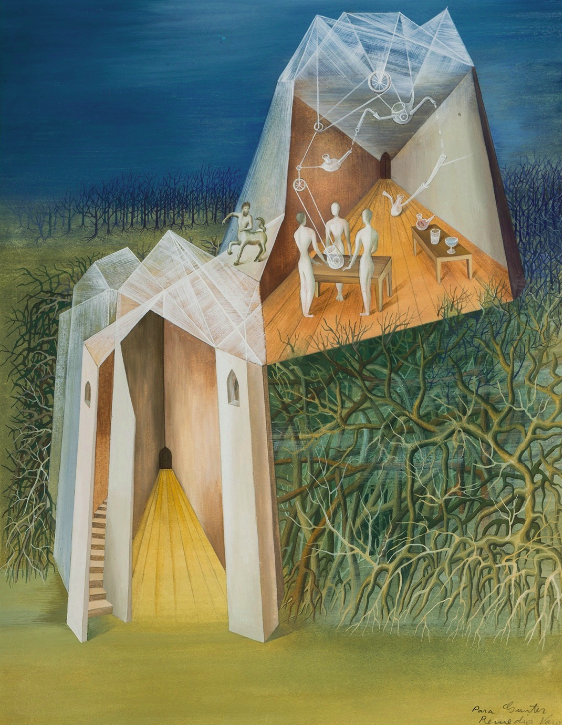
Landscape, Tower, Centaur — Remedios Varo

Screenshot 2018-04-18 at 8.12.25 PM

Landscape, Tower, Centaur, 1943 by Remedios Varo (1908-1963)

Celestina’s House — Paula Rego

9f605cea344c133c21e4350266e0d493

Celestina’s House, 2001 by Paula Rego (b. 1935)

Few virgins (I thank God for it) have you seen in this city that I have not helped sell their wares. As soon as the girl is born, I write her down in my register and keep a catalogue of all their names to the intent that I might know how many escaped my net. Why, what did you think of me, Sempronio? Can I live by the air? Can I feed myself with wind? Do I inherit any other land? Have I any other house or vineyard? Know you of any other substance of mine besides this office? By what do I eat and drink? By what do I put clothes on my back and shoes on my feet? In this city  was I born; in it was I bred; and in it I live (though I say it) in good credit and estimation, as all the world knows. You may rest assured that he who knows not both my name and my house is a stranger in this town.

From José María Ruano de la Haza’s adaptation of Celestina. Based on the English translation by James Mabbe (1631) of the Comedia de Calisto y Melibea by Fernando de Rojas (1499).

Baked — Peter Doig

baked-1990large

Baked, 1990 by Peter Doig (b. 1959)

Blog about my aunt’s recipe for oven rice

Ten or twelve years ago my aunt, who is the best home cook I can think of and who has made some of the best meals I have ever eaten, shared her recipe for oven rice for me. This is not a complex recipe, but rather a simple take on cooking rice that (at least for me) always turns out perfect. My aunt gave me this recipe after I tried her rice and remarked on how perfect it was—not too wet or too dry, certainly not mushy or crispy or any other texture that wasn’t perfectly pleasantly perfect. I complained that my rice often turned out too soft or too hard or too sticky or too dry. She asked how I cooked it (standard boiling and then simmering on the stove top), and then told me to start cooking it in the oven. I’ve never gone back.

This is my standard rice dish—like, if I’m going to make rice as a side, or make rice to go with beans or chicken gravy, etc., this is the go to. I generally use long grain white rice, but I’ve used the exact same recipe with various brown rices, as well as japonica, jasmine, basmati, and even middlins. I’ve had the best results when I never vary the steps that I follow; when I’ve tried to follow (or in most cases adapt) a particular rice’s cooking directions instead of following my aunt’s process, the results have never been quite as good.

Here’s the basic recipe.

You will need—

An oven

A stove top

A heavy bottomed pan, preferably enameled cast iron (I’ve found a 3.5 quart round dutch oven is ideal)

One cup of rice

Two cups of liquid—I like chicken stock or chicken broth, but do what you feel

Salt

Olive oil

img_9531

This isn’t that complicated to make:

  1. Preheat the oven to 350°F (or your oven’s equivalent of that idealized temperature—I think you get what I mean. I mean, Know thy oven).
  2. Coat a heavy-bottomed pan (one that can go in the oven) with good olive oil, then stir in a cup of rice. Salt the pan, but, hey, don’t put too much salt in there.
  3. Heat up the pan on your favorite stove eye (or at least your second favorite—if you have another dish under way—maybe some greens, maybe chicken innards and onions, maybe red beans—don’t be afraid to set it aside for a moment. The rice only needs to set on the eye for less than the length of one song by the American punk rock band The Ramones. You can get your black eyed peas back to their spot in no time).
  4. Keep stirring until the rice is translucent but not the least bit browned. img_9532(Hey, don’t stop stirring like I did to take this pic earlier tonight. You can see on my spoon that the rice is almost there—some grains are not translucent yet though).

  5. Add your two cups of liquid (preferably chicken broth or stock). I like to take the rice off the heat when I do this, and give it maybe 30 seconds so that it’s not too hot when I add the liquid. Avoid adding cold liquid to the dish. (You can also add alcohol before the two cups of liquid—sherry or white wine are both good, or even red if you’re feeling adventurous—but keep it to just a few ounces and cook it out before you add the broth).
  6. Bring the rice and broth to a not-quite boil. Like, I hope you preheated that oven like you were supposed to, because it should be good to go. Put a lid on your dish and stick that sucker in the oven for 30 minutes. Set a timer, because you’re going to forget!
  7. Take the dish out after 30 minutes and don’t open it until you plan to serve it (it should be fine for a while if you’ve used a heavy dish). You don’t need to fluff it if you’ve done it right.

img_9533

“Fragment” — William Carlos Williams

Capture

Blog about a devastating passage from Gerald Murnane’s story “Stream System”

dacgkouvwaazexo

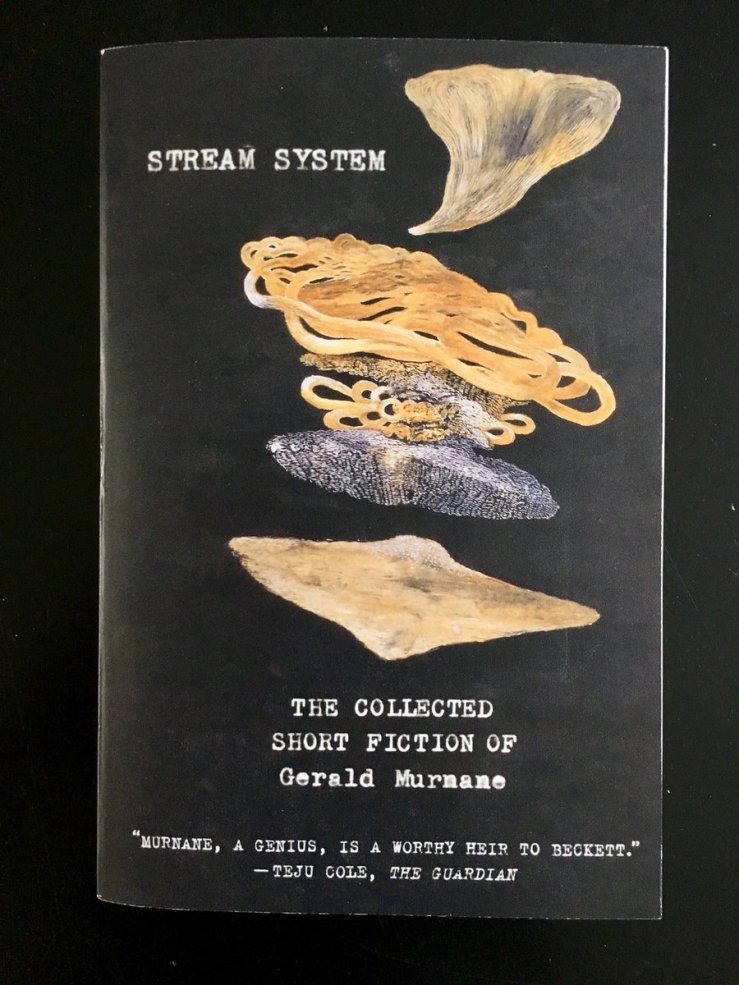
The title of this blog post is Blog about a devastating passage from Gerald Murnane’s story “Stream System, but I admit that I wanted to put the word story under a bit of suspicion—rein it in with quotation marks, call it a “story.”

See, “Stream System” isn’t really a “story” — except that it is — “Stream System” is, like, a kind of biographical excerpt, less fictionalized (Yeah but how do you know that?) than the other pieces I’ve thus far read in the 2018 collection of Gerald Murnane’s fiction (“fiction”?) Stream System.

In Stream System the story “Stream System” gets a little asterisk next to its title. The initial asterisk’s twin in the footnote informs the reader:

“‘Stream System’ was written to be be read aloud at a gathering in the Department of English at La Trobe University in 1988.”

(The original campus of La Trobe University is in Melbourne, Australia, a city I visited three times as a boy between 1987 and 1991; during this time my family lived in Papua New Guinea and New Zealand (but never Australia). The city of Melbourne, Florida is 177 miles south of where I currently live, and although I have driven past it, I have never visited it).

So “Stream System” is not a fiction but a speech, a written speech, but really a “story,” I guess—a story (sort of) about Murnane’s boyhood in the southeastern Australian state of Victoria.

In any case, in titling this blog post Blog about a devastating passage from Gerald Murnane’s story “Stream System,” I found myself wanting to put quotation marks around “story,” but realizing that those quotation marks would butt up against the quotation marks of “Stream System” (quotation marks indicating, This is the title of a short work—perfectly logical quotation marks in a shared punctuation system). And well yeah so I realized that the two sets of quotation marks did not belong to the same logical system. One set of quotation marks are so-called “scare quotes”; the other set of quotation marks are simply the basic English punctuation for indicating the title of a short work—whether the work is an essay, speech, poem, or short story. Even more importantly, putting the two sets of quotation marks together looked ugly as hell.

I started with the title for the post and seem to not have gotten past it. This has been a bad start, but I’ll keep blogging.

I’m not going to summarize “Stream System” — unpacking it would be too much, like drawing a diagram of an intricate memory map. I mean, really it’s better to just read it. I’ll just say that it condenses memory into the concrete reality of place, and makes those memories bristle with sharp, strange meaning.

I just said I’ll just say, but I’ll also just say — “Stream System” is deeply unsettling: Its repetitive tics are addictive; its compulsions compel the reader along into the speaker’s reflective labyrinth. And yet for all its coercive power, Murnane’s anamnesis is also extraordinarily discomforting. Murnane’s prose never editorializes, yet its concrete prowess, its evocation of surfaces, contours, true and real details—all of this leads the reader towards an emotional epiphany that the narrator refuses to name, directly invoke, or otherwise dramatize.

And yet so but well really “Stream System” does dramatize its epiphany, or one of its epiphanies, but in this really oblique and elliptical way that walks and talks through the story’s central trauma, walks through it in such a way that it seems like the narrator has kept going, leaving the reader a bit winded and left behind, holding a stitch in his side, saying, Hey, wait, what about this, what about this really really devastating thing you just evoked?

I realize that I titled this post Blog about a devastating passage from Gerald Murnane’s story “Stream System,” but I admit that I’m not really going to write about that devastating passage—not really. Maybe I should have titled it Blog leading up to a devastating passage from Gerald Murnane’s story “Stream System” — I mean, that’s what I should have titled this post, and I could easily go back and rewrite the title and revise this whole thing. But I won’t. Here are those four paragraphs that so very much got to me:

My brother spoke to nobody but he often looked into the face of a person and made strange sounds. My mother said that the strange sounds were my brother’s way of learning to speak and that she understood the meaning of the sounds. But no one else understood that my brother’s strange sounds had a meaning. Two years after my parents and my brother and I had left the house of red bricks my brother began to speak, but his speech sounded strange.

When my brother first went to school I used to hide from him in the schoolground. I did not want my brother to speak to me in his strange speech. I did not want my friends to hear my brother and then to ask me why he spoke strangely. During the rest of my childhood and until I left my parents’ house, I tried never to be seen with my brother. If I could not avoid travelling on the same train with my brother I would order him to sit in a different compartment from mine. If I could not avoid walking in the street with my brother I would order him not to look in my direction and not to speak to me.

When my brother first went to school my mother said that he was no different from any other boy, but in later years my mother would admit that my brother was a little backward.

My brother died when he was forty-three years old and I was forty-six. My brother never married. Many people came to my brother’s funeral, but none of those people had ever been a friend to my brother. I was certainly never a friend to my brother. On the day before my brother died I understood for the first time that no one had ever been a friend to my brother.


Tentacles — Tilo Baumgärtel

baumgaertel-tentakel2c-20172c-occ88l-auf-leinwand2c-180x150cm

Tentacles, 2017 by Tilo Baumgärtel (b. 1972)

Blog about Blog about 2

Two weeks ago, on Easter Sunday/April Fools’ Day, I wrote a blog post I titled “Blog about Blog about” declaring a goal to blog — like, to write words about something  — every day in the month of April 2018. The basic idea was to free myself from some of the anxiety that has built up into a genuine fear of writing over the past few years, which has led to me simply not to write as much as I used to.

It is now half way through the month of April and I have written fourteen (including this one) of my intended thirty posts. I failed to write on Friday the 13th.

Here are the things I’ve written about so far and my reflections on forcing myself to write about them in a fast and loose spirit:

April 2, on Iris Murdoch’s novel The Bell: I finished The Bell the day after I started the Blog about project. Had I not been doing the project, I probably would have sketched a few notes toward a review that I’d never end up actually finishing. It would hang out in the blog’s drafts folder forever. I’m strangely and probably unduly happy with what I ended up writing.

April 3, on starting a reread of Nathaniel Hawthorne’s novel The Blithedale Romance: Still reading Blithedale; the reread was inspired by The Bell (they share a kinda-similar setting). Writing about starting a book that you’ve already read is not hard.

April 4, on a particular Gordon Lish sentence: Reflecting on this one makes me realize that this is the kind of post I should be doing more of—looking closely at something small.

April 5, on Goya’s painting The Straw Man: I was very tired and did not want to write. I pulled down Robert Hughes’ biography Goya and thumbed through it, landing on a page I’d dogeared. Then I wrote the post. This method—grabbing a book somewhat at random—-also seems like a good way to write a post.

April 6, on the etymology of the word “blog”: I don’t even remember writing this one. I guess that’s why we write, to remember. I think that’s one of Socrates’ observations (or at least I think Plato wrote it down that Socrates observed this).

April 7, on Don DeLillo’s novel The Names: I often feel a bizarre and unnecessary guilt when I do not write about a novel I’ve read. I read The Names earlier this year and had intended to write about it and then didn’t. Or rather, I did write a bit about it, but I got bogged down in a kind of silly accounting of the novel’s approach to linguistics, which isn’t really what interested me about it that much anyway. The Blog about approach freed me to the extent that I didn’t even bother to quote from the novel, which is like, a bad approach to writing reviews—but a blog isn’t a review.

April 8, on Ursula K. Le Guin’s short story “Schrödinger’s Cat”: I think we read in my class that day or maybe the day before. I turned my notes into the post, sort of. Maybe that’s cheating.

April 9, on an image from Hawthorne’s The Blithedale Romance: Don’t recall writing it at all, although I recall the image, which, I don’t know. Maybe these reflections aren’t as valuable to me as I thought they would be.

April 10, on the“ The Silvery Veil” tale that’s embedded in The Blithedale Romance : I also made some connections here to Madame Psychosis, a character in David Foster Wallace’s novel Infinite Jest. I’m sure someone’s already made those connections and written about them somewhere, but most of my Google searches led me back to, like, my own blog, which says more about my search strategies than anything else I guess.

April 11, on William Carlos Williams’ ekphrastic poem “The Wedding Dance in the Open Air” (a poem about a Brueghel painting): My favorite thing in writing this was realizing how frequently Williams’ poem “The Dance” (about a Brueghel painting) is mistakenly cited as having been published in Pictures from Brueghel and Other Poems (1962). There is a poem called “The Dance” in Brueghel but it is not about a Brueghel painting. That “Dance” was published in The Wedge in 1944.

April 12, on Lydia Davis’s short story “Happiest Moment”: Again, I think the takeaway here is: Go smaller.

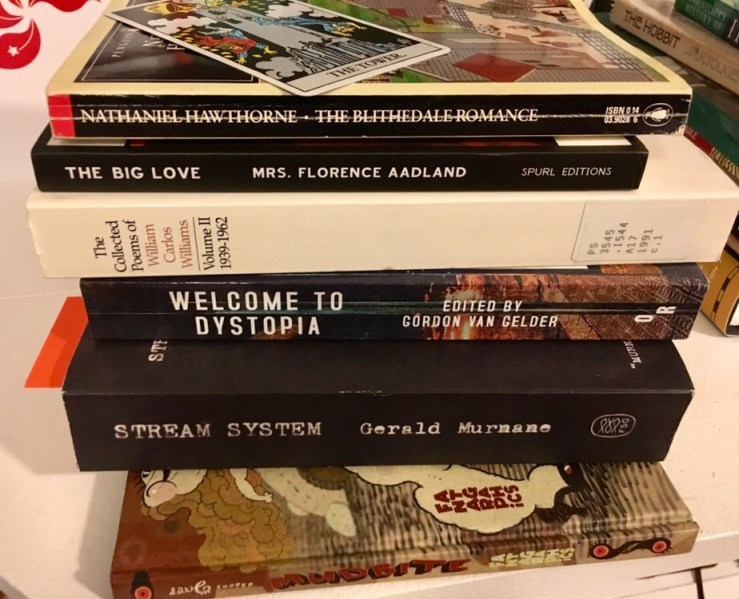
April 13: Didn’t write. Couldn’t get it out. Make up post? How about this picture I took of a stack of books I’m reading that I thought I might write about it and then thought, Nah…

img_9524

April 14, on Nathaniel Hawthorne’s journal of April 14, 1841—which happens to correlate with Hawthorne’s time on Brook Farm, the basis of his novel The Blithedale Romance which I’m still reading: I actually really enjoyed writing this one, although I don’t think anyone really read it. I researched mid-19th century farm equipment for almost an hour.

April 15 is today. I saw Wes Anderson’s film Isle of Dogs with my wife and kids and thought I would write about it, but then I didn’t. I wrote this post instead.

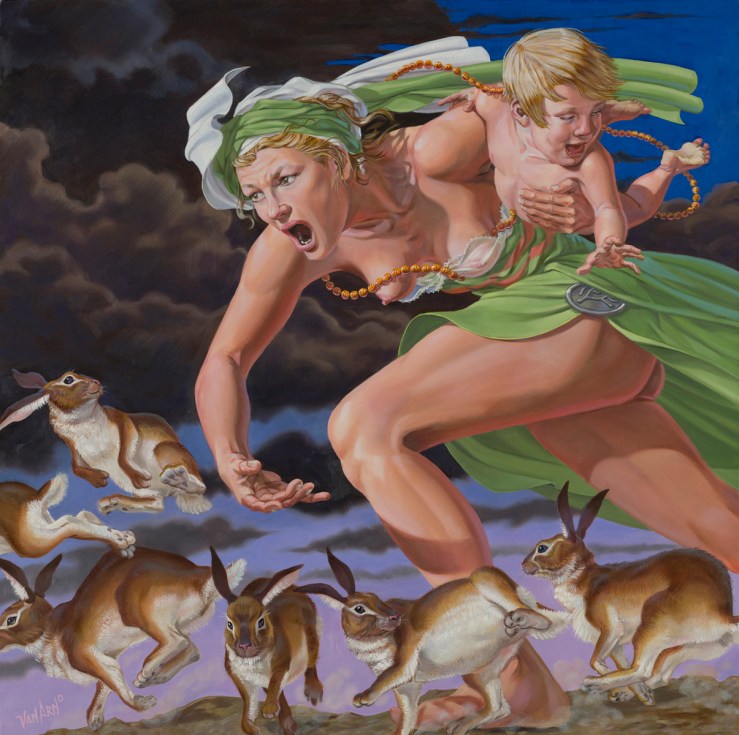
Hagar and Ishmael Flee the Bible — Van Arno

hagar-and-ishmael-flee-the-bible-01

Hagar and Ishmael Flee the Bible, 2012 by Van Arno

Blog about Nathaniel Hawthorne’s journal entry for April 14th, 1841 (including a recipe for buckwheat cakes)

For years now, I’ve been reading, rereading, and sharing on this website excerpts from Nathaniel Hawthorne’s journals. I like to post selections that share dates. For example, yesterday, April 13th, I posted Hawthorne’s notebook entry from April 13th, 1841. This particular post, which records Hawthorne’s arrival at Brook Farm, was especially felicitous, as I’m currently reading Hawthorne’s novel The Blithedale Romance, which is loosely based on the author’s time at Brook Farm.

In the novel’s second chapter, the Hawthorne-figure (Coverdale) arrives at Blithedale on “an April day, as already hinted, and well towards the middle of the month.” He complains that though the morning could be described as “balmy,” by noon it was snowing. Hawthorne’s corresponding journal entry (composed over a decade before he published Blithedale) perhaps-mockingly refers to Brook Farm as a “polar Paradise”; some of this language finds its way into the protagonist’s description of Blithdale: “Paradise, indeed! Nobody else in the world, I am bold to affirm—nobody, at least, in our bleak little world of New England,—had dreamed of Paradise that day except as the pole suggests the tropic.”

There are twenty-four chapters to Blithedale, and Hawthorne devotes the first five to that first day (presumably April 13th, 1841). The novel’s sixth chapter, “Coverdale’s Sick Chamber,” begins the next morning with our narrator too sick to attend to his first day of farm work. However, Hawthorne’s journal makes clear that the real-life Hawthorne did not fall ill until a few weeks later, around April 28th, and that he recovered around May 4th (“My cold no longer troubles me, and all the morning I have been at work under the clear, blue sky, on a hill-side”).

(I know my audience—you come to this site to read about Nathaniel Hawthorne’s head colds, right?).

Unlike his stand-in Coverdale, Hawthorne went to work at Brook Farm almost immediately. He recounts his first morning’s work in his journal entry for April 14, which I have annotated via footnotes:

April 14th, 10 A.M.–. . . I did not milk the cows last night, 1 because Mr. Ripley 2 was afraid to trust them to my hands, or me to their horns 3, I know not which. But this morning I have done wonders. 4 Before breakfast, I went out to the barn and began to chop hay for the cattle, and with such “righteous vehemence,” as Mr. Ripley says, did I labor, that in the space of ten minutes I broke the machine. 5 Then I brought wood and replenished the fires; and finally went down to breakfast, and ate up a huge mound of buckwheat cakes. 6 After breakfast, Mr. Ripley put a four-pronged instrument into my hands, which he gave me to understand was called a pitchfork 7; and he and Mr. Farley being armed with similar weapons, we all three commenced a gallant attack upon a heap of manure. This office being concluded 8, and I having purified myself, I sit down to finish this letter. . . .

Miss Fuller’s cow hooks the other cows, and has made herself ruler of the herd, and behaves in a very tyrannical manner. . . . I shall make an excellent husbandman,–I feel the original Adam 10 reviving within me.

Nathaniel Hawthorne’s journal entry for April 14th, 1841. From Passages from the American Note-Books.

1 Coverdale’s first night at Blithedale ends with Slias Foster (the only real farmer there) telling everyone to go to sleep early as they have “nine cows to milk, and a dozen other things to do, before breakfast.”

2 George Ripley, a Unitarian minister and charter member of the Transcendentalist Club, founded Brook Farm in 1840. Following Charles Fourier’s brand of communal socialism,  Brook Farm was intended to put transcendentalist idealism into concrete action. Ripley has no clear corollary in Blithedale as far as I can tell.

Never fear—Hawthorne reports in his journal a few days later (April 16th): “I have milked a cow!!!” What charming enthusiasm! Not two !! but three exclamation marks!!! Hawthorne only deploys a triple exclamation one other time in the journals collected as The American-Notebooks: On May 31st, 1844, he joyously notes, “P.S. 3 o’clock.–The beef is done!!!” Dude got excited for bovines.

I genuinely love Hawthorne’s ironic humor, which I think is often overlooked by some readers.

Good job breaking the farm equipment there, city boy! The reference to “machine” here is vague; you can read more about 19th-century feed-cutters (and see some images of them) here.

A contemporaryish recipe for buckwheat cakes from S. S. Schoff and ‎B. S. Caswell’s 1867 cookbook The People’s Own Book of Recipes and Information for the Million: Containing Directions for the Preservation of Health, for the Treatment of the Sick and the Conduct of the Sick-room : with a Full Discussion of the More Prominent Diseases that Afflict the Human Family, with Full Directions for Their Rational Treatment : Also, 1000 Practical and Useful Recipes, Embracing Every Department of Domestic Economy and Human Industry : with Copious Notes and Emendations, Explanatory and Suggestive:

buckwheat cakes

7 If you haven’t caught on, Hawthorne (and the rest of these fops too) is going to be a terrible farmer.

Hawthorne’s phrase “a gallant attack upon a heap of manure” is a wonderfully poetic turn, but his referring to finishing his shit-shoveling as “this office being concluded” straight up kills me.

Margaret Fuller was the author of Woman in the Nineteenth Century, one of American feminism’s earliest works. She was also the first editor of The Dial, (first a transcendentalist journal, and later a vehicle for modernist literature). Fuller spent time at Brook Farm, although she was never a full member. Many critics and historians suggest that Fuller is in part the inspiration for Zenobia, the soul of Hawthorne’s Blithedale.

10 The biblical Adam was of course the first gardener. Hawthorne’s romantic turn of phrase points to the idealism of Brook Farm’s utopian experiment—but also underscores the eventual fall.

The Beggars — Lucas van Leyden

DP822134

The Beggars, 1520 by Lucas van Leyden (c. 1494–1533)

Half Time — Axel Krause

krause-halbzeit2c-20152c-oil-on-canvas2c-140x200cm

Half Time, 2015 by Axel Krause (b. 1958)

The unregenerated man shivers within me | Nathaniel Hawthorne’s journal entry for April 13th, 1841

Brook Farm, Oak Hill, April 13th, 1841.–. . . Here I am in a polar Paradise! I know not how to interpret this aspect of nature,–whether it be of good or evil omen to our enterprise. But I reflect that the Plymouth pilgrims arrived in the midst of storm, and stepped ashore upon mountain snow-drifts; and, nevertheless, they prospered, and became a great people,–and doubtless it will be the same with us. I laud my stars, however, that you will not have your first impressions of (perhaps) our future home from such a day as this, . . . Through faith, I persist in believing that Spring and Summer will come in their due season; but the unregenerated man shivers within me, and suggests a doubt whether I may not have wandered within the precincts of the Arctic Circle, and chosen my heritage among everlasting snows, . . . Provide yourself with a good stock of furs, and, if you can obtain the skin of a polar bear, you will find it a very suitable summer dress for this region. . . .

I have not yet taken my first lesson in agriculture, except that I went to see our cows foddered, yesterday afternoon. We have eight of our own; and the number is now increased by a transcendental heifer belonging to Miss Margaret Fuller. She is very fractious, I believe, and apt to kick over the milk-pail. . . . I intend to convert myself into a milkmaid this evening, but I pray Heaven that Mr. Ripley may be moved to assign me the kindliest cow in the herd, otherwise I shall perform my duty with fear and trembling.

I like my brethren in affliction very well; and, could you see us sitting round our table at meal-times, before the great kitchen fire, you would call it a cheerful sight. Mrs. B—- is a most comfortable woman to behold. She looks as if her ample person were stuffed full of tenderness,–indeed, as if she were all one great, kind heart.

Nathaniel Hawthorne’s journal entry for April 13th, 1841. From Passages from the American Note-Books.

The entry is the first of Hawthorne’s journals to mention Brook Farm, a utopian enterprise that forms the basis of Hawthorne’s 1852 novel The Blithedale Romance (which I am currently re-reading).