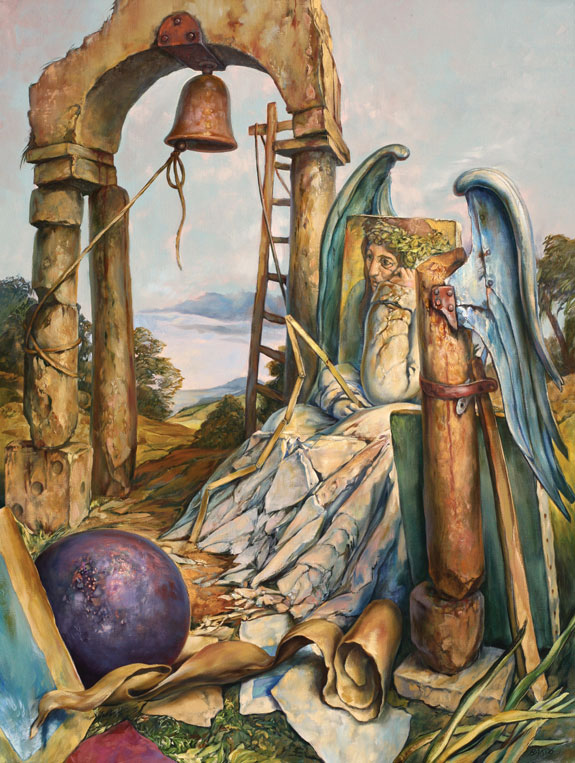
Guardian of Suspended Warnings — Samuel Bak

bk1129_images

Guardian of Suspended Warnings, 2006 by Samuel Bak (b. 1933)


“Baby” — Suburban Lawns

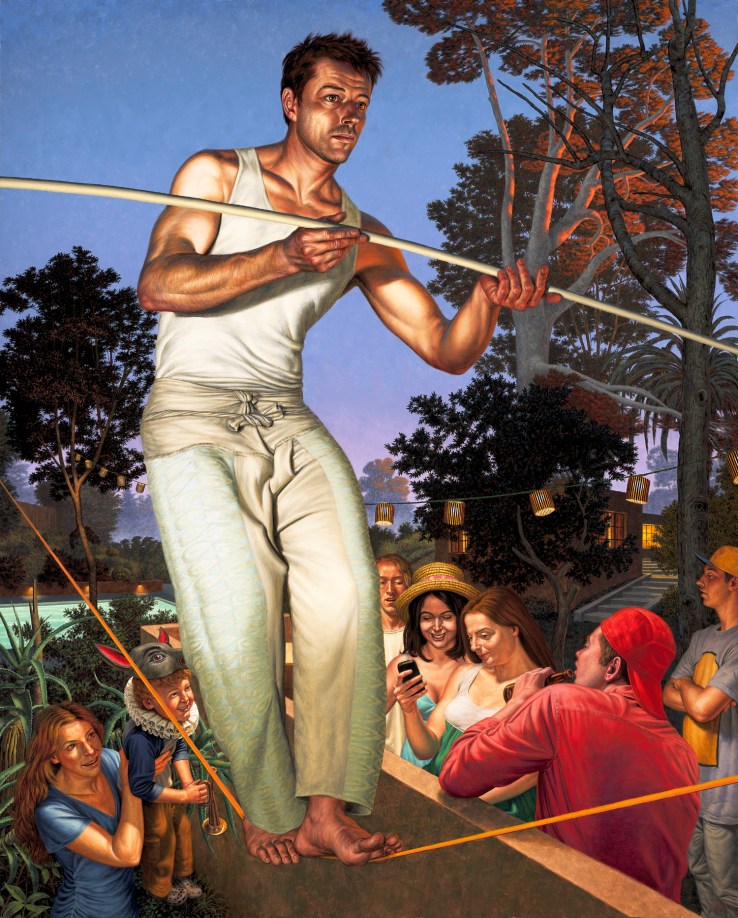
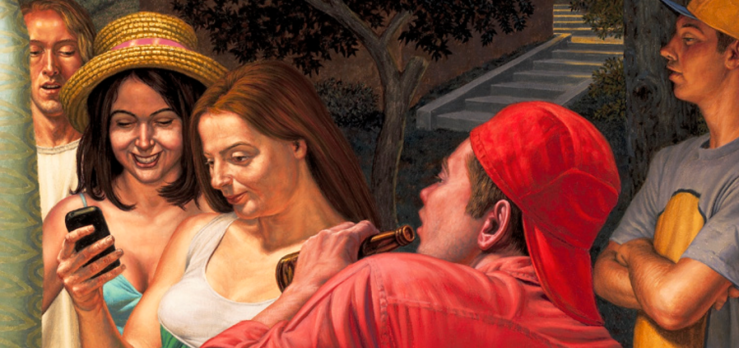
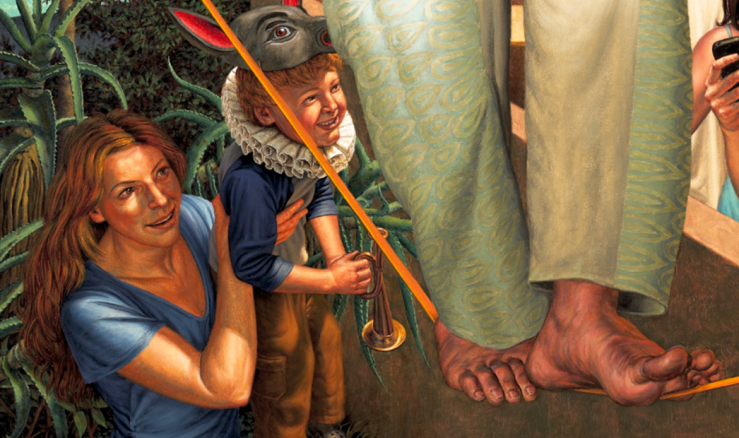
The Rope Walker — F. Scott Hess

109-theropewalker

Screenshot 2017-08-02 at 2.56.29 PM

Screenshot 2017-08-02 at 2.56.10 PM

Screenshot 2017-08-02 at 2.56.50 PM

The Rope Walker, 2010 by F. Scott Hess (b. 1955)

“The Boss,” a new short story by Robert Coover

“The Boss” is  a new (very short) short story by Robert Coover. Read the whole thing at The New Yorker

Read my review of Coover’s latest novel, Huck Out West, here.

Here are the first two paragraphs of “The Boss”:

The gunman lights a cigarette, watches despondently as dusk falls upon the empty alley. He is alone in a lonely place, summoned here to receive instructions from a master criminal known only as the Boss, but the Boss isn’t here. No one is. It’s spooky. He feels like a marked man. The Boss is known for his ruthlessness. When he orders a killing, someone dies. The gunman would like there to be witnesses for what happens next, but the alley’s deserted.

He glances at his watch, a gift from the Boss. Face a gold coin, no numbers. A joke, probably: time is money. Or, maybe, money is time; it depends on what you’re short of. The Boss is a great joker. The watch hands are hair-thin, like the edge of a razor blade, hard to see, especially in this fading light. There and not there, like time itself. Which is perhaps not being clocked—perhaps that’s what the numberless face is saying. How can you measure the shit you’re buried in? He doesn’t know what keeps the watch running. Battery inside, maybe. When the battery dies? Don’t think about it.

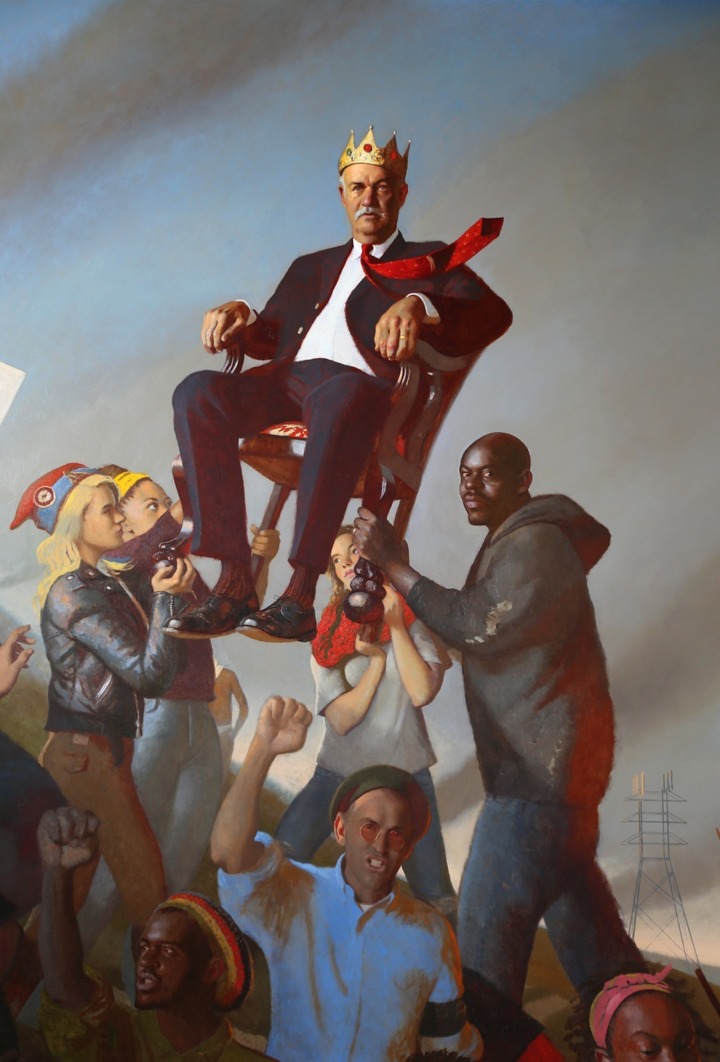
Oligarchy — Bo Bartlett

57654e3e2200002600f81b86

Oligarchy, 2016 by Bo Bartlett (b. 1955)

To the Left and to the Right — Samuel Bak

bk1140_images1

To the Left and to the Right, 2007 by Samuel Bak (b. 1933)

Read Peter Taylor’s short story “A Spinster’s Tale”

“A Spinster’s Tale”

by

Peter Taylor


My brother would often get drunk when I was a little girl, but that put a different sort of fear into me from what Mr. Speed did. With Brother it was a spiritual thing. And though it was frightening to know that he would have to burn for all that giggling and bouncing around on the stair at night, the truth was that he only seemed jollier to me when I would stick my head out of the hall door. It made him seem almost my age for him to act so silly, putting his white forefinger all over his flushed face and finally over his lips to say, “Sh-sh-sh-sh!” But the really frightening thing about seeing Brother drunk was what I always heard when I had slid back into bed. I could always recall my mother’s words to him when he was sixteen, the year before she died, spoken in her greatest sincerity, in her most religious tone:

“Son, I’d rather see you in your grave.”

Yet those nights put a scaredness into me that was clearly distinguishable from the terror that Mr. Speed instilled by stumbling past our house two or three afternoons a week. The most that I knew about Mr. Speed was his name. And this I considered that I had somewhat fabricated—by allowing him the “Mr.”—in my effort to humanize and soften the monster that was forever passing our house on Church Street. My father would point him out through the wide parlor window in soberness and severity to my brother with: “There goes Old Speed, again.” Or on Saturdays when Brother was with the Benton boys and my two uncles were over having toddies with Father in the parlor, Father would refer to Mr. Speed’s passing with a similar speech, but in a blustering tone of merry tolerance: “There goes Old Speed, again. The rascal!” These designations were equally awful, both spoken in tones that were foreign to my father’s manner of addressing me; and not unconsciously I prepared the euphemism, Mister Speed, against the inevitable day when I should have to speak of him to someone.

I was named Elizabeth, for my mother. My mother had died in the spring before Mr. Speed first came to my notice on that late afternoon in October. I had bathed at four with the aid of Lucy, who had been my nurse and who was now the upstairs maid; and Lucy was upstairs turning back the covers of the beds in the rooms with their color schemes of blue and green and rose. I wandered into the shadowy parlor and sat first on one chair, then on another. I tried lying down on the settee that went with the parlor set, but my legs had got too long this summer to stretch out straight on the settee. And my feet looked long in their pumps against the wicker arm. I looked at the pictures around the room blankly and at the stained-glass windows on either side of the fireplace; and the winter light coming through them was hardly bright enough to show the colors. I struck a match on the mosaic hearth and lit the gas-logs.

Kneeling on the hearth I watched the flames till my face felt hot. I stood up then and turned directly to one of the full-length mirror-panels that were on each side of the front window. This one was just to the right of the broad window and my reflection in it stood out strangely from the rest of the room in the dull light that did not penetrate beyond my figure. I leaned closer to the mirror trying to discover a resemblance between myself and the wondrous Alice who walked through a looking-glass. But that resemblance I was seeking I could not find in my sharp features, or in my heavy, dark curls hanging like fragments of hosepipe to my shoulders. Continue reading “Read Peter Taylor’s short story “A Spinster’s Tale””

Seven Views of Tokyo — Shinji Tsuchimochi

From Shinji Tsuchimochi’100 Views of Tokyo. More at Spoon & Tomago, where you can also buy the book.

“The Itch,” a new Don DeLillo story in The New Yorker

There’s a new DeLillo story in The New Yorker. It’s called “The Itch” and I started itching terribly about halfway through. First three sections (and yeah, the story starts with “But”):

But nobody showed up, so he sat awhile looking at the wall. It was one of those Saturdays that feel like Sunday. He didn’t know how to explain this. It happened intermittently, more often in the warmer months, and it was probably normal, although he’d never discussed it with anyone.

After the divorce he felt an odd numbness, mental and physical. He looked in the mirror, studying the face that looked back. At night he kept to his half of the bed with his back to the other half. Over time a life slithered out. He talked to people, took long walks. He bought a pair of shoes but only after testing them rigorously, both shoes, not just one. He walked from one end of the shoe store to the other, four times at various speeds, then sat and looked down at the shoes. He took one shoe off and handled it, pressing the instep, placing his hand inside the shoe, nodding at it, tapping with the fingers of his free hand on the rigid sole and heel.

The salesman stood in the near distance, watching and waiting, whoever he was, whatever he said and did when he wasn’t there.

In the office his desk was set alongside a window and he spent time looking at a building across the street, where nothing was visible inside the rows of windows. There were times when he could not stop looking.

He looks and scratches, semi-surreptitiously. Certain days it’s the left wrist. Upper arms at home in the evening. Thighs and shins most likely at night. When he’s out walking, it happens now and then, mostly forearms.

He was forty-four years old, trapped in his body. Arms, legs, torso. Face did not itch. Scalp developed something that a doctor gave a name to, but it itched only rarely, then not at all, so the name didn’t matter.

His eyes swept the windows across the street horizontally, never vertically. He did not try to imagine the lives inside.

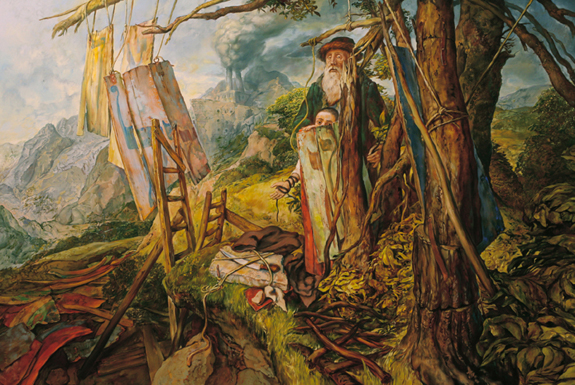
Izaak — Samuel Bak

bk1245_images

Izaak, 1999-2008 by Samuel Bak (b. 1933)

A sense of not pretending | Sam Shepard on Days of Heaven

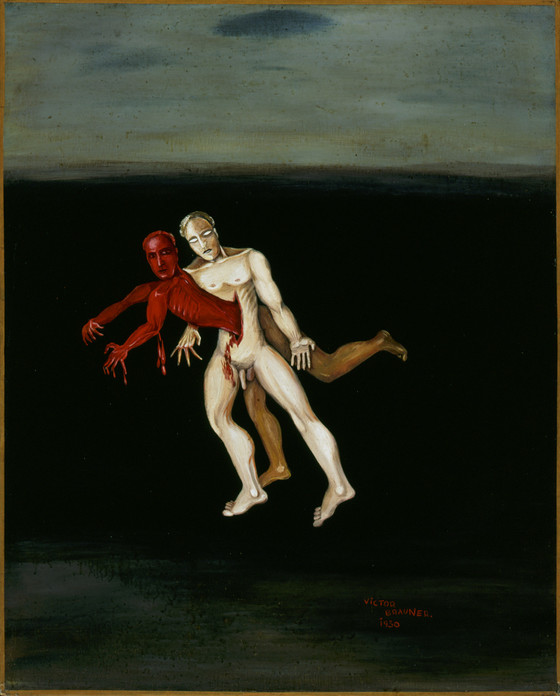
Suicide at Dawn — Victor Brauner

ma-113932-web

Suicide at Dawn, 1930 by Victor Brauner (1903-1966)

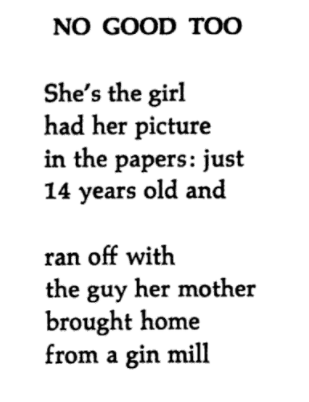
“No Good Too” — William Carlos Williams

Screenshot 2017-07-30 at 7.56.50 PM

Rossetti’s Willow Wood — Robin Ironside

02_lg

Rossetti’s Willow Wood, 1944 by Robin Ironside (1912-1965)

Self-Portrait at the Easel — Sofonisba Anguissola

Self-Portrait at the Easel, 1556 by Sofonisba Anguissola (c. 1532-1625)

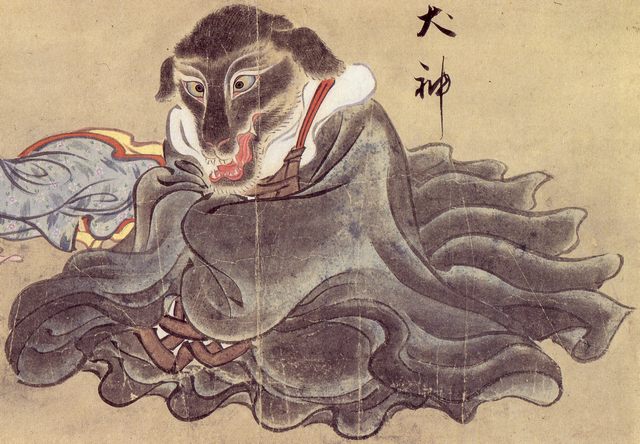
Inugami — Sawaki Suushi

suushi_inugami

Inugami (Dog Spirit), 1736 by Sawaki Suushi (1707-1772)