

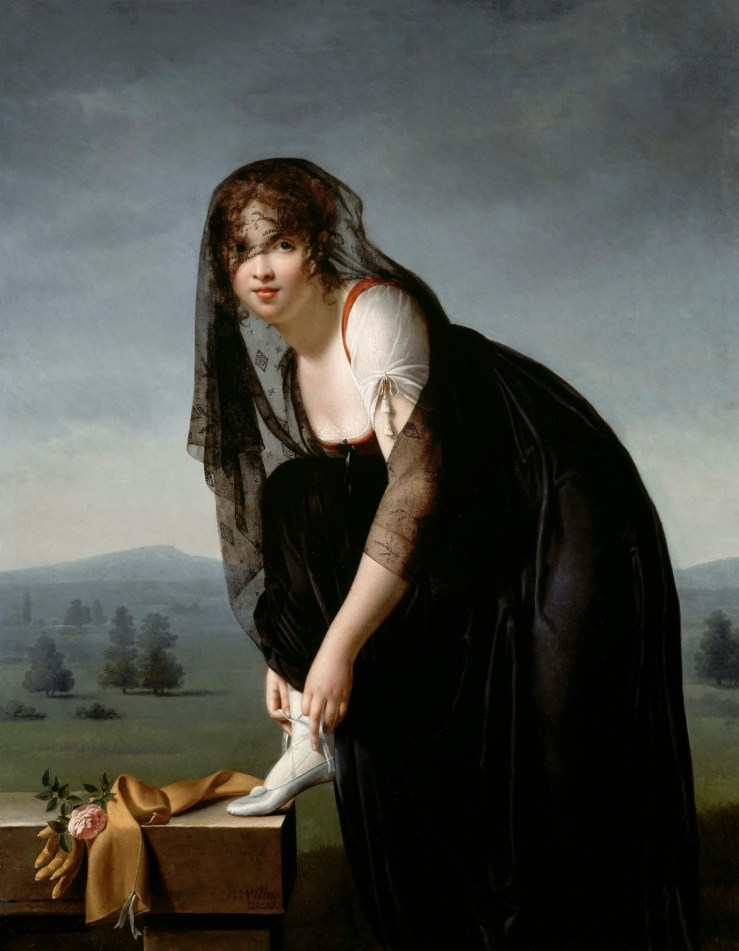
Two Women, Gwen John
Here’s a short review of Jane Bowles’ only novel, Two Serious Ladies: The book is amazing, a confounding, energetic picaresque suffused with sinister humor and dark delight. I read it knowing nothing about the plot on the recommendation of Ben Marcus, who described it as “so insane, so beautiful, and in some sense, unknowable to me. On the surface, it’s not really about much, but the arrangement of words does something chemical to me.” My recommendation is to dispense with the rest of my review and read Bowles’ novel.
“Unknowable” is a fair description, and Two Serious Ladies was met with bewilderment when it was first published in 1943, as Negar Azimi points out in the comprehensive essay “The Madness of Queen Jane”:
Edith Walton, writing in the Times Book Review, called the book senseless and silly: “To attempt to unravel the plot of ‘Two Serious Ladies’ would be to risk, I am sure, one’s own sanity.” Another reviewer said, simply, “The book is about nothing.” Jane’s family, in the meantime, found it unseemly in its stark depiction of lesbianism. Its characters, who have goals and motivations that are hard to grasp, were difficult to relate to. Yet another critic wrote, “The only shocking thing about this novel is that it ever managed to find its way to print.” Jane was only twenty-four.
The notion that “The book is about nothing,” is corrected by Marcus’s qualifier about its “surface”: Two Serious Ladies moves through the phenomenological world that its characters experience, but it does not mediate the concrete contours of that world in a way that its characters can name for the reader. When the characters, those two serious ladies, do stumble into language that might name, pin down, or otherwise fix their experience, fix their consciousness into a stable relation with the world, Bowles spins the wheel again, flings her characters into new scenarios. Moments of epiphany are transitory and hard-purchased. A (perhaps) illustrating passage, offered without context:
Mrs. Copperfield started to tremble after the girl had closed the door behind her. She trembled so violently that she shook the bed. She was suffering as much as she had ever suffered because she was going to do what she wanted to do. But it would not make her happy. She did not have the courage to stop from doing what she wanted to do. She knew that it would not make her happy, because only the dreams of crazy people come true. She thought that she was only interested in duplicating a dream, but in doing so she necessarily became the complete victim of a nightmare.
The free indirect style here still hides so much from the reader, who must suss the characters’ unnamed desires from bewildering details alone. The passage above shows us fear and trembling, dream, nightmare—and crazy people. What does Copperfield want to do? One subtext here is a lesbian desire seemingly comprehended by everyone but Mrs. Copperfield herself. (In some of the book’s strangest moments, Mr. Copperfield leaves his near-mad wife in a dangerous part of a foreign city to encounter hookers of every stripe). Two Serious Ladies is about women searching for something, but something they can’t name, can’t conceive in language—but can perhaps imagine.
A third-act epiphany—again transitory and hard-purchased—parallels Mrs. Copperfield’s fear and trembling. Miss Goering—
—okay, wait, it occurs to me now that I’ve completely neglected to offer any kind of plot description that might anchor this ostensible “review,” to set up who exactly Miss Goering is, etc., so here goes (and I encourage you to just go ahead and skip the next long paragraph)—
A bad summary: Two Serious Ladies comprises three long chapters, each of which might stand on its own as a long short story. Part the first: Miss Goering is rich but strange. Her childhood is bizarre; alienated from others “she wore the look of certain fanatics who think of themselves as leaders without once having gained the respect of a human being.” Her attempt to baptize another child luckily doesn’t end in a drowning. She grows up out of step with her peers, dresses odd, speaks odd. One day out of nowhere appears a Miss Gamelon, who becomes her (often disagreeable) companion. At a party she runs into the other serious lady, Mrs. Copperfield, whose adventures in Panama comprise the second section of the book. At the same party she meets Arnold, a would-be artist, goes home with him, meets his folks, his father. She elects to move (with Arnold and Miss Gamelon) to a run-down cottage on a drab island, forsaking her wealth, sort of. Part the second: We shift to section two, the Copperfields’ adventures in Panama. Mr. Copperfield checks the couple into a seedy hotel in the wrong part of town and promptly drops his wife off where the brothels are. She moves into a run-down hotel with a prostitute named Pacifica while her husband does God-knows-what. There’s a lot of drinking and near-madness, run-ins with bad boyfriends and snooty hoteliers. Mr. Copperfield leaves without his wife. Part the third: We return to Miss Goering and gang in the dilapidated cottage. Arnold’s father soon moves in with them. Miss Goering starts going out at night alone. She gets picked up at bar and moves in with a man named Andy. She eventually leaves him for a gangster who mistakes her for a prostitute. On a dinner date—okay, not really a dinner date but—on a dinner date with the gangster (who, like the dinner date, is never actually named as a “gangster”), Miss Goering runs into Mrs. Copperfield. Both are much changed.
—okay, so this time with (or without) some context—
A third-act epiphany—again transitory and hard-purchased—parallels Mrs. Copperfield’s fear and trembling. Miss Goering and her gangster:
This man, they had noticed, drove up to the saloon in a very beautiful big automobile that resembled more a hearse than a private car. Miss Goering had examined it one day when the man was drinking in the saloon. It appeared to be almost brand new. She and Andy had looked in through the window and had been a little surprised to see a lot of dirty clothes on the floor. Miss Goering was completely preoccupied now with what course to take should the newcomer be willing to make her his mistress for a little while. She was almost sure that he would, because several times she had caught him looking at her in a certain way which she had learned to recognize. Her only hope was that he would disappear before she had the chance to approach him. If he did, she would be exempt and thus able to fritter away some more time with Andy, who now seemed so devoid of anything sinister that she was beginning to scrap with him about small things the way one does with a younger brother.
And of course she gives in to her terrible desire. The plot of Two Serious Ladies might be described as a search for “anything sinister.” Miss Goering and Mrs. Copperfield seek the brink of all those things one can be brinked upon: disasters, abysses, madness. Love?
The novel most reminded me of what I love best in the films of David Lynch and the fiction of Roberto Bolaño—that sense of perverse night-time dread, the sordid intimation of just how easily the veneer might crack, of how simple it might be for civilization to give way to the madness under the surface.
David Lynch and Roberto Bolaño suffuse their work with an absurd howling humor that percolates along with the dread, and Two Serious Ladies operates along the same horror/humor axis. The book is hilarious, but my several attempts to capture that here in a few excerpts of dialogue fail to translate into this digest form. Will you take my word? Will you take my word that the book was much funnier the second time I read it?
The reading experience cannot be easily distilled. (Strike that adverb). Two Serious Ladies resists unfolding in the way we expect our narratives to unfold—to be about something—Bowles withholds exposition, clarification, and motivation—well, okay, not withholds, but rather hides, or obscures, or enshadows. (I don’t have the verbs for this book). I think of Harold Bloom’s rubric for canonical literature here. In The Western Canon, he argues that strong literature exemplifies a “strangeness, a mode of originality that either cannot be assimilated, or that so assimilates us that we cease to see it as strange.” Nearly three-quarters of a century after its publication, Two Serious Ladies is still strange, still strong, still ahead of its time. Its vignettes flow (or jerk or shift or pitch wildly or dip or soar or sneak) into each other with a wonderfully dark comic force that simultaneously alienates and invites the reader, who, bewildered by its transpositions, is compelled to follow into strange new territory. Very highly recommended.
[Ed. note: Biblioklept first published this review of Two Serious Ladies in February of 2015].












 Biblioklept