Upon the pleasant veranda of Père Antoine’s cottage, that adjoined the church, a young girl had long been seated, awaiting his return. It was the eve of Easter Sunday, and since early afternoon the priest had been engaged in hearing the confessions of those who wished to make their Easters the following day. The girl did not seem impatient at his delay; on the contrary, it was very restful to her to lie back in the big chair she had found there, and peep through the thick curtain of vines at the people who occasionally passed along the village street.
She was slender, with a frailness that indicated lack of wholesome and plentiful nourishment. A pathetic, uneasy look was in her gray eyes, and even faintly stamped her features, which were fine and delicate. In lieu of a hat, a barege veil covered her light brown and abundant hair. She wore a coarse white cotton “josie,” and a blue calico skirt that only half concealed her tattered shoes.
As she sat there, she held carefully in her lap a parcel of eggs securely fastened in a red bandana handkerchief.
Twice already a handsome, stalwart young man in quest of the priest had entered the yard, and penetrated to where she sat. At first they had exchanged the uncompromising “howdy” of strangers, and nothing more. The second time, finding the priest still absent, he hesitated to go at once. Instead, he stood upon the step, and narrowing his brown eyes, gazed beyond the river, off towards the west, where a murky streak of mist was spreading across the sun.
“It look like mo’ rain,” he remarked, slowly and carelessly.
“We done had ’bout ‘nough,” she replied, in much the same tone.
“It’s no chance to thin out the cotton,” he went on.
“An’ the Bon-Dieu,” she resumed, “it’s on’y to-day you can cross him on foot.”
“You live yonda on the Bon-Dieu, donc?” he asked, looking at her for the first time since he had spoken.
It is hardly likely that a goddess may die. Then Eastre, the old Saxon goddess of spring, must be laughing in her muslin sleeve at people who believe that Easter, her namesake, exists only along certain strips of Fifth Avenue pavement after church service.
Aye! It belongs to the world. The ptarmigan in Chilkoot Pass discards his winter white feathers for brown; the Patagonian Beau Brummell oils his chignon and clubs him another sweetheart to drag to his skull-strewn flat. And down in Chrystie Street—
Mr. “Tiger” McQuirk arose with a feeling of disquiet that he did not understand. With a practised foot he rolled three of his younger brothers like logs out of his way as they lay sleeping on the floor. Before a foot-square looking glass hung by the window he stood and shaved himself. If that may seem to you a task too slight to be thus impressively chronicled, I bear with you; you do not know of the areas to be accomplished in traversing the cheek and chin of Mr. McQuirk.
McQuirk, senior, had gone to work long before. The big son of the house was idle. He was a marble-cutter, and the marble-cutters were out on a strike.
“What ails ye?” asked his mother, looking at him curiously; “are ye not feeling well the morning, maybe now?”
“He’s thinking along of Annie Maria Doyle,” impudently explained younger brother Tim, ten years old.
“Tiger” reached over the hand of a champion and swept the small McQuirk from his chair.
“I feel fine,” said he, “beyond a touch of the I-don’t-know-what-you-call-its. I feel like there was going to be earthquakes or music or a trifle of chills and fever or maybe a picnic. I don’t know how I feel. I feel like knocking the face off a policeman, or else maybe like playing Coney Island straight across the board from pop-corn to the elephant houdahs.” Continue reading ““The Easter of the Soul,” a short tale by O. Henry”→
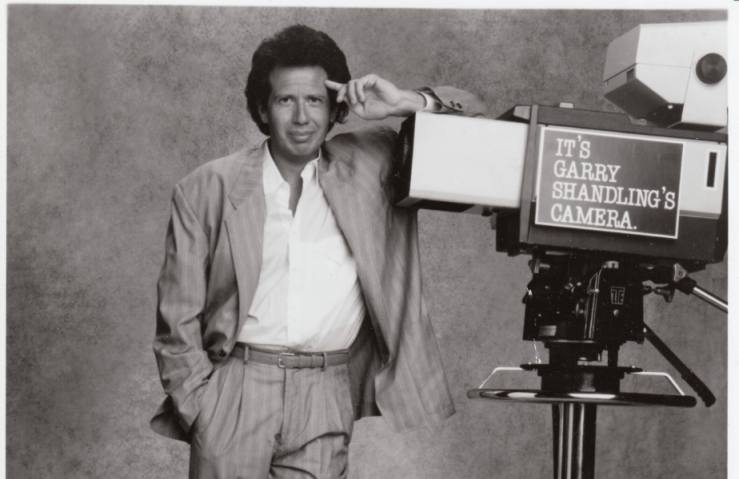
I grew up with Garry Shandling on TV—weird, enigmatic even—dry, sure—watching him when I was too young to get what he was doing. But he stuck out more than others to me when I’d watch Carson late at night with my grandmother. And then watching It’s Garry Shandling’s Show on Fox sometimes, with my parents: it was like Newhart (and Bob Newhart’s stuff in general)—I didn’t quite get it (yet), but I wanted to get it. It wasn’t dumb—and when it was dumb, it was dumb in a smart way.
And then came The Larry Sanders Show. I was, what, 13? 12? HBO wasn’t really HBO yet—sure, it had The Kids in the Hall, Tales from the Crypt, *ahem* Real Sex, and the largely forgotten Dream On—but it’s hard to imagine contemporary laugh-trackless-meta shows without The Larry Sanders Show.
Saying The Larry Sanders Show was ahead of its time is an understatement. Sure, it had its progenitors (Albert Brooks’s Real Life comes to mind—hell, The Muppet Show too)—but The Larry Sanders Show somehow synthesized its parts as both a show about a show, but also, like, a show. The late-night show on The Larry Sanders Show (uh, The Larry Sanders Show) was very very funny.
The writers’ room segments (and all the showbiz backstage stuff) were/are hilarious too; The Larry Sanders Show is the obvious progenitor of not just 30 Rock, but any number of dry, deadpan shows that purport to look behind the scenes (Veep comes quickly to mind, as do Curb Your Enthusiasm and Arrested Development).
The Larry Sanders Show was so overloaded with talent that I’m not going to bother listing all the names. Suffice to say that the show was basically a starting point, or at least an early stomping ground, for a large number of Gen X comedians and actors. Shandling was great at letting other people be funny, even as his character Sanders expressed deep anxieties over being replaced by the younger, hipper Jon Stewart. In a sense, Shandling was a Boomer bridge between a style of comedy he had grown up with and been influenced by, like Johnny Carson’s reserved irony, and the new (but not new) irony of Generation X.
And while Shandling let the Gen Xers have their time on his show, perhaps the funniest stuff on the show came from its more senior cast members. God bless, Artie; God bless Hank.
Garry Shandling was fucking funny and I’ll miss the guy. I follow(ed?) him on Twitter and he was tweeting just a few days ago. I think his legacy and influence on contemporary television can’t be underappreciated.



,_Volume_1,_Songs_of_Experience_-_Holy_Thursday.png)



 Biblioklept