First, I bought an ebook of William T. Vollmann’s really really long new novel The Dying Grass a few weeks ago.
I bought this ebook rather late at night, after rather many drinks, against rather better judgment—or, rather, no judgment. If I can reconstruct my thought process: I think I rationalized paying so much money for an electronic file would like, necessitate a commitment to reading The Dying Grass that I might not feel if it were, say, a review copy, or a copy obtained via store credit at my favorite local book shop. Well I’ve been reading the ebook, putting a little edent in it in little eincrements, but it’s still damn long, and our narrator William the Blind can be awfully opaque at times (not to mention the shifts in narrative).
Anyway, I’ve been reading the ebook, which does, I think (?) a nice job of preserving Vollmann’s occasional indulgence in Whitmanesque free verse (prose) style—but well, I sort of want the physical thing too. So I went by my local bookshop in the hopes of securing a copy (and also pick up some Valentine’s books for my kiddoes). No luck in the new hardback section, so they directed me to Historical Fiction, an area I rarely browsed. No luck for The Dying Grass, but there was a hardback copy of Argall there. All 736 pages of it.
Reader, I acquired it.
Why? I don’t know. I love the faux-Elizabethan prose that Pynchon deployed in Mason & Dixon (and I tolerated Barth’s in The Sot-Weed Factor)—and Vollmann’s has a different flavor that’s intriguing (and difficult). The story, the base story, is the Pocahontas story, which in Vollmann’s telling might go past the Pocahontas myth (more than Malick, more than Disney).
“Argall,” whose story emblematizes a personified and of course feminine Virginia, is no better or worse than any of the other “Seven Dreams.” That is why nobody reads “Argall.” No one looks for “Argall.” No one can find “Argall.” Good riddance, say I. To quote from “Argall” itself (the reference is to a fellow who’s searching for Pocahontas’ skeleton), “had the critic found her, what would he have done? Coffined her, borne her back seaward to some brown Virginian marsh crowned by grey and yellow weeds? Locked her into his cabinet of curiosities? All he discovered was a menagerie of human and animal remnants. What power could have swallowed her so thoroughly, but ooze?”
Enough. Holding our noses, let’s try to take this menagerie of remnants on its own terms.
This book’s first sin, as you might have already gathered from the foregoing, consists in its so-called Elizabethan language, whose archaisms, variant spellings and preposterous figures of speech substantially impede the reader in any attempt to envision the ball in any uniform fashion. Here is a sentence plucked at random from the mess: “He search’d for an issue of fair water, there to make another well, for he misdoubted him not that the river they drunk from was somehow tainted with disease, yet could discover no convenient place to make his diggings.” Much time and trouble would have been saved, had this so-called novelist written what he meant: “In order to get more healthful water, he intended to dig a well, but couldn’t.” The arch apostrophe, the ignorant substitution of “drunk” for “drank,” the ink-wasting double negation, well, really all this makes me crave to spew.
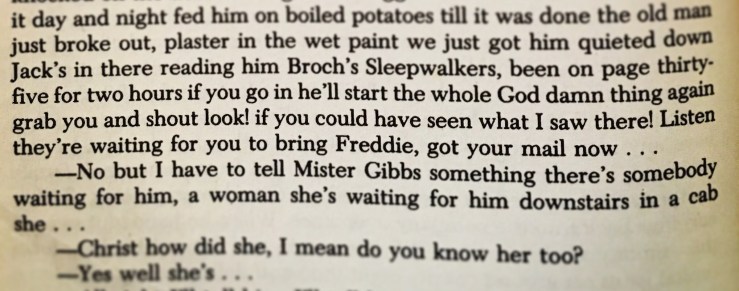
From page 724 (of 726) of my Penguin edition of William Gaddis’s novel J R. I shall endeavor to answer my own question—what happens on page 35 of Hermann Broch’s novel The Sleepwalkers?
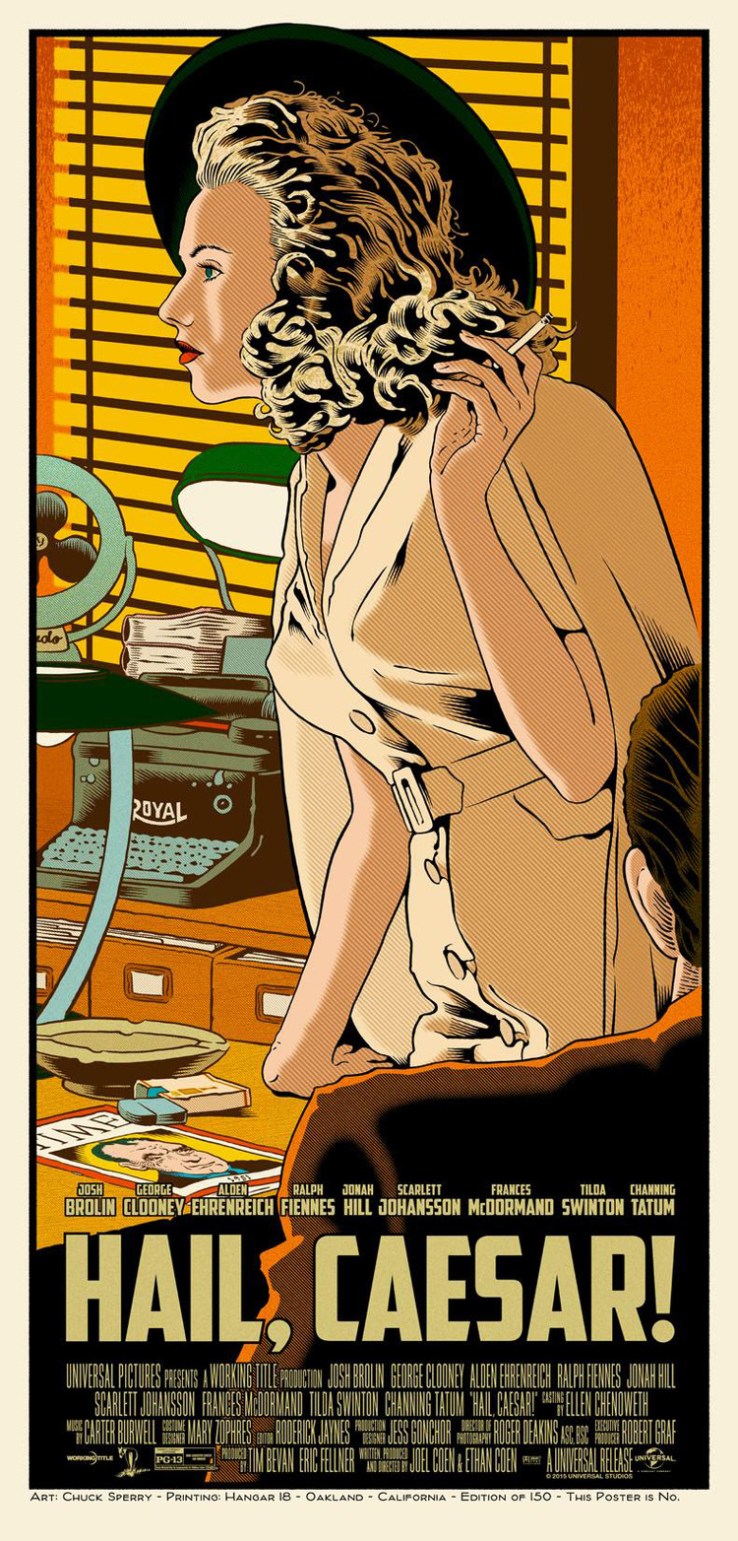
Hail, Caesar! film poster by Chuck SperryIn her cameo in the Coen brothers’ newest film, Hail, Caesar!, Frances McDormand gets her scarf stuck in her editing machine. It nearly chokes her (or, I should write, her character, film editor C.C. Calhoun) before Josh Brolin’s studio head/fixer Eddie Mannix hits “Reverse,” saving her life.
Like so many of the scenes in Hail, Caesar!, the editing scene is funny, well-acted, impeccably filmed, and ultimately superfluous. It’s a throwaway, a wonderful scrap, one of many scraps that the Coens seem to toss to their audience, goading, Hey, you put all of this together.
The McDormand scene is ultimately just another way for the Coens to highlight the artificiality of their medium. Hail, Caesar! is of course a film about film, a film that aims to satirize how the metaphorical sausage is made. As such, Hail, Caesar! is self-satirizing, meta-metaphorical. It’s the Coens pointing out the flawed seams or imperfect varnish before the product is even finished. McDormand’s editor getting caught in the machine is some kind of clumsy synecdoche then.
These metatextual gestures only helped to heighten my own awareness of Hail, Caesar’s! flawed seams. This is a film brimming with wonderful, energetic set pieces—synchronized swimming with Scarlett Johannsson! — Channing Tatum tap-dancing on a bar! — Alden Ehrenreich (not so famous, yet) stunting on horses!—that add up to almost nothing. The end result would almost be fascinating were it not so dull.
Alden Ehrenreich’s singing cowboy Hobie Doyle is not dull, and every time he’s on the screen Hail, Caesar! threatens to become interesting. “Called up” to be in more, eh, prestigious fare than the cowboy pictures he’s been doing so well in, young Hobie’s plot has the slightest (just the slightest) tinge of Mulholland Drive — “This is the girl.” (Or, eh, “This is the boy. The cowboy”).
Hail, Caesar! can’t commit fully to Hobie for its hero, alas. Instead the film, after an initial bout of goodwill-building (including an especially funny early scene in which religious leaders are invited to critique Hail, Caesar!, the film-within-a-film here)—instead the film (the Coens’ Hail, Casear!, that is) plods along a few not-quite-intersecting tracks, introducing the occasional grotesque for a cameo that serves no real plot point.
Look, I get it. Having a character’s fate expositioned away via clumsy dialogue at the end of the film is like, meta, right? It’s the Coens way of grinning at the corny clumsy past of their chosen medium, hey? It’s like, purposefully, self-reflexively bad, a piss-take on an audience’s willed suspension of disbelief, hm?
Suspension of disbelief—faith. Does Hail, Caser! aim to take on faith? It certainly dabbles, exploring (“exploring” is not the right verb—but I already used “dabbles”) political faith, economic faith, religious faith. Faith in the aesthetic power of film, which again and again Hail, Caesar! attempts to embody via kinetic spectacle before puncturing said aesthetic transcendence with ironc winking (or technical failure).
The signal moment in the film’s ironic treatment of faith is delivered in its penultimate scene. George Clooney’s character Baird Whitlock’s character (a Roman soldier whose name I can’t recall, but, hey, note the layering, man) deilvers a monologue. The speech is meant to be this kinda sorta Road-to-Damascus epiphanic transcendence deaile, and the aesthetic power of Clooney’s Whitlock’s delivery is confirmed internally on set by the various film people (grips and script folk, etc.) offering up admiring Brady nods—only Whitlock stumbles over the last word of the speech—which last word, of course, was faith. Charlie Kaufman did the same thing much better in the funeral monologue near the end of his film Synecdoche, New York. In Hail, Caesar!, the moment feels like a glib trick played on the audience
It’s entirely likely that there’s a much finer design to Hail, Caesar! than I’ve credited the Coens here. Maybe on a second viewing, I won’t be bogged down so hard looking for a thread to follow. (Shagginess is hardly a sin though, yes Lebowski?). And I’ve failed to point out some of the fine performances here—Josh Brolin anchors the film admirably (although half the time he was on the screen, I kept hoping the film would turn into Inherent Vice). Hail, Caesar! has plenty of great moments, and those moments, like I said, might cohere into something sharper upon a second screening. But right now there’s nothing that compels me toward a second screening any time soon.






 Biblioklept