Falling from favor, or grace, some high artifice, down he dropped like a discredited predicate through what he called space (sometimes he called it time) and with an earsplitting crack splattered the base earth with his vital attributes. Oh, I’ve had a great fall, he thought as he lay there, numb with terror, trying desperately to pull himself together again. This time (or space) I’ve really done it! He had fallen before of course: short of expectations, into bad habits, out with his friends, upon evil days, foul of the law, in and out of love, down in the dumps—indeed, as though egged on by some malevolent metaphor generated by his own condition, he had always been falling, had he not?—but this was the most terrible fall of all. It was like the very fall of pride, of stars, of Babylon, of cradles and curtains and angels and rain, like the dread fall of silence, of sparrows, like the fall of doom.
The Sweet Assassin — Mike Worrall

Disks of Newton, Study for Fugue in Two Colors — Frantisek Kupka

Jim O’Rourke’s Simple Songs
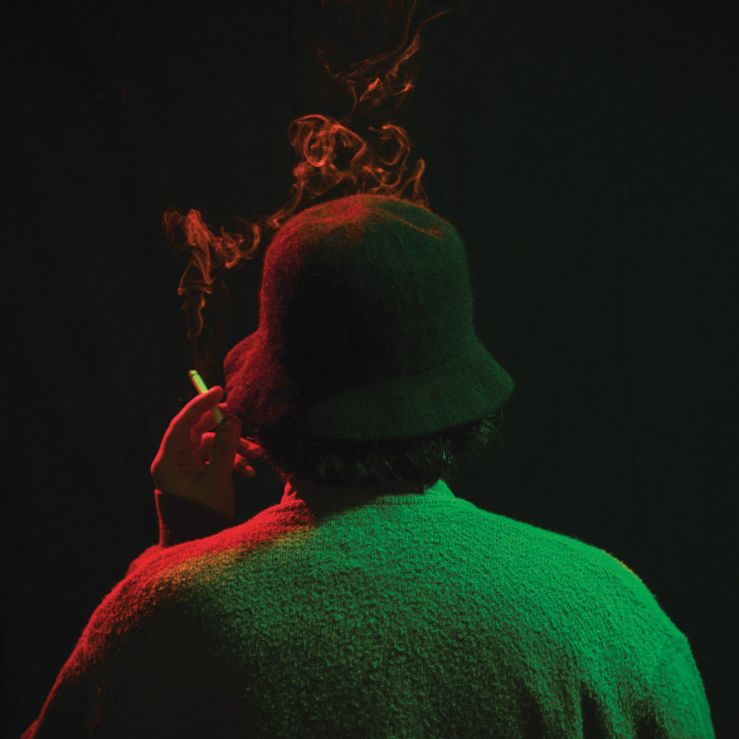
In the last minute of “Hotel Blue,” the fourth track on his new LP Simple Songs, Jim O’Rourke belts out his lines with an emotional directness we haven’t heard in his work before. He sings, and sings with a sincere presence and confidence perhaps previously absent from his fine work. The song builds from a few strums of acoustic guitar into a crescendo worthy of Harry Nilsson.
Like Nilsson (or Nilsson’s hero Randy Newman), O’Rourke’s work is saturated in a dark humor that’s perhaps easy to ignore because his music sounds so pretty. Simple Song’s first track “Friends with Benefits” reveals that welcoming-repulsing impetus in its opening lines: “Nice to see you once again / Been a long time, my friend / since you’ve crossed my mind at all.”
The initial moments of “Friends with Benefits” feel like an overture, unfurling in little episodes that recall O’Rourke’s 2009 suite The Visitor. The track eventually coalesces and climaxes in Terry Riley violin strokes, reverberating, decisive guitar lines, and stomping drums.
These musical elements continue throughout the album, which is often driven by piano riffs cribbed from all your favorite ’70s groups. Standout track “Half Life Crisis” bounces along in a Steely Dan strut, punctuated by Brian May guitar squiggles. Dissonant orchestral touches creep into the song’s final moments, recalling some of O’Rourke’s more “experimental” work—but also calling back to The Beatles.
Simple Songs feels like the culmination 0f some of O’Rourke’s projects over the past decade, and it made me revisit them. The Visitor sounds almost like a sketchbook for this record,and All Kinds of People, the record of Burt Bacharach songs O’Rourke recorded with various vocalists, feels in retrospect like a practice run at a personal pop record. Simple Songs builds on O’Rourke’s previous two “pop” records (Eureka and Insignificance), and even though it’s not named after a Nic Roeg film, it completes a trilogy of sorts. (But I hope this is more than a trilogy, to be clear).
The emotional intensity promised in “Hotel Blue” returns in the album’s closing tracks. “End of the Road” sees O’Rourke singing—not just talk-singing, but really singing—over McCartney piano and strings. “If you were at sea / They’d throw you overboard,” our misanthrope suggests. And in the final rousing track “All Your Love,” O’Rourke sings, “I’m so happy now / And I blame you,” before promising that “All your love / Will never change me.”
I’m not very good at writing about music, and really, writing is no substitute for listening. You can stream the album now at NPR—just do it over a real sound system or at least with some proper headphones. It sounds too good for your laptop’s tinny little noise holes.
Simple Songs is out on vinyl, etc., from Drag City next week.
Scupstoel — Rogier van der Weyden

Portrait of Lucian Freud — Francis Bacon
Glossary of Hobo Terms
GLOSSARY OF HOBO TERMS
(from Nels Anderson’s The Milk and Honey Route)
This list of words and phrases is in no sense complete. Nor is it solely hobo slang. Many terms began in Hobohemia and were taken up in time by other groups. Other terms are found among both hobo and other groups, but in each case with a different meaning. Indeed, you will find a hobo term with one meaning on the Pacific and another on the Atlantic Seaboard, and still another in the Southland. In this book I have made no strained effort to use much of this freightyard folklore. This is opposite to the practice of many contemporary hobo writers. They think by the use of slang to add a bona fide touch to the fiction they weave. I am including this glossary largely for the information of those of you who may be interested, and for reference if you want to test some of the “authorities” in this field.
Accommodation – A local freight train. It may carry passengers.
Adam and Eve on a raft – Two fried eggs on toast. “Wreck ’em” if they are scrambled. “With their eyes open,” if not.
Alligator bait – Fried or stewed liver. Too costly now for hobos.
Anchor – A pick. Companion tool of the shovel or banjo.
Angel – A person who gives more than you expect. One who takes an interest without trying to reform you.
Angel food – Mission preaching about the Bread of Life.
Angelina – Punk or road kid acting as a hobo’s companion.
A-No-1 – A famous tramp who writes his name “on everything like J. B. King.” He writes books about his alleged adventures. Many young hobos write this monicker on water tanks, and chalk it on box cars.
Auntie – Angelina grown older.
Axle grease – Butter. Sometimes called plaster.
Baldy – Generally an old man “with a high forehead”.
Balloon – A roll of bedding carried on the back; a bindle.
Barnacle – A fellow who sticks to one job a year or more.
Banjo – A short-handled shovel. Continue reading “Glossary of Hobo Terms”
A deleted scene from Inherent Vice
The Mérode Altarpiece — Robert Campin

A Coffee Chronology
A COFFEE CHRONOLOGY
Giving dates and events of historical interest in legend, travel, literature, cultivation, plantation treatment, trading, and in the preparation and use of coffee from the earliest time to the present
900[L]—Rhazes, famous Arabian physician, is first writer to mention coffee under the name bunca or bunchum.[M]
1000[L]—Avicenna, Mahommedan physician and philosopher, is the first writer to explain the medicinal properties of the coffee bean, which he also calls bunchum.[M]
1258[L]—Sheik Omar, disciple of Sheik Schadheli, patron saint and legendary founder of Mocha, by chance discovers coffee as a beverage at Ousab in Arabia.[M]
1300[L]—The coffee drink is a decoction made from roasted berries, crushed in a mortar and pestle, the powder being placed in boiling water, and the drink taken down, grounds and all.
1350[L]—Persian, Egyptian, and Turkish ewers made of pottery are first used for serving coffee.
1400–1500—Earthenware or metal coffee-roasting plates with small holes, rounded and shaped like a skimmer, come into use in Turkey and Persia over braziers. Also about this time appears the familiar Turkish cylinder coffee mill, and the original Turkish coffee boiler of metal.
1428–48—Spice grinder to stand on four legs first invented; subsequently used to grind coffee.
1454[L]—Sheik Gemaleddin, mufti of Aden, having discovered the virtues of the berry on a journey to Abyssinia, sanctions the use of coffee in Arabia Felix.
1470–1500—The use of coffee spreads to Mecca and Medina.
1500–1600—Shallow iron dippers with long handles and small foot-rests come into use in Bagdad and in Mesopotamia for roasting coffee.
1505[L]—The Arabs introduce the coffee plant into Ceylon.
1510—The coffee drink is introduced into Cairo.
1511—Kair Bey, governor of Mecca, after consultation with a council of lawyers, physicians, and leading citizens, issues a condemnation of coffee, and prohibits the use of the drink. Prohibition subsequently ordered revoked by the sultan of Cairo.
1517—Sultan Selim I, after conquering Egypt, brings coffee to Constantinople.
1524—The kadi of Mecca closes the public coffee houses because of disorders, but permits coffee drinking at home and in private. His successor allows them to re-open under license.
1530[L]—Coffee drinking introduced into Damascus.
1532[L]—Coffee drinking introduced into Aleppo.
1534—A religious fanatic denounces coffee in Cairo and leads a mob against the coffee houses, many of which are wrecked. The city is divided into two parties, for and against coffee; but the chief judge, after consultation with the doctors, causes coffee to be served to the meeting, drinks some himself, and thus settles the controversy.
Leviathan — Bo Bartlett
“All Things Decay and Die” — Robert Herrick

The Fall — Hugo van der Goes

Critical Mass (Gravity’s Rainbow)
“I think that there is a terrible possibility now, in the World. We may not brush it away, we must look at it. It is possible that They will not die. That it is now within the state of Their art to go on forever—though we, of course, will keep dying as we always have. Death has been the source of Their power. It was easy enough for us to see that. If we are here once, only once, then clearly we are here to take what we can while we may. If They have taken much more, and taken not only from Earth but also from us—well, why begrudge Them, when they’re just as doomed to die as we are? All in the same boat, all under the same shadow… yes… yes. But is that really true? Or is it the best, and the most carefully propagated, of all Their lies, known and unknown?
“We have to carry on under the possibility that we die only because They want us to: because They need our terror for Their survival. We are their harvests… .
“It must change radically the nature of our faith. To ask that we keep faith in Their mortality, faith that They also cry, and have fear, and feel pain, faith They are only pretending Death is Their servant—faith in Death as the master of us all—is to ask for an order of courage that I know is beyond my own humanity, though I cannot speak for others… . But rather than make that leap of faith, perhaps we will choose instead to turn, to fight: to demand, from those for whom we die, our own immortality. They may not be dying in bed any more, but maybe They can still die from violence. If not, at least we can learn to withhold from Them our fear of Death. For every kind of vampire, there is a kind of cross. And at least the physical things They have taken, from”“Earth and from us, can be dismantled, demolished—returned to where it all came from.
“To believe that each of Them will personally die is also to believe that Their system will die—that some chance of renewal, some dialectic, is still operating in History. To affirm Their mortality is to affirm Return. I have been pointing out certain obstacles in the way of affirming Return…”
From pages 539-40 of Thomas Pynchon’s novel Gravity’s Rainbow.
The sermon is from a Jesuit, one Father Rapier, and takes place in one of GR’s stranger episodes (which is really saying something, that adjective there). Before the sermon—a “Critical Mass,” our narrator takes unusual pains to make sure that we get it, that we understand that the Jesuit is here to preach “against return. Here to say that critical mass cannot be ignored. Once the technical means of control have reached a certain size, a certain degree of being connected one to another, the chances for freedom are over for good.”
Compare the Jesuit’s notation of “once, only once” to the passage on pages 412-13 on Kekulé, the snake that eats its own tale: “…a quote from Rilke: ‘Once, only once…’ One of Their favorite slogans. No return, no salvation, no Cycle—”. The sermon also echoes the They/We riff on page 521.
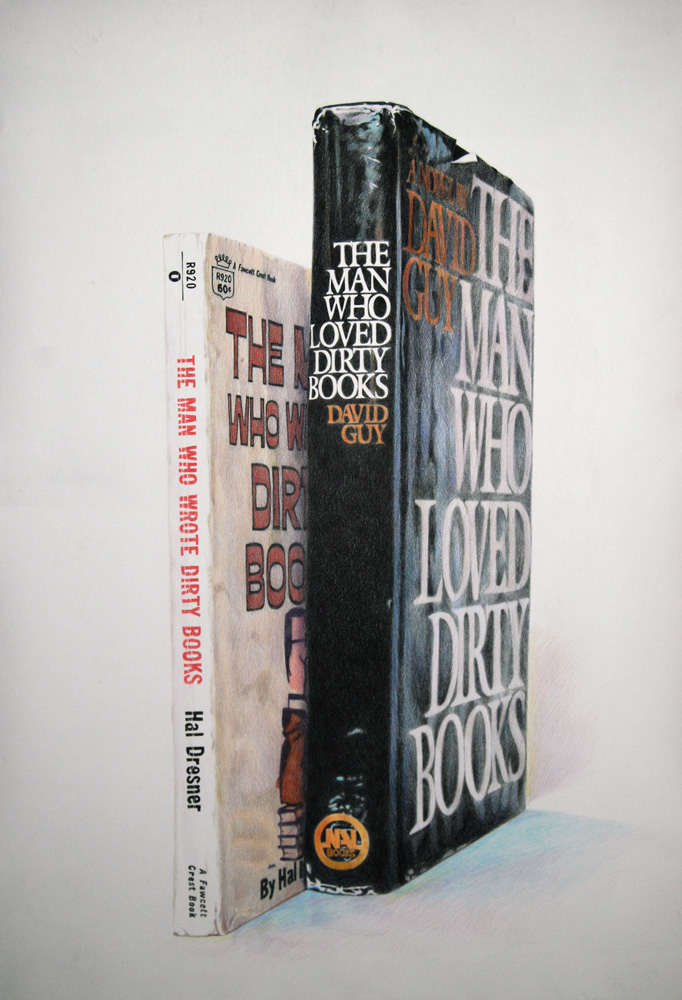
A Dirty Pair — Eric Yahnker
May 11, 1838 entry from Nathaniel Hawthorne’s Note-Books
May 11, 1838.–At Boston last week. Items:–A young man, with a small mustache, dyed brown, reddish from its original light color. He walks with an affected gait, his arms crooked outwards, treading much on his toes. His conversation is about the theatre, where he has a season ticket,–about an amateur who lately appeared there, and about actresses, with other theatrical scandal.–In the smoking-room, two checker and backgammon boards; the landlord a great player, seemingly a stupid man, but with considerable shrewdness and knowledge of the world.– F—-, the comedian, a stout, heavy-looking Englishman, of grave deportment, with no signs of wit or humor, yet aiming at both in conversation, in order to support his character. Very steady and regular in his life, and parsimonious in his disposition,–worth $50,000, made by his profession.–A clergyman, elderly, with a white neck-cloth, very unbecoming, an unworldly manner, unacquaintance with the customs of the house, and learning them in a childlike way. A ruffle to his shirt, crimped.–A gentleman, young, handsome, and sea-flushed, belonging to Oswego, New York, but just arrived in port from the Mediterranean: he inquires of me about the troubles in Canada, which were first beginning to make a noise when he left the country,–whether they are all over. I tell him all is finished, except the hanging of the prisoners. Then we talk over the matter, and I tell him the fates of the principal men,–some banished to New South Wales, one hanged, others in prison, others, conspicuous at first, now almost forgotten.–Apartments of private families in the hotel,–what sort of domesticity there may be in them; eating in public, with no board of their own. The gas that lights the rest of the house lights them also, in the chandelier from the ceiling.–A shabby-looking man, quiet, with spectacles, at first wearing an old, coarse brown frock, then appearing in a suit of elderly black, saying nothing unless spoken to, but talking intelligently when addressed. He is an editor, and I suppose printer, of a country paper. Among the guests, he holds intercourse with gentlemen of much more respectable appearance than himself, from the same part of the country.–Bill of fare; wines printed on the back, but nobody calls for a bottle. Chairs turned down for expected guests. Three-pronged steel forks. Cold supper from nine to eleven P.M. Great, round, mahogany table, in the sitting-room, covered with papers. In the morning, before and soon after breakfast, gentlemen reading the morning papers, while others wait for their chance, or try to pick out something from the papers of yesterday or longer ago. In the forenoon, the Southern papers are brought in, and thrown damp and folded on the table. The eagerness with which those who happen to be in the room start up and make prize of them. Play-bills, printed on yellow paper, laid upon the table. Towards evening comes the “Transcript.”
Mother and Child — Egon Schiele

 Biblioklept