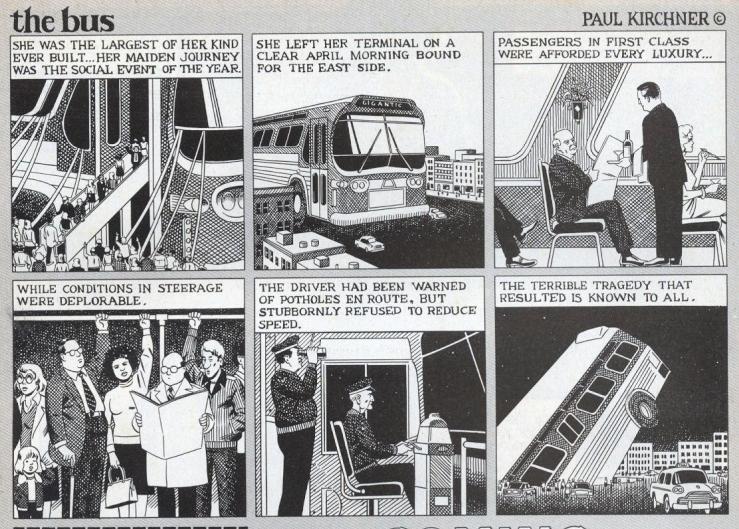
Kekulé dreams the Great Serpent holding its own tail in its mouth, the dreaming Serpent which surrounds the World. But the meanness, the cynicism with which this dream is to be used. The Serpent that announces, “The World is a closed thing, cyclical, resonant, eternally-returning,” is to be delivered into a system whose only aim is to violate the Cycle. Taking and not giving back, demanding that “productivity” and “earnings” keep on increasing with time, the System removing from the rest of the World these vast quantities of energy to keep its own tiny desperate fraction showing a profit: and not only most of humanity—most of the World, animal, vegetable and mineral, is laid waste in the process. The System may or may not understand that it’s only buying time. And that time is an artificial resource to begin with, of no value to anyone or anything but the System, which sooner or later must crash to its death, when its addiction to energy has become more than the rest of the World can supply, dragging with it innocent souls all along the chain of life. Living inside the System is like riding across the country in a bus driven by a maniac bent on suicide… though he’s amiable enough, keeps cracking jokes back through the loudspeaker, “Good morning folks, this is Heidelberg here we’re coming into now, you know the old refrain, ‘I lost my heart in Heidelberg,’ well I have a friend who lost both his ears here! Don’t get me wrong, it’s really a nice town, the people are warm and wonderful—when they’re not dueling. Seriously though, they treat you just fine, they don’t just give you the key to the city, they give you the bung-starter!” u.s.w. On you roll, across a countryside whose light is forever changing—castles, heaps of rock, moons of different shapes and colors come and go. There are stops at odd hours of the mornings, for reasons that are not announced: you get out to stretch in lime-lit courtyards where the old men sit around the table under enormous eucalyptus trees you can smell in the night, shuffling the ancient decks oily and worn, throwing down swords and cups and trumps major in the tremor of light while behind them the bus is idling, waiting—passengers will now reclaim their seats and much as you’d like to stay, right here, learn the game, find your old age around this quiet table, it’s no use: he is waiting beside the door of the bus in his pressed uniform, Lord of the Night he is checking your tickets, your ID and travel papers, and it’s the wands of enterprise that dominate tonight… as he nods you by, you catch a glimpse of his face, his insane, committed eyes, and you remember then, for a terrible few heartbeats, that of course it will end for you all in blood, in shock, without dignity—but there is meanwhile this trip to be on… over your own seat, where there ought to be an advertising plaque, is instead a quote from Rilke: “Once, only once…” One of Their favorite slogans. No return, no salvation, no Cycle—that’s not what They, nor Their brilliant employee Kekulé, have taken the Serpent to mean. No: what the Serpent means is—how’s this—that the six carbon atoms of benzene are in fact curled around into a closed ring, just like that snake with its tail in its mouth, GET IT?
From pages 412-13 of Thomas Pynchon’s novel Gravity’s Rainbow.
A couple of days ago I posted a brief excerpt from Jules Siegel’s March 1977 Playboy profile “Who is Thomas Pynchon… And Why Did He Take Off With My Wife?” The excerpt came from an excerpt posted on the Pynchon-L forum, but most of the article had been removed at the (apparent) request by Siegel. Several folks sent me the whole article though (thanks!) and I read it.
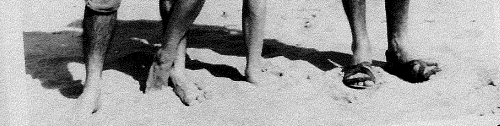
Some of these feet may or may not belong to Thomas Pynchon
Siegel was briefly a Cornell classmate of Pynchon’s in 1954, and they remained friends (in Siegel’s recollection) for at least two decades after. During this time, Siegel claims that Pynchon wrote him dozens of letters, which were ultimately sold at auction (along with much of Siegel’s property) to help pay for a hip replacement. Material from the letters soak into Siegel’s sketch of Pynchon’s progress, along with several stoned/drunken adventures that would not be out of place in V. or Mason & Dixon or Gravity’s Rainbow, or really, any person’s young life.
A competitive anxiety reverberates under the piece. “We were friends, maybe at some points best friends, very much alike in some important ways,” Siegel writes. “We were both writers,” he boldly writes. Siegel reminds us that “In Mortality and Mercy in Vienna, Pynchon’s first published short story, the protagonist is one Cleanth Siegel,” but protests he doesn’t see himself in that hero.
The competitive anxieties culminate in the big reveal that (spoiler!) Thomas Pynchon had an affair with Siegel’s second wife Chrissie. There’s probably a Freudian reading we can append to the details that Siegel offers about Pynchon’s sexual prowess: “He was a wonderful lover, sensitive and quick, with the ability to project a mood that turned the most ordinary surroundings into a scene out of a masterful film—the reeking industrial slum of Manhattan Beach would become as seen through the eye of Antonioni, for example.”
Or maybe these unsexy details are just a sign of Playboy’s editorial hand. Wedged gracelessly between ads for vibrators and nude greeting cards, Siegel’s lines often reek of 1970’s Playboy’s rhetorical house style, a kind of frank-but-(attempted)-sensual glossiness that contrasts heavily with Pynchon’s own sex writing. At times I found myself reading Siegel’s prose in one of Will Ferrell’s more pompous accents.
Even worse is the casual sexism of the piece—which again, may be attributable to Playboy’s editors. Siegel, on his first wife (sixteen when he married her): “She was so wonderful a lover, generous and easily aroused, but I was too callow then to appreciate her.” Of his second wife: “It is easy to underestimate her intelligence, but it is a mistake. She is obviously too pretty to be serious, conventional wisdom would have you believe.” Of one of Pynchon’s girlfriends: “Susan has red hair and is breathtakingly beautiful, with the voluptuous body of a showgirl. Like Chrissie, she is much brighter than she looks.”
More interesting, obviously, are the (supposedly) real-life details that inform Pynchon’s fiction. Siegel notes some of the contents of Pynchon’s Manhattan Beach apartment: “A built-in bookcase had rows of piggy banks on each shelf and there was a collection of books and magazines about pigs.” Pigs, of course, are a major motif of Gravity’s Rainbow. Another detail that seems to connect to GR: “On the desk, there was a rudimentary rocket made from one of those pencil-like erasers with coiled paper wrappers that you unzip to expose the rubber. It stood on a base twisted out of a paper clip.” Siegel lets us know that he knocked the rocket down. Pynchon puts it back together; Siegel knocks it down again.
(Parenthetically: Siegel’s evocation of Pynchon’s Manhattan Beach days fits neatly into my picture of Inherent Vice).
In accounting details of Pynchon’s alleged affair with his wife, Chrissie, Siegel shares the following:
Once, out on the freeway, she told him that we had all gone naked at the commune, he professed to find that incredible and dared her to take off her blouse right there. She did. A passing truck hooted its horn in lewd applause. He loved her Shirley Temple impersonations—On the Good Ship Lollipop sung and danced like a kid at a birthday party. They talked about running away together.
It is hardly possible here not to recall the episode early in Gravity’s Rainbow wherein Jessica Swanlake removes her blouse in the car on a dare from Roger Mexico. Is Siegel daring the reader to extrapolate further? Extrapolation, paranoid connections—isn’t this part of Pynchonian fun?
In that spirit, I’ll close with my favorite moment from the article.
“You know the W.A.S.T.E. horn in The Crying of Lot 49? The symbol of the secret message service? Every weirdo in the world is on my wave length. You cannot understand the kind of letters I get. Someone wrote to tell me that the very same horn was the symbol of a private mail system in medieval times. I checked it out at the library. It’s true. But I made it up myself before the book was ever published, before I ever got that letter.”
The lines are supposedly from Pynchon himself. Siegel even puts them in quotation marks—so they must be real, right?
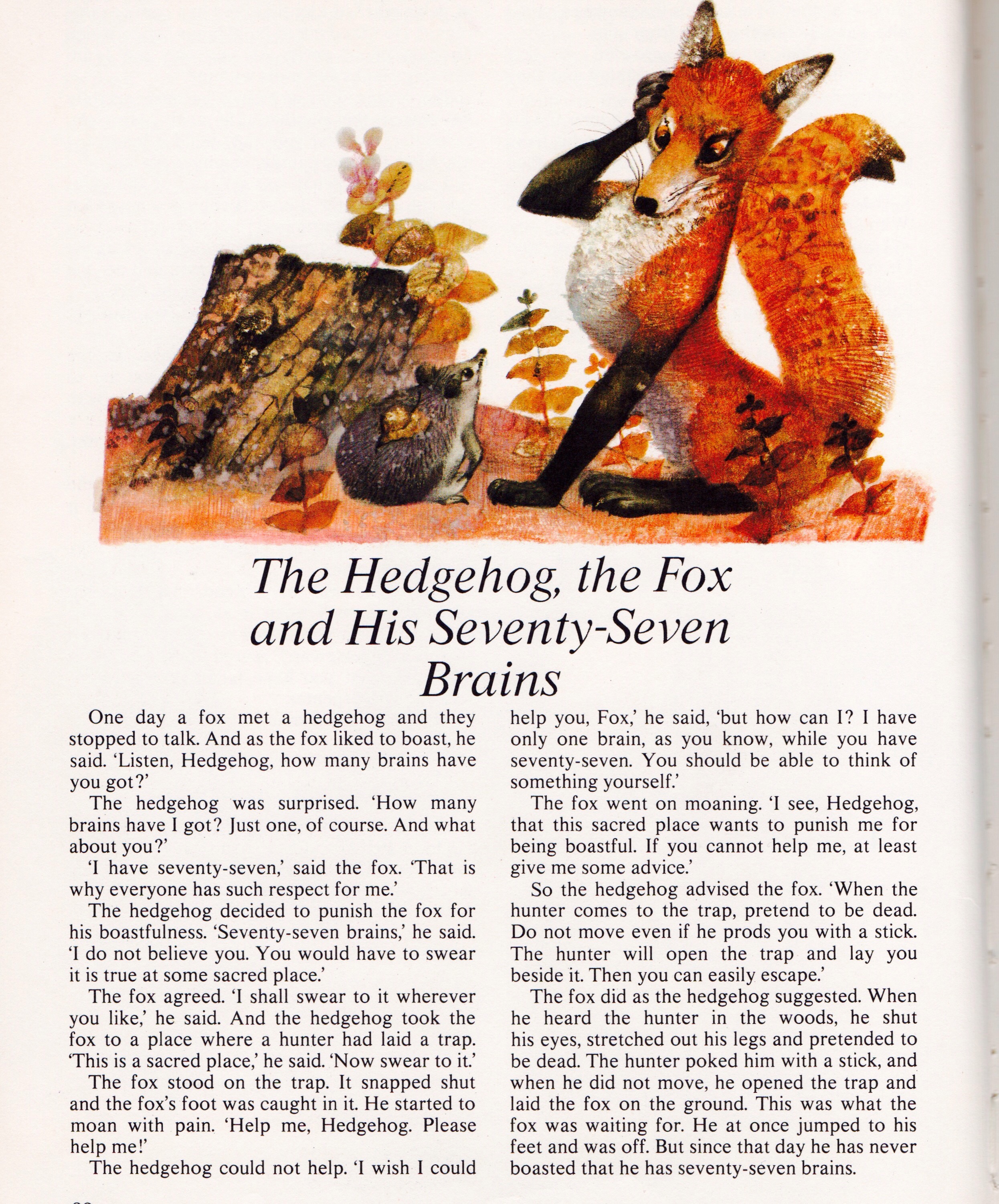
A Serbian fairy tale retold by Alena Benesova and translated into English by Ruth Shepherd. The marvelous illustration is by Karel Franta. From Animal Fairy Stories.
At the beginning of the last year of his life, he fell into a custom of taking, immediately after dinner, a cup of coffee, especially on those days when it happened that I was of his party. And such was the importance that he attached to his little pleasure that he would even make a memorandum beforehand, in the blank paper book that I had given him, that on the next day I was to dine with him, and consequently “that there was to be coffee.” Sometimes in the interest of conversation, the coffee was forgotten, but not for long. He would remember and with the querulousness of old age and infirm health would demand that coffee be brought “upon the spot.” Arrangements had always been made in advance, however; the coffee was ground, and the water was boiling: and in the very moment the word was given, the servant shot in like an arrow and plunged the coffee into the water. All that remained, therefore, was to give it time to boil up. But this trifling delay seemed unendurable to Kant. If it were said, “Dear Professor, the coffee will be brought up in a moment,” he would say, “Will be! There’s the rub, that it only will be.” Then he would quiet himself with a stoical air, and say, “Well, one can die after all; it is but dying; and in the next world, thank God, there is no drinking of coffee and consequently no waiting for it.”
When at length the servant’s steps were heard upon the stairs, he would turn round to us, and joyfully call out: “Land, land! my dear friends, I see land.”
This anecdote of Thomas de Quincey’s is from William H. Ukers’s All About Coffee (1922). Ukers introduces the quote: “In his old age, Immanuel Kant, the great metaphysician, became extremely fond of coffee; and Thomas de Quincey relates a little incident showing Kant’s great eagerness for the after-dinner cup.”









 Biblioklept