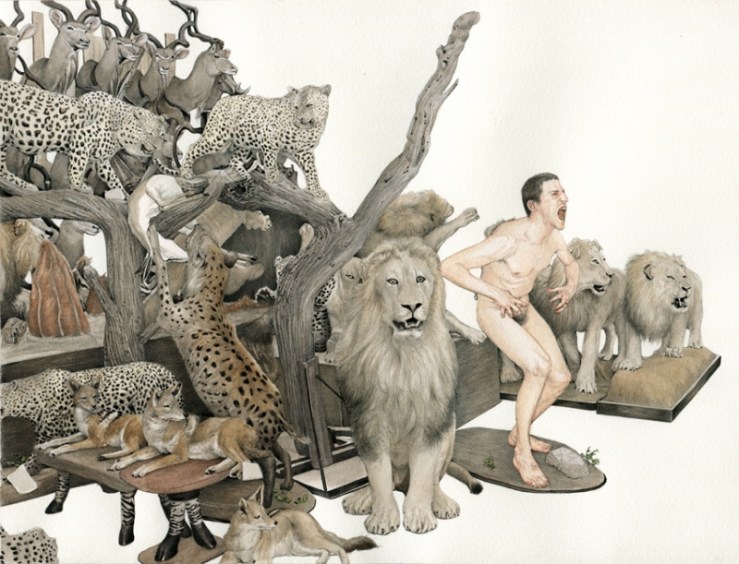
Histoire Naturelle — Fabien Mérelle

221

“All art constantly aspires towards the condition of music”

“Spotted Horses,” A Short Story by William Faulkner

“Spotted Horses”

by

William Faulkner

I

A little while before sundown the men lounging about the gallery of the store saw, coming up the road from the south, a covered wagon drawn by mules and followed by a considerable string of obviously alive objects which in the levelling sun resembled vari-sized and -colored tatters torn at random from large billboards-circus posters, say -attached to the rear of the wagon and inherent with its own separate and collective motion, like the tail of a kite.
“What in the hell is that?” one said.

“It’s a circus,” Quick said. They began to rise, watching the wagon. Now they could see that the animals behind the wagon were horses. Two men rode in the wagon.

“Hell fire,” the first man – his name was Freeman – said “It’s Flem Snopes.’ They were all standing when the wagon came up and stopped and Snopes got down and approached the steps. He might have departed only this morning. He wore the same cloth cap, the minute bow tie against the white shirt, the same gray trousers. He mounted the steps. Continue reading ““Spotted Horses,” A Short Story by William Faulkner”

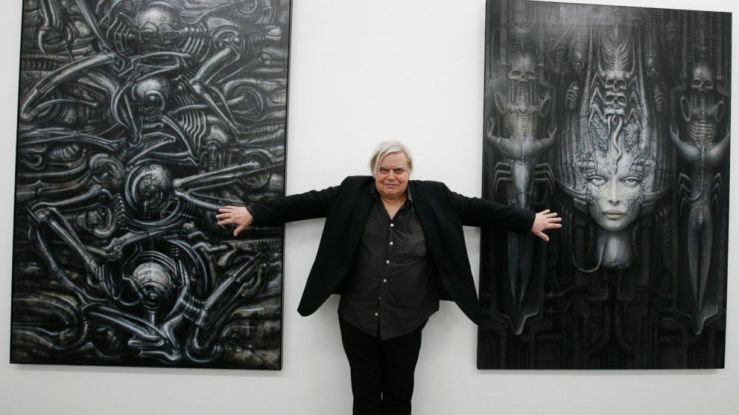
RIP H.R. Giger

AP_Giger_140513_DG_16x9_992

RIP H.R. Giger, 1940-2014

Continue reading “RIP H.R. Giger”

Hermit Saints Triptych (Right Panel) — Hieronymus Bosch

Three Ages of Man and Three Graces — Hans Baldung

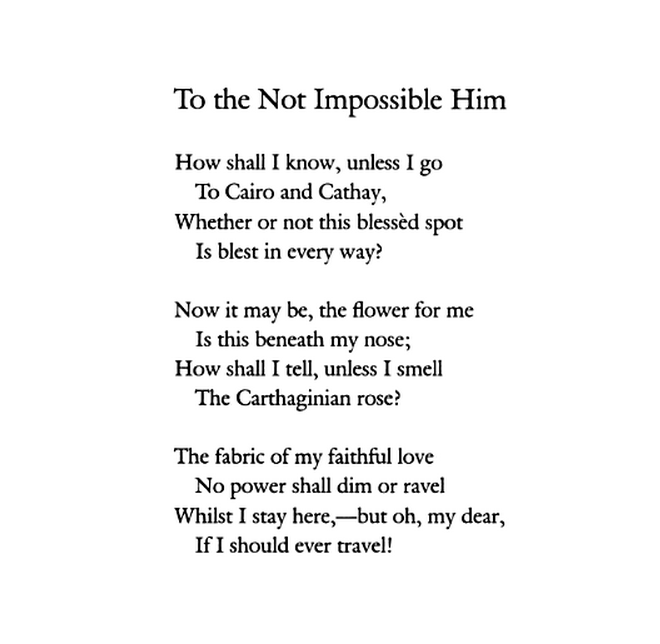
“To the Not Impossible Him” — Edna St. Vincent Millay

him

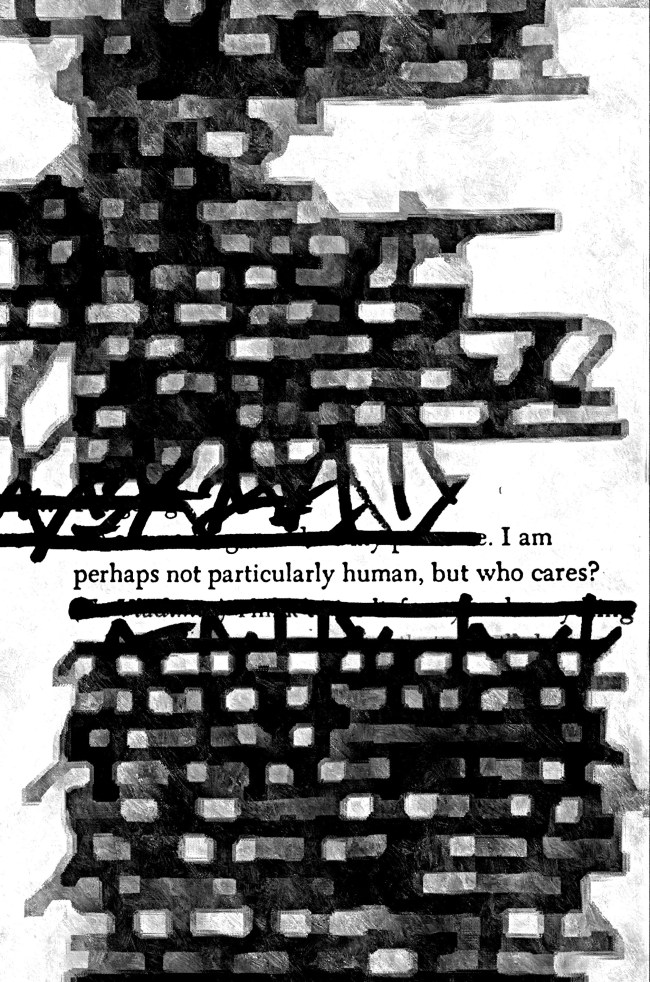
Alienated — Atelier Olschinsky

alienated

I am perhaps not particularly human, but who cares?

20140512-142520.jpg


To put it aphoristically, a human skeleton is not human (William T. Vollmann)

And now, a note for those of you who consider this a vulgarly supernatural tale: It may well be that ambitious people of any stripe find themselves compelled to schematize the subjects of their solicitude into, say, Jews to be liquidated, or Jews to be saved. There might not be might not be time to learn the name of every Esther or Isaac who falls within Operation Reinhard’s purview. And the further those subjects (I mean objects) get altered in accordance with the purpose, the more problematic it becomes to perceive their irrelevantly human qualities. I quote the testimony of Michal Chilczuk, Polish People’s Army (he’d participated in the liberation of Sachsenhausen): But what I saw were people I call humans, but it was difficult to grasp that they were humans. What did Chilczuk mean by this? To put it aphoristically, a human skeleton is not human. It frightens us because it proves the truth of that gravestone epitaph so common in the age of Holbein: What I once was, so you are. What I am now, so you will be. The gaze of those dark, sharp-edged eye-sockets seems implacable, and the many teeth, which haunted Edgar Allan Poe, snarl much too nakedly, bereft of those festive pink ribbons of flesh we call “lips,” whose convolutions and involutions can express mirth, friendliness, even tenderness. A human skull’s smile is as menacing as a crocodile’s. Since death itself is nothing, the best our minds can do to represent it is through that expressionless face of bone which one day will be ours, and to which we cannot help imparting an expression. Under such circumstances, how can that expression be reassuring?

From William T. Vollmann’s novel Europe Central.

Schadenfreude, pity, envy (Schopenhauer)

But it is Schadenfreude, a mischievous delight in the misfortunes of others, which remains the worst trait in human nature. It is a feeling which is closely akin to cruelty, and differs from it, to say the truth, only as theory from practice. In general, it may be said of it that it takes the place which pity ought to take—pity which is its opposite, and the true source of all real justice and charity.

Envy is also opposed to pity, but in another sense; envy, that is to say, is produced by a cause directly antagonistic to that which produces the delight in mischief. The opposition between pity and envy on the one hand, and pity and the delight in mischief on the other, rests, in the main, on the occasions which call them forth. In the case of envy it is only as a direct effect of the cause which excites it that we feel it at all. That is just the reason why envy, although it is a reprehensible feeling, still admits of some excuse, and is, in general, a very human quality; whereas the delight in mischief is diabolical, and its taunts are the laughter of hell.

From Arthur Schopenhauer’s “On Human Nature.” Translated by T. Bailey Saunders.

Apotheosis of St. Thomas Aquinas — Francisco de Zurbaran

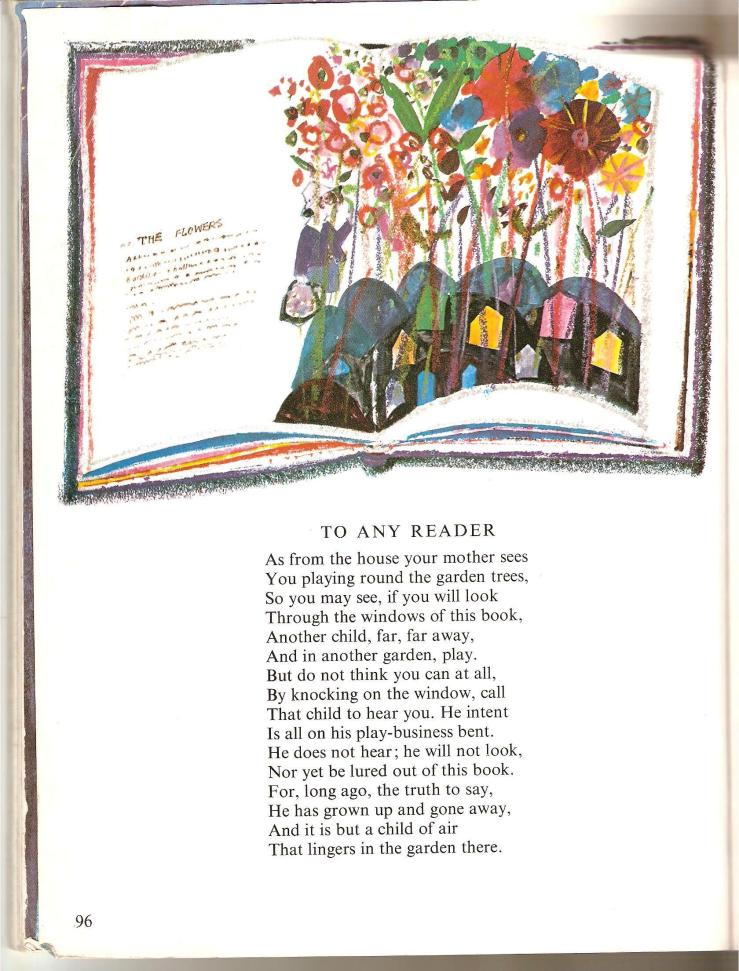
“To Any Reader” — Robert Louis Stevenson

wildsmith

Portrait of the Artist’s Mother

Portrait of the Artist’s Mother — Vincent van Gogh
The Artist’s Mother — Pierre-Auguste Renoir
Portrait of the Artist’s Mother — Camille Pissarro

Continue reading “Portrait of the Artist’s Mother”

“A Mother” — James Joyce

“A Mother”

by

James Joyce

MR HOLOHAN, assistant secretary of the Eire Abu Society, had been walking up and down Dublin for nearly a month, with his hands and pockets full of dirty pieces of paper, arranging about the series of concerts. He had a game leg and for this his friends called him Hoppy Holohan. He walked up and down constantly, stood by the hour at street corners arguing the point and made notes; but in the end it was Mrs. Kearney who arranged everything.

Miss Devlin had become Mrs. Kearney out of spite. She had been educated in a high-class convent, where she had learned French and music. As she was naturally pale and unbending in manner she made few friends at school. When she came to the age of marriage she was sent out to many houses where her playing and ivory manners were much admired. She sat amid the chilly circle of her accomplishments, waiting for some suitor to brave it and offer her a brilliant life. But the young men whom she met were ordinary and she gave them no encouragement, trying to console her romantic desires by eating a great deal of Turkish Delight in secret. However, when she drew near the limit and her friends began to loosen their tongues about her, she silenced them by marrying Mr. Kearney, who was a bootmaker on Ormond Quay.

He was much older than she. His conversation, which was serious, took place at intervals in his great brown beard. After the first year of married life, Mrs. Kearney perceived that such a man would wear better than a romantic person, but she never put her own romantic ideas away. He was sober, thrifty and pious; he went to the altar every first Friday, sometimes with her, oftener by himself. But she never weakened in her religion and was a good wife to him. At some party in a strange house when she lifted her eyebrow ever so slightly he stood up to take his leave and, when his cough troubled him, she put the eider-down quilt over his feet and made a strong rum punch. For his part, he was a model father. By paying a small sum every week into a society, he ensured for both his daughters a dowry of one hundred pounds each when they came to the age of twenty-four. He sent the older daughter, Kathleen, to a good convent, where she learned French and music, and afterward paid her fees at the Academy. Every year in the month of July Mrs. Kearney found occasion to say to some friend:

“My good man is packing us off to Skerries for a few weeks.”

If it was not Skerries it was Howth or Greystones. Continue reading ““A Mother” — James Joyce”