“Physiognomy of a Dog” — Ryan Chang

Frequent Biblioklept contributor Ryan Chang’s new short story, “Physiognomy of a Dog” (about shame and feces and etc.) is up now at Hypothetical. Here’s a taster:

It’s come to my attention that a rumor, of which I am the sole authority to its verity, has been pinging through the halls of our fine institution. He, the normal student, M—, enrolled in a program that would take at least one hundred years to complete—this being the exception, established by the Exceptional Student—supposedly reported to me that were it not for the existence of such an exception his “anxieties and pains” may have been relieved; the dream of graduation in just 99 years would not have evaporated. Red-rashed, he’d said, according to the halls, the normal student rushed a letter to the Advisory, only to be told to consult the framed statement on the wall that details the circumstances of this particular exception; he’d see it on his way to the Advisory, near the door to the infirmary, which often doubles as our morgue.—Before I continue, the Advisory, the governing body pro-tem, now entering its seventh century, having caught wind of this normal student’s experience, would have me preface this with the acknowledgment of said student’s discomforts, and their, let’s say, profound effects.

Read the rest of “Physiognomy of a Dog.”

“The brain may be regarded as a kind of parasite” (Schopenhauer)

The brain may be regarded as a kind of parasite of the organism, a pensioner, as it were, who dwells with the body: and leisure, that is, the time one has for the free enjoyment of one’s consciousness or individuality, is the fruit or produce of the rest of existence, which is in general only labor and effort. But what does most people’s leisure yield?—boredom and dullness; except, of course, when it is occupied with sensual pleasure or folly. How little such leisure is worth may be seen in the way in which it is spent: and, as Ariosto observes, how miserable are the idle hours of ignorant men!—ozio lungo d’uomini ignoranti. Ordinary people think merely how they shall spend their time; a man of any talent tries to use it. The reason why people of limited intellect are apt to be bored is that their intellect is absolutely nothing more than the means by which the motive power of the will is put into force: and whenever there is nothing particular to set the will in motion, it rests, and their intellect takes a holiday, because, equally with the will, it requires something external to bring it into play. The result is an awful stagnation of whatever power a man has—in a word, boredom. To counteract this miserable feeling, men run to trivialities which please for the moment they are taken up, hoping thus to engage the will in order to rouse it to action, and so set the intellect in motion; for it is the latter which has to give effect to these motives of the will. Compared with real and natural motives, these are but as paper money to coin; for their value is only arbitrary—card games and the like, which have been invented for this very purpose. And if there is nothing else to be done, a man will twirl his thumbs or beat the devil’s tattoo; or a cigar may be a welcome substitute for exercising his brains.

From The Wisdom of Life by Arthur Schopenhauer (translation by T. Bailey Saunders).

Reading — Jose Ferraz de Almeida Junior

almeida-jr-reader

An Excerpt From Gerald Murnane’s Barley Patch

After the young man of the upstairs flat had first disclosed his plans for the Black Mass in the building of several storeys, it became the custom on every Friday and Saturday evening for all of the young persons gathered in the upstairs flat, including the young woman who lived there, to spend some or another part of each evening in discussing how they might spend one or another Friday or Saturday evening in the building of several storeys after the young man of the upstairs flat had bought the building and had fitted it out to his liking. The discussions at first were simple. The young man of the upstairs flat owned a copy each of several issues of the American magazine Playboy, which had recently been allowed into Australia after having been previously a prohibited import. All of the persons gathered in the upstairs flat would look at one after another illustration of a bare-breasted young woman from the magazines and would cast votes in order to decide whether or not the young woman should spend some time as a guest in the building of several storeys. The young woman of the upstairs flat was interested in dance and music and would describe some of the items that she would later choreograph, as she put it, for performance by herself and other naked young women during banquets. The chief character tried to amuse the others by reading to them parodies he had composed of prayers from the Mass. In each parody words such as God, angels, and sacrifice were replaced by words such as Lucifer, devils, and farce. However, few of the persons in the flat knew anything about Catholic doctrine and liturgy, and the parodies aroused little interest. The only means that the chief character found for amusing the others in the upstairs flat was his performing a brief mime in which he took the role of a priest first turning from the altar towards his congregation with his head bowed and his eyes closed, then seeming to notice something was amiss, and finally looking aghast. (The chief character never held back from discussing with the other persons in the upstairs flat the details of the banquets and the orgies in the building of several storeys, but he was never able to imagine himself as taking part in an orgy. Whenever the chapel of the building of several storeys appeared as an image in his mind, it was always fitted with a so-called side-chapel, a sort of alcove with a few pews to one side of the altar. If an orgy seemed about to begin, he would slip unnoticed into the front pew of the side-chapel and would there masturbate quietly while he watched the goings-on in the sanctuary.)

Orlando — Sally Potter (Full Film)

“Died” — Ben Marcus

Capture

Flannery O’Connor Sitting Under Her Self-Portrait

flannery

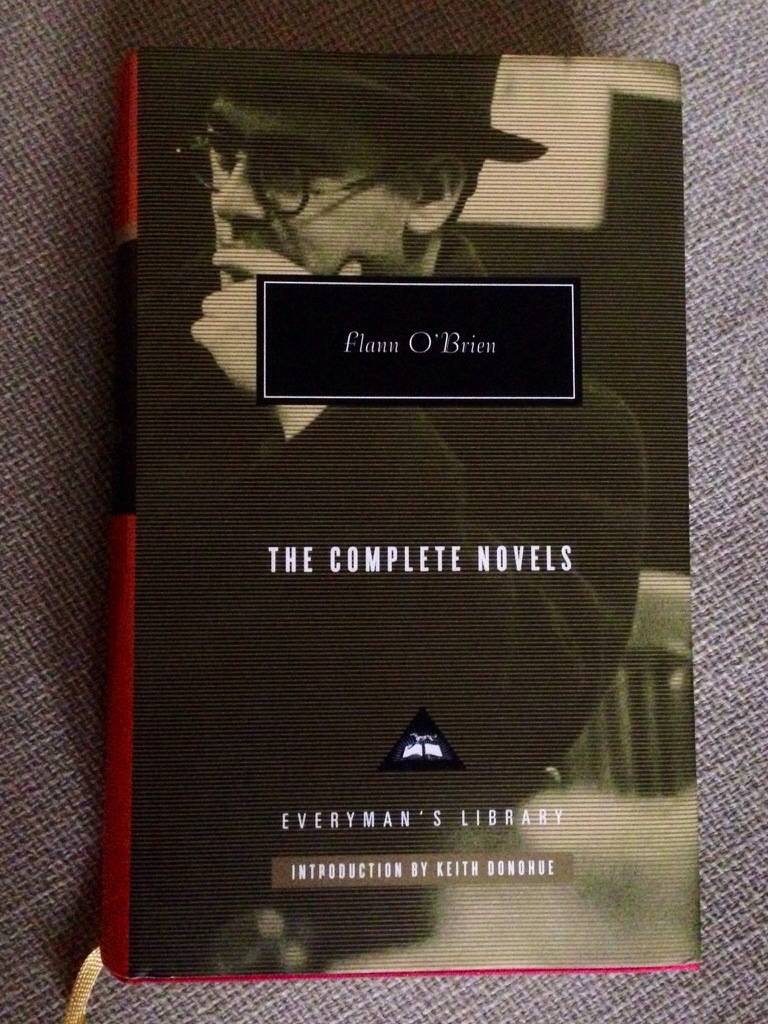
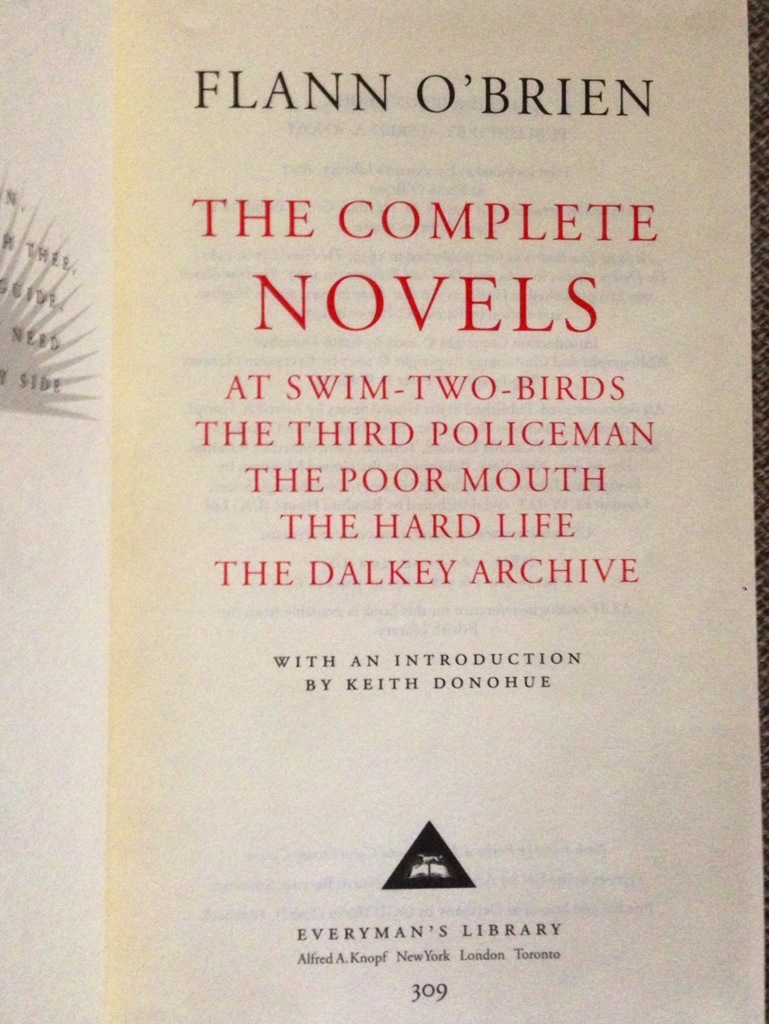
Flann O’Brien’s Complete Novels (Book Acquired, 3.24.2014)

20140324-175658.jpg

20140324-175710.jpg

I was looking for something else when I found Everyman’s edition of The Complete Novels of Flann O’Brien. I gave away The Third Policeman to a friend who has yet to read it; I can also now give away At Swim-Two Birds. (I won’t give away my copy of The Poor Mouth though, which is illustrated by Ralph Steadman).

Kitchen — Walter Burger

A Hermit Praying — Gerrit Dou

“The water’s gonna rise in flame” (Days of Heaven)

Sometimes I think Days of Heaven is my favorite film.

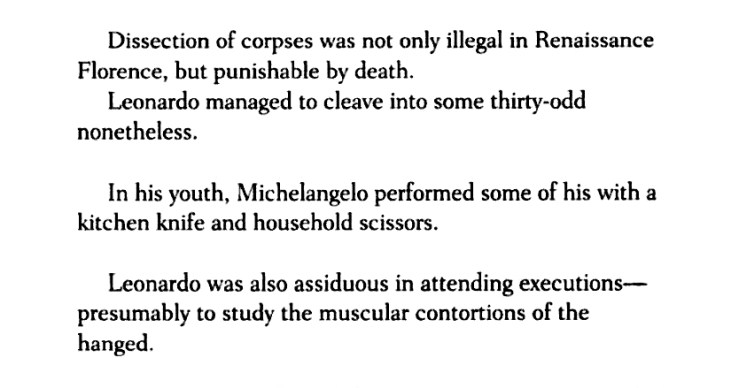
Dissection (David Markson)

Capture

Jealousy — Thomas Theodor Heine

Girl with Raven — Christian Schad

girl with raven

“On Angels” — Donald Barthelme

“On Angels”

by Donald Barthelme

The death of God left the angels in a strange position. They were overtaken suddenly by a fundamental question. One can attempt to imagine the moment. How did they look at the instant the question invaded them, flooding the angelic consciousness, taking hold with terrifying force? The question was,”What are angels?”

New to questioning, unaccustomed to terror, unskilled in aloneness, the angels (we assume) fell into despair.

The question of what angels “are” has a considerable history. Swedenborg, for example, talked to a great many angels and faithfully recorded what they told him. Angels look like human beings, Swedenborg says. “That angels are human forms, or men, has been seen by me a thousand times.” And again:”From all my experience, which is now of many years, I am able to state that angels are wholly men in form, having faces, eyes, ears, bodies, arms, hands, and feet…” But a man cannot see angels with his bodily eyes, only with the eyes of the spirit.

Swedenborg has a great deal more to say about angels, all of the highest interest: that no angel is ever permitted to stand behind another and look at the back of his head, for this would disturb the influx of good and truth from the Lord; that angels have the east, where the Lord is seen as a sun, always before their eyes; and that angels are clothed according to their intelligence. “Some of the most intelligent have garments that blaze as if with flame, others have garments that glisten as if with light; the less intelligent have garments that are glistening white or white without the effulgence; and the still less intelligent have garments of various colors. But the angels of the inmost heaven are not clothed.”

All of this (presumably) no longer obtains.

Gustav Davidson, in his useful Dictionary of Angels, has brought together much of what is known about them. Their names are called: the angel Elubatel, the angel Friagne, the angel Gaap, the angel Hatiphas (genius of finery), the angel Murmur (a fallen angel), the angel Mqttro, the angel Or, the angel Rash, the angel Sandalphon (taller than a five hundred years’ jouney on foot), the angel Smat. Davidson distinguishes categories: Angels of Quaking, who surround the heavenly throune, Masters of Howling and Lords of Shouting, whose work is praise; messengers, mediators, watchers, warners. Davidson’s Dictionary is a very large book; his bibliography lists more than eleven hundred items.

The former angelic consciousness has been most beautifully described by Joseph Lyons (in a paper titles The Psychology of Angels published in 1957). Each angel, Lyons says, knows all that there is to know about himself and every ohter angel. “No angel could ever ask a question, because questioning proceeds out of situation of not knowing, and of being in some way aware of not knowing. An angel cannot be curious; he has nothing to be curious about. He cannot wonder. Knowing all that there is to know, the world of possible knowledge must appear to him as as ordered set of facts which is completely behind him, completely fixed and certain and within his grasp…”

But this, too, no longer obtains.

It is a curiosity of writing about angels that, very often, one turns outto be writing about men. The themes are twinned. Thus one finally learns that Lyons, for example, is really writing not about angels but about schizophrenics–thinking about men by invoking angels. And this holds true of much other writing on the subject– a point, we may assume, that was not lost on the angels when they began considering their new relation to the cosmos, when the analogues (is an angel more like a quetzal or more like a man? or more like music?) were being handed about.

We may frther assume that some attempt was made at self-definition by function. An angel is what he does. Thus it was necessary to investigate possible new roles (you are reminded that this is impure speculation). After the lamentation had gone on for hundreds and hundreds of whatever the angels use for time, an angel proposed that lamentation be the function of angels eternally, as adoration was formerly. The mode of lamentation would be silence, in contrast to the unceasing chanting of Glorias that had been their former employment. But it is not in the nature of angels to be silent.

A counterproposal was that the angels affirm chaos. There were to be five great proofs of the existence of chaos, of which the first was the abscence of God. The other four could surely be located. The work of definition and explication could, if done nicely enough, occupy the angels forever, as the contrary work has occupied human theologians. But there is not much enthusiasm for chaos among the angels.

The most serious because most radical proposal considered by the angels was refusal –that they would remove themselves from being, not be. The tremendous dignity that would accrue to the angels by this act was felt to be a manifestation of spiritual pride. Refusal was refused.

There were other suggestions, more subptle and complicated, less so, none overwhelmingly attractive.

I saw a famous angel on television; his garments glistened as if with light. He talked about the situation of angels now. Angels, he said are like men in some ways. The problem of adoration is felt to be central. He said that for a time the angels had tried adoring each other, as we do, but had found it, finally, “not enough.” He said they are continuing to search for a new principle.
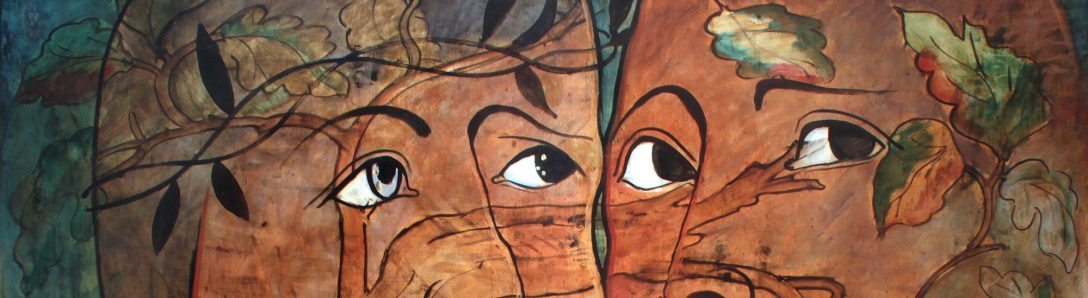

Homework — Carl Larsson