Shooting the Arrows in Kurosawa’s Throne of Blood Finale

“There’s a purity of intent and a lack of self-consciousness that I wish I could achieve when I was experiencing pleasure” (David Foster Wallace)

Let’s put it this way. Say you’ve got really serious art, and it takes really hard work, whether it’s painting or music or literature. That stuff’s not fun in the way commercial entertainment is fun. I mean fun — like eating a Twinkie. It’s like slipping into a warm bath after a hard day. It’s an escape. It’s a relaxation. And that’s fine, and that’s entirely appropriate. The danger comes when the escape becomes the overriding purpose. And one of the ways it seems that television has affected me is that my expectation for the amount of fun and pleasure to work — that ratio is very different than they are for my parents. I think my pain threshold is lower. My expectations are higher. My level of resentment at having to do anything I don’t particularly want to do that isn’t pleasurable is higher. I think a certain amount of that comes from the fact that for six hours a day I receive certain messages — you know, ‘relax, we’re going to give to you, you don’t have to give anything back, all you need to do is every so often go and buy this product.’ But animals have fun. My dogs play. And watching them play — there’s a purity of intent and a lack of self-consciousness that I wish I could achieve when I was experiencing pleasure. But Plato and John Stuart Mill both take books to talk about different types of pleasure. In my own personal life, I like really arty stuff a lot of the time. But there’s also times I watch an enormous amount of TV, and I’ve read probably 70 percent of Stephen King’s books. And I’ve read them basically because for a little while I want to forget that my name is David Wallace, you know, and that I have limitations, and that I’m sad that my girlfriend yelled at me. I think serious art is supposed to make us confront things that are difficult in ourselves and in the world. And one of the dangers is if we get conditioned to confront less and less and experience more and more pleasure, the commercial stuff’s gonna win out.

From a 1997 interview with David Foster Wallace by David Wiley, originally published in The Minnesota Daily, and archived here.

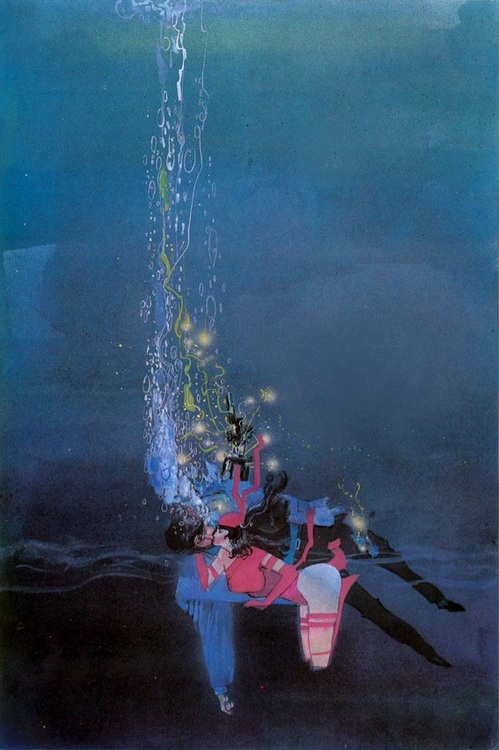
Elektra — Bill Sienkiewicz

elektra

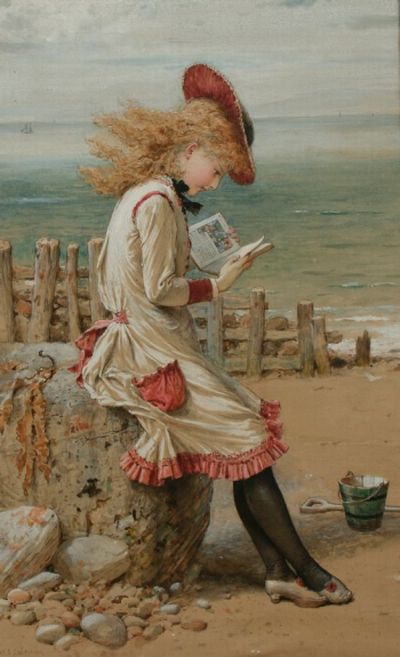
An Interesting Story — William Stephen Coleman

tumblr_m60hnfIpE11qjehcpo1_500

Idyll — Jacek Malczewski

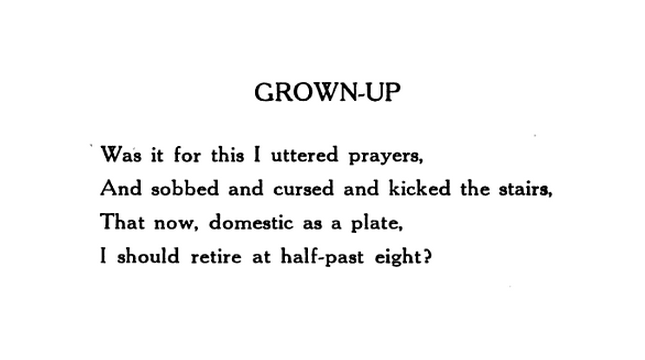
“Grown-Up” — Edna St. Vincent Millay

grown up

“All art constantly aspires towards the condition of music”

Mars and Venus Discovered by the Gods — Joachim Wtewael

William S. Burroughs looking serious, sad lover’s eyes, afternoon light in window (Photo by Ginsberg)

“Authors” — Voltaire

“Authors” — Voltaire

(From Philosophical Dictionary)

Author is a generic name which can, like the name of all other professions, signify good or bad, worthy of respect or ridicule, useful and agreeable, or trash for the wastepaper-basket.


We think that the author of a good work should refrain from three things—from putting his name, save very modestly, from the epistle dedicatory, and from the preface. Others should refrain from a fourth—that is, from writing.


Prefaces are another stumbling-block. “The ‘I,'” said Pascal, “is hateful.” Speak as little of yourself as possible; for you must know that the reader’s self-esteem is as great as yours. He will never forgive you for wanting to condemn him to have a good opinion of you. It is for your book to speak for you, if it comes to be read by the crowd.


If you want to be an author, if you want to write a book; reflect that it must be useful and new, or at least infinitely agreeable.


If an ignoramus, a pamphleteer, presumes to criticize without discrimination, you can confound him; but make rare mention of him, for fear of sullying your writings.


If you are attacked as regards your style, never reply; it is for your work alone to make answer.


Someone says you are ill, be content that you are well, without wanting to prove to the public that you are in perfect health. And above all remember that the public cares precious little whether you are well or ill.


A hundred authors make compilations in order to have bread, and twenty pamphleteers make excerpts from these compilations, or apology for them, or criticism and satire of them, also with the idea of having bread, because they have no other trade. All these persons go on Friday to the police lieutenant of Paris to ask permission to sell their rubbish. They have audience immediately after the strumpets who do not look at them because they know that these are underhand dealings.


Real authors are those who have succeeded in one of the real arts, in epic poetry, in tragedy or comedy, in history or philosophy, who have taught men or charmed them. The others of whom we have spoken are, among men of letters, what wasps are among birds.
The Princes in the Tower — Paul Delaroche

Vicious Circle — Jacek Malczewski

An Interview with Jason Schwartz

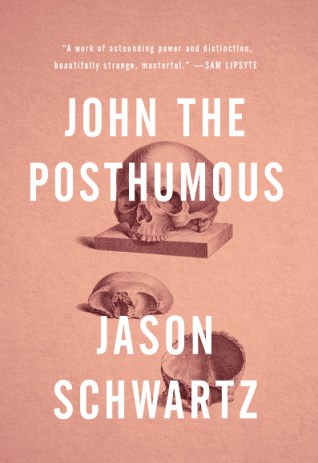
Jason Schwartz’s novel John the Posthumous was published last year to wide acclaim, despite—or maybe because of—its challenging, disruptive qualities. With blurbs from Gordon Lish, Ben Marcus, and Sam Lipsyte, John the Posthumous had “cult novel” written all over it from the outset. It was a 2013 highlight for many critics, including K. Thomas Khan, who called it “a dizzyingly delightful and hypnotically haunting book that resists easy classification,” and David C. Winters, who described it as a “Fractal baroque: an unfurling art that enfolds us in incomprehension, in fear, but also in irreducible beauty.” In my review, I  wrote that John the Posthumous is “strong, strange literature, a terrifying prose-poem that seizes history and folklore, science and myth . . . and distills it to a sustained, engrossing nightmare.”

Schwartz is the author of another book, A German Picturesque (1998). He lives and works in Florida. Schwartz kindly consented to an interview with me via email; his answers here approach the same oblique verbal dexterity that we see in his fiction. Get John the Posthumous from OR Books or your local bookstore.

SchwartzBiblioklept: Your book John the Posthumous is a challenge to describe, let alone summarize. How do you describe the book to those who haven’t read it?
Jason Schwartz: I lie–it seems the only decent way to proceed.  Why dwell upon unpleasant things?

Biblioklept: In a recent interview with 3:AM Magazine, you said that one of the first things you tried to write—in high school—was “a very long espionage novel.” You mentioned charts and appendices—lots of plots. In the same interview, you also say that you “favor format as someone else might favor plot,” which I think evinces in John the Posthumous and A German Picturesque. I’m curious what experiences—particularly what reading experiences—may have motivated a shift from an initial interest in writing plot-driven genre fiction to the stuff you write now.

JS: I’m sure I was abandoning other things too.  I seem to recall something about a war.  A catalog of imaginary battles, land and air–that would have been a handy enough project for a kid.  Remember Little Wars?  I don’t, but I like the idea of H.G. Wells and company concealed behind end tables, orchestrating cavalry raids.  Unless the tactician was free to explore the drawing room, inspecting positions and so on, enumerating the wounded, admiring an especially fine artillery barrage.  That seems more likely.  But the would-be novel, espionage–I started that on a lark.  I’d found an old Olivetti somewhere in the house–in the attic, I’d like to say, but we didn’t have an attic–and one thing led to another, et cetera, et cetera.  A turn may or may not have occurred at that same moment, give or take, with all those devices, the appendices, the charts and annotated maps, captions for photographs that didn’t exist.  Hard to say, exactly, going back now to the tenth grade.  But they began to overtake the plot, such as it was.  I liked some of the Bond books, and Graham Greene–still do–but I also liked The Encyclopedia of Espionage and that kind of thing, compendiums of jargon, biographies of Bulgarian spies.  So maybe it was more the subject than the genre.

Biblioklept: Do you think about a particular audience when you compose?

JS: A young family, stranded on a mountain pass, killing time until help arrives.  They take turns reading aloud–the text in question having been purchased by mistake and packed by accident, and later discovered in the luggage as potential kindling.  The father shields the first child from those passages displaying traces of grotesquerie.  The mother corrects the second child’s pronunciation or praises his elocution–as the case may be–on the occasion of the most ostentatious phrases.  The third child, meanwhile, has wandered off into the woods.  Ah!–it’s beginning to rain.

Biblioklept: Did John the Posthumous start as something smaller, like the pieces that make up A German Picturesque? Did you have the theme of adultery in mind from the outset?

jtpJS: Yes, it was there from the outset, adultery, running through a number of things–directly and otherwise–and many of these appeared in magazines as individual pieces, beginning in 2003 or so.  The “Corinthians” section, for instance, was once called “Breviary.”  The final section in “Hornbook” was “Notation on Hidden Children.”  Another one in that little series–a section in “Adulterium”–was “Notation on the Principal Graves.”  There were changes in every case–all this happened over a very long period of time, obviously.  “Housepost,” on the other hand, was done more or less at once, mostly in sequence.  I published certain parts of this–“The Mary Casket” is an example–in various combinations, dismantling the house a few different ways.

Biblioklept: Your sentences are precise and concrete, but they also often refuse to give the reader something definite to grip on to. There’s a lot of power—and, I’d argue horror—in this restraint. How much of this technique is attributable to editing? How do you edit your work?

JS: As to the second question: it varies.  No set method.  And as to the first:  I’m not really editing in that direction, no.  I see this more as a simple matter of description.  So–for instance–the schoolmarm in the museum, a wax form, with pins for eyes.  A person of reputation in her hometown, I take it, and–it turns out–a distant relation of mine.  I don’t wish to be flippant–or to sunder a cousin without good reason, here on the spur of the moment–but she seems easy enough to grasp in one’s hands, or at least as easy as any other set of letters.  And she was, she certainly was, when they cut her in two, at the waist, and then into several smaller portions–her coat and purse set off to one side, forgotten there (the former eaten by moths, I’d guess, the remnants used to stuff the dummies on the second floor; the latter left on a shelf and, later on, mistaken for something foreign and important, given its own display)–in order to get her out the door.  She’d have used, by the way, back at the schoolhouse, a razor blade and a ruler, according to a practice now out of fashion.  “Children, let’s remove all your objectionable words and phrases, replacing them with more companionable ones.”  And in the evening, the janitor and janitress would sweep up the scraps, and then use them to write ransom notes.

Biblioklept: Have you ever stolen a book?

JS: Sure.  Including one from my grandparents’ bookcase, I’m ashamed to say.  The book was The Deer Park.  I was three, I believe, or four, or five.  I was not, at the time, a fan of Norman Mailer.  I must have mistaken it for something else–or maybe I had plans for it in the construction of a fort or what have you, some structure already underway, or only in the earliest planning stages, back home, down in the basement, off in a corner reserved for projects of just that sort.  I suppose it could have been the jacket art, an attraction to that, but I can’t recall what was depicted on the cover, or even the colors on display.  It’s unfair to speculate in this way, I know, but–to be on the safe side, and to put the matter out of mind, once and for all–let’s just assume it was a stick-figure deer, in black, on a field of red.  Very much, in other words, the kind of stick figure–and field–I’d have quite disliked as a child.  Anyway, my grandmother gave chase.  She shouted in a language manufactured on the spot, and composed wholly of bedbugs and regret, dozens of variations on these words, accompanied by near-simultaneous translations, bent by the effect of her breathlessness, and taking curious shapes, in formation, at my back and overhead–or so it all seemed to me.  And then?  I was caught, of course.

Volvox Olympia — Jeroen Hermkens

Portrait of James Joyce — Eduardo Arroyo

James Joyce Dies

James Joyce Dies; Wrote ‘Ulysses’

ZURICH, Switzerland, Monday, Jan 13- James Joyce, Irish author whose “Ulysses” was the center of one of the most bitter literary controversies of modern times, died in a hospital here early today despite the efforts of doctors to save him by blood transfusions. He would have been 59 years old Feb. 2.

Joyce underwent an intestinal operation Saturday afternoon at the Schwesternhaus von Rotenkreuz Hospital. For a time he appeared to be recovering. Only yesterday his son reported him to have been cheerful and apparently out of danger.

During the afternoon, however, the writer suffered a sudden relapse and sank rapidly. He died at 2:15 A.M. (8:15 P.M., Eastern standard time).

His wife and son were at the hospital when he died.

Hailed and Belittled by Critics

The status of James Joyce as a writer never could be determined in his lifetime. In the opinion of some critics, notably Edmund Wilson, he deserved to rank with the great innovators of literature as one whose influence upon other writers of his time was incalculable. On the other hand, there were critics like Max Eastman who gave him a place with Gertrude Stein and T.S. Eliot among the “Unintelligibles” and there was Professor Irving Babbitt of Harvard who dismissed his most widely read novel, “Ulysses,” as one which only could have been written “in an advanced stage of psychic disintegration.”

Originally published in 1922, “Ulysses” was not legally available in the United States until eleven years later, when United States Judge John Monro Woolsey handed down his famous decision to the effect that the book was not obscene. Hitherto the book had been smuggled in and sold at high prices by “bookleggers” and a violent critical battle had raged around it.

From James Joyce’s obituary in The New York Times (January 13, 1941). Read the rest.

James Joyce’s Death Mask