Conference — Albert Bloch

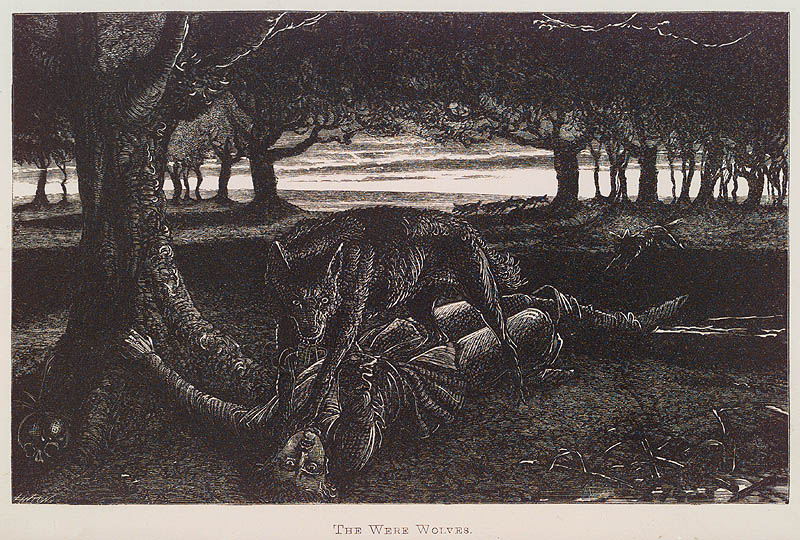
Bolaño’s Werewolves

In the first chapter of his estimable volume The Book of Were-Wolves (1865), Sabine Baring-Gould outlines his project (emphasis mine):

In the following pages I design to investigate the notices of were-wolves to be found in the ancient writers of classic antiquity, those contained in the Northern Sagas, and, lastly, the numerous details afforded by the mediæval authors. In connection with this I shall give a sketch of modern folklore relating to Lycanthropy.

It will then be seen that under the veil of mythology lies a solid reality, that a floating superstition holds in solution a positive truth.

This I shall show to be an innate craving for blood implanted in certain natures, restrained under ordinary circumstances, but breaking forth occasionally, accompanied with hallucination, leading in most cases to cannibalism. I shall then give instances of persons thus afflicted, who were believed by others, and who believed themselves, to be transformed into beasts, and who, in the paroxysms of their madness, committed numerous murders, and devoured their victims.

The first few chapters of the book recount werewolf mythology in heavily archetypal terms: we’re talking Greek and Norse stuff here, really ancient stories that tap into primal-human-animal-instinct and so forth. Then there are a few chapters on Scandinavian werewolves (and other shapeshifters) that reminded me of William Vollmann’s marvelous saga The Ice-Shirt, a book that treats warriors shifting into bears as totally standard fare. The book then tackles “The Were-Wolf in the Middle Ages,” where Baring-Gould relies heavily on monks who seem to view their subject through the heady lens of supernaturalism. Baring-Gould weaves together these culturally disparate stories, citing a strong backlist of sources, and refraining from pointing out the obvious archetypal flavor that girds these tales.

It’s in Chapter VI, “A Chamber of Horrors,” that mythology and archetype give way to a kind of terrible realism. Perhaps this is simply an effect of records-keeping, of the vague fact that narratives and terms of the early Renaissance seem so much more accessible to us than, say, the terms of Scandinavian saga. In any case, the book takes on a horrific scope: the vagaries of myth give way to dates, names, places, witnessestrialsverdicts. To go back to Baring-Gould’s intro, we see the “solid reality” under “the veil of mythology,” stripped away. Continue reading “Bolaño’s Werewolves”

Woman Reading a Letter — Pieter de Hooch

Untitled — Zdislav Beksinski

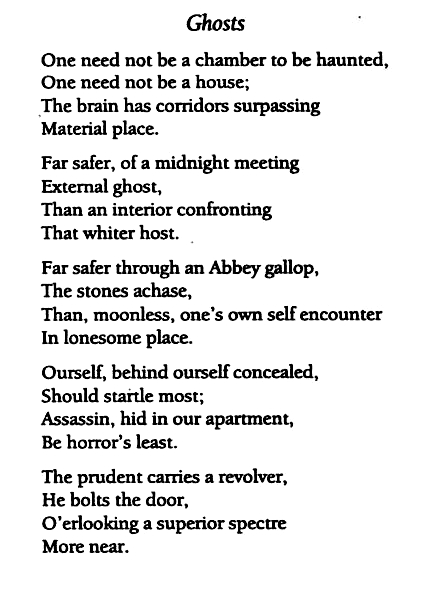
“One need not be a chamber to be haunted” — Emily Dickinson

ghosts

Witch — Andy Warhol

Warhol_Witch

Skeleton Frolic — Ub Iwerks

La Comedie de la Mort — Rodolphe Bresdin

Riff #2 on Thomas Bernhard’s Old Masters

I’ve been trying to think of a way to talk about Bernhard’s (or, really, the translator Ewald Osers’) style and affect relative to, say, American prose traditions. I turned to some scholarship on old Bernie, and most of the articles focused on how musical forms (the fugue, sonata, etc.) frame Bernhard’s sentences (and, in some cases, the entire narrative, like The Loser). These were very welcome insights. But before I touch on that, I read a quote by the ever-excellent Deb Olin Unferth this morning that helps start a conversation about Bernhard’s style relative to American prose traditions. Here it is:

Prose can be what keeps you wanting to read. Strong prose contains conflict, even at the level of the sentence. If a sentence is pushing against itself, or if each sentence is contradicting what just came before it and you’re wondering how you can hold all these contradictory statements in your mind at once, that’s interesting to me. What you’re getting then is a complex psychology or philosophy as a result of the very sentences that you’re reading. That’s a Lishian way of looking at prose. I subscribe to it. I admire work and I strive to in my own work have that kind of pressure on the individual sentence, so that each sentence is in conflict with what’s around it in some way.

I think you could pick things out of this quote and posture Bernhard into them. Contradiction–surely. Self-imposed pressure–definitely. I would also say these qualities aren’t specific to Lish, though. So-called Lishians often default into a kind of prosody that depends on physical characteristics of sound to help move meaning within a sentence. In other words, sound thematizes presence and produces the emotional effect; and sound thematization is the affect of Lishian prose. So, for example, a sentence that evokes a sharpness and harshness would have a lot of alliterative K-sounds, or something. Diane Williams’ sentences are very proud of this prose. Look at this, from “One of The Great Drawbacks” in Vicky Swanky is a Beauty:

If left to themselves, they fight like fiends or yell out the great news and one of these girls is entirely out of danger.

Notice the alliteration and assonance in the first part of sentence on the F-sounds, the short E’s, and long I’s. From a “craft perspective,” I guess, there’s a sense that making the sounds of the words symbiotic take precedence before plot and character. Composition first depends on making the sounds interesting, and lead the other components into the story. It’s a very different set of restrictions on the writer to depend on the physical properties of language than what Bernhard is doing.

But, I think, Bernhard is one of the most musical writers I’ve ever read. There’s a quote by him somewhere that details his focus on style, and he calls it a “theoretical music.” Where Lishians want the reader to “hear” the prose in the head, Bernhard wants her to feel the consciousness of the ostensible narrator as if she were listening to music; namely, the composition of Old Masters, or Frost, or The Loser. Bernhard’s favorite technique to achieve this effect is repetition with slight variation which, if I remember correctly, is the most infantile way to describe the classical sonata.

Incidentally, he was speaking English, which I found agreeable, but then suddenly also German, very broken German, that broken German which all Englishmen speak when they believe they know German, which, however, is never the case, Reger said, the Englishman probably wanted to speak German rather than English in order to improve his German, and after all why not, when abroad one prefers to speak the foreign language unless one is a blockhead, and so in his broken German he said that he had in fact come to Austria and to Vienna solely for the White-Bearded Man, he was not interested in the museum as a whole, not in the least, he was not one for museums, he hated museums and had always only visited them reluctantly, he had only come to the Vienna Kunsthistorisches Museum in order to study the White-Bearded Man because back home he had just such a White-Breaded Man hanging over his bed in his bedroom in Wales, in actual fact the same White-Bearded Man, the Englishman said, Reger said.

I don’t think I’ve ever read a sentence by a “Lishian” that was ever this long. Where the musicality of a Lishian sentence is in the very materiality of language, Bernhard performs his music in the construction of the melody (sentence) by arranging the phrases (clauses) in this sort of point-counterpoint call and response. English calls to German, and vice versa, and we get a sense of the character within the rant; all the phrases that repeat “German” respond to Reger finding the English “agreeable” perform his total ambivalence for the Englishman. It makes me think that “Lishian” sentences still aim for a kind of story in the traditional sense, and Bernhard’s aim to stage a mind at work, a mind paralyzed (This was touched on in the Frost post). Less a story than a confession, testimony, absurd anecdote.

(Read the first riff).
In the Garden — Alfred Stevens

Watch Can–The Documentary, a Film about Can–The Band

Decoy — Simon Stalenhag

decoy_1920_badge

Jonathan Littell’s Latest, The Fata Morgana Books (Book Acquired, 10.21.2013)

20131027-130105.jpg

The Fata Morgana Books collects four novellas from Jonathan Littell and is forthcoming from Two Line Press, a new indie specializing in publishing English language translations of some of the world’s best literature. Here is their blurb about The Fata Morgana Books, Littell’s follow up to The Kindly Ones:

Ranging from swimming pools to art galleries, from beds to battlefields, and a few mythical places, these novellas are narrated by hermaphrodites, ghosts, wanderers, and wonders. Littell here once again mixes his love of the grotesque with time-twisting narratives and ethereal protagonists. Like an Italo Calvino or a Clarice Lispector, Littell channels the emotions of loss and desire to illuminate the shadowy depths of solitude, reflection, longing, and lust.

With fleet prose and Proustian self-reflection, these stories range from chaotic airlifts to a series of bullfights under the hot sun, fatal negotiations resolved as mathematical equations, and the nine circles of Hell. Commanding and beguiling, The Fata Morgana Books rings with depth and mystery, always pushing through to explore the in-between spaces: between thoughts, between bodies, between hungers and their satisfactions, between eyes and the things they look at.

I was psyched to get a review copy of The Fata Morgana Books; Littell’s previous novel about an SS officer’s depraved undertakings, The Kindly Ones, stuck with me in a weird, gross, foul way. In my review I suggested that it was “a novel that might as well take place in the asshole, or at least the colon.”

I read the first novella in The Fata Morgana BooksEtudes, which is comprised of four stories that read like an overture for what will come. The first piece, “A Summer Sunday,” sets an unnerving and estranging tone, where pleasure seems to mingle with ennui and dread:

That Sunday, then, after the beer near the cemetery, I accompanied B. to meet our friend A. and we went out to lunch at a beautiful, somewhat isolated restaurant with a terrace only half enclosed, which allowed one to stay out in the open air without breaking police regulations too much. We ate slowly, all afternoon, lamb chops with an onion salad, and drank a bottle of red wine. Afterward, B. and I shared a cigar, too dry but a great pleasure nonetheless. Then we bought some cakes and went over for drinks on my balcony, opposite the cemetery, with the two towers at our feet. It wasn’t till the next day, reading the papers, that we realized just how bad the weekend had been. But the summer had been like that for six weeks already, and it seemed likely it would continue that way.

By “The Wait,” the next chapter of Etudes, we’ve descended into Littell’s abject terrain. More to come in a full review.

The Witch with the Comb — Paul Klee

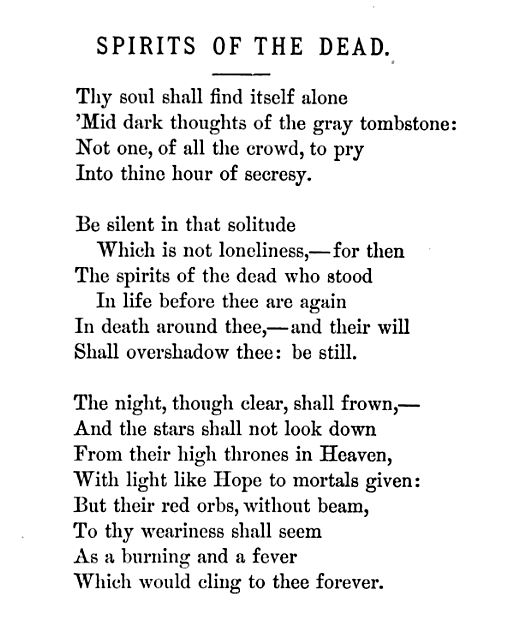
“Spirits of the Dead” — Edgar Allan Poe

spirits

Portrait of Alexandre Benois — Leon Bakst

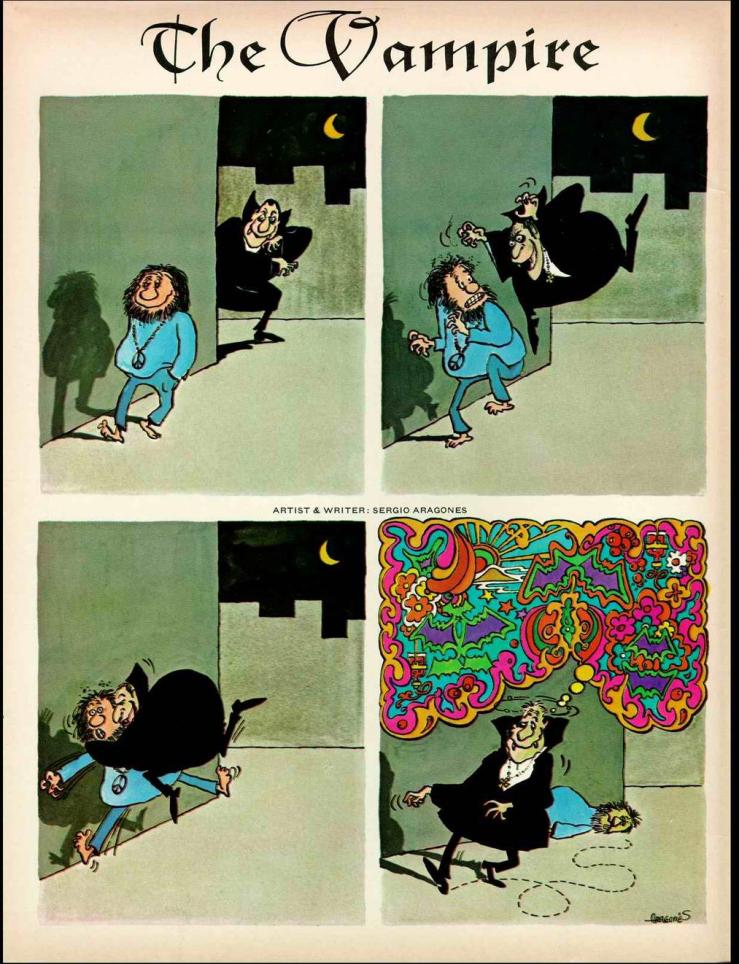
The Vampire — Sergio Aragones

sergio aragones. the vampire. 001