“Character Is Fate” — Tom Clark

Capture

Born — Kiki Smith

“Willie & Wade” — Donald Barthelme

“Willie & Wade” by Donald Barthelme

Well we all had our Willie & Wade records ‘cept this one guy who was called Spare Some Change? ’cause that’s all he ever said and you don’t have no Willie & Wade records if the best you can do is Spare Some Change?

So we all took our Willie & Wade records down to the Willie & Wade Park and played all the great and sad Willie & Wade songs on portable players for the beasts of the city, the jumpy black squirrels and burnt-looking dogs and filthy, sick pigeons.

And I thought probably one day Willie or Wade would show up in person at the Willie & Wade Park to check things out, see who was there and what record this person was playing and what record that person was playing.

And probably Willie (or Wade) would just ease around checking things out, saying “Howdy” to this one and that one, and he’d see the crazy black guy in Army clothes who stands in the Willie & Wade Park and every ten minutes screams like a chicken, and Willie (or Wade) would just say to that guy, “How ya doin’ good buddy?” and smile, ’cause strange things don’t bother Willie, or Wade, one bit.

And I thought I’d probably go up to Willie then, if it was Willie, and tell him ’bout my friend that died, and how I felt about it at the time, and how I feel about it now. And Willie would say, “I know.”

And I would maybe ask him did he remember Galveston, and did he ever when he was a kid play in the old concrete forts along the sea wall with the giant cannon in them that the government didn’t want any more, and he’d say, “Sure I did.” And I’d say, “You ever work the Blue lay in San Antone?” and he’d say, “Sure I have.”

And I’d say, “Willie, don’t them microphones scare you, the ones with the little fuzzy sweaters on them?” And he’d say to me, “They scare me bad, potner, but I don’t let on.”

And then he (one or the other, Willie or Wade) would say, “Take care, good buddy,” and leave the Willie & Wade Park in his black limousine that the driver of had been waiting patiently in all this time, and I would never see him again, but continue to treasure, my life long, his great contributions.
Woman in a Bookshop — Aubrey Beardsley

Thomas Bernhard’s Reger on the Purpose of Art

Art is the most sublime and the most revolting thing simultaneously, he said. But we must make ourselves believe that there is high art and the highest art, he said, otherwise we should despair. Even though we know that all art ends in gaucherie and in ludicrousness and in the refuse of history, like everything else, we must, with downright self-assurance, believe in high and in the highest art, he said. We realize what it is, a bungled, failed art, but we need not always hold this realization before us, because in that case we should inevitably perish, he said.

Departure from an Island at Night — Henryk Siemiradzki

RIP Álvaro Mutis

Alvaro-Mutis-600x300

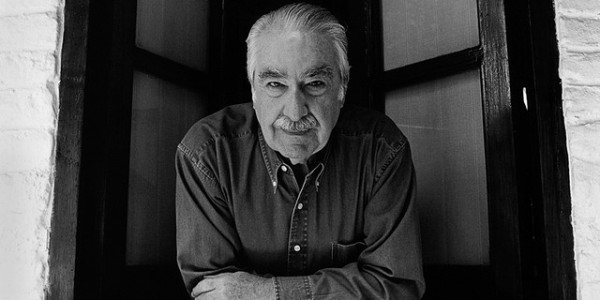
RIP Álvaro Mutis, 1923 – 2013

Colombian writer Álvaro Mutis died in Mexico City today. He was ninety.

Mutis is likely most famous in the English-speaking world for his excellent series of picaresque novellas focusing on the Gaviero, which have been collected as The Adventures and Misadventures of Maqroll. I first learned of the book through a friend who reviewed it on this blog; his review made me pick it up and read and riff on it myself. I don’t know if I can overstate how wonderful these novellas are. I’ve mixed them into my readings over the past year, breaking up the space between new novels by taking a trip with the Gaviero. They are something beyond palate-cleansers; they are the kind of adventure narratives that made me fall in love with reading in the first place. I feel strangely fortunate that there are two more I have yet to read.

Here’s John Updike’s thorough, excellent review of The Adventures and Misadventures of Maqroll.

And: a 2001 interview with Mutis by Francisco Goldman. From that interview:

FG: If you could travel with Maqroll to any period, which would it be?

AM: The 18th century. Casanova and I would have been friends. I would have been friends with the Prince de Ligne and I would have lived in Paris and Venice. I’d take the elegant life, the brilliant prose, like Voltaire—each time you read him you realize that he’s the real thing. And that is where my interest in the 18th century ends; once they get to the French Revolution and the horror and saving of mankind, that’s where I exit.

And a few last scraps from Un Bel Morir:

All the stories and lies about his past accumulating until they formed another being, always present and naturally more deeply loved than his own pale, useless existence composed of nausea and dreams.

A crack of wood waking him in the humble hotel on the Rue de Rempart and, in the middle of the night, leaving him on that shore where only God is aware of other people.

The eyelid twitching with the autonomous speed of one who knows he is in the hands of death. The eyelid of the man he had to kill, with repugnance, with no anger, to save the life of a woman whom he now found unbearable. 

All his waiting. All the emptiness of that nameless time used up in the foolishness of negotiations, proceedings, journeys, blank days, mistaken itineraries. All that life, from which he now begs, as he slips through the wounded dark toward death, some of the leftover scraps he thinks he has a right to. 

The Best Storyteller II — Mamma Andersson

Barthelme’s Influences

INTERVIEWER

Your own influences—whom would you like to cite as your spiritual ancestors?

BARTHELME

They come in assorted pairs. Perelman and Hemingway. Kierkegaard and Sabatini. Kafka and Kleist. Kleist was clearly one of Kafka’s fathers. Rabelais and Zane Grey. The Dostoyevsky of Notes from Underground. A dozen Englishmen. The surrealists, both painters and poets. A great many film people, Buñuel in particular. It’s always a stew, isn’t it? Errol Flynn ought to be in there somewhere, and so should Big Sid Catlett, the drummer.

—From Donald Barthelme’s interview with The Paris Review.

Monet in his Studio Boat — Edouard Manet

“Beckett’s Theory of Comedy” — Anne Carson

btc

Sleep — Felix Vallotton

Boat with Two Figures — Odilon Redon

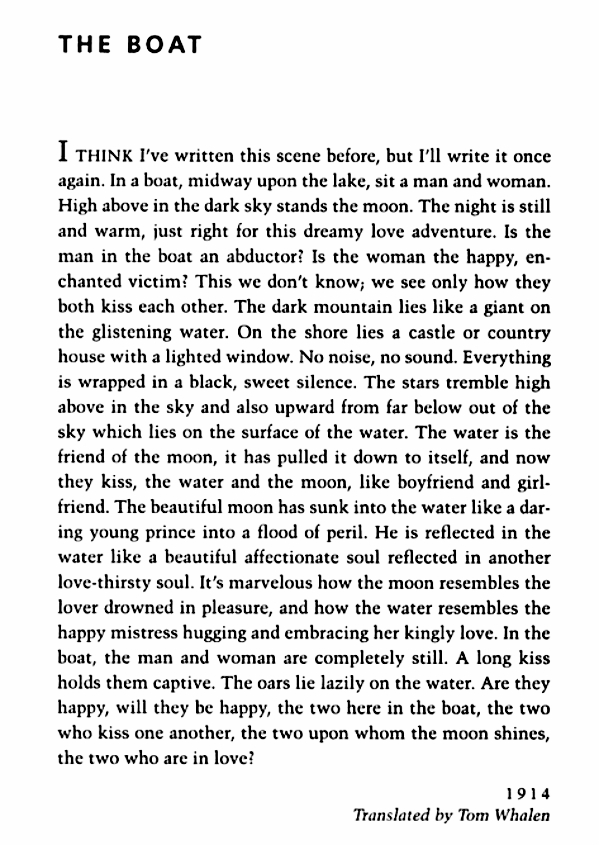
“The Boat” — Robert Walser

tb

Rembrandt — Alexander Korda

Illustration for Kafka’s Metamorphosis — Jean-Michel Folon

folon-kafka-2

(More/via/about; then even more).