“Four Beasts in One—The Homo-Cameleopard” by Edgar Allan Poe

“Four Beasts in One—The Homo-Cameleopard” by Edgar Allan Poe

                     Chacun a ses vertus.
                        —Crebillon's Xerxes.

ANTIOCHUS EPIPHANES is very generally looked upon as the Gog of the prophet Ezekiel. This honor is, however, more properly attributable to Cambyses, the son of Cyrus. And, indeed, the character of the Syrian monarch does by no means stand in need of any adventitious embellishment. His accession to the throne, or rather his usurpation of the sovereignty, a hundred and seventy-one years before the coming of Christ; his attempt to plunder the temple of Diana at Ephesus; his implacable hostility to the Jews; his pollution of the Holy of Holies; and his miserable death at Taba, after a tumultuous reign of eleven years, are circumstances of a prominent kind, and therefore more generally noticed by the historians of his time than the impious, dastardly, cruel, silly, and whimsical achievements which make up the sum total of his private life and reputation.

Let us suppose, gentle reader, that it is now the year of the world three thousand eight hundred and thirty, and let us, for a few minutes, imagine ourselves at that most grotesque habitation of man, the remarkable city of Antioch. To be sure there were, in Syria and other countries, sixteen cities of that appellation, besides the one to which I more particularly allude. But ours is that which went by the name of Antiochia Epidaphne, from its vicinity to the little village of Daphne, where stood a temple to that divinity. It was built (although about this matter there is some dispute) by Seleucus Nicanor, the first king of the country after Alexander the Great, in memory of his father Antiochus, and became immediately the residence of the Syrian monarchy. In the flourishing times of the Roman Empire, it was the ordinary station of the prefect of the eastern provinces; and many of the emperors of the queen city (among whom may be mentioned, especially, Verus and Valens) spent here the greater part of their time. But I perceive we have arrived at the city itself. Let us ascend this battlement, and throw our eyes upon the town and neighboring country.

“What broad and rapid river is that which forces its way, with innumerable falls, through the mountainous wilderness, and finally through the wilderness of buildings?”

That is the Orontes, and it is the only water in sight, with the exception of the Mediterranean, which stretches, like a broad mirror, about twelve miles off to the southward. Every one has seen the Mediterranean; but let me tell you, there are few who have had a peep at Antioch. By few, I mean, few who, like you and me, have had, at the same time, the advantages of a modern education. Therefore cease to regard that sea, and give your whole attention to the mass of houses that lie beneath us. You will remember that it is now the year of the world three thousand eight hundred and thirty. Were it later—for example, were it the year of our Lord eighteen hundred and forty-five, we should be deprived of this extraordinary spectacle. In the nineteenth century Antioch is—that is to say, Antioch will be—in a lamentable state of decay. It will have been, by that time, totally destroyed, at three different periods, by three successive earthquakes. Indeed, to say the truth, what little of its former self may then remain, will be found in so desolate and ruinous a state that the patriarch shall have removed his residence to Damascus. This is well. I see you profit by my advice, and are making the most of your time in inspecting the premises—in

-satisfying your eyes

With the memorials and the things of fame

That most renown this city.—

I beg pardon; I had forgotten that Shakespeare will not flourish for seventeen hundred and fifty years to come. But does not the appearance of Epidaphne justify me in calling it grotesque?

“It is well fortified; and in this respect is as much indebted to nature as to art.”

Very true.

“There are a prodigious number of stately palaces.”

There are.

“And the numerous temples, sumptuous and magnificent, may bear comparison with the most lauded of antiquity.”

All this I must acknowledge. Still there is an infinity of mud huts, and abominable hovels. We cannot help perceiving abundance of filth in every kennel, and, were it not for the over-powering fumes of idolatrous incense, I have no doubt we should find a most intolerable stench. Did you ever behold streets so insufferably narrow, or houses so miraculously tall? What gloom their shadows cast upon the ground! It is well the swinging lamps in those endless colonnades are kept burning throughout the day; we should otherwise have the darkness of Egypt in the time of her desolation.

“It is certainly a strange place! What is the meaning of yonder singular building? See! it towers above all others, and lies to the eastward of what I take to be the royal palace.”

Continue reading ““Four Beasts in One—The Homo-Cameleopard” by Edgar Allan Poe”

Hand Holding Book — Asa Ames

“Best films (not in order)” — Susan Sontag

Best films (not in order)

  1. Bresson, Pickpocket
  2. Kubrick, 2001
  3. Vidor, The Big Parade
  4. Visconti, Ossessione
  5. Kurosawa, High and Low
  6. Syberberg, Hitler
  7. Godard, 2 ou 3 Choses . . .
  8. Rossellini, Louis XIV
  9. Renoir, La Regle du Jeu
  10. Ozu, Tokyo Story
  11. Dreyer, Gertrud
  12. Eisenstein, Potemkin
  13. Von Sternberg, The Blue Angel
  14. Lang, Dr. Mabuse
  15. Anonioni, L’Eclisse
  16. Bresson, Un Condamne a Mort . . . 
  17. Grance, Napoleon
  18. Vertov, The Man with the Movie Camera
  19. Feuillade, Judex
  20. Anger, Inauguration of the Pleasure Dome
  21. Godard, Vivre Sa Vie
  22. Bellocchio, Pugni in Tasca
  23. Carne, Les Enfants du Pradis
  24. Kurosawa, The Seven Samurai
  25. Tati, Playtime
  26. Truffaut, L’Enfant Savage
  27. Rivette, L’Amour Fou
  28. Eisenstein, Strike
  29. Von Stroheim, Greed
  30. Straub, . . . Anna Magadalena Bach
  31. Taviani bros, Padre Padrone
  32. Renais, Muriel
  33. Becker, Le Trou
  34. Cocteau, La Belle et la Bete
  35. Bergman, Persona
  36. Fassbinder, . . . Petra von Kant
  37. Griffith, Intolerance
  38. Godard, Contempt
  39. Marker, La Jete
  40. Conner, Crossroads
  41. Fassbinder, Chinese Rouleette
  42. Renoir, La Grande Illusion
  43. Opuls, The Earrings of Madame de . . .
  44. Kheifits, The Lady with the Little Dog
  45. Godard, Les Carabiners
  46. Bresson, Lancelot du Lac
  47. Ford, The Searchers
  48. Bertolucci, Prima della Rivoluzione
  49. Pasolini, Teorema
  50. Sagan, Madchen in Uniform

[The list continues up to number 228, where SS abandons it].

—From a 1977 entry in one of Susan Sontag’s notebooks. The list is published as part of As Consciousness Is Harnessed to Flesh: Journals & Notebooks, 1964-1980.

“Head On” — Man Man

Cocktail Recipe: The Crocodile, a Traditional Anarchist Favorite (Thomas Pynchon’s Against the Day)

“I’ll be in the bar,” said Reef. Yzles-Bains was in fact one of the few places on the continent of Europe where a sober Anarchist could find a decent Crocodile—equal amounts of rum, absinthe, and the grape spirits known as trois-six—a traditional Anarchist favorite, which Loïc the bartender, a veteran of the Paris Commune, claimed to have been present at the invention of.

A cocktail recipe from Thomas Pynchon’s novel Against the Day. (More on trois-six here; good luck finding real absinthe).

Bonus recipe: Kit Traverse’s drink invention:

“‘Love in the Shadows of Pera,’ ” Kit said. “It’s just Creme de Menthe and beer.”

A Collaboration — Jean-Leon Gerome

Anarchists’ Golf (Maybe a Synecdoche of Thomas Pynchon’s Novel Against the Day)

THE NEXT DAY Reef, Cyprian, and Ratty were out on the Anarchists’ golf course, during a round of Anarchists’ Golf, a craze currently sweeping the civilized world, in which there was no fixed sequence—in fact, no fixed number—of holes, with distances flexible as well, some holes being only putter-distance apart, others uncounted hundreds of yards and requiring a map and compass to locate. Many players had been known to come there at night and dig new ones. Parties were likely to ask, “Do you mind if we don’t play through?” then just go and whack balls at any time and in any direction they liked. Folks were constantly being beaned by approach shots barreling in from unexpected quarters. “This is kind of fun,” Reef said, as an ancient brambled guttie went whizzing by, centimeters from his ear.

From Thomas Pynchon’s ginormous novel Against the Day, which I am almost finished with.

I won’t riff on this (very short) Anarchists’ Golf scene, other than to suggest that it perhaps functions as a condensation or synecdoche of the novel proper: the joy, the optimism, the phallic aggression, the disruption of order, the social angle, the nose-thumbing, the creativity, the synthesis—the anarchy.


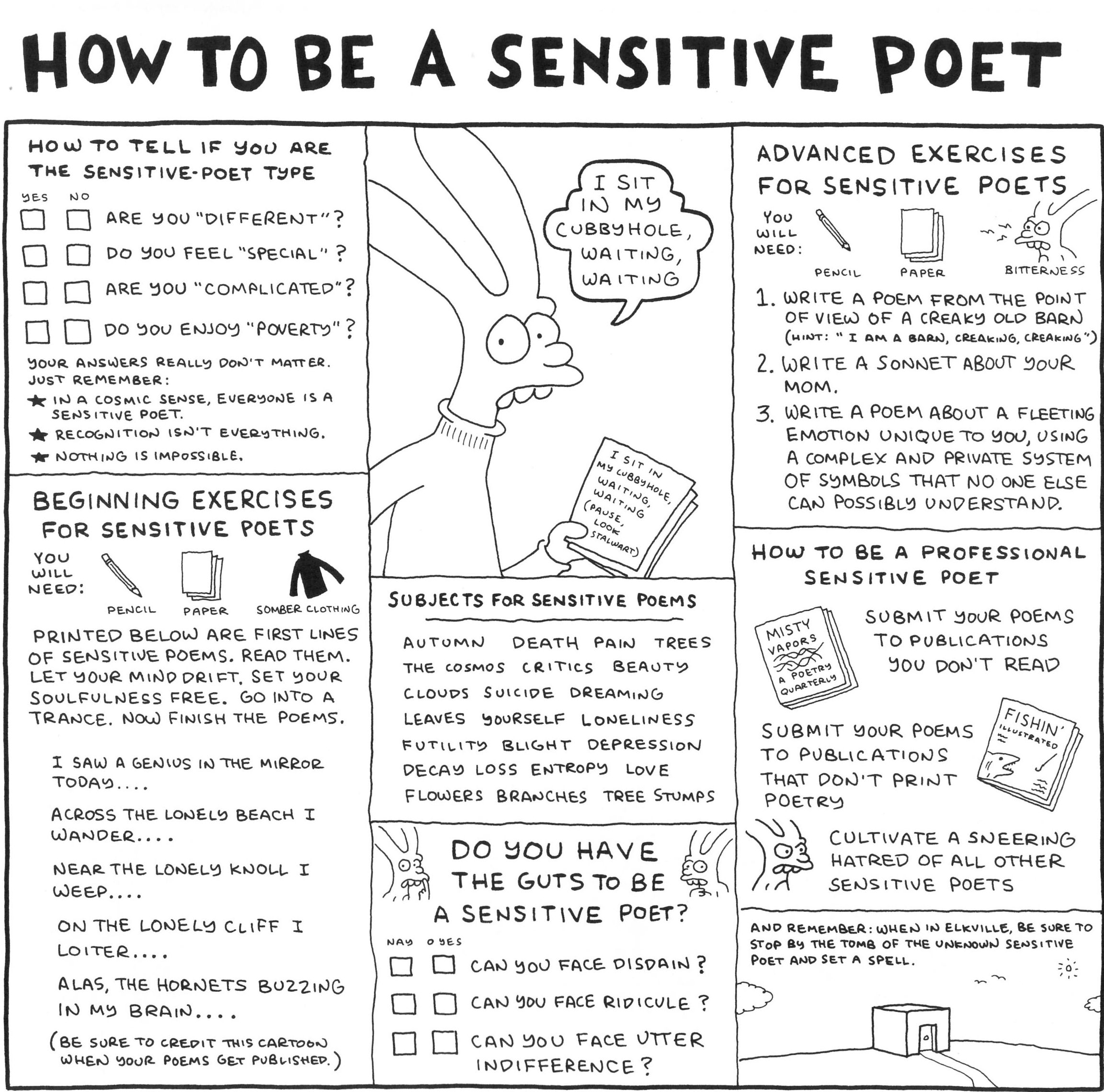
How to Be a Sensitive Poet (Life in Hell)

Sensitive Poet

“He reportedly owns many guns and a flame-thrower” and Other Extracts from William Vollmann’s FBI File

William T. Vollmann has an essay in the newest issue of Harper’s called “Life as a Terrorist.” In the essay, Vollmann details what he finds in his FBI files (after filing a Freedom of Information Act request, an appeal, and a lawsuit to actually get a hold of the thing). He finds out that he was one of the Unabomber suspects:

When I finally received my FBI file, such as it was — namely, two higgledy-piggledy batches of papers, out of order, padded with duplicates, some of which they had forgotten to redact — I learned that I had been Unabomber Suspect Number S-2047:

S-2047 William T. Vollman. Predicated on a referral from a citizen. Investigation has determined that Vollman, a professional author, is widely travelled, however, existing travel records for him do not eliminate him as a viable suspect.

A few more extracts from Vollmann’s FBI file:

  • While VOLLMANN’s appearance varies over the years, New Haven notes strong physical resemblance to UNABOMBER composites. New Haven provided color video prints of book jackets to Sacramento via referenced airtel.
  • UNABOMBER’s moniker FC may correlate with title of VOLLMANN’s largest work, novel Fathers and Crows. That novel reportedly best exemplifies VOLLMANN’s anti-progress, anti-industrialist theme/beliefs/value systems and VOLLMANN, himself, has described it as his most difficult work.
  • [An informant] suggests VOLLMANN has a death wish . . . Reportedly, at age 9, VOLLMANN’s younger sister (age 6) drowned in a backyard pond in New Hampshire while he was supposed to be watching over her. Guilt from that situation may have had a profound effect on VOLLMANN.
  • VOLLMANN’s meticulous nature, as described above, is consistent with manufacture of and presentation on UNABOM devices. Several witnesses have commented that UNABOM packages appeared “seamless” and “too pretty to open.”
  • By all accounts VOLLMANN is exceedingly intelligent and possessed with an enormous ego.
  • He revels in immersing himself in the seamy underside of life. He reportedly has used drugs (crack cocaine) extensively. He reportedly owns many guns and a flame-thrower.

“I would love to own a flamethrower,” Vollmann wryly adds to this last entry. And thus, new entries for the ongoing chronicles of The Myth of the Vollmann!

Vollmann discussed the article on NPR’s NPR’s Morning Edition with David Greene this morning.


Four Notes on the World from Samuel Butler’s Note-Books

  1. The world is a gambling-table so arranged that all who enter the casino must play and all must lose more or less heavily in the long run, though they win occasionally by the way.
  2. We play out our days as we play out cards, taking them as they come, not knowing what they will be, hoping for a lucky card and sometimes getting one, often getting just the wrong one.
  3. The world may not be particularly wise – still, we know of nothing wiser.
  4. The world will always be governed by self-interest.  We should not try to stop this, we should try to make the self-interest of cads a little more coincident with that of decent people.

—From Samuel Butler’s Note-Books.


An Enthralling Novel — Julius LeBlanc Stewart

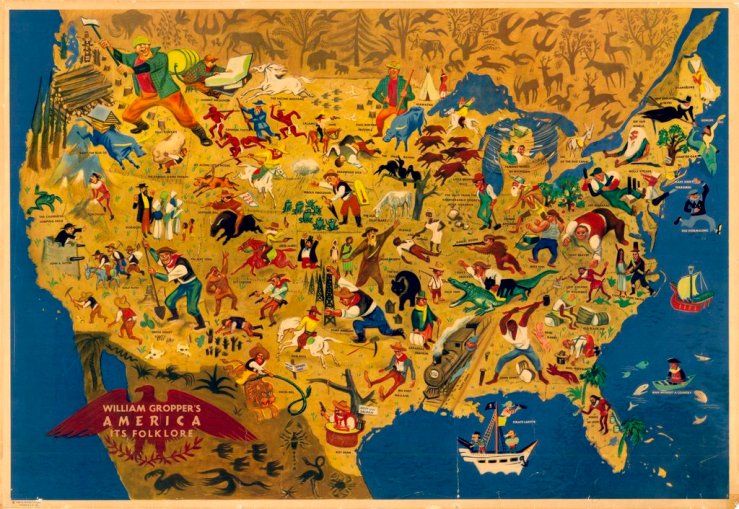
Map of American Folklore

map of folklore

(Via).

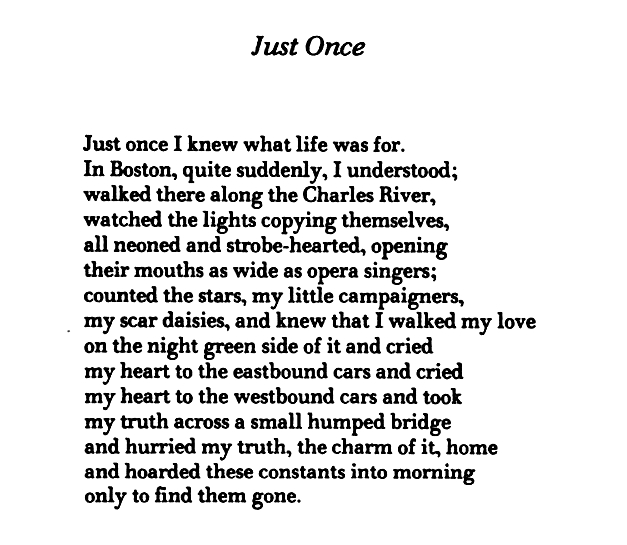
“Just Once” — Anne Sexton

as

“Cheese and Onions” — The Rutles

Palmettos, Florida — John Singer Sargent