Seek some witness | A passage from Cormac McCarthy’s The Crossing

The black eyes all shifted to the leader of their small clan. He sat for a long time. It was very quiet. Out on the road one of the oxen began to piss loudly. Finally he shaped his mouth and said that he believed that fate had intervened in the matter for its own good reasons. He said that fate might enter into the affairs of men in order to contravene them or set them at naught but to say that fate could deny the true and uphold the false would seem to be a contradictory view of things. To speak of a will in the world that ran counter to one’s own was one thing. To speak of such a will that ran counter to the truth was quite another, for then all was rendered senseless. Billy then asked him if it was his notion that the false plane had been swept away by God in order to single out the true and the gypsy said that it was not. When Billy said that he had understood him to say that it was God who had ultimately made the decision concerning the two planes the gypsy said that he believed that to be so but he did not believe that by this act God had spoken to anyone. He said that he was not a superstitious man. The gypsies heard this out and then turned to Billy to see how he would respond. Billy said that it seemed to him that the freighters did not hold the identity of the airplane to be of any great consequence but the gitano only turned and studied him with those dark and troubled eyes. He said that it was indeed of consequence and that it was in fact the whole burden of their inquiry. From a certain perspective one might even hazard to say that the great trouble with the world was that that which survived was held in hard evidence as to past events. A false authority clung to what persisted, as if those artifacts of the past which had endured had done so by some act of their own will. Yet the witness could not survive the witnessing. In the world that came to be that which prevailed could never speak for that which perished but could only parade its own arrogance. It pretended symbol and summation of the vanished world but was neither. He said that in any case the past was little more than a dream and its force in the world greatly exaggerated. For the world was made new each day and it was only men’s clinging to its vanished husks that could make of that world one husk more.

La cascara no es la cosa, he said. It looked the same. But it was not.

Y la tercera historia? said Billy.

La tercera historia, said the gypsy, es esta. El existe en la historia de las historias. Es que ultimadamente la verdad no puede quedar en ningun otro lugar sino en el habla. He held his hands before him and looked at his palms. As if they may have been at some work not of his own doing. The past, he said, is always this argument between counterclaimants. Memories dim with age. There is no repository for our images. The loved ones who visit us in dreams are strangers. To even see aright is effort. We seek some witness but the world will not provide one. This is the third history. It is the history that each man makes alone out of what is left to him. Bits of wreckage. Some bones. The words of the dead. How make a world of this? How live in that world once made?

From Cormac McCarthy’s novel The Crossing. 

The Inheritors — Salman Toor

The Inheritors, 2022 by Salman Toor (b. 1983)

I don’t see what’s being said here at all | William S. Burroughs

BOCKRIS: William, have you ever written anything out of admiration?

BURROUGHS: I don’t know what this term means. It does seem to me an anemic emotion.

SONTAG: Bill, suppose you agreed, which maybe you couldn’t even conceive of doing, to write about Beckett. Somebody offered you a situation at which you said, yes, I’d like to say what I want to say about Beckett, and my feeling about Beckett is mainly positive. I think that’s harder to get down in a way that’s satisfactory than when you’re attacking something.

BURROUGHS: I don’t see what’s being said here at all.

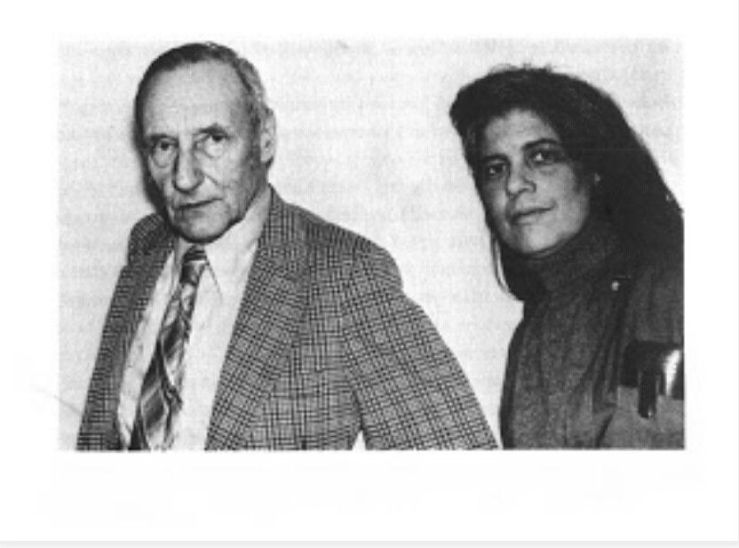
From With William Burroughs: A Report from the Bunker by Victor Bockris. The selection is from Bockris’s recording of a 1980 dinner with Susan Sontag, Stewart Meyer, and Gerard Malanga.

“Old Movie” — William S. Burroughs

“Old Movie”

by

William S. Burroughs


In the noon streets three men sitting on ash cans. One of the men looked up and saw Agent 23. Electric hate crackled between them. In a panic 23 tried to pull his eyes back. He could not do so. He held one point and felt the pilot land. Something cracked in his head like a red egg and the ground swayed beneath him then he could feel it pouring out his eyes. A crowd was gathering quick and silent eyes blazing hate. 23 ran toward them up the narrow street moving his head from side to side burning a path through charred flesh and shredded brains running very light on his feet up the steep stone street toward the skies of Marrakech the whole film tilted now the stones moving in waves under his feet a blaze of blue and he was stabbing two black holes in the blue sky smoking with a sound like falling mountains the sky ripped open and he was through the film barrier. Standing naked in front of a washstand copper luster basin the film jumped and shifted music across the golf course he was a caddy it seems looking for lost balls by the pond flickering silver buttocks in the dark room fading flickering all from an old movie that will give at his touch.

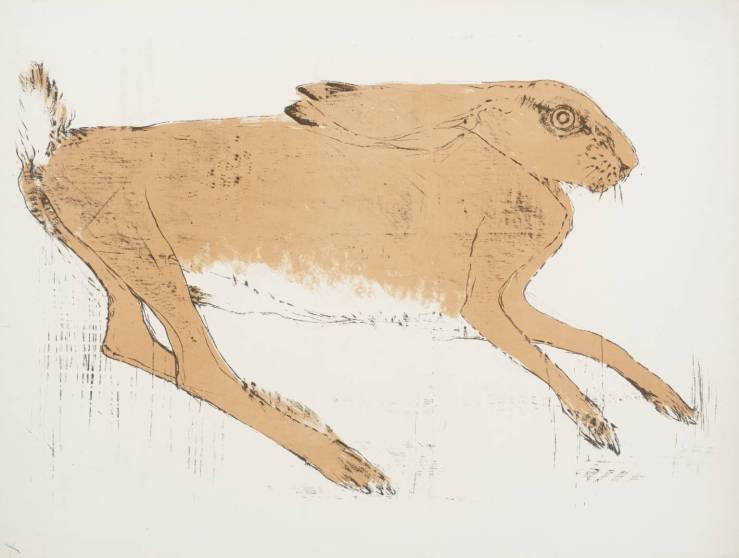
Hare — Elisabeth Frink

Hare, 1967 by Elisabeth Frink (1930-1993)

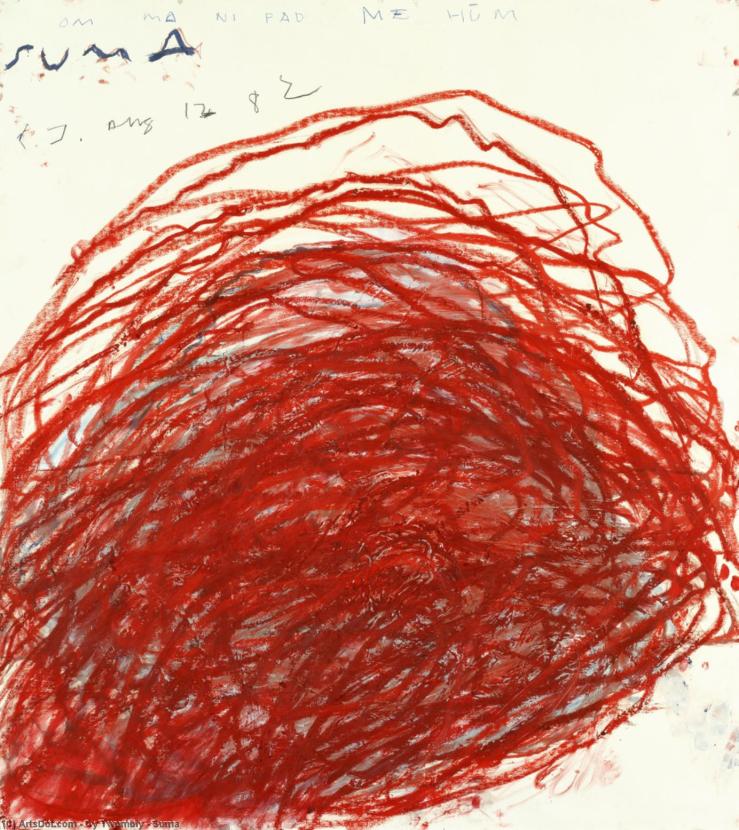
Suma — Cy Twombly

Suma, 1982 by Cy Twombly (1928-2011)

“Buried in Colorado All Alone” — Joy Williams

“Buried in Colorado All Alone”

by

Joy Williams

from 99 Stories of God


The girl from the pharmacy who delivered Darvon to Philip K. Dick, the science fiction writer, wore a golden fish necklace.

“What does that mean?” asked Dick.

She touched it and said, “This is a sign worn by the early Christians so that they would recognize one another.”

“In that instant,” Dick writes, “I suddenly experienced anamnesis, a Greek word meaning, literally, loss of forgetfulness.”

Anamnesis is brought on by the action of the Holy Spirit. The person remembers his true identity throughout all his lives. The person recognizes the world for what it is—his own prior thought formations—and this generates the flash. He now knows where he is.

BURIED IN COLORADO ALL ALONE

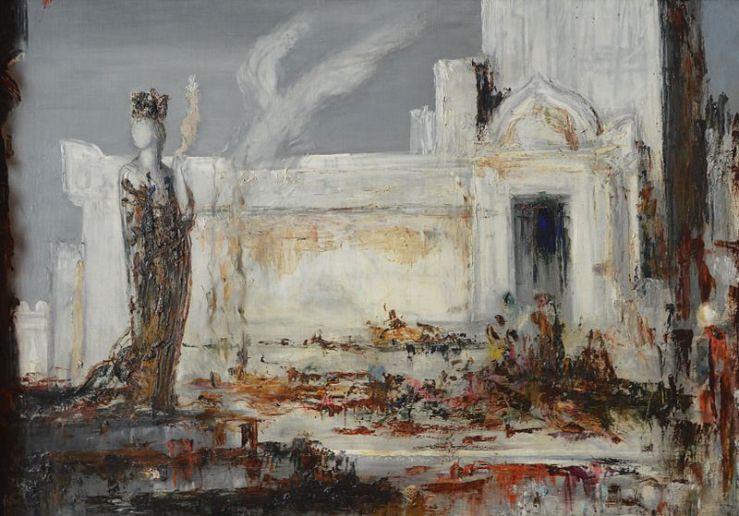
Helen at the Scaean Gate — Gustave Moreau

Helen at the Scaean Gate, c. 1880s by Gustave Moreau (1826–1898)

The Expulsion from Paradise — Paco Pomet

The Expulsion from Paradise, 2017 by Paco Pomet (b. 1970)


Read Vladimir Sorokin’s beautiful, abject, horrifying story “Nastya”

You can read the full text of  Vladimir Sorokin’s beautiful, abject, horrifying very long short story “Nastya” at The Baffler. 

The novella-length piece swirls between fairy tale magic and Sadean cruelty. It is probably best if you consume “Nastya” on an empty stomach—like his novel Their Four Hearts, “Nastya” is reminiscent of Pasolini’s horrifying masterpiece Salò, or the 120 Days of Sodom. And like Their Four Hearts, this story is translated by Max Lawton, who vividly conveys the dream-nightmare-reality energy of Sorokin’s prose.

“Nastya” is from the collection Red Pyramid, which will publish in Lawton’s English-language translation early next year. (You can read the title story here.)

Here are the opening paragraphs of “Nastya”

A GRAYISH-BLUE LULL BEFORE DAWN, a slow boat on the heavy mirror of Denezh Lake, emerald caverns in the juniper bushes creeping menacingly toward the white wash of the alpine waters.

Nastya turned the brass knob of the door to the balcony and pushed it open. The thick, reeded glass swam to the right, splintering the landscape with its parallel flutes and mercilessly dividing the little boat into twelve pieces. A damp avalanche of morning air flowed through the open door, embraced her, and shamelessly flew up into her nightgown.

Nastya inhaled greedily through her nose and walked out onto the balcony.

Her warm feet recognized the cool wood, and its boards creaked gratefully. Nastya lay her hands upon the peeling paint of the railing, tears came to her eyes as she took in the motionless world: the left and right wings of the manor, the garden’s milky green, the severity of the linden grove, the sugar-cube church on the hill, the willow branches lying on the ground, the stacks of mown grass.

Nastya rolled her wide, thin shoulders, let down her hair, and stretched out with a moan, listening to her vertebrae crack as her body woke up.

And here is a sentence from later in the story that made me laugh out loud:

“Don’t dare overcook my daughter!”

Great fucked up stuff.

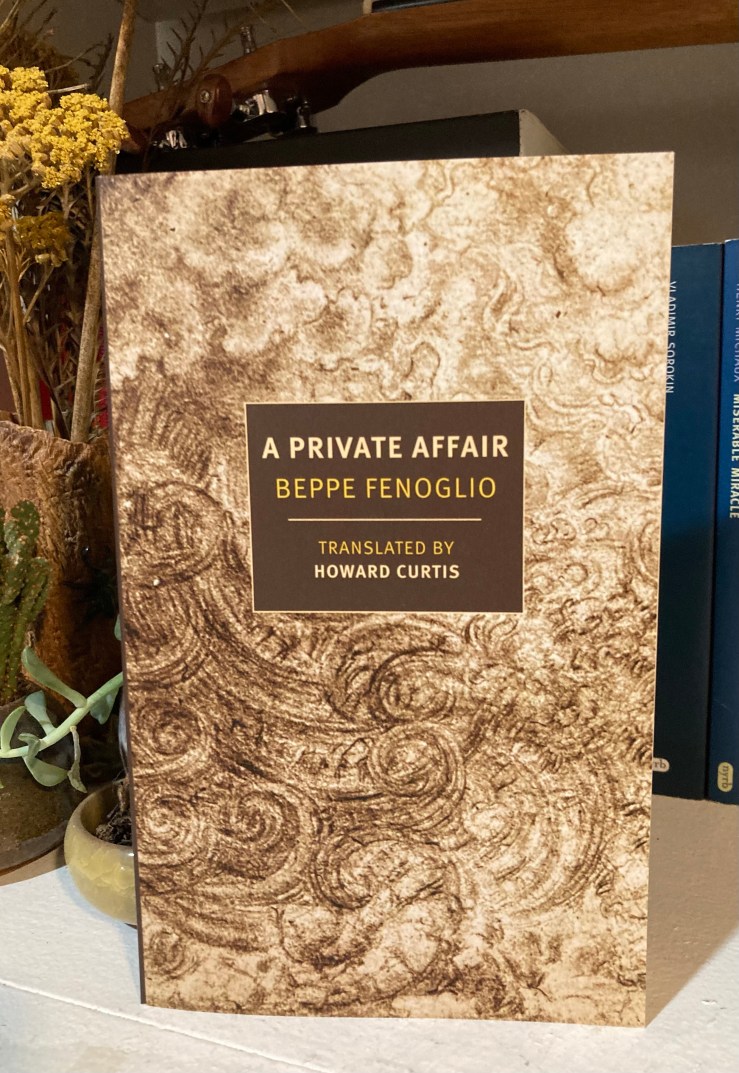
Beppe Fenoglio’s A Private Affair (Book acquired, 9 Jan. 2023)

Beppe Fenoglio’s A Private Affair is forthcoming this spring in translation by Howard Curtis from NYRB. Their blurb:

Milton—the name is a nom de guerre—is a member of a partisan band battling Italian Fascists and German forces in the chaotic last years of World War II. Before the war Milton was a student of English literature and a lover of poetry. He was in love with a girl, too, Fulvia, and from time to time she’d invite him over to her rich family’s fine house and have him read to her. Now, in the thick of war, he discovers that handsome Giorgio, his friend and fellow partisan, was sleeping with Fulvia at the time. Furious with jealousy, Milton hastens to have it out with Giorgio, but Giorgio has been captured by the Germans. A Private Affair tells the story of Milton’s mad quest—through mud and fog, rain and terror, while barely evading enemy patrols—to rescue his friend, the better to settle a grudge from a lost world of peace. Beppe Fenoglio’s masterpiece is a peerless story of the violent heart and world.

The Cage — Lawrence Daws

The Cage, 1972 by Lawrence Daws (b. 1927)

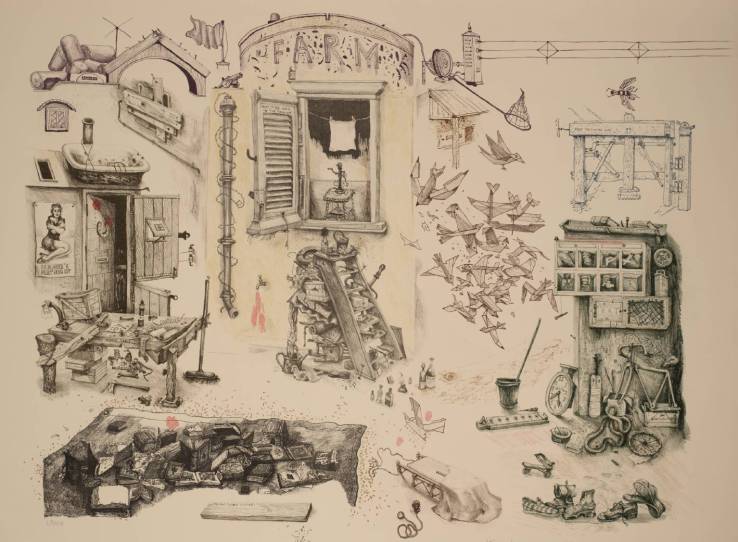
Farm — Chris Orr

Farm, 1975 by Chris Orr (b. 1943)

Farce, then tragedy | A few thoughts on Osvaldo Soriano’s novel A Funny Dirty Little War

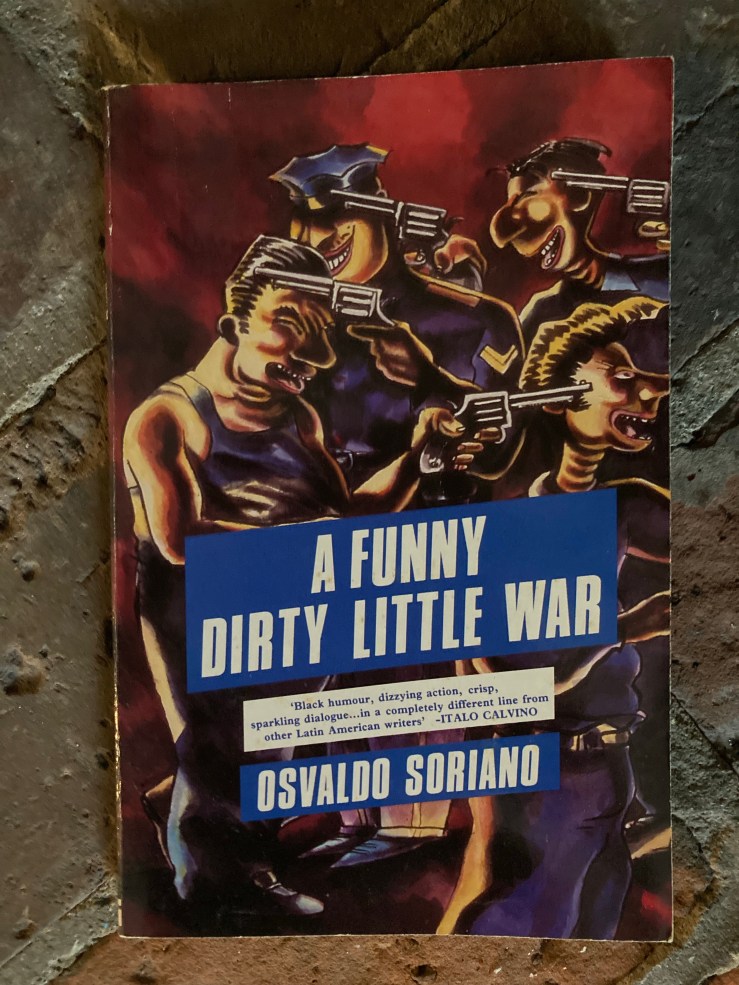
I had never heard of the Argentinian author Osvaldo Soriano, but I plucked his novel A Funny Dirty Little War from the bookstore shelf because of its title. The goofy, menacingly violent cover, featuring an illustration by Oscar Zarate, intrigued me, and the Italo Calvino blurb on the back sold me on the book before I’d even opened it.

Calvino’s blurb offers a succinct summary of the novel:

A Funny Dirty Little War tells the story of a political confrontation in a small village in Argentina. Obscure differences between Peronist supporters and leaders escalate in a crescendo of violence to the final massacre.

Those “obscure differences” first evince as absurd, petty eruptions between the various characters. “You’ve got infiltrators,” the novel opens, and from there accusations accumulate and intensify.

That first accuser is the Inspector, who tells Ignacio, the city’s Council Leader, to fire a mild mannered clerk for his Marxist sympathies. Ignacio refuses, and the early part of the novel casts his as the closest thing to the protagonist. To be clear though, Soriano’s journalistic style recalls Hemingway’s brevity. His camera rarely dips into the interior lives of his characters; most of the action is conveyed in short, punchy sentences and often-terse, often-humorous dialogue. As Calvino observes, the “characters, who with each chapter evolve from the comic and grotesque to the tragic, are observed by the author with a cool, dispassionate gaze.”

The initial grotesquerie lends the novel a farcical air at the outset. Ignacio quickly deputizes an ad hoc militia to square off against the Inspector and his goon squad, and the atmosphere is one of buffoonish amateurism, best encapsulated in the drunken agricultural pilot who takes to the sky to spray DDT on his adversaries. As the violence escalates, we get farther from any ideological differences. Both sides claim to be true Peronists, yet there’s no real politics here beyond grievances exploding into vengeance.

That vengeance and violence overtakes the farcical absurdity of the novel’s first half, sweeping into brusque tragedy. “[In} the end we are left with a feeling of bitter pity,” Calvino writes, and I agree. There is a punchline at the end of the novel, but that punchline isn’t the novel’s cumulative, explosive slaughter—an explosion, an abject corpse laid out on a toilet.

Nick Caistor’s translation telegraphs Soriano’s journalistic, clipped style. At times, I wished that the dialogue might be rougher. While the men do curse at each other, there’s a veneer of gentility that at times seems out of place (at times I found myself substituting words or phrases I thought one of Bolaño’s translators might have employed). A Funny Dirty Little War could be even dirtier.

I’m not sure if Caistor or an editor or even Soriano settled on the English title A Funny Dirty Little War, which, as I mentioned above, called for my attention. Soriano’s original title is No habrá más penas ni olvido: “Pain and longing shall be no more.” This original title (from a tango by Carlos Gardel and Alfredo Le Pera that expresses a longing to return to Argentina) suggests the deeper melancholy behind the narrative’s farcical, funny contours. The novel was first published in 1978, while Soriano was living in exile in Europe after the US-supported 1976 military coup in Argentina. He returned to Buenos Aires in 1984 after the junta’s collapse. Caistor’s English translation of No habrá más penas ni olvido published two years later.

A Funny Dirty Little War will in no way explain the Dirty War to those unfamiliar with its history. The causes and effects here unfold in the most basic way (all in a neat Aristotelian unity of action, place, and time). There is no introspection, no analysis—the violence just escalates. Absurd farce hurtles into absurd tragedy. Yet for all their outlandish, grotesque contours, Soriano’s characters are ultimately sympathetic. Or at least pathetic. In any case, this short novel will reward those who don’t mind their black humor extra bitter, with a heavy dose of violence.

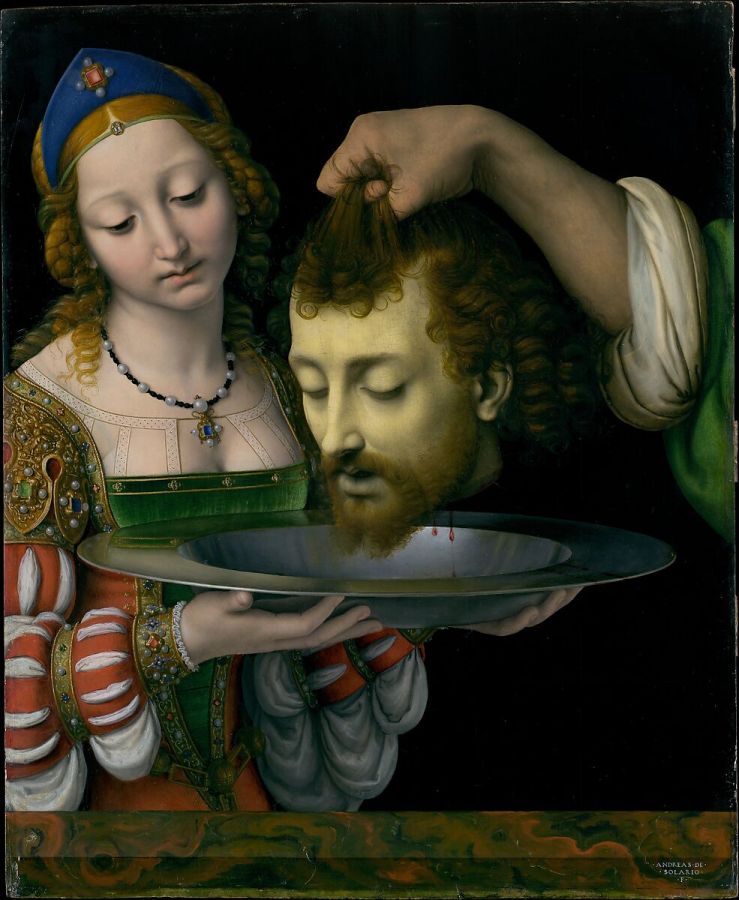
Salome with the Head of Saint John the Baptist — Andrea Solario

Salome with the Head of Saint John the Baptist (c. 1507–1509) by Andrea Solario (1460–1524)

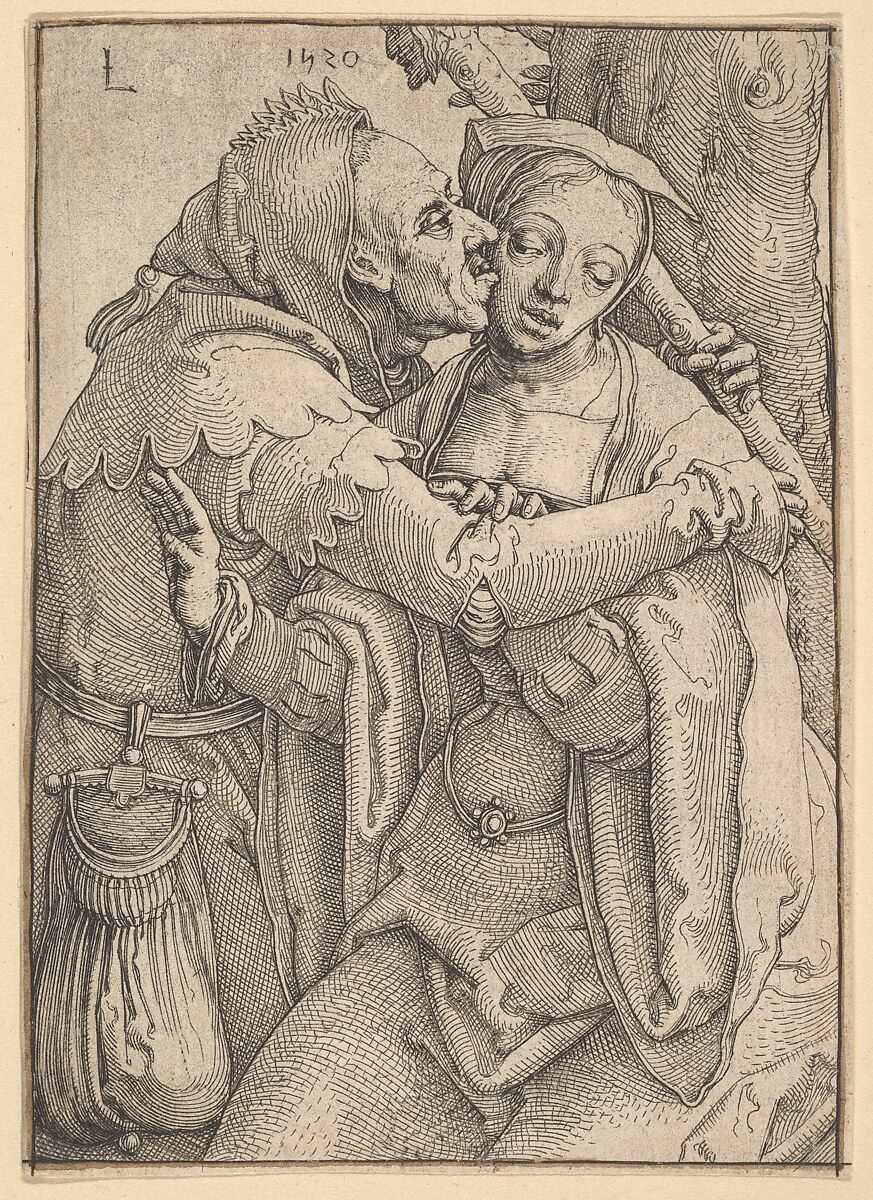
A Fool and a Woman — Lucas van Leyden

A Fool and a Woman, 1520 by Lucas van Leyden (c. 1494–1533)

Well, what happened there is a metaphor | William H. Gass

The full metaphor is not accepted any more. It isn’t taken seriously, and as we say, an arm of the sea threw a curve at the batter. No. Things do deflate and become literal in that sense. That is a conventional, standard way of thinking. My notion of metaphor comes again from scientific practice. Science consists of two realms of scientific operation: on one view, mathematical systems are proceeding and developing on their own, with their own rules on relationship. Then on the other side you have a collection of observations — very chaotic, unorganized. The idea of science is to get the observations into the system, because over here in the system all is wonderful, deductive, clear (relatively speaking). If we could get the observations over here, we could create a model which is an invested system. What Galileo did, for example, was to figure out how to get motion into geometry, once he saw that an inclined plane was a triangle, or that he could get, say, distance as a rectangle with speed and time — it’s just the same formula as the area of a rectangle. Then somebody like Descartes transforms the whole science of mechanics by putting geometry into algebra—makes it a much more sophisticated, subtle system. Everything is transformed without any move except that the algebra swallows geometry, and geometry has swallowed kinetics.

So you have those great moves, and what it means is that what science does is develop a model in which we look at the shadow the tree casts, and we see a right triangle. If we make a few measurements, we make some deductions. Now, what a metaphor tends to do, it seems to me, is that one element of a metaphor tends to stand as the abstract system, while the other is the set of unorganized observations, and what you build is a model that all observational system to be structured by the abstract system is a choice — it is arbitrary, in the sense that there is nothing more abstract about the one term in the metaphor than the other. And you can have interactive ones where they take turns — this suddenly is the abstract system where it was disorganized.

Furthermore, what is the system? Let’s say, “rose.” There is a history of the term, and it isn’t organized in a nice, algebraic way. It is, in fact, this great landscape of meanings connected in various ways, and sometimes not, and even connected with other meanings — “he rose up” — just on sound parallels. We now create this model that is one thing seen in terms of this whole system. Then, just as in science, you have the scope of the law. It only holds for gases. It has only a range of things. And so there is this scope of the metaphor: How far is it pushed? Is it just to be held for a certain distance, and then dropped? Shakespeare is wonderful, because he tends to hold on to an image throughout a play.

For me, when you are doing this, you are exploring what would happen to this one meaning if it suddenly reorganized. Then it produces a multiple of metaphors, of models. One of my favorite examples is in Shakespeare’s Antony and Cleopatra, “The hearts that spanieled me at heels.” Antony is complaining that his followers have deserted him: “Hearts that spanieled me at heels, to whom I gave their wishes, do discandy, melt their sweets on blossoming Caesar, and this pine is barked, that overtopped them all.” Well, what happened there is a metaphor. “Hearts” right from the beginning is a pun on “harts,” in a way, and then the dog imagery for the followers is put inside, and then another one and then another one. Incredibly complex, incredibly rich multiplying imagery. You know how the followers behave, in detail. But every phrase is a metaphor.

From an interview with William H. Gass published in 2002 in Contemporary Literature, vol. 43, no. 4. Jim Neighbors conducted the interview.