He had brought with him a dime novel, one of the Chums of Chance series, The Chums of Chance at the Ends of the Earth, and for a while each night he sat in the firelight and read to himself but soon found he was reading out loud to his father’s corpse, like a bedtime story, something to ease Webb’s passage into the dreamland of his death.
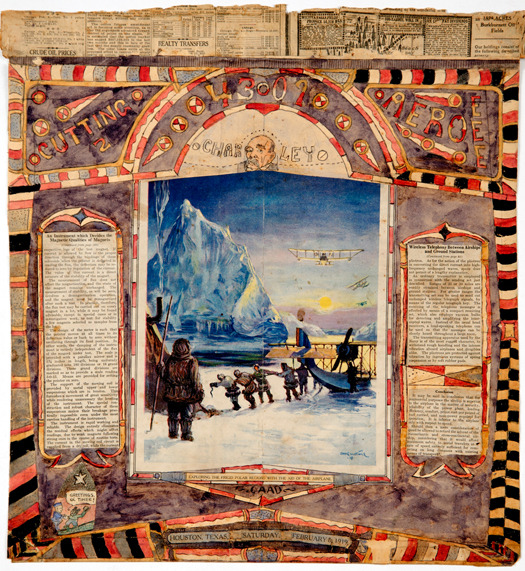
Reef had had the book for years. He’d come across it, already dog-eared, scribbled in, torn and stained from a number of sources, including blood, while languishing in the county lockup at Socorro, New Mexico, on a charge of running a game of chance without a license. The cover showed an athletic young man (it seemed to be the fearless Lindsay Noseworth) hanging off a ballast line of an ascending airship of futuristic design, trading shots with a bestially rendered gang of Eskimos below. Reef began to read, and soon, whatever “soon” meant, became aware that he was reading in the dark, lights-out having occurred sometime, near as he could tell, between the North Cape and Franz Josef Land. As soon as he noticed the absence of light, of course, he could no longer see to read and, reluctantly, having marked his place, turned in for the night without considering any of this too odd. For the next couple of days he enjoyed a sort of dual existence, both in Socorro and at the Pole. Cellmates came and went, the Sheriff looked in from time to time, perplexed.
At odd moments, now, he found himself looking at the sky, as if trying to locate somewhere in it the great airship. As if those boys might be agents of a kind of extrahuman justice, who could shepherd Webb through whatever waited for him, even pass on to Reef wise advice, though he might not always be able to make sense of it. And sometimes in the sky, when the light was funny enough, he thought he saw something familiar. Never lasting more than a couple of watch ticks, but persistent. “It’s them, Pa,” he nodded back over his shoulder. “They’re watching us, all right. And tonight I’ll read you some more of that story. You’ll see.”
Riding out of Cortez in the morning, he checked the high end of the Sleeping Ute and saw cloud on the peak. “Be rainin later in the day, Pa.”
“Is that Reef? Where am I? Reef, I don’t know where the hell I am—”
“Steady, Pa. We’re outside of Cortez, headin up to Telluride, be there pretty soon—”
“No. That’s not where this is. Everthin is unhitched. Nothin stays the same. Somethin has happened to my eyes. . . .”
“It’s O.K.”
“Hell it is.”
—From Thomas Pynchon’s novel Against the Day (215).
1. There’s so much I like about this passage.
2. First, Pynchon explicitly ties together two groups of his characters here. Pynchon connects the Traverses of Colorado with those champions of the ether, The Chums of Chance.
And he does it through a novel, which I’ll get to in a minute.
3. I’ve already remarked on the adventurous, even light-hearted tone of the Chums of Chance episodes, which often buoy the narrative out of its byzantine winding.
4. The Chums passages contrast strongly with the Colorado episodes featuring the Traverses.
While Pynchon is not really known for his pathos or the depth of his characters, the Traverse story line is genuinely moving. We see the family disintegrate against the greed of the Colorado mining rush. Patriarch Webb cannot hold his family together, and he gives over to a deep bitterness; his union becomes his raison d’etre, and he undertakes dangerous secret missions to fight the forces of capitalism. It’s worth giving Webb’s opinion at length:
“Here. The most precious thing I own.” He took his union card from his wallet and showed them, one by one. “These words right here”—pointing to the slogan on the back of the card— “is what it all comes down to, you won’t hear it in school, maybe the Gettysburg Address, Declaration of Independence and so forth, but if you learn nothing else, learn this by heart, what it says here—‘Labor produces all wealth. Wealth belongs to the producer thereof.’ Straight talk. No doubletalking you like the plutes do, ’cause with them what you always have to be listening for is the opposite of what they say. ‘Freedom,’ then’s the time to watch your back in particular—start telling you how free you are, somethin’s up, next thing you know the gates have slammed shut and there’s the Captain givin you them looks. ‘Reform’? More new snouts at the trough. ‘Compassion’ means the population of starving, homeless, and dead is about to take another jump. So forth. Why, you could write a whole foreign phrase book just on what Republicans have to say.”
5. It’s also worth pointing out that Webb is likley the Kieselguhr Kid: He has a secret identity and secret powers, like many of the characters who inhabit Against the Day.
6. The Traverse passages recall the social realism of Steinbeck at times, with a dose of the moralizing we might find in Upton Sinclair. There’s also a heavy dash of Ambrose Bierce’s cynicism, and something of Bret Harte’s milieu here.
A kind of ballast for Pynchon’s flightier whims? Not sure.
7. Returning to our initial citation:
As prodigal son Reef Traverse moves his father’s corpse across Colorado, he reads from The Chums of Chance at the Ends of the Earth. We learn that he’s had the dime novel for years and we learn of its physical condition — “dogeared, scribbled in, torn and stained from a number of sources, including blood.” The book is a kind of abject survivor, a physical totem with powers of endurance, which, in turn, grants metaphysical powers on its user-reader.
8. (Parenthetical (i.e. unexplored) aside: The cover of The Chums of Chance at the Ends of the Earth features handsome, uptight Lindsay Noseworth facing off against a “bestially rendered gang of Eskimos.” Here is our Manifest Destiny; here is our White Man’s Burden).
9. The Chums of Chance at the Ends of the Earth allows Reef brief transcendence of time (“whatever ‘soon’ meant”) and space (it provides him escape from his jail cell).
10. Also: The Chums of Chance at the Ends of the Earth grants its reader the power to read in the dark. There is something of a huge in-joke here that all late-night readers will appreciate.
Also: the major motif of At the End of the Day is darkness and light. The Chums of Chance at the Ends of the Earth works as a kind of self-illuminating object outside the confines of the physical world, but only when the user is not conscious of this power (“As soon as he noticed the absence of light, of course, he could no longer see to read”).
11. The Chums of Chance at the Ends of the Earth bestows upon Reef, its operator, “a sort of dual existence, both in Socorro and at the Pole.” This relationship, again, won’t be unfamiliar to voracious readers. Hell, many of us chase that transcendent space the rest of our lives. The older we get, the harder it is to get back to Dickensian London or Rivendell or Crusoe’s island or Narnia or Thornfield Hall or wherever it was that we got to live out part of our dual existence.
Here Reef, a grown-ass man, gets to be one of the Chums and traverse an alien frontier.
12. And the biggie: Somehow this dime novel wakes the dead.
Now, it’s easy to say that Webb doesn’t really talk to Reef, just as we can easily say that Reef doesn’t really head to the pole with the Chums, doesn’t really transcend time and space, etc. We could look for simple answers in psychology—Reef has internalized his father’s voice; Reef is going mad.
But I think Pynchon’s presentation of the scene suggests something more—but something I don’t know how to name or describe, only a fifth of the way into this book. Something to look for in any case.
And so thus end with Webb’s line: “Somethin has happened to my eyes.”
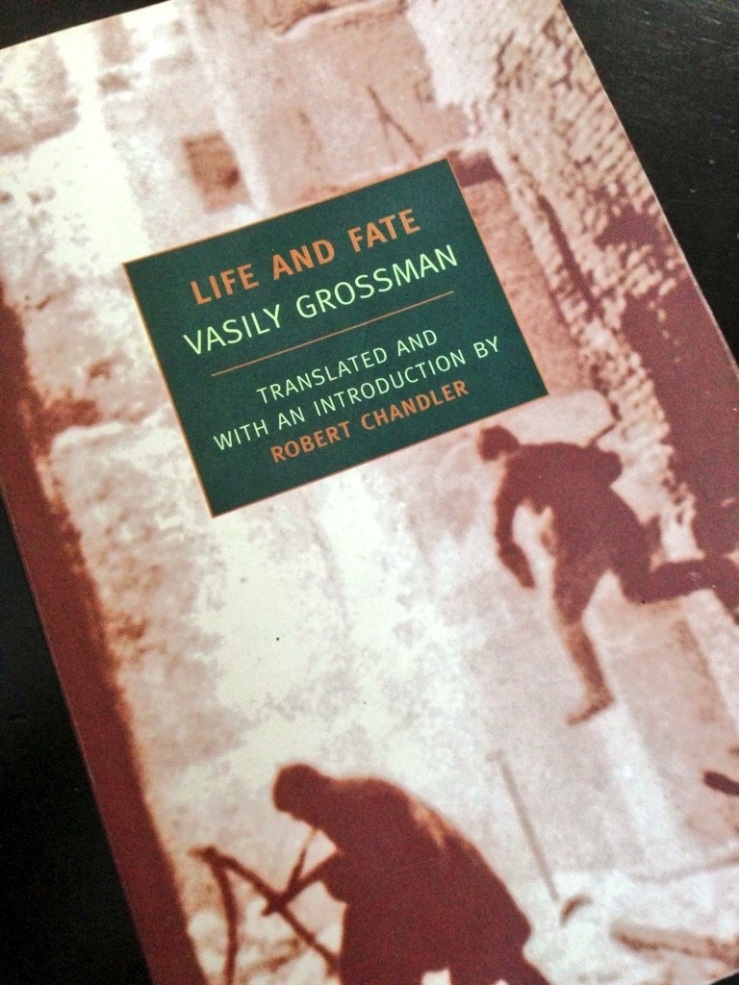
Big thanks to Mr. BLCKDGRD for sending me this copy of Vasily Grossman’s enormous novel Life and Fate. Over the past few years I’ve come to admire and trust BLCKDGRD’s taste, and I generally love these types of novels, so I’m looking forward to getting into this later in the year.
Here’s publisher NYRB’s blurb:
A book judged so dangerous in the Soviet Union that not only the manuscript but the ribbons on which it had been typed were confiscated by the state, Life and Fate is an epic tale of World War II and a profound reckoning with the dark forces that dominated the twentieth century. Interweaving a transfixing account of the battle of Stalingrad with the story of a single middle-class family, the Shaposhnikovs, scattered by fortune from Germany to Siberia, Vasily Grossman fashions an immense, intricately detailed tapestry depicting a time of almost unimaginable horror and even stranger hope. Life and Fate juxtaposes bedrooms and snipers’ nests, scientific laboratories and the Gulag, taking us deep into the hearts and minds of characters ranging from a boy on his way to the gas chambers to Hitler and Stalin themselves. This novel of unsparing realism and visionary moral intensity is one of the supreme achievements of modern Russian literature.
TO SEEK to extinguish anger utterly, is but a bravery of the Stoics. We have better oracles: Be angry, but sin not. Let not the sun go down upon your anger. Anger must be limited and confined, both in race and in time. We will first speak how the natural inclination and habit to be angry, may be attempted and calmed. Secondly, how the particular motions of anger may be repressed, or at least refrained from doing mischief. Thirdly, how to raise anger, or appease anger in another.
For the first; there is no other way but to meditate, and ruminate well upon the effects of anger, how it troubles man’s life. And the best time to do this, is to look back upon anger, when the fit is thoroughly over. Seneca saith well, That anger is like ruin, which breaks itself upon that it falls. The Scripture exhorteth us to possess our souls in patience. Whosoever is out of patience, is out of possession of his soul. Men must not turn bees;
… animasque in vulnere ponunt.
Anger is certainly a kind of baseness; as it appears well in the weakness of those subjects in whom it reigns; children, women, old folks, sick folks. Only men must beware, that they carry their anger rather with scorn, than with fear; so that they may seem rather to be above the injury, than below it; which is a thing easily done, if a man will give law to himself in it.
For the second point; the causes and motives of anger, are chiefly three. First, to be too sensible of hurt; for no man is angry, that feels not himself hurt; and therefore tender and delicate persons must needs be oft angry; they have so many things to trouble them, which more robust natures have little sense of. The next is, the apprehension and construction of the injury offered, to be, in the circumstances thereof, full of contempt: for contempt is that, which putteth an edge upon anger, as much or more than the hurt itself. And therefore, when men are ingenious in picking out circumstances of contempt, they do kindle their anger much. Lastly, opinion of the touch of a man’s reputation, doth multiply and sharpen anger. Wherein the remedy is, that a man should have, as Consalvo was wont to say, telam honoris crassiorem. But in all refrainings of anger, it is the best remedy to win time; and to make a man’s self believe, that the opportunity of his revenge is not yet come, but that he foresees a time for it; and so to still himself in the meantime, and reserve it.
To contain anger from mischief, though it take hold of a man, there be two things, whereof you must have special caution. The one, of extreme bitterness of words, especially if they be aculeate and proper; for cummunia maledicta are nothing so much; and again, that in anger a man reveal no secrets; for that, makes him not fit for society. The other, that you do not peremptorily break off, in any business, in a fit of anger; but howsoever you show bitterness, do not act anything, that is not revocable.
For raising and appeasing anger in another; it is done chiefly by choosing of times, when men are frowardest and worst disposed, to incense them. Again, by gathering (as was touched before) all that you can find out, to aggravate the contempt. And the two remedies are by the contraries. The former to take good times, when first to relate to a man an angry business; for the first impression is much; and the other is, to sever, as much as may be, the construction of the injury from the point of contempt; imputing it to misunderstanding, fear, passion, or what you will.
Must we no longer believe in words? Since when do they express the contrary of what the organ that utters them thinks and wants?
Herein fies the great secret:
Thought is made in the mouth
— Tristan Tzara, from Dada Manifesto of Feeble Love and Weak Love
The eternal hourglass of existence is turned upside down again and again, and you with it, speck of dust!
The struggle itself toward the heights is enough to fill a man’s heart. One must imagine Sisyphus happy.
Antimetabole. Repetition of two words or short phrases, but in reversed order to establish a contrast. It is a specialized form of chiasmus.
Sometimes a cigar.
Freedom from morality.
Epiphora. The repetition of a phrase or word at the end of several sentences or clauses.
Sisyphus was son of King Aeolus of Thessaly and Enarete, and the founder and first king of Ephyra.
Epizeuxis. Emphasizing an idea using one word repetition.
Everything becomes and recurs eternally – escape is impossible! – Supposing we could judge value, what follows?
Conduplicatio. The repetition of a word in various places throughout a paragraph.
So one must be resigned to being a clock that measures the passage of time, now out of order, now repaired, and whose mechanism generates despair and love as soon as its maker sets it going?
Inque tuo sedisti, Sisyphe, saxo.
Parachesis. Repetition of the same sound in several words in close succession.
New means against the fact of pain.
Epistrophe. The repetition of a word or phrase at the end of every clause.
Are we to grow used to the idea that every man relives ancient torments, which are all the more profound because they grow comic with repetition?
Antanaclasis. The repetition of a word or phrase to effect a different meaning
Tantalus was made to stand in a pool of water beneath a fruit tree with low branches, with the fruit ever eluding his grasp, and the water always receding before he could take a drink.
Anadiplosis. The repetition of the last word of a preceding clause.
The enjoyment of all kinds of uncertainty.
That human existence should repeat itself, well and good, but that it should repeat itself like a hackneyed tune, or a record a drunkard keeps playing as he feeds coins into the jukebox?
Anaphora. The repetition of a word or phrase at the beginning of every clause.
Wu Gang, known for endlessly cutting down a self-healing Bay Laurel on the Moon.
Experimentalism, as a counterweight to this extreme fatalism.
Polyptoton. The repetition of a word or root in different cases or inflections within the same sentence.
Abolition of the concept of necessity. Abolition of the “will.”
The most famous facet of Naranath Branthan’s life is his apparently eccentric habit of rolling big stones up the hill and letting them roll down back, and laughing thunderously on seeing this sight
Polysyndeton. The repeated use of conjunctions within a sentence, particularly where they do not necessarily have to be used.
Abolition of “knowledge-in-itself.”
Nothing is harder to understand than a symbolic work. A symbol always transcends the one who makes use of it and makes him say in reality more than he is aware of expressing.








 Biblioklept