“… this easy, indifferent sword must be chance…” (Moby-Dick)

I was the attendant or page of Queequeg, while busy at the mat. As I kept passing and repassing the filling or woof of marline between the long yarns of the warp, using my own hand for the shuttle, and as Queequeg, standing sideways, ever and anon slid his heavy oaken sword between the threads, and idly looking off upon the water, carelessly and unthinkingly drove home every yarn: I say so strange a dreaminess did there then reign all over the ship and all over the sea, only broken by the intermitting dull sound of the sword, that it seemed as if this were the Loom of Time, and I myself were a shuttle mechanically weaving and weaving away at the Fates. There lay the fixed threads of the warp subject to but one single, ever returning, unchanging vibration, and that vibration merely enough to admit of the crosswise interblending of other threads with its own. This warp seemed necessity; and here, thought I, with my own hand I ply my own shuttle and weave my own destiny into these unalterable threads. Meantime, Queequeg’s impulsive, indifferent sword, sometimes hitting the woof slantingly, or crookedly, or strongly, or weakly, as the case might be; and by this difference in the concluding blow producing a corresponding contrast in the final aspect of the completed fabric; this savage’s sword, thought I, which thus finally shapes and fashions both warp and woof; this easy, indifferent sword must be chance—aye, chance, free will, and necessity—nowise incompatible—all interweavingly working together. The straight warp of necessity, not to be swerved from its ultimate course—its every alternating vibration, indeed, only tending to that; free will still free to ply her shuttle between given threads; and chance, though restrained in its play within the right lines of necessity, and sideways in its motions directed by free will, though thus prescribed to by both, chance by turns rules either, and has the last featuring blow at events.

From “The Mat-Maker,” Chapter 47 of Moby-Dick by Herman Melville.
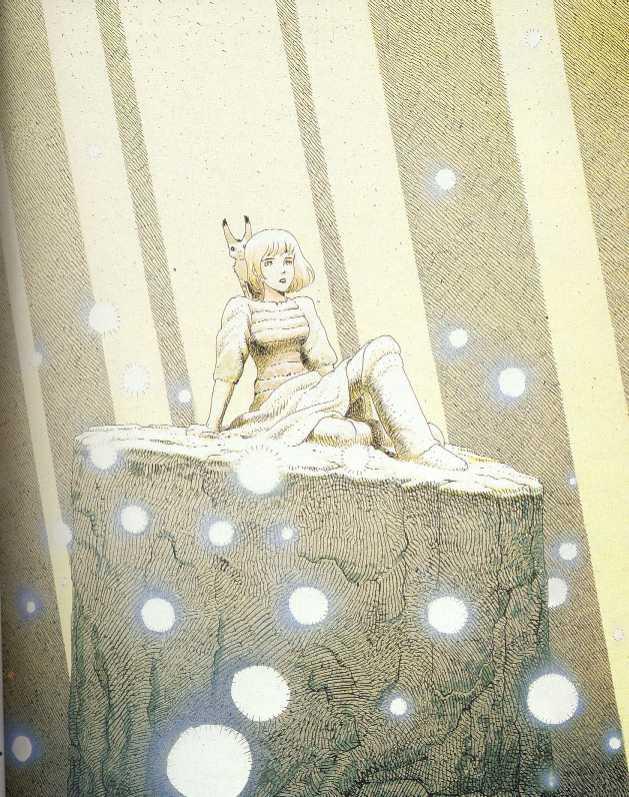
 

Nausicaä of the Valley of the Wind — Moebius

nausicaa-moebius

Orson Welles Talks About Making Fun of Ernest Hemingway

“Cézanne” — Gertrude Stein

“Cézanne” by Gertrude Stein

The Irish lady can say, that to-day is every day. Caesar can say that
every day is to-day and they say that every day is as they say.
In this way we have a place to stay and he was not met because
he was settled to stay. When I said settled I meant settled to stay.
When I said settled to stay I meant settled to stay Saturday. In this
way a mouth is a mouth. In this way if in as a mouth if in as a
mouth where, if in as a mouth where and there. Believe they have
water too. Believe they have that water too and blue when you see
blue, is all blue precious too, is all that that is precious too is all
that and they meant to absolve you. In this way Cézanne nearly did
nearly in this way. Cézanne nearly did nearly did and nearly did.
And was I surprised. Was I very surprised. Was I surprised. I was
surprised and in that patient, are you patient when you find bees.
Bees in a garden make a specialty of honey and so does honey. Honey
and prayer. Honey and there. There where the grass can grow nearly
four times yearly.

“Letter of Advice and Apology to a Young Burglar” — Hilaire Belloc

“Letter of Advice and Apology to a Young Burglar” — Hilaire Belloc


My dear Ormond,

Nothing was further from my thoughts. I had imagined you knew me well enough—and, for the matter of that, all your mother’s family—to judge me better. Believe me, no conception of blaming your profession entered my mind for a moment. Whether there be such a thing as “property” in the abstract I should leave it to metaphysicians to decide: in practical affairs everything must be judged in its own surroundings.

It was not upon any musty theological whimsy that I wrote; the definition of stealing or “theft”—I care not by what name you call it—is not for practical men to discuss. Nor was I concerned with the ethical discussion of burglary (to give the matter its old legal and technical title); it was lack of judgment, sudden actions due to nothing but impulse, and what I think I may call “the speculative side” of a burglar’s life.

You have not, as yet, any great responsibilities. No one is dependent upon you—you have but yourself to provide for; but you must remember that such responsibilities will arrive in their natural course, and that if you form habits of rashness or obstinacy now they will cling to you through life. We are all looking forward to a certain event when Anne is free again; in plain English, my boy, we know your loyal heart, and we shall bless the union; but I should feel easier in my mind if I saw you settled into one definite branch of the profession before you undertook the nurture of a family.

Adventure tempts you because you are brave, and something of a poet in you leads you to unusual scenes of action. Well, Youth has a right to its dreams, but beware of letting a dangerous Quixotism spoil your splendid chances.

Take, for example, your breaking into Mr. Cowl’s house. You may say Mr. Cowl was not a journalist, but only a reviewer; the distinction is very thin, but let it pass. You know and I know that the houses of none in any way connected with the daily Press should ever be approached. It is plain common sense. The journalist comes home at all hours of the night. His servant (if he keeps one) is often up before he is abed. Do you think to enter such houses unobserved? Continue reading ““Letter of Advice and Apology to a Young Burglar” — Hilaire Belloc”

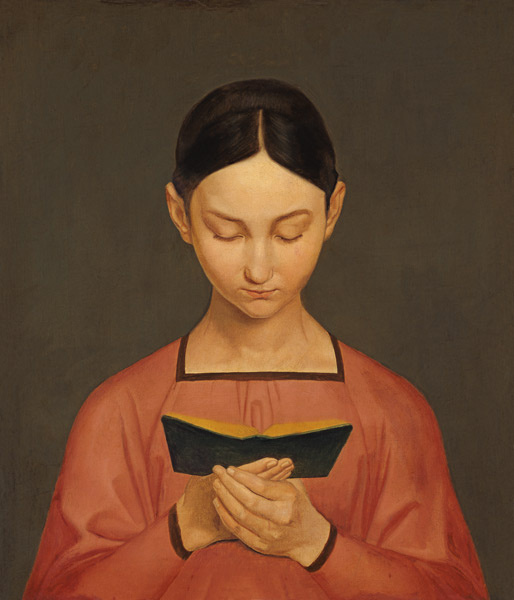
Reading Girl — Gustav Hennig

Lesendes-Maedchen

Summary of Bloom’s Day in Ulysses — Evan Lavender-Smith (From Old Notebooks)

Makes breakfast for his wife. Goes to the butcher. Goes to the post office. Goes to church. Goes to a chemist. Goes to a public bath. Goes to a funeral. Goes to a newspaper press. Goes to a locksmith to canvass an ad. Feeds some seagulls. Goes to a bar. Helps a blind man cross the street. Goes to the museum. Goes to to the library. Visits a bookseller. Window-shops. Goes to a restaurant. Listens to some live music. Writes a love letter. Goes to another bar. Nearly gets in a fight. Masturbates to a beautiful eighteen-year-old exhibitionist giving him a private show. Takes an alfresco nap. Takes up a collection for a widow. Goes to a hospital to visit a pregnant woman. Flits with a nurse. Feeds a stray dog. Goes to a whorehouse. Helps avert a row with the police. Goes to a cabman’s shelter and listens to a sailor tell stories. Breaks into his own house. Urinates under the stars with another man. Watches the sunrise. Kisses his wife on her arse.

It would have been the single busiest, most adventurous day of my life.

From Evan Lavender-Smith’s From Old Notebooks.


“Prepare Your Coffin” — Tortoise

Hemingway and His Infernal Sleeping Bag — Eddie Campbell

campbell_hemingway

(Via).

“…by its indefiniteness it shadows forth the heartless voids and immensities of the universe…” (Moby-Dick)

But not yet have we solved the incantation of this whiteness, and learned why it appeals with such power to the soul; and more strange and far more portentous—why, as we have seen, it is at once the most meaning symbol of spiritual things, nay, the very veil of the Christian’s Deity; and yet should be as it is, the intensifying agent in things the most appalling to mankind.

Is it that by its indefiniteness it shadows forth the heartless voids and immensities of the universe, and thus stabs us from behind with the thought of annihilation, when beholding the white depths of the milky way? Or is it, that as in essence whiteness is not so much a colour as the visible absence of colour; and at the same time the concrete of all colours; is it for these reasons that there is such a dumb blankness, full of meaning, in a wide landscape of snows—a colourless, all-colour of atheism from which we shrink? And when we consider that other theory of the natural philosophers, that all other earthly hues—every stately or lovely emblazoning—the sweet tinges of sunset skies and woods; yea, and the gilded velvets of butterflies, and the butterfly cheeks of young girls; all these are but subtile deceits, not actually inherent in substances, but only laid on from without; so that all deified Nature absolutely paints like the harlot, whose allurements cover nothing but the charnel-house within; and when we proceed further, and consider that the mystical cosmetic which produces every one of her hues, the great principle of light, for ever remains white or colourless in itself, and if operating without medium upon matter, would touch all objects, even tulips and roses, with its own blank tinge—pondering all this, the palsied universe lies before us a leper; and like wilful travellers in Lapland, who refuse to wear coloured and colouring glasses upon their eyes, so the wretched infidel gazes himself blind at the monumental white shroud that wraps all the prospect around him. And of all these things the Albino whale was the symbol. Wonder ye then at the fiery hunt?

From “The Whiteness of the Whale,” Chapter 42 of Moby-Dick by Herman Melville.


Nelson Algren’s Mugshot

(More/about).

“A Dry Spell” — Einar Hjörleifsson Kvaran

“A Dry Spell” by Einar Hjörleifsson Kvaran

It had rained for a fortnight—not all the time heavily, but a fog had sullenly hung about the mountain tops, clinging to the atmosphere and rendering the whole of existence a dull gray colour. Every little while it would discharge a fine drizzle of rain or a heavy shower down upon the hay and everything else on earth, so that only the stones would occasionally be dry—but the grass never.

We were tired of the store—indeed, I should like to know who would have enjoyed it. It dated back to the beginning of the last century, a tarred, coal-black, ramshackle hut. The windows were low and small, the windowpanes diminutive. The ceiling was low. Everything was arranged in such a way as to exclude the possibility of lofty flights of thought or vision.

Just now, not a living soul looked in—not even those thriftless fellows who lived by chance jobs in the village and met in daily conclave at the store. We had often cursed their lengthy visits, but now that they had hired themselves out during the haymaking, we suddenly realized that they had often been entertaining. They had made many amusing remarks and brought us news of the neighbourhood. And now we cursed them for their absence.

We sat there and smoked, staring vacantly at the half-empty shelves, and all but shivering in the damp room. There was no heater in the store at any season, and the one in the office, if used, emitted spurts of smoke through every aperture except the chimney. It had not been cleaned since sometime during winter, and we were not ambitious enough for such an undertaking in the middle of the summer.

We tried to transfer our thoughts from the store to the world outside. We made clever comments to the effect that the farmers were now getting plenty of moisture for the hay-fields, and that it would be a pity if rain should set in now, right at the beginning of the haying season. We had nothing further to say on the subject, but this we repeated from day to day. In short, we were depressed and at odds with things in general. Until the dry spell.

One morning, about nine o’clock, the bank of fog began to move. First, there appeared an opening about the size of your hand, and through it the eastern sky showed a bright blue. Then another opening, and through it shone the sun. Continue reading ““A Dry Spell” — Einar Hjörleifsson Kvaran”

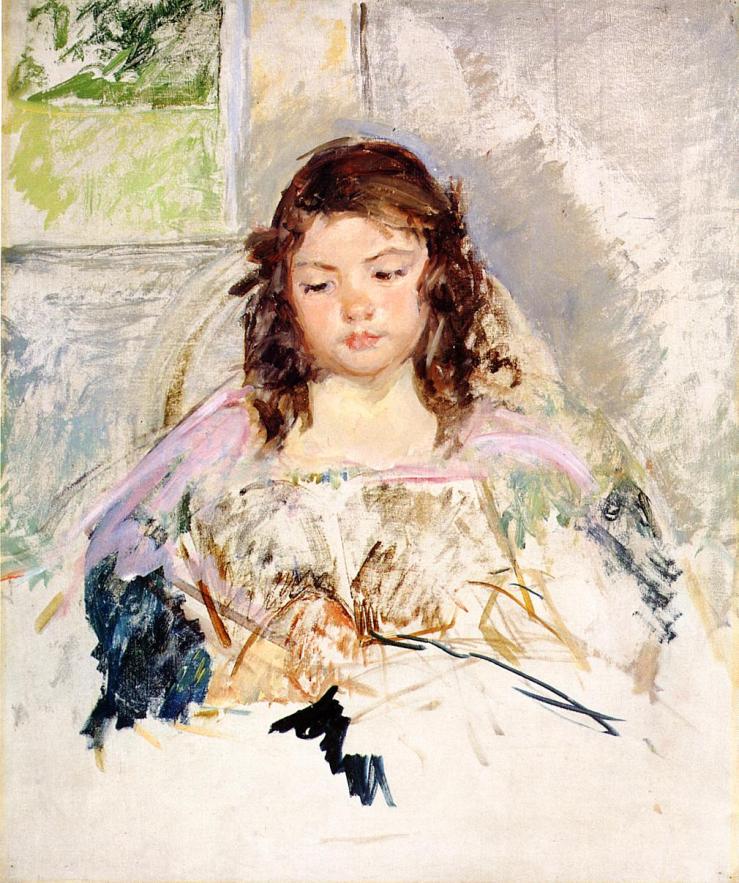
Girl in Pink — Mary Cassatt

sketch-for-francoise-in-a-round-backed-chair-reading-or-a-girl-in-pinkM

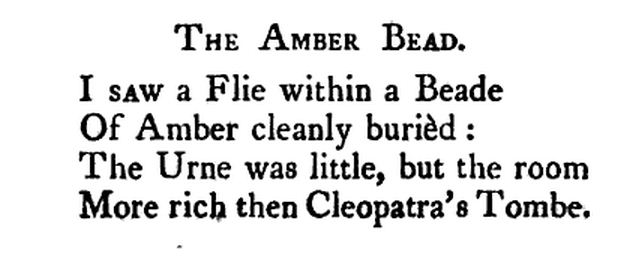
“The Amber Bead” — Robert Herrick

herrick

Lindsay Anderson on Ozu’s Tokyo Story

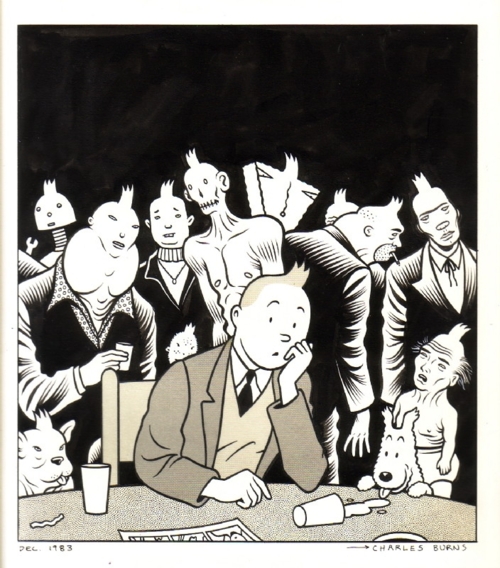
Tintin — Charles Burns

tintin charles burns

Margaret Atwood on Hiding Exposition from the Reader