Bluebeard’s Castle — Béla Bartók (Full Performance)

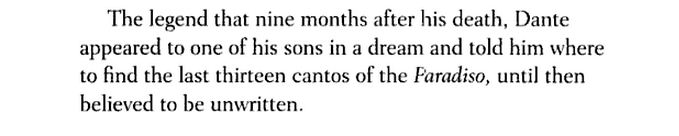
Dante Legend, as Reported by David Markson

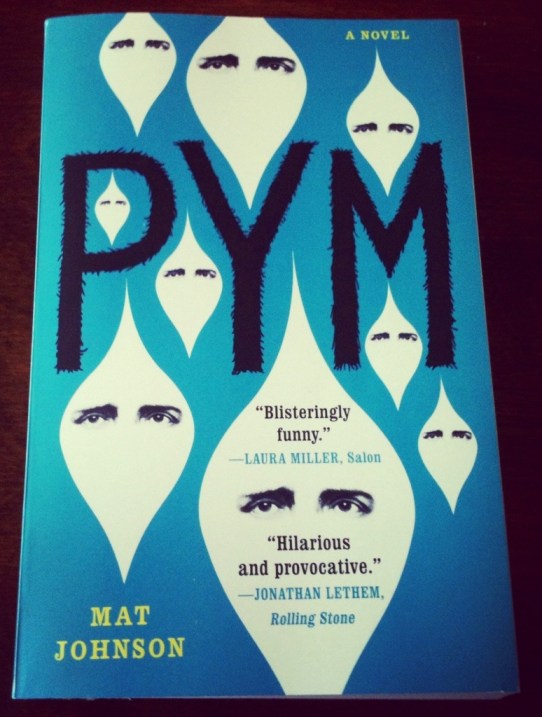
Pym (Book Acquired, 8.16.2012)


20120818-174043.jpg

I wanted to read Mat Johnson’s novel Pym when it came out last year, so I was pleased when Random House sent me a copy of the forthcoming trade paperback. Random House’s blurb:

Recently canned professor of American literature Chris Jaynes has just made a startling discovery: the manuscript of a crude slave narrative that confirms the reality of Edgar Allan Poe’s strange and only novel,The Narrative of Arthur Gordon Pym of Nantucket. Determined to seek out Tsalal, the remote island of pure and utter blackness that Poe describes, Jaynes convenes an all-black crew of six to follow Pym’s trail to the South Pole, armed with little but the firsthand account from which Poe derived his seafaring tale, a bag of bones, and a stash of Little Debbie snack cakes. Thus begins an epic journey by an unlikely band of adventurers under the permafrost of Antarctica, beneath the surface of American history, and behind one of literature’s great mysteries.


By Reading — David Burliuk

The Temptation of St. Anthony (Detail) — Matthias Grünewald

Werner Herzog’s Wheel of Time (Full Documentary)

List with No Name #4

  1. A Tale of Two Cities
  2. Robinson Crusoe
  3. The Iliad
  4. Maggie: A Girl of the Streets
  5. Tender Is the Night
  6. Catch-22
  7. Native Son

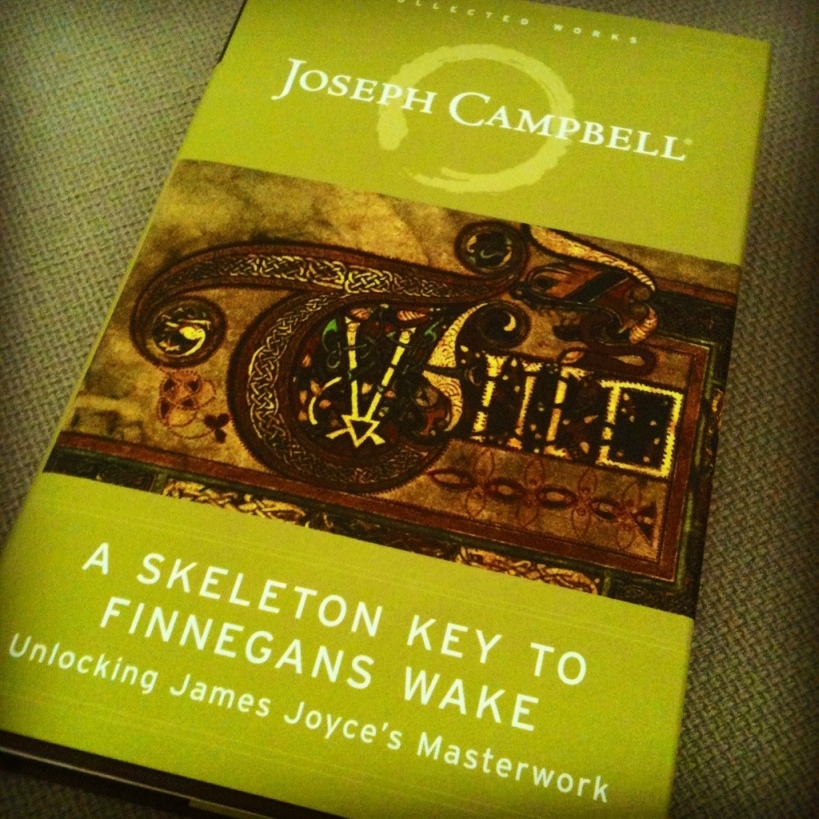
A Skeleton Key to Finnegans Wake (Book Acquired, 8.18.2012)


20120818-174214.jpg

A few weeks ago, for some reason beyond my ken, I stumbled into Finnegans Wake, read on the gentle glow of my Kindle Fire. I’ve been poking into the book for years now, but that particular night I read it with an ease—not an ease of understanding, but an ease of spirit, or of mind. Or ear, really. I had fun with it. I went back each night since then, sometimes only going through a page or two before slipping into slumbers.

Anyway, I’ve been searched for a used copy of Joseph Campbell’s Skeleton Key to the Wake for years, but I finally just broke down and ordered a new copy through my bookstore.  My plan is to read Finnegans Wake next year. It’s not a plan, so much as something I’ve just typed.


“John Mortonson’s Funeral” — Ambrose Bierce

“John Mortonson’s Funeral,” a very short story by Ambrose Bierce

John Mortonson was dead: his lines in ‘the tragedy “Man”‘ had all been spoken and he had left the stage.

The body rested in a fine mahogany coffin fitted with a plate of glass. All arrangements for the funeral had been so well attended to that had the deceased known he would doubtless have approved. The face, as it showed under the glass, was not disagreeable to look upon: it bore a faint smile, and as the death had been painless, had not been distorted beyond the repairing power of the undertaker. At two o’clock of the afternoon the friends were to assemble to pay their last tribute of respect to one who had no further need of friends and respect. The surviving members of the family came severally every few minutes to the casket and wept above the placid features beneath the glass. This did them no good; it did no good to John Mortonson; but in the presence of death reason and philosophy are silent.

As the hour of two approached the friends began to arrive and after offering such consolation to the stricken relatives as the proprieties of the occasion required, solemnly seated themselves about the room with an augmented consciousness of their importance in the scheme funereal. Then the minister came, and in that overshadowing presence the lesser lights went into eclipse. His entrance was followed by that of the widow, whose lamentations filled the room. She approached the casket and after leaning her face against the cold glass for a moment was gently led to a seat near her daughter. Mournfully and low the man of God began his eulogy of the dead, and his doleful voice, mingled with the sobbing which it was its purpose to stimulate and sustain, rose and fell, seemed to come and go, like the sound of a sullen sea. The gloomy day grew darker as he spoke; a curtain of cloud underspread the sky and a few drops of rain fell audibly. It seemed as if all nature were weeping for John Mortonson.

When the minister had finished his eulogy with prayer a hymn was sung and the pall-bearers took their places beside the bier. As the last notes of the hymn died away the widow ran to the coffin, cast herself upon it and sobbed hysterically. Gradually, however, she yielded to dissuasion, becoming more composed; and as the minister was in the act of leading her away her eyes sought the face of the dead beneath the glass. She threw up her arms and with a shriek fell backward insensible.

     The mourners sprang forward to the coffin, the friends followed, and as the clock on the mantel solemnly struck three all were staring down upon the face of John Mortonson, deceased.

They turned away, sick and faint. One man, trying in his terror to escape the awful sight, stumbled against the coffin so heavily as to knock away one of its frail supports. The coffin fell to the floor, the glass was shattered to bits by the concussion.

From the opening crawled John Mortonson’s cat, which lazily leapt to the floor, sat up, tranquilly wiped its crimson muzzle with a forepaw, then walked with dignity from the room.


Girl with Book — Aleksandr Deyneka

St. George Killing the Dragon — Giorgio de Chirico

“Right now I am a pathetic and very confused young man” — Read an Excerpt from the New David Foster Wallace Biography by D.T. Max


The only thing Wallace knew for sure was that he desperately wanted to be a novelist again but some piece of him still felt too fragile to attempt an effort so key to his well-being. The problem, he felt, was not really the words on the page; he had lost confidence not in his ability to write so much as the need to have written. Jonathan Franzen, with whom he had struck up an epistolary friendship, offered to get together that April when he was in Boston. Wallace said fine but stood him up after they made plans. But because one tenet of recovery is to make amends to those you have wronged, he wrote to his friend explaining his behavior. “The bald fact is that I’m a little afraid of you right now,” he wrote. He begged to be allowed to bow out of their embryonic competition, to declare a truce against this writer who was so “irked by my stuff,” because Wallace was no longer “a worthy opponent in some kind of theoretical chess-by-mail game from which we can both profit by combat.”

He went on: “Right now I am a pathetic and very confused young man, a failed writer at 28, who is so jealous, so sickly searingly envious of you and Vollmann and Mark Leyner and even David F–kwad Leavitt and any young man who is right now producing pages with which he can live … that I consider suicide a reasonable—if not at this point a desirable—option with respect to the whole wretched problem.”

From D.T. Max’s forthcoming David Foster Wallace biography Every Love Story Is a Ghost StoryRead the rest of the excerpt.


William H. Gass Reads from His Novel The Tunnel (Video)

So this weekend I started auditing William Gass’s novel The Tunnel on mp3, read by the author: Sonorous, strange, ugly, beautiful, poetic, abyssal, phallic, anal, fragmented, rich. Here he is in 2007 reading from the beast of a book at The Village Voice Bookshop in Paris (RIP). More on The Tunnel.

Tuft of Grass — Albrecht Dürer

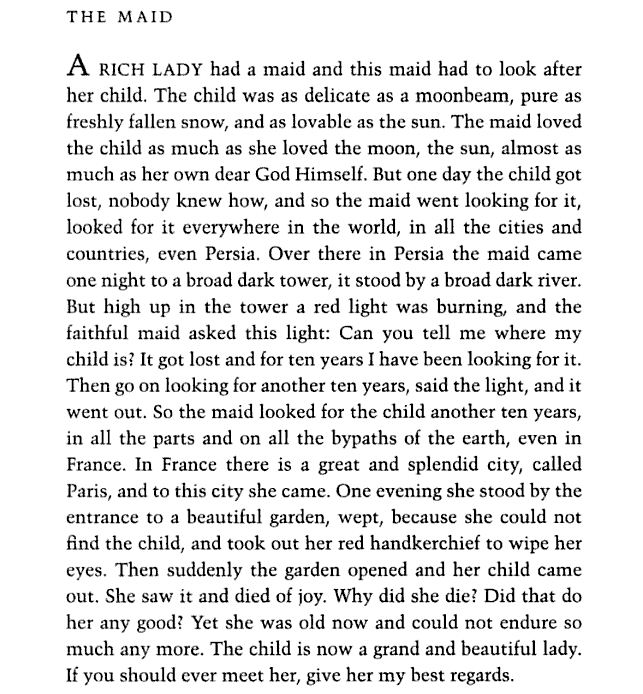
“The Maid” — Robert Walser

Memories of the Future (Book Acquired, 8.11.2012)


20120818-174253.jpg

I saw Sigizmund Krzhizhanovsky’s at the bookstore last week, read the first few pages of the first story, and had to have it. (Although the NYRB logo is always enticement enough). From Liesl Schillinger’s review in the NYT:

Krzhizhanovsky’s stories are more like dream diaries than fiction. Quite intentionally, he blurs the line between sleep and waking, real and unreal, life and death. While his translators admirably convey the whirligigging quality of his narratives, Krzhizhanovsky’s peregrinations demand unstinting focus and frequent compass checks. His characters often seem half, or wholly, asleep. Sometimes, as in “The Thirteenth Category of Reason,” they are dead — which doesn’t stop them from boarding city trams and chatting with commuters. “Alive or dead, they didn’t care.” Their only concern is whether such conduct is “decrimiligaturitized” — that is, legal. “In “Quadraturin,” the man with the proliferspansion ointment never exits a state of benumbed grogginess. Lying on his bed, “unable to part eyelids stitched together with exhaustion,” he tries to sleep through the night, “mechanically, meekly, lifelessly.” When inspectors from the Remeasuring Commission drop by to make sure he hasn’t exceeded his allotted 86 square feet of space, he hovers, terror-stricken, at the door, hoping they won’t spot his infraction. It’s an archetypal nightmare, reminiscent of Kafka.

 

The Open Book — Juan Gris