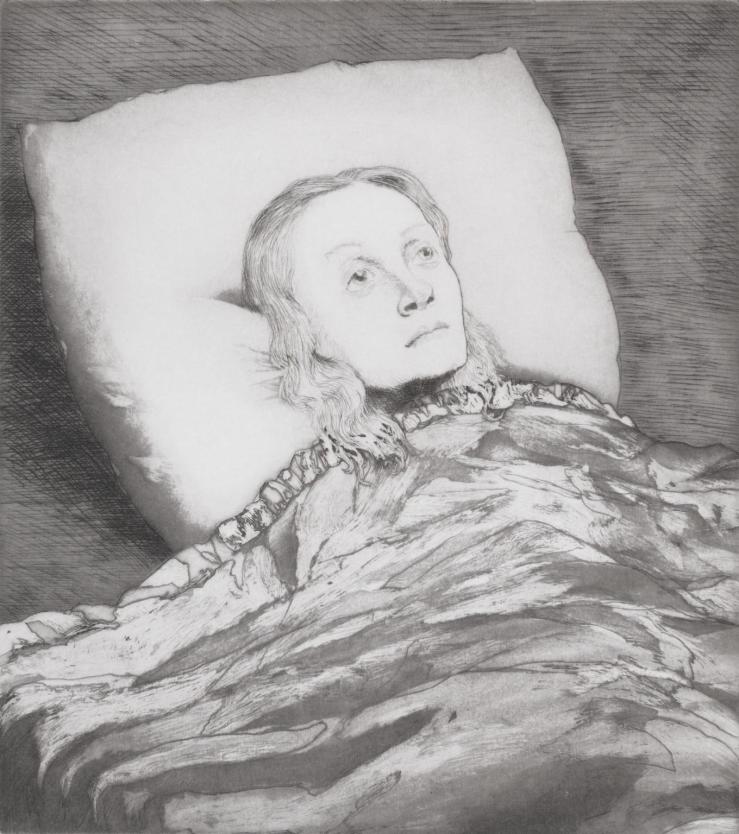
Girl in Bed — John Currin

Girl in Bed, 2006 by John Currin (b. 1962)

(Another copy of) Vladimir Sorokin’s Telluria (Book acquired, 23 July 2022)

A finished copy of Vladimir Sorokin’s novel Telluria arrived at Biblioklept World Headquarters yesterday. The novel, in translation by Max Lawton, has been my favorite read so far this year. It’s on sale in a few weeks from the good people at NYRB. I would normally share their copy from the back of the book, but I have something better. I’ve got an interview with translator Max Lawton forthcoming, and here’s his description of Telluria:

TELLURIA is “Oxen of the Sun” as sci-fi novel, without any notion of a language’s generation—without any notion of “progress.” It is fractal and rhizome, scattered out over 50 chapters, with the only hint of redemption coming in a narcotic vision of Christ. TELLURIA is about pushing one’s mastery of style to the point where it begins to break down—in the mode of late Miles. It is at these moments of breaking down that something new begins to come into being. On the level of content, TELLURIA suggests that the small is always more charming—more desirable—than the master narrative. Nationalism, he suggests, can only be cute if it’s a doll-sized state that’s doing the nationalizing. Anything bigger is monstrous. The book, then, is an ode to difference. And a challenge to land-grabbing, logos-hijacking imperialists who believe in a single story. For Sorokin, the world is a million different textures, a million different languages, and no ONE can be said to triumph.

A giant plume of dust, like the tail of a hallucinogenic coyote, and ninety-nine other similes from Roberto Bolaño’s novel 2666

  1. The knife sharpener’s eyes narrowed until they looked like two lines drawn with charcoal.
  2. music like water tumbling over smooth stones
  3. like a child trying not to vomit
  4. he looked like a madman
  5. Like a child on the verge of tears.
  6. children scattering through the countryside like defeated soldiers
  7. a giant plume of dust, like the tail of a hallucinogenic coyote
  8. The sidewalk was gray but the sun coming through the branches of the trees made it look bluish, like a river.
  9. like a pig staring into the sun
  10. the tops of trees were visible like a green-black carpet
  11. he drifted like a ghost
  12. eyes were a brown so light they looked yellow like the desert
  13. letting the buckle dangle like a bell
  14. La Vaca stood motionless, waiting, like someone who walks down a random street and suddenly hears her favorite song, the saddest song in the world, coming from a window
  15. She fucks like someone on the brink of death
  16. like a hummingbird
  17. mazelike mountains
  18. like a gold nugget in a trash heap
  19. like a doll lost and found in a heap of somebody else’s trash
  20. like a procession of penitents with their purple or fabulous vermilion or checkered hoods
  21. Reinaldo felt a shiver descend his spine like an elevator, or maybe rise, or both at once
  22. A goddamn gash, like the crack in the earth’s crust they’ve got in California, the San Bernardino fault
  23. like a melon-colored pyramid, its sacrificial altar hidden behind smokestacks and two enormous hangar doors though which workers and trucks entered
  24. the world was like a creaky coffin
  25. like the stars
  26. corpselike pallor
  27. like dogs
  28. like extraterrestrials
  29. On the rare occasions when he laughed he sounded like a donkey and only then did his face seem bearable.
  30. Lying there with his ass in the air, Farfan looked like a sow, but Gomez fucked him regardless and they resumed their friendship.
  31. his eyes like a hawk’s as he strode that labyrinth of snores and nightmares
  32. For me, being in prison was exactly like being dumped on a Saturday at noon in a neighborhood like Colonia Kino, San Damian, Colonia Las Flores. A lynching. Being torn to pieces. Do you understand? The mob spitting on me and kicking me and tearing me to pieces. With no time for explanations.
  33. It’s like a noise you hear in a dream. The dream, like everything dreamed in enclosed spaces, is contagious.
  34. like a mosquito around a campfire
  35. paths off the highway that melted away like dreams, without rhyme or reason
  36. like a skull
  37. There were Cessna planes flying low over the desert like the spirits of Catholic Indians ready to slit everyone’s throats.
  38. like a madman
  39. He carried the amphetamines everywhere, like a tiny talisman that would protect him from evil.
  40. like commandos lost on a toxic island on another planet
  41. Gomez scooped the balls off the floor and remarked that they looked like turtle eggs. Nice and tender, he said.
  42. what it was like to be in purgatory
  43. like a flock of vultures
  44. the policemen, moving wearily, like soldiers trapped in a time warp who march over and over again to the same defeat, got to work
  45. like a free man
  46. she would go everywhere wrapped in bandages, like a mummy, not an Egyptian mummy but a Mexican mummy
  47. like an archaeologist who has just discovered an incredible bone
  48. like a girl who carefully unwraps, bit by bit, a present that she wants to make last, forever
  49. all the bandages slither like snakes, or all the bandages open their sleepy eyes like snakes, although she knows they aren’t snakes but rather the guardian angels of snakes
  50. they talked about freedom and evil, about the highways of freedom where evil is like a Ferrari
  51. like a troupe of gypsies heading into the unknown
  52. like a worm or an insomniac mole
  53. like a baby bird
  54. the steam was tinted green, an intense green, like a tropical forest, and when Garibay saw it he invariably said: fuck, that’s pretty
  55. they slunk out like vultures
  56. a long coffee shop like a coffin, with few windows
  57. like a squash ball
  58. women are like laws
  59. the slope of a hill that looked like a dinosaur or a Gila monster
  60. witchlike language and manner
  61. Living in this desert, thought Lalo Cura as the car, with Epifanio at the wheel, left the field behind, is like living at sea.
  62. like a fast-acting tranquilizer
  63. Sometimes he felt like a shepherd misunderstood by the very stones.
  64. like children hearing the same story for the thousandth time
  65. like somebody talking about medieval history or politics
  66. the night like a glove over the hotel
  67. that toadlike creature, that dumb, helpless greasy illegal, that lump of coal who in some other reincarnation could have been a diamond
  68. like someone talking in his sleep
  69. He could feel the Sonora night brushing his back like a ghost.
  70. And most surprising of all: tied around her head, like a strange but not entirely implausible hat, was an expensive black bra.
  71. like looking for a phantom
  72. Being a criminologist in this country is like being a cryptographer at the North Pole.
  73. It’s like being a child in a cell block of pedophiles.
  74. It’s like being a beggar in the country of the deaf.
  75. It’s like being a condom in the realm of the Amazons
  76. his neck long like a turkey’s
  77. we got out of there like a bomb was about to go off
  78. sinking like crocodiles in the swamp
  79. they spend money like water
  80. like a queen
  81. night crept like a cripple toward the east
  82. like a giant chapel
  83. like two whores allowed for the first time to dress their pimp
  84. like boiled fruit
  85. like a plaster cast
  86. like a statue
  87. ranches empty like shoe boxes
  88. like a puzzle repeatedly assembled and disassembled
  89. like a gift
  90. like a double spinal cord
  91. The truth is like a strung-out pimp.
  92. The truth is like a strung-out pimp in the middle of a storm, said the congresswoman.
  93. smiling and sniveling like a lap dog
  94. like an eternity
  95. trading puns like a couple of zombies
  96. like someone in a trance
  97. like a rat
  98. like Satan’s helpers
  99. like a mirror image
  100. like black holes

These similes are from “The Part About the Crimes,” the fourth part of 2666, a novel by Roberto Bolaño, in English translation by Natasha Wimmer.

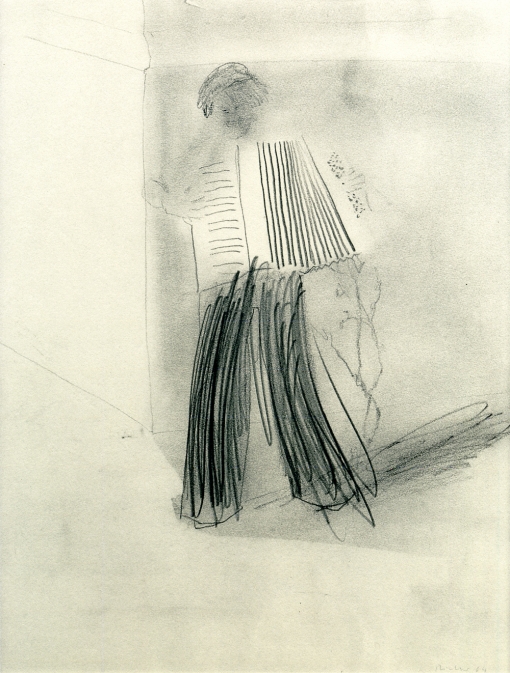
Accordion Player — Gerhard Richter

Accordion Player, 1964 by Gerhard Richter (b. 1932)

“Looking Out the Window Poem” — Denis Johnson

“Looking Out the Window Poem”

by

Denis Johnson


The sounds of traffic
die over the back lawn
to occur again in the low
distance.

The voices, risen, of
the neighborhood cannot
maintain that pitch
and fail briefly, start
up again.

Similarly my breathing rises
and falls while I look out
the window of apartment
number three in this slum,
hoping for rage, or sorrow.

They don’t come to me
anymore. How can I lament
anything? It is all
so proper, so much
as it should be, now

the nearing cumulus
clouds, ominous,
shift, they are like the
curtains, billowy,
veering at the apex
of their intrusion on the room.
If I am alive now,
it is only

to be in all this
making all possible.
I am glad to be
finally a part
of such machinery. I was
after all not so fond
of living, and there comes
into me, when I see
how little I liked
being a man, a great joy.

Look out our astounding
clear windows before evening.
It is almost as if
the world were blue
with some lubricant,
it shines so.

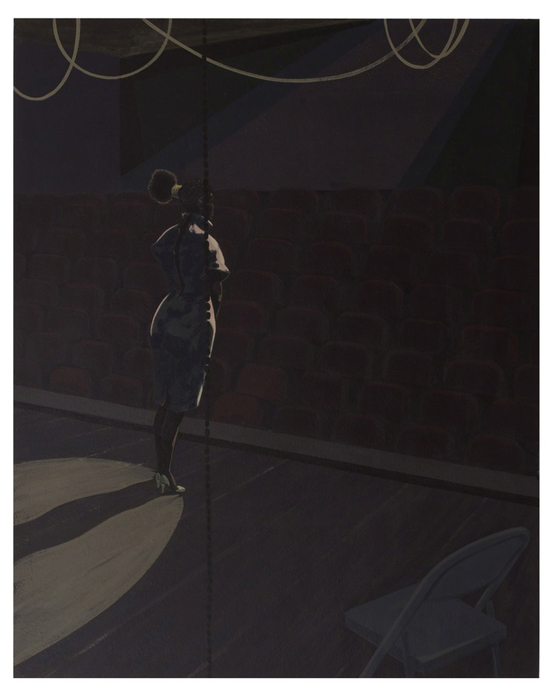
Untitled (Stage) — Kerry James Marshall

Untitled (Stage), 2018 by Kerry James Marshall (b. 1955)

“Legend,” a very short tale from Jorge Luis Borges

“Legend” by Jorge Luis Borges

Translated by Andrew Hurley


Cain and Abel came upon each other after Abel’s death. They were walking through the desert, and they recognized each other from afar, since both men were very tall. The two brothers sat on the ground, made a fire, and ate. They sat silently, as weary people do when dusk begins to fall. In the sky, a star glimmered, though it had not yet been given a name. In the light of the fire, Cain saw that Abel’s forehead bore the mark of the stone, and he dropped the bread he was about to carry to his mouth and asked his brother to forgive him.

“Was it you that killed me, or did I kill you?” Abel answered. “I don’t re-member anymore; here we are, together, like before.”

“Now I know that you have truly forgiven me,” Cain said, “because forgetting is forgiving. I, too, will try to forget.”

“Yes,” said Abel slowly. “So long as remorse lasts, guilt lasts.”

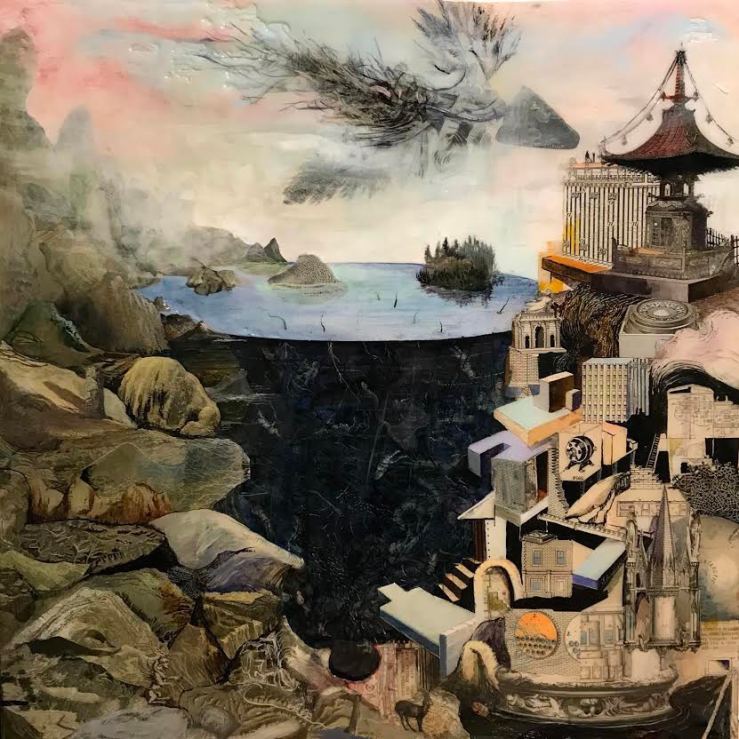
The Hoverer Returns — Josh Dorman

The Hoverer Returns, 2018 by Josh Dorman (b. 1966)

Portrait of a Girl — John Downton

Portrait of a Girl, c. 1938 by John Downton (1906-1991)

Blog about some books acquired, 15 July 2022


I live in an old neighborhood filled with old people who are dying at a reliable rate, which means that there are frequent estate sales in the neighborhood. I walk the neighborhood pretty much every day, and if I see an estate sale sign, I’ll walk toward it and go through the house, looking at the items of the recently deceased, or recently relocated, or what have you, not so much interested in purchasing anything as I am trying to piece together a little bit of a life from objects, colors, totems. Sometimes the interiors of these houses remind me of being in my own grandparents’ homes back in 1985—homes built in the 1950s with few updates, some tasteful furniture, maybe a bit of fanciful wallpaper, a pink-tiled bathroom. Sometimes I might buy a knife or a tool or a mirror, or even get lucky with an old print or painting. And of course I always look through the books.

The books you might find in the homes in the estate sales in my neighborhood are generally predictable. There are bibles, a small selection of “great books,” classics, what have you, a few books that indicate the removed persons’ hobbies, old cookbooks with few or no color pictures. Often you might find the books of the eldest or middle child, selections from their freshman English course. Westerns, mysteries, a few art books.

Today I came across an estate sale not even a block from my house and meandered in. The man running the estate sale had sold me a large signed Alexander Calder print a few years ago, not realizing its full value; he had then called me repeatedly trying to sell me three more Calder prints which he had repriced and overpriced. He didn’t recognize me. The house was much smaller inside than I had expected, but beautifully furnished. There was a large framed photograph of Winston Churchill on the fireplace mantel along with a leather-bound collection of his memoirs. On the other side was an incomplete selection of Shakespeare plays, also bound in leather. Outside was a small shallow swimming pool, clearly original to the house.

The layout of the house—a brick midcentury ranch home, like almost all of the homes in the neighborhood—was very similar to my own house’s layout, and I could even see the use of the some of the same materials (particularly in the guest bathroom, which had not been updated). The first and second bedrooms suggested a couple who at some point had had two children, a boy and a girl, probably five or ten years older than I am. The last bedroom was being used as an office or study, and it was filled with books. There was a large electric Olivetti typewriter on the desk in this room, as well as a beautiful early 1980’s Bose sound system with a strange control box.

The first row of books I saw soured my hopes of finding anything worthwhile. It was mostly conservative stuff, including stuff by Charles Murray and David Brooks. Nothing fringe exactly, but still. There were also lots of books about travel and France in particular, including several plays in French (one by Moliere). This book case also held several books about writing—style manuals, thesauruses, etc., but also a book about selling one’s writing and a book on the publishing industry. The next book case was filled with paperbacks. Someone before me had fished out A Clockwork Orange and left it unshelved; it was the same edition I had read myself almost thirty years ago. The case held lots of sci-fi paperback—at least a dozen books by John Brunner and Robert Heinlein.

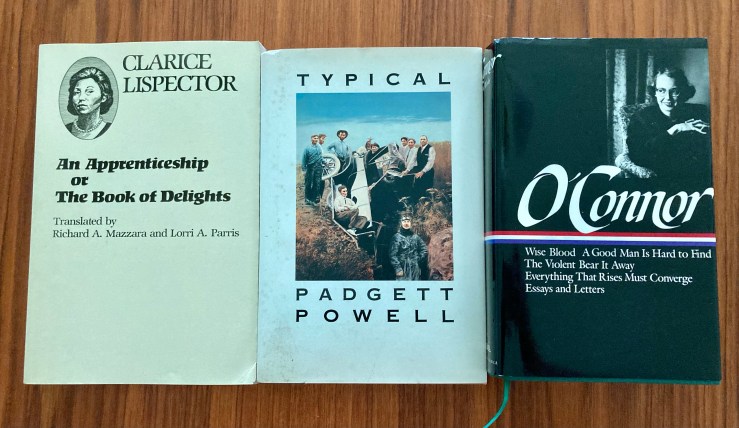
Near the bottom shelf was an oddity—a poorly-printed Clarice Lispector book, An Apprenticeship; or, The Book of Delights, published by the University of Texas in 1986. I have a matching copy of Lispector’s Family Ties.

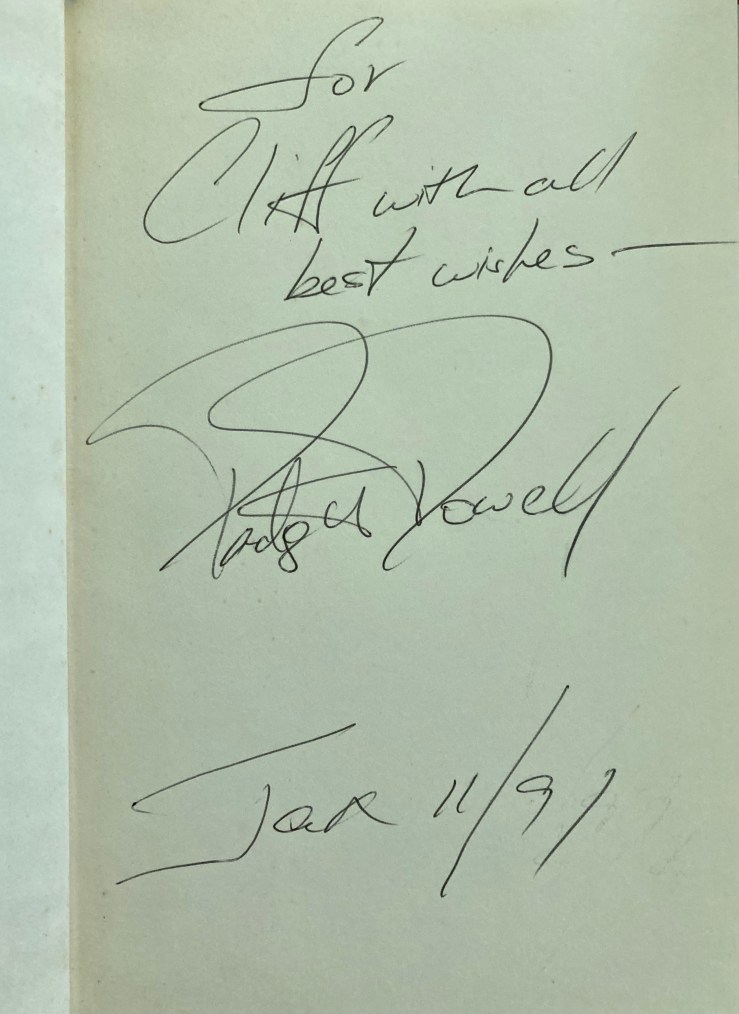
The last shelf held mostly hardbacks, including lots of Steinbeck, Hemingway, and other twentieth-century American novelists. I picked up the first-edition hardback copy of Padgett Powell’s first collection of stories, opened it, and was surprised to find that it was signed by the author.

I wondered if I was in Cliff’s old study. Once I’d committed to taking the Lispector and Powell with me, it was easy to take the Library of America’s Collected Works of Flannery O’Connor.

I didn’t buy the beautiful deer antler knife from the kitchen, and I didn’t buy the Emory University Alumni coffee cup, although I wanted both, but I think that they are waiting for someone else.


Twelve-year-old Cormac McCarthy starred in a 1946 agricultural documentary called Dairying in Tennessee

Redditor Jarslow posted the short film Dairying in Tennessee today on the Cormac McCarthy Reddit page. The short film was posted on Vimeo by the Tennessee Archive of Moving Image and Sound yesterday,  where the organization notes that “A year earlier, McCarthy was on the shortlist to play Jody in Clarence Brown’s film adaptation of “The Yearling.” Of McCarthy’s audition, an MGM representative told a Knoxville Journal reporter, “This boy has personality plus, and he’s done a good job living down jests tossed at him because of his name.” The role ultimately went to Claude Jarman, Jr.”


Roberto Bolaño’s 2666 | Rambling notes around a very long audiobook

img_3357

I listened to Roberto Bolaño’s opus 2666 on audiobook (in English translation by Natasha Wimmer) over the last month,

I listened while I took long early walks in my neighborhood before the big sun burned me back home; I listened while I gardened; I listened while I undertook a list of summer chores that included painting the interior of the house.

I was listening to the book when our fire alarm gave alarum to an accidental fire in our kitchen, which I put out quickly (I was hearing but not listening to the book during this exercise). I was walking, listening to the audiobook of 2666 when I started getting texts from friends about the Supreme Court’s overturning Roe. I was walking, listening to the audiobook of 2666 when my neighbor waved me down, approached me, told me while crying (she was walking her dog) that her ex-husband, who I was very close to, loved, frankly, a kind man who I spent a few hours a week drinking wine and discussing x and y and z, but especially discussing literature and civics film and local raptors, this man, my friend, had died unexpectedly the previous morning. I turned the audiobook off, finished my walk, and drove four hours to the Gulf shore, a nice place I take every July 4th holiday with my extended family. I took a week off 2666.

I finished the 2666 audiobook yesterday. This audiobook is 39 hours and 15 minutes long. A different reader reads each of the novel’s five distinct parts. (The readers are John Lee, Armando Durán, G. Valmont Thomas, Scott Brick, and Grover Gardner.)

Should someone who hasn’t read 2666 before try it on audiobook first?

I have no idea.

(Try it and tell me.)

I don’t think it would have worked for me, an audiobook on the first go around, for a lot of reasons, but the main one is that there are so so so many voices in the novel, and not all of the five readers necessarily fully capture those voices. (G. Valmont Thomas and Grover Gardner do; Armando Durán gets close; John Lee fares well for the most part; Scott Brick tries too hard at times and not hard enough at others).

Some people are pretty good at auditing audiobooks; other people have a difficult time zoning in. Forty hours is a long time, and if I opened with a list of “I” statements, related to the book, it was because it felt like a sharp chunk of life passed as I listened to 2666. (Sorry.)

img_3356

As for the actual novel, the story, the prose, whatever—it’s great. Just amazing. These are poor adjectives for a giant work. This was my fourth full trip through 2666, and it only confirms my impression that the novel is a labyrinthine masterpiece, sinister, brave, lurid, abject, often very funny, and stuffed with so much life and experience. I’ve written several “reviews” of the novel on this site over the years, if you want to be persuaded in greater detail. Probably the better of these riffs was a piece on intertextuality in the novel. There’s also my first review in early 2009 and one from my reread it in late 2009. I wrote about abjection and horror in 2666. At some point I wrote about werewolves and 2666 and argued that Dracula is a secret character in the book.

I probably also connected 2666 in some way to many, many other things while writing on this blog over the past thirteen years. I think it’s great, more than great, grand, gargantuan, giant stuff. I felt all sad and hollowed out when I got to the end yesterday, deflated, punctured, the final images of Archimboldi eating Neapolitan ice cream with a descendant of its creator, Fürst Pückler, kinda breaking my brain.

Put forty more hours in my ears.

If you follow this blog semi-regularly, you might’ve seen (and I hope read) excerpts I’ve posted from 2666 over the past few weeks. Something that initially caught me off guard, but that I soon came to predict, was that I would audit a section, and jot down notes, something like, Post this as an excerpt on the blog—and then it would turn out that I’d posted the same excerpt a decade ago.

I also remembered specific moments where I’d read some of the selections — on airplanes, or in hotel beds, or even on the beach of the Gulf, ten or eleven years ago over a July 4th vacation that wasn’t set against such a oh-wow-we’re-sliding-into-overt-authoritarian-oligarchy-dang backdrop. But also in blank or banal places, a black couch a now-dead cat clawed up, a chair my wife threatened to axe. Two different beds. And so much of what I audited the past month is blended into my experiences of the past month. (I will never ever forget that the moment when I found out about Roe, I was listening to a painful litany of misogynistic “jokes” told by a crooked cop to an audience of other cops in “The Part About the Crimes” — the section goes on and on, a little echo or prefiguration of the litany of rapes that formalize that particular section. I am looking for a way to use the word indelible here.)

(And while I’m in parentheses: Something I would have tuned out while reading 2666 that I certainly noticed while auditing it is how often Bolaño (and his translator Wimmer, of course) uses the phrase Around this time to begin a new paragraph.)

And so well anyway: A few remarks on the readers, translators all in their own right of the material:

John Lee reads “The Part About the Critics.” His posh British twang is well-suited to conveying the semi-serious/semi-ironic tone of this section, and if he sounds annoying as shit at times, that can be forgiven. Lee, who is often too arch, shows more restraint than in other audiobooks I’ve audited that he’s read.

Armando Durán reads “The Part About Amalfitano.” He’s perfect when conveying Amalfitano’s voice, as well as consciousness, but centers too closely to that consciousness. This is a very specific and petty criticism that is more about how I hear certain other voices in the novel. Great voice.

G. Valmont Thomas reads “The Part About Fate.” He inhabits the various voices the journalist Fate speaks to with aplomb, characterizing each voice with its own unique phrasing while staying true to the tone of the “Fate” section, which tip-toes to full-blown abject madness. My only gripe, and it’s not really even a gripe, is that he voices Fate himself as a total weirdo, a weirdo who simultaneously realizes he’s out of sync with everyone around him, but also doesn’t see to register that fact as a functioning human being might. Good interpretation, I guess, but still a bit of a bold choice.

Scott Brick reads “The Part About the Crimes.” Brick has the longest and arguably most-arduous section of 2666. I think the direction he takes (or the direction he was given) is a bit too intense — again this is a case of my own reading of the voices in the novel — I think the main narrative voice of “The Part About the Crimes” should be flat, affectless, reportorial, and that all drama and verve in that section should come from characters who ventriloquize the narrative — and Brick does a good job there.

Grover Gardner reads “The Part About Archimboldi” and I loved what he did, but I’m a big fan of his voice in general. And I love that particular section.

img_3360

If I have quibbled with these voices it comes from a place of love—I loved getting to reread 2666 through their voices. And, like I said above, they are ultimately translators too of the work. So I’ll close with Bolaño himself on translation (via his 2666 translator, Natasha Wimmer, from his essay “Translation Is an Anvil,” collected in Between Parentheses):

How to recognize a work of art? How to separate it, even if just for a moment, from its critical apparatus, its exegetes, its tireless plagiarizers, its belittlers, its final lonely fate? Easy. Let it be translated. Let its translator be far from brilliant. Rip pages from it at random. Leave it lying in an attic. If after all of this a kid comes along and reads it, and after reading makes it his own, and is faithful to it (or unfaithful, whichever) and reinterprets it and accompanies it on its  voyage to the edge, and both are enriched and the kid adds an ounce of value to its original value, then we have something before us, a machine or a book, capable of speaking to all human beings; not a plowed field but a mountain, not the image of a dark forest but the dark forest, not a flock of birds but the Nightingale.

I love the mountain, the forest, the Nightingale.

The Finding of Pier Paolo Pasolini’s Body — Nicola Verlato 

The Finding of Pier Paolo Pasolini’s Body , 2020 by Nicola Verlato (b. 1965)

Yes Sisyphus, known as the craftiest of men | From Roberto Bolaño’s 2666

Then, incomprehensibly, he began to make faces that in some way linked him to the wife of the writer from Mainz, to such a degree that Bubis thought they must be brother and sister and only thus could one fully understand the presence of the writer and his wife at the meal. It was also possible, thought Bubis, that they were lovers, because it was common knowledge that lovers often began to resemble each other, usually in their smiles, their opinions, their points of view, in short, the superficial trappings that all human beings are obliged to bear until their deaths, like the rock of Sisyphus, yes Sisyphus, known as the craftiest of men, son of Aeolus and Enarete, founder of the city of Ephyra, which is the old name for Corinth, a city that the good Sisyphus turned into the staging ground of his happy misdeeds, because with his characteristic nimbleness of body and intellectual inclination to see every turn of fate as a chess problem or a detective story to unravel, and his instinct for laughter and jokes and jests and cracks and quips and gags and pranks and punch lines and spoofs and stories and gibes and taunts and send-ups and satires, he turned to theft, in other words parting all passersby from their belongings, even going so far as to steal from his neighbor Autolycus, also a thief, perhaps with the remote hope that one who steals from a thief is granted one hundred years of forgiveness, and at the same time smitten by his neighbor’s daughter, Anticlea, because Anticlea was very beautiful, a treat, but the girl had an official suitor, she was promised to Laertes, of subsequent fame, which didn’t daunt Sisyphus, who could count on the complicity of the girl’s father, the thief Autolycus, whose admiration for Sisyphus had sprung up like the regard of an objective and honorable artist for another artist of superior gifts, so that even though it could be said that as a man of honor he remained true to his promise to Laertes, he didn’t look unkindly upon the romantic attentions Sisyphus lavished on his daughter or treat them as disrespect or mockery of his future son-in-law, and in the end his daughter married Laertes, or so it’s said, but only after surrendering to Sisyphus one or two or five or seven times, possibly ten or fifteen times, always with the collusion of Autolycus, who wanted his neighbor to plant the seed of a grandchild as clever as Sisyphus, and on one of these occasions Anticlea was left with child and nine months later, now the wife of Laertes, her son would be born, the son of Sisyphus, called Odysseus or Ulysses, who in fact turned out to be just as clever as his father, though Sisyphus never gave him a thought and continued to live his life, a life of excesses and parties and pleasure, during which he married Merope, the dimmest star in the Pleiades precisely because she married a mortal, a miserable mortal, a miserable thief, a miserable gangster in thrall to his excesses, blinded by his excesses, among which not least was the seduction of Tyro, the daughter of Sisyphus’s brother Salmoneus, whom Sisyphus pursued not because he was interested in Tyro, not because Tyro was particularly sexy, but because Sisyphus hated his own brother and wanted to cause him pain, and for this deed, after his death, he was condemned in hell to push a stone to the top of a hill only to watch it roll down to the bottom and then push it back up to the top of the hill and watch it roll again to the bottom, and so on eternally, a bitter punishment out of all proportion to his crimes or sins, the vengeance of Zeus, it’s said, because on a certain occasion Zeus passed through Corinth with a nymph he had kidnapped, and Sisyphus, who was smarter than a whip, seized his chance, and when Asopus, the girl’s father, came by in desperate search of his daughter, Sisyphus offered to give him the name of his daughter’s kidnapper, but only if Asopus made a fountain spring up in the city of Corinth, which shows that Sisyphus wasn’t a bad citizen or perhaps he was thirsty, to which Asopus agreed and the fountain of crystalline waters sprang up and Sisyphus betrayed Zeus, who, in a blind rage, sent him ipso facto to Thanatos, or death, but Sisyphus was too much for Thanatos, and in a masterstroke perfectly in keeping with his craftiness and sense of humor he captured Thanatos and threw him in chains, a feat within reach of very few, truly very few, and for a long time he kept Thanatos in chains and during all that time not a single human being died on the face of the earth, a golden age in which men, though still men, lived free of the anxiety of death, in other words, free of the anxiety of time, because now they had more than enough time, which is perhaps what distinguishes a democracy, spare time, surplus time, time to read and time to think, until Zeus had to intervene personally and Thanatos was freed and then Sisyphus died.

But the faces Junge was making didn’t have anything to do with Sisyphus, thought Bubis.

From “The Part About Archimboldi,” 2666, by Roberto Bolaño in translation by Natasha Wimmer.

Posted in Art

Ivan Turgenev’s Fathers and Children (Book acquired, 6 July 2022)

NYRB is publishing Ivan Turgenev’s novel Fathers and Children next month, in English translation by Nicolas Pasternak Slater and Maya Slater. NYRB’s blurb:

Ivan Turgenev’s Fathers and Children is a masterpiece not only of the nineteenth century but of the whole of Russian literature, a book full to bursting with life. It is a novel about the relationships between the young and the old; about love, families, politics, religion; about strong beliefs and heated disagreements, illness and death. It is about the clash between liberals and conservatives, revolutionaries and reactionaries. At the time of its publication in 1862, the book aroused indignation in its critics who felt betrayed by Turgenev’s refusal to let his novel serve a single ideology; it also received a spirited defense by those who saw in his diffuse sympathies a greater service to art and to humanity. Fathers and Children is not a practical manifesto but a lasting work of art and a timely book for our present age, newly and ably translated by Nicolas Pasternak Slater and Maya Slater.

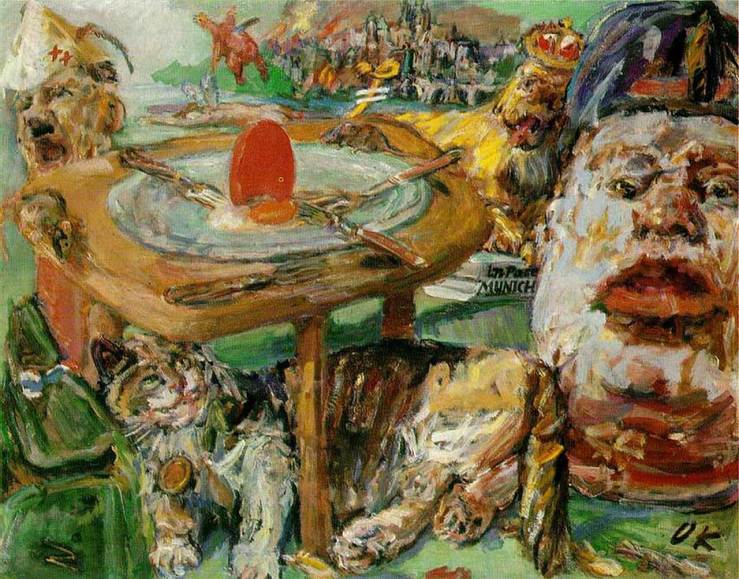
The Red Egg — Oskar Kokoschka

The Red Egg, 1941 by Oskar Kokoschka (1886-1980)

Chaos XXLIII — Michael Palmer