Capitalism, Innovation, McNuggets (The Wire)

RIP Joe Simon

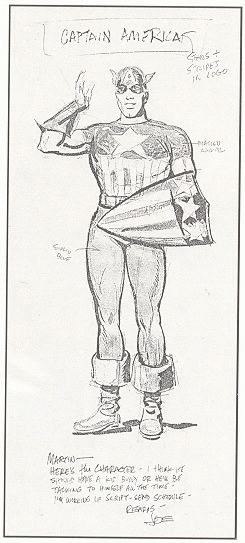
Early Captain America Design Sketch by Joe Simon

RIP comic book legend Joe Simon.

Book Acquired, 12.12.2011

20111214-204653.jpg

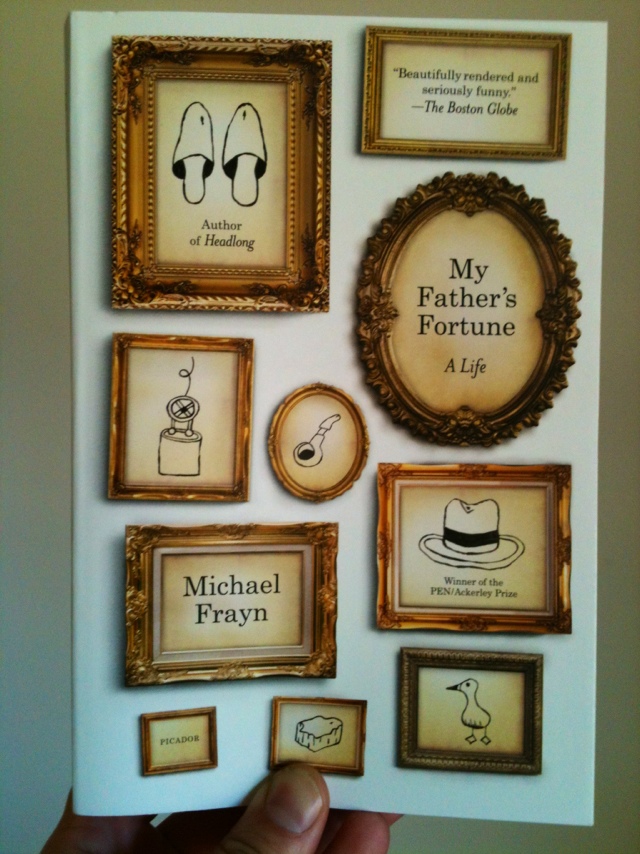
Michael Frayn’s memoir My Father’s Fortune. Publisher Picador’s (trade paperback) description:

Winner of the PEN/Ackerley Prize

Award-winning playwright and novelist Michael Frayn “makes the family memoir his own” (The Daily Telegraph) as he tells the story of his father, Tom Frayn. A clever lad, an asbestos salesman with a winning smile and a racetrack vocabulary, Tom Frayn emerged undaunted from a childhood spent in two rooms with six other people, all of them deaf. And undaunted he stayed, through German rockets, feckless in-laws, and his own increasing deafness; through the setback of a son as bafflingly slow-witted as the father was quick on his feet; through the shockingly sudden tragedy that darkened his life. As Peter Kemp wrote in The Sunday Times (London), “Frayn has never written with more searching brilliance than in his quest for his past.”

Costanza’s Christmas Card

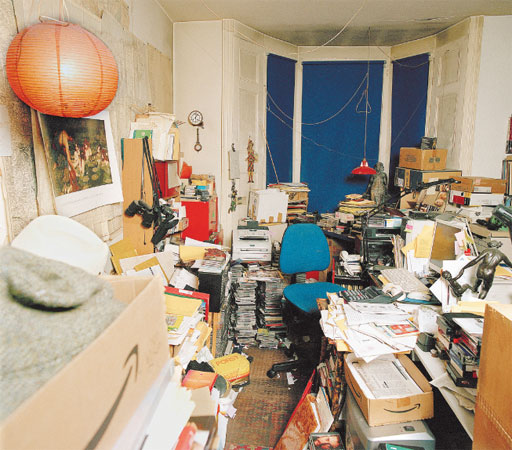
“Here You See Some of the Clutter but You Can’t See the Danger” — Russell Hoban’s Writing Room

(From The Guardian’s Writer’s Rooms series)

RIP Russell Hoban

Russell Hoban, author of Riddley Walker and other cult classics, died last night at the age of 86. The first “review” I ever wrote on this site was for Riddley Walker (the review is so bad that I won’t link to it out of shame); that was back when Biblioklept’s primary mission was to document stolen books. I stole the book from a dear friend and subsequently lent it to a student who never returned it. Oh, the circle of theft! Riddley Walker is the sort of book that begs to be stolen (or never returned, or passed on to another). It’s an apocalyptic Huckleberry Finn, a coming of age story set against the backdrop of a new dark age. Riddley Walker is deeply weird and strongly strange; I don’t know what a “cult” novel is, but I know of no better example.

Riddley Walker might be Hoban’s most famous work (aside from his children’s works, including the Frances the Badger series), but readers who stopped there would do well to pick up some of his earlier books. The Lion of Boaz-Jachin and Jachin-Boaz is a fantasy piece about fathers, sons, and map-making; Kleinzheit, a baffling schizophrenic novel, explores death and illness in an animistic world; Pilgermann plumbs the medieval intersection of Judaism, Christianity, and Islam, narrated through the eyes of the ghost of a castrated European Jew on a bizarre holy quest—it’s like Hieronymous Bosch on LSD.

The Guardian has a short but lucid biographical obit for Hoban, which ends with Hoban contemplating how death might affect his career:

Death, Hoban predicted in 2002, would “be a good career move”. “People will say, ‘yes, Hoban, he seems an interesting writer, let’s look at him again’,” he said.

The grim humor there was always part of Hoban’s program, and I hope that he’s right: I hope that folks who haven’t heard of Hoban will pick up Riddley Walker, and perhaps those who haven’t read beyond that book will make time to read another.

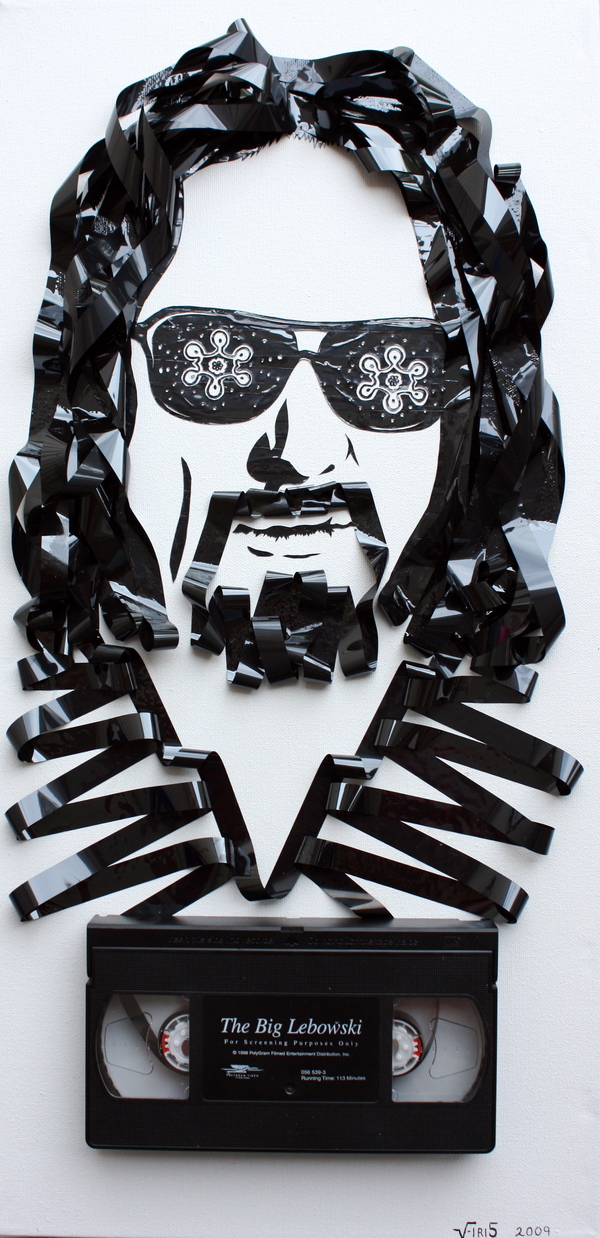
Analog Lebowski

The Dude Abides -- Erika Iris Simmons

(I know we all saw this a few years ago, but damn, I just love it).

The Best and Worst Film Titles of 2011

The Best Film Titles of 2011

The Tree of Life: Solid, evocative, stately.

Melancholia: Simple and meaningful, but also easy to remember.

Star Watching Dog: I have no idea what this movie is, but I love this as an idea or as an image, or as a plot for a film. It makes me want to find out which of those three it actually is. If I’m lucky it will be all three.

We Need to Talk About Kevin: This has the right kind of loaded evocation to it. It’s great as a long-but-not-too-long title.

Tyrannosaur: Awesome. One word with a huge amount of weight, probably the best title of the year except for the obvious problem that it probably confused people into thinking the film was about dinosaurs. But other than that it doesn’t get better than this.

Your Sister’s Sister: I don’t really know what this means. Is it wordplay? Is there plot relevance? It makes me want to know though.

Another Earth: A brilliant combination of two words that manages in three syllables to open up hours upon hours of thoughts and possibilities.

Outside Satan: I would compare to the previous entry. A great two words that sounds good and suggests a lot of weird things, many of which I can’t quite put my finger on. Definitely makes me want to see what happens in the movie.
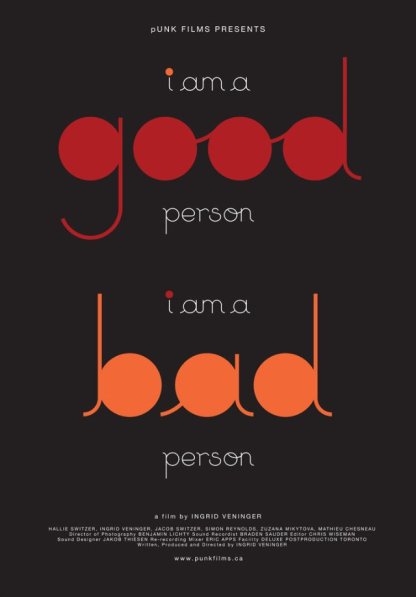
I Am A Good Person/I Am A Bad Person: Maybe it’s too long. And maybe it’s totally confusing. But I would watch something called this for sure.

The Rabbi’s Cat: Well it sounds like I know upfront two things I can expect to see. And I like both of these things.

The Catechism Cataclysm: Alliteration sucks. Here’s an exception that proves the rule.

Blackthorn: I would buy a cut of meat called Blackthorn, I would buy a bottle of wine called Blackthorn, I would vacation in a mountain city called Blackthorn, I would buy an album from a doom metal band called Blackthorn. Blackthorn would be a good word for many things. This time it is a movie.

Gingerdead Man 3: Saturday Night Cleaver: Double puns! Really? Okay fine, sure. It’s better than all the Air Bud titles combined.

Red State: Two evocative words, a sort of double-entendre but still easy to remember.

The Future: I would eat a burger called The Future, I would name my car The Future, I would name my dog The Future, I would love for my friends to give me the nickname The Future. So yeah I would watch a movie called The Future.

I Melt With You: Memorable and emotional, it tells me nothing about the film in any literal way, but it gives me some kind of sense of expectation.

Hobo With a Shotgun: Perfect. Truth in advertising; we’re all on the same page here.

***

The Worst Film Titles of 2011

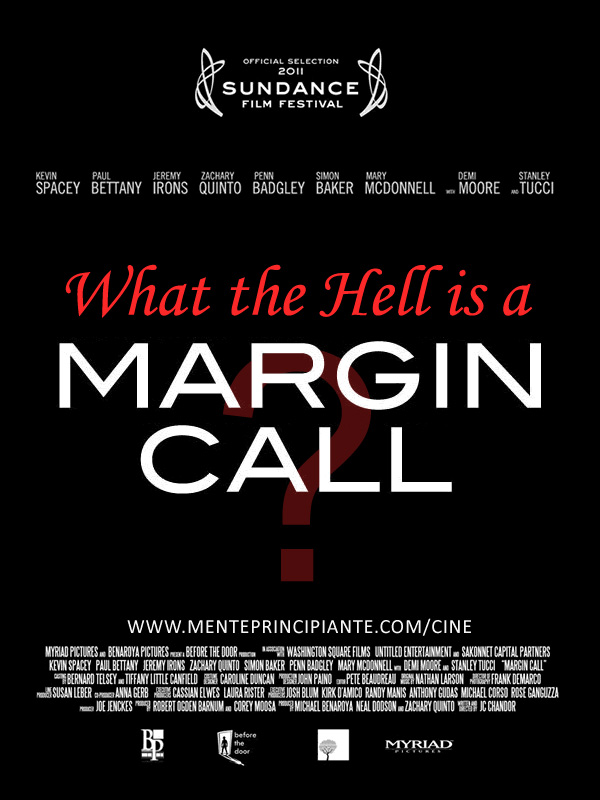
Margin Call: What the hell is a Margin Call? Why would I voluntarily pay for anything called Margin Call. It sounds like something your accountant would suggest, but that’s why you hire that guy: to deal with boring stuff like Margin Calls. I would rather be watching a good movie than worrying about a Margin Call. If there are two things, and one is called Tyrannosaur and the other is Margin Call, which do you think I will be buying?
Hugo: Hugo is a stupid little word and I don’t like saying it or hearing it.  The only thing worse is the original title, The Invention of Hugo Cabret. Gross. Cabret is far too close to Cabaret and Cabaret is least appealing noun I can think of.

Weekend: Wow, title your indie movie the same thing as a famous art film. Always a good idea when your only potential audience is the miniscule slice of people who know this. Watch for the director’s next small festival hit, sure to be called The 400 Blows.

The Brooklyn Brothers Beat The Best: Alliteration is the worst.

A Beautiful Belly: Further proof of the above sentiment, only this one is also gross sounding. The only way I can even imagine saying this out loud is if it was the humorous name of a menu item at the best BBQ joint in Atlanta or something.

The Skin I Live In: I blame the second-language aspect here, but something about this sentence is annoying.
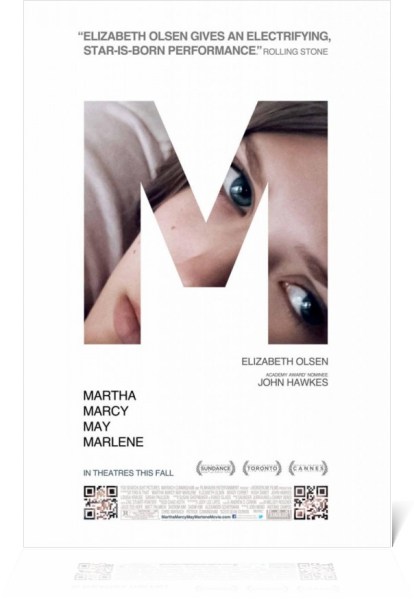
Martha Marcy May Marlene: AKA Marble-Mouthed Nonsense. I will concede that this one may be actually brilliant, as everyone who sees the film seems to universally love the title after the face. Still, there is definitely something idiotic about giving yr film a title no one can remember.

Crazy, Stupid, Love.: I hate seeing this written down, I hated typing it, I hate hearing it out loud and I can’t imagine speaking it. There is a weird kind of perfection here. Three words that are just fine on their own, but somehow in this order they make me want to die.

Take This Waltz: And shove it.

No One Killed Jessica: Oh well that’s a relief, you had me worried for a second there. I guess I can skip watching the movie altogether and go eat some lunch or something.

Water for Elephants: This sounds like part of some little piece of wisdom like “pearls before swine” or something, except that you think about it for five seconds and realize that it isn’t and that it’s just dumb sounding.

Twixt: This is one of those words that maybe girls under the age of 16 could get away with saying. Or like the name of new line of sexy dolls, like the new Bratz or something.

Soul Surfer: Soul Surfer sounds like the shittiest tattoo idea possible.
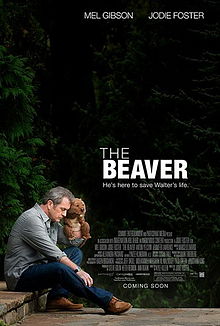
The Beaver: This immediately undercuts the notion that it can be at all serious by virtue of the obvious vulgar connotations. Unless of course the writer only chose the word “Beaver” because he thought it would be such a riot to see it written everywhere and to have serious actors say it a million times for two hours. So either way what we have here is totally ignorant or absurdly immature. Count me out either way.

Our Idiot Brother: If I wanted to watch a shitty ’90s sitcom I would have stayed home.

This Is Not A Movie: Yes it is.

Benjamin Sniddlegrass and the Cauldron of Penguins: This is so stupid that maybe it belongs on the “Best” list. Nah, maybe not.

Cowboys & Aliens: This and Hobo With a Shotgun are two sides of the same coin. This side is the shitty one that loses all the time.

I Am Number Four: The only way this could be worse is if it was I Am Number Two.

Green Lantern: The discussion surrounding this movie’s failure brought up a lot of valuable points: 1) Ryan Reynolds is The Worst, 2) The movie was a piece of shit and 3) Martin Campbell is not an auteur. But the big point I think everyone missed is that The Green Lantern is also just a stupid combination of three English words. I don’t care how long he’s been a comic book hero, please compare the title of this movie to the other famous DC tentpole franchises: Batman and Superman. And please analyze the various connotations involved in three titles: One is a man who is also a bat, alright cool. The other is a man who is super, yeah alright I bet he’s pretty tough. This is a lantern that is somehow green… is this meant to surprise or excite me? “No shit!? All my lanterns are blue, this guy must be AMAZING!” Even The Green Hornet is a better title because it has the word Hornet in it and everyone knows that Hornet is basically the coolest word in all of entomology, with the obvious exception of “Scorpion.” No movie with the word Lantern in the title will ever gross 500 million dollars, unless preceded by the words “Harry Potter” or “Twilight.” Lanterns suck and somehow this fact is known deep in the hearts of all Americans.
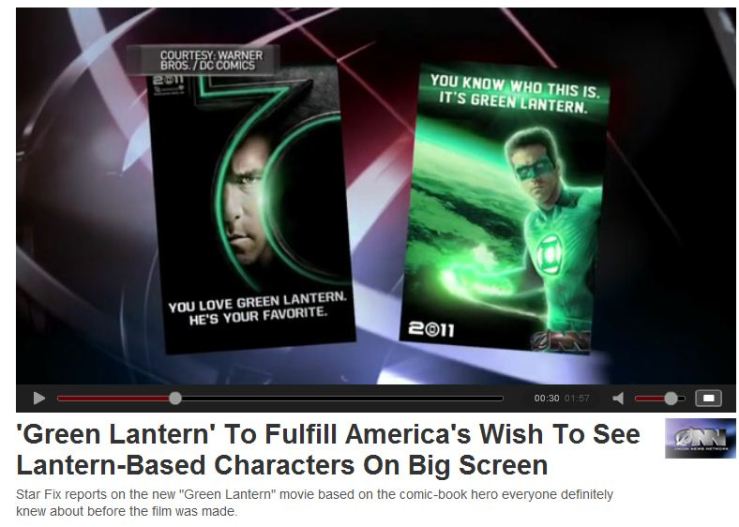

A Good Old Fashioned Orgy: The obvious sarcasm just tells me right away that this is insincere bullshit.

Straw Dogs: As the title for some weird VHS tape you find at the video store and rent on a lark only to be blown away by how gnarly and intense movies were allowed to be in the ’70s: Yes Straw Dogs is a great title, and it’s implacable weirdness somehow fully encapsulates everything strange an unnerving about that movie. But as the title for a contemporary product on the market for people who have no built-in context I can’t imagine anything worse. It might as well have been called Marble Lanterns, it would have done just as well.

Another Happy Day: Either the movie is actually about a succession of days that are happy, or it is very obviously the exact opposite. Both options annoy me and put me off for different reasons. They could have called it Are We Having Fun Yet? and it might have been a bigger hit, but that is equally stupid and probably taken already.

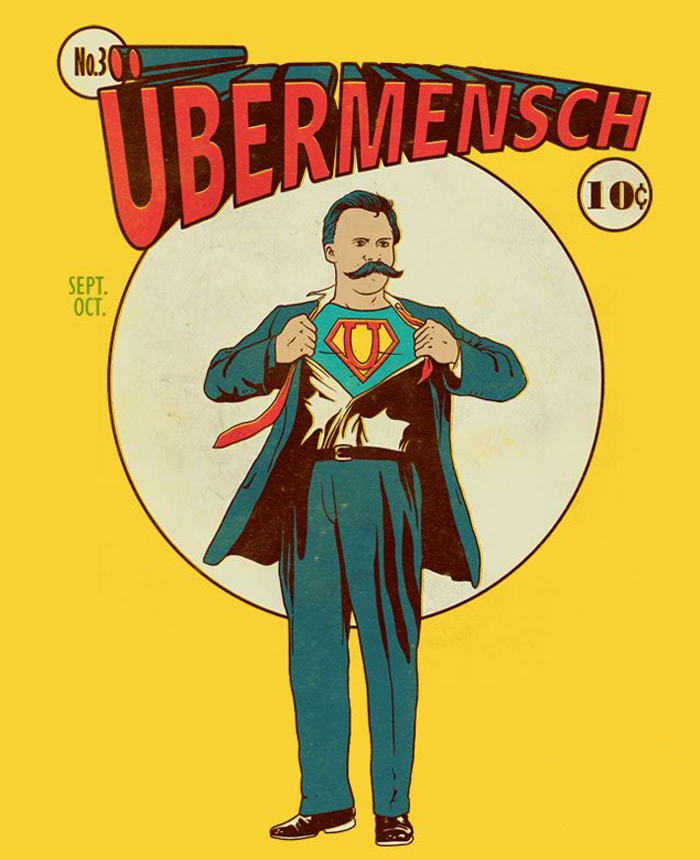
Übermensch Comics #3

Read Nathaniel Hawthorne’s Short Story “The Christmas Banquet”

“The Christmas Banquet,” a tale from Nathaniel Hawthorne (from Mosses from an Old Manse; it might be, like, an allegory or something):

“I HAVE HERE attempted,” said Roderick, unfolding a few sheets of manuscript, as he sat with Rosina and the sculptor in the summer-house–“I have attempted to seize hold of a personage who glides past me, occasionally, in my walk through life. My former sad experience, as you know, has gifted me with some degree of insight into the gloomy mysteries of the human heart, through which I have wandered like one astray in a dark cavern, with his torch fast flickering to extinction. But this man–this class of men–is a hopeless puzzle.”

“Well, but propound him,” said the sculptor. “Let us have an idea of him, to begin with.”

“Why, indeed,” replied Roderick, “he is such a being as I could conceive you to carve out of marble, and some yet unrealized perfection of human science to endow with an exquisite mockery of intellect; but still there lacks the last inestimable touch of a divine Creator. He looks like a man, and, perchance, like a better specimen of man than you ordinarily meet. You might esteem him wise–he is capable of cultivation and refinement, and has at least an external conscience–but the demands that spirit makes upon spirit, are precisely those to which he cannot respond. When, at last, you come close to him, you find him chill and unsubstantial–a mere vapor.”

Continue reading “Read Nathaniel Hawthorne’s Short Story “The Christmas Banquet””

“Fleck the Walls” — Ren & Stimpy

“Letter from Santa Claus” — Mark Twain

Hey, didn’t we just accuse Mark Twain of dissing Santa? Dude had a heart, of course. Here’s a letter he ghost wrote for St. Nick to his beloved daughter Susie:

Palace of St. Nicholas
In the Moon
Christmas Morning

MY DEAR SUSIE CLEMENS:

I have received and read all the letters which you and your little sister have written me by the hand of your mother and your nurses; I have also read those which you little people have written me with your own hands–for although you did not use any characters that are in grown peoples’ alphabet, you used the characters that all children in all lands on earth and in the twinkling stars use; and as all my subjects in the moon are children and use no character but that, you will easily understand that I can read your and your baby sister’s jagged and fantastic marks without any trouble at all. But I had trouble with those letters which you dictated through your mother and the nurses, for I am a foreigner and cannot read English writing well. You will find that I made no mistakes about the things which you and the baby ordered in your own letters–I went down your chimney at midnight when you were asleep and delivered them all myself–and kissed both of you, too, because you are good children, well trained, nice mannered, and about the most obedient little people I ever saw. But in the letter which you dictated there were some words which I could not make out for certain, and one or two small orders which I could not fill because we ran out of stock. Our last lot of kitchen furniture for dolls has just gone to a very poor little child in the North Star away up, in the cold country above the Big Dipper. Your mama can show you that star and you will say: “Little Snow Flake,” (for that is the child’s name) “I’m glad you got that furniture, for you need it more than I.” That is, you must write that, with your own hand, and Snow Flake will write you an answer. If you only spoke it she wouldn’t hear you. Make your letter light and thin, for the distance is great and the postage very heavy.

There was a word or two in your mama’s letter which I couldn’t be certain of. I took it to be “a trunk full of doll’s clothes.” Is that it? I will call at your kitchen door about nine o’clock this morning to inquire. But I must not see anybody and I must not speak to anybody but you. When the kitchen doorbell rings, George must be blindfolded and sent to open the door. Then he must go back to the dining room or the china closet and take the cook with him. You must tell George he must walk on tiptoe and not speak–otherwise he will die someday. Then you must go up to the nursery and stand on a chair or the nurse’s bed and put your car to the speaking tube that leads down to the kitchen and when I whistle through it you must speak in the tube and say, “Welcome, Santa Claus!” Then I will ask whether it was a trunk you ordered or not. If you say it was, I shall ask you what color you want the trunk to be. Your mama will help you to name a nice color and then you must tell me every single thing in detail which you want the trunk to contain. Then when I say “Good-by and a merry Christmas to my little Susie Clemens,” you must say “Good-by, good old Santa Claus, I thank you very much and please tell that little Snow Flake I will look at her star tonight and she must look down here–I will be right in the west bay window; and every fine night I will look at her star and say, ‘I know somebody up there and like her, too.’ ” Then you must go down into the library and make George close all the doors that open into the main hall, and everybody must keep still for a little while. I will go to the moon and get those things and in a few minutes I will come down the chimney that belongs to the fireplace that is in the hall–if it is a trunk you want–because I couldn’t get such a thing as a trunk down the nursery chimney, you know.

People may talk if they want, until they hear my footsteps in the hall. Then you tell them to keep quiet a little while till I go back up the chimney. Maybe you will not hear my footsteps at all–so you may go now and then and peep through the dining-room doors, and by and by you will see that thing which you want, right under the piano in the drawing room-for I shall put it there. If I should leave any snow in the hall, you must tell George to sweep it into the fireplace, for I haven’t time to do such things. George must not use a broom, but a rag–else he will die someday. You must watch George and not let him run into danger. If my boot should leave a stain on the marble, George must not holystone it away. Leave it there always in memory of my visit; and whenever you look at it or show it to anybody you must let it remind you to be a good little girl. Whenever you are naughty and somebody points to that mark which your good old Santa Claus’s boot made on the marble, what will you say, little sweetheart?

Good-by for a few minutes, till I come down to the world and ring the kitchen doorbell.

Your loving SANTA CLAUS
Whom people sometimes call “The Man in the Moon”

“27 Sounds Manufactured in a Kitchen” — John Cage

Mark Twain Disses Santa Claus

In Chapter 31 of his travel piece A Tramp Abroad, Mark Twain wonders (in typical cynical fashion) why dear ole Saint Nick, who abandoned his kids, should deserve a loving reputation:

Presently we passed the place where a man of better odor was born. This was the children’s friend, Santa Claus, or St. Nicholas. There are some unaccountable reputations in the world. This saint’s is an instance. He has ranked for ages as the peculiar friend of children, yet it appears he was not much of a friend to his own. He had ten of them, and when fifty years old he left them, and sought out as dismal a refuge from the world as possible, and became a hermit in order that he might reflect upon pious themes without being disturbed by the joyous and other noises from the nursery, doubtless.

Judging by Pilate and St. Nicholas, there exists no rule for the construction of hermits; they seem made out of all kinds of material. But Pilate attended to the matter of expiating his sin while he was alive, whereas St. Nicholas will probably have to go on climbing down sooty chimneys, Christmas eve, forever, and conferring kindness on other people’s children, to make up for deserting his own. His bones are kept in a church in a village (Sachseln) which we visited, and are naturally held in great reverence. His portrait is common in the farmhouses of the region, but is believed by many to be but an indifferent likeness. During his hermit life, according to legend, he partook of the bread and wine of the communion once a month, but all the rest of the month he fasted.

Riffing on Michel Houellebecq’s Novel The Elementary Particles

1. If I had anything resembling a decent thesis about Michel Houellebecq’s 1998 novel The Elementary Particles, I’d try to write a proper review; but I don’t have anything approaching a thesis about it, so I’ll just riff a bit.

2. Re: item 1: there are just too many “big ideas” to hash out without a second reading. The book tackles social and cultural evolution, taking a hard aim at what the boomers hath wrought: it attacks the concepts of the free market, free love, and even free will.

3. The themes of The Elementary Particles: sex and death.

4.  Les Particules élémentaires is the original French title. The book was sold with the title Atomised in its British publication. The Elementary Particles is the “American” title; it’s fine, I suppose, but Atomised strikes me as more fitting. Both titles allude to the book’s plot, which involves molecular biology as well as the “metaphysical mutations” that happen over human history. But the American title seems too positive—it connotes imagery of building blocks, of growth, of possibility. Atomised conjures disintegration, which is more in tune with the novel’s tone.

5. Frank Wynne translates.

6. Is it silly to say that I find the novel very French? I think this is a silly comment, one that says more about me than the book.

7. Still, I find the book very French.

8. The Elementary Particles isn’t a “novelly novel.” Don’t read this book if you are interested in plot arc, character development, or emotional uplift.  Catharsis? Validation of the existential human drama? Not gonna happen here.

9. This isn’t a book for everyone. This is probably not a book for most people, in fact.

10. I loved it though. It was funny and mean and shocking. Bristly, brisk, engaging. Most of all, I was fascinated by Houellebecq’s intelligence.

11. It is possible that many readers will be annoyed or aggravated at Houellebecq’s artless ventriloquizing of his characters, who often deliver long, occasionally polemical, speeches on any number of subjects, including the Huxleys (Aldous and his brother Julian), problems with the French education system, the merits and tragedies of anonymous sex, the emotional cost of a culture mediated by advertising and consumerist desire, the terrors of post-boomer moral fallout (ritualized slayings and the like) . . .

12. Things that The Elementary Particles reminds me of:

Louis-Ferdinand Céline

William Burroughs

Albert Camus

The Marquis de Sade

Aldous Huxley

J.G. Ballard

Neuromancer

Pornography

Wikipedia

Flat narrative voice-overs in films both foreign and domestic

Nietzsche

Peter Greenaway’s film A Zed and Two Noughts

The late twentieth century

13. What do the two half-brothers of The Elementary Particles crave? Motherly love.

14. Sensationalism that repels more than it titillates in The Elementary Particles: group sex, voyeurism, exhibitionism, ritualistic Satanic murder.

15. A weak shot at plot summary: Michel and Bruno are half-brothers. Their mother, a selfish hippie (there can be no other kind in Houellebecq’s world), abandons them to be raised by different family members. Bruno, more or less forgotten by his father, is brutalized in boarding school. Michel, raised by his paternal grandmother, becomes emotionally isolated and withdrawn. He grows up to become a brilliant molecular biologist whose work on DNA mapping leads to a new type of cow (later he does something that changes the course of humanity forever, but hey, no spoilers). Michel cannot make human connection and finds no interest in sex. Bruno, in contrast, spends his life in arrested development, lusting after young girls like a sex-crazed maniac (which he kinda sorta technically is, I suppose). Both men reconnect with each other, connect with meaningful women, and some other stuff happens too.

16. Look, the plot isn’t really that important in The Elementary Particles. It’s an idea novel. A novel of ideas. [Shudders].

17. A lot of people hated this book; that is, they hated the ideas in this book and the presentation of those ideas.

18. Here’s Michiko Kakutani in The New York Times:

The reader of the newly translated English version can only conclude that controversy — over the book’s right-wing politics and willfully pornographic passages — accounts for the novel’s high profile. As a piece of writing, ”The Elementary Particles” feels like a bad, self-conscious pastiche of Camus, Foucault and Bret Easton Ellis. And as a philosophical tract, it evinces a fiercely nihilistic, anti-humanistic vision built upon gross generalizations and ridiculously phony logic. It is a deeply repugnant read.

19. I generally disagree with Kakutani, who is often disingenuous or lazy as a critic. I think that she completely misreads the novel.

20. I find it reassuring that Houellebecq offends Kakutani.

21. Kakutani loved Gary Shteyngart’s awful dystopian sex and death and aging novel Super Sad True Love StoryI super hated it! While reading Houellebecq’s novel, I occasionally thought about Shteyngart’s book, which I think seems not just watery and weak next to The Elementary Particles, but cowardly.

22. Is The Elementary Particles sci-fi? Maybe. Sort of. Not really.

23. Is it dystopian? I think that it posits the globalized, post-boomer world as a dystopia, as a place obsessed with aging and image, as a world of enslaved people who falsely extol their own freedom. But it works its way toward a positive vision of life.

24. Is it utopian then? No, not really. I mean, this positive vision of life doesn’t include human beings.

25. The ending of the book is a philosophical dodge, the kind of misanthropy that too easily dismisses the entirety of history, philosophy, religion, and even basic biological impulses.

26. Maybe the ending is ironic. So much of the book is blackly bleakly ironic, that, hey, yeah, it’s possible the ending is ironic.

27. I’m not really sure, of course.

Ezra Pound’s Death Mask

(Yes, yes; we know it’s a life mask. We use the term “death mask” for editorial reasons).

“Brave New World Is Our Idea of Heaven” — A Passage from Michel Houellebecq’s Novel The Elementary Particles

The following passage from Michel Houellebecq’s novel The Elementary Particles is part of a dialog between half brothers Michel and Bruno. Otherwise, context unimportant:

When Bruno arrived at about nine o’clock, he had already had a couple of drinks and was eager to talk philosophy. “I’ve always been struck by how accurate Huxley was in Brave New World,” he began before he’d even sat down. “It’s phenomenal when you think he wrote it in 1932. Everything that’s happened since simply brings Western society closer to the social model he described. Control of reproduction is more precise and eventually will be completely disassociated from sex altogether, and procreation will take place in tightly guarded laboratories where perfect genetic conditions are ensured. Once that happens, any sense of family, of father-son bonds, will disappear. Pharmaceutical companies will break down the distinction between youth and old age. In Huxley’s world, a sixty-year-old man is as healthy as a man of twenty, looks as young and has the same desires. When we get to the point that life can’t be prolonged any further, we’ll be killed off by voluntary euthanasia; quick, discreet, emotionless. The society Huxley describes in Brave New World is happy; tragedy and extremes of human emotion have disappeared. Sexual liberation is total—nothing stands in the way of instant gratification. Oh, there are little moments of depression, of sadness or doubt, but they’re easily dealt with using advances in anti-depressants and tranquilizers. ‘Once cubic centimeter cures ten gloomy sentiments.’ This is exactly the sort of world we’re trying to create, the world we want to live in.

“Oh, I know, I know,” Bruno went on, waving his hand as if to dismiss an objection Michel had not voiced. “Everyone says Brave New World is supposed to be a totalitarian nightmare, a vicious indictment of society, but that’s hypocritical bullshit. Brave New World is our idea of heaven: genetic manipulation, sexual liberation, the war against aging, the leisure society. This is precisely the world that we have tried—and so far failed—to create.”