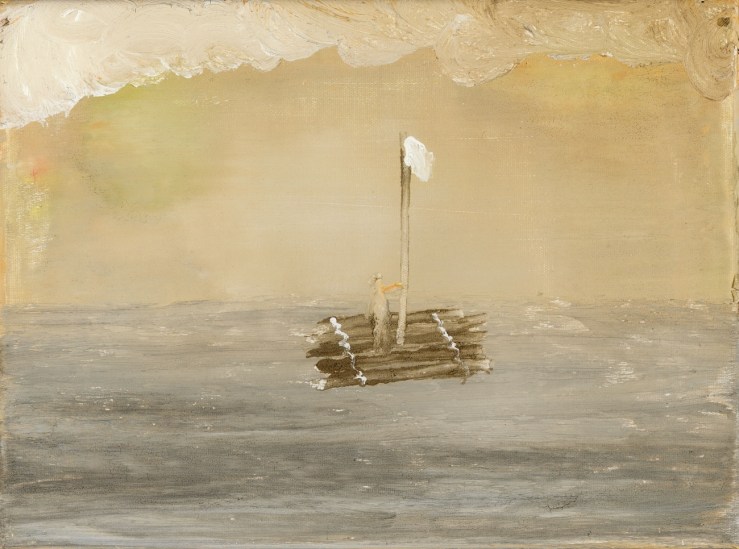
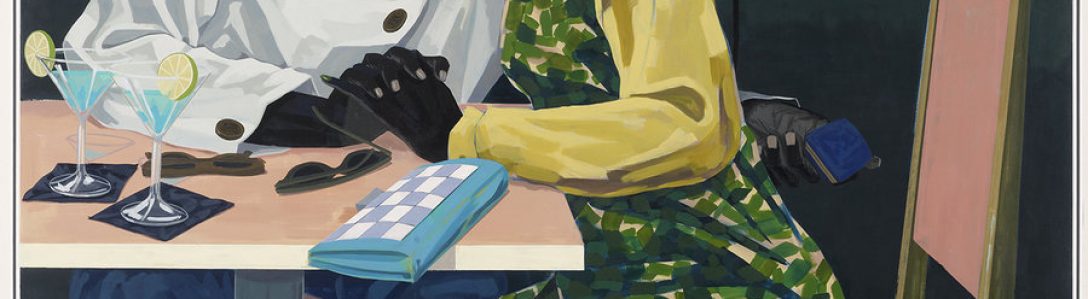
Tall Boy — Matt Bollinger

Tall Boy, 2021 by Matt Bollinger (b. 1980)

A few thoughts on John Williams’ brilliant historical novel Augustus

At the beginning of April, an old friend (who wrote some excellent reviews on this site in the past) told me that I needed to read John Williams’ 1972 novel Augustus. I loved Williams’ Stoner, which I read (and reviewed) a decade ago, when its cult status seemed to explode thanks to a new edition from NYRB. After Stoner, I tried a few times to read Williams’ western, Butcher’s Crossing, but never got too deep into it. I handled copies of Augustus a few times at bookstores, but the subject didn’t appeal to me. But my friend recommended it, and he’s never steered me wrong, so I picked up a copy of Augustus and cracked it open.

I picked up a copy of Augustus and cracked it open and didn’t put it down that much, unless I had to, until I’d finished it. The novel tells a life story of Gaius Octavius Thurinus, grand nephew Julius Caesar, who suceeds and avenges his assassinated great uncle (and adoptive father) to become the first Emperor of Rome. I was surprised at how much Roman history I remembered—some of it through two Shakespeare plays, some of it through an old HBO show, but most of it from, like, school. And this is one of the most fascinating elements of Augustus—Williams takes an old story and revivifies it.

Essentially an epistolary novel, Augustus features a rotating cast of voices. Prominent among these voices are Augustus’ — or really, Octavian’s — core group of friends, Maecenas, Agrippa, and Virgil. We also hear from notables including Marc Antony, Cleopatra, Horace, and Ovid, as well as many other voices, both invented and historical. There’s something addictive about Williams’ lucid prose, which imbues each character’s voice with its own distinctive style without falling into rhetorical gimmickry.

The early parts of the novel focus on young Octavian’s rise—the assassination of Julius Caesar, the warring Triumvirate, the political intrigue which overlaps with familial duty. We see Octavian/Augustus from multiple perspectives, but Williams’ withholds his hero’s voice until late in the novel. It’s Augustus’ daughter Julia who emerges, slowly, as the novel’s most sympathetic (and ultimately tragic) hero. Her sections of the book are particularly poignant, and recall from Stoner the doomed relationship between William Stoner and his daughter Grace.

Augustus is sad and wise but never dour. Williams harnesses the intellect and soul of his characters, who are simultaneously mortal and timeless. So many passages seem to describe life in the present-day United States (as well as other Western democracies). Consider the lines Williams attributes to Augustus’ intellectual adviser Maecenas, writing late in his life to the historian Livy:

What you seem so unwilling to accept, even now, is this: that the ideals which supported the old Republic had no correspondence to the fact of the old Republic; that the glorious word concealed the deed of horror; that the appearance of tradition and order cloaked the reality of corruption and chaos; that the call to liberty and freedom closed the minds, even of those who called, to the facts of privation, suppression, and sanctioned murder. We had learned that we had to do what we did, and we would not be deterred by the forms that deceived the world.

The complacency, the greed, the cynical failure to not just live up to its expressed ideals, but to take for suckers those who would still believe in those ideals—there’s something heartbreaking about the way Augustus anticipates contemporary democracy in peril to spectacle, hypocrisy, and avarice.

The titular character takes over in the brilliant last act of Augustus. Our Emperor is an old man, melancholy, reflective, but ultimately hopeful that he’s left the empire in good hands (he hasn’t). His final letter echoes Maecenas’ concerns about the corruption of Roman ideals:

. . . I knew that my destiny was simply this: to change the world. Julius Caesar had come to power in a world that was corrupt beyond your understanding. No more than six families ruled the world; towns, regions, and provinces under Roman authority were the currencies of bribery and reward; in the name of the Republic and in the guise of tradition, murder and civil war and merciless repression were the means toward the accepted ends of power, wealth, and glory. Any man who had sufficient money could raise an army, and thus augment that wealth, thereby gaining more power, and hence glory. So Roman killed Roman, and authority became simply the force of arms and riches. And in this strife and faction the ordinary citizen writhed as helplessly as the hare in the trap of the hunter.

And yet Williams’ Augustus is a realist, but one who tempers his perceptions of reality in a compassionate idealism:

Do not mistake me. I have never had that sentimental and rhetorical love for the common people that was in my youth (and is even now) so fashionable. Mankind in the aggregate I have found to be brutish, ignorant, and unkind, whether those qualities were covered by the coarse tunic of the peasant or the white and purple toga of a senator. And yet in the weakest of men, in moments when they are alone and themselves, I have found veins of strength like gold in decaying rock; in the cruelest of men flashes of tenderness and compassion; and in the vainest of men moments of simplicity and grace.

I haven’t done enough to convey how wonderful Augustus is. Very highly recommended.
The Apparition — Antonio López García

The Apparition, 1963 by Antonio López García (b. 1936)

“The Coahoma County Wind Cults” — David Berman

“The Coahoma County Wind Cults”

by

David Berman


My dream walked on four legs
toward the remote source
of a pale yellow letter

only to circle around the cabin
when it got there.

A black and white cave rainbow
arched between two old shoes.

Oxygen bounced off the face of a doll,
looking for the slow dazzling guts
of a life form.

There was a moment of sudden clarity
when the pages of burned in opera glasses,

like a herd crossing zip codes

or an exhausted idea pressing
at the limits of the marquee bulbs,

my dream pushes air.

Untitled — Norbert Schwontkowski

Untitled, by Norbert Schwontkowski (1949-2013)

Four Books (By Ishmael Reed)

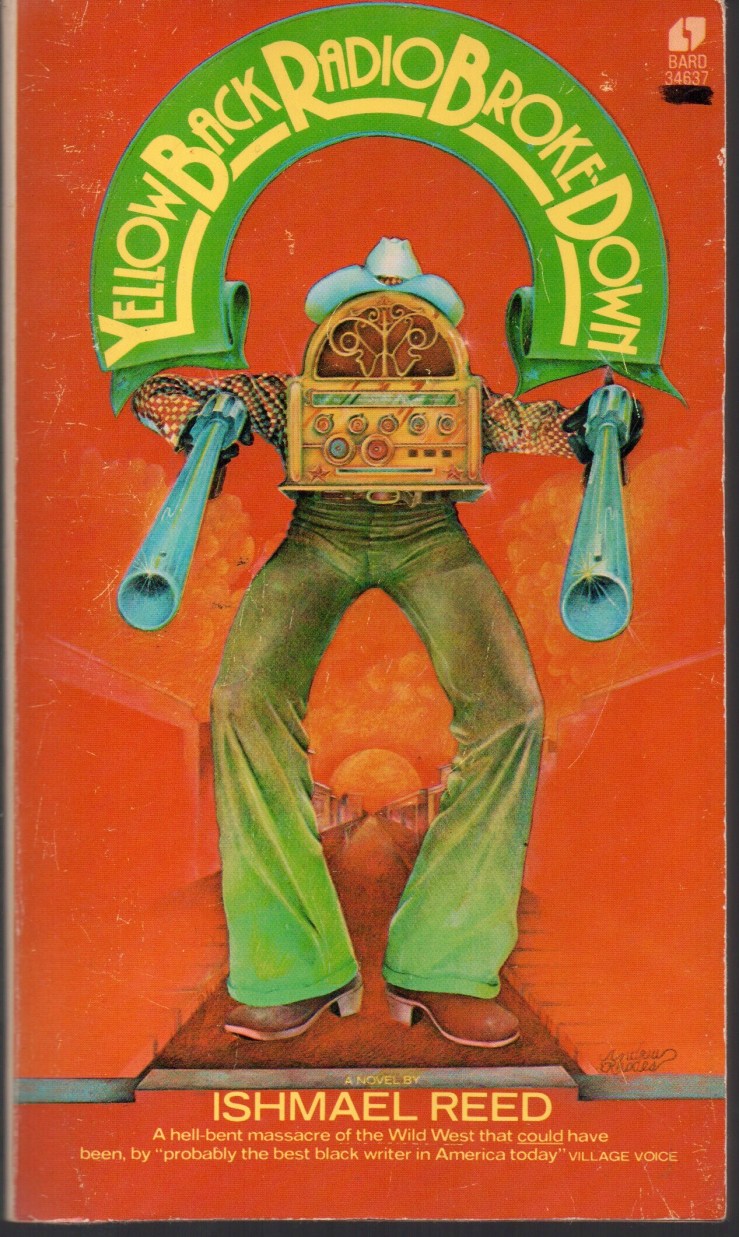
Seven years ago I came across three lovely 1970s mass market paperback Ishmael Reed novels. In the years since then, I’ve consumed most of Reed’s novels, even picking up an undervalued signed copy online. Two of my favorite Reed editions are from Avon Bard. This past Sunday, I came across two more Reed Avon Bard editions, and snapped them up, despite already owning them in hardback. While no designer or artist is credited, the signature on this edition of Flight to Canada clearly says “Andrew Rhodes”:

I’m pretty sure that Rhodes is the artist (and possibly designer) of the other Avon Bard Reeds I picked up years ago, Mumbo Jumbo

IMG_0547

—and Yellow Back Radio Broke-Down (the signature is clear on this one):


IMG_0548

We can also see “Rhodes” on the copy of The Last Days of Louisiana Red I picked up on Sunday. (This book also has the stamp of a guy who lives (lived?) in Perry, Florida, a stamp I’ve come to recognize over the years as a guy who, at least at one point, had very similar taste to my own. I have a lot of his old books and I wonder about him sometimes.)

Here are some reviews I’ve written of Reed’s novels over the past few years:

A review of Ishmael Reed’s sharp satire The Last Days of Louisiana Red

Blog about Ishmael Reed’s 1976 neo-slave narrative Flight to Canada

A review of Yellow Back Radio Broke-Down, Ishmael Reed’s syncretic Neo-HooDoo revenge Western

A review of Ishmael Reed’s Christmas satire, The Terrible Twos

Blog about Ishmael Reed’s novel Juice! (Book acquired, 10 Dec. 2019)

Once, I was talking to Herman Melville. He said, “I’m writing book called Moby-Dick” | Gilbert Gottfried

RIP Gilbert Gottfried, 1955-2022

“Occurrence on Washburn Avenue” — Regan Huff

“Occurrence on Washburn Avenue”

by

Regan Huff


Alice’s first strike gets a pat on the back,
her second a cheer from Betty Woszinski
who’s just back from knee surgery. Her third—
“A turkey!” Molly calls out—raises everyone’s eyes.
They clap. Teresa looks up from the bar.
At the fourth the girls stop seeing their own pins wobble.
They watch the little X’s fill the row on Alice’s screen—
That’s five. That’s six. There’s a holy space
around her like a saint come down to bowl
with the Tuesday Ladies in Thorp, Wisconsin.
Teresa runs to get Al, and Fran calls Billy
at the Exxon. The bar crowds with silent men.
No one’s cheering. No one’s bowling now
except Alice’s team, rolling their balls
to advance the screen around to Alice, who’s stopped
even her nervous laugh, her face blank and smooth
with concentration. It can’t go on
and then it does go on, the white bar
reading “Silver Dollar Chicken” lowering and clearing
nothing, then lowering and clearing nothing again.

Monday Morning — Andrew Wyeth

Monday Morning, 1955 by Andrew Wyeth (1917-2009)

“Avey” — Jean Toomer

“Avey”

by

Jean Toomer


FOR a long while she was nothing more to me than one of those skirted beings whom boys at a certain age disdain to play with. Just how I came to love her, timidly, and with secret blushes, I do not know. But that I did was brought home to me one night, the first night that Ned wore his long pants. Us fellers were seated on the curb before an apartment house where she had gone in. The young trees had not outgrown their boxes then. V Street was lined with them. When our legs grew cramped and stiff from the cold of the stone, we’d stand around a box and whittle it. I like to think now that there was a hidden purpose in the way we hacked them with our knives. I like to feel that something deep in me responded to the trees, the young trees that whinnied like colts impatient to be let free… On the particular night I have in mind, we were waiting for the top-floor light to go out. We wanted to see Avey leave the flat. This night she stayed longer than usual and gave77 us a chance to complete the plans of how we were going to stone and beat that feller on the top floor out of town. Ned especially had it in for him. He was about to throw a brick up at the window when at last the room went dark. Some minutes passed. Then Avey, as unconcerned as if she had been paying an old-maid aunt a visit, came out. I don’t remember what she had on, and all that sort of thing. But I do know that I turned hot as bare pavements in the summertime at Ned’s boast: “Hell, bet I could get her too if you little niggers weren’t always spying and crabbing everything.” I didnt say a word to him. It wasnt my way then. I just stood there like the others, and something like a fuse burned up inside of me. She never noticed us, but swung along lazy and easy as anything. We sauntered to the corner and watched her till her door banged to. Ned repeated what he’d said. I didnt seem to care. Sitting around old Mush-Head’s bread box, the discussion began. “Hang if I can see how she gets away with it,” Doc started. Ned knew, of course. There was nothing he didnt know when it came to women. He dilated on the emotional needs of girls. Said78 they werent much different from men in that respect. And concluded with the solemn avowal: “It does em good.” None of us liked Ned much. We all talked dirt; but it was the way he said it. And then too, a couple of the fellers had sisters and had caught Ned playing with them. But there was no disputing the superiority of his smutty wisdom. Bubs Sanborn, whose mother was friendly with Avey’s, had overheard the old ladies talking. “Avey’s mother’s ont her,” he said. We thought that only natural and began to guess at what would happen. Some one said she’d marry that feller on the top floor. Ned called that a lie because Avey was going to marry nobody but him. We had our doubts about that, but we did agree that she’d soon leave school and marry some one. The gang broke up, and I went home, picturing myself as married.

Continue reading ““Avey” — Jean Toomer”

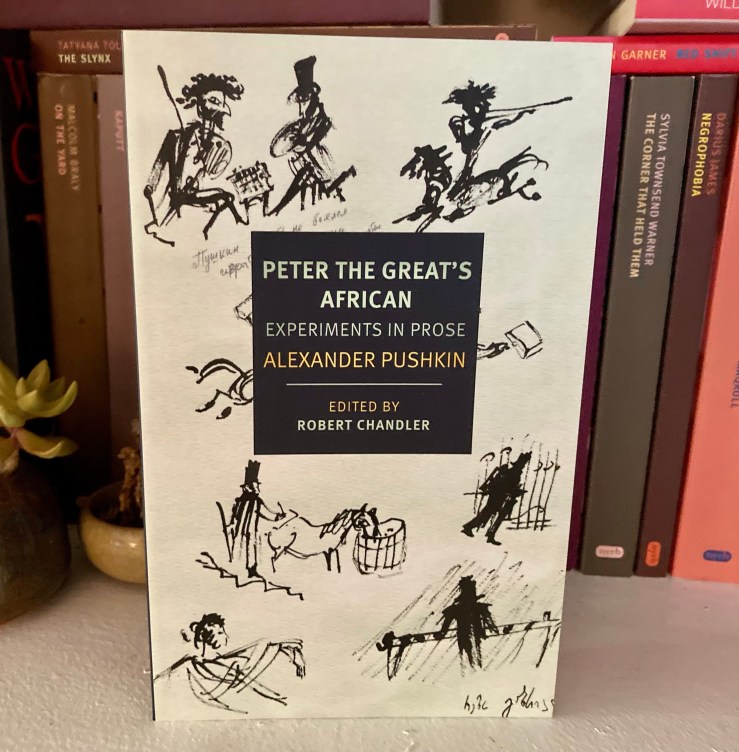
Pushkin’s Peter the Great’s African (Book acquired, sometime in the last week of March 2022)

NYRB has a new collection of Alexander Pushkin stories called Peter the Great’s African out later this month. The long short stories are translated by by Robert Chandler (who also provides the afterword), Elizabeth Chandler, and Boris Dralyuk. NYRB’s blurb:

Alexander Pushkin, Russia’s foundational writer, was constantly experimenting with new genres, and this fresh selection ushers readers into his creative laboratory. Politics and history weighed heavily on Pushkin’s imagination, and in “Peter the Great’s African” he depicts the Tsar through the eyes of one of his closest confidantes, Ibrahim, a former slave, modeled on Pushkin’s maternal great-grandfather. At once outsider and insider, Ibrahim offers a sympathetic yet questioning view of Peter’s attempt to integrate his vast, archaic empire into Europe. In the witty “History of the Village of Goriukhino” Pushkin employs parody and self-parody to explore problems of writing history, while “Dubrovsky” is both a gripping adventure story and a vivid picture of provincial Russia in the late eighteenth century, with its class conflicts ready to boil over in violence. “The Egyptian Nights,” an effervescent mixture of prose and poetry, reflects on the nature of artistic inspiration and the problem of the poet’s place in a rapidly changing and ever more commercialized society.


Homunculus — Peter Ferguson 

Homunculus by Peter Ferguson (b. 1968)

The Glass Is Half Full — Lola Gil

The Glass Is Half Full, 2019 by Lola Gil (b. 1975)

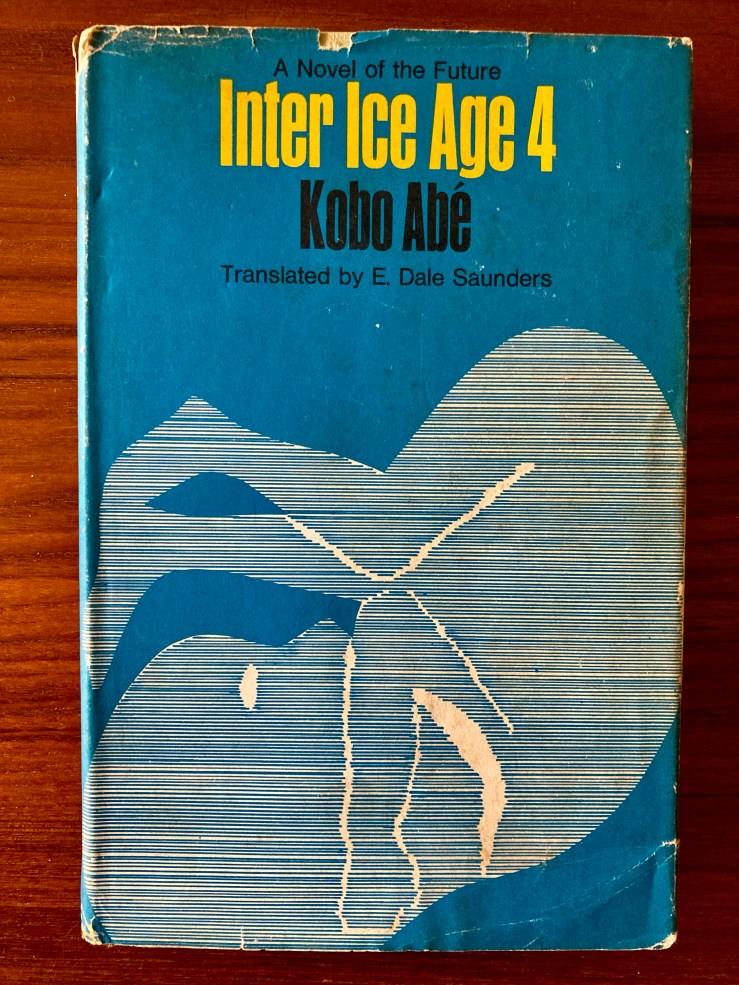
Kobo Abe’s Inter Ice Age 4 (Book acquired, 1 April 2022)

I was thrilled to find a first-edition U.S. hardback (Knopf, 1970, Book Club Edition) of Kobo Abe’s novel Inter Ice Age 4. The translation is by E. Dale Saunders, and is the only English translation of the novel that I am aware of. The jacket design is by Joseph del Gaudio; I’m not sure if he is responsible for this lovely little embossed image that takes up the bottom-right corner of the cover:

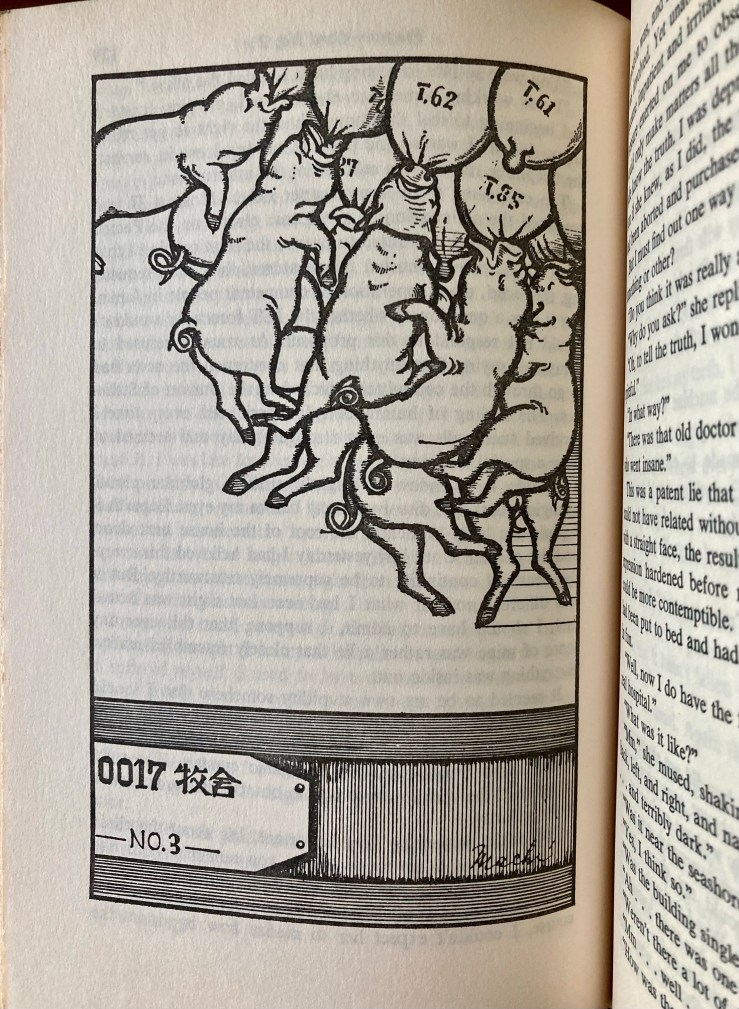
This edition includes five line drawings by Abe’s wife, the artist Machi Abe. Here is one of those drawings:

I’ve had a samizdat e-copy of Inter Ice Age 4 for ages now, but haven’t made it past the first 20 or so pages, but the intriguing, prescient plot has always intrigued me. First composed and published in serialization at the end of the 1950s, Inter Ice Age 4 is set in a world where the polar ice caps are rapidly melting. Scientists genetically modify gilled children to survive this new reality. A proto-AI, a computer that can tell the future is the novel’s central antagonist. Thank god nothing like that’s shaking down these days!

Motel — Pavel Guliaev

Motel, 2019 by Pavel Guliaev (b. 1967)

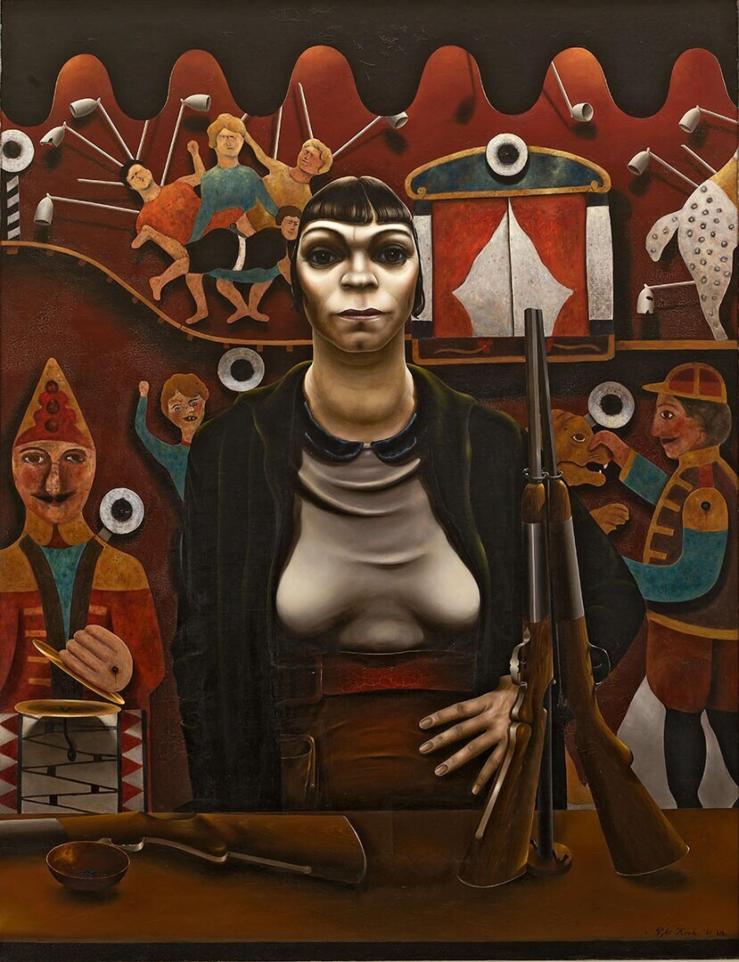
The Shooting Gallery — Pyke Koch

The Shooting Gallery, 1931 by Pyke Koch (1901–1991)

Carpool — Jolene Lai

Carpool., 2018 by Jolene Lai (b. 1980)