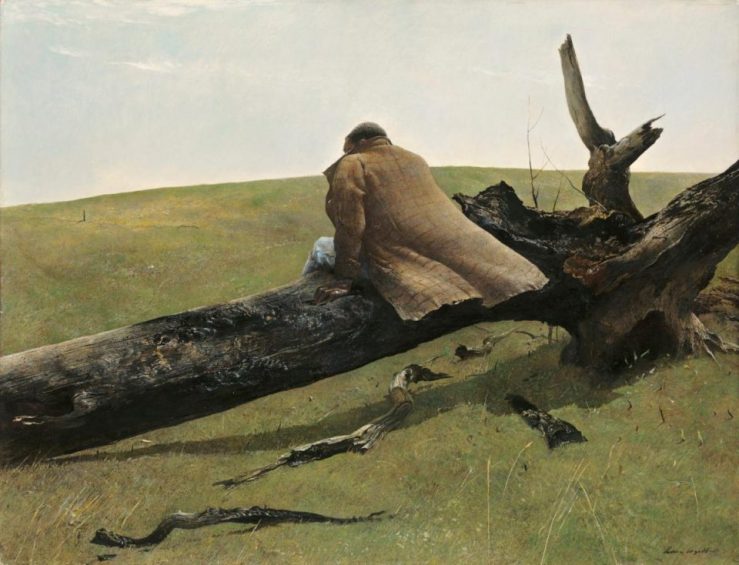
Monday Morning — Andrew Wyeth

Monday Morning, 1955 by Andrew Wyeth (1917-2009)

“Avey” — Jean Toomer

“Avey”

by

Jean Toomer


FOR a long while she was nothing more to me than one of those skirted beings whom boys at a certain age disdain to play with. Just how I came to love her, timidly, and with secret blushes, I do not know. But that I did was brought home to me one night, the first night that Ned wore his long pants. Us fellers were seated on the curb before an apartment house where she had gone in. The young trees had not outgrown their boxes then. V Street was lined with them. When our legs grew cramped and stiff from the cold of the stone, we’d stand around a box and whittle it. I like to think now that there was a hidden purpose in the way we hacked them with our knives. I like to feel that something deep in me responded to the trees, the young trees that whinnied like colts impatient to be let free… On the particular night I have in mind, we were waiting for the top-floor light to go out. We wanted to see Avey leave the flat. This night she stayed longer than usual and gave77 us a chance to complete the plans of how we were going to stone and beat that feller on the top floor out of town. Ned especially had it in for him. He was about to throw a brick up at the window when at last the room went dark. Some minutes passed. Then Avey, as unconcerned as if she had been paying an old-maid aunt a visit, came out. I don’t remember what she had on, and all that sort of thing. But I do know that I turned hot as bare pavements in the summertime at Ned’s boast: “Hell, bet I could get her too if you little niggers weren’t always spying and crabbing everything.” I didnt say a word to him. It wasnt my way then. I just stood there like the others, and something like a fuse burned up inside of me. She never noticed us, but swung along lazy and easy as anything. We sauntered to the corner and watched her till her door banged to. Ned repeated what he’d said. I didnt seem to care. Sitting around old Mush-Head’s bread box, the discussion began. “Hang if I can see how she gets away with it,” Doc started. Ned knew, of course. There was nothing he didnt know when it came to women. He dilated on the emotional needs of girls. Said78 they werent much different from men in that respect. And concluded with the solemn avowal: “It does em good.” None of us liked Ned much. We all talked dirt; but it was the way he said it. And then too, a couple of the fellers had sisters and had caught Ned playing with them. But there was no disputing the superiority of his smutty wisdom. Bubs Sanborn, whose mother was friendly with Avey’s, had overheard the old ladies talking. “Avey’s mother’s ont her,” he said. We thought that only natural and began to guess at what would happen. Some one said she’d marry that feller on the top floor. Ned called that a lie because Avey was going to marry nobody but him. We had our doubts about that, but we did agree that she’d soon leave school and marry some one. The gang broke up, and I went home, picturing myself as married.

Continue reading ““Avey” — Jean Toomer”

Pushkin’s Peter the Great’s African (Book acquired, sometime in the last week of March 2022)

NYRB has a new collection of Alexander Pushkin stories called Peter the Great’s African out later this month. The long short stories are translated by by Robert Chandler (who also provides the afterword), Elizabeth Chandler, and Boris Dralyuk. NYRB’s blurb:

Alexander Pushkin, Russia’s foundational writer, was constantly experimenting with new genres, and this fresh selection ushers readers into his creative laboratory. Politics and history weighed heavily on Pushkin’s imagination, and in “Peter the Great’s African” he depicts the Tsar through the eyes of one of his closest confidantes, Ibrahim, a former slave, modeled on Pushkin’s maternal great-grandfather. At once outsider and insider, Ibrahim offers a sympathetic yet questioning view of Peter’s attempt to integrate his vast, archaic empire into Europe. In the witty “History of the Village of Goriukhino” Pushkin employs parody and self-parody to explore problems of writing history, while “Dubrovsky” is both a gripping adventure story and a vivid picture of provincial Russia in the late eighteenth century, with its class conflicts ready to boil over in violence. “The Egyptian Nights,” an effervescent mixture of prose and poetry, reflects on the nature of artistic inspiration and the problem of the poet’s place in a rapidly changing and ever more commercialized society.


Homunculus — Peter Ferguson 

Homunculus by Peter Ferguson (b. 1968)

The Glass Is Half Full — Lola Gil

The Glass Is Half Full, 2019 by Lola Gil (b. 1975)

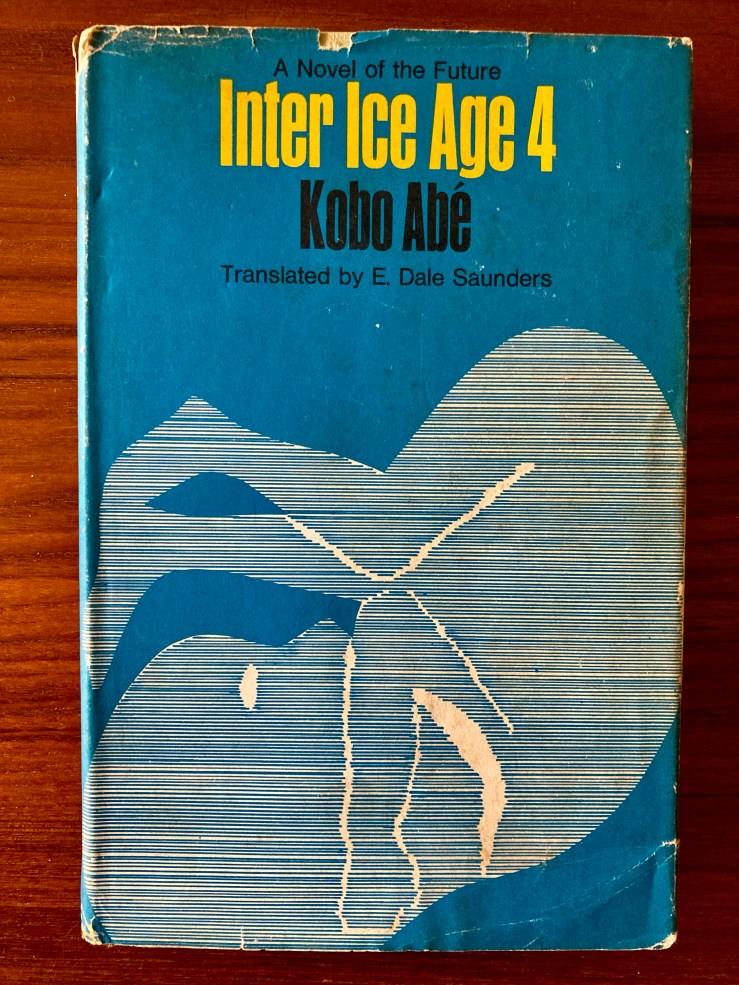
Kobo Abe’s Inter Ice Age 4 (Book acquired, 1 April 2022)

I was thrilled to find a first-edition U.S. hardback (Knopf, 1970, Book Club Edition) of Kobo Abe’s novel Inter Ice Age 4. The translation is by E. Dale Saunders, and is the only English translation of the novel that I am aware of. The jacket design is by Joseph del Gaudio; I’m not sure if he is responsible for this lovely little embossed image that takes up the bottom-right corner of the cover:

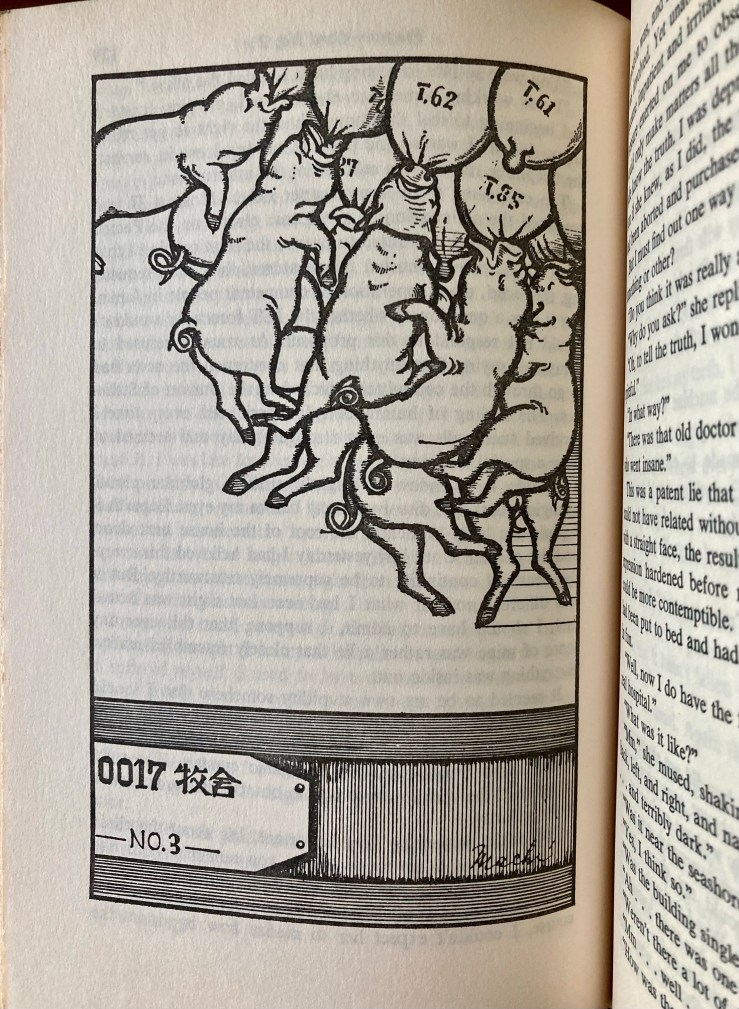
This edition includes five line drawings by Abe’s wife, the artist Machi Abe. Here is one of those drawings:

I’ve had a samizdat e-copy of Inter Ice Age 4 for ages now, but haven’t made it past the first 20 or so pages, but the intriguing, prescient plot has always intrigued me. First composed and published in serialization at the end of the 1950s, Inter Ice Age 4 is set in a world where the polar ice caps are rapidly melting. Scientists genetically modify gilled children to survive this new reality. A proto-AI, a computer that can tell the future is the novel’s central antagonist. Thank god nothing like that’s shaking down these days!

Motel — Pavel Guliaev

Motel, 2019 by Pavel Guliaev (b. 1967)

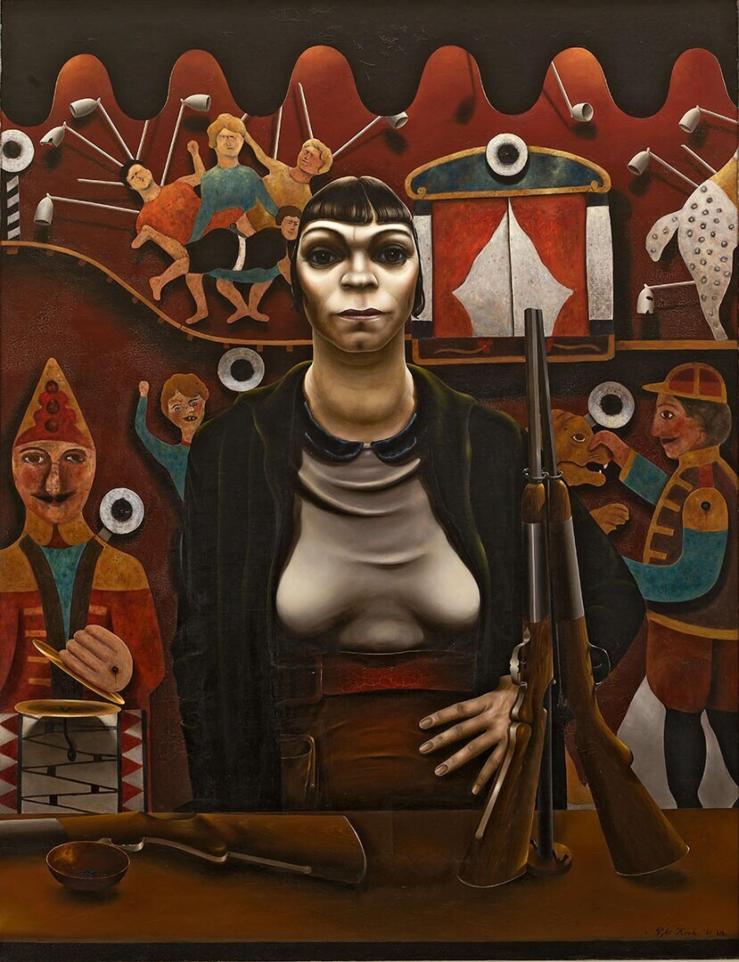
The Shooting Gallery — Pyke Koch

The Shooting Gallery, 1931 by Pyke Koch (1901–1991)

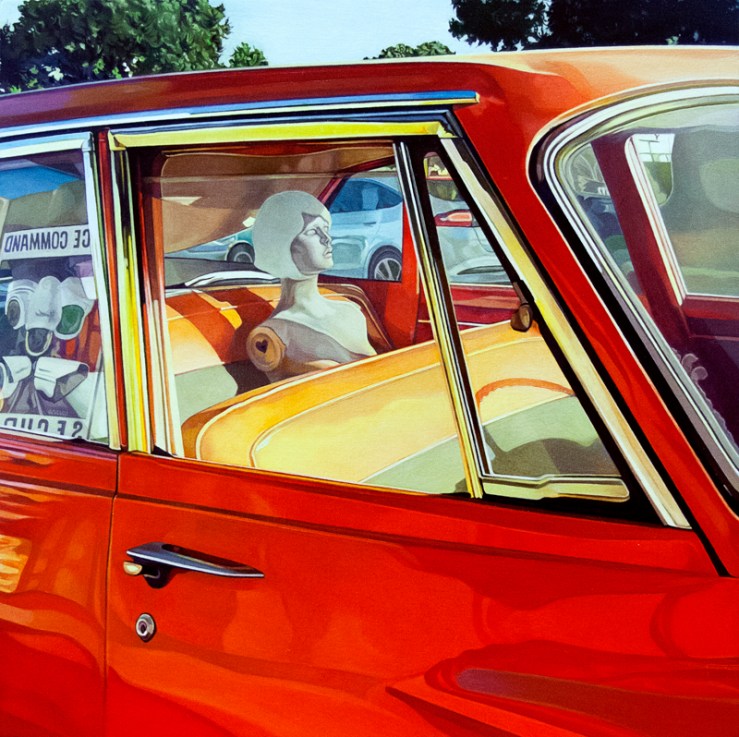
Carpool — Jolene Lai

Carpool., 2018 by Jolene Lai (b. 1980)

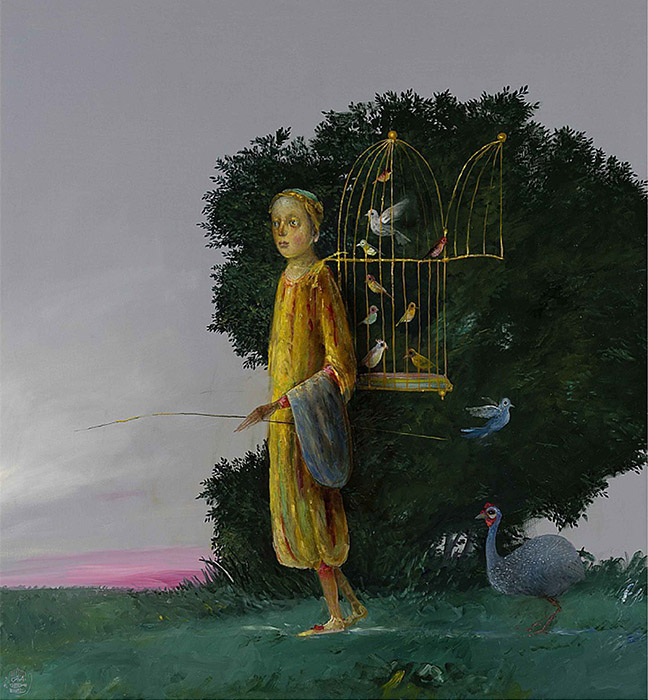
The Cage — Stefan Caltia

The Cage, 2006 by Stefan Caltia (b. 1942)

Hiroko Oyamado’s subtle novel The Hole captures the banal surreal loneliness of modern life

Hiroko Oyamada’s novel The Hole is a subtle, slim, slow-burn low-stakes horror story that tiptoes neatly between banality and surrealism. Our first-person narrator is Asahi, a young, recently-married woman. Asahi–or Asa, as she thinks of herself–is a part-time employee in a large city somewhere in Japan. She doesn’t really have any friends or hobbies, let alone any ambitions. When her husband Muneaki gets a job transfer to the countryside, Asa’s mother-in-law Tomiko offers the young couple the house next to hers, rent-free. The young couple’s economic situation means they can’t refuse, so they don’t. Asa’s only real acquaintance, a work buddy, remarks how lucky she is to be a housewife, but Asa is ambivalent.

That ambivalence radiates throughout The Hole. In David Boyd’s spare, direct translation, Oyamada pushes her hero into a stifling, stuffy, overheated summer. The skinny novel is an exercise in boredom-as-horror: Even before Asa arrives in her husband’s rural hometown, everything’s just a wee bit off. The cicadas vibrate at a different pitch; the locals seem to come from a different era; time seems to run backwards and forwards.

Without a car or job, Asa is essentially stranded, spending her days guilty over running the AC, and unable to communicate with her husband’s grandfather, who mutely gardens his hours away.

Her only cultural landmark is a 7-Eleven convenient store, where mother-in-law Tomiko sends her on an errand one day. The banal errand becomes a bizarre Carollonian quest—but a quest without a clear object. On her route to the convenience store (what could be more boring and inconvenient?) Asa spies a large, strange, dark-furred creature:

 It had wide shoulders, slender and muscular thighs, but from the knees down, its legs were as thin as sticks. The animal was covered in black fur and had a long tail and rounded ears. Its ribs were showing, but its back was bulky, maybe with muscle or with fat.

Frantically following it, she falls into a hole that fits her nearly perfectly (like a proscribed role, or a coffin, or like, whatever):

As I tried to move, I realized how narrow the hole really was. The hole felt as though it was exactly my size – a trap made just for me. The bottom of the hole was covered with something dry, maybe dead grass or straw. Looking toward the river through a break in the grass, all I could see was white light.

A mysterious white-clad neighbor named Sera (who calls Asa “the bride”) pulls her out from the hole, and she makes her way to the 7-Eleven, where a gang of strange children block her mission. She also meets an oddball who later claims to be the white rabbit to her lost Alice. He claims to be an unacknowledged mystery brother-in-law who lives in a shed, having relinquished adult responsibility. There are centipedes and bug bites and other strange goings on—and Asa  talks about absolutely none of it with her husband or mother-in-law.

The Hole captures the stifling omnipresence of loneliness. Asa is a sympathetic character, and while many of the details of her circumstance are particular to Japanese culture, the narrative resonates with the larger absurdities of contemporary life. Asahi’s loneliness burns all the more real for the novel’s surrealism. Her loneliness is the realest thing in The Hole, its presence never acknowledged because it cannot fully be named. The “loneliness” is more real than the quasi-mystical hole-digging creature that plagues the countryside, or the manic brother-in-law-who-lives-in-a-shed-in-the-backyard whom no one ever mentions. But unlike these surreal entities, Asa’s loneliness is never directly invoked.

The Hole will be somewhat familiar with anyone who’s climbed about in the Kafka tree. While Oyamada directly evokes Carroll’s Alice stories, her story is far less fanciful, its dire core obscured with a thin veneer of the banal. The Hole recalls the tone and mood of Kobo Abe’s The Woman in the Dunes, where the protagonist comes to be in an uncanny scenario that becomes uncannier by the moment. But Oyamada’s narrator doesn’t seem to demarcate the separation into unreality; rather, the novel absorbs its narrator into a new unreal-real reality.

The Hole is wonderfully dull at times, as it should be. It’s layered but brittle, with notes of a freshness just gone sour. It’s a quick, propulsive read—a thriller, even, perhaps—but its thrills culminate in sad ambiguity. Recommended.

April Wind — Andrew Wyeth

April Wind, 1952 by Andrew Wyeth (1917-2009)

The Fools — Agostino Arrivabene

i-folli

The Fools, 2017 by Agostino Arrivabene (b. 1967)

Cruelest month

New books by Caren Beilin and Cristina Rivera Garza from the Dorothy Project (Books acquired, 28 March 2022)

Two new enticing titles from the Dorothy Project: Caren Beilin’s novel Revenge of the Scapegoat and Cristina Rivera Garza’s collection New and Selected Stories. 

The Beilin seems like a picaresque surrealist joint, which is right up my alley. Press copy:

One day Iris, an adjunct at a city arts college, receives a terrible package: recently unearthed letters that her father wrote to her in her teens, in which he blames her for their family’s crises. Driven by the raw fact of receiving these devastating letters not once but twice in a lifetime, and in a panic of chronic pain brought on by rheumatoid arthritis, Iris escapes to the countryside—or some absurdist version of it. Nazi cows, Picassos used as tampons, and a pair of arthritic feet that speak in the voices of Flaubert’s Bouvard and Pécuchet are standard fare in this beguiling novel of odd characters, surprising circumstances, and intuitive leaps, all brought together in profoundly serious ways.

I spent a half hour reading a few of the stories in the Rivera Garza collection, going from an older track to a few that haven’t yet been published in Spanish yet. The later stories seem more daring in form and content–exciting stuff.

New and Selected Stories brings together in English translation stories from across Rivera Garza’s career, drawing from three collections spanning over 30 years and including new writing not yet published in Spanish. It is a unique and remarkable body of work, and a window into the ever-evolving stylistic and thematic development of one of the boldest, most original, and affecting writers in the world today.

The collection seems like a great introduction to Rivera Garza’s three decades of work. The translations are by Sara Brooker, Lisa Dillman, Francisca González Arias, Alex Ross, and Rivera Garza herself.

The Rooster and the Devil — Susannah Martin 

The Rooster and the Devil, 2020 by Susannah Martin (b. 1964)