“The List Is the Origin of Culture” — Umberto Eco

From a 2009 interview with Der Spiegel

Umberto Eco: The list is the origin of culture. It’s part of the history of art and literature. What does culture want? To make infinity comprehensible. It also wants to create order — not always, but often. And how, as a human being, does one face infinity? How does one attempt to grasp the incomprehensible? Through lists, through catalogs, through collections in museums and through encyclopedias and dictionaries. There is an allure to enumerating how many women Don Giovanni slept with: It was 2,063, at least according to Mozart’s librettist, Lorenzo da Ponte. We also have completely practical lists — the shopping list, the will, the menu — that are also cultural achievements in their own right.

SPIEGEL: Should the cultured person be understood as a custodian looking to impose order on places where chaos prevails?

Eco: The list doesn’t destroy culture; it creates it. Wherever you look in cultural history, you will find lists. In fact, there is a dizzying array: lists of saints, armies and medicinal plants, or of treasures and book titles. Think of the nature collections of the 16th century. My novels, by the way, are full of lists.

SPIEGEL: Accountants make lists, but you also find them in the works of Homer, James Joyce and Thomas Mann.

Eco: Yes. But they, of course, aren’t accountants. In “Ulysses,” James Joyce describes how his protagonist, Leopold Bloom, opens his drawers and all the things he finds in them. I see this as a literary list, and it says a lot about Bloom. Or take Homer, for example. In the “Iliad,” he tries to convey an impression of the size of the Greek army. At first he uses similes: “As when some great forest fire is raging upon a mountain top and its light is seen afar, even so, as they marched, the gleam of their armour flashed up into the firmament of heaven.” But he isn’t satisfied. He cannot find the right metaphor, and so he begs the muses to help him. Then he hits upon the idea of naming many, many generals and their ships.

SPIEGEL: But, in doing so, doesn’t he stray from poetry?

Eco: At first, we think that a list is primitive and typical of very early cultures, which had no exact concept of the universe and were therefore limited to listing the characteristics they could name. But, in cultural history, the list has prevailed over and over again. It is by no means merely an expression of primitive cultures. A very clear image of the universe existed in the Middle Ages, and there were lists. A new worldview based on astronomy predominated in the Renaissance and the Baroque era. And there were lists. And the list is certainly prevalent in the postmodern age. It has an irresistible magic.

“I’m a Writer You Monsters!”

John Turturro on Miller’s Crossing and Barton Fink

Great interview with John Turturro at the AV Club today—it’s part of their Random Roles feature, where an actor (usually a character actor) discusses his or her films. Here’s Turturro talking about some of the films he’s made with the Coen brothers

JT: I’ve known [the Coens] a long time. I’ve known them from the mid-’80s, because I’m friends with Fran [McDormand]. That’s how I know them. I’ve worked with them on four movies, and they were my executive producers for and really helped me edit Romance And Cigarettes. They’re really good friends—and so is someone like Spike [Lee]. It’s a pleasure in this business when you work with someone more than once. It’s nice, because everybody knows each other.

The Coens are like a mom-and-pop operation. They write it, they edit it, they do the whole thing. They’re involved in everything. It’s very low stress, working with them. There’s almost no stress. If I could make a movie with them every couple of years I would, just because of the pleasure of it.

AVC: How did you finally come to work with them on Miller’s Crossing?

JT: They’d seen me do a lot of plays, and so they said they were going to write a part for me. Then they wrote two parts for me in a row! [Laughs.] Those are big things. When someone writes something for you, you really want to return the favor. So I put a lot of work into it, and tried to give them a little surprise back. Actually I’m going to be directing these three one-act plays on Broadway soon, and Ethan is one of the writers. Woody Allen is one and Elaine May is one and Ethan is one. So I’m working with him again. This is, I guess, the sixth time we’ve worked together.

AVC: The big “look into your heart” scene in the woods. How many takes was that?

JT: I don’t remember how many takes. I just know it was 13 degrees, that’s all. It was really cold. You know, it was a long time ago. It was a hard scene. Sometimes you think about movies, and you say, “Well, I want to try to do something that’s not exactly in a movie.” If you’ve ever been in a very dangerous situation, you know that people will do all kinds of things to keep themselves alive. It was very well-written, but you want to imagine what it’s really like to be in that kind of situation. It depends on what you’re willing to do, and in real life you would do a lot of different things. I tried to capture a little bit of that. I had a couple close encounters throughout my life before that, and you store that stuff in the back of your mind. It’s how you do it, but it’s what they choose and how they put it together too. But that was my goal when I did that, was to do something that was almost a little difficult to watch, because people aren’t trying to be heroic at those moments.

AVC: When you first came across that scene in the screenplay, was it obvious to you that it would be so central and important to the movie? They even used it for the poster.

JT: I guess maybe, but not completely. I kind of knew it was important, and they kept telling me it was. But you don’t want to put too much pressure on yourself, because then it’s like going to bed with somebody the first time or something. You’re like, “Oh God, I got to be great.” [Laughs.] You just don’t want to put too much pressure on yourself. I just thought about it in the context of the story, that’s it. Because you can overthink something, too. It all felt really good when they did it, but it was hard to do.

Barton Fink (1991)—“Barton Fink”
AVC: Since the Coens were writing Barton Fink while they were still struggling through Miller’s Crossing, were you guys discussing that during the shoot?

JT: No. They said at the end—the guy, [executive producer] Ben Barenholtz, said there was this other movie. The way he talked, it sounded like Bart And Fink. I thought it was Bart And Fink. I was like, Bart And Fink? I don’t know about that.” And I didn’t completely get it when I first read it. Their scripts you have to read a bunch of times. And now I guess people can read them easier—someof their scripts—because they know their sensibility. But their sensibility can be quite different, depending on the movie that they’re linked to.

AVC: Did you really go to secretarial school just to study typing for Barton Fink?

JT: Yeah, I did. It was in Brooklyn Heights. It was with electric typewriters; they didn’t have computers. But then I had to use the old manual typewriter, which I loved. They get stuck, but I really love the sound of it, and the whole visceral experience. I wrote a lot of things on that typewriter during the shoot, a lot of ideas for other things.

AVC: Didn’t you write Romance And Cigarettes on it?

JT: I wrote the title of it and some ideas. A couple of scenes. But then I kind of sat on it. I put it in this box for 10 years. So yeah, it was “A Film by Barton Fink.” [Laughs.]

AVC: Your character talks a lot about creating “a new living theater of, about, and for the common man,” which is relevant to the sort of stories you seem to tell in a lot of your own work. But in the film, it seems like that whole idea is being mocked as pretentious. 

JT: [Laughs.] Yeah. Well, there’s guys who are outside of that and who talk about it, and there are guys who are inside of it. I did Mac right after that, which was really, for me, inside. And Fink is more from the outside. Plenty of writers have taken those stances—especially in the ’30s, because people came out of immigration, and there was a lot of Socialism. People were really liberal. There were anarchists. There was a Communist Party in this country. There was also a Nazi party that people don’t really talk about. So there were a lot of these things going on, and you kind of have to go back years to understand this thing. It was in the Group Theatre, and people like Arthur Miller obviously had that in his plays. Sometimes it could become a little bit pretentious, and other times not. But everything’s connected in different ways.

AVC: My favorite scene—honestly, maybe my favorite scene in a movie ever—is just a simple dialogue between you and Tony Shalhoub.

JT: Which one?

AVC: “Throw it hard.”

JT: “Throw it hard, Fink!” [Laughs.] Yeah, there were some great actors in that movie, and I got to work with all of them. It was just a treat. There was just wonderful writing in it too. Even though it was a strange movie and stuff like that, when I see the movie now, I really appreciate it. I’m like, “Wow, that was really good.” When I first saw it, it’s hard, because you’re in it. But it’s a good movie, so thank you. It’s a really well-crafted film. It was a treat to make that film, and to work with every one of those actors. Judy Davis is just fabulous.

“Style and Content Must Match” — William Gaddis on Voice and Risk in His Novels

From a brief  1982 interview with William Gaddis

Q: The pervasive and distinctive authorial voice of The Recognitions gives way in J R to a self-effacing voice that seems to serve only functional purposes. Also in J R there is an increased dependence on dialogue. For verisimilitude in Lolita, Nabokov “travelled in school buses to listen to the talk of schoolgirls.” Did you take any special measures to hear and note the speech patterns of any of the wide variety of people who speak in “J R”?

William Gaddis: Style and content must match, must be complementary, accounting in part for a difference between the two books, though the lack of a conventional narrative style had already jarred a good many readers of The Recognitions when it appeared, as its hapless reviews show. J R was started as a story which quickly proved unsatisfactory, inspired- here’s the legitimate gossip—-by the postwar desecration of the Long Island village of Massapequa where my family had had property since around 1910, take a look at it now and you’ll see all the book’s worst hopes realized. In approaching J R as a novel, I was at pains to remove the author’s presence from the start as must be obvious. This was partly by way of what I mentioned earlier, obliging the thing to stand on own, take its own chances. But it was also by way of setting up a problem, a risk, in order to sustain my own interest, especially since the largely uninterrupted dialogue raised the further risk of presenting a convincing sense of real time without the conventional chapter breaks, white spaces, such narrative intrusions as “A week later . . .” How some of the writers I come across get through their books without dying of boredom is beyond me. As for what you call speech patterns, one is always listening and has got an ear or hasn’t, and without one, unless perhaps in dealing with an unfamiliar language and culture, no amount of your special measures like riding around on school buses will get you out of the swamp.

Ten Thousand Years Older — Werner Herzog

The Goodbye Place — Richard Kelly

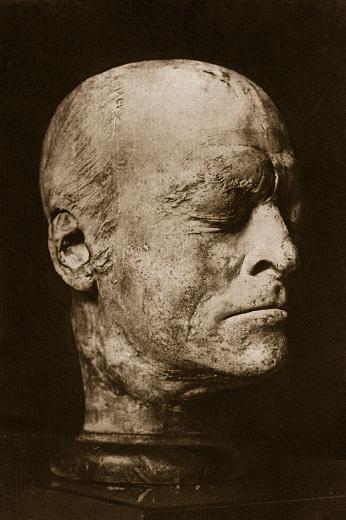
William Blake’s Death Mask

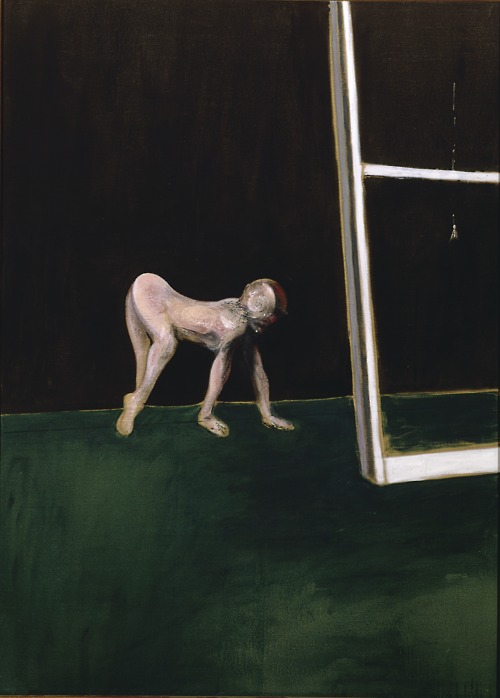
Paralytic Child Walking on All Fours (from Muybridge) — Francis Bacon

“Finnegans Wake: What It’s All About” — Anthony Burgess

Read Anthony Burgess’s essay on James Joyce’s Finnegans Wake. From said essay—

In his dream HCE, as we shall now call him, tries to make the whole of history swallow up his guilt for him. His initials are made to stand for the generality of sinful man, and they are expanded into slogans like “Here Comes Everybody” and “Haveth Childers Everywhere”. After all, sexual guilt presupposes a certain creative, or procreative, vitality, and a fall only comes to those who are capable of an erection. The unquenchable vitality appears in “our Human Conger Eel” (despite the “down, wantons, down” of the eel-pie-maker in King Lear); the erector of great structures is seen in “Howth Castle and Environs”. From the point of view of the ultimate dreamer of the dream, though (the author himself), “HCE” has a structural task to perform. As a chemical formula (H2CE3) or as a genuine vocable (“hec” or “ech” or even “Hecech”) it holds the dream down to its hero, is sewn to it like a mono­gram-HCE: his dream. But HCE has, so deep is his sleep, sunk to a level of dreaming in which he has become a collective being rehearsing the collective guilt of man. Man falls, man rises so that he can fall again; the sequence of falling and rising goes on till doomsday. The record of this, expressed in the lives of great men, in the systems they make and unmake and remake, is what we call history.

RIP Peter Falk

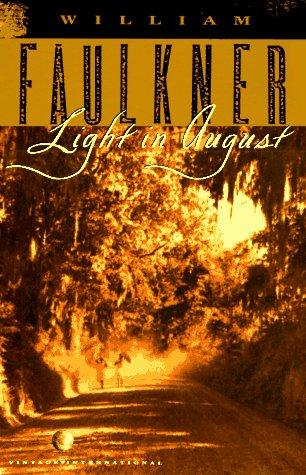
Light in August — William Faulkner

I can’t unpack William Faulkner’s novel Light in August here. There’s too much in it. It’s too thick. Faulkner piles on his sentences in a gelatinous mass, smearing words on top of words into a deep swamp of meaning, motif, and symbol. The novel is archaeological, a deep dig into the South’s abject wounds. It is the most Faulkneresque Faulkner novel I have read, a heady strange brew that tries to suss out racism, misogyny, fear of paternity, the scars of the plantation system, the fallout of the Civil War, the cold comfort of religion, and so much more. Like any good modern text, you could say it’s about a quest for identity, and how the quester must come into conflict with the codes and terms of the dominant social order to find that solid identity. But in Faulkner there is no stable identity, and Light in August dramatizes this problem, even as it points to a possible inherent payoff.

A book review should give some sense of what happens in the book, but as in much of Faulkner’s work, explaining “what happens” in a Light in August would spoil the puzzle, the synthesis, the game, the shock of it all. But some outlines should suffice. The novel is set in the Jim Crow South, mostly in Jefferson, seat of Yoknapatawpha County, the Faulknerverse. It opens with Lena Grove walking “all the way from Alabama” into Mississippi; she’s in her third trimester of pregnancy and still has no ring on her finger, a sign that every Southerner knows how to read. Lena is looking for the father’s child, Lucas Burch; she hears tell that a Burch might work at the planing mill. It’s not Burch though, but Byron Bunch, who falls for Lena right away, plays Joseph to her Mary. Meanwhile, Lucas Burch is around—only the rascal’s taken up the false name Joe Brown. He’s also taken up with the novel’s tragic anti-hero, Joe Christmas, helping that strange man bootleg whiskey out of old servant quarters adjoining a decaying plantation house. Joe Christmas, an abandoned orphan, may have black blood in him. In Jim Crow Mississippi this makes him black, even worse than black—an unknown, unknowable something. Christmas (is there a more overdetermined name in fiction?) is accused of killing the woman who lives the old plantation house, a woman the community of Jefferson shunned for her family’s abolitionist, carpetbaggin’ past, yet now the community must exact the only kind of justice suitable for a black man accused of killing a white woman in Mississippi in the 1920s. JC, always estranged, must now keep on the run to avoid being lynched.

In any other novel, the two protagonists would have to meet, but Faulkner never allows a scene between Christmas and Lena. Yet they are undeniably tied together: somehow he is both the metaphysical father of her child and the child itself, Faulkner’s answer to the inescapable violent fatalism that curses the South. There is no exit from the wounded past, but there might be new possibilities, and we might find them in Lena’s baby. Lena provides a feminine antidote to Christmas’s abject fear of women, his utterly Faulknerian despair of genitalia and menstruation; at the same time, Christmas becomes the sacrificial lamb for the South’s sins, the totem whose ritualistic dismemberment will at once reaffirm the dominant social patriarchal order of the plantation system at the very same time it reveals that system’s deep hypocrisy and radical instability.

In Light in August, Faulkner shows us a world where social codes are rigid, inflexible, immutable, unspoken, and bear absolutely no relation to the concrete reality of the phenomenal, external world they pretend to govern. It’s the primal sin of the plantation system, which paradoxically separated and joined blacks and whites; which said that miscegenation was abomination yet created the optimal circumstances for racial mixing; which proscribed the very concept of a multiracial family while enforcing the Darwinian circumstances that would necessitate such a collective. It is a world where nothing fits together, nothing connects, yet Faulkner finds a place for his misfits, although he must find it by mixing up the system.

Here’s Lena talking to Hightower, the defrocked minister and ersatz medicine man (I will not even begin to discuss Hightower). Lena’s concern is over Christmas’s grandmother, who through a bizarre series of events is present at the baby’s birth—-

“She keeps on talking about—–She is mixed up someway. And sometimes I get mixed up too, listening, having to . . . . . . .” Her eyes, her words, grope, fumble.

“Mixed up?”

“She keeps on talking about him like his pa was that—–that one in jail, that Mr Christmas. She keeps on, and the I get mixed up and it’s like sometimes I can’t——like I am mixed up too and I think that his pa is that Mr—–Mr Christmas too—–” She watches him; it is as though she makes a tremendous effort of some kind. “But I know that aint so. I know that’s foolish. It’s because she keeps on saying it and saying it, and maybe I ain’t strong good yet, and I get mixed up too. But I am afraid . . . . . . .”

“Of what?”

“I don’t like to get mixed up. And I am afraid she might get me mixed up, like they say how you might cross your eyes and then you can’t uncross . . . . . . .”

But the eyes and the I’s (both are ways of seeing, of course) do get crossed in Light. Faulkner mixes up the system, crosses the wires as a way out of the ugly circuit, even as he paradoxically reconfirms the circuit’s contours. This is not a writer who flinches from history and all its despair, even as he tries to find a metaphysical answer outside of religious doctrine and conventional morality.

I feel like I’ve made, at best, some very broad, superficial scratches into the surface of a very dense, thick book; even worse, I’ve barely provided even a hint of Faulkner’s astounding prose. Mea culpa. I’ll take a second, more specific shot at Light in August in an upcoming post. For now: Very highly recommended.

Bill Murray Reads Billy Collins’s Poem “Forgetfulness”

(More).

Anthony Burgess Laments the Loss of History

In 1972, Burgess could already see the loss of historical perspective that was happening in institutionalized education. I suppose he would consider 2011 a nightmare that no one is even attempting to wake up from. Also, is there anything like this on TV today? Seriously—is conservatism simply the opposite of intellectualism at this point? Could you imagine a leading conservative pundit having a literary author like Burgess on his or her show to actually, like, talk about history (or anything else for that matter)?
(See also).

Seven Fragmentary Novels That Aren’t The Pale King

I finished David Foster Wallace’s The Pale King the other night (don’t worry—I know that there’s been a terrible shortage of coverage for this obscure book, so I’ll post a review pretty soon review here). The Pale King unfolds as a series of fragments, some short as one page, many the length of long short stories, and one novella length piece. Characters recur, but themes, images, and motifs hold these pieces together rather than any linear plot. The better pieces can stand on their own as short stories, yet are much richer when read with/against the rest of the novel. The Pale King remained unfinished at the time of Wallace’s death, but his notes on the manuscript (published at the end of the book) suggest that fragmentation was always his intentional method.

The fragmentary novel is nothing new, but its particular powers have gained resonance against the backdrop of a world where authority, information, and communication are increasingly decentralized, scattered, and, well, fragmented. Fragmentary novels might have roots in the picaresque (those one-damn-thing-after-the-next novels like Don QuixoteCandide, Huckleberry FinnInvisible Man, Orlando, Blood Meridian . . .), but picaresque novels tend to have a shape, a trajectory, even if they seem to lack traditional plot arcs or characterization. What I’m talking about here are novels made of pieces, segments, or chapters that work fine on their own, and  may even seem self-contained, but when synthesized help reveal the novel’s greater project. So, seven fragmentary novels that aren’t The Pale King—

Steps, Jerzy Kosinski

There’s force and vitality and horror in Steps, all compressed into lucid, compact little scenes. In terms of plot, some scenes connect to others, while most don’t. The book is unified by its themes of repression and alienation, its economy of rhythm, and, most especially, the consistent tone of its narrator. In the end, it doesn’t matter if it’s the same man relating all of these strange experiences because the way he relates them links them and enlarges them. At a remove, Steps is probably about a Polish man’s difficulties under the harsh Soviet regime at home played against his experiences as a new immigrant to the United States and its bizarre codes of capitalism. But this summary is pale against the sinister light of Kosinski’s prose. Here’s David Foster Wallace: “Steps gets called a novel but it is really a collection of unbelievably creepy little allegorical tableaux done in a terse elegant voice that’s like nothing else anywhere ever. Only Kafka’s fragments get anywhere close to where Kosinski goes in this book, which is better than everything else he ever did combined.”

Speedboat, Renata Adler

Telegraphed in bristling, angular prose, Speedboat unwinds as a series of seemingly unrelated vignettes, japes, and jokes all filtered through the narrator’s ironic, faux-journalist sensibility. Adler’s novel eschews plot, conventional characters, and resolution—its contours are its center. Speedboat was published in the early 1970s, but it would seem ahead of its time even if it were published tomorrow.  Adler captures the deep existential alienation of modern life, converting dread into verve and despair into marvel.

2666, Roberto Bolaño

Bolaño’s opus bears considerable superficial comparison to Wallace’s The Pale King: both were published posthumously, both have endured a process of buzz and backlash, both are unfinished, and both are purposefully fragmented. 2666 comprises (at least five) parts, some connected explicitly, others tied loosely together, but all interwoven with themes of violence, darkness, art, and love. The book’s most notorious section, “The Part About the Crimes,” is itself a fragmented beast, a procession of murders and rapes, dead-end investigations, bizarre TV appearances, and other sinister doings. Prominent characters disappear into the violence of Santa Teresa never to return again; the great mystery of the book seems unsolved. But like Ariadne, Bolaño offers his readers a thread through the labyrinth, a layering of motifs, as words and images repeat throughout shifts in space and time.

Naked Lunch, William S. Burroughs

Naked Lunch’s cut-up origins are well-known and probably greatly exaggerated: the book is far more coherent than its reputation insists. Still, Burroughs’s infamous novel is all over the place (quite literally), moving through time and space and even to Interzone. Comic, rambling, lusty, and perverse, Naked Lunch’s satire is often overshadowed by its seedier, more sensational side. Burroughs claimed his novels were part of an antique literary pedigree: “I myself am in a very old tradition, namely, that of the picaresque novel. People complain that my novels have no plot. Well, a picaresque novel has no plot. It is simply a series of incidents.”

Vertigo, W. G.  Sebald

Vertigo blurs the lines between fiction, history, autobiography, and biography. The book comprises four sections. The first section tells the story of the romantic novelist Stendhal (or, more to the point, a version of Stendhal); the second section details two trips Sebald made to Italy, one in 1980, and one in 1987; the third section describes a trip Kakfa took to Italy near the end of his life; the final section describes the narrator hiking from Austria to visit the village where he was born in Bavaria. Underwriting and uniting these separate episodes is the narrator’s attempt to find a common thread between past and present, to find a unity in a Europe fractured by time and war. There’s also a deep, throbbing melancholy mixed with beauty and wisdom here.

Cloud Atlas, David Mitchell

Mitchell constructs Cloud Atlas like a doubled matryoshka doll, nesting narratives inside narratives that work their way to an apocalyptic future; once Cloud Atlas hits its middle mark, it works outward to the past, back to its own edges. With the exception of the middle piece, a nod to Russell Hoban’s Riddley Walker, Mitchell fragments each piece of Cloud Atlas at a key turning point, an old literary trick really, but one that pays off. The tales likely hold up on their own, but their intertextual play is the real delight of the novel, as Mitchell showcases a variety of styles and genres and forms that reflect the content and era of each tale. At its core,  Cloud Atlas explores Nietzschean themes of eternal recurrence and the will to power; its clever fragmented structure emphasizes the loops of history humanity finds itself caught in again and again, even as brave souls seek a new way of seeing, living, doing.

Go Down, Moses, William Faulkner

Faulkner always insisted that Go Down, Moses was a novel, although in its initial publication it was presented as a collection of short stories.  And granted, any of the stories can be read on their own. “Was” is hilarious homosocial hijinks, but read against the sorrow and anger in “The Fire and the Hearth” and “Pantaloon in Black,” or the prolonged majesty of “The Bear,” Faulkner’s project becomes much clearer—he is taking on a century in the lives of the Mississippi McCaslins. Go Down, Moses is strange and sad and funny and truly an achievement, a book that works as a sort of time machine, an attempt to undo or recover the racial and familial (and in Faulkner, these are the same) divides of the past.

Boy Bitten by Lizard — Caravaggio

See the Trailer for A Dangerous Method: David Cronenberg Does Freud and Jung

Parental Admonition — Gerard ter Borch