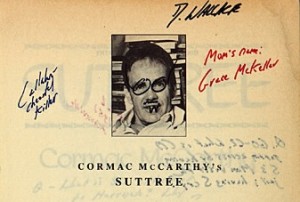
David Foster Wallace on Cormac McCarthy’s Blood Meridian: “Don’t even ask.” From his 1999 piece in Salon, “Five direly underappreciated U.S. novels > 1960.”
David Foster Wallace on Cormac McCarthy’s Blood Meridian: “Don’t even ask.” From his 1999 piece in Salon, “Five direly underappreciated U.S. novels > 1960.”
 Biblioklept wants to give you a copy of Random House’s new 25th anniversary edition of Cormac McCarthy’s Blood Meridian. But you’ll have to earn it because if Blood Meridian teaches us anything (beyond spitting and scalping and riding on), it’s that existence costs. So, if you’d like one to win a handsome new hardback, send us a postcard–the most Blood Meridianish one you can muster. (Do not put blood or anything like blood on the postcard. Seriously). If you’re a fan of the book, include a favorite quote. If you’ve never read it before, let us know why you want to read it. Email us at biblioklept.ed at gmail dot com to get our snail mail address (please make “Blood Meridian contest” the subject of your email). The sender of our favorite postcard will receive a copy of the book, courtesy Biblioklept and Random House. Contest closes October 12, 2010 and is limited to addresses in the continental US.
Six Versions of Blood Meridian is an ongoing project where six artists–Zak Smith, Sean McCarthy, John Mejias, Craig Taylor, Shawn Cheng, and Matt Wiegle–illustrate each page of Cormac McCarthy’s novel Blood Meridian. Zak Smith’s illustrations are particularly intriguing; he depicts the Glanton gang as women, a strange inversion that for some reason recalls the “Circe/Nighttown” episode of Joyce’s Ulysses. The Six Versions project’s eclectic range of styles and interpretations makes for one of the more fascinating approaches to a contemporary illuminated manuscript that I’ve seen on the internet (I’m also keen on Matt Kish’s handling of Moby-Dick). A few examples–
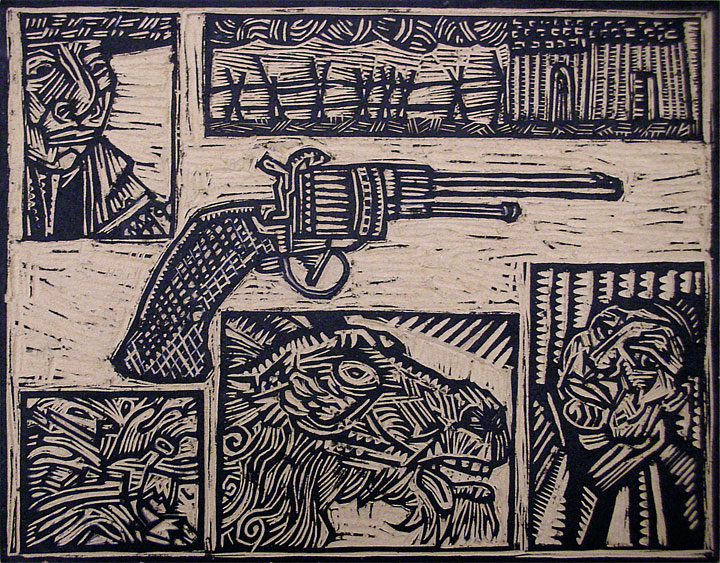
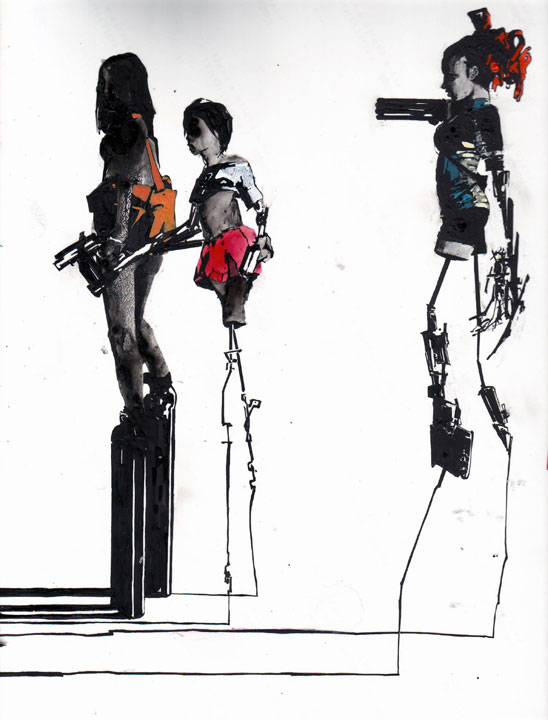
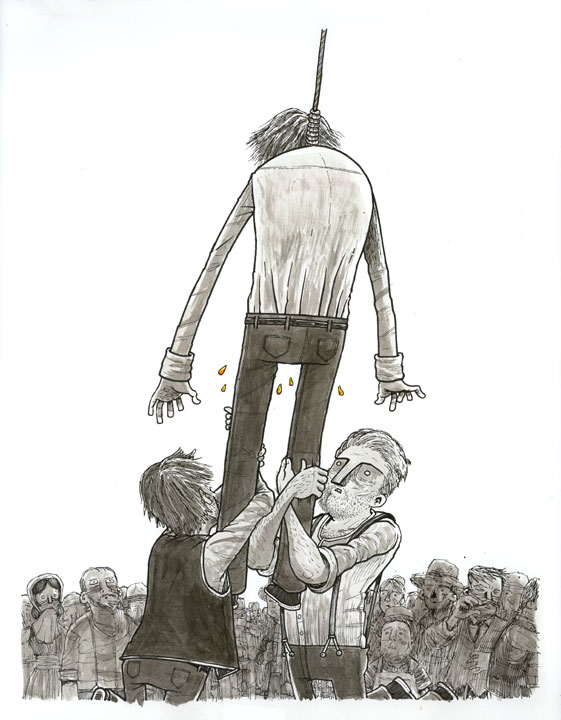
Critic James Wood wrote extensively about Cormac McCarthy’s Blood Meridian in his 2005 essay for The New Yorker, “Red Planet.” Here’s his lede–
To read Cormac McCarthy is to enter a climate of frustration: a good day is so mysteriously followed by a bad one. McCarthy is a colossally gifted writer, certainly one of the greatest observers of landscape. He is also one of the great hams of American prose, who delights in producing a histrionic rhetoric that brilliantly ventriloquizes the King James Bible, Shakespearean and Jacobean tragedy, Melville, Conrad, and Faulkner.
Wood later details McCarthy’s gift as “one of the greatest observers of landscape”–
“Blood Meridian” is a vast and complex sensorium, at times magnificent and at times melodramatic, but nature is almost always precisely caught and weighed: in the desert, the stars “fall all night in bitter arcs,” and the wolves trot “neat of foot” alongside the horsemen, and the lizards, “their leather chins flat to the cooling rocks,” fend off the world “with thin smiles and eyes like cracked stone plates,” and the grains of sand creep past all night “like armies of lice on the move,” and “the blue cordilleras stood footed in their paler image on the sand like reflections in a lake.”
Wood then goes about attempting to explain his problems with McCarthy the “ham” who produces “histrionic rhetoric” —
[McCarthy’s] prose opens its lungs and bellows majestically, in a concatenation of Melville and Faulkner (though McCarthy always sounds more antique, and thus antiquarian, than either of those admired predecessors). . . .
It is a risky way of writing, and there are times when McCarthy, to my ear, at least, sounds merely theatrical. He has a fondness for what could be called analogical similes, in which the linking phrase “like some” introduces not a visual likeness but a hypothetical and often abstract parallel: “And he went forth stained and stinking like some reeking issue of the incarnate dam of war herself.” . . .
The danger is not just melodrama but imprecision and, occasionally, something close to nonsense. . . .
The inflamed rhetoric of “Blood Meridian” is problematic because it reduces the gap between the diction of the murderous judge and the diction of the narration itself: both speak with mythic afflatus. “Blood Meridian” comes to seem like a novel without internal borders.
So, Blood Meridian doesn’t meet the standard of Wood’s cherished “free indirect style,” where an author subtly shifts into a character’s voice. Wood craves these delicate internal borders. He can’t bear the idea that the towering figure of Judge Holden might come to ventriloquize the novel. It is worth noting here that Wood frequently extols the free indirect styles of Marcel Proust and Henry James–two authors McCarthy dismissed in a 1992 interview with The New York Times, saying “I don’t understand them . . . that’s not literature.” Wood values a mannered precision of realism that McCarthy openly professes little interest in; rather, McCarthy uses a mythic, amplified, and at times grandiose style in Blood Meridian to explore issues of life and death. And Wood is perhaps not wrong here. At times Blood Meridian edges into bombast, although I believe McCarthy controls his language more than Wood allows. In either case, McCarthy’s language is ripe for parody, as exemplified in this clip from Wes Anderson’s 2001 film The Royal Tenenbaums—
I would be happy to leave Wood’s criticism of Blood Meridian and McCarthy alone at this point. Fine, Wood doesn’t like it when McCarthy goes balls-to-the-wall; whatever. But at the end of “Red Planet” Wood turns to attacking McCarthy’s perceived failure to vindicate God’s goodness in the face of evil. Wood here (and elsewhere, always elsewhere) shows his deep conservatism. Wood necessitates that all literature reveal a platonic center, a stable, beating heart that must also be a platonic good. Here he is, griping about McCarthy’s “metaphysical cheapness”–
Like most writers committed to pessimism, McCarthy is never very far from theodicy. Relentless pain, relentlessly displayed, has a way of provoking metaphysical complaint. . . .
But McCarthy stifles the question of theodicy before it can really speak. His myth of eternal violence—his vision of men “invested with a purpose whose origins were antecedent to them”—asserts, in effect, that rebellion is pointless because this is how it will always be. Instead of suffering, there is represented violence; instead of struggle, death; instead of lament, blood.
If Wood finds only a nihilism in Blood Meridian (and the rest of McCarthy’s oeuvre) that he fundamentally disagrees with, he should simply say so. Instead, Wood demands that Blood Meridian be a theodicy and then condemns it for not being one. He shamefully attempts to hold the work to a radically subjective rubric that cannot be answered. Put another way, the failure that Wood finds in Blood Meridian is a failure to answer to a version of God–and God’s judgment–that Wood would like to believe in (or, more accurately, be comforted by).
Wood is a bully (of both authors and readers) whose criticisms rarely enlarge the works they seek to address. We see his program at work in “Red Planet,” where his aim is to deflate Blood Meridian’s giant language and not appraise it on its own terms. That the book survives–and thrives–despite Wood’s criticism is hardly surprising; that a critical conversation of Blood Meridian should include Wood is depressing.

Blood Meridian is a blood-soaked, bloodthirsty bastard of a book, and certainly the most violent piece of literature I’ve read outside of the Bible and certain Greek tragedies. Cormac McCarthy’s 1985 novel passes itself off as a Western–and it is a Western, to be sure–but more than anything, it’s a brutal horror story.
Set predominantly in the 1850s, Blood Meridian chronicles the westward journey of a protagonist we know only as “the kid.” After a few false starts (including getting shot, robbed, arrested, and surviving a Comanche massacre) the kid eventually meets up with John Joel Glanton‘s “expedition”–a group of men of mixed backgrounds hired by Mexican authorities to kill–and scalp–the nomadic Apache who prey upon Mexican villages. However, led by the nefarious, larger-than-life Judge Holden, Glanton’s gang quickly descends into a relentless robbing, raping, and killing spree; they savagely massacre peaceful Indian settlements along with the Mexican villages they were contracted to protect.
I could keep summarizing the book, but I don’t see the point, honestly–a mere description of the plot could never do real justice to the weight of this book. The narrative is taut and fast-paced–in fact, at points the action is so radically condensed that I had to go back and re-read sections–and there’s no shortage of the “men doing men stuff” that McCarthy is so good at detailing–but it’s really the combination of the book’s evocative imagery and philosophical pondering that hook the reader.

Most of that philosophical pondering comes from the Judge, who waxes heavy on everything from space aliens to metallurgy. In his parables and aphorisms, the Judge comes across as part-Mephistophelean, part-Nietzschean, all dark wisdom and irreverent chaos. I found myself re-reading the Judge’s speeches several times and chewing them over, trying to digest them; for me, they were the best part of a great book.
Blood Meridian, like most excellent things, is simply not for everyone, and I don’t mean that in any snobbish, elitist sense. Any reader turned off by its freewheeling violence would be justified, and I’m sure plenty of folks out there would take issue with its ambiguous conclusion. Depictions of genocidal mania that seem to end inconclusively are not for everyone, particularly when they are rife with archaisms, untranslated Spanish, and McCarthy’s signature apostrophe-free punctuation. I had two false starts with the novel, including one where, at about exactly half way through, I realized I had to go back and start the novel again. I owed it that much. And it was worth it.
Blood Meridian is literally stunning; perhaps the best analogy I can think of is going to see a really, really good band that plays really, really brutal and strange music that sorta melts your face off. After the show you’re sweaty and exhilarated and even unnerved; your ears are ringing and your chest is pounding. And then the band packs up, and the house lights go on, and they pump in music from a CD, of all things, and the music just sounds tinny and pale and blanched of life after the raw power you’ve witnessed. Reading anything else right after finishing Cormac McCarthy’s Blood Meridian, or the Evening Redness in the West is sort of like that. Highly recommended.
[Editorial note–Biblioklept originally published this review on April 6th, 2008. We’re running it again as part of a week of coverage celebrating Blood Meridian’s 25th anniversary].
Read “The Dungeon Master,” a new story from Biblioklept fave Sam Lipsyte (from The New Yorker). From the story–
The Dungeon Master has detention. We wait at his house by the county road. The Dungeon Master’s little brother Marco puts out corn chips and orange soda.
Marco is a paladin. He fights for the glory of Christ. Marco has been many paladins since winter break. They are all named Valentine, and the Dungeon Master makes certain they die with the least possible amount of dignity.
It’s painful enough when he rolls the dice, announces that a drunken orc has unspooled some Valentine’s guts for sport. Worse are the silly accidents. One Valentine tripped on a floor plank and cracked his head on a mead bucket. He died of trauma in the stable.
“Take it!” the Dungeon Master said that time. Spit sprayed over the top of his laminated screen. “Eat your fate,” he said. “Your thread just got the snippo!”
The Dungeon Master has a secret language that we don’t quite understand. They say he’s been treated for it.
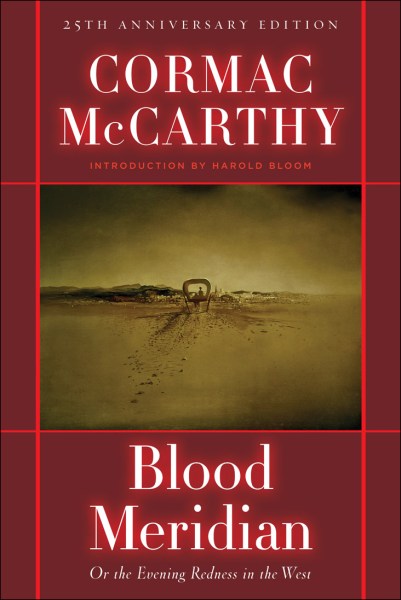
This week, Random House celebrates the 25th anniversary of Cormac McCarthy’s masterpiece Blood Meridian by releasing a new hardback edition of the book. This new Modern Library version retains Harold Bloom’s now-oft-cited introductory essay and features a new cover design by Richard Adelson that echoes the first edition and restores its original art work, The Phantom Cart by Salvador Dali. Here is the new cover–

The release of this new edition and the book’s anniversary give us a great excuse to declare the next five days Blood Meridian Week on Biblioklept. (Yes, we know that it’s also Banned Books Week this week. But celebrating Blood Meridian seems to gel with that). We’ll re-run our original review, take a look at what different critics have had to say about the book, quote some of our favorite passages at length, share some of the better resources at large for tackling this often difficult book, examine some of the history behind it, and generally laud it for its horrifying excellence. We’ll also be giving away a copy of the new 25th anniversary edition to one lucky reader, so keep your eyes peeled for details.

(Via).
We continue to raid The Paris Review’s interview archive. Here’s J.G. Ballard on William Burroughs, in a 1984 interview–
INTERVIEWER: Burroughs wrote an eccentric and laudatory, in its way, introduction to the American edition of Atrocity Exhibition. Do you know him?
BALLARD: Burroughs, of course, I admire to the other side of idolatry, starting with Naked Lunch, then Ticket, Soft Machine, and Nova Express. I’m less keen on his later books. In his way he’s a genius. It’s a pity that his association with drugs and homosexuality has made him a counterculture figure, but I suppose his real links are with Jack Kerouac, Allen Ginsberg, and the Beats. Still, I think he’s much more of an establishment figure, like Dean Swift, with a despairing disgust for the political and professional establishments of which he is a part. I have met Burroughs quite a few times over the last fifteen years, and he always strikes me as an upper-class Midwesterner, with an inherent superior attitude towards blacks, policemen, doctors, and small-town politicians, the same superior attitude that Swift had to their equivalents in his own day, the same scatological obsessions and brooding contempt for middle-class values, thrift, hard work, parenthood, et cetera, which are just excuses for petit-bourgeois greed and exploitation. But I admire Burroughs more than any other living writer, and most of those who are dead. It’s nothing to do with his homosexual bent, by the way. I’m no member of the “homintern,” but a lifelong straight who prefers the company of women to most men. The few homosexual elements in Crash and Atrocity Exhibition, fucking Reagan, et cetera, are there for reasons other than the sexual—in fact, to show a world beyond sexuality, or, at least beyond clear sexual gender

(Via).
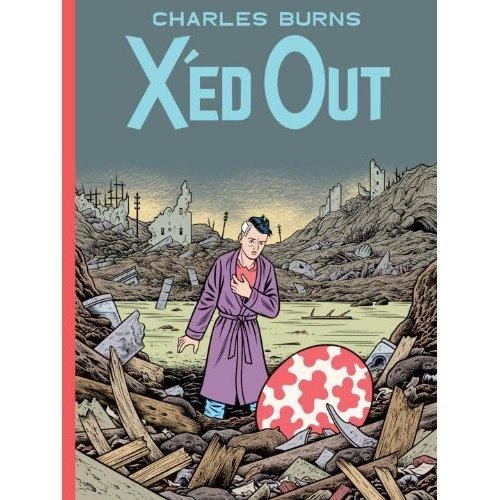
I devoured Charles Burns’s X’ed Out last night. Then I read it again this afternoon. I’ll read it again before I give it a proper review closer to its release date near the end of October. It’s weird, wild stuff, working in the idioms of William Burroughs and Hergé, brimming with punk rock energy and druggy art madness. It’s thoroughly Burnsian. X’ed Out is the first volume in what the publisher promises will be “an epic masterpiece of graphic fiction in brilliant color.” Like I said, full review down the line, but look out for this book. X’ed Out comes from the good folks at Pantheon, who’ve already proven their commitment to the graphic novel medium in stunners by publishing soon-to-be classics like David Mazzucchelli’s Asterios Polyp and Dash Shaw’s BodyWorld.
The Paris Review interviews Biblioklept fave Sam Lipsyte. From the interview–
I’m not sure why you love reading about drugs. Maybe at a certain point the reading high is better than actually doing them? That could be preposterous though. I guess I’ve written about drugs a good deal because for a time, in my younger days, certain hard substances were the major elements in my life. My movements and decisions revolved around them. I like to pretend it was all some meaningless blur, but it was a very intense and focused time. I had a daily purpose (to get more drugs) that heightened the experience of being alive (a heightening then nullified by the drugs). I felt very alert during the mission phase of the day. Make no mistake, it was a horrible time, but I’ve always been fascinated by that robotic intensity. Also, it’s a way to give your character something to do, and we all know you have to keep those fuckers in motion, or readers might find out they are just constructions in a fiction! I try to make sure the drug-users in my stories aren’t acting high. Most of them tend to do drugs to get straight anyway. They are in that awful place. So their interactions might seem slightly off, but mostly these could easily be people not doing dangerous drugs. It’s just that occasionally they die from their addictions or else make really bad decisions that lead to more misery. That’s where the comedy kicks in. Drugs are hard to resist for some people because they work really well. And then don’t. But you find that out later.
Many books have been written depicting drug addictions, drug addicts and how drug addiction treatment centers actually work, with varying degrees of consistency.
More from The Paris Review’s vaults–a 2008 interview with Umberto Eco—
INTERVIEWER: Have you read The Da Vinci Code?
ECO: Yes, I am guilty of that too.
INTERVIEWER: That novel seems like a bizarre little offshoot of Foucault’s Pendulum.
ECO: The author, Dan Brown, is a character from Foucault’s Pendulum! I invented him. He shares my characters’ fascinations—the world conspiracy of Rosicrucians, Masons, and Jesuits. The role of the Knights Templar. The hermetic secret. The principle that everything is connected. I suspect Dan Brown might not even exist.
The Paris Review has made their famous cache of author reviews–spanning seven decades–available online. Here’s Harold Bloom griping about the New Testament in a 1991 interview—
INTERVIEWER: You’ve written that the Christian Bible is, on the whole, a disappointment.
BLOOM: The aesthetic achievement is so much less than that of the Old—or original—Testament. The New Testament is a very curious work from a literary point of view. So much of it is written by writers who are thinking in Aramaic and writing in demotic Greek. And that curious blend of Aramatic syntax with a Greek vocabulary is a very dubious medium. It’s particularly egregious in the Revelation of St. John the Divine, the Apocalypse, which is a very bad and hysterical and nasty piece of writing. Even the most powerful parts of the New Testament from a literary point of view—certain epistles of Paul and the Gospel of John—are not works that can sustain a close aesthetic comparison with the stronger parts of the Hebrew Bible. It is striking how the Apocalypse of John has had an influence out of all proportion to its aesthetic, or for that matter, I would think, its spiritual value. It is not only an hysterical piece of work, but a work lacking love or compassion. In fact, it is the archetypal text of resentment, and it is the proper foundation for every school of resentment ever since.
If you don’t have time to read Nathan Rabin’s epic interview with Violent J of Insane Clown Posse, we offer some highlights–
On the inspiration and rationale behind their revisionist Western, Big Money Rustlas: “You know, just for the fuck of it all.”
On keeping one’s cards close to one’s breast: “I don’t want to give our secrets away, but they might be obvious”
On opinions: “In our opinion, it’s not cool to actually see us doing the murders, as cool as it is to imagine it when you’re hearing the song. That’s our opinion.”
On making quality comedies: “I think the crew that was working the movie, they didn’t respect us. They didn’t respect our humor. I think a lot of them felt like it was a bum job. The attitude on the set every day was shitty. We got into arguments and battles with the crew. We’d be the only ones laughing. To do a comedy, it seems like you would need the whole crew laughing and having fun, to keep that morale up on the set, but the only ones that were having fun were us. The rest of the crew just seemed like, ‘Ah, this shit’s not funny. We’re only doing this because we have to.’ ”
On making career decisions: “We knew it was gonna be basically garbage, but we thought about it and decided to do it.”
On capitalism: “If people knew how little money we actually make, I think it makes us more impressive.”
On logical fallacies in Martin Bashir’s Nightline profile of ICP: “They talked about crime happening and about how some Juggalos have committed these crimes. We made the point that millions of people bought our albums, and out of millions of people, there is going to be some bad apples. I’m sure Barbra Streisand fans have committed crimes as well….”
On what killed Michael Jackson: “It was Martin Bashir’s documentary that eventually killed Michael Jackson.”
On having quotes taken out of context: ” . . . they took my response to one question and edited it so I looked like I was responding to another question. And what’s scary to me is that this is Nightline. This is a respected piece of American journalism, and they were full of shit.”
On pulling shenanigans: “It’s scary to me to see somebody that’s that trusted pulling shenanigans like that. It’s just fucking crazy to me.”
On being interviewed by Bill O’Reilly: “Looking at that also makes me sick, because I know we could have schooled his ass a lot better than we did. We were kind of weak with it on his show.”
On your loss: “But anybody that can stand there, looking at a rainforest or something and not think that’s a miracle—I mean, that’s their loss. Anybody that can sit there and look at shooting stars or a fucking full moon when it’s red and hanging over the city and not sit there and think, “That looks awesome, and that’s a miracle that we get to see that and have that on this earth and all this shit,” you know, that’s their loss.”
On what it takes to find out if Slick Rick might or might not be interested in performing at The Gathering of the Juggalos: “Just finding out if Slick Rick is interested can be a monthlong process. It’s very fucking drawn out.”
On why ICP declined to play Ozzfest: “It was probably something along the lines of you can’t throw Faygo or something.”
On The Wrestler: “Like, nothing they showed in that movie we didn’t already know. I’m that tuned in to the wrestling world.”
On forgetting that he’s being interviewed: “Do you have an ink pen with you? Or something to mark this down?”
On the internet and clothing: “You can’t download a T-shirt.”
On Nickelodeon and Beyoncé: “I don’t even mind Nickelodeon, or Kids’ Choice Awards, or any of that. I’m not against all that. I’m not against Beyoncé. I love Beyoncé. I’m not against pop music.”
On what people have to realize about “Miracles”: “See, what people have to realize about the “Miracles” video is that that went out into the world, but that wasn’t for the world. That was for Juggalos.”
Thank you for the pure motherfucking magic.
We’re loving Jean-Christophe Valtat‘s new book Aurorarama, a steampunk-romance-high-adventure-academic satire-etc. set in the alternaworld of New Venice, an Arctic metropolis. Check out this post at MobyLives for a chance to win a copy of the book.
 Biblioklept