Man is doomed to constantly fabricate new agonies for himself | On Dino Buzzati’s novella The Singularity

Two years after it was first published in Italy, Dino Buzzati’s 1960 novella Il grande ritratto got its first English translation by Henry Reed under the title Larger Than Life. This year, NRYB issued a new translation of Il grande ritratto by Anne Milano Appel under the title The Singularity. This is the second new English translation of a Buzzati book from NYRB; last year saw the publication of Lawrence Venuti’s translation of Buzzati’s most famous novel, Il deserto dei Tartari, published as The Stronghold (in lieu of the more recognizable title The Tartar Steppe).

It makes sense, from both a cultural and a marketing stance, that Il grande ritratto would find new life as The Singularity, a term that refers to the hypothetical point where artificial intelligence surpasses human intelligence, which in turn triggers a dramatic existential change for humanity. AI slop abounds on the internet; misinformation replicates and mutates; we are told that the chatbots that frustrate us so frequently are an inevitable part of a future that no one seems to want. A sci-fi novel called The Singularity is pretty zeitgeisty.

The scant plot of The Singularity builds to the revelation of an artificial intelligence, part of a military science project perched high in the Italian Alps. I don’t think I’ve necessarily spoiled the grand reveal; both its title and its publisher’s blurb declare The Singularity “a startlingly prescient parable of artificial intelligence.”

Perhaps it’s this prescience that makes the central sci-fi conceit of The Singularity seem a bit dated. There’s a creakiness to Buzzati’s staging of his grand portrait of an artificial intelligence. The novella is more compelling in its initial chapters, which ignite a mood of slow-burning dread, the kind of Kafkaesque foreboding he served up in his superior novel Il deserto dei Tartari.

That slow-burn starts with a certain Professor Ismani, “who had always had an inferiority complex with respect to figures.” He and his much younger wife, the archetypal innocent Elisa (who “had not gone beyond middle school”) agree to undertake a mysterious journey up the mountain to “Experimental Camp of Military Zone 36,” where Ismani will join a scientific project he knows nothing about. As they zig and zag up the mountain, chauffeured by their military liaison, Ismani and Elisa (and the reader) gather crumbs about their destination. “So many mysteries,” a soldier tells them, at a penultimate stop. “If they at least told us what it is we’re guarding. I mean, let’s call it what it is, a kind of prison.”

In response to all this anxious foreboding, we are told that “Ismani felt the return of apprehension and dismay, the feeling of being insignificant in the face of immense, threatening things, a panic that he had once experienced in the war.” None of Ismani’s time in the war comes to bear on the narrative itself. Indeed, Ismani is thrown to the reader as a decoy; initially presented to the audience as the potential big-brain hero of a sci-fi thriller, he ends up a background ghost.

We eventually achieve the summit, where the natural splendor is overrun by the enormous complex that houses the titular singularity:

But the cliffs were no longer visible, nor could any vegetation be seen, or land, or flowing waters. Everything had been invaded and overwhelmed by a tangled succession of buildings similar to silos, towers, mastabas, retaining walls, slender bridges, barbicans, fortifications, blockhouses, and bastions, which plunged in dizzying geometries. As though a city had crashed down the sides of a ravine.

But there was an exceedingly abnormal element that gave those structures an air of enigma. There were no windows. Everything seemed hermetically sealed and blank.

From this moment, more or less, the best bits of The Singularity come not from sci-fi plotting but rather philosophical asides that add weight to the pulp narrative. Most of these are delivered by the handful of scientists who haunt the experimental camp. One of these scientists repeats the mantra, “Language is the worst enemy of mental clarity.” In their attempt to author an artificial consciousness, these scientists decreed that their singularity would have “No language,” for “Every language is a trap for the mind.”

Here in their “little kingdom, hermetically closed off and apart from the rest of the world,” the scientists have created a “machine made in our likeness” which “will read our thoughts, create masterpieces, reveal the most hidden mysteries.” Through hints, intimations, weird noises, and other creaky trappings of pulp horror, we come to learn that the singularity might not be, like, sane. As one of our (maybe not like exactly sane either) scientists declares, “before we knew it we had lost the reins, and all that was left for us to do was to record the machine’s behavior.”

In a move that would surprise no one familiar with the tropes of Gothic romance, we come to learn that the singularity’s consciousness is based on a beautiful dead woman. The whole operation is powered by a mysterious glowing egg. Indeed, The Singularity is perhaps most interesting if approached through a feminist lens. As it rushes to its climax, Elisa the innocent takes over the role of hero. She somehow learns to speak the strange “language” of the pre-lingual singularity, and through conversation, comes to understand that the singularity views herself as a desiring machine. The singularity wants a body; specifically a female body; specifically a body that can be desired by a male body and bear offspring.

Ultimately, The Singularity feels less like a novella than it does a short story stretched a bit too thin. Buzzati adroitly crafts an atmosphere of suspense and foreboding, but the characters are underdeveloped. Like a lot of pulp fiction, Buzzati’s book often reads as if it were written very quickly (and written expressly for money). Still, Buzzati’s intellect gives the book a philosophical heft, even if it sometimes comes through awkwardly in forced dialogue. Anne Milano Appel’s translation is smooth and nimble; it’s a page turner, for sure, and if it seems like I’ve been a bit rough on it in this paragraph in particular, I should be clear: I enjoyed The Singularity.

Like many of the modernist writers of the twentieth century, Buzzati intuited a future in which technology would become increasingly self-propelled, mutating unchecked in the notion of a progress wholly divorced from the needs of the human spirit. In our own era, we see con artists and hucksters banging the drum for “artificial intelligences” to “read our thoughts, create masterpieces, reveal the most hidden mysteries” for us. The results have been utter shit. Buzzati’s mad scientist isn’t so much prescient as he is simply describing the human condition then, when he declares that “man is doomed to torment himself, he doesn’t see the consolations offered to him, right there, within reach, he has to constantly fabricate new agonies for himself.” We can fabricate the agonies, but we can fight them too.

Debbie Urbanski’s After World (Book acquired, Dec. 2023)

I plan to start into Debbie Urbanski’s debut After World this weekend. Here’s publisher Simon & Schuster’s blurb:

Sen Anon is assigned to be a witness for the Department of Transition, recording the changes in the environment as the world begins to rewild. Abandoned by her mother in a cabin somewhere in Upstate New York, Sen will observe the monumental ecological shift known as the Great Transition, the final step in Project Afterworld. Around her drones buzz, cameras watch, microphones listen, digitizing her every move. Privately she keeps a journal of her observations, which are then uploaded and saved, joining the rest of humanity on Maia, a new virtual home. Sen was seventeen years old when the Digital Human Archive Project (DHAP) was initiated. 12,000,203,891 humans have been archived so far. Only Sen remains.

[storyworker] ad39-393a-7fbc’s assignment is to capture Sen’s life, and they set about doing this using the novels of the 21st century as a roadmap. Their source files: 3.72TB of personal data, including images, archival records, log files, security reports, location tracking, purchase histories, biometrics, geo-facial analysis, and feeds. Potential fatal errors: underlying hardware failure, unexpected data inconsistencies, inability to follow DHAP procedures, empathy, insubordination, hallucinations. Keywords: mothers, filter, woods, road, morning, wind, bridge, cabin, bucket, trying, creek, notebook, hold, future, after, last, light, silence, matches, shattered, kitchen, body, bodies, rope, garage, abandoned, trees, never, broken, simulation, gone, run, don’t, love, dark, scream, starve, if, after, scavenge, pieces, protect.

As Sen struggles to persist in the face of impending death, [storyworker] ad39-393a-7fbc works to unfurl the tale of Sen’s whole life, offering up an increasingly intimate narrative, until they are confronted with a very human problem of their own.

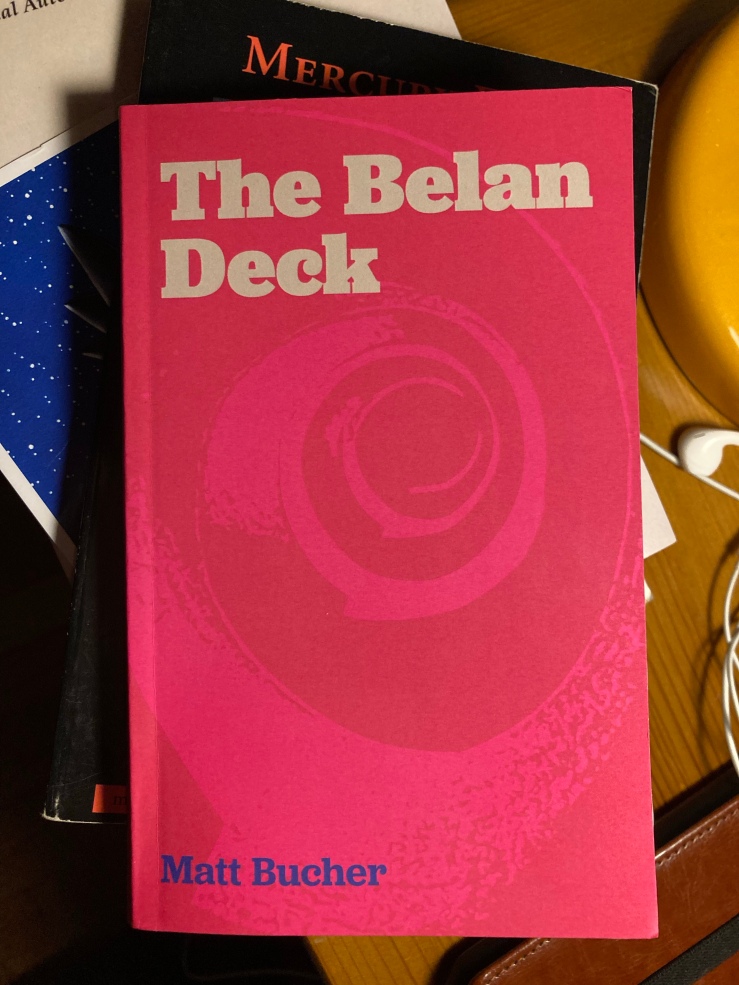
Matt Bucher’s The Belan Deck is an unexpectedly moving argument for humanity and serious triviality

I stayed up later than I meant to the other night reading all of Matt Bucher’s new book The Belan Deck in one cover-to-cover go. On his website, Bucher describes The Belan Deck as “a little book…set mostly during a layover at SFO” that “centers around a person who maybe doesn’t really fit in at their AI tech job but still needs to produce one final PowerPoint deck.” This description approximates the plot, in the barest sense, but doesn’t touch on the spirit or form of The Belan Deck.

Let’s talk about the spirit and form of The Belan Deck. Bucher borrows the epigraphic, anecdotal, fractured, discontinuous style that David Markson practiced (perfected?) in his so-called Notecard Quartet (1996-2007: Reader’s Block, This Is Not A NovelVanishing Point, and The Last Novel). “An assemblage…nonlinear, discontinuous, collage-like,” wrote Markson, to which Bucher’s narrator replies, “Bricolage. DIY culture. Amateurism. Fandom. Blackout poems.”

Bucher’s bricolage picks up Markson’s style and spirit, but also moves it forward. Although Markson’s late quartet is arguably (I would say, by definition) formally postmodernist, the object of the Notecard Novels’ obsession is essentially Modernism. Bucher’s book is necessarily post-postmodern, taking as its objects the detritus and tools of postmodern communication: PowerPoint, Google Street View, Wikipedia, social media, artificial intelligence.

At the same time, Bucher continues Markson’s obsessions with artists and death, adding to the mortality lists that wormed through DM’s quartet. Bucher’s updates are odd though, in that they seem to, in their print form, contextualize anew coincidences that were so raw and immediate when they popped up on Twitter and other social media:

Nicanor Parra died the day after Ursula K. LeGuin died.

Larry McMurty and Beverly Cleary died the same day.

(In my memory, William H. Gass died the day before LeGuin, but this is not true. He died almost two months before LeGuin. But I recall teaching selections from both of their work in a literature class in the spring semester of 2018, and pointing out to my students that the empty spaces behind the dashes after their birth years might now be filled in. “An encyclopedia entry demands at least a birth or a death,” notes Bucher’s narrator.)

The encyclopedia, by which I mean Wikipedia, becomes a heroic motif in The Belan Deck. “Wikipedia is the number one result for over 50% of Google searches,” Bucher’s narrator points out, following it up with,

Wikipedia, made by humans, for free, is a better search engine than Google, the most expensive and sophisticated algorithm in the world.

Earlier in The Belan Deck, the narrator points to the “mindless pleasure of going down a deep Wikipedia rabbit hole,” a pleasure that an artificial intelligence, no matter how developed, could never feel. About three dozen pages later, Bucher’s narrator throws a slant rhyme to his previous note on the “mindless pleasures” of Wikipedia rabbit holes, pointing out that Thomas Pynchon had used Mindless Pleasures as a working title for Gravity’s Rainbow. That’s how this book operates: Disparate fragments of information are “Clues rather than trivia.”

The goal is to find the sublime in these connections; Bucher’s narrator repeatedly and succinctly argues that finding the beautiful, much less the sublime, is impossible for an artificial intelligence. The Belan Deck plays out as a discursive, looping, and unexpectedly moving argument for humanity, in all its serious triviality, against the backdrop of capital’s rapid encroachment into the human position in the arts.

“Capitalism is incompatible with being an artist, for most people,” avers our narrator. “Yet you participate!” might come the retort, and it’s true—not only does Bucher’s narrator work in a soulless medium, the deck (trying to inject some soul, some sublime, some humanity into it), he also works for the soulless Belan, a money guy who would love to replace artists with machines. (In what I think has to be a great intentional gag, Bucher’s narrator’s point of contact for Belan is a middleman named  Jimmy Chen. I just have to believe that the character’s a take on the Jimmy Chen who wrote and designed on HTMLGIANT for all those years.)

The narrator participates because there aren’t that many other options, as we all know. “Do you understand what I am saying? Does it also feel this way to you?” the narrator plaintively asks. I mean, for me, that’s a Yes, all the time. 

There’s much more in The Belan Deck than I can get to here—more on art, artists, baseball, airports—it’s voluminous for a “little book.” (“When we buy a book, we think we are buying time to read” is a line I underlined but could not otherwise work into this review, so I’ll include it here parenthetically. (A lot of this review has happened in parentheses.))

I’ll end with two bits of personal trivia, two coincidences.

First: The day The Belan Deck arrived in my mail, which is the day that I read The Belan Deck, some AI-cheerleading dork went viral on Twitter for posting a series of unasked-for renderings of “what the backgrounds of the most famous paintings in the world look like with AI.” He was roundly and rightly mocked for his endeavors, and I found the general antipathy heartening, but still a small cadre of people who know absolutely nothing about art congratulated his vapidity.

Second: Earlier that same day, I read a passage from Walter Tevis’s 1980 dystopian novel Mockingbird, and found its sentiment largely heartening as well. The hero of the novel, staring at a “dumb parody of humanity” declares it “nothing, nothing at all.” He continues, pointing out that the forces of capital “had given robots to the world with the lie that they would save us from labor or relieve us from drudgery so that we could grow and develop inwardly.” But underneath this false promise was a deep “contempt for the ordinary life of men and women,”  a deep hatred of human life itself. The sentiment I find heartening here is in the hero’s recognition and resistance to this contempt.

The Belan Deck isn’t a straightforward guidebook or manifesto or map, but it nevertheless, in its elliptical, poetic approach, offers a winding, thinking, feeling path of opposition to not only the machines themselves, but also the hollow men who would gladly replace artists and creators and thinkers with those machines. It’s also really fun to read. Great stuff.

They had given robots to the world with the lie that they would save us from labor or relieve us from drudgery so that we could grow and develop inwardly | From Walter Tevis’s Mockingbird

I had never looked at a robot that closely before, having been brought up to fear and respect them. And I became aware, looking at his stupid, manufactured face, that I was seeing for the first time what the significance of this dumb parody of humanity really was: nothing, nothing at all. Robots were something invented once out a blind love for the technology that could allow them to be invented. They had been made and given to the world of men as the weapons that nearly destroyed the world had once been given, as a “necessity.” And, deeper still, underneath that blank and empty face, identical to all the thousands of faces of its make, I could sense contempt—contempt for the ordinary life of men and women that the human technicians who had fashioned it had felt. They had given robots to the world with the lie that they would save us from labor or relieve us from drudgery so that we could grow and develop inwardly. Someone must have hated human life to have made such a thing—such an abomination in the sight of the Lord.

From Walter Tevis’s 1980 novel Mockingbird.

Gertrude Stein’s “Cake” via DALL-E mini


“Cake” by Gertrude Stein is from Food, part of Tender Buttons.

DALL-E mini is by Boris Dayma and colleagues.


“Cake”

by

Gertrude Stein

Cake cast in went to be and needles wine needles are such.

This is today. A can experiment is that which makes a town, makes a town dirty, it is little please. We came back. Two bore, bore what, a mussed ash, ash when there is tin. This meant cake. It was a sign.

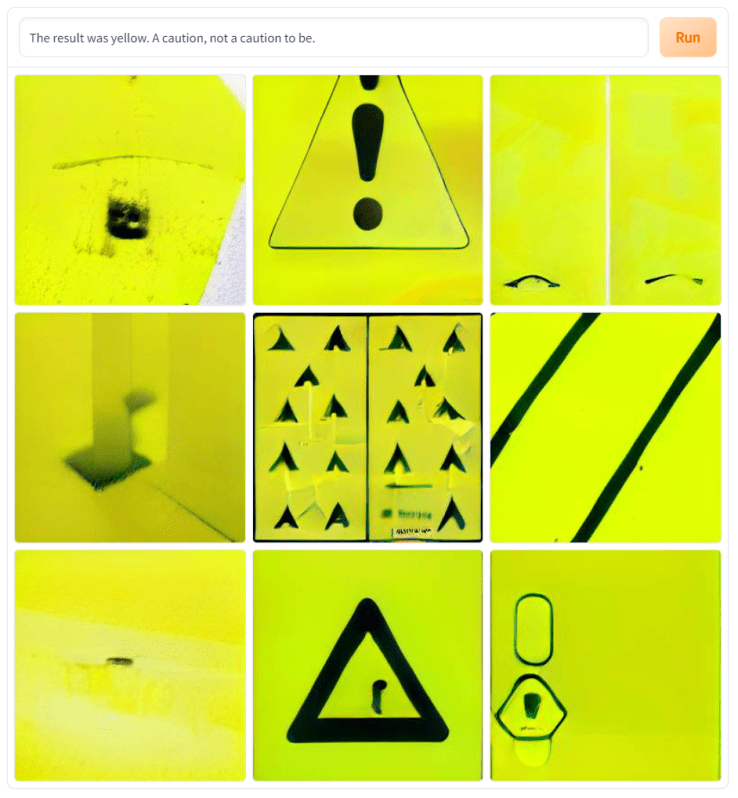
Another time there was extra a hat pin sought long and this dark made a display. The result was yellow. A caution, not a caution to be.

It is no use to cause a foolish number. A blanket stretch a cloud, a shame, all that bakery can tease, all that is beginning and yesterday yesterday we had it met. It means some change. No some day.

A little leaf upon a scene an ocean any where there, a bland and likely in the stream a recollection green land. Why white.

Read “Moxon’s Master,” Ambrose Bierce’s story about a chess-playing automaton

“Moxon’s Master”

by

Ambrose Bierce


“Are you serious?—do you really believe a machine thinks?”

I got no immediate reply; Moxon was apparently intent upon the coals in the grate, touching them deftly here and there with the fire-poker till they signified a sense of his attention by a brighter glow. For several weeks I had been observing in him a growing habit of delay in answering even the most trivial of commonplace questions. His air, however, was that of preoccupation rather than deliberation: one might have said that he had “something on his mind.”

Presently he said:

“What is a ‘machine’? The word has been variously defined. Here is one definition from a popular dictionary: ‘Any instrument or organization by which power is applied and made effective, or a desired effect produced.’ Well, then, is not a man a machine? And you will admit that he thinks—or thinks he thinks.”

“If you do not wish to answer my question,” I said, rather testily, “why not say so?—all that you say is mere evasion. You know well enough that when I say ‘machine’ I do not mean a man, but something that man has made and controls.”

“When it does not control him,” he said, rising abruptly and looking out of a window, whence nothing was visible in the blackness of a stormy night. A moment later he turned about and with a smile said:

“I beg your pardon; I had no thought of evasion. I considered the dictionary man’s unconscious testimony suggestive and worth something in the discussion. I can give your question a direct answer easily enough: I do believe that a machine thinks about the work that it is doing.”

Continue reading “Read “Moxon’s Master,” Ambrose Bierce’s story about a chess-playing automaton”