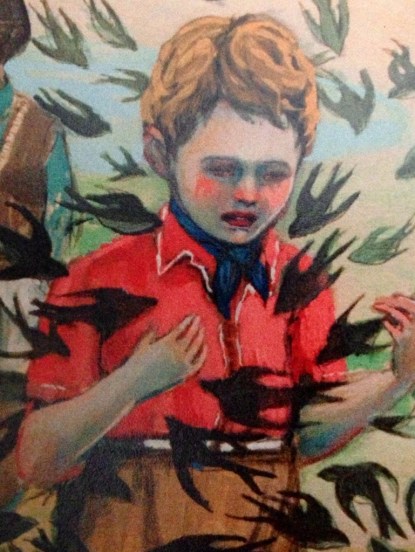
Tintoretto’s Abduction of the Body of St. Mark / Kid Jesus the Hellraiser (Thomas Pynchon)

One day, strolling in the Piazzetta, Hunter motioned her under the arcade and into the Library, and pointed up at Tintoretto’s Abduction of the Body of St. Mark. She gazed for some time. “Well, if that ain’t the spookiest damned thing,” she whispered at last. “What’s going on?” she gestured nervously into those old Alexandrian shadows, where ghostly witnesses, up far too late, forever fled indoors before an unholy offense.

“It’s as if these Venetian painters saw things we can’t see anymore,” Hunter said. “A world of presences. Phantoms. History kept sweeping through, Napoleon, the Austrians, a hundred forms of bourgeois literalism, leading to its ultimate embodiment, the tourist—how beleaguered they must have felt. But stay in this town awhile, keep your senses open, reject nothing, and now and then you’ll see them.”

A few days later, at the Accademia, as if continuing the thought, he said, “The body, it’s another way to get past the body.”

“To the spirit behind it—” “But not to deny the body—to reimagine it. Even”—nodding over at the Titian on the far wall—“if it’s ‘really’ just different kinds of greased mud smeared on cloth—to reimagine it as light.”

“More perfect.”

“Not necessarily. Sometimes more terrible—mortal, in pain, misshapen, even taken apart, broken down into geometrical surfaces, but each time somehow, when the process is working, gone beyond. . . .”

Beyond her, she guessed. She was trying to keep up, but Hunter didn’t make it easy. One day he told her a story she had actually already heard, as a sort of bedtime story, from Merle, who regarded this as a parable, maybe the first on record, about alchemy. It was from the Infancy Gospel of Thomas, one of many pieces of Scripture that early church politics had kept from being included in the New Testament.

“Jesus was sort of a hellraiser as a kid,” as Merle had told it, “the kind of wayward youth I’m always finding you keepin company with, in fact, not that I’m objecting,” as she had sat up in bed and looked for something to assault him with, “used to go around town pulling these adolescent pranks, making little critters out of clay, bringing them to life, birds that could fly, rabbits that talked, and like that, driving his parents crazy, not to mention most of the local adults, who were always coming by to complain—‘You better tell ’at Jesus to watch it.’ One day he’s out with some friends looking for trouble to get into, and they happen to go by the dyer’s shop, where there’s all these pots with different colors of dye and piles of clothes next to them, all sorted and each pile ready to be dyed a different color, Jesus says, ‘Watch this,’ and grabs up all the clothes in one big bundle, the dyer’s yelling, ‘Hey Jesus, what’d I tell you last time?’ drops what he’s doing and goes chasing after the kid, but Jesus is too fast for him, and before anybody can stop him he runs over to the biggest pot, the one with red dye in it, and dumps all the clothes in, and runs away laughing. The dyer is screaming bloody murder, tearing his beard, thrashing around on the ground, he sees his whole livelihood destroyed, even Jesus’s lowlife friends think this time he’s gone a little too far, but here comes Jesus with his hand up in the air just like in the paintings, calm as anything—‘Settle down, everybody,’ and he starts pulling the clothes out of that pot again, and what do you know, each one comes out just the color it’s supposed to be, not only that but the exact shade of that color, too, no more housewives hollerin ‘hey I wanted lime green not Kelly green, you colorblind or something,’ no this time each item is the perfect color it was meant to be.”

“Not a heck of a lot different,” it had always seemed to Dally, “in fact, from that Pentecost story in Acts of the Apostles, which did get in the Bible, not colors this time but languages, Apostles are meeting in a house in Jerusalem, you’ll recall, Holy Ghost comes down like a mighty wind, tongues of fire and all, the fellas come out and start talking to the crowd outside, who’ve all been jabbering away in different tongues, there’s Romans and Jews, Egyptians and Arabians, Mesopotamians and Cappadocians and folks from east Texas, all expecting to hear just the same old Galilean dialect—but instead this time each one is amazed to hear those Apostles speaking to him in his own language.”

Hunter saw her point. “Yes, well it’s redemption, isn’t it, you expect chaos, you get order instead. Unmet expectations. Miracles.”

Another amazing passage from Thomas Pynchon’s novel Against the Day.


Auvers Town Hall in 14 July 1890 — Vincent van Gogh

Reading Girl — Henri Matisse

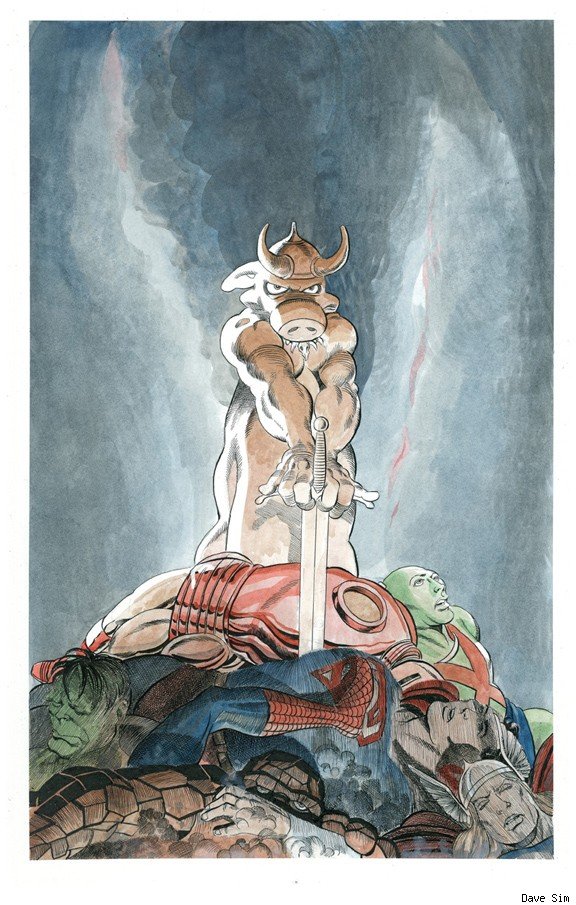
Cerebus vs. Superheroes — Dave Sim

bonfire-redux

(Via).

The Opium Smoker’s Dream — Gulacsy Lajos

Olenka and Kolya on the Steps — Konstantin Makovsky

Antonioni Film Poster — Milton Glaser

(Via/more).

Hegel’s Happy End — Ged Quinn

(Via/more).

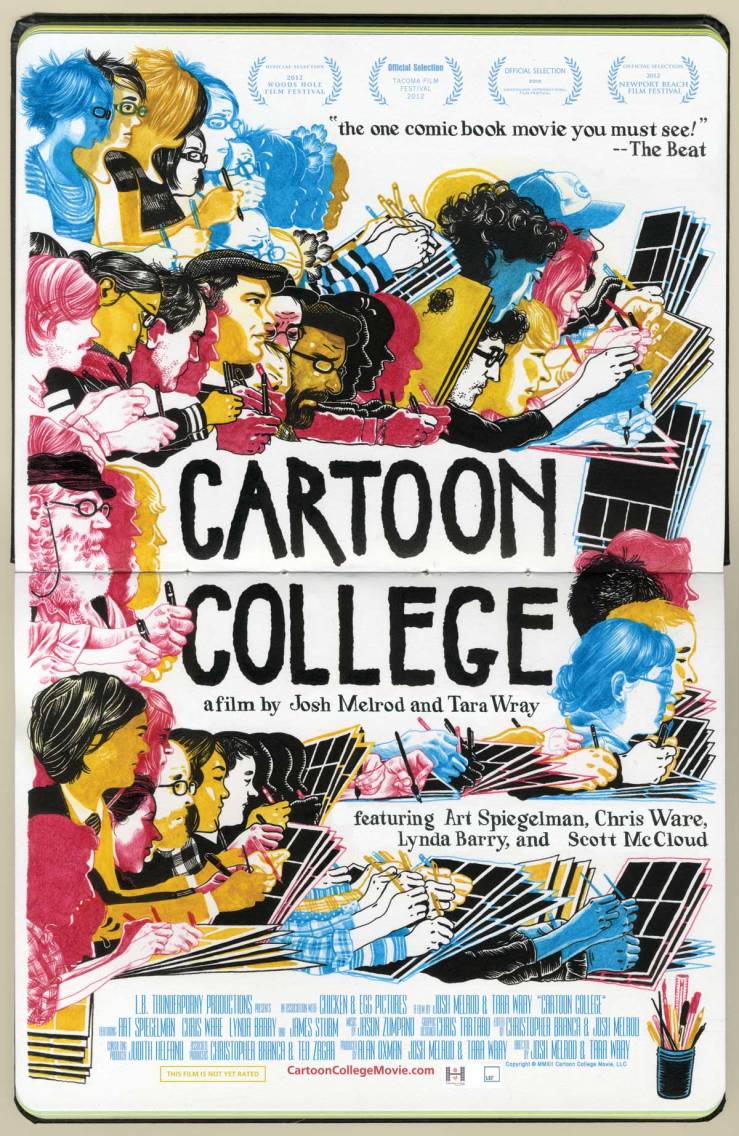
Cartoon College, A Documentary Featuring Chris Ware, Charles Burns, Art Spiegelman and Other Comics Legends

CCSketchResize

In the opening scene of Josh Melrod and Tara Wray’s new documentary Cartoon College, aspiring cartoonist Ryland Ianelli lays out the reality that, despite all the progress the medium has made as an art form worthy of respect, comic books are still outré:  “It’s gotten easier to talk to people who are open to the idea of comics being worthwhile—but at the point you say, Yes I’m going to school for comics, they’re completely ready to dismiss you.”

Cartoonists have always been outsiders—even in art schools, a traditional gathering spot for outsiders—and it’s this feeling of alienation and displacement that undergirds the emotional platform of Cartoon College. The film is not just about the Center for Cartoon Studies (CSS), a highly-selective two year MFA program founded in 2005 in White River Junction, Vermont, or the cadre of master cartoonists who inspired the school, and, in some cases teach there. For plenty of comix nerds (like me), it’s enough to see masters like Art Spiegelman, Charles Burns, Lynda Barry, and Chris Ware talk about the art, medium, and business of cartooning. But this documentary offers more. Cartoon College succeeds because it tells the genuinely moving and engaging story of its students, self-described outcasts who find a sense of community and even family in the program.

Melrod and Wray take us into the extreme demands of the CSS program. In the first year (“boot camp”), students practice fundamentals—drawing, theory, writing, history. In the second year, the students produce a thesis—a finished work of some kind—to determine if they pass the program and receive an MFA. All this work is to ensure that students “will be ready to face the uncertainty of a career in one of the most labor-intensive, drudgery inducing art forms,” as the film puts it.

The faculty (all distinguished cartoonists,  including Stephen Bissette, James Sturm, and Alec Longstreth, who are featured prominently in the film) repeatedly remind students and audience alike that most of cartooning is labor-intensive drudgery: it’s not really that fun, it requires lots of discipline, and most people can’t cut it. The CSS, like most art schools, employs a workshop technique to help students grow, get feedback—and also, implicitly, as a means of maintaining quality control. Workshop scenes and other critiques are often some of the most painful moments in the film, as they highlight the very personal stakes for the aspiring cartoonists, who quite literally put their lives into their work.

Melrod and Wray wisely compose their narrative around just a few of these students, while giving us enough scenes with others to flesh out the film. Blair Sterrett gives the film a definitive arc. He’s clearly a troubled, struggling artist, trying to channel his former experiences as a Mormon missionary into a thesis, but as the deadline approaches, it’s clear his book’s unfinished. Sterrett’s scenes (particularly an early critique) are very moving, and—a bit of a spoiler—there’s a triumphant feeling when he returns to the CSS to finish his MFA. 

We find another arc in Jen Vaughn, who has too many jobs and too many ideas. Of all the student artists, she seems the most open to the camera, and her self-assured posture by turns belies a greater vulnerability and depth. In one illuminating scene at the MoCCA Fest, Vaughn tries to pique a muted festival goer’s interest in her project Menstruation Station; when he walks away without seeming to say anything we catch a glimpse of weariness bordering on desperation.

There’s also Al Wesolowsky, who at 61 is the oldest student. An archaeologist at Boston University, Wesolowsky tries his hand at the CSS program despite his self-admitted limitations as a draftsman. In some ways he’s the soul of the film. At one point he delivers a brief monologue wherein he describes the loneliness he feels at having no family, but the pleasure he’s found in a makeshift family at CSS.

Loneliness and alienation are perhaps the bedrock themes of comix and cartooning, as anyone who’s read Spiegelman or Ware or Burns—or really any of the master cartoonists interviewed in Cartoon College—can attest. Spiegelman is the first professional to pop up in the film, after the filmmakers have already introduced us to the students, and one of the first comments he makes is that comix allows cartoonists to come into contact with “a bunch of other outcasts.” This sentiment is repeated again and again, by students, teachers, and masters alike; we learn that Ryland Ianelli was voted Prom Queen by the cruel students of his high school; student Casey Bohn tells us that everyone in his small town thought he was “gay or British”; Lynda Barry puts it plain: “Childhood seemed to me like it lasted too long.”

Of all the master cartoonists on screen, I was most captivated by Chris Ware, who comes across as reflective, cerebral, and even philosophical. He points out that cartoonists are always “sifting through generations”,” handing down tropes, skills, ideas. Ware, chronicler of loneliness, perhaps makes the strongest case for cartoonists-as-community.

The idea that the students need to foster a community is reinforced by Bissette, who tells the that they must share contacts, share ideas, and be colleagues. Bissette and the other CSS instructors repeatedly emphasize the publishing dimension of cartooning, paying special attention to the idea that these cartoonists can self-publish. Cartoon College is larded with shots of students hand-crafting their art, and Bissette likens what they are doing to Warhol and his Factory. He also points out that this new generation’s desire is not to draw Spider-Man or Batman but their own creations.

An energetic scene at the MoCCA Fest shows this cottage industry at work, as artists buy and trade for each other’s work. But the instructors and pros are very clear—or try to be clear—about the economic realities most cartoonists will face. Ware and Burns point out that commercial illustration is a necessity to feed their other projects. Juxtaposed with these moments, our students describe their dreams of a comfortable retirement and book deals, a moment undercut by Lynda Barry gleefully pointing out that she makes most of her moeny selling “shit on E-bay.” 

It might have been tempting for Melrod and Wray to cram all the footage they had of famous cartoonists like Barry, Françoise Mouly, Scott McCloud, and others into Cartoon College, but to the filmmakers’ credit they use the masters sparingly. Art Spiegelman tells us at one point that “We think in bursts of language, not in long Jamesian sentences…the number of words that might be able to fit in a speech balloon are the core of a linguistic thought.” The insight is intended for cartooning, but the filmmakers apply it to their medium, letting the camera do much of the work for them,  offering only the most essential moments (like when Charles Burns completes a sketch and the student audience breaks into applause). Cartoon College is at its best when it shows us the difficult experiences of the students intercut with commentary by the seasoned, successful professionals, who understand precisely the pain these people are undergoing. 

Before I started watching Cartoon College, I wondered who it was for. My interest in Spiegelman, Ware, Burns, et al. was enough to prod my interest (and the soundtrack featuring Archers of Loaf, Portastatic, and Tortoise didn’t hurt)—but would the film appeal to, uh, non-geeks? Ultimately, I think the documentary is about the drive toward art and self-expression, and the ways that communities and relationships can form around this drive. Cartoon College offers an intriguing story about real people trying to do something that they love, and I enjoyed that. This is a film about the impetus, motivation, and hard, hard work that goes into the creative process. Great stuff.

Website and trailer:

Drawing Room — Balthus

Take Off With Books (Tomi Ungerer Poster)

bookweek

Drawing Room — Balthus

Eine Kleine Nachtmusik — Dorothea Tanning

Smithers — Aubrey Beardsley

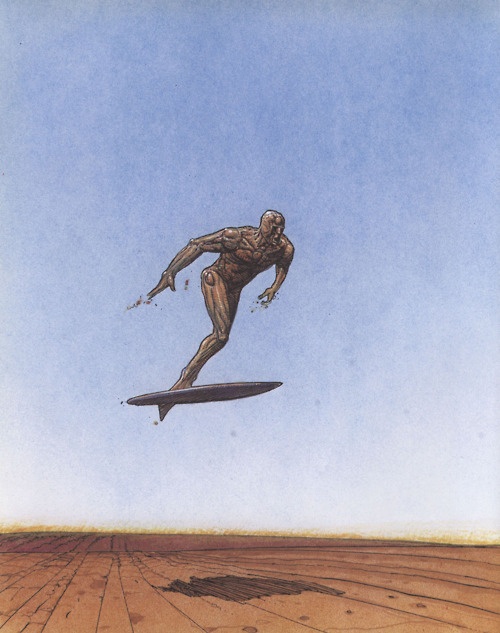
Silver Surfer — Moebius

silver surfer

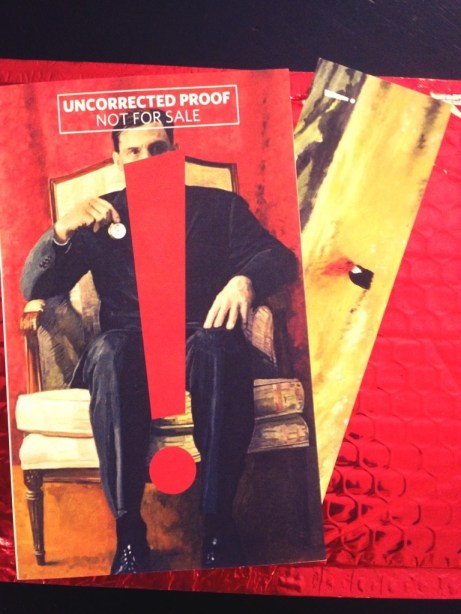
The NewerYork #3 (Book Acquired, 6.17.2013)

20130709-154848.jpg

I kept meaning to do a book acquired post of the forthcoming issue of TheNewerYork but the smallish book was sort of with me in a lot of places, like tucked in my pocket or a car or my backpack. I actually should review it at this point, but I haven’t read everything in it yet. Short review: An increase in print quality over the last issue (read my review of The NewerYork #2), and the same spirit.

This little anthology’s vision might be bizarre, but it’s also clear. Anyway, good stuff (Anton Nimblett’s “Show & Tell: An American Game” might be my favorite—simultaneously witty and devastating). Full review to come. In the meantime, some samples: 

20130709-154256.jpg

20130709-154303.jpg
Detail from The Beauty Curse by Lori Nelson

20130709-154308.jpg


Sanctuary — Earl Cunningham