Robert Downey Sr. and PT Anderson Talk About Putney Swope

Fir Forest I — Gustav Klimt

https://i0.wp.com/uploads4.wikipaintings.org/images/gustav-klimt/fir-forest-i.jpg

Camille Monet Reading — Pierre-Auguste Renoir

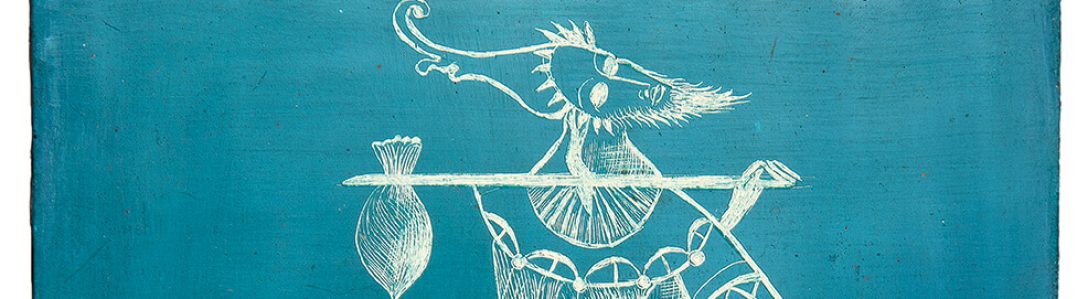
Nemo — Moebius

Nemo

Reading Chris Ware’s Building Stories / Disconnect

20121206-181909.jpg

“Disconnect,” one of the longer episodes in Chris Ware’s novel Building Stories, serves as a reminder of Ware’s strength as a prose writer. Wordiness tends to kill illustrated storytelling, at least in my estimation. Sure, there are exceptions—Joe Sacco and Harvey Pekar come to mind—but in general, I think comics are at their best when thought and word bubbles are uncluttered (or nonexistent).  Ware clearly understands the economy of his medium, and some of Building Stories’ finest moments have been wordless ones where Ware constructs the story in pure imagery. We can see so much of the plot and themes of  “Disconnect” in this full page, for instance:
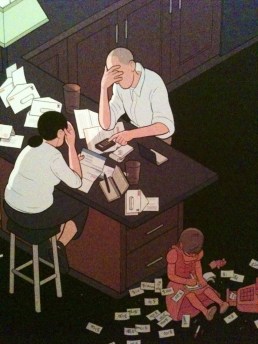
20121206-181944.jpg

But Ware also packs plenty of storytelling into his prose in “Disconnect,” where he continues the story of Lonely Girl, who it’s probably better to now call Married Mom—I still think of her as Lonely Girl though, after first really meeting her in “September 23rd, 2000,” an episode ostensibly narrated by her diary. “Disconnect” is a second diary of sorts, her internal narration guiding us subtly through episodes in her life over a series of years. “Disconnect” focuses on LG/MM raising her young daughter against the backdrop of a strained marriage.

Lonely Girl/Married Mom’s observations ring particularly true. She points out that “When your children aren’t around, you miss them with every fiber of your being—but when they are, you just want to get them to bed so you can go read the news or something,” an observation simultaneously profound, disturbing, and banal. When our heroine recalls how her relationship to her pet cat changed after her child was born, I also saw shades of myself:  “The day we brought Lucy home, almost to the minute, all applied personality to Miss Kitty evaporated, and we saw her for what she was—an animal—and an animal who we were beholden to feed and house, with, suddenly it seemed, little to offer in return.”

Through Lonely Girl/Married Mom, Ware paints a portrait of modern disconnection and alienation, and, even as we sympathize with the heroine, Ware also allows us to see through her—or rather, to see what she can’t see, or to see what she refuses to see. The effect is an irony that tips into small, banal tragedy.

Ware’s prose is usually overshadowed by his gifts as a draftsman, an architect—he’s the builder of Building Stories, a fact that this chapter alludes to, both internally, intertextually, and metatextually. We learn, for example, that Branford the Bee is a story within a story:
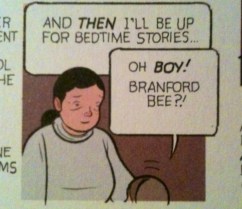
20121206-181917.jpg

This nesting of stories emerges in the final part of “Disconnect,” wherein our aged narrator—addressing her grown daughter—relates a dream:
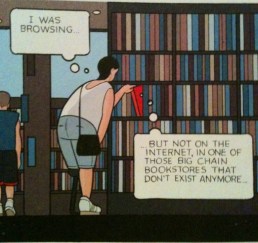
20121206-181924.jpg

The scene culminates so beautifully that it brought a little tear to my eye. Most postmodern novels contain (often more than once) their own descriptions, and Building Stories is no exception:
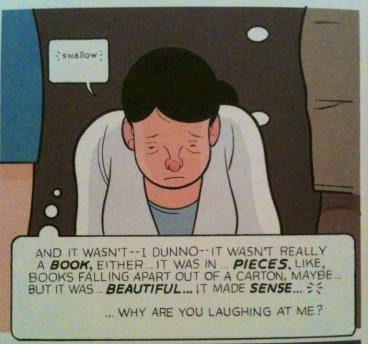
20121206-181934.jpg

And yet what we see here isn’t postmodern cleverness or empty gimmickry, but the evocation of dream and imagination and desire and creation—the spirit of the book, of what it means to build stories. Reading the final panels of “Disconnect,” I immediately recalled the epigraph to Building Stories (it’s on the interior of the box lid, by the colophon and dedication):

20121206-181951.jpg


And the Children Shall Inherit the Earth — Chris Buzzelli

Still Life — MC Escher

https://i0.wp.com/uploads0.wikipaintings.org/images/m-c-escher/still-life.jpg

Fowl in a Damson Tree — Charles Tunnicliffe

https://i0.wp.com/uploads5.wikipaintings.org/images/charles-tunnicliffe/fowl-in-a-damson-tree%281%29.jpg

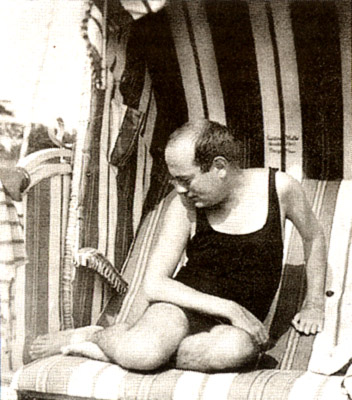
Theodor Adorno Shows Off His Sexy Legs

Hermits — Egon Schiele

https://i0.wp.com/uploads4.wikipaintings.org/images/egon-schiele/hermits-1912.jpg

“Up in the Gallery” — Franz Kafka

If some frail tubercular lady circus rider were to be driven in circles around and around the arena for months and months without interruption in front of a tireless public on a swaying horse by a merciless whip-wielding master of ceremonies, spinning on the horse, throwing kisses and swaying at the waist, and if this performance, amid the incessant roar of the orchestra and the ventilators, were to continue into the ever-expanding, gray future, accompanied by applause, which died down and then swelled up again, from hands which were really steam hammers, perhaps then a young visitor to the gallery might rush down the long stair case through all the levels, burst into the ring, and cry “Stop!” through the fanfares of the constantly adjusting orchestra.

But since things are not like that—since a beautiful woman, in white and red, flies in through curtains which proud men in livery open in front of her, since the director, devotedly seeking her eyes, breathes in her direction, behaving like an animal, and, as a precaution, lifts her up on the dapple-gray horse, as if she were his grand daughter, the one he loved more than anything else, as she starts a dangerous journey, but he cannot decide to give the signal with his whip and finally, controlling himself, gives it a crack, runs right beside the horse with his mouth open, follows the rider’s leaps with a sharp gaze, hardly capable of comprehending her skill, tries to warn her by calling out in English, furiously castigating the grooms holding hoops, telling them to pay the most scrupulous attention, and begs the orchestra, with upraised arms, to be quiet before the great jump, finally lifts the small woman down from the trembling horse, kisses her on both cheeks, considers no public tribute adequate, while she herself, leaning on him, high on the tips of her toes, with dust swirling around her, arms outstretched and head thrown back, wants to share her luck with the entire circus—since this is how things are, the visitor to the gallery puts his face on the railing and, sinking into the final march as if into a difficult dream, weeps, without realizing it.

“Up in the Gallery” by Franz Kafka

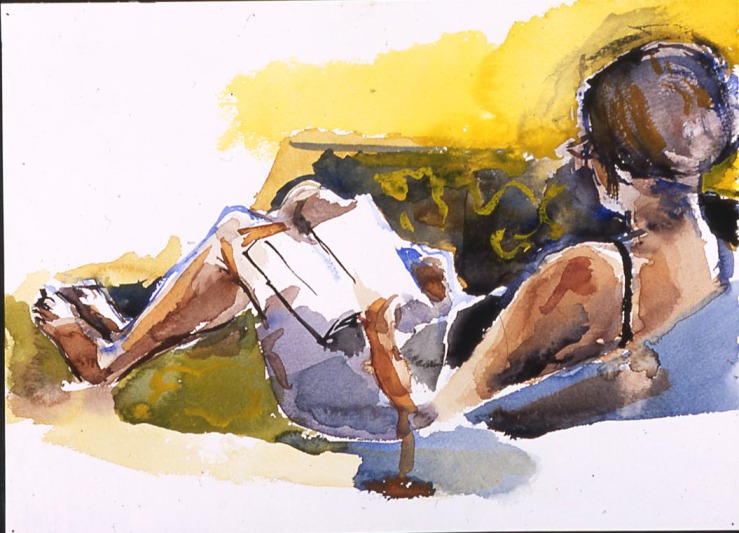
Reading — Dmitry Samarov

reading

Meadowland — Gerhard Richter

https://i0.wp.com/uploads5.wikipaintings.org/images/gerhard-richter/meadowland.jpg

Portrait of Dr. Hugo Koller — Egon Schiele

https://i0.wp.com/uploads5.wikipaintings.org/images/egon-schiele/portrait-of-dr-hugo-koller-1918.jpg

Other World — MC Escher

https://i0.wp.com/uploads1.wikipaintings.org/images/m-c-escher/other-world.jpg

Pier Paolo Pasolini Interviews Ezra Pound

(Thanks to Giovanni for sending this in).

The Spiderweb — Ohara Koson

https://i0.wp.com/uploads4.wikipaintings.org/images/ohara-koson/the-spiderweb.jpg