Gordon Lish’s My Romance (Book Acquired, 2.22.2013)

20130225-173906

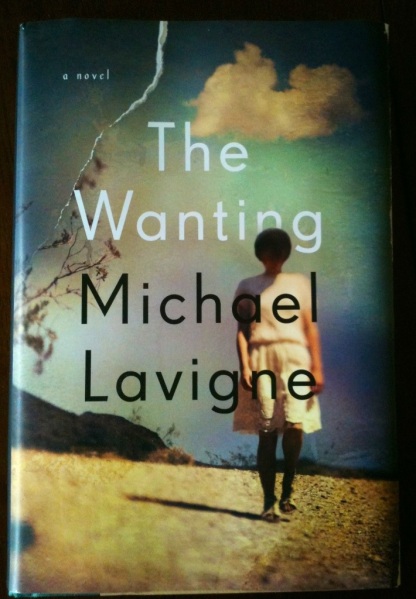
The Wanting (Book Acquired, 2.08.2013)

20130213-170623.jpgThe Wanting is new this month in hardback from Schocken. Here’s Publishers Weekly’s blurb:

Lavigne’s second novel (after Not Me) confronts the moral questions surrounding religious extremism and the Israeli-Palestinian conflict. The novel’s literally explosive opening takes place in Jerusalem in 1996, as a bomb goes off outside renowned architect Roman Guttman’s office, triggering a sort of fever dream that sends him into Palestinian territory and deep into memories of his communist youth in the U.S.S.R. Guttman narrates sections of the novel in language both vivid and disturbing. Also narrating is the suicide bomber, Amir Hamid, now dead, who has found in the afterlife not a martyr’s reward but rather the curse of following Guttman through the desert and retracing his own youthful journey toward violent extremism. Finally, Guttman’s 13-year-old daughter Anyusha, whose Zionist radical mother, Collette, died in a Soviet prison soon after giving birth, seeks answers of her own, revealing in diary form her attraction toward a messianic Jewish extremist group. Though some narrative digressions keep the novel from being truly elegant, Lavigne’s heartfelt examination offers what reportage never could: an intensely intimate and humane depiction of the forces that unite and powerfully divide this region and its people.


André Brink’s Philida (Book Acquired, Some Time in January 2013).

20130213-170550.jpg

André Brink’s Philida is new in handsome trade paperback from Vintage. Love the cover on this one, and the story seems intriguing. From the Man Booker Prize site (the book was longlisted last year):

The year is 1832 and the Cape is rife with rumours about the liberation of the slaves. Philida made a pact for freedom with Francois Brink, the son of her master, but he has reneged on his promise to set her free. Deciding to take matters into her own hands, Philida risks her life by setting off on foot for distant Stellenbosch, in a journey that begins with the small act of saying no.

And from The Guardian’s favorable review:

In order to underline the multiplicity of experiences, Philida hops from one narrator to another, interspersed with third-person, quasi-historical material; each chapter begins with what is to follow in précis (“In which Philida and Ouma Petronella travel to the Caab where they encounter a woman who farms with slaves”), gesturing towards the conventions of both the picaresque novel and the folk-tales that [one of the characters] relates. Unsurprisingly, given the strength of her story, Philida’s voice dominates. If she can occasionally feel like a mouthpiece for a rather overworked metaphor (“What happen to me will always be what others want to happen. I am a piece of knitting that is knitted by somebody else.”), she can also be brilliantly irreverent and almost ribald. “That’s what the old goat make us listen to every night at prayers,” she reflects on Cornelis’s fondness for Bible stories of a sexual nature. “And almost every time it is a woman who get it in her sticky parts.”

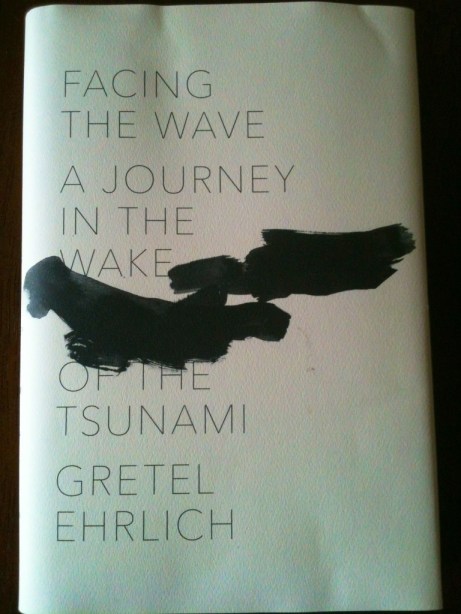
Gretel Ehrlich’s Facing the Wave (Book Acquired, Some Time Earlier This Month)

20130213-170614.jpg

Got into this a bit the other day. Last year, a reader sent me a copy of Ehrlich’s The Future of Ice, which was nice, but I could never really get into it. Anyway, like the cover on this one. Blurb from publisher Pantheon (you can also read an excerpt here):

From one of the preeminent and most admired observers of the natural world, a heartrending and inspirational portrait of Japan after the 2011 tsunami, when survivors found their world utterly transformed by loss, grief, destruction, and the urgent need to reconstruct their homes, their towns, and their lives.

A passionate student of Japanese poetry, theater, and art for much of her life, Gretel Ehrlich felt compelled to return to the earthquake-and-tsunami-devastated Tohoku coast to bear witness, listen to survivors, and experience their terror and exhilaration in villages and towns where all shelter and hope seemed lost. In an eloquent narrative that blends strong reportage, poetic observation, and deeply felt reflection, she takes us into the upside-down world of northeastern Japan, where nothing is certain and where the boundaries between living and dying have been erased by water.

The stories of rice farmers, monks, and wanderers; of fishermen who drove their boats up the steep wall of the wave; and of an eighty-four-year-old geisha who survived the tsunami to hand down a song that only she still remembered are both harrowing and inspirational. Facing death, facing life, and coming to terms with impermanence are equally compelling in a landscape of surreal desolation, as the ghostly specter of Fukushima Daiichi, the nuclear power complex, spews radiation into the ocean and air. Facing the Wave is a testament to the buoyancy, spirit, humor, and strong-mindedness of those who must find their way in a suddenly shattered world.

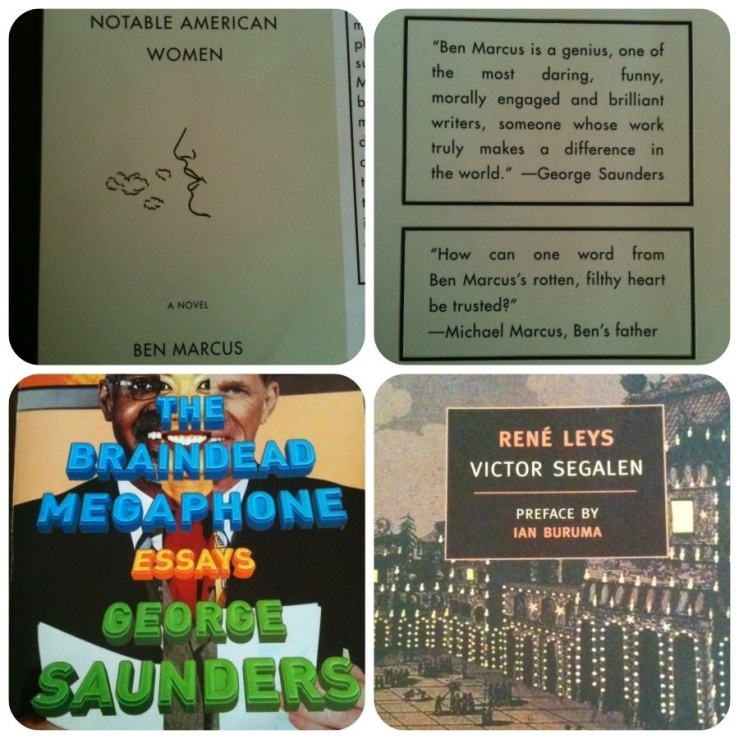
Ben Marcus/Victor Segalen/George Saunders (Books Acquired, 2.01.2013)

20130203-165505.jpg

I went to the bookstore on Friday afternoon to drop off some trade-ins and order a few books for my wife and kids for Valentine’s Day. I had no intention of buying anything, but a bit of random browsing led to me leaving with Ben Marcus’s collection Notable American Women (how could I resist that blurb?), a collection of George Saunders essays, and René Leys by Victor Segalen—the NYRB edition stuck out, and then the blurb sold me on this tale of a Westerner trying to access the Forbidden City of imperial China.

I’m reading Ben Marcus’s The Flame Alphabet right now, along with some short stories by Yoko Ogawa, as well as Lars Iyer’s latest, Exodus; I’m pretty sure René Leys is on deck after one of those.


Lars Iyer’s Exodus (Book Acquired, 1.15.2013)

20130120-173952.jpg

Lars Iyer’s latest, Exodus presumably concludes the trilogy that began with Spurious and DogmaExodus picks up the adventures/failures of our tragicomic (anti)heroes Lars and W. Here’s publisher Melville House’s description:

With philosophy professors being moved to badminton departments and gin in short supply — although not short enough—the two hapless intellectuals embark on a relentless mission. Well, several relentless missions. For one, they must help gear a guerrilla philosophy movement — conducted outside the academy, perhaps under bridges — that will save the study of philosophy after the long intellectual desert known as the early 21st-century.

For another, they must save themselves, perhaps by learning to play badminton after all. Gin isn’t free, you know.

Exodus is on deck in my reading stack.  I talked to Lars a few years ago about Spurious (and other stuff), and he brought up the idea of “exodus” (as in the concept, not the book) early on:

As someone who had made some progress as an academic – a journey which implies valuable training as well as compromise and despair – I thought a kind of exodus was necessary, from existing forms of published writing. Leave it all behind!, I told myself. Leave the Egypt of introductory books and academic journals and edited collections behind. Leave the slave-drivers behind, and the sense you have of being a slave. Leave capitalism and capitalist relations behind. Leave behind any sense of the importance of career and advancement. Leave behind those relationships that are modeled on investment and return.

I love the cover on this one.


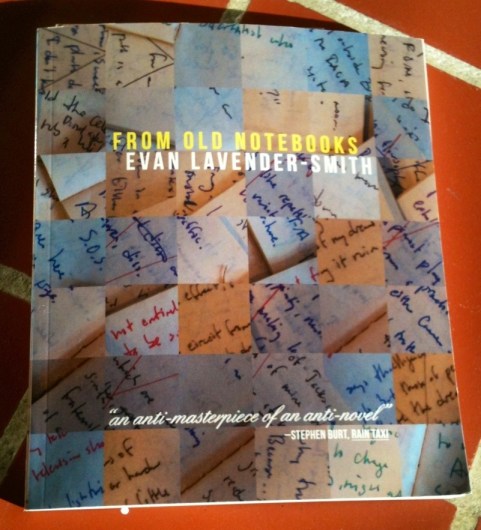
From Old Notebooks/The Freak Chronicles (Books Acquired, 1.04.2013)

20130107-202041.jpg

A few weeks back, Matt Bucher (via Twitter) suggested that because I enjoyed David Markson’s “notecard” novels so much, I should get a hold of Evan Lavender-Smith’s anti-novel From Old Notebooks. I went to order it from my bookstore, promptly found out it was out of print, and was bummed. And then like maybe a week after this, Matt let me know that the book was back in print from the good people at Dzanc. Anyway, it’s good stuff, and I’ll have a full write-up later this month.

Because of a postage screw-up, my original order was lost. When I let Dzanc know my book hadn’t arrived yet, they promptly sent another copy of the book, along with Jennifer Spiegel’s story collection The Freak Chronicles:

20130107-202048.jpg

Dzanc’s blurb:

An American missionary sleeps on the dung floor in a witch doctor’s hut in South Africa. Two women contemplate “poverty porn” while trying to start a nonprofit in China. An heiress locks eyes with a whore on the streets of Cape Town. A college girl stalks Mickey Rourke. A professor from New Jersey gets scammed in Old Havana before Castro’s demise. A mom obsesses about the fate of Sesame Street characters. A study abroad student goes home with a Russian street artist. Backpackers question their global idealism. Terrain, both ordinary and extraordinary, work on the imaginations and perceptions of people on the run, freaks in the making, eccentrics by choice.

The short stories in this collection explore, both implicitly and explicitly, the notion of freakiness. They worry over eccentricity, alienation, normalcy, and intimacy. What is it that makes one a freak, makes one want to embrace quirkiness, have the fortitude to cultivate oddity? Is there a fine line between abnormality and the extraordinary? Jennifer Spiegel’s stories delve into these questions and others.

Andrei Tarkovsky: The Collector of Dreams (Book Acquired, 12.29.2012)

20130107-202014.jpg

Layla Alexander-Garrett’s memoir Andrei Tarkovsky: The Collector of Dreams is new from Glagoslav. Their blurb:

The Sacrifice is Andrei Tarkovsky’s final masterpiece. The film was shot in Sweden, during the summer of 1985, while Tarkovsky was in exile; it turned out to be his final testament. Day after day, while the film was being made, Layla Alexander-Garrett – Tarkovsky’s on-site interpreter – kept a diary which forms the basis of her award-winning book Andrei Tarkovsky: The Collector Of Dreams. In this book the great director is portrayed as a real, living person: tormented, happy, inexhaustibly kind but at times harsh, unrelenting, conscience-stricken and artistically unfulfilled.

I’ve been riffling through it over the past few days. Alexander-Garrett describes her time with Tarkovsky in vivid detail—there’s a concrete richness to the book, and the author doesn’t try to psychoanalyze or interpret or otherwise interpose herself between the reader and the subject. More to come.

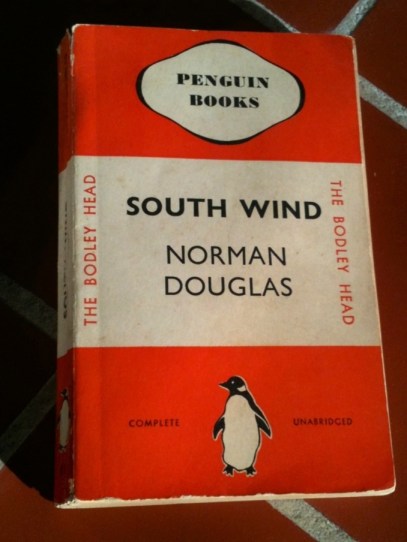
South Wind, A Lovely Penguin Books Original (Book Acquired, 1.04.2013)

20130107-201944.jpg

Big thanks to Ryan Mihaly for sending me this copy of Norman Douglas’s novel South Wind, which is the 11th Penguin Book (1st printing, 1935). This book is beautiful and it was very kind of Ryan to send it to me. Ryan writes reviews (good ones!) at Flying Object.

South Wind is now in the public domain, so you can read it for free if you like. Here are the first few paragraphs:

The bishop was feeling rather sea-sick. Confoundedly sea-sick, in fact.

This annoyed him. For he disapproved of sickness in every shape or form. His own state of body was far from satisfactory at that moment; Africa—he was Bishop of Bampopo in the Equatorial Regions—had played the devil with his lower gastric department and made him almost an invalid; a circumstance of which he was nowise proud, seeing that ill-health led to inefficiency in all walks of life. There was nothing he despised more than inefficiency. Well or ill, he always insisted on getting through his tasks in a businesslike fashion. That was the way to live, he used to say. Get through with it. Be perfect of your kind, whatever that kind may be. Hence his sneaking fondness for the natives—they were such fine, healthy animals.

Fine, healthy animals; perfect of their kind! Africa liked them to “get through with it” according to their own lights. But there was evidently a little touch of spitefulness and malice about Africa; something almost human. For when white people try to get through with it after their particular fashion, she makes hay of their livers or something. That is what had happened to Thomas Heard, D.D., Bishop of Bampopo. He had been so perfect of his kind, such an exemplary pastor, that there was small chance of a return to the scenes of his episcopal labours. Anybody could have told him what would happen. He ought to have allowed for a little human weakness, on the part of the Black Continent. It could not be helped. For the rest, he was half inclined to give up the Church and take to some educational work on his return to England. Perhaps that was why he at present preferred to be known as “Mr. Heard.” It put people at their ease, and him too.

Whence now this novel and unpleasant sensation in the upper gastric region? Most annoying! He had dined discreetly at his hotel the evening before; had breakfasted with moderation. And had he not voyaged in many parts of the world, in China Seas and round the Cape? Was he not even then on his return journey from Zanzibar? No doubt. But the big liner which deposited him yesterday at the thronged port was a different concern from this wretched tub, reeking with indescribable odours as it rolled in the oily swell of the past storm through which the MOZAMBIQUE had ridden without a tremor. The benches, too, were frightfully uncomfortable, and sticky with sirocco moisture under the breathless awning. Above all, there was the unavoidable spectacle of the suffering passengers, natives of the country; it infected him with misery. In attitudes worthy of Michelangelo they sprawled about the deck, groaning with anguish; huddled up in corners with a lemon-prophylactic against sea-sickness, apparently-pressed to faces which, by some subtle process of colour-adaptation, had acquired the complexion of the fruit; tottering to the taffrail….

There was a peasant woman dressed in black, holding an infant to her breast. Both child and parent suffered to a distressing degree. By some kindly dispensation of Providence they contrived to be ill in turns, and the situation might have verged on the comical but for the fact that blank despair was written on the face of the mother. She evidently thought her last day had come, and still, in the convulsions of her pain, tried to soothe the child. An ungainly creature, with a big scar across one cheek. She suffered dumbly, like some poor animal. The bishop’s heart went out to her.

He took out his watch. Two more hours of discomfort to be gone through!
Then he looked over the water. The goal was far distant.

Everyday Reading: Poetry and Popular Culture in America (Book Acquired, Sometime in December of 2012)

20130105-110115.jpg

I got a little lax with these “books acquired” posts at the end of last year—chalk it up to end of semester deadlines and meetings, family-oriented holiday stuff, and an awful illness. Anyway–

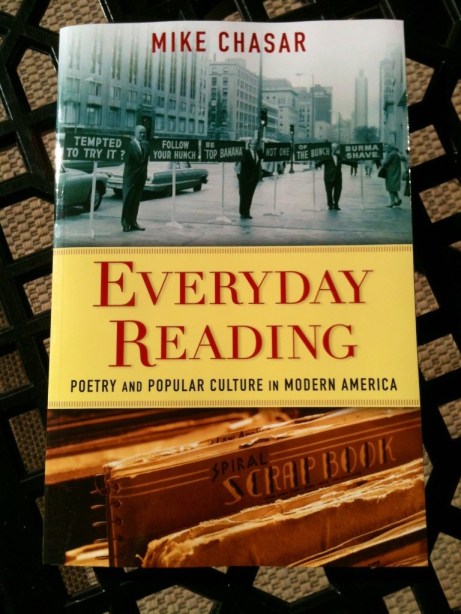
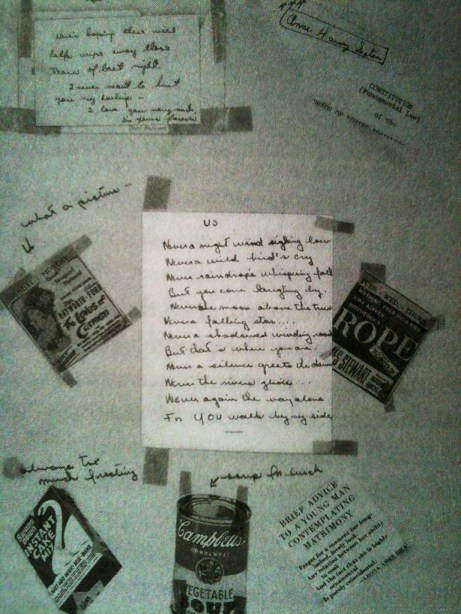
Mike Chasar’s Everyday Reading: Poetry and Popular Culture in Modern America, new from Columbia University Press is pretty cool: it’s kind of a dialogic study of how poetry evinces (or infiltrates or collides or emerges from or is bound by) a variety of popular media. Some of the most fascinating chapters dwell on scrapbooking. Here’s Columbia U of P’s blurb:

Exploring poetry scrapbooks, old-time radio show recordings, advertising verse, corporate archives, and Hallmark greeting cards, among other unconventional sources, Mike Chasar casts American poetry as an everyday phenomenon consumed and created by a vast range of readers. He shows how American poetry in the first half of the twentieth century and its reception helped set the stage for the dynamics of popular culture and mass media today.

Poetry was then part and parcel of American popular culture, spreading rapidly as the consumer economy expanded and companies exploited its profit-making potential. Poetry also offered ordinary Americans creative, emotional, political, and intellectual modes of expression, whether through scrapbooking, participation in radio programs, or poetry contests. Reenvisioning the uses of twentieth-century poetry, Chasar provides a richer understanding of the innovations of modernist and avant-garde poets and the American reading public’s sophisticated powers of feeling and perception.

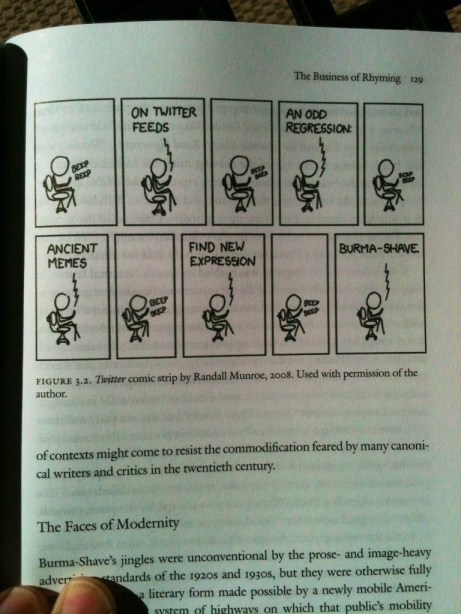
A couple of snaps from the book—pics of pages from one of those scrapbooks—

20130105-110232.jpg

20130105-110245.jpg

And—

20130105-110159.jpg

Pier Paolo Pasolini / Alvaro Mutis (Books Acquired, 12.21.20212)

20121223-132457.jpg

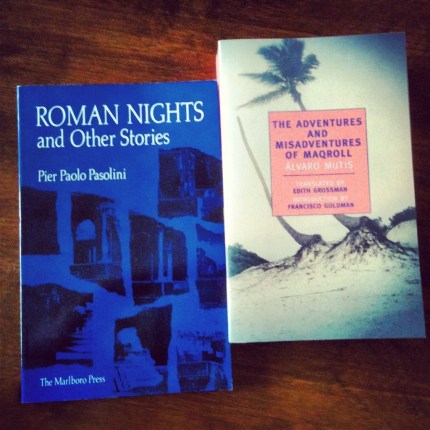
The edition I had of Mutis’s Maqroll only holds the first three novellas, so I ordered the NYRB seven-story volume. It’s like 700 pages and very attractive.

I also found this collection of Pier Paolo Pasolini short stories.

The President in Her Towers (Book Acquired, 12.20.2012)

20121221-122159.jpg

I just read the first few chapters of The President in Her Towers, Tom Whalen’s satire of academia—good stuff: short, punchy chapters that illustrate the reality of academia in all its paranoid surreality. Here’s publisher Ellipsis Press’s blurb:

Through the corridors of the university’s Humanities and Sciences Towers, rumors are swirling about the President: her bizarre decrees, her midnight meetings, her strange projects (the Head-in-Progress, the Activated Eye, the Gestation Chamber). The President’s dedicated personal assistant, Thomas (a.k.a. Herr Abjectus), is charged with investigating and reporting on these and other matters, but it won’t be easy—especially since the President has disappeared. And now there is a new rumor: that she has been marked for assassination


Watering Heaven (Book Acquired, Some Time Back in October)

20121217-104453.jpgThe stories Peter Tieryas Liu’s Watering Heaven move at a sharp clip, propelled by realistic dialogue set against a surreal backdrop. “Every time I have sex, I lay an egg,” one character tells another in the opening scene of “Chronology of an Egg.” The strange romance culminates in a fantastic punchline to this magical set-up. The protagonist of “The Wolf’s Choice,” facing an existential crisis, transforms his outward appearance by extensive plastic surgery. And in “Rodenticide”—well, let me just share a paragraph of Liu’s prose:
He dreamed of rats. One named Zhucheng lost her tail—a pink, gnarled tube with a texture like a gizzard. She was crying a shrill homily and there were flags with emblems of rat ears. He realized all rats were psychics with more understanding of humans than humans themselves—a homeopathic conglomeration of half-defunct diseases. Telepathy is my disease, Zhucheng screamed, I know you’re planning our mass extermination!

 “Rodenticide” is just one example of Liu’s strange mix of absurdity, realism, and magic. The stories of Watering Heaven suggest a world where comedy and romance might tip over dramatically into horror or despair at any moment. Good stuff.

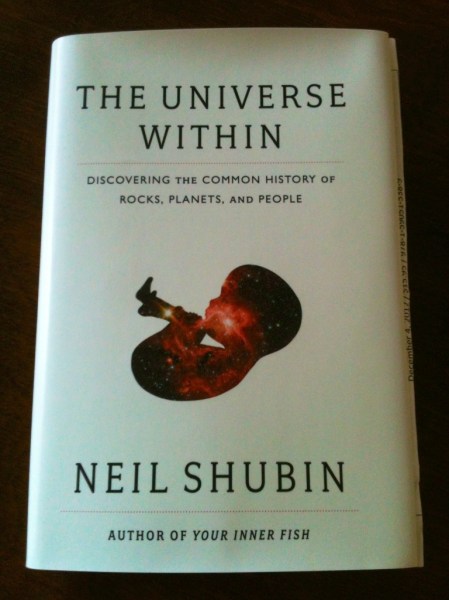
The Universe Within (Book Acquired, 12.15.2012)

20121217-104445.jpgThe Universe Within is new from Pantheon early next year. Their blurb:

From one of our finest and most popular science writers, and the best-selling author of Your Inner Fish, comes the answer to a scientific mystery as big as the world itself: How are the events that formed our solar system billions of years ago embedded inside each of us?

In Your Inner Fish, Neil Shubin delved into the amazing connections between human bodies—our hands, heads, and jaws—and the structures in fish and worms that lived hundreds of millions of years ago. In The Universe Within, with his trademark clarity and exuberance, Shubin takes an even more expansive approach to the question of why we look the way we do. Starting once again with fossils, he turns his gaze skyward, showing us how the entirety of the universe’s fourteen-billion-year history can be seen in our bodies. As he moves from our very molecular composition (a result of stellar events at the origin of our solar system) through the workings of our eyes, Shubin makes clear how the evolution of the cosmos has profoundly marked our own bodies.

PW‘s review:

University of Chicago paleontologist Shubin wrote about the fishy origins of humanity in 2009’s Your Inner Fish. In his new book, he goes farther back and further out, explaining how humans bear the markings of cosmic phenomena; as he puts it, “Written inside us is the birth of the stars.” Here, the author surveys everything from glints in “Greenlandic rocks” to the spreading signs of supernovae to reveal “deep ties to the forces that shaped our bodies.” He demonstrates how mammals owe their “high-energy lifestyle[s]” to oxygen released hundreds of millions of years ago as continents spread apart, and how color vision arose after continental drift cooled the planet, diversified flora, and resulted in biological competition that favored those organisms who could identify nutritious plants according to hue (“Every time you admire a richly colorful view, you can thank India for slamming into Asia”). Shubin is a leading proponent of the fusion of paleontology, developmental genetics, and genomics, and the result of his efforts is a volume of truly inspired science writing. Appropriately vast in scope, Shubin deftly balances breadth and depth in his search for a “sublimely beautiful truth.”


André Maurois’s Climates (Book Acquired, 12.11.2012)

20121217-104436.jpg

This one looks pretty cool—André Maurois’s 1928 novel Climates. Here’s publisher Other Press’s blurb:

Written in 1928 by French biographer and novelist Andre Maurois, Climates became a best seller in France and all over Europe. The first 100,000 copies printed of its Russian translation sold out the day they appeared in Moscow bookstores. This magnificently written novel about a double conjugal failure is imbued with subtle yet profound psychological insights of a caliber that arguably rivals Tolstoy’s. Here Phillipe Marcenat, an erudite yet conventional industrialist from central France, falls madly in love with and marries the beautiful but unreliable Odile despite his family’s disapproval. Soon, Phillipe’s possessiveness and jealousy drive her away. Brokenhearted, Phillipe then marries the devoted and sincere Isabelle and promptly inflicts on his new wife the very same woes he endured at the hands of Odile. But Isabelle’s integrity and determination to save her marriage adds yet another dimension to this extraordinary work on the dynamics and vicissitudes of love.

I haven’t had time to dip into Climates yet, but it got a compelling write-up in The New Yorker last month. Excerpt:

At first sight, “Climates” is a simple fable. It tells of Philippe Marcenat, the heir to a provincial paper-mill business, who falls in love with the woman of his dreams, Odile Malet. He loses her, but is later loved in turn by Isabelle de Cheverny, a woman not of his dreams at all, although he tries (“Vertigo”-ishly) to make her so. We follow first Philippe and then Isabelle as they reflect on their love. There is a happy ending of sorts, though not for Philippe. Maurois has summarized his first vision of the story, in its bare-bones form, as:

Part 1. I love, and am not loved.

Part 2. I am loved, and do not love.

Put that way, it sounds like a perfectly balanced diptych. In fact, it is neither balanced nor anywhere near simple. Each of these four “love” and “non-love” elements conceals some complication, something moving at cross-purposes to it. Beneath what seems to be love, there lurks tyranny or submission, or a mixture of both. Beneath what seems to be non-love, there is… it’s hard to say what, but something indefinable that looks very much like love.

Read more: http://www.newyorker.com/online/blogs/books/2012/11/the-two-loves-of-andre-maurois.html#ixzz2FKDinsNq


Eco/Krasznahorkai (Books Acquired, 11.30.2012)

20121130-173840.jpg

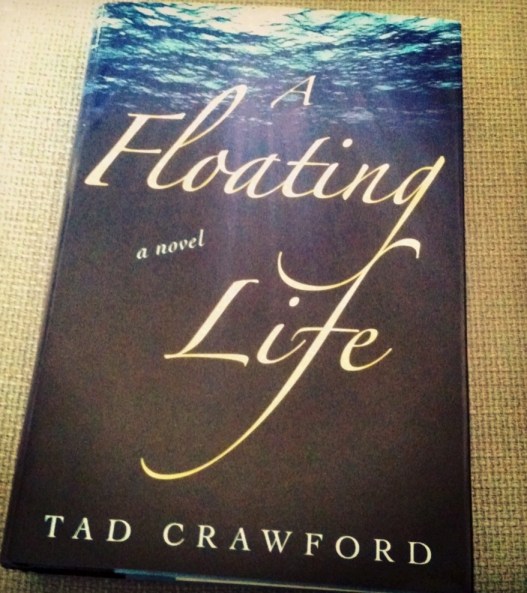
A Floating Life (Book Acquired, 11.09.2012)

20121118-122922.jpg

A Floating Life by Tad Crawford. Here’s PW‘s review, which is a bit-too-unkind in my estimation:

A nameless narrator bumbles through a series of bewildering nightmares linked only by the flimsiest narrative thread in Crawford’s disjointed debut. The protagonist ricochets between two realities: in one, he is addled by mundane afflictions (e.g., erectile dysfunction) and finds work as an assistant in a shop called the Floating World, which specializes in model boats and miniature canal systems. The store’s owner, Pecheur, dreams of using these models to harness the destructive power of the ocean for the good of humanity. The narrator’s other reality is a shifting landscape wherein he awakes time and again from horrifying fantasies—from a cage suspended above a bottomless pit to a ravenous family of talking bears. This is Crawford’s approximation of the floating world, “the Buddhist concept of a world filled with pain [that] came to mean the transient and unreliable nature of our world, how fleetingly it floats in the illusion of time,” but the execution is buoyed more by concept than plot. It is an experiment in storytelling, but without motivated characters and dramatic tension, it fails to tell a story at all.

I think it’s more likely that Crawford fails to tell the story that the editors of PW want (or rather, expect) to read. Crawford’s got an ear for dialogue, and much of the book is propelled by conversations—dialogue that sometimes carries on for pages at a time. Kirkus seems to better understand what Crawford is attempting in their review:

In Crawford’s world, boundaries, especially those between people, are semipermeable membranes with tenuous connections to reality.

At times, Crawford seems to be channeling Kafka or Borges, a feeling reinforced when, at a party his unnamed narrator engages a vaguely familiar woman in conversation. She informs her interlocutor that she’s written a letter to her husband, outlining his deficiencies and the hopelessness of their marriage. The narrator finally figures out whom he’s talking to—his wife. Equally dreamlike sequences emerge from this one. The couple decides to live in separate bedrooms in their apartment, but when this turns out to be unfeasible, the narrator goes to look for a new place to live. The real estate agent he talks to firmly rejects some of the narrator’s choices and eventually tells him he’d be happy in a small efficiency, but the building is being constructed under this apartment, deep in the ground, so in a surreal way, the apartment is actually a penthouse. One of the most important connections the narrator makes is to The Floating World, a weird and elusive shop where one can buy model ships, something the narrator starts to develop an intense interest in. The shop is located in a brownstone with no identifying marks, and its proprietor is a Dutchman who goes by the nautical name of Pecheur. Over time, the narrator and the shopkeeper become quite close, the latter taking on the narrator as an assistant. In addition to the death of Pecheur, the narrator ultimately must also confront his erectile dysfunction as well as the dilemma of waking up in an infirmary where he breastfeeds an infant, rather unusual since the narrator is a man.

Odd, offbeat and strangely shimmering.