2. There are seven Maqroll novellas; I’ve read the first three. They are excellent.
3. Let me steal from Cianci’s review. He describes Maqroll the Gaviero as
a fleshed-out character, as well as the embodiment of an ideal: the knife fighters and Viking poets idolized by Borges, a mixture of Robinson Crusoe, Sam Spade, and Don Quixote. He indulges fantasy but prepares for disappointment. He lives between lawlessness and acceptability.
4. The Gaviero—the lookout—is a picaro, a roguish but poetical sailor. Mutis’s book is picaresque, carnivalesque, a river—or maybe a maze—of storytelling.
5. This is maybe what Maqroll is about: storytelling. Each Maqroll novella is framed as another’s story, or a found document—you know this trick, you’ve read Borges, right?
6. The book is crammed with stories, stories that lead to other stories, that recall other stories, that tell their own stories—or cover over other stories.
7. A line that might instructively illustrate point 6: In Ilona Comes with the Rain, Mutis unpacks the life of a minor character, a sea captain named Wito. Consider his opening gambit:
His life deserves an entire book. It was so full of adventures, some of which he hurried over as if they were hot coals, that one became lost in their labyrinthine complexity.
The life described here could just as well be the Gaviero’s.
8. Well of course, that’s what Mutis is doing, channeling and conveying and expressing Maqroll’s life, a life of picaresque adventures (and titular misadventures), of loss and gain, of love and despair, drinking, sailing, scheming and plotting—a life full of allusions and hints and digressions. Mutis’s technique is marvelous (literally; he made this reader marvel): he gives us an aging (anti-)hero, a hero whose life is overstuffed with stories and mishaps and feats and enterprises and hazards; he gives us one strand of that life at a time in each novella—but then he points to the other adventures, the other serials of Maqroll that we would love to tune into if only we could.
9. To illustrate point 8: Consider Maqroll in Un Bel Morir, doing some time in prison: His consciousness floats to other prisons, other countries: Afghanistan, British Columbia: And then we get those stories, miniature epics—and nested within them, their own characters tell stories.
10. There’s a wonderful timelessness to Maqroll, a sense that the adventures exist somehow before the postmodern world, that they belong to the pulp fictions of jungle adventure…
11. (Indeed, re: point 10: In Ilona, we find one character who is unstuck in time, taking a Naopleonic lover during a transcontinental voyage…)
12. I’ve already noted the Borgesian quality of Mutis’s tales, brought up their picaresque scope (a la Cervantes), so let me lazily compare Mutis to others: let me note the sprawl of his storytelling, which recalls García Márquez—only more compact, more precise. Let me suggest that there’s something of Kafka in there too—indeed, the first novella, The Snows of the Admiral seems to me a reworking of “Before the Law.” (The tale is also conspicuously quixotic; tilting at windmills and all that). Conrad of course, but also something of Melville—the grand (Moby-Dick) and the sly (The Confidence Man). And hell, also something of Edgar Rice Burroughs’s high adventure, or even, dare I say it, the better parts of the Indiana Jones films.
13. Lazy as I am, I’ve failed to quote Mutis at any length—a shame, because it’s wonderful prose (translated by Edith Grossman, by the way). So here’s a little morsel—one that I think captures why we tell stories—from the appendix to Un Bel Morir, the last of the three novellas I read; before I offer it up I’ll conclude my riff by saying how happy I am that there are four more of these Maqroll novellas to read:
All the stories and lies about his past accumulating until they formed another being, always present and naturally more deeply loved than his own pale, useless existence composed of nausea and dreams.
I got a little lax with these “books acquired” posts at the end of last year—chalk it up to end of semester deadlines and meetings, family-oriented holiday stuff, and an awful illness. Anyway–
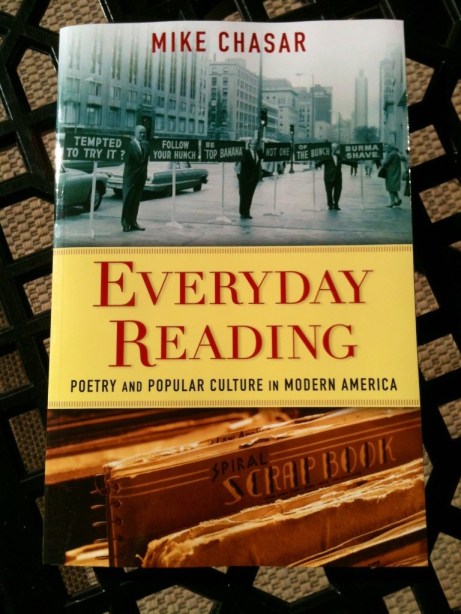
Mike Chasar’s Everyday Reading: Poetry and Popular Culture in Modern America, new from Columbia University Press is pretty cool: it’s kind of a dialogic study of how poetry evinces (or infiltrates or collides or emerges from or is bound by) a variety of popular media. Some of the most fascinating chapters dwell on scrapbooking. Here’s Columbia U of P’s blurb:
Exploring poetry scrapbooks, old-time radio show recordings, advertising verse, corporate archives, and Hallmark greeting cards, among other unconventional sources, Mike Chasar casts American poetry as an everyday phenomenon consumed and created by a vast range of readers. He shows how American poetry in the first half of the twentieth century and its reception helped set the stage for the dynamics of popular culture and mass media today.
Poetry was then part and parcel of American popular culture, spreading rapidly as the consumer economy expanded and companies exploited its profit-making potential. Poetry also offered ordinary Americans creative, emotional, political, and intellectual modes of expression, whether through scrapbooking, participation in radio programs, or poetry contests. Reenvisioning the uses of twentieth-century poetry, Chasar provides a richer understanding of the innovations of modernist and avant-garde poets and the American reading public’s sophisticated powers of feeling and perception.
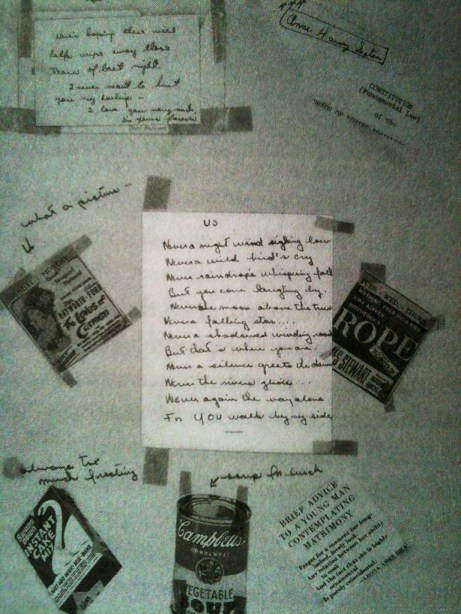
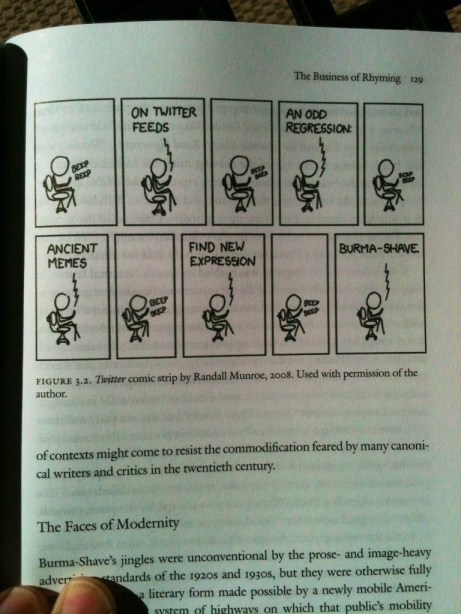
A couple of snaps from the book—pics of pages from one of those scrapbooks—
At the present time no one I know has the slightest desire to hit Samuel Meredith; possibly this is because a man over fifty is liable to be rather severely cracked at the impact of a hostile fist, but, for my part, I am inclined to think that all his hitable qualities have quite vanished. But it is certain that at various times in his life hitable qualities were in his face, as surely as kissable qualities have ever lurked in a girl’s lips.
I’m sure every one has met a man like that, been casually introduced, even made a friend of him, yet felt he was the sort who aroused passionate dislike—expressed by some in the involuntary clinching of fists, and in others by mutterings about “takin’ a poke” and “landin’ a swift smash in ee eye.” In the juxtaposition of Samuel Meredith’s features this quality was so strong that it influenced his entire life.
What was it? Not the shape, certainly, for he was a pleasant-looking man from earliest youth: broad-bowed with gray eyes that were frank and friendly. Yet I’ve heard him tell a room full of reporters angling for a “success” story that he’d be ashamed to tell them the truth that they wouldn’t believe it, that it wasn’t one story but four, that the public would not want to read about a man who had been walloped into prominence.
It all started at Phillips Andover Academy when he was fourteen. He had been brought up on a diet of caviar and bell-boys’ legs in half the capitals of Europe, and it was pure luck that his mother had nervous prostration and had to delegate his education to less tender, less biassed hands.
At Andover he was given a roommate named Gilly Hood. Gilly was thirteen, undersized, and rather the school pet. From the September day when Mr. Meredith’s valet stowed Samuel’s clothing in the best bureau and asked, on departing, “hif there was hanything helse, Master Samuel?” Gilly cried out that the faculty had played him false. He felt like an irate frog in whose bowl has been put goldfish. Continue reading ““The Four Fists” — F. Scott Fitzgerald”→
As I sat there in that now lonely room; the fire burning low, in that mild stage when, after its first intensity has warmed the air, it then only glows to be looked at; the evening shades and phantoms gathering round the casements, and peering in upon us silent, solitary twain; the storm booming without in solemn swells; I began to be sensible of strange feelings. I felt a melting in me. No more my splintered heart and maddened hand were turned against the wolfish world. This soothing savage had redeemed it. There he sat, his very indifference speaking a nature in which there lurked no civilized hypocrisies and bland deceits. Wild he was; a very sight of sights to see; yet I began to feel myself mysteriously drawn towards him. And those same things that would have repelled most others, they were the very magnets that thus drew me. I’ll try a pagan friend, thought I, since Christian kindness has proved but hollow courtesy. I drew my bench near him, and made some friendly signs and hints, doing my best to talk with him meanwhile. At first he little noticed these advances; but presently, upon my referring to his last night’s hospitalities, he made out to ask me whether we were again to be bedfellows. I told him yes; whereat I thought he looked pleased, perhaps a little complimented.










 Biblioklept