Reading Man in Park — August Macke

“The Model Millionaire” — Oscar Wilde

“The Model Millionaire” by Oscar Wilde

Unless one is wealthy there is no use in being a charming fellow. Romance is the privilege of the rich, not the profession of the unemployed. The poor should be practical and prosaic. It is better to have a permanent income than to be fascinating. These are the great truths of modern life which Hughie Erskine never realised. Poor Hughie! Intellectually, we must admit, he was not of much importance. He never said a brilliant or even an ill-natured thing in his life. But then he was wonderfully good-looking, with his crisp brown hair, his clear-cut profile, and his grey eyes. He was as popular with men as he was with women, and he had every accomplishment except that of making money. His father had bequeathed him his cavalry sword, and a History of the Peninsular War in fifteen volumes. Hughie hung the first over his looking-glass, put the second on a shelf between Ruff’s Guide and Bailey’sMagazine, and lived on two hundred a year that an old aunt allowed him. He had tried everything. He had gone on the Stock Exchange for six months; but what was a butterfly to do among bulls and bears? He had been a tea-merchant for a little longer, but had soon tired of pekoe and souchong. Then he had tried selling dry sherry. That did not answer; the sherry was a little too dry. Ultimately he became nothing, a delightful, ineffectual young man with a perfect profile and no profession. Continue reading ““The Model Millionaire” — Oscar Wilde”

Three Girls Reading — Edmund Charles Tarbell

“The Dead” — James Joyce

“The Dead” by James Joyce

Lily, the caretaker’s daughter, was literally run off her feet. Hardly had she brought one gentleman into the little pantry behind the office on the ground floor and helped him off with his overcoat than the wheezy hall-door bell clanged again and she had to scamper along the bare hallway to let in another guest. It was well for her she had not to attend to the ladies also. But Miss Kate and Miss Julia had thought of that and had converted the bathroom upstairs into a ladies’ dressing-room. Miss Kate and Miss Julia were there, gossiping and laughing and fussing, walking after each other to the head of the stairs, peering down over the banisters and calling down to Lily to ask her who had come.

It was always a great affair, the Misses Morkan’s annual dance. Everybody who knew them came to it, members of the family, old friends of the family, the members of Julia’s choir, any of Kate’s pupils that were grown up enough and even some of Mary Jane’s pupils too. Never once had it fallen flat. For years and years it had gone off in splendid style as long as anyone could remember; ever since Kate and Julia, after the death of their brother Pat, had left the house in Stoney Batter and taken Mary Jane, their only niece, to live with them in the dark gaunt house on Usher’s Island, the upper part of which they had rented from Mr Fulham, the corn- factor on the ground floor. That was a good thirty years ago if it was a day. Mary Jane, who was then a little girl in short clothes, was now the main prop of the household for she had the organ in Haddington Road. She had been through the Academy and gave a pupils’ concert every year in the upper room of the Antient Concert Rooms. Many of her pupils belonged to better-class families on the Kingstown and Dalkey line. Old as they were, her aunts also did their share. Julia, though she was quite grey, was still the leading soprano in Adam and Eve’s, and Kate, being too feeble to go about much, gave music lessons to beginners on the old square piano in the back room. Lily, the caretaker’s daughter, did housemaid’s work for them. Though their life was modest they believed in eating well; the best of everything: diamond-bone sirloins, three-shilling tea and the best bottled stout. But Lily seldom made a mistake in the orders so that she got on well with her three mistresses. They were fussy, that was all. But the only thing they would not stand was back answers.

Of course they had good reason to be fussy on such a night. And then it was long after ten o’clock and yet there was no sign of Gabriel and his wife. Besides they were dreadfully afraid that Freddy Malins might turn up screwed. They would not wish for worlds that any of Mary Jane’s pupils should see him under the influence; and when he was like that it was sometimes very hard to manage him. Freddy Malins always came late but they wondered what could be keeping Gabriel: and that was what brought them every two minutes to the banisters to ask Lily had Gabriel or Freddy come. Continue reading ““The Dead” — James Joyce”

Grammar — Gentile da Fabriano

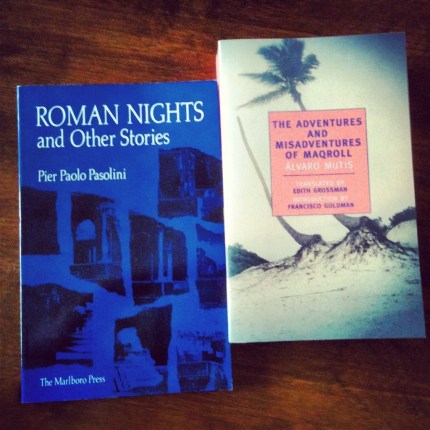
Pier Paolo Pasolini / Alvaro Mutis (Books Acquired, 12.21.20212)

20121223-132457.jpg

The edition I had of Mutis’s Maqroll only holds the first three novellas, so I ordered the NYRB seven-story volume. It’s like 700 pages and very attractive.

I also found this collection of Pier Paolo Pasolini short stories.

Silent Prayer — Stanley Spencer

Reading the Letter — Nikolay Bogdanov-Belsky

Young Man Reading by Candlelight — Matthias Stom

The President in Her Towers (Book Acquired, 12.20.2012)

20121221-122159.jpg

I just read the first few chapters of The President in Her Towers, Tom Whalen’s satire of academia—good stuff: short, punchy chapters that illustrate the reality of academia in all its paranoid surreality. Here’s publisher Ellipsis Press’s blurb:

Through the corridors of the university’s Humanities and Sciences Towers, rumors are swirling about the President: her bizarre decrees, her midnight meetings, her strange projects (the Head-in-Progress, the Activated Eye, the Gestation Chamber). The President’s dedicated personal assistant, Thomas (a.k.a. Herr Abjectus), is charged with investigating and reporting on these and other matters, but it won’t be easy—especially since the President has disappeared. And now there is a new rumor: that she has been marked for assassination


Sally and Paul, Reds and Greens — John French Sloan

André Maurois’s Climates (Book Acquired, 12.11.2012)

20121217-104436.jpg

This one looks pretty cool—André Maurois’s 1928 novel Climates. Here’s publisher Other Press’s blurb:

Written in 1928 by French biographer and novelist Andre Maurois, Climates became a best seller in France and all over Europe. The first 100,000 copies printed of its Russian translation sold out the day they appeared in Moscow bookstores. This magnificently written novel about a double conjugal failure is imbued with subtle yet profound psychological insights of a caliber that arguably rivals Tolstoy’s. Here Phillipe Marcenat, an erudite yet conventional industrialist from central France, falls madly in love with and marries the beautiful but unreliable Odile despite his family’s disapproval. Soon, Phillipe’s possessiveness and jealousy drive her away. Brokenhearted, Phillipe then marries the devoted and sincere Isabelle and promptly inflicts on his new wife the very same woes he endured at the hands of Odile. But Isabelle’s integrity and determination to save her marriage adds yet another dimension to this extraordinary work on the dynamics and vicissitudes of love.

I haven’t had time to dip into Climates yet, but it got a compelling write-up in The New Yorker last month. Excerpt:

At first sight, “Climates” is a simple fable. It tells of Philippe Marcenat, the heir to a provincial paper-mill business, who falls in love with the woman of his dreams, Odile Malet. He loses her, but is later loved in turn by Isabelle de Cheverny, a woman not of his dreams at all, although he tries (“Vertigo”-ishly) to make her so. We follow first Philippe and then Isabelle as they reflect on their love. There is a happy ending of sorts, though not for Philippe. Maurois has summarized his first vision of the story, in its bare-bones form, as:

Part 1. I love, and am not loved.

Part 2. I am loved, and do not love.

Put that way, it sounds like a perfectly balanced diptych. In fact, it is neither balanced nor anywhere near simple. Each of these four “love” and “non-love” elements conceals some complication, something moving at cross-purposes to it. Beneath what seems to be love, there lurks tyranny or submission, or a mixture of both. Beneath what seems to be non-love, there is… it’s hard to say what, but something indefinable that looks very much like love.

Read more: http://www.newyorker.com/online/blogs/books/2012/11/the-two-loves-of-andre-maurois.html#ixzz2FKDinsNq


“A Christmas Thought” — Barry Hannah

Reflections — John William Godward

Book Shelves #51, 12.16.2012


Book shelves series #51, fifty-first Sunday of 2012

20121216-092447.jpg

I am very ready for this project to be over. Two more weeks.

At this point, I’ve photographed all book shelves (and other bookbearing surfaces) in the house, but clearly the book shelves aren’t stable.

I mean, structurally, sure, they’re stable.

But their content shifts.

So this week (having three weeks left to fill), I go back to a sitting room in the front of the house where I like to read.

Above, resting on this cabinet, some current reading, including the latest DFW collection and Chris Ware’s Building Stories.

Below, a coffee table (first photographed in #7 of this series):


20121216-092518.jpg

As usual, a few coffee table books, plus several review copies that I need to look at sometime next week:

20121216-092535.jpg

One of the coffee table books is by Thomas Bernhard:

20121216-092544.jpg

To the right of the case, a bin of books—mostly review copies that come in that I plan to write more about:

20121216-092558.jpg


Reading in the Forest — Eva Gonzales

Reading a Story — James Tissot