Woman in a Bookshop — Aubrey Beardsley

Barthelme’s Influences

INTERVIEWER

Your own influences—whom would you like to cite as your spiritual ancestors?

BARTHELME

They come in assorted pairs. Perelman and Hemingway. Kierkegaard and Sabatini. Kafka and Kleist. Kleist was clearly one of Kafka’s fathers. Rabelais and Zane Grey. The Dostoyevsky of Notes from Underground. A dozen Englishmen. The surrealists, both painters and poets. A great many film people, Buñuel in particular. It’s always a stew, isn’t it? Errol Flynn ought to be in there somewhere, and so should Big Sid Catlett, the drummer.

—From Donald Barthelme’s interview with The Paris Review.

“Beckett’s Theory of Comedy” — Anne Carson

btc

Sleep — Felix Vallotton

Illustration for Kafka’s Metamorphosis — Jean-Michel Folon

folon-kafka-2

(More/via/about; then even more).

Sunday Funnies — Red Grooms

Astronomer — Gerrit Dou

The Favorite Poet — Sir Lawrence Alma-Tadema

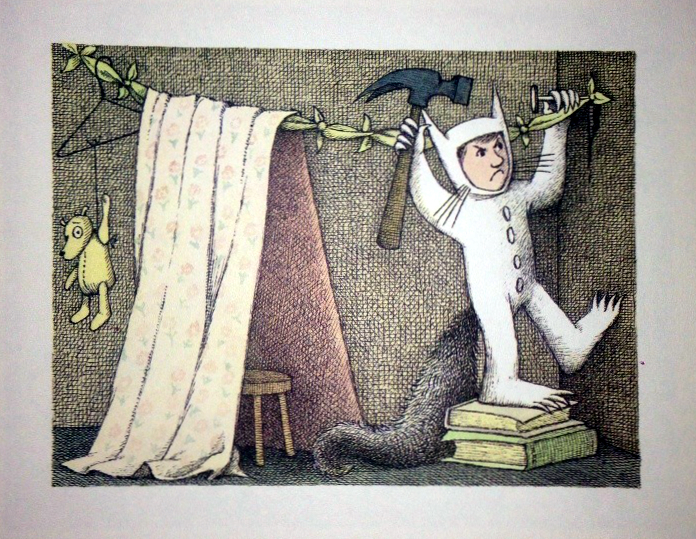
Mischief of One Kind — Maurice Sendak

sendak

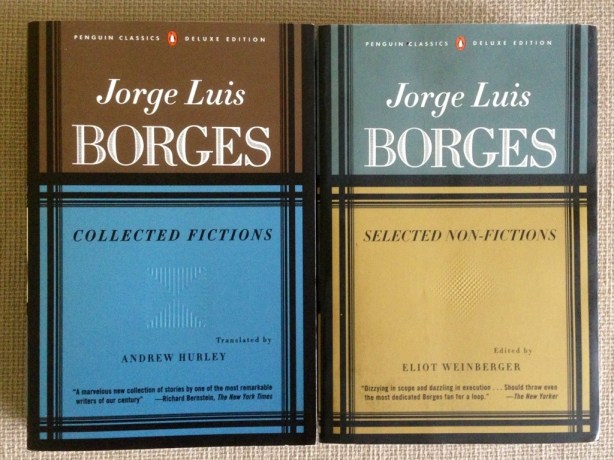
Double Borges (Books Acquired, 9.13.2013)

20130917-155302.jpg

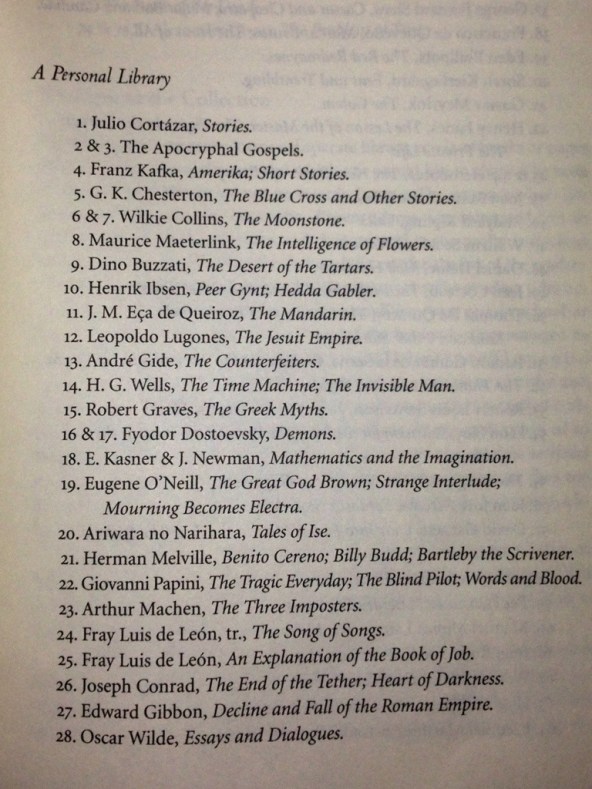
I was lucky enough this past Friday the 13th to pick up two Borges volumes, lovely twins with tactile covers, running over 500 pages each—they swallow a lot of Borges books I already own (although curiously leave out entire collections). I found a heartfelt note from mother to son in one the nonfiction collection, where she explains the difficulty she had with the book. I have my own Borges anxieties. Two from the collections: first, from the fiction and then the start of a list from the nonfiction.

20130917-160652.jpg

20130917-160659.jpg

The Green Dress — John Singer Sargent

Recent Stuff I’ve Found in Books

20130916-172934.jpg

So this Friday, I bought two enormous fat thick Penguin volumes of Jorge Luis Borges in utterly pristine condition (fictions and non-). I own other books that cover some of the material here, but 1100+ pages of JLB is hard to pass up (especially used, especially when I have store credit).

And then today, I was made privy to this lovely Flickr set, “Things found in books,” and thought I’d play along.

So back to Borges: I was somewhat touched by this note (above) I found in the nonfiction collection: Mom sends the book to her son so he “may understand it,” “this most difficult book”; mom also reports it “very hard to read” and appends a frowny face.

20130916-172940.jpg

Maybe a week or two before, I found this lovely little wisp of paper:

20130916-172950

In Vlad Nabokov’s Lectures on Don Quixote:

20130916-172955.jpg

Which reminded me of this James Joyce clipping—not so recent, I’ll admit, but still carefully placed as a bookmark in a Finnegans Wake guide:

20130916-173003.jpg

Okay, annotations, more properly:

20130916-173008.jpg

Do most people leave stuff in books? I think most bibliophiles do. (Forgive the snobbish italics there. I’m sure there are bibliophiles who don’t, of course). I have a habit of never reusing a bookmark, so that when I pull out a volume there’s some little tag there that acts as a third point (along with the text and my addled brain) to help triangulate the reading experience (the concrete circumstances of the reading process, the where, the when, the how much, etc.).

And so, after finishing Pynchon’s Against the Day a few weeks ago, I resolved to return to Mason & Dixon. Pulling out my copy,  where I found an entry ticket to Wat Phra Ram in Ayutthaya. I’m pretty sure I bought the book in Chiang Mai (after buying V. in Bangkok; books were the only thing I ever thought were expensive in Thailand).

20130916-173022.jpg

20130916-173026.jpg

A few weeks ago my grandmother let me take one of my grandfather’s favorite books with me when I left her house, a Walt Kelly collection.

20130916-173054.jpg

I was thrilled to find inside the Pogo volume the syllabus of my grandfather’s college chemistry class from the Fall of 1947:

20130916-173044.jpg

20130916-173038.jpg

And some of his notes (cryptic to me, but endearing):

20130916-173048.jpg

I think the best part about finding my grandfather’s old syllabus tucked away into a book he loved is knowing that we shared a habit.

“The thingness of books” (From Chrostowska’s Novel Permission)

The thingness of books, especially of many books kept in a small space, stacked high without rhyme or reason, can become impressive. I worry about being oppressed by the books I own––quite different from being oppressed by the ownership of books. There are days when I am certainly very oppressed by the presence of so many books in such a small space. There is really no more room for me with them around, just as there is no room for more books with me around. Yet I keep introducing new books, and reintroducing books that have either fallen or been misplaced and have now been picked up or found, or those I have lent (both with relief at the extra space and with apprehension at never seen them again) and that have just been returned to me. So now: loads and loads of books everywhere, and the fear that they will all come falling down one moment as I am passing through (or edging through) or sitting or (worse) dozing in my armchair, and that I or (more so) that they might be injured in the fall. The idea of all those books tipping over or (even) a shelf detaching itself from the wall and crashing to the floor, is positively nerve-wracking. Every time a book is taken off the shelf, transposed or put back I feel I am pushing my luck. I have so far been unusually lucky in avoiding an avalanche of book matter. I do believe a little order goes a long way, and that the ordering of books and maintaining always some semblance of order are possibly the best way of obviating the clutter typical of book-laden apartments. One really cannot speak of a book collection without having taken stock and organized and subjected one’s books to a more or less logical and consistent access-and-retrieval system. And apartments where the number of books impedes one’s access to them and exceeds a sustainable human-to-book ratio, books attract a frightful degree of clutter in a category unto itself. If it were merely dust and cobwebs everything would still be manageable; but a book heaven that has not been whipped into shape invites its owner to let go of themselves, is an invitation to physical sloth, if not intellectual sloth and downright mental confusion (too many books in too much chaos too often proves deadly for a thinking brain). The typical flat where books predominate, hence a space dominated by books, sooner or later adapts to the physical dimensions of books and reconfigures itself to accommodate even more of them––that is, ceases to be a flat and becomes a library. The sole occupant of such a space is, properly speaking, sharing accommodation. Without realizing it, this inhabitant has already given up many of the advantages of living alone. For starters, there is the uncontrollable, self-begetting clutter. You can deceive yourself that you could straighten up any day, but the mess that comes with the preponderance of books is addictive and ineradicable. It takes considerable exertion of the will to alter this reality. Similarly you may claim to be free to move out any day, to leave the mass and cramped conditions behind, but the truth is only too material: you are not going anywhere as long as you hold on to this many books. There is finally, the sheer lack of space for independent thought. These towers of intellect are known for their diminishing effects. You feel dwarfed both physically and mentally, and when this inequality in stature becomes too great you are done for as an independent thinker. Intellectual inferiority won’t let you scale the shoulders of giants to see further than them.

–From Sylwia Chrostowska’s novel Permission.

The Newspaper — William Russell Flint

russellflint-newspaper

The O. Henry Prize Stories 2013 (Book Acquired, Sometime Last Week)

20130914-084712.jpg

Here are the table of contents for the 2013 O. Henry Prize Stories:

Your Duck Is My Duck, by DEBORAH EISENBERG
Sugarcane, by DEREK PALACIO
The Summer People, by KELLY LINK
Leaving Maverley, by ALICE MUNRO
White Carnations, by POLLY ROSENWAIKE
Sail, by TASH AW
Anecdotes, by ANN BEATTIE
Lay My Head, by L. ANNETTE BINDER
He Knew, by DONALD ANTRIM
The Visitor, by ASAKO SERIZAWA
Where Do You Go? by SAMAR FARAH FITZGERALD
Aphrodisiac, by RUTH PRAWER JHABVALA
Two Opinions, by JOAN SILBER
They Find the Drowned, by MELINDA MOUSTAKIS
The Mexican, by GEORGE MCCORMICK
Tiger, by NALINI JONES
Pérou, by LILY TUCK
Sinkhole, by JAMIE QUATRO
The History of Girls, by AYŞE PAPATYA BUCAK
The Particles, by ANDREA BARRETT

My favorite thing about the list is that I’ve only heard of a handful of the writers here. Read the introduction here.

Woman with a Newspaper — Richard Diebenkorn

Two on the Aisle — Edward Hopper