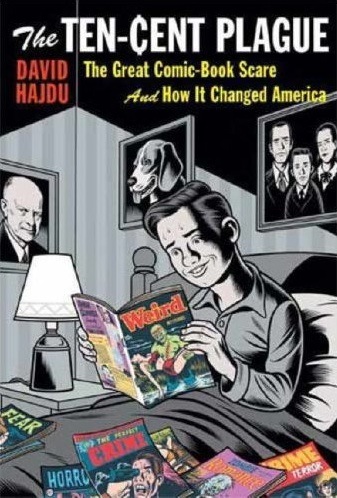
The Ten-Cent Plague — David Hajdu

10centplague

David Hajdu’s The Ten-Cent Plague serves as a fascinating cultural history of Cold War-era America. Hajdu’s book, subtitled “The Great Comic-Book Scare and How It Changed America,” illustrates the strange paradoxes at work in the post-WWII zeitgeist. Under the veneer of the conformity and suburban affluence of the Eisenhower years, a counter-cultural movement was finding its voice in the unlikely medium of comic books. Hajdu traces the history of the comic from its beginnings at the turn of the twentieth century through the end of the 1950s. Working in part from Gilbert Seldes‘s thesis that comics exemplified a type of “critical democratization” of art (along with “the movies, ragtime, vaudeville [and] popular song”) that “challenged aesthetic elitism,” Hajdu explains how such a maligned medium became a conduit for social change.

Although Hajdu covers the early strips like “Katzenjammer Kids” and “The Yellow Kid,” tracks the rise of Walt Disney and the pulp beginnings of Will Eisner, and explores the rise of seminal superheroes like Superman, the majority of the book is devoted to the national panic that arose from the massive popularity of crime and horror comics in the 1950s. Many of these comics were published by Bill Gaines’s EC comics. Bill Gaines became a crusader against the false morality of the Comics Code Authority (ironic side note: Gaines actually created the CCA as an attempt to bypass censorial influence, a maneuver that backfired) and its champions like Frederic Wertham whose pseudopsychological tome Seduction of the Innocent led to Congressional hearings on comic books, of all things. Hajdu explores not only the underlying civil rights battle on this censorship front, but also the themes of civil rights to which these comics were ultimately sensitive. Hajdu makes a persuasive case for comics as the foment of the anti-establishment youth culture of the 1960s–a beginning many cultural historians choose to identify exclusively with rock and roll and television. The epilogue of the book neatly dovetails this theme, moving from the establishment of Stan Lee’s Marvel Comics, a group that would feature outsiders and misfits of every stripe and color, to the bizarre and outlandish comix of Robert Crumb, who attests that “Mad was probably the biggest influence of all” on both himself and most of the other underground comix artists. So even though Gaines–the erstwhile hero of Hajdu’s narrative–has to give up EC–his legacy influenced not only the mainstream heroism of Marvel, but also forever affected the underground current of the counter-culture.
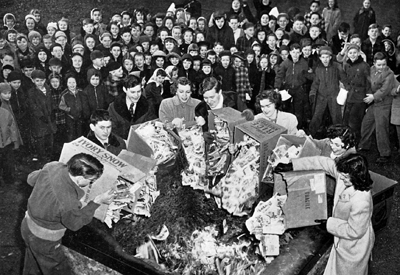
Comics on fire at St. Patrick's Academy in Binghamton, New York, 1949

Hajdu’s writing is both erudite and populist, well-researched with a thorough bibliography and index but also highly narrativized, the sort of nonfiction that reads at a tidy clip. In short, the book works on two levels, both as a scholarly undertaking, ready for handsome quoting in any MA’s term paper for Graphic Narratives, but also as simply a good beach read for those fascinated–or astounded–by the paranoia of America’s McCarthyian past. If you’ve read Michael Chabon’s The Amazing Adventures of Kavalier & Clay, you may know a bit of this history, and The Ten-Cent Plague would be an entertaining way to learn more. Most die-hard comics fans will know the background here, but will surely want Hajdu’s book to get the full story. An entertaining, often funny, and even sometimes enraging narrative. Recommended.

The Ten-Cent Plague is now available in paperback from Picador Books.
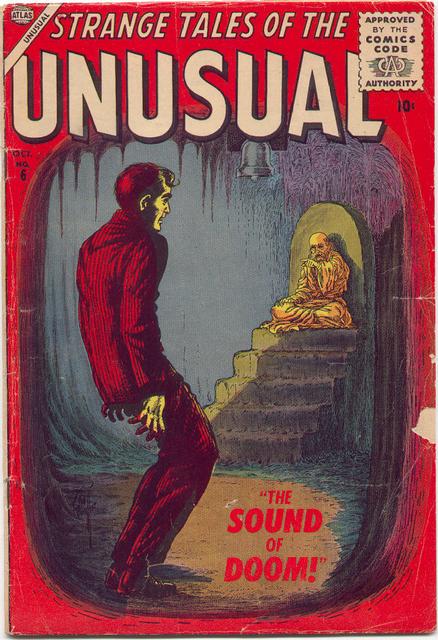
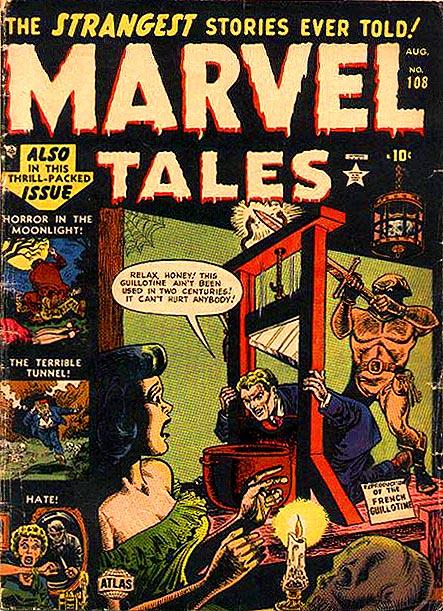
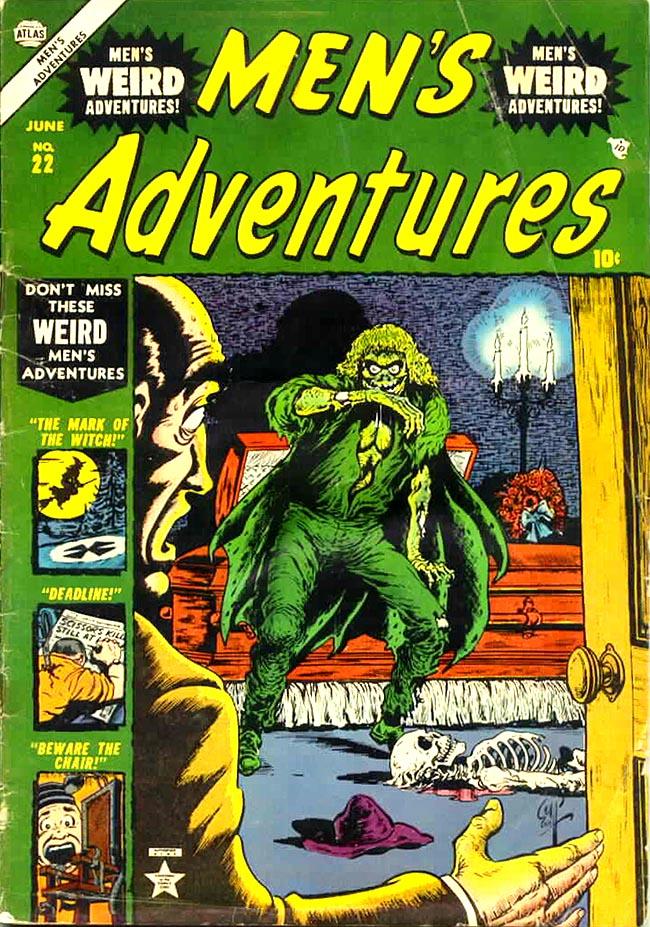
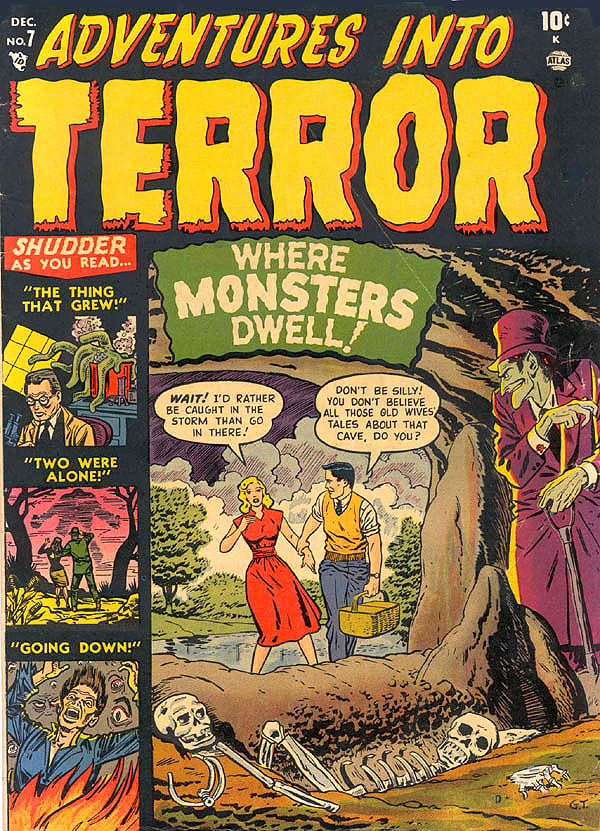
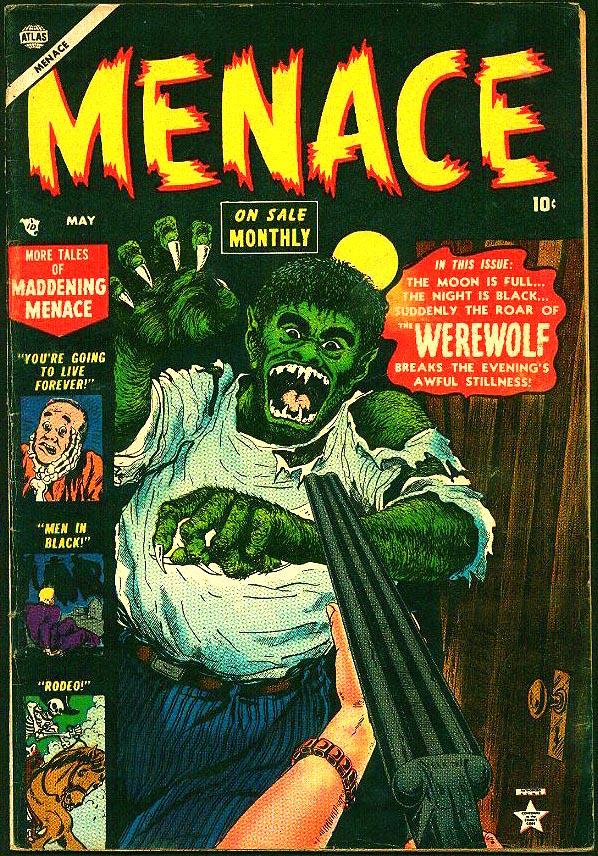
Strange Tales of the Unusual, Men’s Weird Adventures, and All Sorts of Marvelous Horror

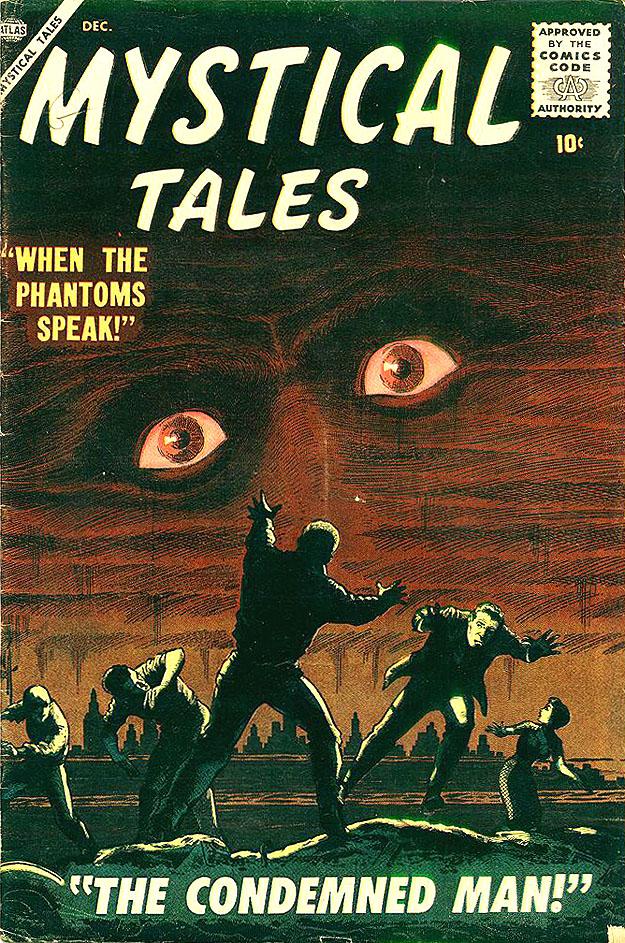
Let’s kick off Halloween week right by analyzing some old horror comic book covers from the 1950s.

I love this one: the jagged posture, the bloody reds, the weird mystic guy. And what can beat a title as redundant as Strange Tales of the Unusual?
Of course, all of these titles are strange, except when they’re weird or uncanny or unusual. Or mystical. But honestly, what’s so strange about putting your head in an old guillotine? I mean, seriously, relax. Who hasn’t put their neck on the chopping block like this. Literally, that is. (I love the bottom corner panel that just says “HATE!” incidentally).

Let me be clear on this: I am a man. Further, I am a manly man. Therefore, I require–no, demand–only men’s adventures. Further, I require my adventures to be weird. And not just slightly weird. I need creepy-green-gay-zombie weird. I need mark-of-the-witch weird. Newspaper-oriented-murder weird. Chair weird!

This comic is a clear forerunner of all those eighties slasher films that warned against teenage sex. Look at all the sexual anxiety here: “THE THING THAT GREW!”? “TWO WERE ALONE!”? “GOING DOWN!”? Jeez! Or, alternately, I am a pervert who sees sex everywhere. But seriously, don’t go into caves, kids.

My grandpa always taught me that the only thing more maddeningly menacing than a werewolf is a green werewolf.

Nothing snarky to say about this one: it’s beautiful. But really, I love them all.

All images from the Timely-Atlas Cover Gallery of old horror comics covers. Great stuff.

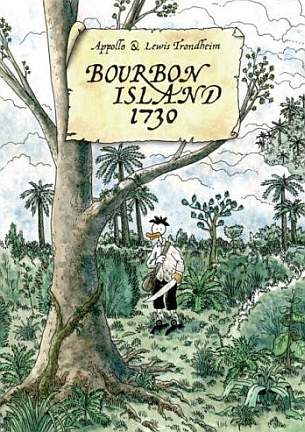
Bourbon Island 1730 — Olivier Appollodorus and Lewis Trondheim

Bourbon Island 1730, part funny animal graphic novel, part historical literature, recounts the story of Raphael Pommeroy who travels from France to Bourbon Island with his ornithology professor in search of a living dodo. On the journey to the French colony, Raphael becomes entranced by pirate tales, and when he arrives to Bourbon Island, he immediately tries to join up with some ex-pirates–unsuccessfully, of course. The French government has offered an amnesty to all pirates, and many have become successful plantation owners. However, their new wealth comes at the expense of the large population of slaves brought to Bourbon Island from Madagascar and Mozambique. The most interesting subplot of Bourbon Island 1730 involves a network of maroons, runaway slaves who have colonized their own villages at the top of the island’s treacherous terrain. When the notorious pirate Captain Buzzard is captured, some of the maroons plan to set him free and lead a revolt against the French colonials. In the meantime, the colonial authorities, including the scheming governor and the greedy priest, are trying to get Buzzard to reveal where he’s hidden a large cache of treasure.

Lewis Trondheim’s art strikes a nice balance between vivid detail and the classic funny animal style, and the book’s measured pacing delivers the story at a nice clip. Appollodorus and Trondheim never rush, taking the time to convey the cultural complexity of Bourbon Island–quite a feat, really, when you consider how much is going on here: the end of a pirate age, the horrors of slavery, and the problematics of colonization. Appollodorus and Trondheim envision Bourbon Island as a strange nexus of slavery and freedom, piracy and central authority, of the meeting of the cultures of Africa, India, and Europe. Leading man Raphael is a hopeless romantic who pines wistfully for the absolute freedom he sees as the life of a pirate and the natural right of all men. And yet, as the book makes clear, idealism can rarely stand up to the corrosive complexity of the real world.

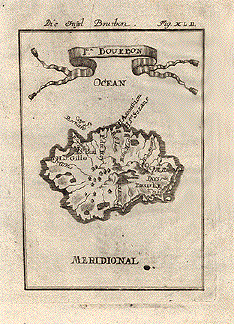
Allain Mallet's 1719 Map of Bourbon Island

With twelve pages of endnotes, Bourbon Island 1730 is just the kind of well-researched historical fiction that would fit neatly into any post-colonial studies course. There’s only one major fault with the book: it ends too quickly. Appollodorus and Trondheim have too many fascinating subplots that they don’t bother to resolve. While we have no problem with ambiguous conclusions, Bourbon feels simply rushed at the end, as it sprints to a virtual non-conclusion. We would’ve been much happier with a cliff-hanger and a promise of a part two. Nonetheless, anyone interested in colonialism and post-colonial studies should check out this book.

Bourbon Island 1730 is available October 28th, 2008 from First Second.

Poster Making

If you had a million years to do it in, you couldn’t rub out even half the ‘Fuck you’ signs in the world. It’s impossible. –Holden Caulfield in The Catcher in the Rye

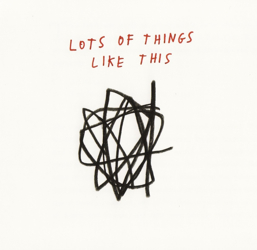
Royal Art Lodge piece from Lots of Things Like This, a slim volume of pictures with words (or words with pictures?) included with McSweeney’s #27 (two other books comprise the issue: a volume of short stories including pieces by Jim Shepard and Stephen King, and a really cool notebook of weird doodles and crazy thoughts by Art Spiegelman). Other artists represented in Lots of Things Like This include Magritte, Goya, Warhol, Raymond Pettibon, Jeffrey Brown, Leonard Cohen, David Mamet, David Berman, Basquiat, and more.

Summer Reading List: Anthologies to Know and Love

No summer reading is complete without imbibing the variegated prose of an anthology. The following are the literary equivalents of skillfully-detailed mixtapes, made by a friend who wishes to communicate only that he or she has your best interest at heart.

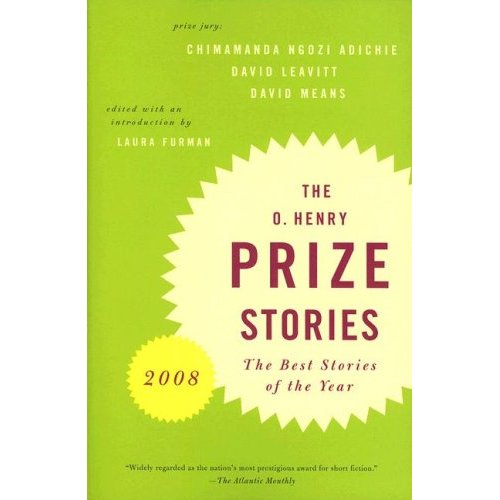
The 2008 O. Henry Prize Stories anthology is a great way to play catch up on all of the reading you missed last year. Culled from publications like Zoetrope, Harper’s, Granta, and Tin House, this anthology features established masters like William Gass and Alice Munro along with newer voices. There are plenty of highlights and no duds. Sharon Cain’s “The Necessities of Certain Behaviors” explores an amorphous world of gender-bending, while Stephen Millhauser’s “A Change in Fashion” imagines a new mode where women cover every inch of their flesh from the gaze of men. Lore Segal’s “Other People’s Deaths” perfectly captures the painful awkwardness and shame we experience when encountering, um, other people’s deaths. Similarly, the title of Tony Tulathimutte’s “Scenes from the Life of the Only Girl in Water Shield, Alaska” is spot-on, and Gass’s contribution, “A Little History of Modern Music,” is the funniest monologue we’ve read all year. But our favorite in the collection has to be Edward P. Jones’s “Bad Neighbors,” which examines the changing fortunes of an African-American neighborhood in Washington, D.C. A great collection, and if a story disappoints you, there’ll be three to make up for it.

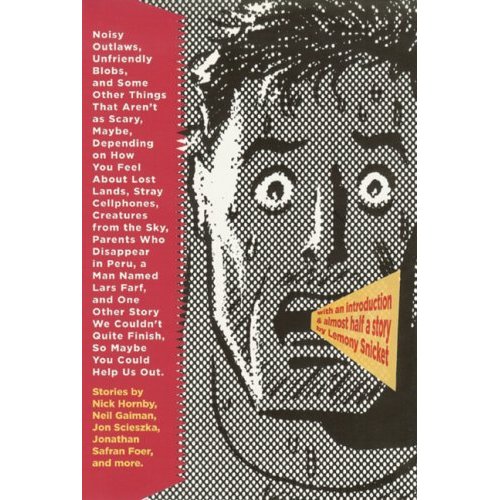
In the ultimate in lazy reviewing, we will let the title of McSweeney’s kids anthology Noisy Outlaws, Unfriendly Blobs, and Some Other Things That Aren’t as Scary, Maybe, Depending on How You Feel About Lost Lands, Stray Cellphones, Creatures from the Sky, Parents Who Disappear in Peru, a Man Named Lars Farf, and One Other Story We Couldn’t Quite Finish, So Maybe You Could Help Us Out stand as its own summary. However, this is a beautiful book with lots of lovely pictures, and the collection is worth it for Nick Hornby’s story alone. Good stuff.

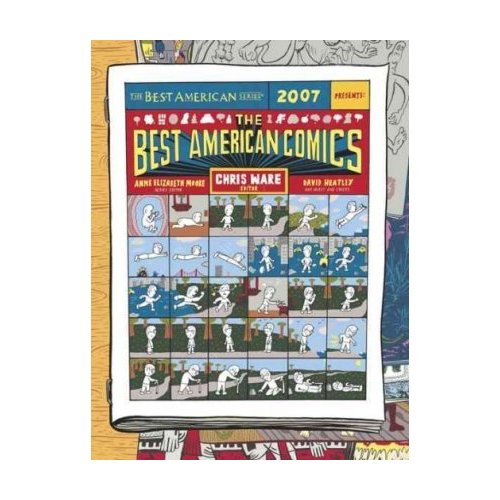
Edited by superstar Chris Ware, The Best American Comics 2007 serves as a delicious tasting menu of some of the best comix published in the past few years. Although hardcore comix fans will no doubt have already read the selections from Charles Burns’s Black Hole and Adrian Tomine’s Optic Nerve, there’s plenty here for aficionados and newbies alike.

Chances are you’ve read a number of the canonical texts in 50 Great Short Stories, but it’s also likely you haven’t read them in years. We’ve had this book for years, and have revisited often to indulge in old favorites for new inspiration. Classics like Shirley Jackson’s “The Lottery” and Hemingway’s “The Three-Day Blow” nestle up against lesser-reads like Edmund Wilson’s “The Man Who Shot Snapping Turtles” and Francis Steegmuller’s “The Foreigner.” And have you read Flannery O’Connor’s “A Good Man is Hard to Find” since high school? No? Shame on you! What about Carson McCuller’s “The Jockey”? Dorothy Parker? Kipling? Consider it a light crash course in great literature.

Summer Reading List: Tales of Adventure

Indulge yourself this summer by taking a fantastic voyage–literary or literally. To help you get started, check out the following tales of adventure.

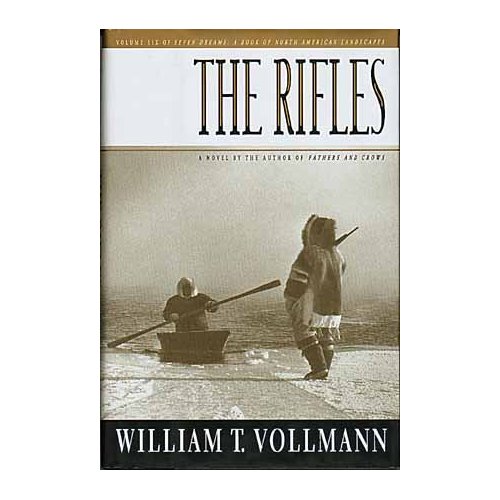
William Vollman’s The Rifles, part of his as-yet-unfinished Seven Dreams series is a brilliant engagement of history, colonialism, identity, and all of those Big Profound Issues that we so adore in our modern literature. It’s also a really cool adventure story, the tale of John Franklin’s nineteenth-century exploration of Inuit territory. Sad, beautiful, breathtaking.

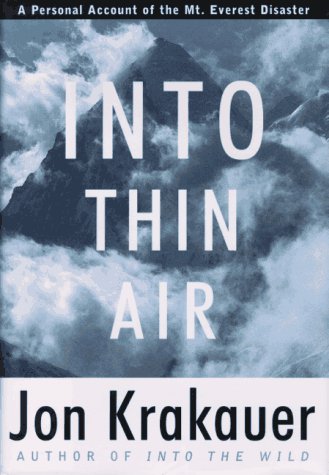
If you prefer your adventure tales uncomplicated by postmodern gambits, check out John Krakauer’s Into Thin Air, a journalistic account of the writer’s 1996 ascent of Mt. Everest, and the disasters that befell his expedition. The word “harrowing” fits well, gentle readers.

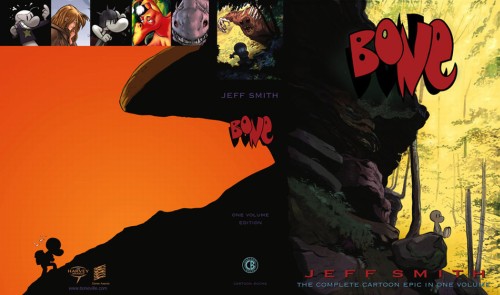
On the lighter-but-not-too-much-lighter side, Jeff Smith’s self-published comic Bone is fantastic; even better, you can get the entire 1300 page run of the whole series in Bone: One Volume Edition. We use the word “delightful” here in an absolutely unpejorative sense, friends: the adventures of Fone Bone, his cousins Phoney Bone and Smiley Bone, and Thorn, Granma Rose, and the Red Dragon are epic in scope yet retain an honest humor that will keep in the most cynical folks laughing. A major literary accomplishment that has been unjustly overlooked.

Also somewhat overlooked is Herman Melville’s Benito Cereno. In Bone, protagonist Fone Bone lugs around a massive copy of Melville’s masterpiece Moby-Dick everywhere he goes–and while that book is undoubtedly a desert island classic, Benito Cereno is an underappreciated gem of a tale. Revealing the strange secret at the heart of this book would spoil it, so suffice to say that the short novel enigmatically investigates slavery and colonialism in ways that beg for closer analysis. Good stuff.

Perhaps, though, you beg for the real thing. In that case, we recommend Ultimate Adventures (from Rough Guides) for all your camel-trekking-in-the-Sahara, rock-climbing-at-Joshua-tree, Pacuare-River-rafting needs. Beautiful photography and tantalizing descriptions are coupled with informative “Need to Know” sections that spell out the who-what-when-where-and-how that will help you get your adventure under way.

Also in the exploratory vein, Where to Go When: The Americas, from DK’s Eyewitness Travel, serves as a kind of travel almanac–the kind that makes you wish you were very, very rich with an excess of free time. If that were the case, you’d be spending nine days in May on the Amazon River, spotting pink river dolphins, gorgeous macaws, and darling squirrel monkeys instead of reading this blog right now. Even if you’re not excessively rich with nothing more pressing to do other than trek the Alaskan fjords, The Americas is fun daydreaming material–perhaps the realist response to Vollman’s Seven Dreams. In any case, Ultimate Adventures and The Americas both come out at the end of this summer, giving you plenty of time to plan that awesome adventure getaway for next year.

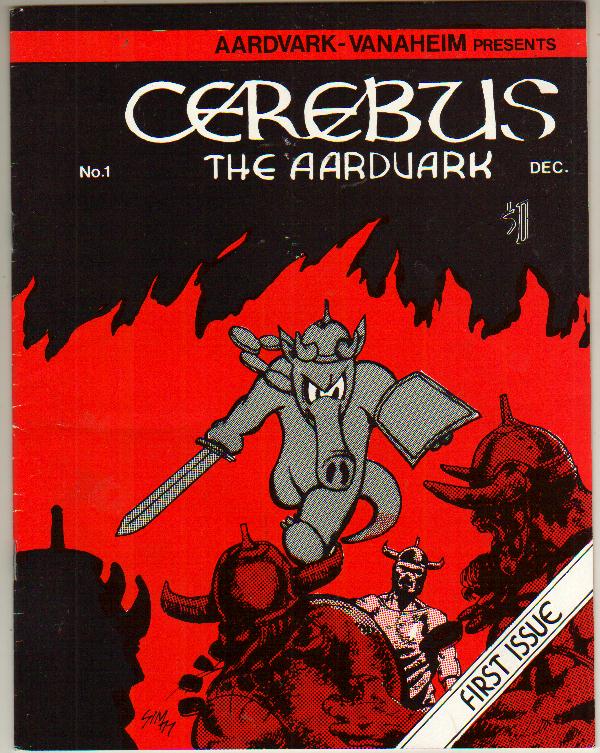
Cerebus — Dave Sim

Quick disclaimer:

What follows is a review of the first Cerebus graphic novel, not a review of the series as a whole. I initially contemplated such a feat, but handling Dave Sim’s (and Gerhard’s) 300-issue-long magnum opus in one post would result in either a really, really long post or a really, really inadequate handling of such fine (and troubled) material. Instead, I’ll review the series chronologically, covering one volume a month.

I suppose, also, that a quick primer or introduction may be necessary, so here goes–

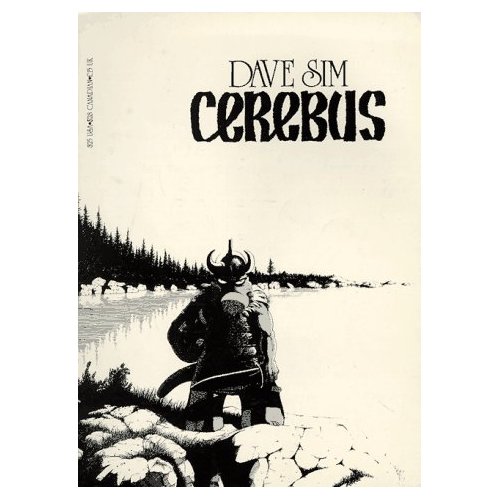
Cerebus is a 300 issue black and white comic book, conceived, written, and drawn by Dave Sim (with stunning background art by Gerhard in issues 66-300). Sim published the book himself via his Aardvark-Vanaheim imprint. The book follows the adventures (and non-adventures) of Cerebus the Aardvark, a surly barbarian who, as one of only three existing aardvarks in Estarcion, has a sort of catalytic power to influence major world events. It’s satire, it’s drama, it’s action, it’s art. The series contemplates politics, religion, literature, economics, and just about everything else under the sun. Only this is really not an adequate summary at all, so I’ll stop here, and get to the actual review. You can google “Cerebus” and “Dave Sim,” of course, and read all about Sim’s rise and fall (it gets spectacularly crazy, folks!); or, you can just wait until we get to the Reads book to learn all about Dave Sim, misogynist. But I’ve digressed before I’ve even begun. (The Cerebus Wikipedia page is pretty good; and this 2004 AV Club interview is also insightful).

Let’s start the review with yet another non-start: another disclaimer:

If you’re at all interested in Cerebus, Cerebus, the first graphic novel in the series, collecting issues
1-25, is not the place to start. If you really are interested in Sim’s work, start with the next collection, High Society. It’s much funnier, tighter, and Sim comes into his own as a draftsman by these issues (although there’s no denying that the art only gets better and better as the story progresses). Sim claims that he knew more or less from the beginning that Cerebus would have a scope of 300 issues (taking 27 years to complete), but the first 15 or so issues don’t really reveal anything that promising. Very early Cerebus is a silly funny animal Conan-Red Sophia parody. However, with issue 20, “Mind Games”–a comic Sim composed in interlocking images that when reconstituted created a new image (all right, that’s not a great description)–the book starts to get really interesting. By this point, Sim has already introduced my favorite character, Lord Julius, the anarchic Groucho Marx parody who wreaks havoc throughout the series; Sim further stirs things up by injecting the matriarchialist Cirinists into the chaos. The emerging Cirinists’ political/martial power becomes the conflict that will dominate the first half of the Cerebus series, and the larger issue of female power can rightly be named the Sim’s thematic obsession throughout the entire comic’s run. Before these themes come into their own, issues 1-17 or so of the book are stock fantasy tropes poked at with a stoner’s sense of humor. Like I said before, Cerebus–volume 1 of Cerebus–will be most enjoyed by those who’ve already had a taste of the good stuff–High Society and Church & State. Good stuff. More to come.

Happy Bissextile Day

From the OED:

“bissextile, a. and n.

Containing the bissextus or extra day which the Julian calendar inserts in leap-year. bissextile day (= L. bissextus dies; see above).

[1398 The yere Bisextilis: see prec..] 1594 BLUNDEVIL Exerc. III. I. xli. (ed. 7) 355 The Bissextile or leape yeere, containing 366 daies. 1696 WHISTON Th. Earth II. (1722) 158 The Julian Calendar..intercalates the Bissextile Day immediately after the Terminalia. 1768 BLACKSTONE Comm. II. 140 In bissextile or leap-years. 1854 TOMLINSON Arago’s Astron. 189 Thus 1600 was bissextile, 1700 and 1800 were not so.

B. n. Leap-year.

1581 LAMBARDE Eiren. IV. v. (1588) 491 The Bissextile (or Leepe yeere) which hapneth once in every foure yeeres. 1601 HOLLAND Pliny I. 586. 1834 M. SOMERVILLE Connex. Pys. Sc. xii. 95 If in addition to this, a bissextile be suppressed every 4000 years, the length of the year will be nearly equal to that given by observation.”I want to give a special shout-out to all of those who count leap day as their birthday, including contemporary music recording artist and performer, Ja Rule, who turns 8 today. Also, Nicky Longlunch sent me this cool link that I thought I’d share. Garfield Minus Garfield is a hilarious tumblog that, as the name suggests, removes Garfield from his own strip to reveal the “empty desperation of modern life.” Observe–

garf.gif
Speaking of doing something about the future, I suggest that we all vote for Ralph Nader this year. Now, please all go nuts at me, tell me I’m wrong, blame me for everything Bush has done (yes, I voted for Nader–in Florida–in 2000). But, before all of that, one last Leap Day sentiment from Diamond Dave:

Omega the Unknown

omegatu1.jpg

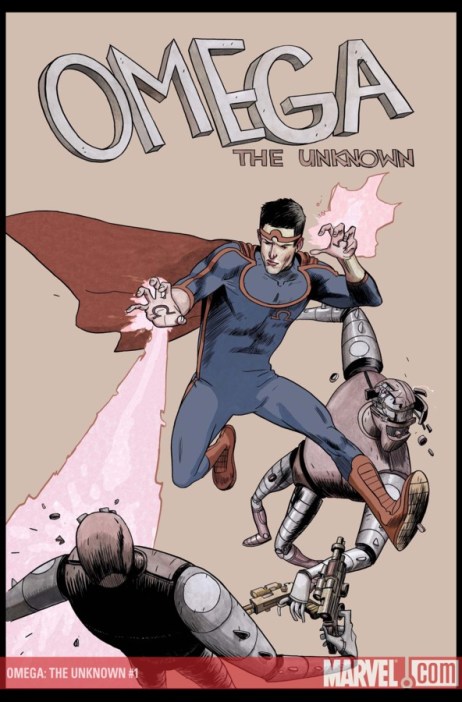
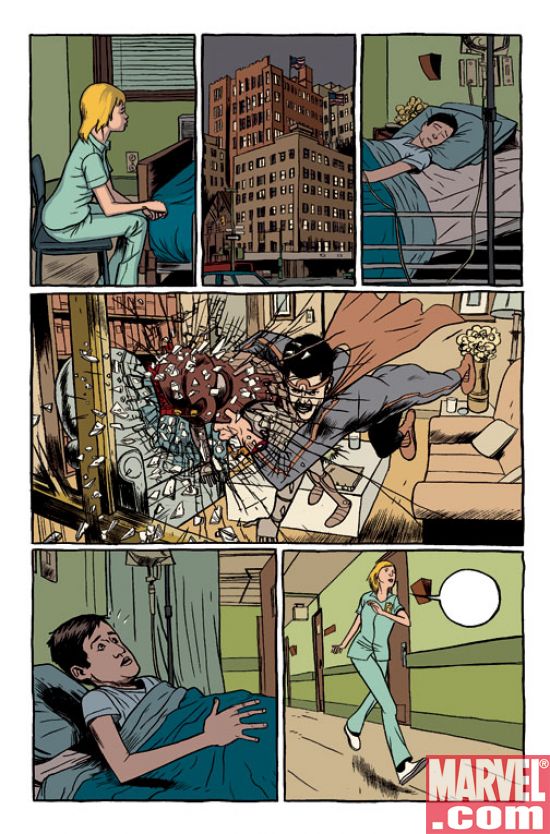
Earlier this year, in an interview with the AV Club, Jonathan Lethem briefly mentioned that he was working on “kind of an emo comic book” for Marvel Comics. The first issue of that comic–part one of a ten issue run–came out back in October, prompting me to go to a comic book store–something that I haven’t done in years. Lethem’s Omega the Unknown is essentially an update of the original Omega the Unknown series, written by Steve Gerber and Mary Skrenes with art by Jim Mooney. The original ten issue run was published by Marvel Comics twenty years ago.

Lethem’s Omega the Unknown centers on robotically erudite teenager Alex Island and his new life after the bizarre death of his parents (who turn out to be–gasp!–robots). Alex has a strange (and still unexplained in the first three issues) relationship with a superhero who doesn’t speak, but who seems to be watching over him, protecting him from alien androids who are out to get him. Also watching over him after his parents’ deaths are a callow young nurse and a cynical social worker. All the while, local Brooklyn “superhero” The Mink tries to figure out how he can turn this new superhero and his robot villains into an opportunity for more publicity.

I haven’t read Marvel comics in over 15 years, but Omega the Unknown is quite a bit better than even the best comics I remember reading in the late eighties/early nineties (um, Chris Claremont’s X-books). Still, despite its introspection, lack of huge splash pages or silly, purposeless fights, Omega is deeply entrenched in superhero terrain: this isn’t an indie comic. Also, I was able to wait a week between reading issues two and three, even though I had both of them in my possession–compare this to a “superhero” comics like Alan Moore’s Watchmen, which I had to read in one sitting.

omega03.jpg

Farel Dalrymple’s art is fantastic, especially given Marvel’s current penchant for anime-inspired overly-muscled cartooning. Dalrymple’s figures recall many of my favorite artists, capturing the quintessential stark simplicity of Jack Kirby’s squarish hulks and the wild energy of early John Romita Jr. coupled with the attention and detail to line Art Adams always puts into his illustrations.

I’ll continue to pick up the issues of Omega the Unknown, but so far, it’s hardly essential Lethem, or, for that matter, essential comic reading. Still, for now, I’ll give it the benefit of the doubt.

The Weird Wild World of Wonder Woman

What’s the deal with Wonder Woman? (images via Superdickery, who provide their own snarky comments).

277_4_219.jpg

A little five-on-one action. Luckily, that nasty voyeur Elongated Man is there to film the whole thing.

bindme.jpg

Good clean Amazon fun.

277_4_068.jpg

Look out for the giant phallus–uh–torpedo!

277_4_2051.jpg

A Freudian’s field day.

277_4_158.jpg

(Evil) mustache rides, 10 cents.

Friday Funnies

16.gif

“The great epochs of our life come when we gain the courage to rechristen our evil as what is best in us.”

The other night, at our last birthing class, our fearless instructor pulled out the old overhead projector (she had previously come out strongly and scornfully against power point presentations), and began showing us various cartoons detailing the ups and downs of life with a new baby.

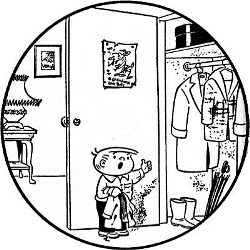
I knew that it was coming. I was clinching my jaw in preparation for it. But nothing could have readied me for just how loud the class laughed in appreciation for a Family Circus comic. I love comics of all kind, so the insipid lifeless crap-o-rama that is Family Circus is particularly offensive to me, especially when it’s somehow deemed to be true or, even worse, truly funny. Then again, the people in my birthing class are the same crew that suggested a few weeks ago that eating the placenta was distinctly un-American, so it seems about par for course that they would appreciate FC.

Fortunately, there’s an antidote to Bil Keane’s witless garbage. Check out The Nietzsche Family Circus, which pairs a random FC image to a random Nietzsche quote. If not always hilarious, the results are often instructive, and always constitute legitimate satire. Good stuff.

166.gif

“He who cannot give anything away cannot feel anything either. “


The Sunday Comics

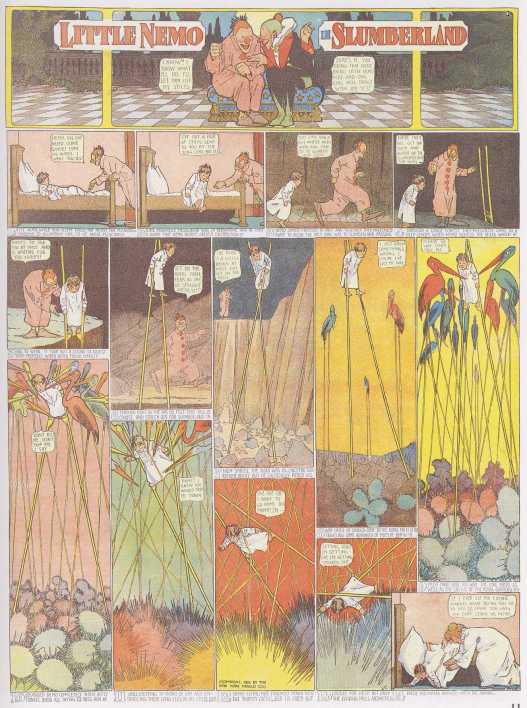
I’ve spent hours adoring the first volume of The Complete Little Nemo in Slumberland by Winsor McKay instead of grading my Seniors’ research papers or writing my own final paper for my theory class. And who wouldn’t want to get absorbed and distracted by McKay’s lush and fantastical world? It’s both sad and silly that the comics page nowadays has been compressed into a minute fraction of the massive broadsides that used to grace each Sunday edition of the paper. Calvin & Hobbes creator Bill Watterson has lamented the incredible shrinking comics page in the introductions to several of the C & H collections, and Art Spiegelman paid tribute to the glory days of the broadside in In the Shadow of No Towers. Still, even as comics creators draw attention to this downsizing, it seems that the trend in newspapers will be to continue to dwarf creativity, to literally minimize (pop) art. This marks a serious social regression over the past century. But why? If I knew that something on the scale of the broadside below–both in terms of physical size and imagination–was waiting for me each Sunday, I’d be excited to get a subscription to the local rag. For now, enjoy this episode of Little Nemo (image links to a full page, but you still might need to use the magnifying glass!)–

littlenemo02.jpg

In the Shadow of No Towers–Art Spiegelman

Art Spiegelman’s Maus, released as a graphic novel over twenty years ago, did more to legitimize the comic as an art form than any other work I can think of. It won a Pullitzer Prize Special Award in 1992 (the Pullitzer committee found it hard to classify…perhaps they didn’t want to admit that they were giving a prestigious award to a comic book!), and today Maus is a standard on many college English syllabi.

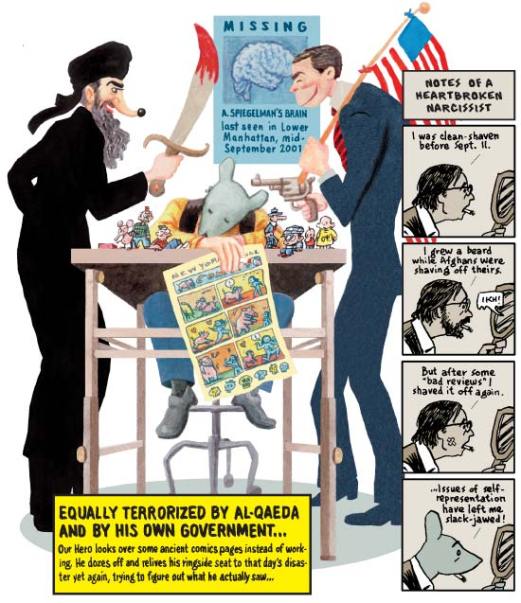
After Maus, Spiegelman worked for The New Yorker for over ten years, quitting in early 2002 after the September 11th attacks to work on a series of broadsheets entitled In the Shadow of No Towers. These broadsheets were collected in 2004 in an unwieldy 15″ x 10″ book.

spiegelman_02_550×637.jpg

Spiegelman lived in downtown Manhattan, right by the towers; his daughter attended school a few blocks away. He saw the towers collapse in person, fleeing for his life with his family. Spiegelman attempts to capture this raw, unmediated, and very personal experience in In the Shadow of No Towers (Sonic Youth’s 2002 album Murray Street works to the same end–only much more abstractly): the narrative is discontiguous, fluctuating from bitter satire to earnest inquiry. Spiegelman’s choice of the broadsheet as his medium (the broadsheets were published monthly by different newspapers as Spiegelman produced them) is tremendously affective: just like the 9/11 attacks, the broadsheets are larger than life, hard to grasp, hyperbolically resisting easy, singular readings. Spiegelman balances bitter attacks against the conformist mentality spurred by the Bush administration with pathos and humor; In the Shadow of No Towers recalls the good-natured satire of broadsheet comics from a hundred years ago, bittersweetening the content. The 2004 collection wisely contextualizes Spiegelman’s work by reprinting broadsheets of “The Yellow Kid” and “The Katzenjammer Kids.”

Like Maus, In the Shadow of No Towers is a fascinating exploration of how disaster confronts and transforms identity. And reflecting its heinous subject, In the Shadow of No Towers ends without concluding: as the foolish Iraq war begins, Spiegelman can no longer shape any meaning or sense from his work. This isn’t a graphic novel–don’t look for a cohesive narrative structure here; instead, In the Shadow of No Towers explores the loose ends, the detritus, the psychic remnants of disaster.

Leisure Town

lt_top.jpg

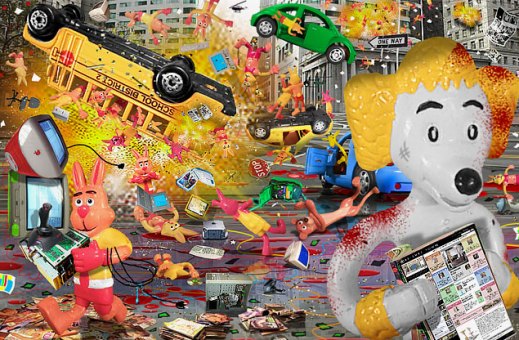
Tristan Farnon’s hilarious webcomic Leisure Town plays ludicrously with distinctly American tropes of sex and violence, resulting in some of the most mean-spirited humor this side of Peter Bagge or Robert Crumb.

Populated with psychopathic plastic animals and dope-smoking astronauts, Leisure Town is a world plagued by school shootings and AIDS jokes, misogynists and cubicle drones. Farnon’s ugly sense of humor might be hard for some to swallow–or even understand–but his work addresses the stochastic cruelty inherent in a commodified culture, a culture where people only have value as faceless automatons, as lumps of flesh to be detonated. Enter at your own risk.

tristanfarnon161.jpg

Piercing

David Gaddis produced only one webcomic, but it’s beautiful. Do another one, Mr. Gaddis! In the meantime, take five minutes to read “Piercing.”

p4col.jpg 

McSweeney’s Issue 13 (Chris Ware)

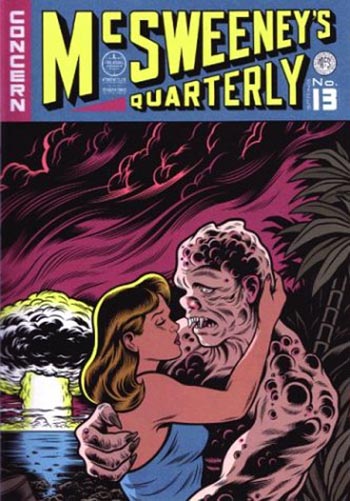
McSweeney’s Issue 13

Charles Burns’s gorgeous title page for McSweeney’s Issue 13 captures the bizarre mix of romance, abject horror, and mutually assured destruction present in the horror comics of the 1950’s.

I love all things McSweeney’s–Dave Eggers, The Believer, etc–but Issue 13 of McSweeney’s Quarterly Concern is particularly excellent, and is easily the most beautiful, most aesthetically pleasing book I own. Designer and editor Chris Ware (author of the sad and dense graphic novel Jimmy Corrigan, Smartest Kid on Earth) offers a concise but thorough history of cartooning. Ware places Robert Crumb, the Hernandez brothers, Art Spiegelman, Daniel Clowes, and other great artists into a tradition initiated by Rodolphe Töpffer and Krazy Kat, and perfected by Charles Schulz. This richly-colored book comes wrapped in an old fashioned broadsheet comics page, and includes work from some of the best artists and cartoonists from the past 100 years. Despite the wide range of cartoonists represented, Ware unifies the issue in a theme of despair and depression. Imagine this famous moment in cartooning–Lucy pulls the football away from Charlie Brown’s wishful kick at the last minute, tripping him and humiliating him and betraying him: that pretty much somes up Ware’s theme. But even though it’s sad, it’s funny and somehow beautiful–and real.

If you are a bibliophile, you must buy this book. You won’t be disappointed.

Classic Crime Comics Covers

Another covers gallery. I love this one–plenty of weirdness!

chamber_chills23.jpg

Zombie kisses…mmm. The taboo pleasures of necrophilia in four-color glory!

shocksuspens12.jpg

William Burroughs wasn’t the only one addressing the horrors of drug addiction. These touchy themes led to constant censorship battles for EC Comics.

baffling7.jpg

The horrors of love. I like this guy’s beard.