

With Halloween approaching, here are three creepy full page panels from Charles Burns’s Black Hole (Pantheon, 2005).

With Halloween approaching, here are three creepy full page panels from Charles Burns’s Black Hole (Pantheon, 2005).
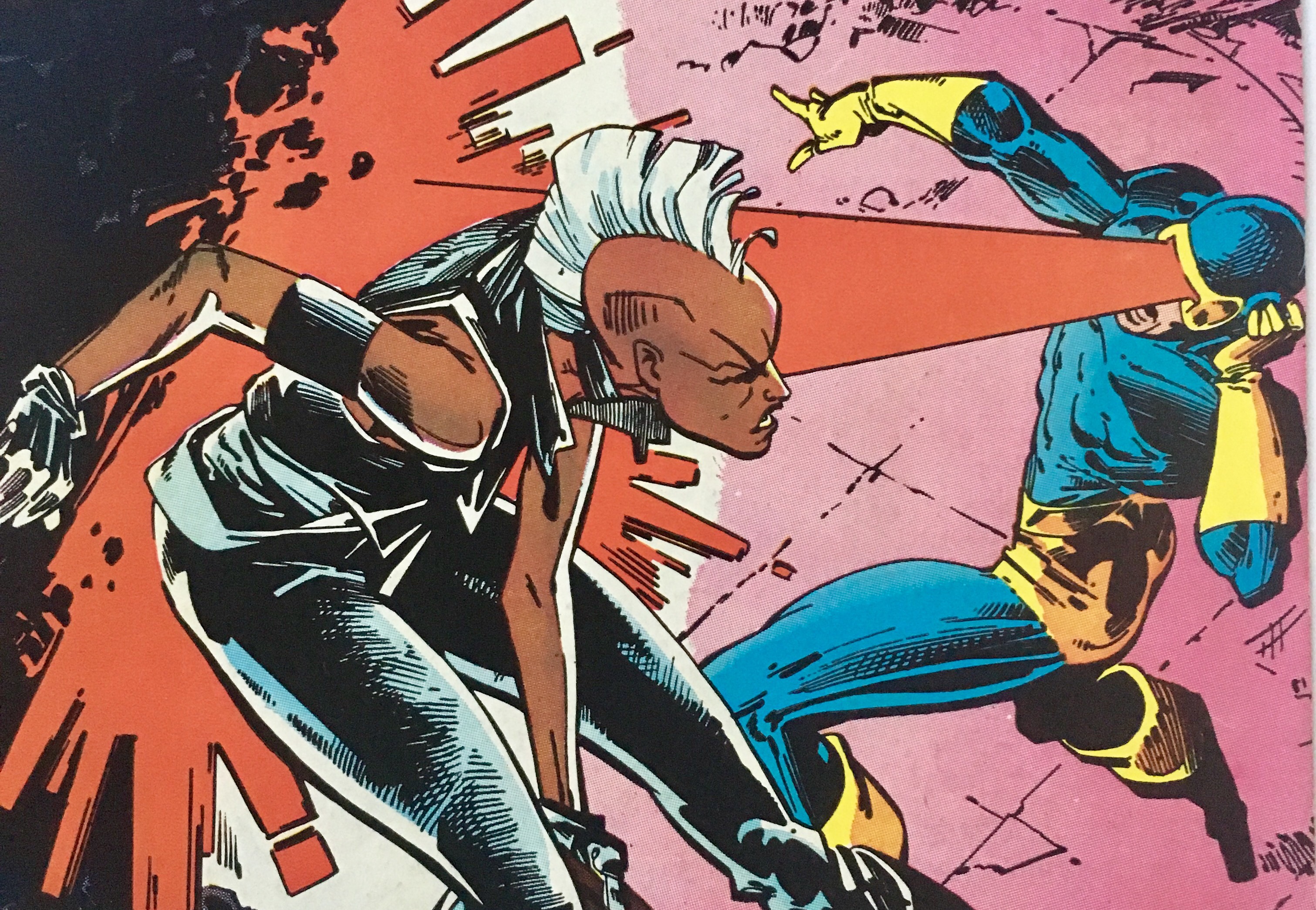
Just got home after three days evacuated from Hurricane Matthew. No power at the house, so no scanner to do Sunday Comics this week—I’ve resorted to the iPhone. Couldn’t resist Storm for this week.
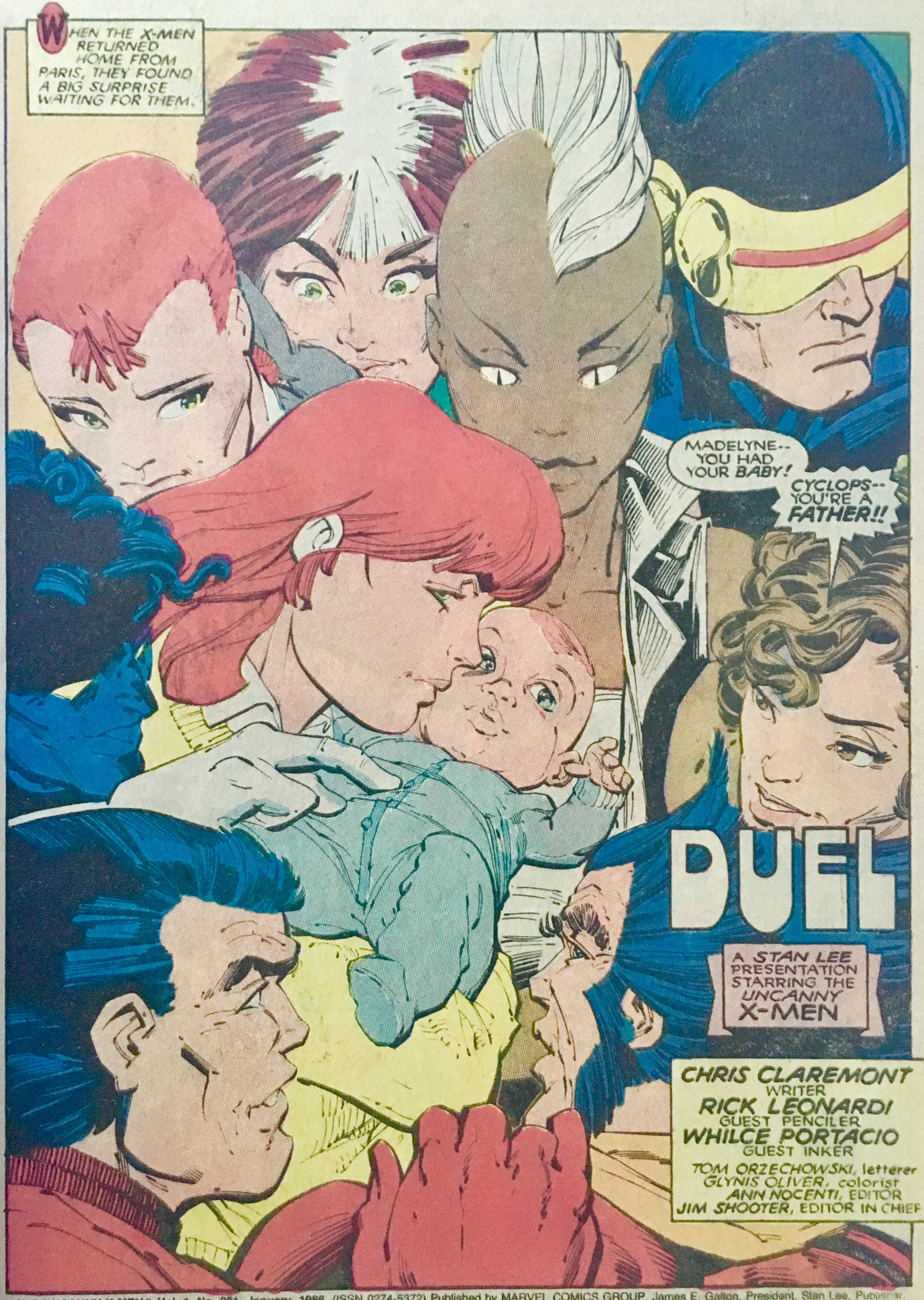
From the cover of The Uncanny X-Men Vol. 1, No. 201, January, 1986. The writer is Chris Claremont with pencils by Rick Leonardi. Whilce Portacio’s inking is the star here.



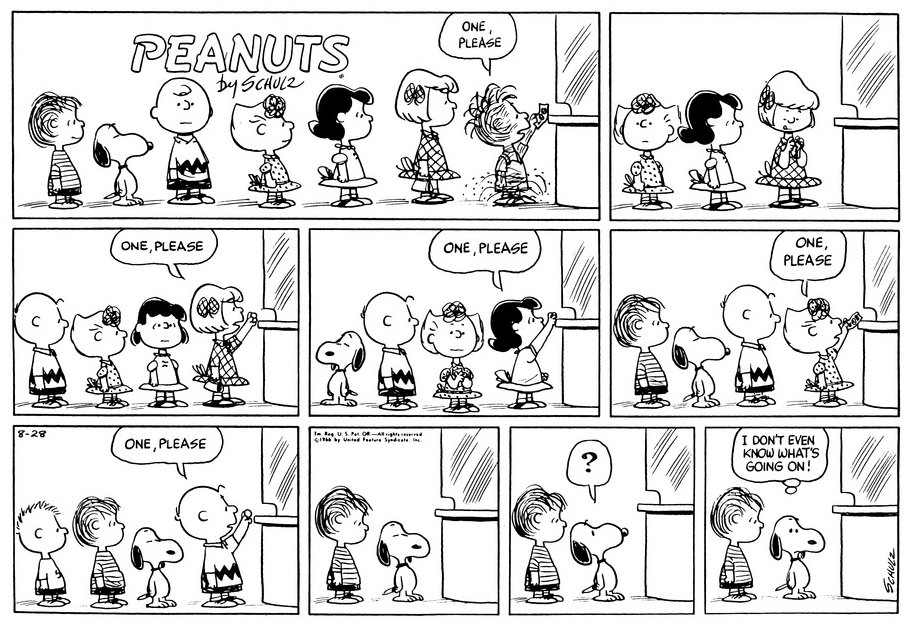
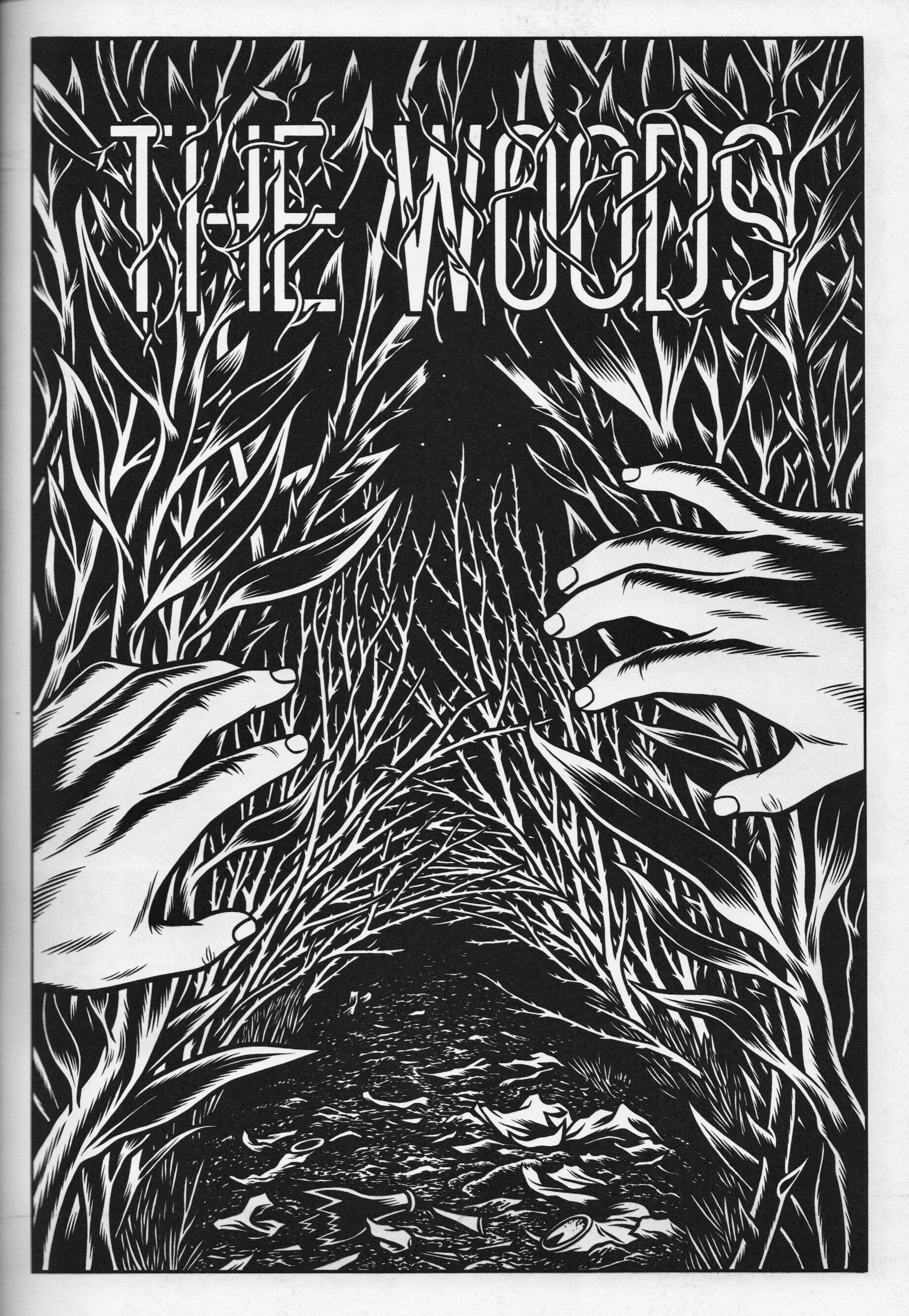
Three pages from Will Eisner’s “Izzy the Cockroach and the Meaning of Life,” part of A Life Force, collected in Eisner’s The Contract with God Trilogy, Norton, 2006.
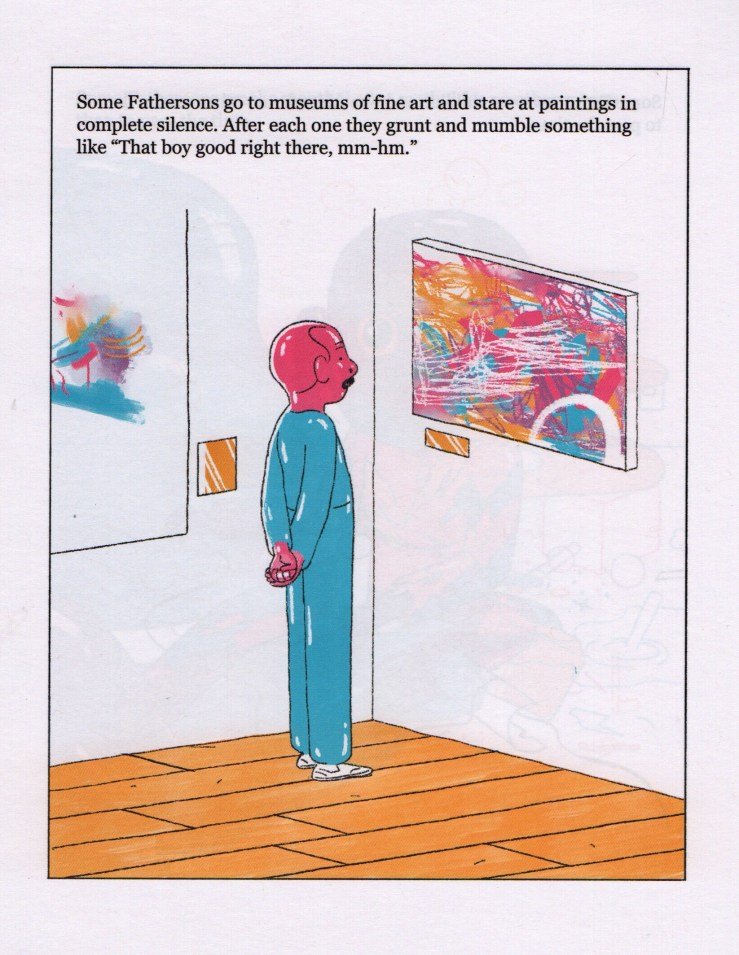
Richie Pope’s Fatherson showed up in today’s mail—it’s issue #13 of Youth in Decline’s monograph series Frontier. It’s so, so good—I’ve gone through it a few times now, and its immediate vibrancy and apparently simplicity slips into richer and richer territory each time.
It reminded me at first of a book my wife brought back to me years ago from San Francisco—a kids book called The Daddy Book by Todd Parr (she took our son when he was like, what—six months old?—left me with our daughter, alone, when she was like, what—twoish? Everything was fine and dandy cotton candy). And then, simultaneously, Fatherson reminded me of Donald Barthelme’s novel The Dead Father—particularly the “Manual for Sons” section.
And Fatherson reminded me of other stuff too, but mostly I loved it because of the stuff it didn’t remind me of. Highly recommended.
I recently re-read all of Jeff Smith’s massive comic Bone—this time to my son, and this time in the Scholastic color reprints. (I read Bone in full with my daughter years ago through the unwieldy 1,300 page single-volume single edition; I read bits and pieces of it earlier in the late nineties, when Dave Sim (of Cerebus fame/infamy) was an early champion of Smith’s cartooning charms).
Anyway, we enjoyed the read, and the fourth book, The Dragonslayer, seemed particularly timely.
In this volume, Phoncible P. Bone—aka Phoney Bone—manipulates the fears of the populace of Barrelhaven. A natural conman, Phoney instructs the townspeople to build a wall to keep “dragons” out. Only sensible Lucius Down (and Phoney’s cousins, who know he’s a scammer) realize that Phoney is driven by egomania and greed.
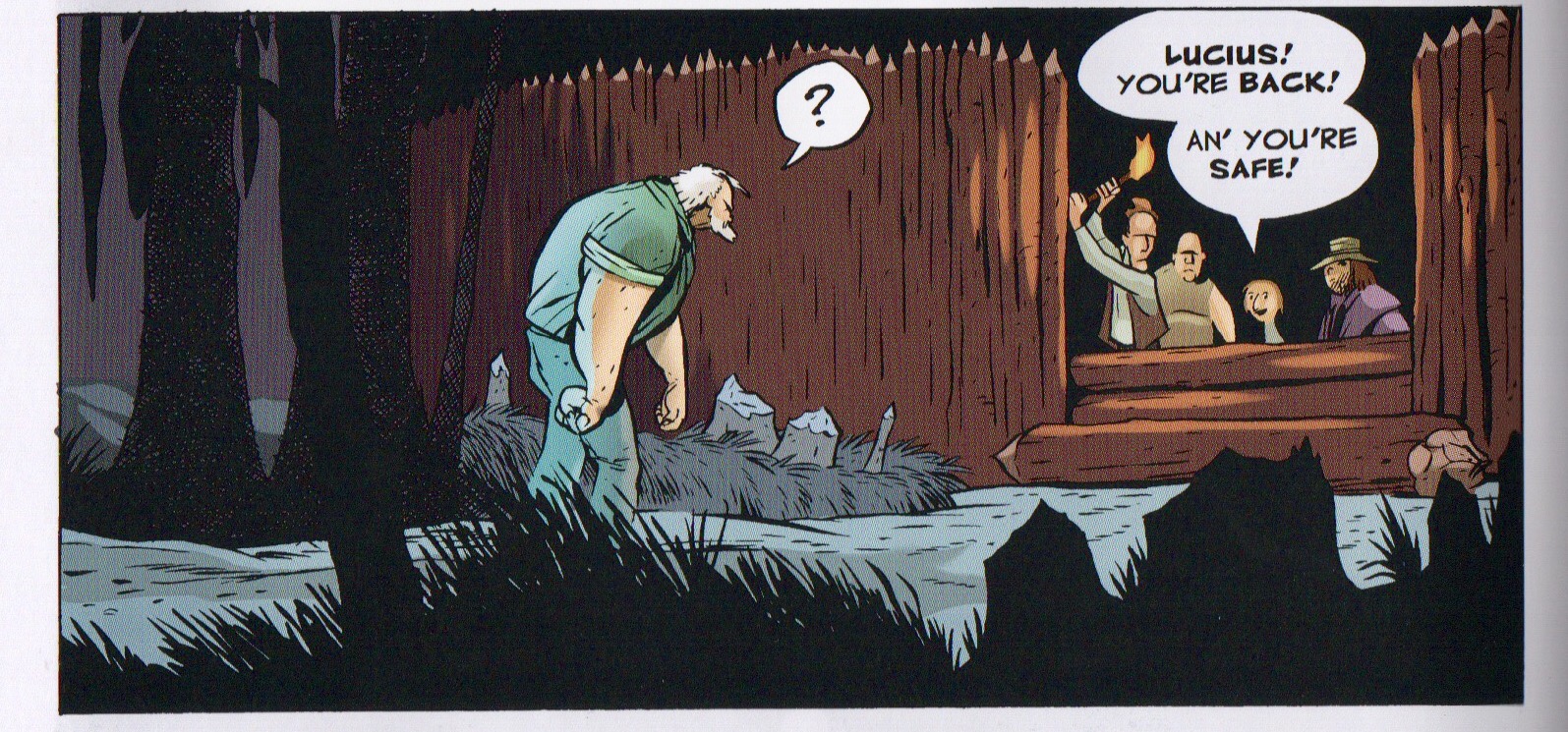
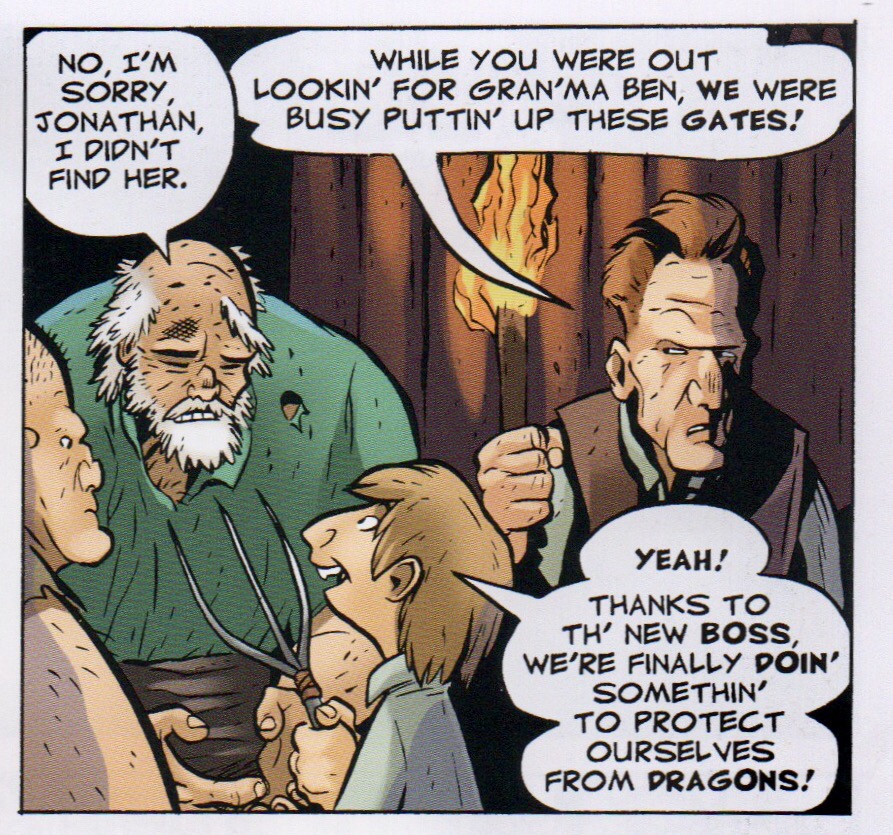
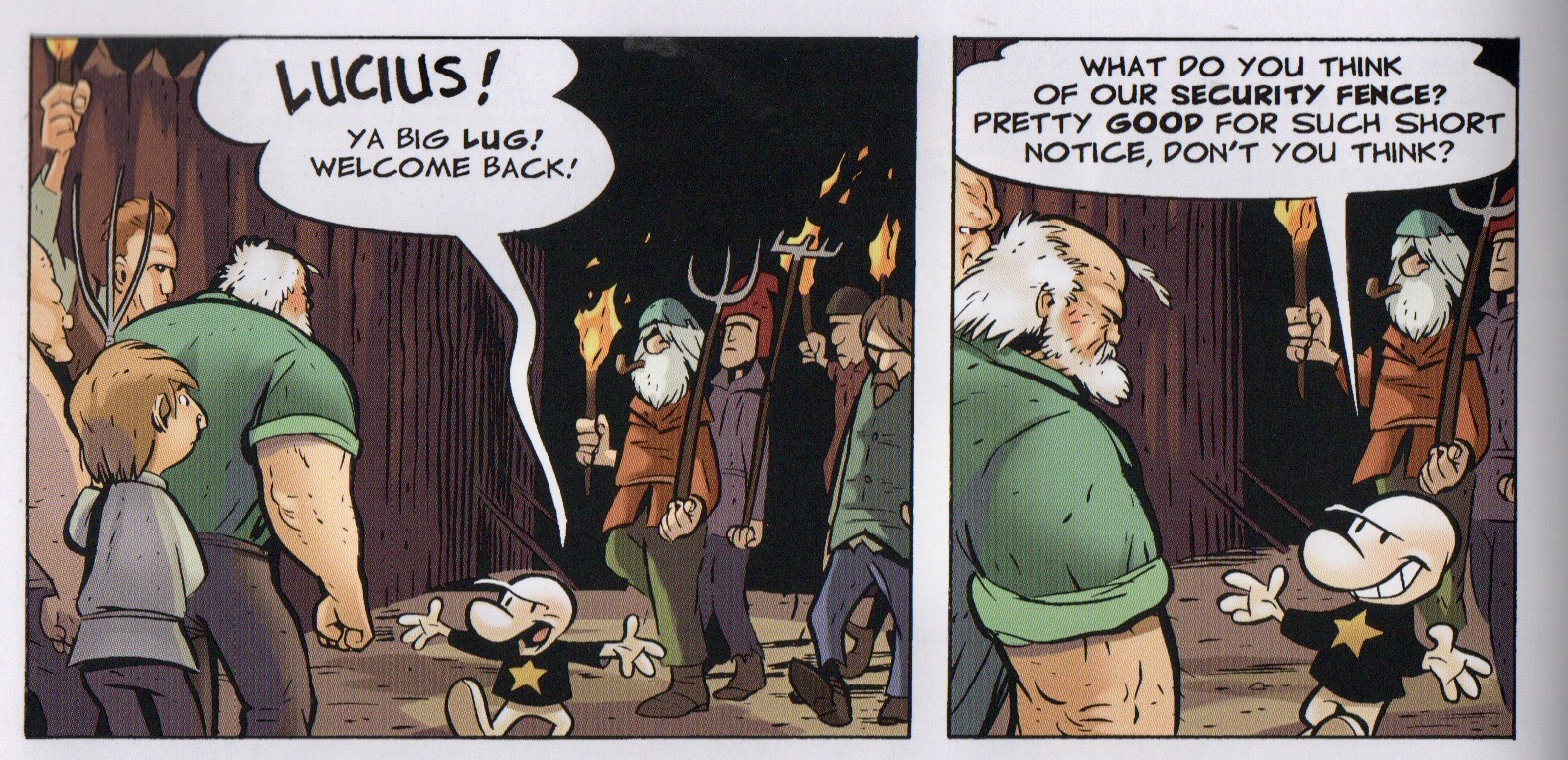
Perhaps the most infuriating moment in the story comes when Phoney—a gifted pitchman—cloaks his greed in the language of ethics and morality.
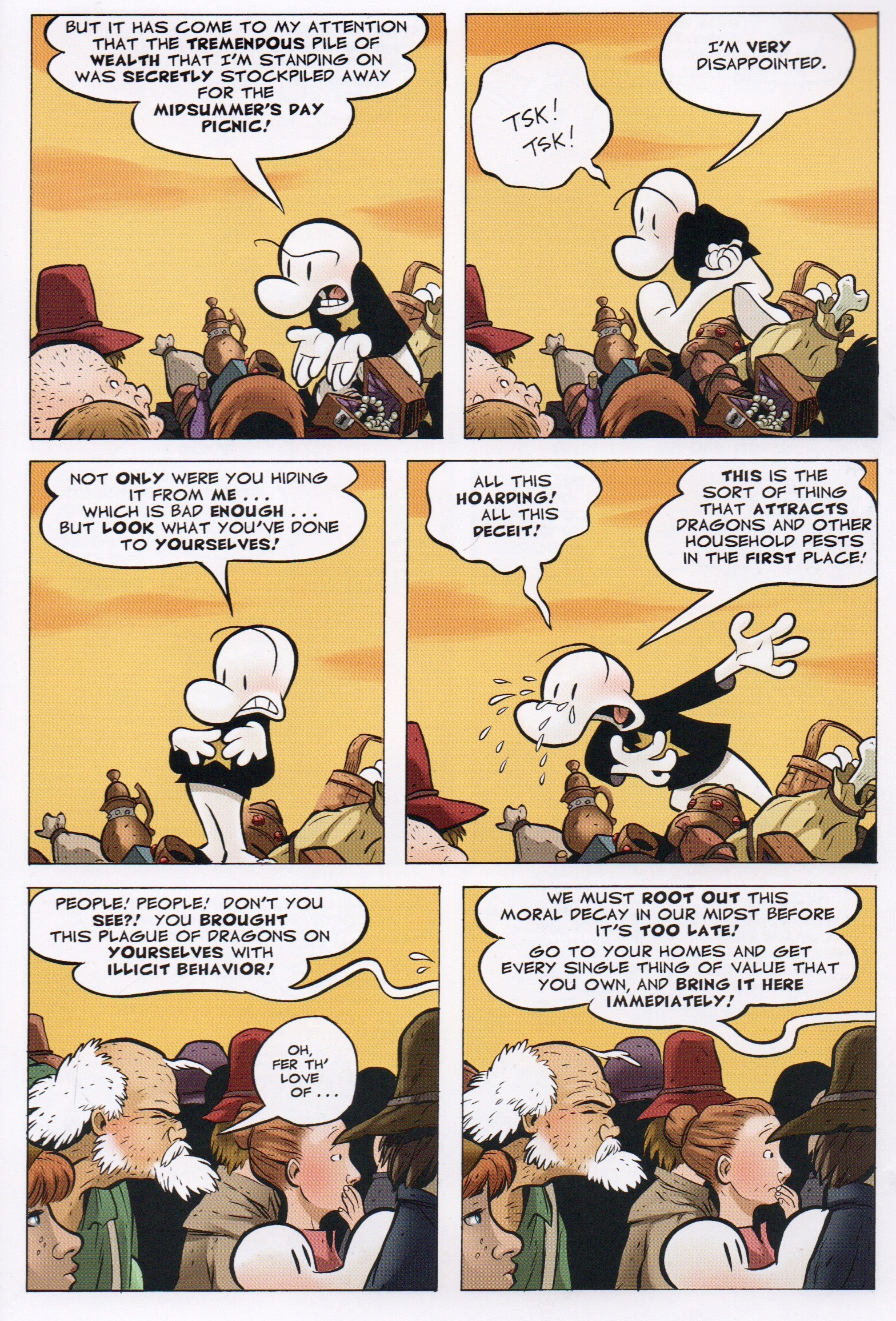
Of course Phoney doesn’t win in the end. And Bone is just a comic; it’s not real life. It’s not like a xenophobic conman could really take sway over the zeitgeist.
Why here? 1 Why should the rainbow edges 2 of what is almost on him be rippling most intense here in this amply coded room? say why should walking in here be almost the same as entering the Forbidden 3 itself—here are the same long rooms, rooms of old paralysis and evil distillery, of condensations and residues you are afraid to smell from forgotten corruptions, rooms full of upright gray-feathered statues with wings spread, indistinct faces in dust 4 —rooms full of dust that will cloud the shapes of inhabitants around the corners or deeper inside, that will settle on their black formal lapels, that will soften to sugar the white faces, white shirt fronts, gems and gowns, white hands that move too quickly to be seen 5 … what game do They deal 6 ? What passes are these, so blurred, so old and perfect? “Fuck you,” whispers Slothrop 7. It’s the only spell 8 he knows, and a pretty good all-purpose one at that. His whisper is baffled by the thousands of tiny rococo surfaces. Maybe he’ll sneak in tonight—no not at night—but sometime, with a bucket and brush, paint FUCK YOU 9 in a balloon 10 coming out the mouth of one of those little pink shepherdesses there 11… .
He steps back out, backward out the door, as if half, his ventral half, were being struck in kingly radiance: retreating from yet facing the Presence feared and wanted. 12
1 Why…not?
Okay—this seems like a fair question. Let’s not be glib.
The question is Our Hero Tyrone Slothrop’s, via Pynchon’s oft-present free indirect style.
The where is the hotel room of Our Man in the French Riviera. Slothrop is on “furlough” (not really, they—They—have his ass hard at work) at the Hermann Goering Casino.
Poor Tyrone returns to his hotel room after a picaresque run (and wardrobe shift: tacky/sexy Hawaiian shirt to purple toga to English army uniform) to find that “everything in this room is really being used for something. Different. Meaning things to Them it has never meant to us. Two orders of being…”
Two orders of being: I could riff all day (night?) on this, but I suppose we can boil it down to GR’s binary theme. (Or, for fun, because it’s Our Boy Slothrop—Visible/Invisible (“paranoia” is the gradation between that binary).
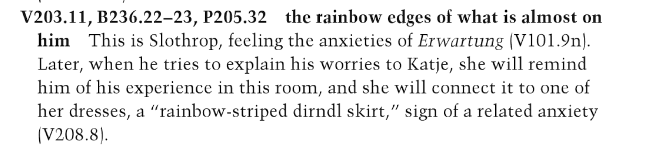
2 The fourth appearance of the word “rainbow” in GR (barring the title, colophon, etc.). Another gradation, the rainbow, between binaries. An arc, a rise, a fall.
Double rainbow. Blind-sighted: False binary. Gradations:

(And music).
Cf. Genesis 9:11-16 (King James Version):
11 And I will establish my covenant with you, neither shall all flesh be cut off any more by the waters of a flood; neither shall there any more be a flood to destroy the earth.
12 And God said, This is the token of the covenant which I make between me and you and every living creature that is with you, for perpetual generations:
13 I do set my bow in the cloud, and it shall be for a token of a covenant between me and the earth.
14 And it shall come to pass, when I bring a cloud over the earth, that the bow shall be seen in the cloud:
15 And I will remember my covenant, which is between me and you and every living creature of all flesh; and the waters shall no more become a flood to destroy all flesh.
16 And the bow shall be in the cloud; and I will look upon it, that I may remember the everlasting covenant between God and every living creature of all flesh that is upon the earth.
Cf. A Gravity’s Rainbow Companion: Sources and Contexts for Pynchon’s Novel, Steven Weisenburger:
3 …the Taboo? The Abject? Another description of Gravity’s Rainbow…? Or do we just feel the meaning here? (Yes).
4 The imagery here—desiccation and paralysis, a taxidermist’s row in an old dusty museum—evokes the death|life binary.
5 The Elect (vs Preterite Slothrop). Our Dude TS has his own issues vis a vis whiteness (revisit his adventures down the toilet back during a night in Roxbury).
6 Recall we are in the Casino Hermann Goering. Recall GR’s themes of chance and fate, probability and statistics, zeroes and ones. Recall They.
7 This seems to me like another thesis statement of Pynchon’s in Gravity’s Rainbow.
Actually, fuck that hedging: A fuck you to the They is Gravity’s Rainbow’s mission statement.
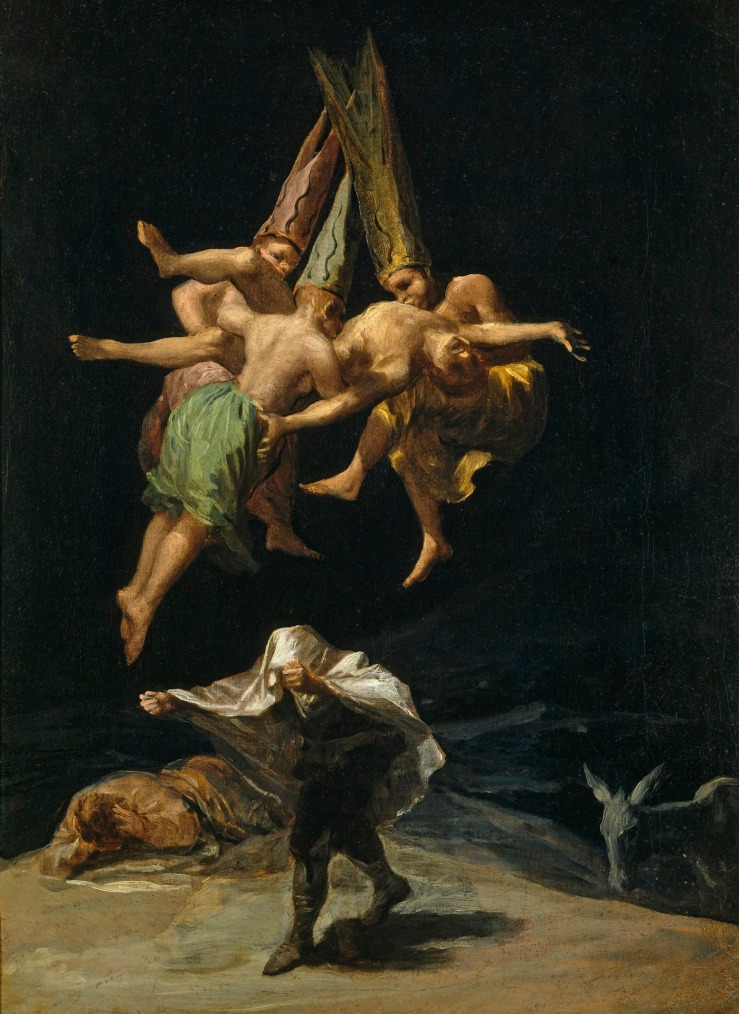
8 Gravity’s Rainbow is full of witches, and maybe Slothrop is a lazy novice.
9 Cf. Ch. 25 of J.D. Salinger’s 1951 novel The Catcher in the Rye:
It’s hopeless, anyway. If you had a million years to do it in, you couldn’t rub out even half the “Fuck you” signs in the world. It’s impossible.
10 Have you read Donald Barthelme’s 1968 short story “The Balloon”?
11 A fascinating image, I think. Leave the rococo knickknack of the pink shepherdess alone a moment (perhaps it suggests erotic enticement to you, pervert preterite?) and attend to just how and where Slothrop intends to append this “FUCK YOU” sign—in a comic book speech bubble. The intertextual (do I mean metatextual—it’s hard to keep up) possibilities here bubble and boil. It’s as if Slothrop would rewrite his room (“Two orders of being”) as a comic book.
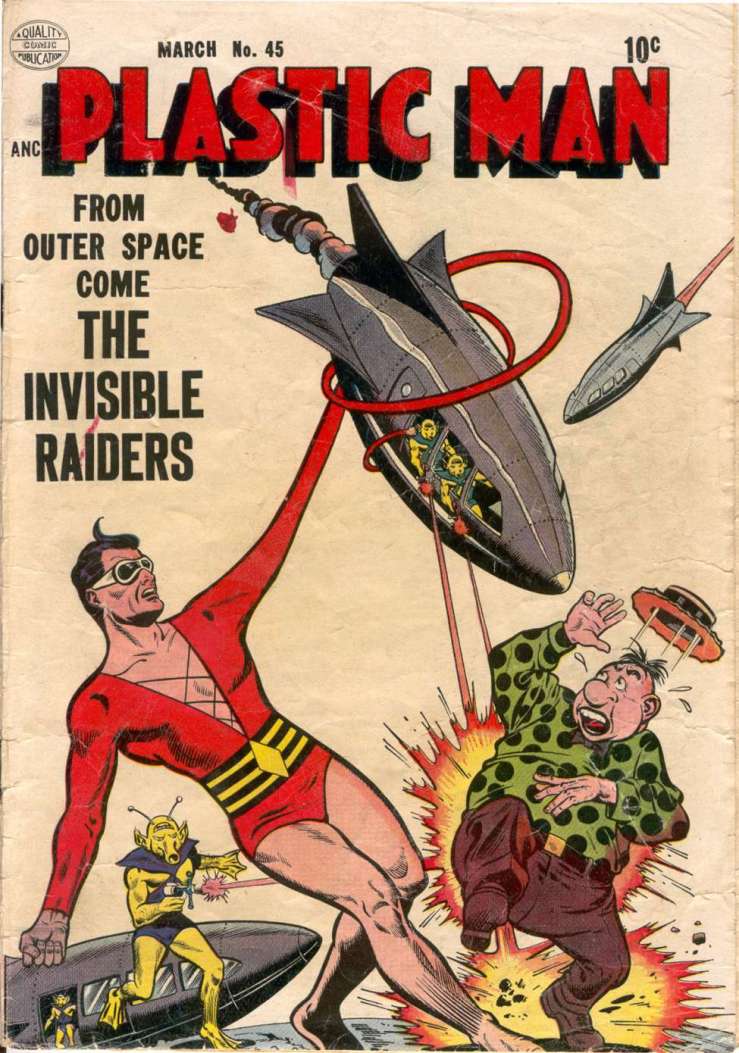
A page or two later, we find Our Guy Slothrop reading an issue of Plastic Man.
12 Note here the halving of Slothrop, the text that cuts him—ventral. He’s in and out, facing a Presence but already half Absent. Is Our Savior Tyrone the one radiating the “kingly radiance” — or is he being radiated by it?—Or am I making too much of light?

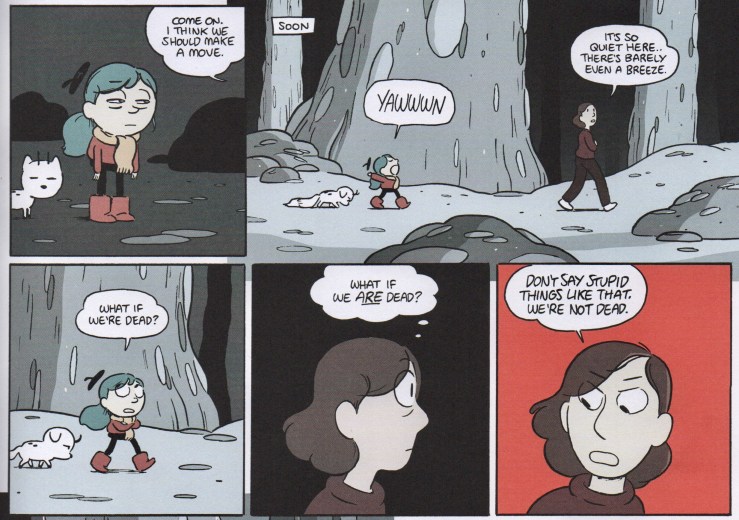
I love love love Hilda and the Stone Forest by Luke Pearson (Flying Eye/Nobrow, 2016). My kids love it too. It’s the richest, funniest, and most heartwarming Hilda book to date.
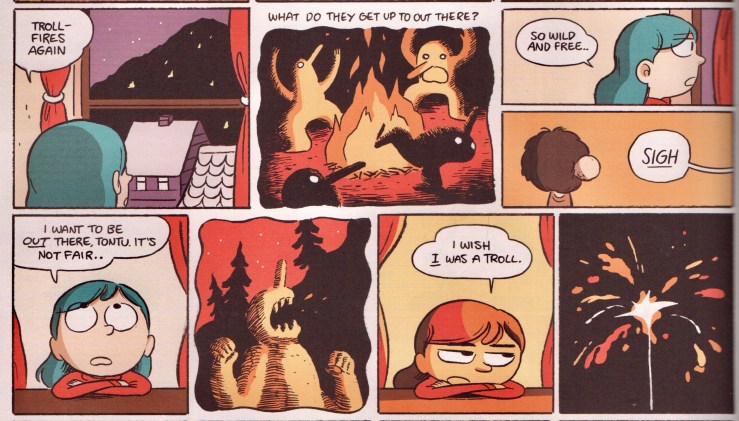
Pearson manages to stuff The Stone Forest with miniature epics and minor gags, which he hangs on the central story of Hilda and her mother in an otherworldly (literally), uh, stone forest, where they encounter trolls and other dangers (including existential despair).
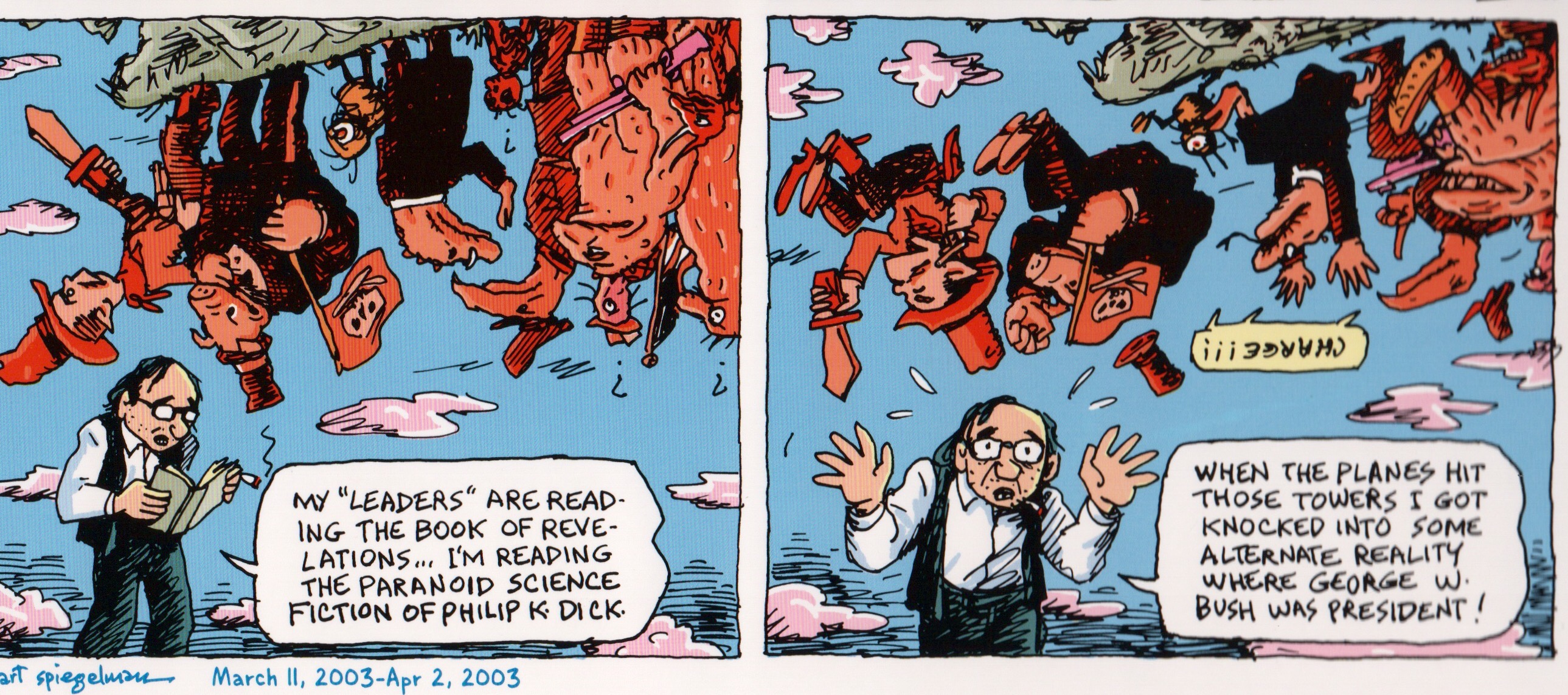
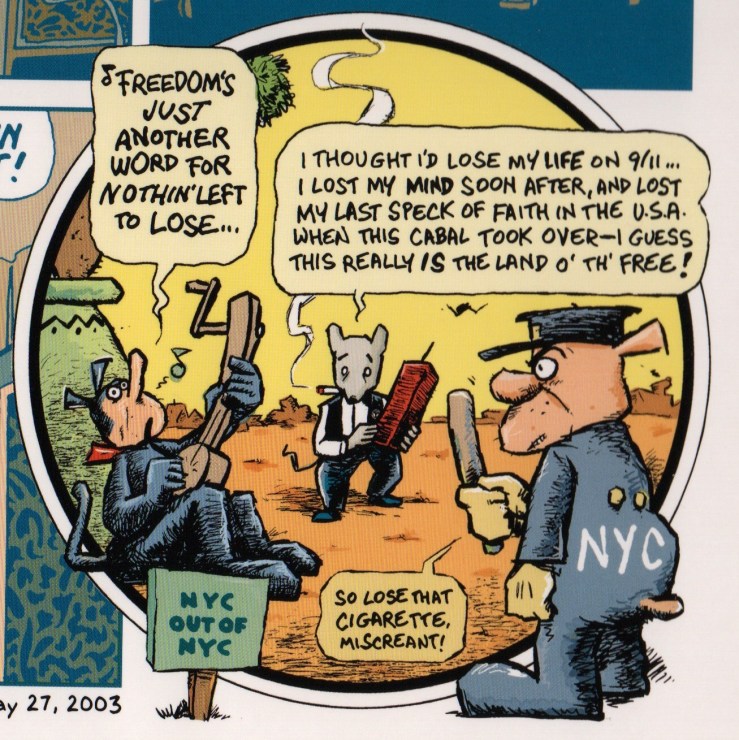

From In the Shadow of No Towers by Art Spiegelman, Pantheon, 2004.
This is the last Three Books post.
I had fun doing this every Sunday but a year seems like long enough. I do, however, like to do a themed post of some kind on Sundays, so I’ll do something with comics each Sunday for a year. Not just cover scans—panels, strips, etc. But this Sunday, three covers/three books:
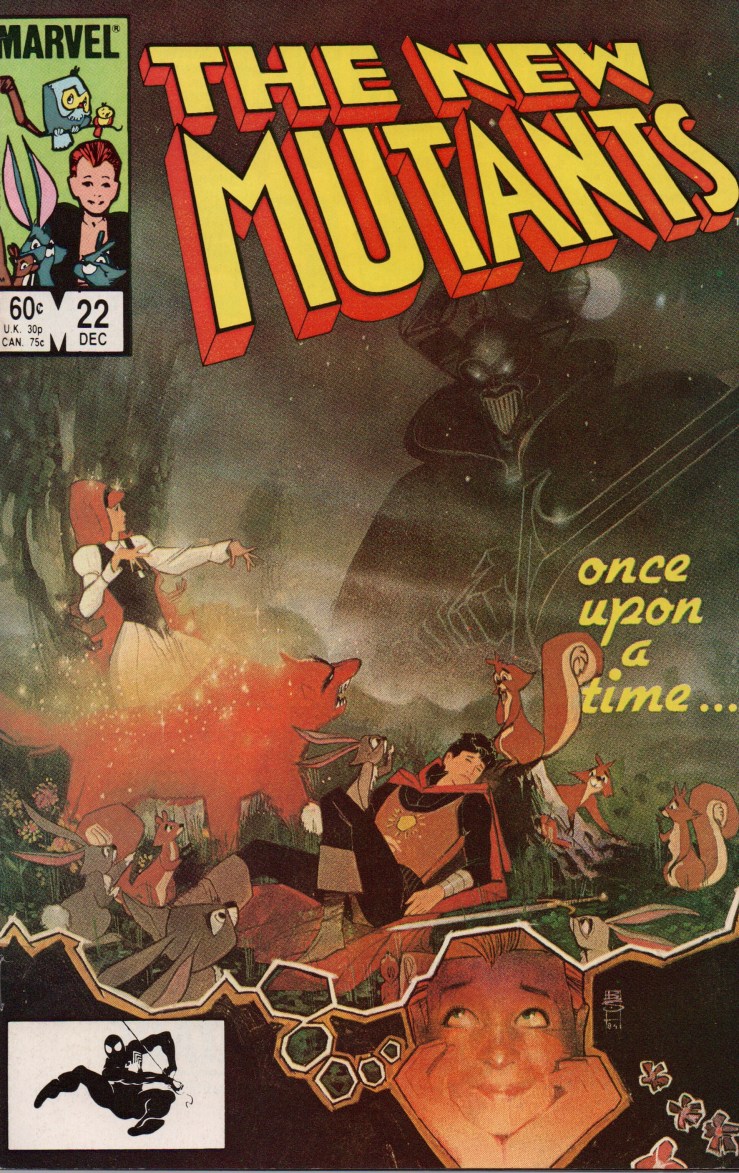
The New Mutants Vol. 1, #22, December 1984. Marvel Comics. Issue by Chris Claremont and Bill Sienkiewicz. Cover painting by Sienkiewicz.
I got rid of most of my Marvel Comics collection when I was 13 but could never bear to part with Sienkiewicz’s run on The New Mutants, my favorite comic book. (I wish I had kept more of Claremont’s 1980s run on The Uncanny X-Men).
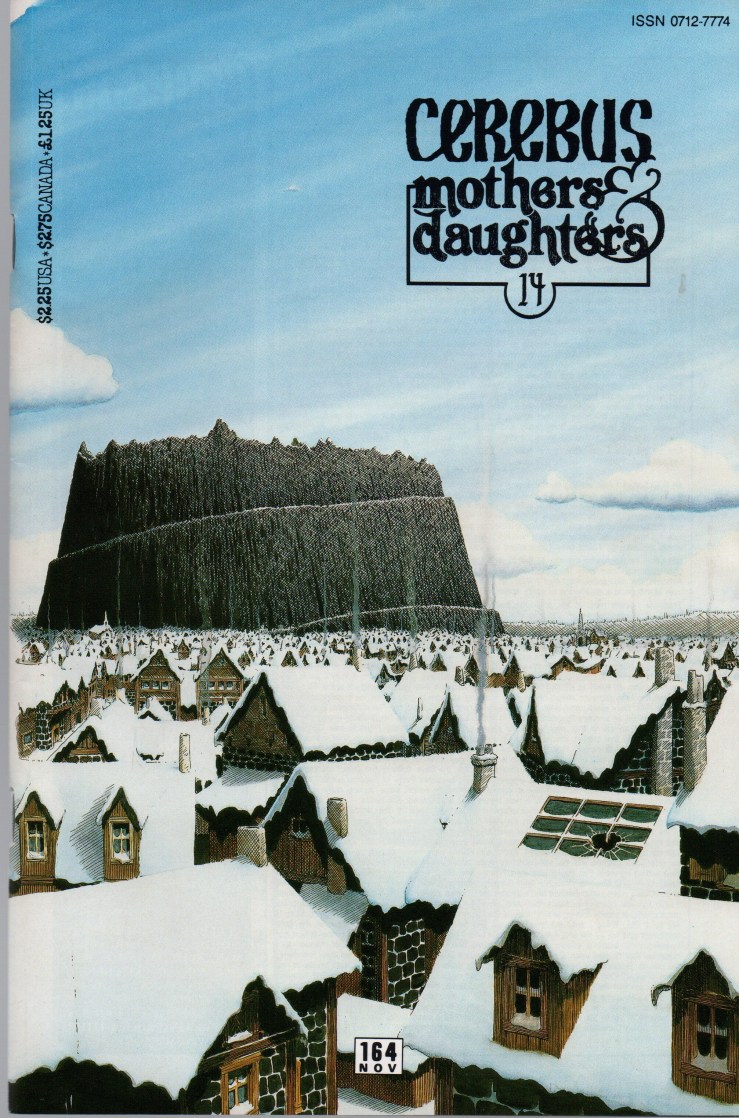
Cerebus #164, November 1992. Aardvark-Vanaheim. Issue (and cover) by Dave Sim and Gerhard. This is the second issue of Cerebus that I bought (issue #163’s cover is not nearly so good, so…not featured today). I had no idea what was going on but loved it. I caught up fairly quickly through Sim’s so-called “phonebooks” of the earlier books. I eventually quit reading Cerebus monthly, but still picked up the big collections, albeit more and more intermittently, until I almost forgot about it altogether. A few years ago I realized that Sim must’ve finished the damn thing (he’d always said it would be 300 issues long and conclude with Cerebus’s death), and I got the final volumes and read them. Let’s just say the first half of Cerebus is much, much better than the second half.
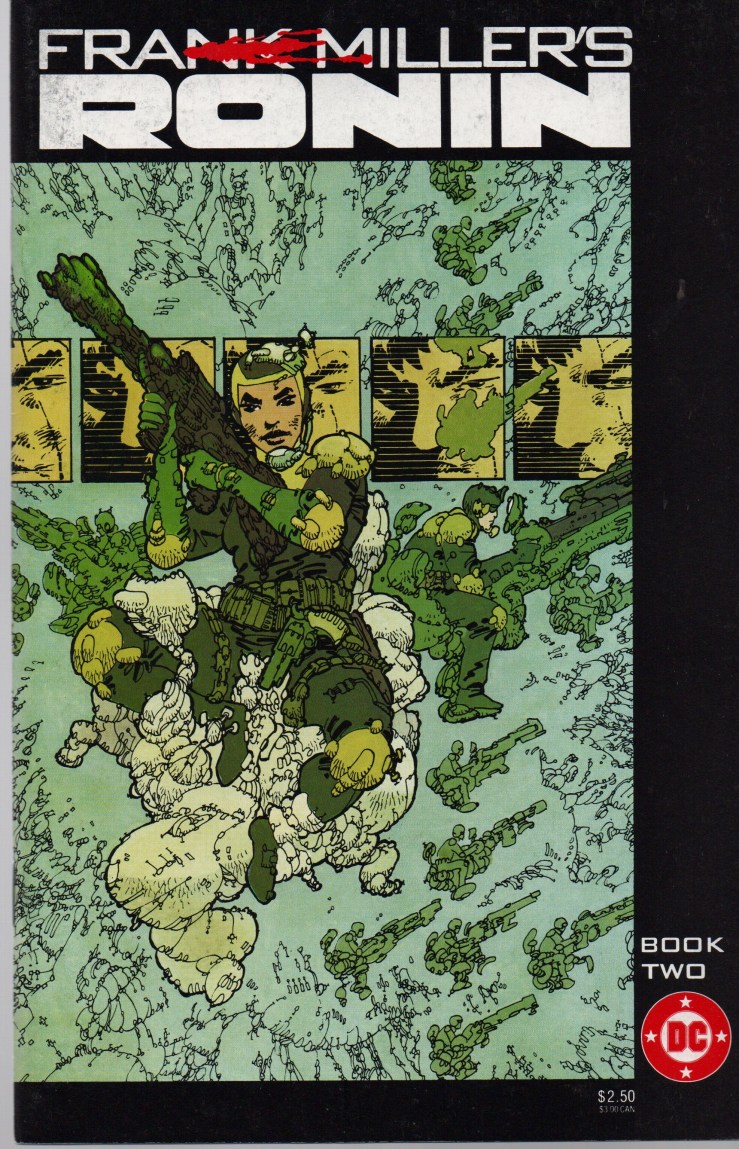
Ronin Vol. 1, #2, September 1983. DC Comics. Issue and cover by Frank Miller (colors by Lynne Varley).
Before Frank Miller became a cranky old fascist hack, he made some pretty good comic books. I’m pretty sure The Dark Knight Returns was the last really good thing he did, and that was thirty years ago, but my favorite Miller will likely always be Ronin.

The kind people at Nobrow sent along three gorgeous Hilda graphic novels by Luke Pearson ten days ago, and we’ve (my family, I mean) read each of them repeatedly since then—we’ve read them independently and to each other (my daughter started her own Hilda comic). I’ll have a proper essay-review thing up down the line, but for now, the short review: These are excellent, gorgeous books—funny, richly-detailed, sweet, and just a little scary (when they need to be).
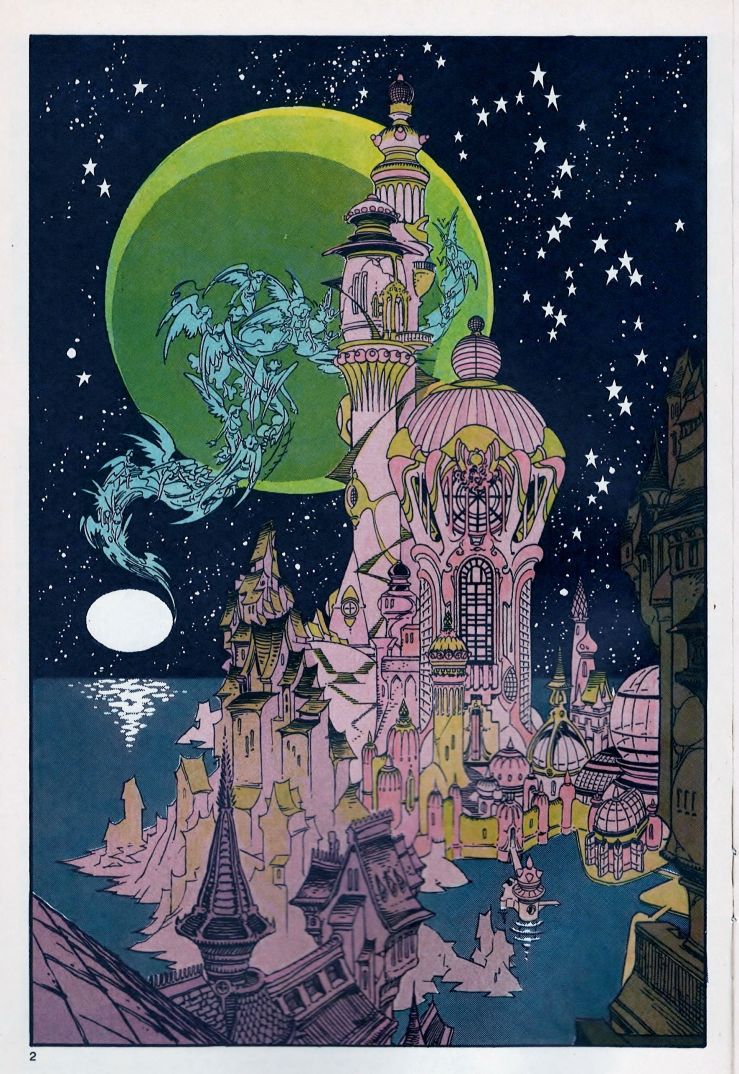
From P. Craig Russell’s “La Sonnambula and the City of Sleep: A Fragment of a Dream.” Published in Night Music #2 (Eclipse Comics). Via Comics A-Go-Go!, where you can find full scans of the story.


Flannery O’Connor’s “Now Comes Spring Fever” was originally published on April 25, 1941 in The Peabody Palladium, O’Connor’s high school student newspaper. O’Connor served as the paper’s art director starting in 1940. O’Connor was 16 when she published this comic. Her comics are reprinted in Flannery O’Connor: The Cartoons, Fantagraphics, 2012.