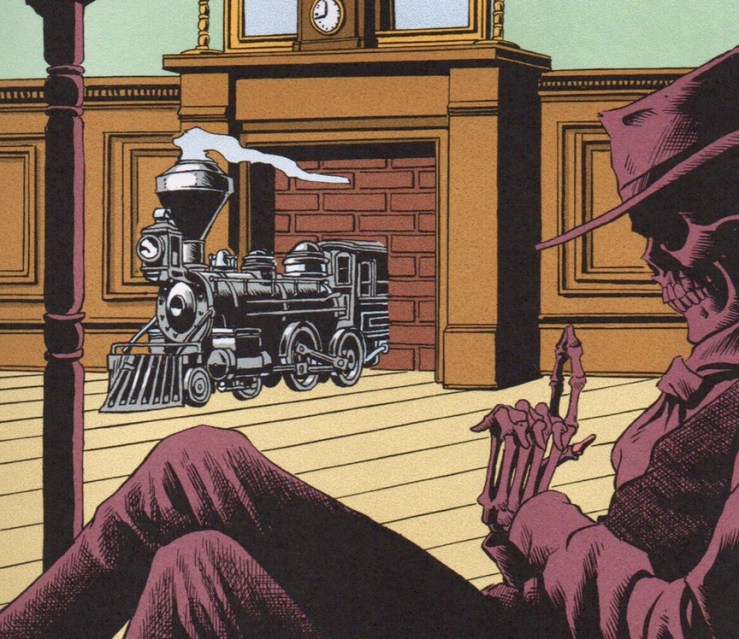
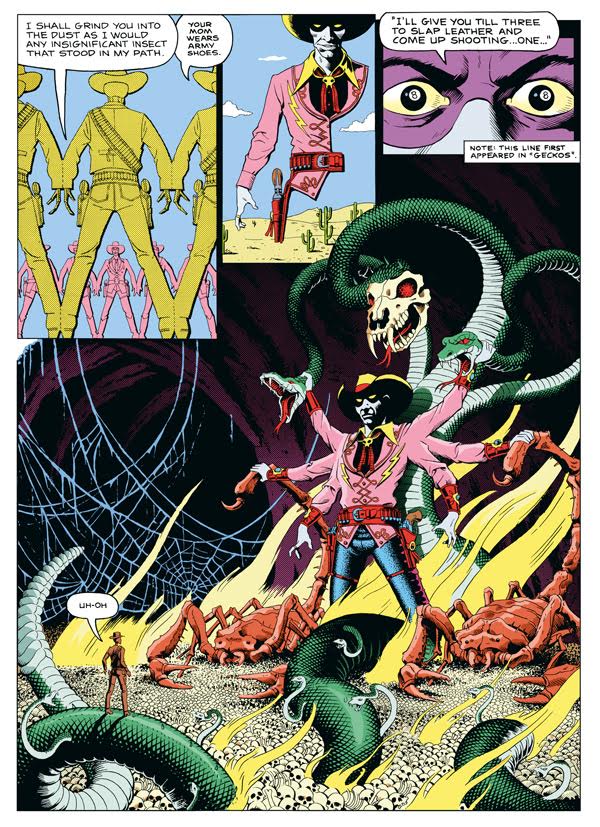
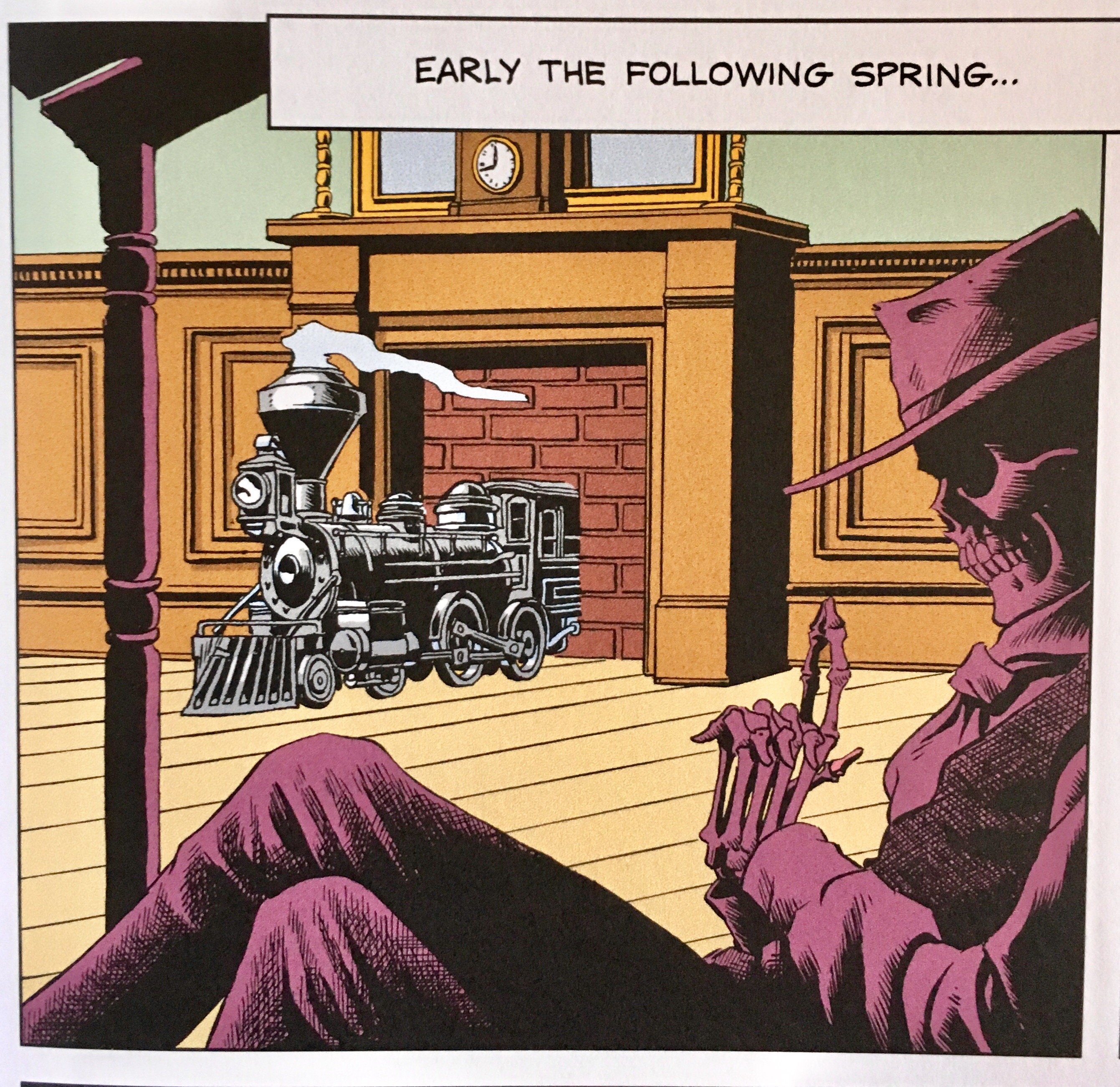
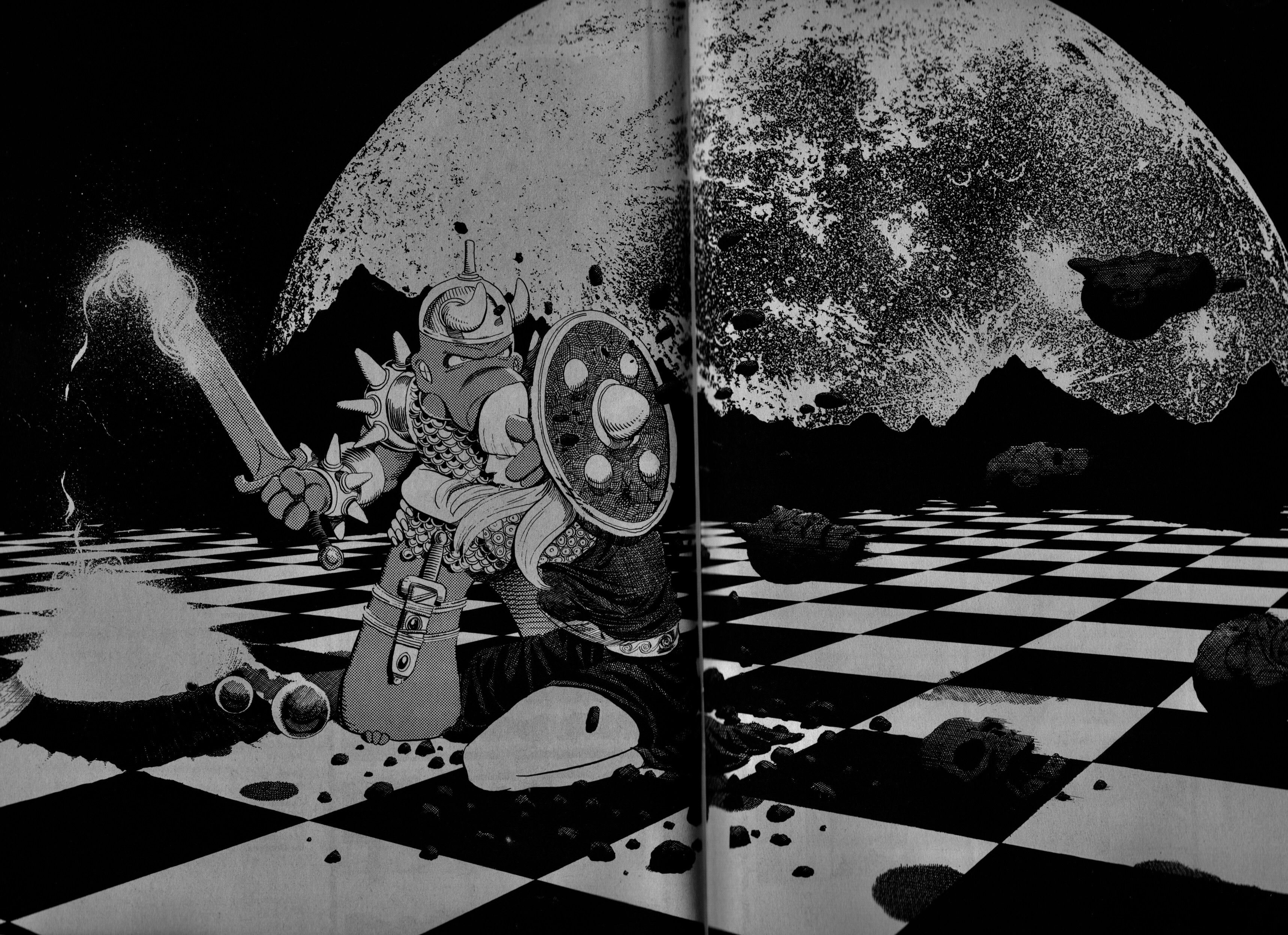
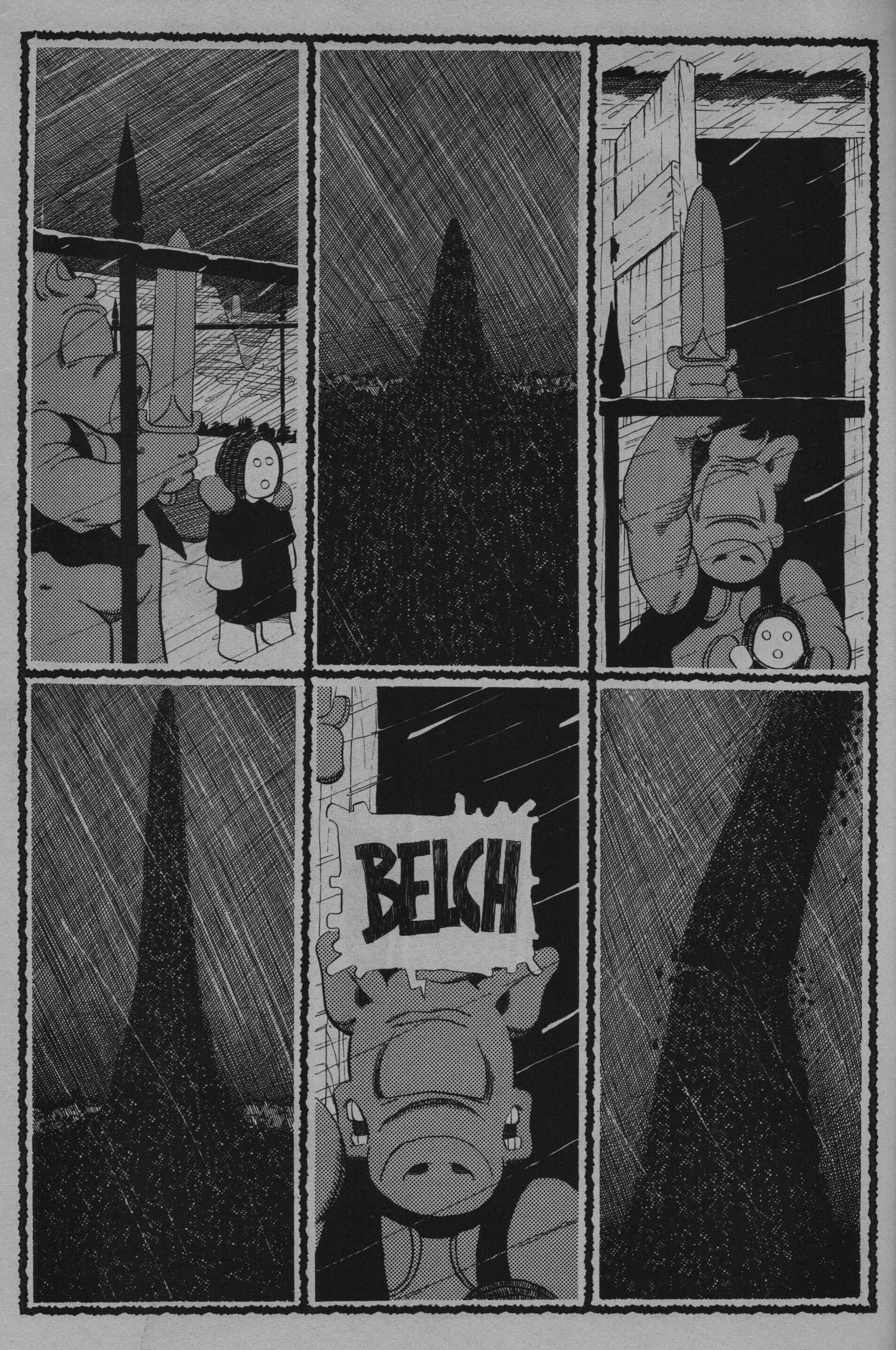
From “Dope Rider — Crescent Queen” by Paul Kirchner. Originally published in High Times #12, Aug. 1976. Republished in Awaiting the Collapse, Tanibis Editions.
Tag: Comix
Eddie Campbell’s canon of great graphic novels, 1977-2001
Eddie Campbell’s book Alec: How to Be an Artist (Eddie Campbell Comics, 2001) covers the “rise and fall of the graphic” over the course of a few decades. Alec combines memoir with art history and art criticism, all told through scratchy inks and spidery lettering (and plenty of pastiche–Campbell literally pastes the work of other comic artists of the last century throughout the book, along with “serious” artwork ). While Campbell’s autobiographical stand-in “Alec MacGarry” is obviously central to the story, other figures loom here, including Bill Sienkiewicz (“Billy the Sink”), Art Spiegelman, Stephen Bissette, Dave Sim, Eastman and Laird—and especially Campbell’s From Hell partner, Alan Moore.
How to Be an Artist offers a fascinating and personal look at the time before (and immediately after) comic books reached a tipping point into (gasp!) serious artistic respectability. Witty, warm, and occasionally cruel, Campbell’s book explores the intersection of commerce and art in a very particular place and a very particular time.
The book was especially revelatory for me, I suppose: I transitioned from super hero comics to, like comix in the early nineties, a transition helped by works championed in How to Be an Artist, like Neil Gaiman and Dave McKean’s Sandman books and Dave Sim’s Cerebus. Indeed, the backpages of Cerebus in the late eighties and early nineties operated like a long messy ranty meditation on the theme of “How to be an (independent, successful, self-publishing) artist”—and it was also in the backpages of an issue of Cerebus that I first saw Campbell’s work (the prologue of From Hell was published in Cerebus #124).
How to Be an Artist’s final chapter sees Campbell offer up a canon of “graphic novels” from 1977 to 2001 (I’ve typed out the full list at the bottom of this post). Campbell (or, properly, Campbell’s persona Alec) begins the chapter by dwelling on the problematic term “graphic novel”:
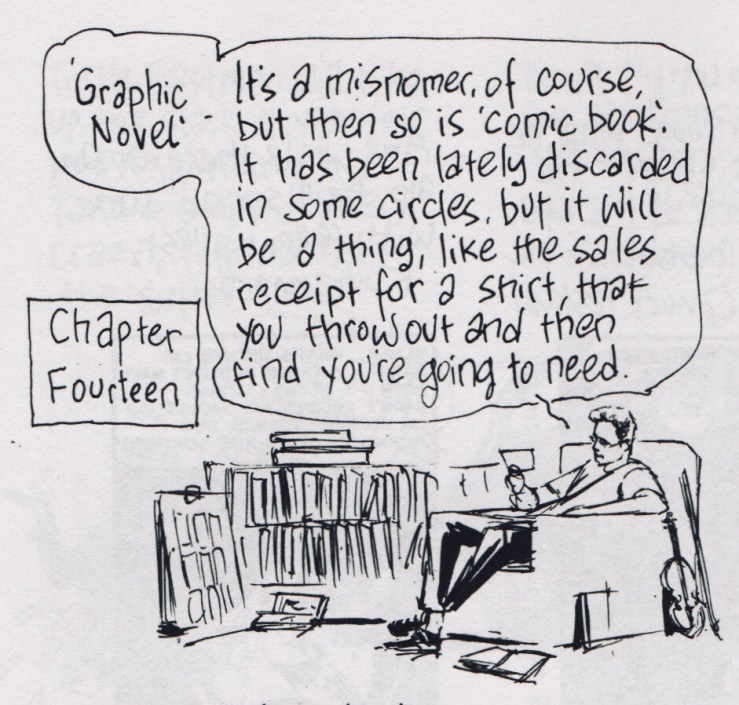
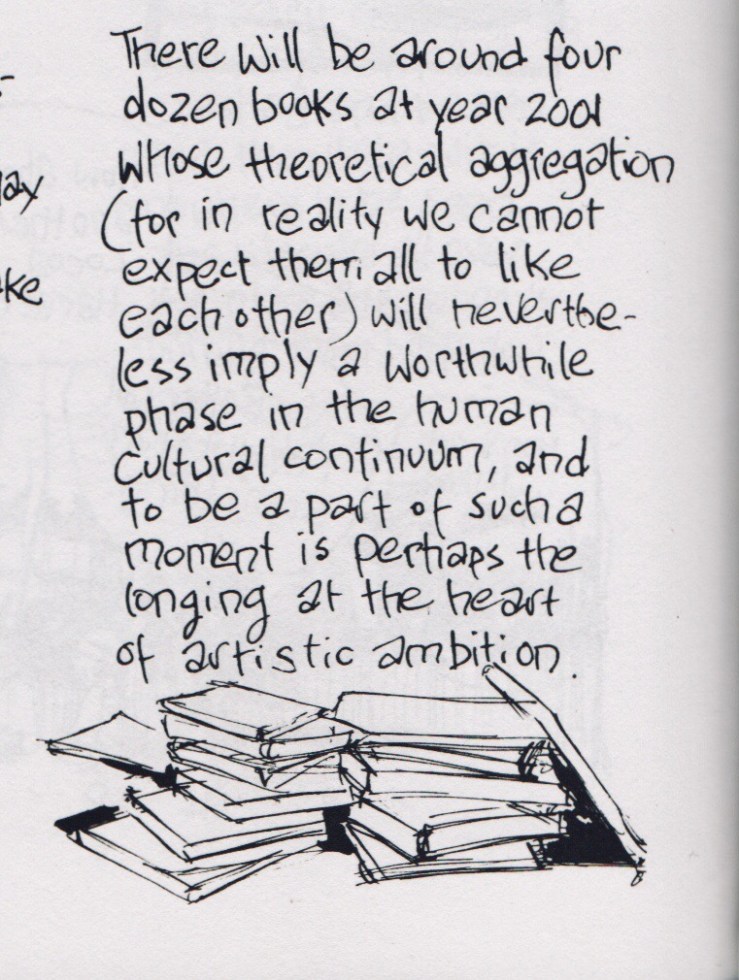
After resolving to use the term, despite whatever problems might be attached to it, Campbell goes on to point out that, after the success of works like Watchmen and Maus, a glut of so-called “graphic novels” flooded the market place. He then goes about naming the best, those works that represent a “worthwhile phase in the human cultural continuum”:
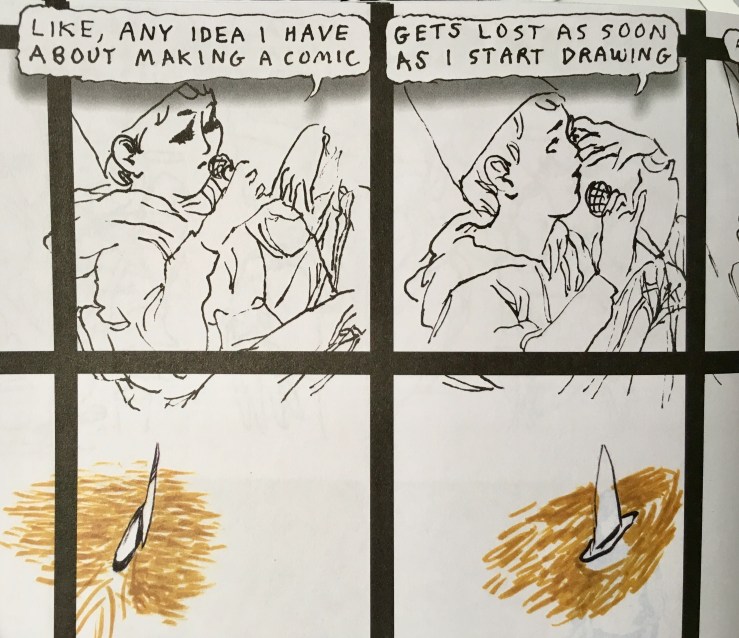
The list is organized semi-chronologically; Campbell groups works in a series together, as with Will Eisner’s Dropsie Ave books. Here’s the first page of the canon, to give you an idea of its form and layout (note that the list, like the entire book, is written in the future tense):
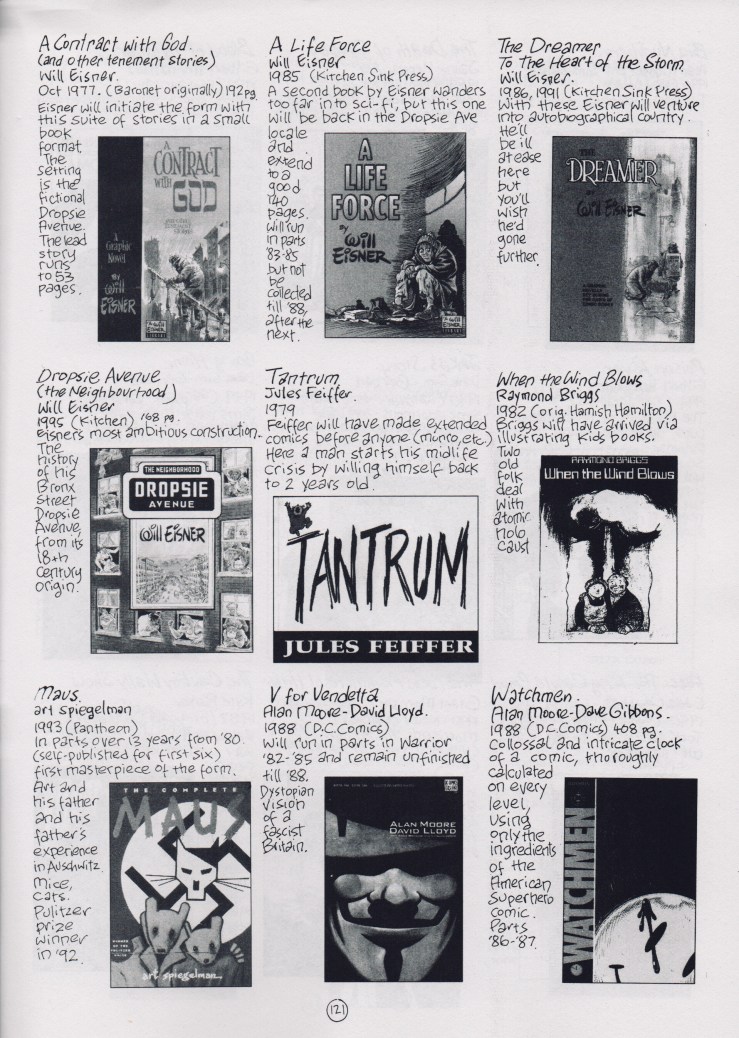
I’ve never read When the Wind Blows.
I’ve also never read, to my shame, the unfinished project Big Numbers (by Alan Moore and Bill Sienkiewicz). Campbell details the drama surrounding why the project was never finished in How to Be an Artist. I’ll have to track it down.

Campbell includes a trio of Love & Rockets novels. Poison River is the first one I read. I was a junior in high school; I checked it out from the public library. Somehow my mother saw it, flicked through it, and was mortified.
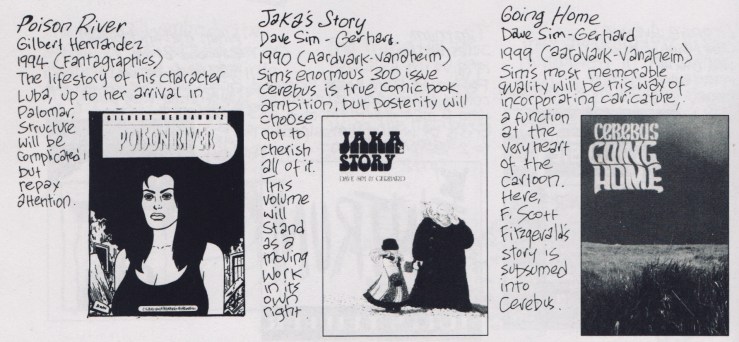
Campbell seems to split the difference on Dave Sim’s Cerebus, including critical favorite Jaka’s Story along with the later novel Going Home (which sees Sim trying to reign in the project and steer it toward a conclusion). (Nobody asked me but I would’ve included Church & State and Church & State II).
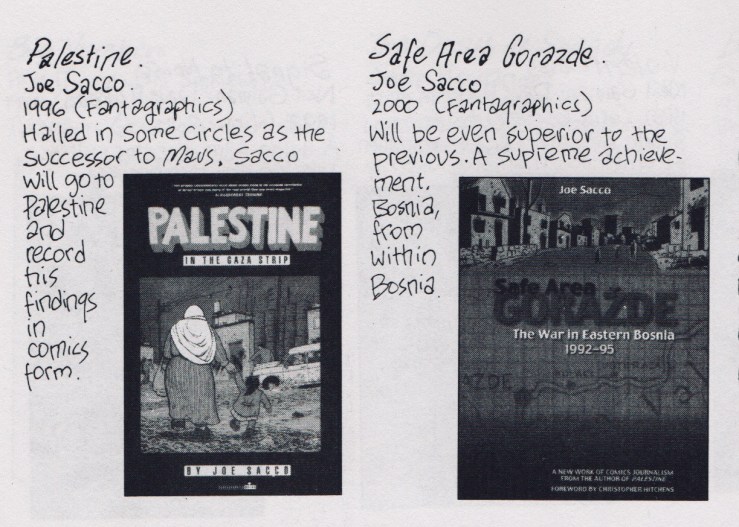
Joe Sacco’s comix-journalism is excellent, and Campbell includes both Palestine and Safe Area Gorazde. These “graphic novels” (they aren’t really graphic novels, except that they are) expanded what was possible not just in comics, but also in journalism.
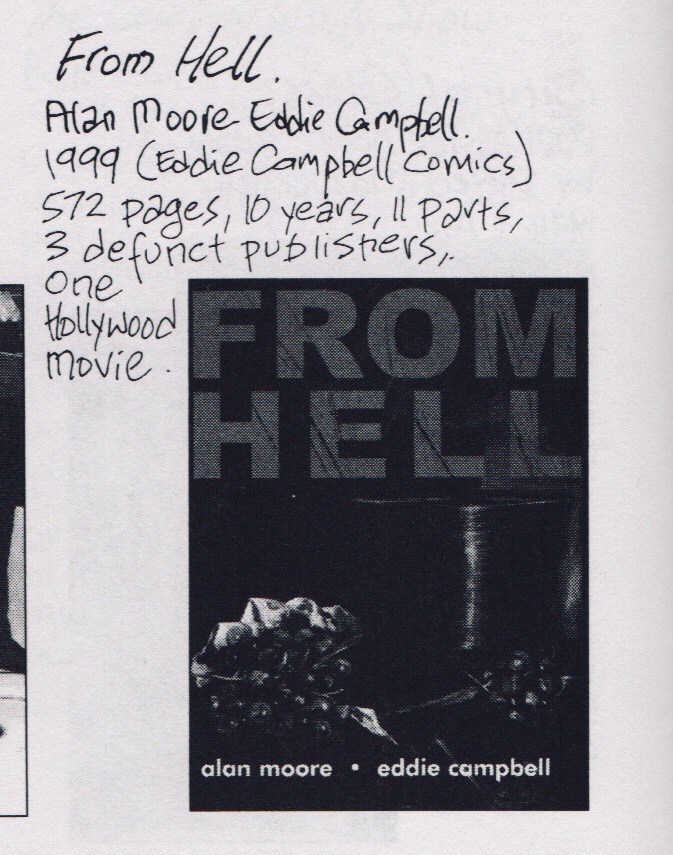
From Hell isn’t the only one of his own works that Campbell includes on his list—he also includes another Alec novel, The King of Canute Crowd. I love the gesture—an artist fully assured of the qualities in his best work. For the record, if pressed to name “the best graphic novel” I would probably immediately say, “Oh, it’s From Hell of course” (and then hem and haw and hedge, bringing up Chris Ware’s Building Stories, the first half of Sim’s Cerebus project, David Mazzucchelli’s Asterios Polyp, Love & Rockets, etc.).
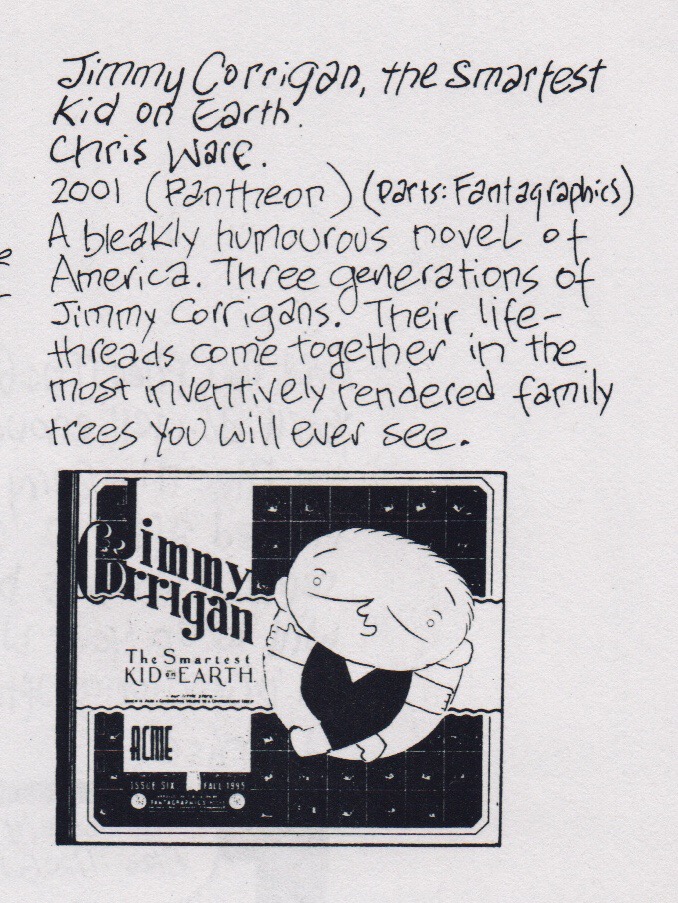
Chris Ware’s Jimmy Corrigan shows up on the list, of course. I’m sure Building Stories would be on here too—along with dozens of others—if the list were updated. Indeed, Campbell’s canon (my term, not his), ends with this disclaimer:

Here’s the full list:
A Contract with God, Will Eisner, 1977
A Life Force, Will Eisner, 1985
The Dreamer, Will Eisner, 1986/1991
Dropsie Avenue, Will Eisner, 1995
Tantrum, Jules Feiffer, 1979
When the Wind Blows, Raymond Briggs, 1982
Maus, Art Spiegleman, 1991
V for Vendetta, Alan Moore and David Lloyd, 1988
Watchmen, Alan Moore and Dave Gibbons, 1988
Big Numbers, Alan Moore and Bill Sienkiewicz, 1990
The Death of Speedy, Jaime Hernandez, 1989
Blood of Palomar, Gilbert Hernandez, 1989
Poison River, Gilbert Hernandez, 1994
Jaka’s Story, Dave Sim and Gerhard, 1990
Going Home, Dave Sim and Gerhard, 1999
Alec: The King Canute Crowd, 1990
The New Adventures of Hitler, Grant Morrison and Steve Yeowell, 1990
The Cowboy Wally Show, Kyle Baker, 1987
Why I Hate Saturn, Kyle Baker, 1990
Violent Cases, Neil Gaiman and Dave McKean, 1987
Signal to Noise, Neil Gaiman and Dave McKean, 1992
Mr. Punch, Neil Gaiman and Dave McKean, 1995
Casanova’s Last Stand, Hunt Emerson, 1993
Tale of One Bad Rat, Bryan Talbot, 1995
City of Glass, Paul Auster/David Mazzucchelli, 1994
The Playboy/I Never Liked You, Chester Brown, 1991/1994
Stuck Rubber Baby, Howard Cruse, 1995
Palestine, Joe Sacco, 1996
Safe Area Gorazde, Joe Sacco, 2000
Ghost World, Daniel Clowes, 1997/2000
It’s a Good Life If You Don’t Weaken, Seth, 1997
Ethel and Ernest, Raymond Briggs, 1998
Gemma Bovery, Posy Simmonds, 1999
Cages, Dave McKean, 1998
Uncle Sam, Steve Darnall and Alex Ross, 1998
From Hell, Alan Moore and Eddie Campbell, 1999
Hicksville, Dylan Horrocks, 1998
The Jew of New York, Ben Katchor, 1998
Jimmy Corrigan, the Smartest Kid on Earth, Chris Ware, 2001
Goodbye, Chunky Rice, Craig Thompson, 1999
Dear Julia, Brian Biggs, 2000
Berlin, Jason Lutes, 2001

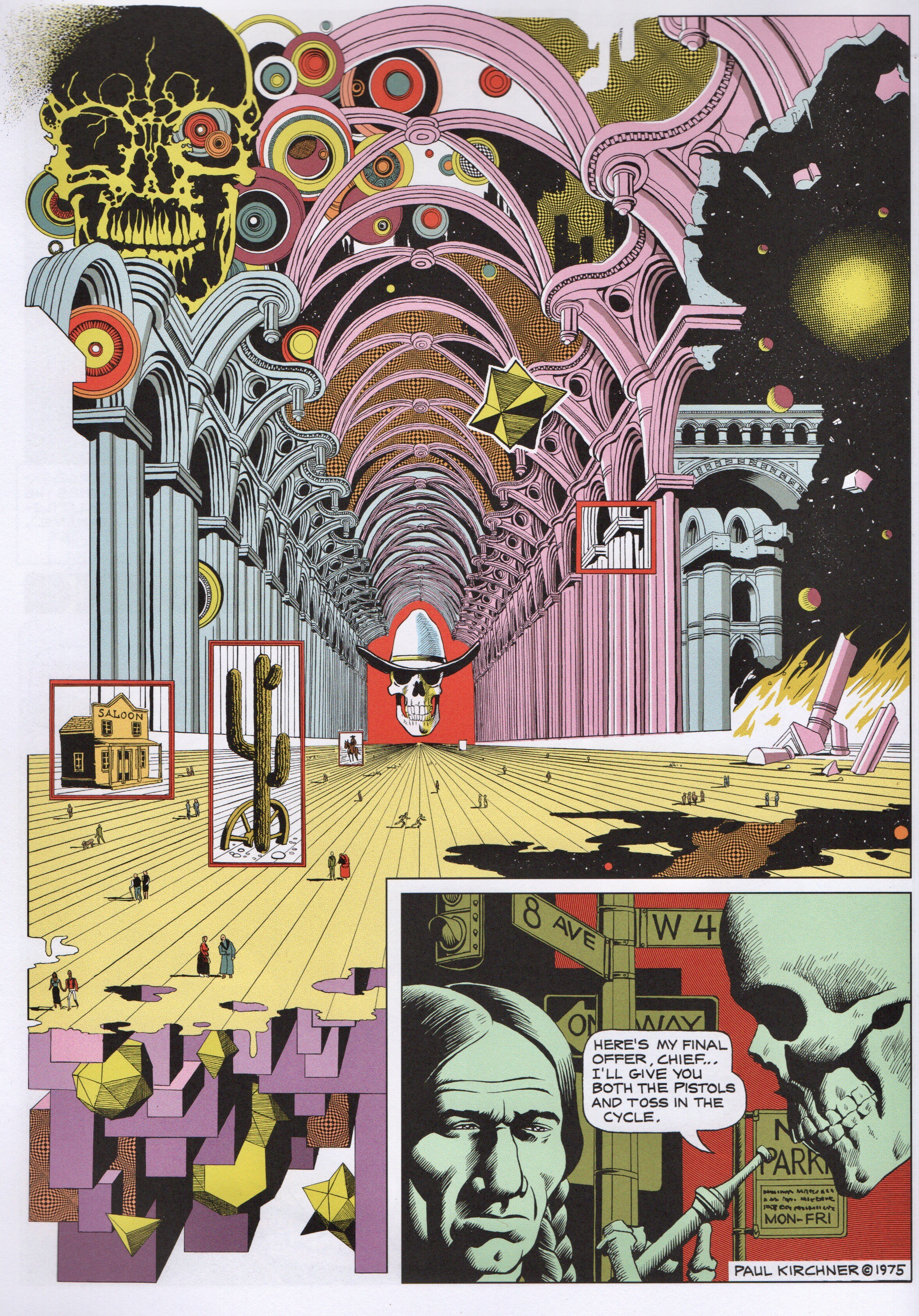
A page from Paul Kirchner’s Dope Rider
From “Dope Rider in ‘Meanwhile Back at the Ranch'” by Paul Kirchner. Originally published in High Times #5, Aug.-Sept. 1975. Republished in Awaiting the Collapse, Tanibis Editions.
Paul Kirchner’s Awaiting the Collapse (Book acquired, 2 Nov. 2017)

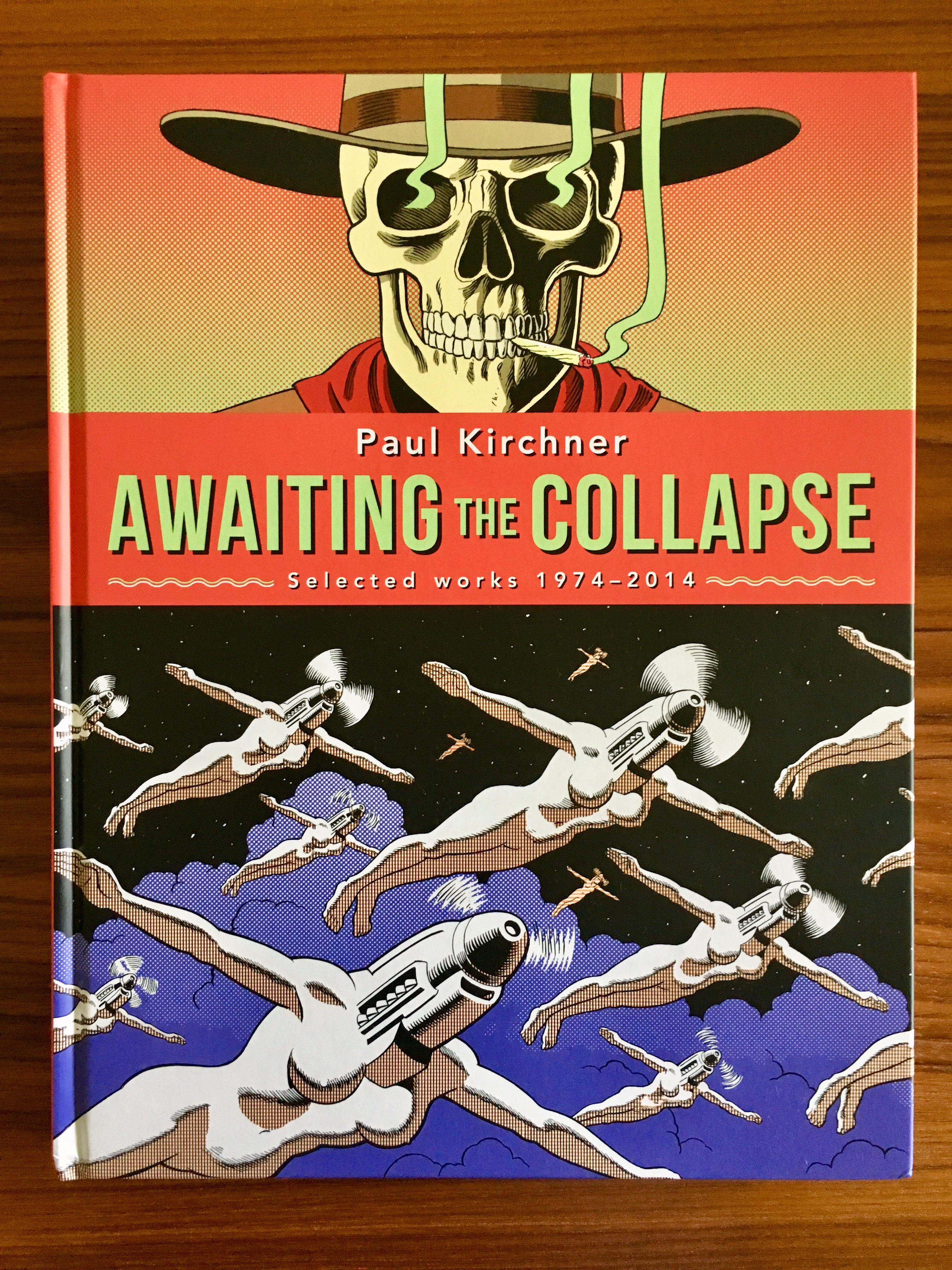
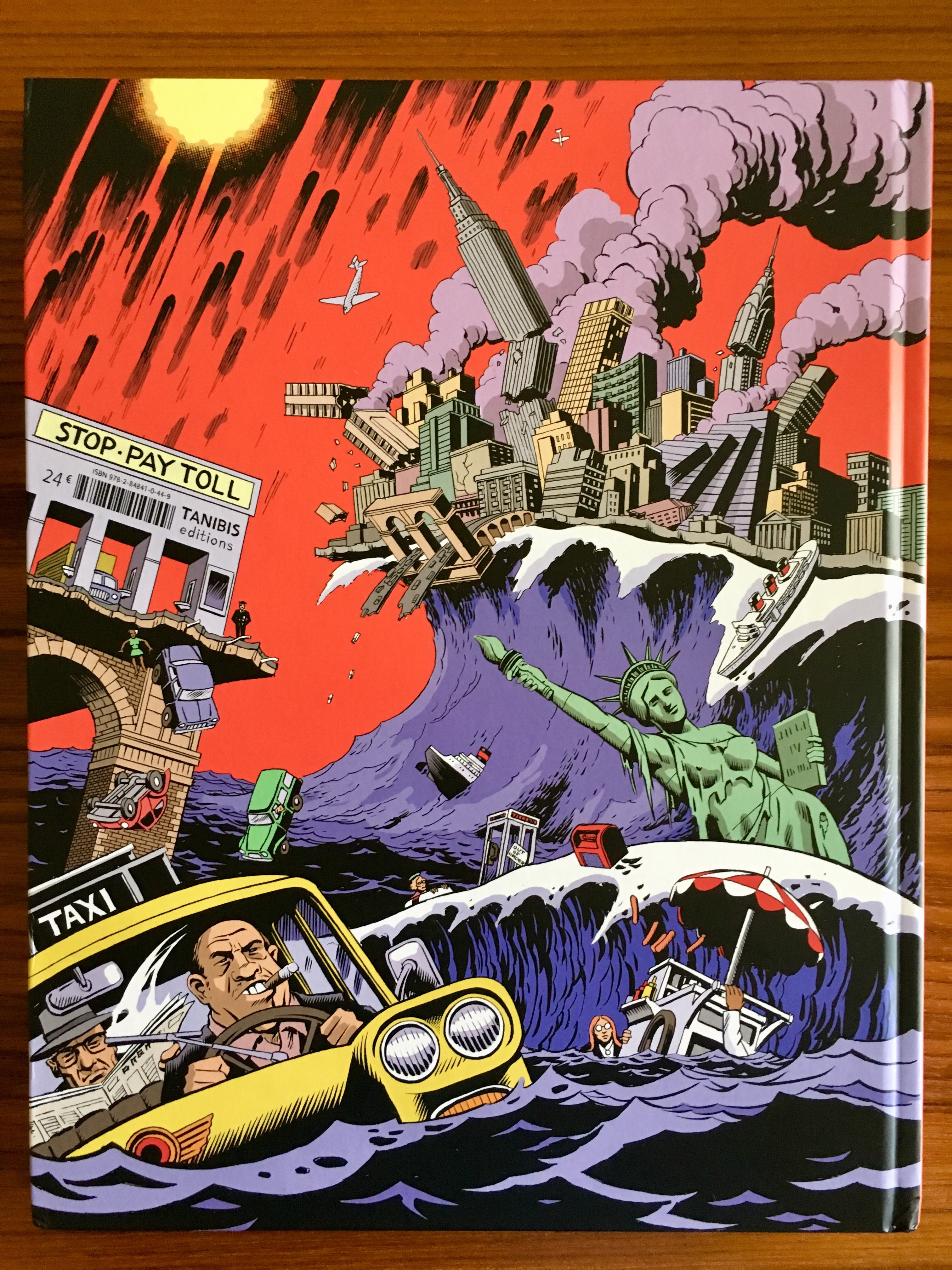
Awaiting the Collapse collects some of the finest and most surreal comix from Paul Kirchner, from the 1970s up through this decade. The book is big and bold and gorgeous. Here’s the back cover:

Awaiting the Collapse is new in hardback from Tanibis Editions, the same good people who brought us hardback editions of The Bus (which I reviewed here), and The Bus 2 (which I reviewed here). A large portion of Collapse features Kirchner’s surreal western Dope Rider strips, which have been hard to find on the internet. It also collects the covers that Kirchner did for Screw magazine, as well as dozens of other one-offs and vignettes, comix in different modes, moods, and manners.

The collection ends with a nice long essay (including numerous photographs, strips, and illustrations) by Kirchner called “Sex, Drugs & Public Transportation: My Strange Trip Through Comics.” I haven’t gotten to it yet because I’m trying to restrain myself from gobbling the collection up all at once.

Here’s Tanibis’s blurb:
This third collaboration between French publishing house Tanibis and comic book artist Paul Kirchner is a collection of the artist’s works, most of them initially published in counter-culture magazines in the 1970s and the 1980s and some dating from his return to comics in the 2010s.
Roughly a third of the stories star Dope Rider, the pot-smoking skeleton whose psychedelic adventures take him through colorful vistas equally reminiscent of Sergio Leone’s spaghetti western films and of the surrealistic paintings of René Magritte and Salvador Dalí. These stories were originally drawn for the marijuana-themed magazine High Times but were also for Kirchner an excuse to create his very own brand of visual poetry.
An other third of the book is a miscellaneous collection of comics whose stories range from the loony (the sextraterrestrial invasion of Earth in “They Came from Uranus”) to the satirical (“Critical mass of cool”) and the outright subversive (if you ever wondered what games toys play at night, read “Dolls at Midnight”).
This book also features a broad selection of the covers Kirchner made for the pornographic tabloid Screw in the 1970s.
Awaiting the Collapse finally contains a previously unpublished essay by Paul Kirchner about his career and his influences, which helps put in perspective the works published in this book.

I promise I’ll have a review of Awaiting the Collapse up soon; for now, let me just underline my enthusiasm—it’s weird and wonderful and gorgeous stuff.

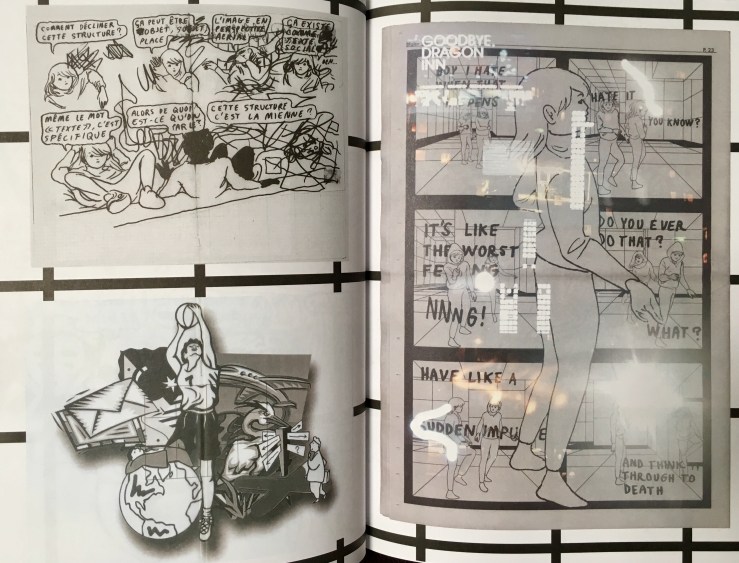
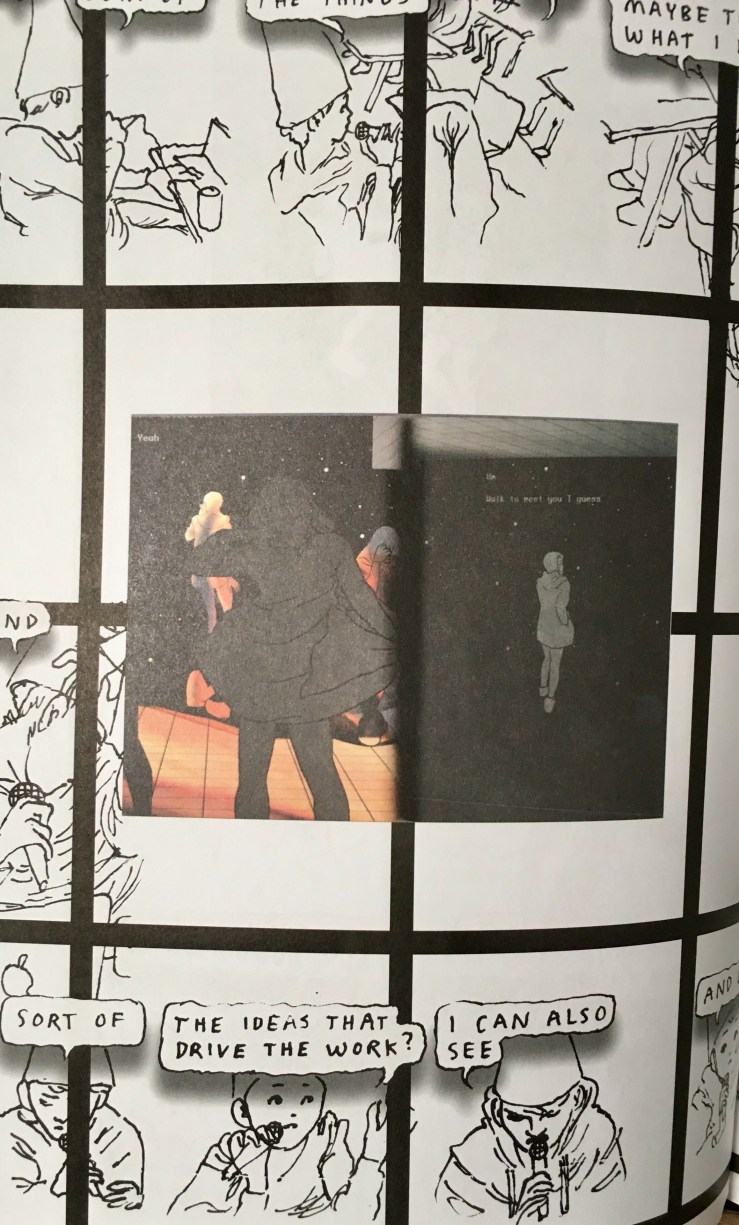
2001, Blaise Larmee’s enigmatic deconstruction of the graphic novel (Book acquired, 16 Oct. 2017)

Blaise Larmee’s 2001 is new from 2dcloud. It showed up at the house a few weeks ago, its minimalist cover strange and intriguing.
I’m not sure what the book is—is it a sort of metatextual commentary on Larmee’s webcomic of the same name? A kind of autobiographical riff? A deconstruction of the graphic novel form?

What Larmee’s book is is not as compelling, ultimately, as how it is—sketchy, loose, messy; littered with hi-res scans–receipts, crushed cans and bottles, a house key—scraps from the real that call attention to the narrative’s artifice.

2001 is strange and fascinating in its fragmentary, elusory nature. Check it out.
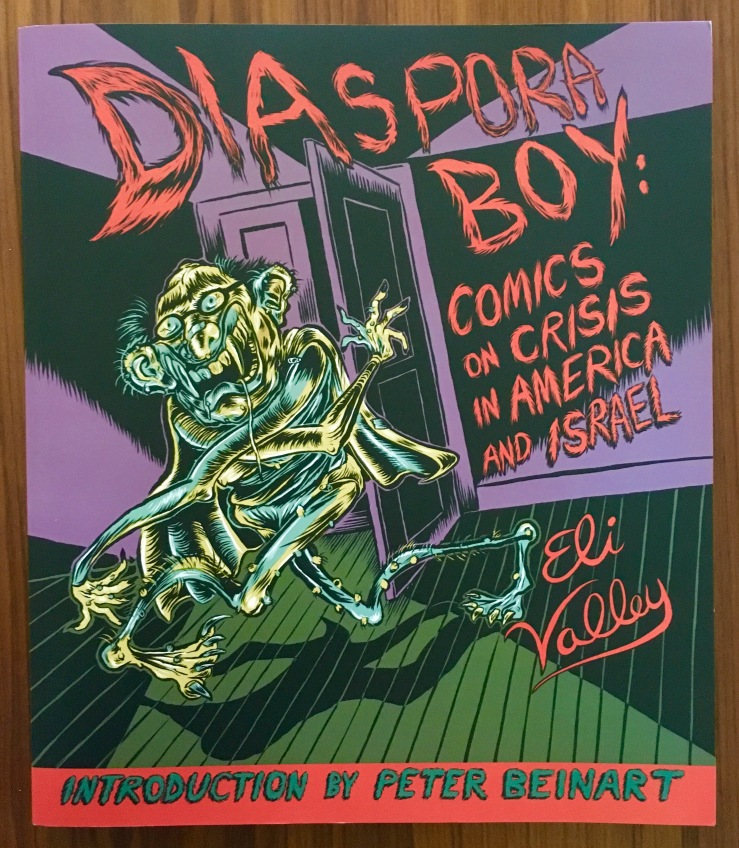
Eli Valley’s comix collection Diaspora Boy

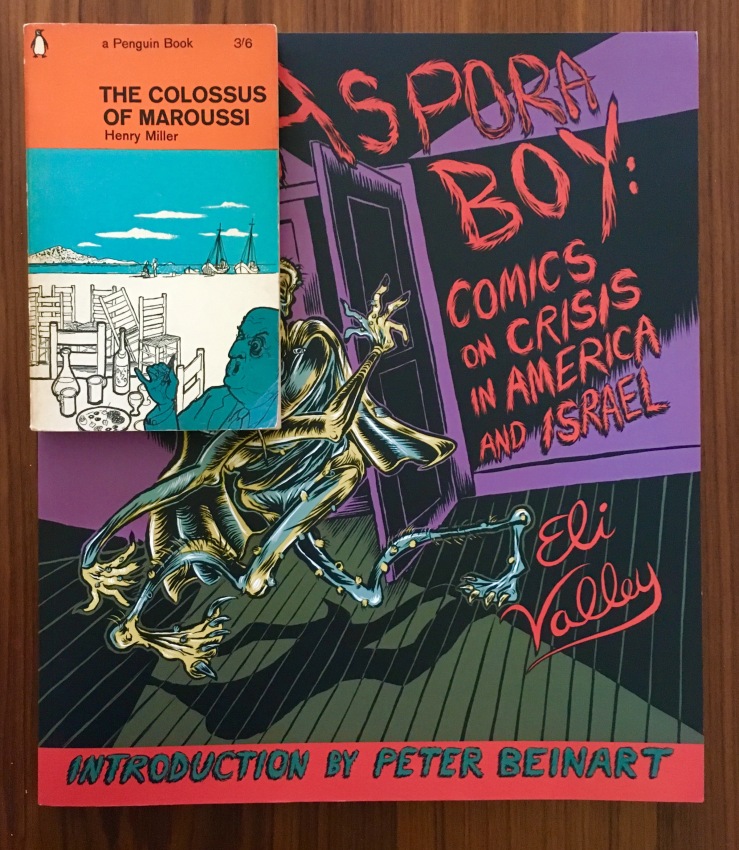
Diaspora Boy, new from O/R Books, collects Eli Valley’s comix from the past decade.
Here’s O/R’s blurb:
Eli Valley’s comic strips are intricate fever dreams employing noir, horror, slapstick and science fiction to expose the outlandish hypocrisies at play in the American/Israeli relationship. Sometimes banned, often controversial and always hilarious, Valley’s work has helped to energize a generation exasperated by American complicity in an Israeli occupation now entering its fiftieth year.
This, the first full-scale anthology of Valley’s art, provides an essential retrospective of America and Israel at a turning point. With meticulously detailed line work and a richly satirical palette peppered with perseverating turtles, xenophobic Jedi knights, sputtering superheroes, mutating golems and zombie billionaires, Valley’s comics unmask the hypocrisy and horror behind the headlines. This collection supplements the satires with historical background and contexts, insights into the creative process, selected reactions to the works, and behind-the-scenes tales of tensions over what was permissible for publication.
Brutally riotous and irreverent, the comics in this volume are a vital contribution to a centuries-old tradition of graphic protest and polemics.
Diaspora Boy, subtitled Comics on Crisis in America and Israel, is enormous (if a slim 144 pages). Valley’s comix are reproduced on full pages; his thick inks and worried lines are never cramped here—and neither are his words. Here’s a shot of the book with a Penguin novel as a comparison point:

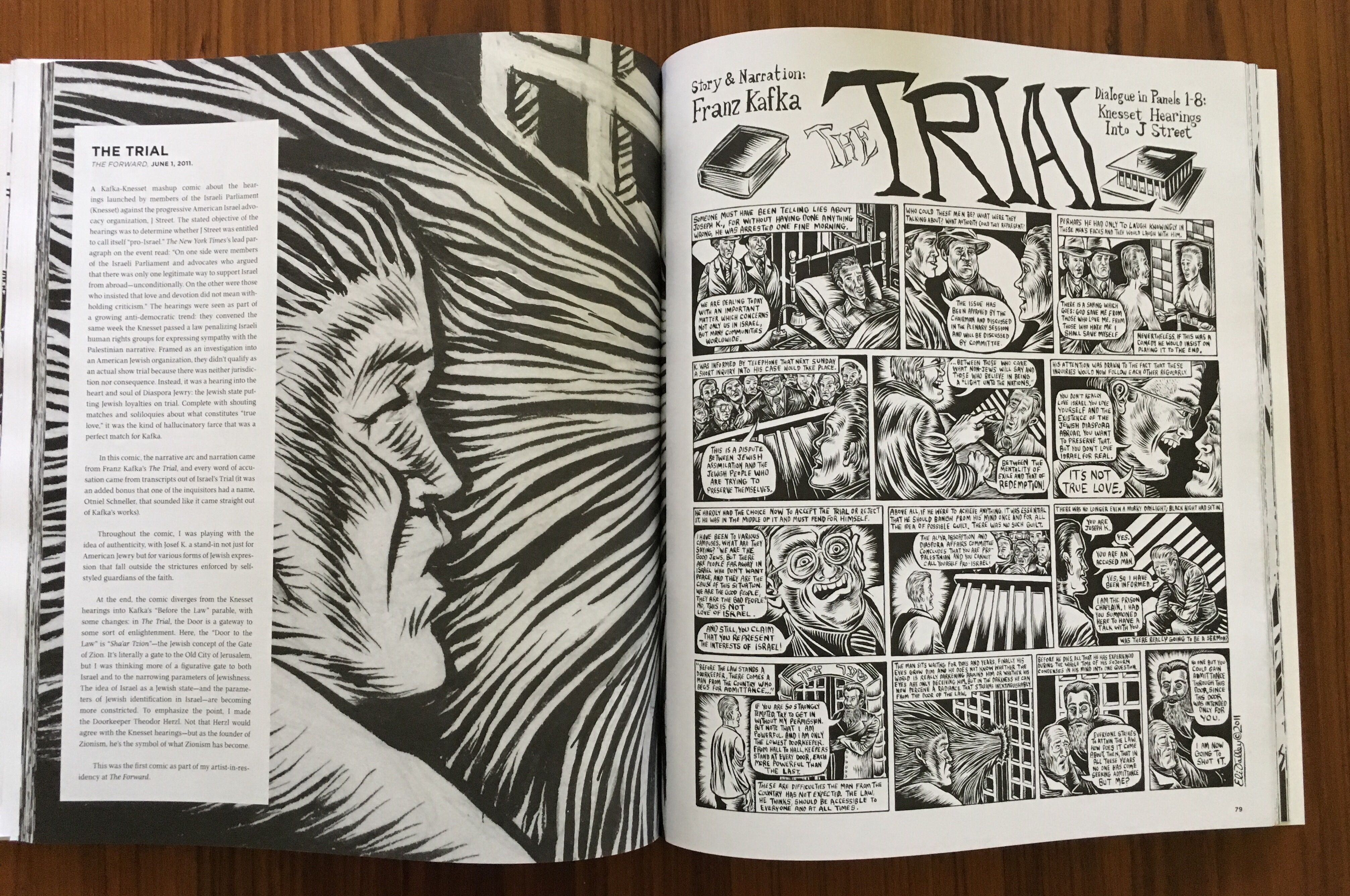
The anthology makes great use of its oversized format. On the left-hand pages, Valley introduces each comic (all chronologically-ordered, by the way) with a short essay that offers context, personal reflections, and even analysis or interpretation. The comics are then reproduced on the right-hand pages. You can see this below, in Valley’s mash-up of Kafka’s The Trial with the Knesset vs. J Street hearings:
The cultural, political—and personal—contexts that Valley provides are perhaps essential for many readers, like me, who may know a bit about comix and Kafka, but are perhaps lost when it comes to a discussion of a “hearing into the heart and soul of Diaspora Jewry” (as Valley puts it).
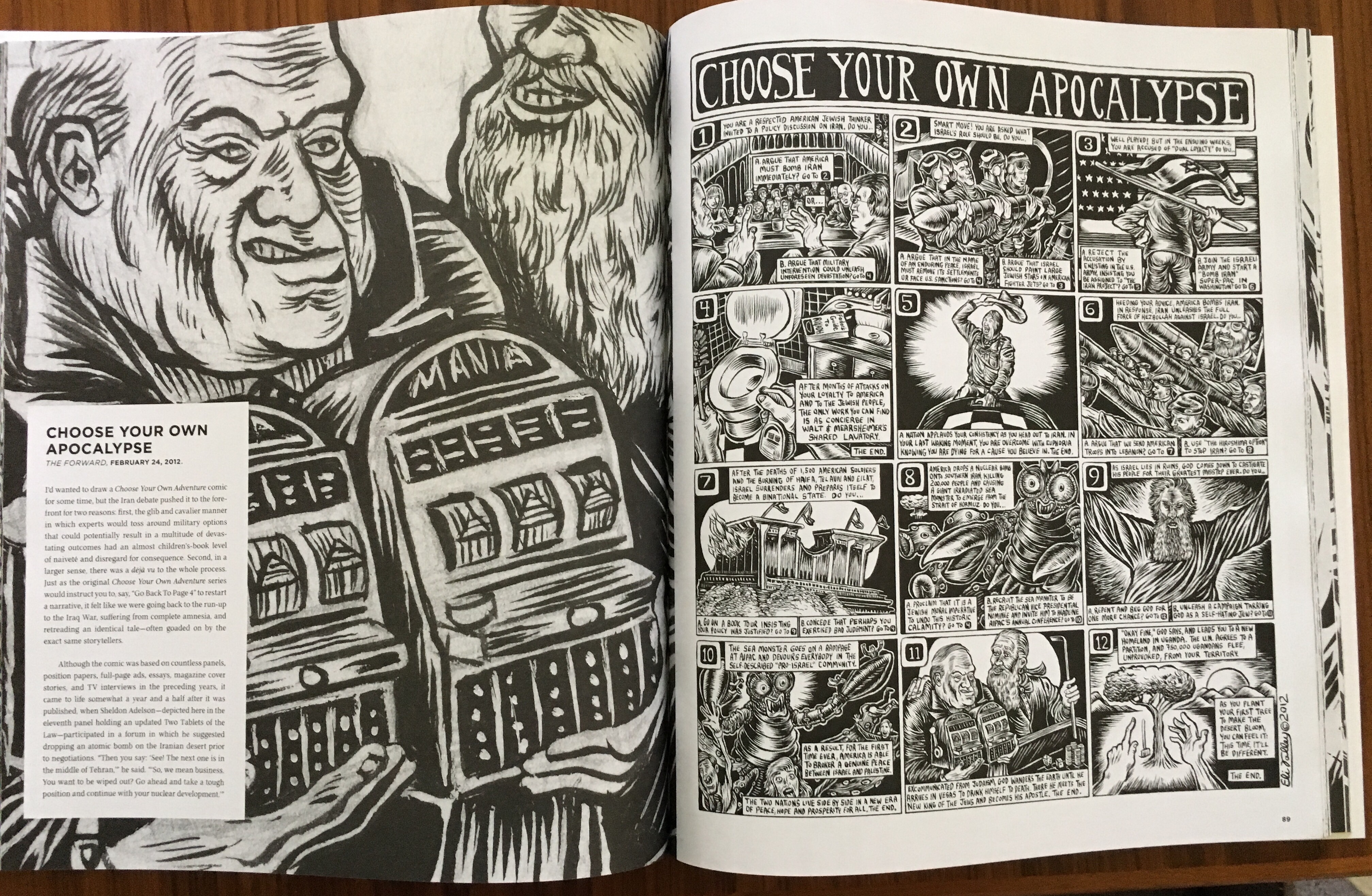
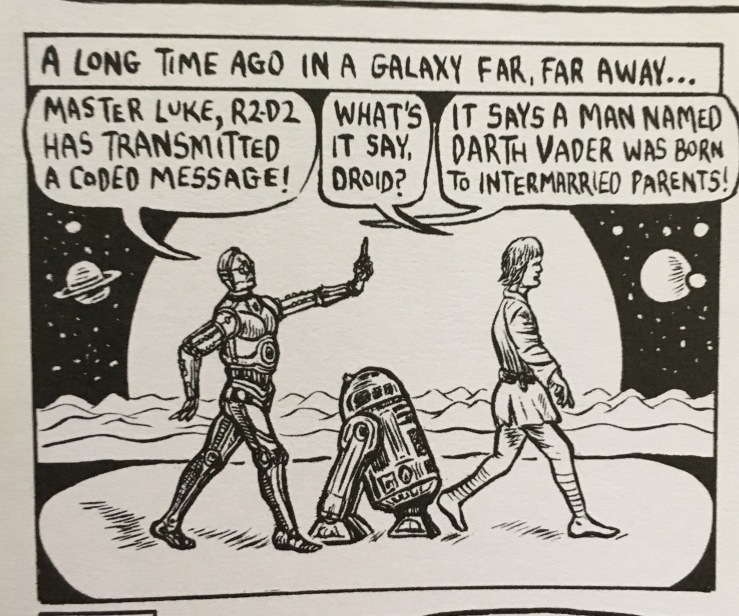
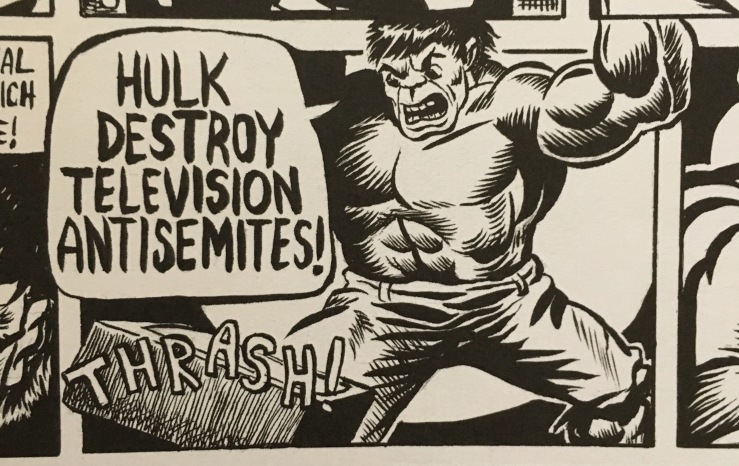
Valley is constantly riffing on American popular culture, mining comic books, films, television and music for his bitter mash-ups, as in “Choose Your Own Apocalypse” below, a comic that turns the Iran debate into a grotesque and ironic Choose Your Adventure tale:

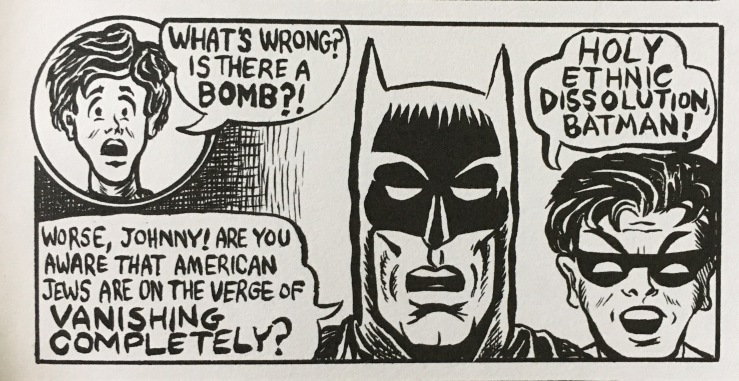
Like many comix artists, Valley’s target audience is nebulous—or rather maybe it’s just himself. He appropriates American culture’s broad shared mythic signifiers to satirize the incredibly specific details of an American Jew’s relationship to Israel—namely, his relationship. The first comic in the collection, 2007’s “What if Batman and Robin Worked in the American Jewish Community?” satirically captures Valley’s teenage anxieties about his relationship to Jewish identity:

In his thorough (and completely necessary) introduction to Diaspora Boy, Valley recounts at some length a complicated relationship with his parents, both Ba’alei Teshurva (he points out that this Hebrew expression “literally means ‘Masters of Return,'” but continues then characterizes it as “a fancy way of of saying ‘Born Again Jews'”). Valley writes that his father interrogated him daily as to whether or not his new friends and acquaintances in his public high school were Jewish or not, and it’s hard not to read these personal anxieties into Valley’s comix (even if I know it’s not good criticism to extrapolate that Valley is “Johnny” in the Batman riff above). Valley’s mother later left the orthodoxy and the marriage, becoming “secular.” Valley positions them, perhaps, as two poles of “reverence and rebellion” which inform his work.

The “reverence” might be hard to spot. In their press page for Diaspora Boy, after three quotes praising Valley’s comix, O/R includes some scathing gems: from former New Republic publisher Marty Peretz: “Your work is disgusting. And also stupid”; Abraham Foxman, former National Director of the Anti-Defamation League: “Bigoted, unfunny”; neocon hack Bret Stephens: “Grotesque…Wretched.” It’s plain to see how conservatives like these might be offended by Valley’s comix. Indeed, it’s not just the message, but the form that they might object to—Valley’s style is sharp but rough, its subtlety relying almost wholly on an extremely ironic viewpoint.

If it’s easy to see how conservatives might resent Valley’s satire, it’s also possible to see how moderates or liberals might misunderstand these comix too. Cartooning has always been a form with an inherently broad appeal. Editorial cartoons are meant to telegraph their ideas quickly and coherently, message and medium intertwined. Valley’s cartoons are harder to suss out. The layering of meaning is intense, magnified. Comic book heroes become displaced into ironic inversions of themselves, consumed by self-hatred. Literary tropes are twisted into a complex entanglement of Jewish-American cultural relations. Biblical stories are transposed into hallucinatory modern horror stories. And in turn contemporary figures—political, economic, cultural, etc.—are subsumed into the same mythic tropes that superheros operate within. It can all be a bit perplexing, and readers who only glance over the surface will miss the real message.
Thus, Valley’s introduction to the volume and his prefaces to each comic become essential context to understanding how to read these comix. The need for political context is especially strong when a cartoon has lost some of its currency due, simply, to the passing of time (they were editorials, after all). However, even when Valley is satirizing a particular news story or political moment that we might have forgotten, a viewpoint comes through, coherent and biting but sincere under all the ironic mechanisms in play. I’ll give Valley the last word here, letting him characterize his own project:
The comics in this collection take pride in Diaspora. Not just in a general sense but in a specific strain of Diaspora experience: the secular, post-Enlightenment, universalist Judaism informed by centuries of Jewish narrative tradition as well as by the experience of living in and amongst other communities. Among other things, it transformed memories of inequality into a lasting cultural norm of solidarity with the oppressed. Theses comics celebrate, relish, and dialogue with that history, a strain of Diaspora that finds far more inspiration in early and mid-twentieth-century social justice movements than in anything wrought in the contemporary Middle East. That is Jewish Pride: pride in the Jewish tradition practiced, experienced, and cherished by the vast majority of American Jews today. And for me, it’s personal. If I’d been brought up solely in the strain of secularism and social justice, I probably wouldn’t have come to filter political passions through an emphatically Jewish lens.
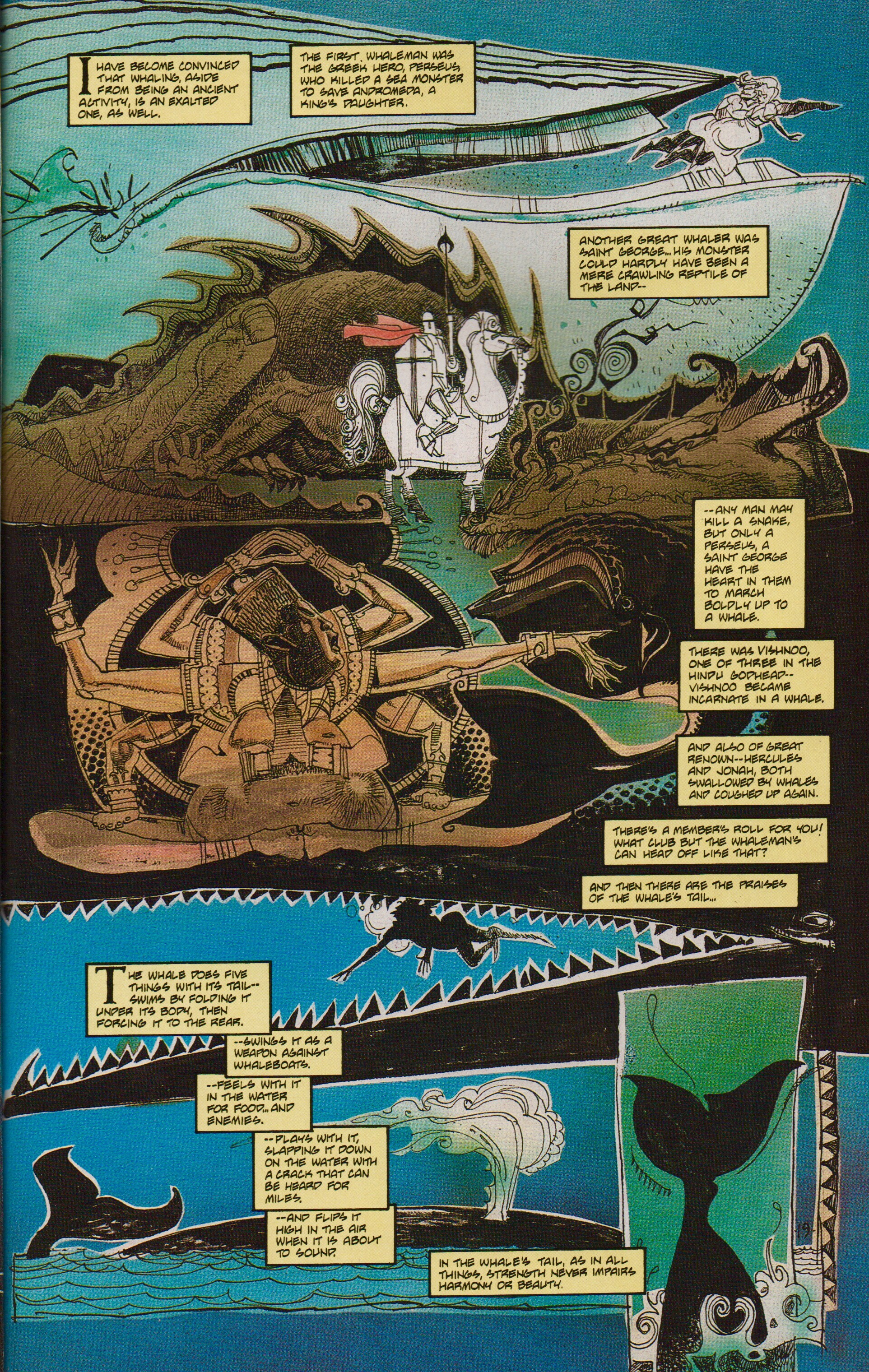
Perseus, whaleman (Melville/Sienkiewicz)
From Bill Sienkiewicz’s adaptation of Herman Melville’s Moby-Dick. The Classics Illustrated edition (February 1990) is one of my favorite Moby-Dicks.
Sunday Comics
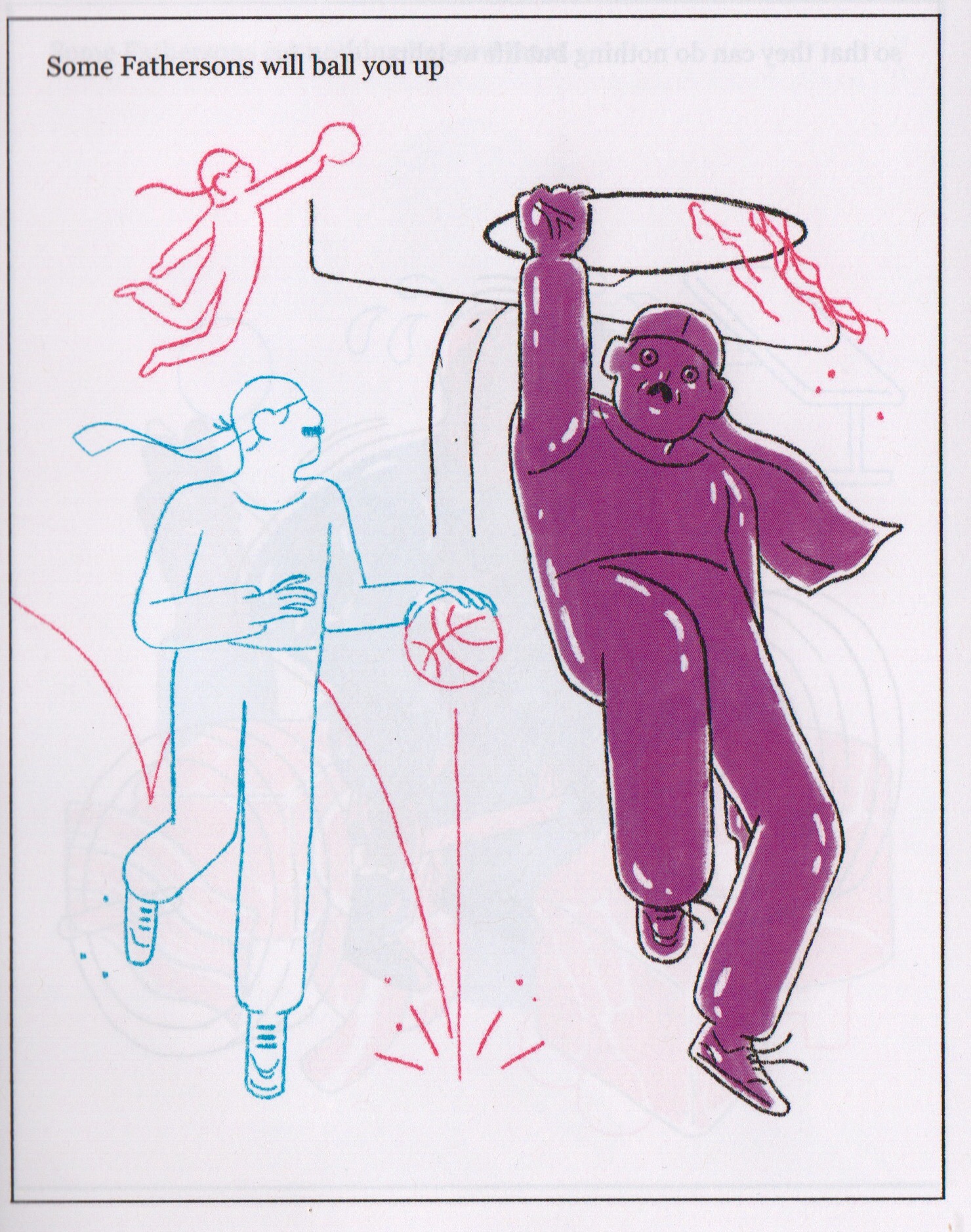
From Richie Pope’s Fatherson, issue #13 of Youth in Decline’s monograph series Frontier. It’s so, so good. My review.
Sunday Comics
Sunday Comics
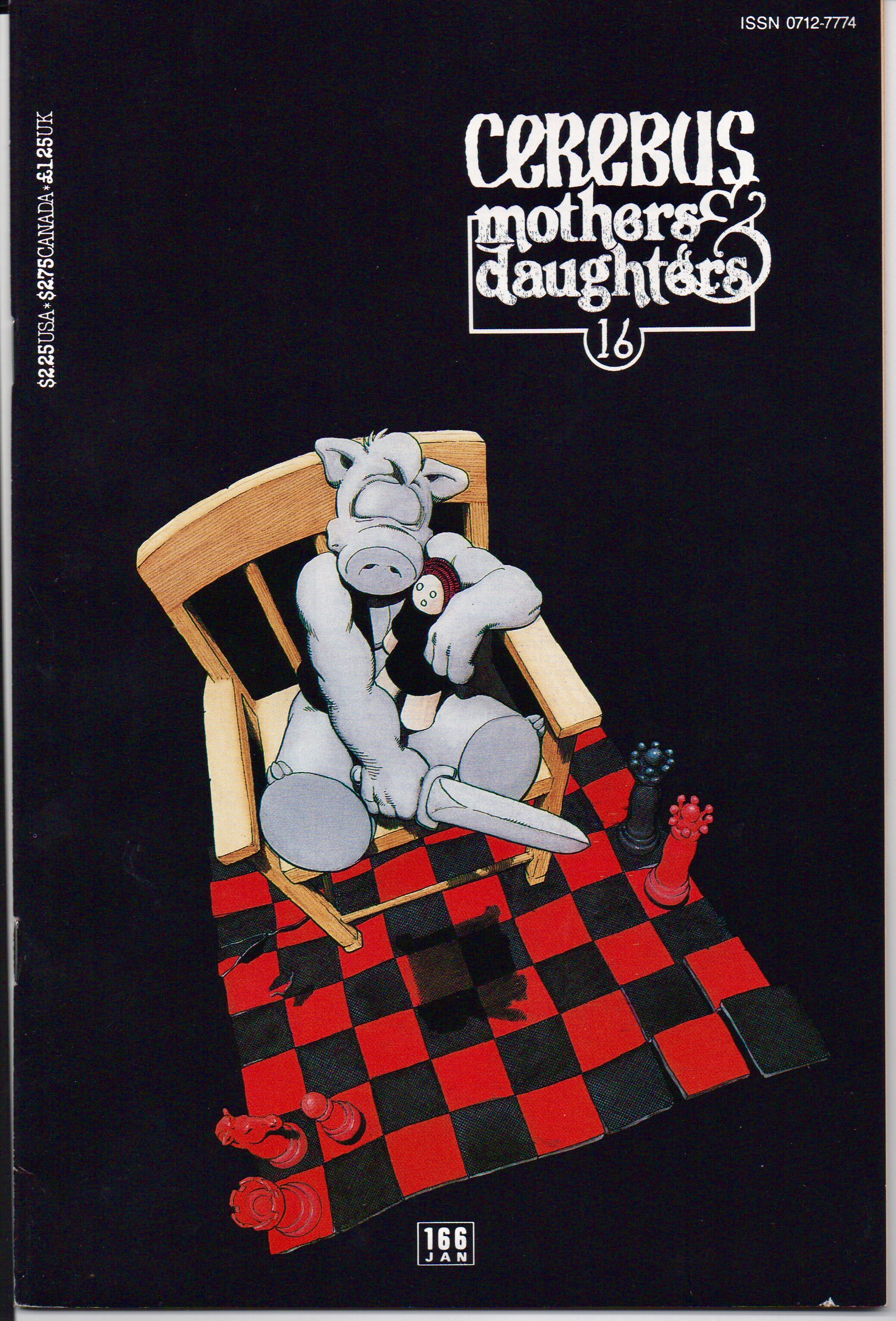
Cerebus #166, January, 1993 by Dave Sim and Gerhard; published by Aardvark-Vanaheim. This issue is Chapter 16 of the Mothers & Daughters storyline, Sim’s imagining of a tyrannical matriarchal state (sort of like The Handmaid’s Tale in reverse, sort of). This issue is one of my favorite chapters in the novel, a riff on Sim’s earlier “Mind Games” issues, wherein Cerebus’s dream-state shapes events in the real world. Mothers & Daughters is pretty much the last good Cerebus novel, before Sim took things completely off the rails in Reads.
Sunday Comics


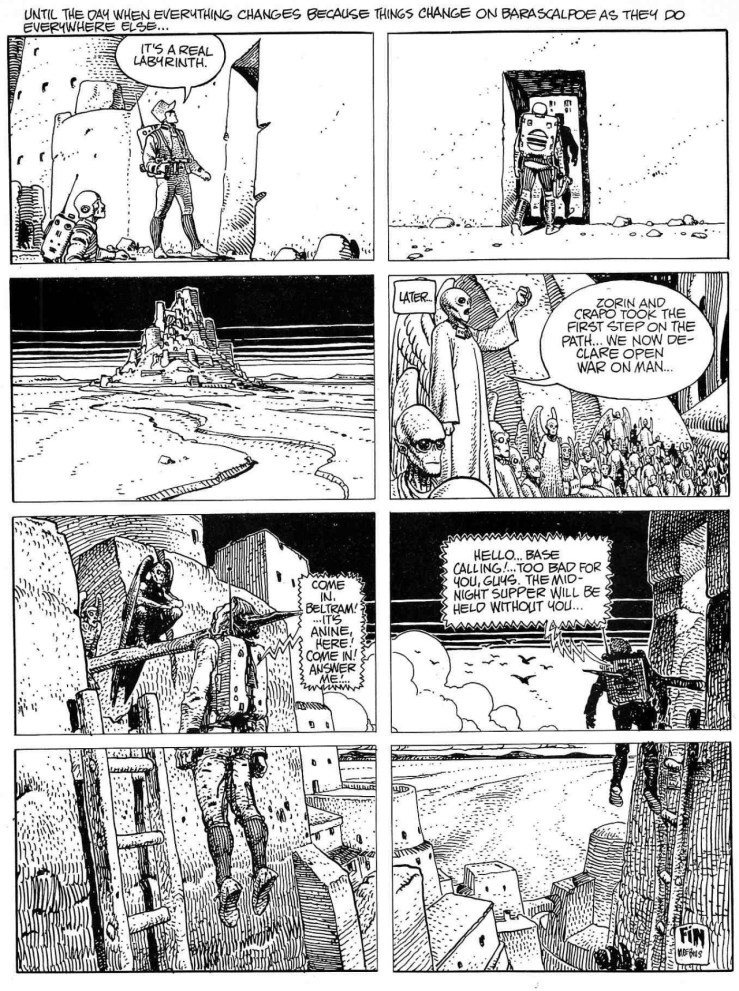
Three (noncontiguous, nonconsecutive, unrelated) panels by Moebius from various comics in Moebius 3: The Airtight Garage (Epic Comics/Marvel).
Sunday Comics
From “A Halo of Flies,” The Saga of the Swamp Thing #30, November 1984. Art by Stephen Bissette with guest inks by Alfredo Alcala; coloring by Tatjana Wood.
I’m still really enjoying my re-read of Alan Moore’s run on Swamp Thing. There’s a cinematic quality to the work, evident in its (often-reserved) pacing, its attention to basic concepts like time and place (it’s astounding frankly how many “superhero” comics pay zero attention to basics like scale or the relationships between physical objects), and its framing of panels. I love how the single-page “Swamp Thing” illustration shows up near the end of this particular issue—like a long cold opening in a film or TV show.
Sunday Comics

Pages from issues 23, 24, and 25 of The Saga of the Swamp Thing, 1984. Art by Stephen Bissette and John Totleben; coloring by Tatjana Wood. Script by Alan Moore.
I’ve been rereading Moore’s run on Swamp Thing and am amazed anew at the comic’s cinematic construction, moody tone, and mix of simplicity and depth in storytelling. Wood’s moody, atmospheric coloring is unlike anything I can think of in contemporary 1980’s “superhero” comics, and Swamp Thing’s detailed contours seem impossible without Totleben’s intricate inking. I plan to write a “thing” on Moore’s Swamp Thing era down the line, but for now, I’m surprised at now just how well it holds up, but how well-constructed the team’s efforts were, right out of the gate on the early issues.
Map of Days (Beautiful book acquired, 2.04.2017)

Robert Hunter’s graphic novel Map of Days is new from Nobrow. It’s gorgeous.

I’ll write a proper review soon, but for now, here’s Nobrow’s blurb:
Richard can’t stop thinking about the clock. He lies in bed each night listening to its tick-tocking, to the pendulum’s heavy swing. Why does his grandfather open its old doors in secret and walk into the darkness beyond?
One night, too inquisitive to sleep, Richard tiptoes from his bed, opens the cherry wood door of the grandfather clock, and steps inside. There, in a strange twilight, he sees the Face the Earth, locked forever in a simulated world, where green things seem to grow in the semblance of trees and plants, from unreal soil…


Sunday Comics
Symbolically Loaded — Glen Baxter

Sunday Comics

From Ron Cobb’s 1970 collection Raw Sewage (Sawyer Press).