“Novels Are Fantasies of Powerlessness and Power” — Biblioklept Talks to Adam Novy About His Novel The Avian Gospels

Adam Novy’s debut novel The Avian Gospels is one of the best novels I’ve read this year, and one of the best contemporary novels I’ve read in ages. It’s a surreal dystopian magical romance set against the backdrop of political and cultural repression, violent rebellion, torture, family, and birds. Lots and lots of birds. (Read my review).
Adam was kind enough to talk to me about his work over a month-long series of email exchanges; the interview presented below reveals much of his generous, creative energy.

Adam currently teaches writing at Scripps College, Pasadena City College, Long Beach City College and Orange Coast College.

The Avian Gospels is available now from Hobart.

Check out Adam’s website. 


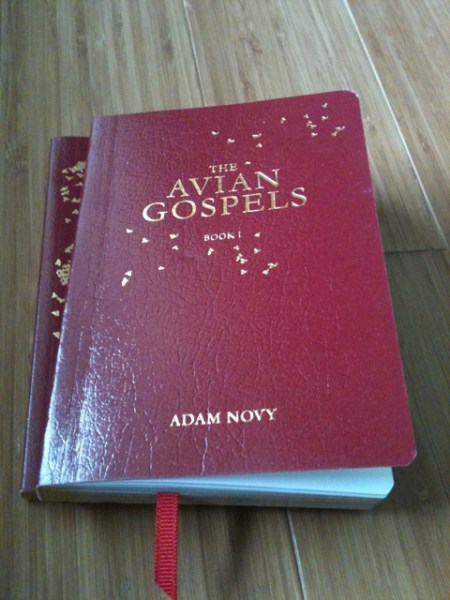
Biblioklept: I have a lot I want to ask you about what’s in your novel, but I have to start by asking about the physical book itself. The Avian Gospels is a lovely little two volume pocket-sized monograph—textured oxblood covers, gilded pages with line numbers, inset bookmarks. Visually, it recalls a Gideon bible, I guess, only not, I don’t know, chintzy. Where did the design idea come from?

Adam Novy: My editor at Hobart, Aaron Burch, had the idea of making the book look like a Bible. He’s an excellent designer and does a wonderful job with Hobart. Some boheemith press in New York City should really snap him up.

Biblioklept: How did the idea for The Avian Gospels come about? When did you start drafting the book? How long did it take to write?

AN: After 9/11, there was a moment where I felt like all Americans were on the same team. Now I wonder if we’ll ever feel that way again. Pardon me for living in the moment, but this country is just so completely fucked. This sensation of being American swiftly curdled into panic, but by then, the coordinates of my work had all been changed. I wanted to find a voice with room for both the historical and the intimate, which led me to a kind of first-person plural officialese. It ended up creating this echo-chamber effect where the personal and political identities of each character were different, and nobody could quite be who they were supposed to be, or wanted to be.

It took months of screwing around to figure this out, and most of it, of course, was accidental. The Lord of the Rings was on TV a lot at the time, and sometimes I thought I wanted to sound like Gandalf if Gandalf was full of shit and, like, a genocider who felt sorry for himself, but still was Gandalf, all mystical and officious, bossing everyone around. I understood the characters right away, except for Jane, who was always hard to deal with. She gets in arguments a lot and she’s usually right. I think I have hard time writing characters who are right. I myself am never right, so I had trouble relating to her. Of course, now she’s my second-favorite character in the book, after Mike.

I started the book in spring of 2002 and finished it in fall of 2005. In 2006, I found an agent and Hobart took the book in 2008. I went through five apartments, three different cities, three computers, one personal trainer and three therapists in that time. And nine adjunct faculty positions.

Biblioklept:  It’s interesting that you mention the LOTR movies as a kind of ambient influence, because they were pretty ubiquitous in the last decade—and there’s so much of the last decade’s zeitgeist in your book: torture, despotism, political and cultural repression, the plight of a refugee class, the idea of “green zones,” etc. You foreground these themes by crafting Gospels as a kind of dystopian novel with elements of magical realism, but it’s also very much a novel about family, and even a love story. (By sheer coincidence I watched the restored edit of Metropolis in the same time frame that I was reading Gospels, and saw so many echoes there). How conscious were you of genre conventions? I’m curious because your book sometimes blends genre tropes, sometimes blurs them, and sometimes straight-up explodes them . . .
AN: The book is quite deliberately a mash-up. I think it’s normal in conversation to try out different ways of seeing things—a fussy way of saying this might be “experiment with different hermeneutics.” For example, one might reference the NBA, The Wire, Shakespeare and Dazed and Confused in a discussion about Obama. I wanted the book to enact this kind of embeddedness, this flailing for a context that makes sense, and I wanted the narrator to sound as though its vernacular was ornate and obsolete, like it trafficked in a pleasure that justified itself as satisfaction while remaining an inadequate moral lens. That’s why I write violence like I do: I want it to be horrifying and beautiful. Unfortunately, violence is cool. I’m not immune—I always watch Kill Bill and Scarface when they’re on cable. It’s disturbing. Everyone knows that torture doesn’t work as an intelligence-gathering method, but our country did it anyway because it simply couldn’t stop. It was a kind of jacking off, the only kind that certain political parties seem to approve of.

Whenever we write about power, we should always defend the powerless, even if they’re just as bad as those in power. I think I saw that in Cioran, and did you know Cioran was a Nazi sympathizer? I just read that Gertrude Stein was, too. I don’t know what kind of paradigm can reckon with this world.

Biblioklept: I had no idea about Stein or Cioran’s Nazi sympathies, but I guess many artists and writers and intellectuals were attracted to the power of fascism, particularly in the modernists’ day (I suppose Ezra Pound and GB Shaw stand out as easy examples, and Heidegger was a member of the Nazi party). Although in our own age, I suppose we also see intellectuals and writers support terrible causes—I think of Christopher Hitchens’s aggressive support of the Iraq War and Bush administration’s policies, for, example.

I don’t want to drop spoilers, but your novel traces an arc that shows how those who are powerless might, given power, recapitulate the aggressive violence that they themselves were once subjected to. In turn, you also reveal how characters who seemed to occupy a clear power position (I’m thinking of Mike here, specifically) are perhaps doomed as well to a life without agency. I found my sympathies shift dramatically throughout the novel. How important are sympathetic characters?

AN: Every writer, including me, wants the reader to cathect to their book with their whole heart. I want my readers to utterly and helplessly engrossed. But sympathy is a means to an end and not the end itself. Technically speaking, it’s just not that hard to accomplish. It’s a skill, like dribbling in basketball is a skill, but it’s not the whole game.

In The Avian Gospels, the character named Mike Giggs is seen in only one scenario—exerting power in the manner of his father—for the first two hundred pages, so he comes off like a jerk until he encounters someone who actually loves him: Chico the band leader. Suddenly, Mike discovers a love of life, a sensitivity and a feeling of camaraderie for his fellows. Not only is he is capable of compassion, he is governed by it. This leaves him ruined in certain ways, but allows him to discover who he can be, and makes him (hopefully) sympathetic.

Meanwhile, on the other end of the book, the character named Zvominir, who was whimperingly sweet for longer than Mike was mean, is meaner than Mike. Novels are fantasies of powerlessness and power—among the zillion other things they are—and I feel like we should at least be conscious of what’s happening to our minds as we are reading. How we deal with power is a serious moral question; counting how many times that we go awwww is not. We have cats on the internet for that. Still, Chad Harbach was probably right when he said that the books that get the best reception are simply “affable.” In desperate times, a nation of New York critic types are turning to . . . Mitt Romney? Or like, Cheever without the psychosexual guilt?

I don’t mean to single out Chad Harbach, whose work I haven’t read, except for his piece on Grantland about the Brewers, which I liked. But what he said is accurate. These days, people seem to feel that art should be uplifting, like art owes it to them, in a customer-service type-way. Have you been to Kinko’s, or excuse me, FedEx Office, lately? It is not a happy place. Novels used to to give the reader the truth in ways no other social narratives would. I’m pretty sure I’m not just being sentimental. There used to be a social lie which said the world was making progress and ascending, but this reversed like fifteen years ago and now we all feel doomed. We need books to tell us how we got here, not to lie about how meaningful our journeys are or however we say it these days. Of course our lives are meaningful, but such a narrow focus on making folks feel better is superficial and disempowering. Our emptiness and dread are trying to tell us something.

Biblioklept: I think you point toward a distinction between art and entertainment here. We want entertainment to comfort us, to ease our worries. In contrast, art challenges us with what we don’t want to see, or can’t see, or can’t see that we can’t see. And yeah, there’s a kind of “literature of comfort” out there, books that simply reconfirm the tropes and tricks and forms of “literary fiction” — so that, even if the protagonists suffer, that suffering is is part and parcel of some greater telos — and not just in terms of the plot, but also in the structure of the novel itself. (Lee Siegel called this camp “Nice Writing” a decade ago, pointing to its “violent affability,” its “deadly sweetness”).

At the risk of asking one of those questions an interviewer is never supposed to ask (but, hey, I really want to know the answer and I think our readers would too), what books move you as a reader?

AN: I think I’m moved by pretty standard stuff. The Portrait of a LadyCharlotte’s WebTo My Twenties, by Kenneth Koch.  On Seeing the Elgin Marbles, by Keats. Places to Look For Your Mind, by Lorrie Moore. Testimony of Pilot and Return to Return by Barry Hannah. Antony and CleopatraStone Arabia, by Dana Spiotta, which is the best new book I’ve read in 2011. Chopin in Winter by Stuart Dybek. The last paragraph of CivilWarLand In Bad Decline. The scene in American Tabloid where Ward steals the pension fund books. The Widow Aphrodissia by Marguerite Yourcenar. There must be fifty different scenes in Buffy that make me cry, and five in Battlestar Galactica. Certain scenes in Lost. This is such a conventional list, I feel like I need to start a fight. FRIDAY NIGHT LIGHTS SUCKS AND YOU ARE ALL A BUNCH OF SAPS. I should also say I’m moved by spectacles of massive human folly. The image of Slim Pickens riding the bomb and waving his hat in Dr. Strangelove and the scene where Kramer and his intern throw the ball of oil out the window are somehow very moving to me.

Biblioklept: I’d love to hear your thoughts on the Occupy Wall Street movement—The Avian Gospels taps into and explores this idea of civil unrest, of disenfranchised voices, of a paramilitary state coping with a populist uprising. You’ve indicated that your novel is in some ways a response to 9/11, but it also seems predictive of the fallout we’re seeing a decade after the fact.

AN: A massive, indescribable injustice was inflicted on our world by the likes of Goldman Sachs and we seem to have no recourse. Law enforcement could not possibly care less, and seeing how they cleared Zucotti Park, they seem jealous of the impunity of Wall Street. In his review of Ron Suskind’s book, Ezra Klein suggests that Washington just did not have the will to pass a stimulus that was big enough. Slavoj Žižek is right when he says this moment is a challenge to our imagination. I think that what happened at Penn State may be a better lens for the recession than Occupy Wall Street. A massive patriarchal network mobilized their resources to preserve an ongoing atrocity. No one will admit that they were wrong, especially the figurehead, Joe Paterno. The community just does not seem to give a shit. They keep telling out-of-towners we don’t get it and rioted in self-pityI guess this is just how power acts.

Biblioklept: What’s next? What are you working on now?

AN: I’m writing a novel about the life and times of Medusa. It’s called The Gore and the Splatter.

Biblioklept: Have you ever stolen a book?

AN: I think the only book I ever stole was an anthology of world literature, which had a really coherent definition of French symbolist poetry. I can’t find this book now, so someone probably stole it from me. Serves me right.


Ray — Barry Hannah

ray

Barry Hannah’s slim 1980 novel Ray is a strange wonder, a poem rocket assured to offend any unsuspecting customer who wanders in unaware. I use the term “offend” here loosely: some may be offended by Hannah’s subject matter (booze, drugs, sex, violence), others may be offended by his refusal to submit to any of the conventions we expect from a “novel.” Sure, there are defined characters, conflicts, hints of a plot even, but don’t expect arc, easily recognizable growth, or even linearity. Hannah breaks almost every convention, right down to a first-person narration that shifts occasionally into a kind of second-person meditation and then into a faux-objective third-person voice and then into the third-person free indirect style that marks modernism. The subject Ray careens not just through perspectives but also through time. Here he is in Chapter V (this is the chapter in its entirety)—

I live in so many centuries. Everybody is still alive.

And if Ray is busy stumbling through his own psychic quagmire, shooting down planes in ‘Nam or killing Yankees under Jeb Stuart’s command, he’s also a very real, concrete personality, a doctor, a family man, an alcoholic, a suffering soul trying to navigate children and lovers and patients and neighbors in the swelter of Tuscaloosa, Alabama at the end of Carter’s presidency.

None of this should work, of course, but Hannah’s writing assimilates the reader, inculcates the reader, infects the reader. Ray is a dramatically unstable figure of the old school—misogynist, casually racist, the kind of doctor who finds himself “drinking five bottles of wine a day just to stay cool” — but Hannah’s syntactic powers (which he awards to his narrator Ray) become the core of a novel that by rights should run off the tracks, what with its sharp velocity and manic force and hairpin turns. But Ray doesn’t run off the tracks; it explodes them.

It’s hard to summarize the plot of this fragmentary novel, but I’ll give it a try (and at least share some of Hannah’s remarkable prose). Ray is a country doctor of some note and education, a former pilot who fought and killed in Vietnam, a man with literary ambitions who tries his hand at poetry and occasionally lectures at the local college. Here’s a taste of one of those lectures, showcasing Hannah’s wit, the radically ambivalent place of history in his work, and the core paradoxes of his lead character—

So now, class, I say:

“Americans have never been consistent. They represent gentleness and rage together. Franklin was the inventor of the stove, bifocals, and so on. Yet he abused his neglected family. Jefferson, with his great theories, could not actually release the slaves even though he regularly fornicated with one of them. One lesson we as Americans must learn is to get used to the conrarieties in our hearts and live with them.” Etc.

Lazy Blakean. In addition to his history lectures, Ray has even written a number of papers with unlikely titles about women and depressives and medicine; it is wholly ironic that Ray should lay claims to understanding women and depressed people, let alone understanding how to treat them. During the course of the novel he marries again, to a woman named Westy, and they combine their children into a post-nuclear family that recalls The Brady Bunch on Dexedrine and bourbon and weed (that description sounds far more negative than I intend; I’m trying to telegraph the spirit or tone of the novel, which is difficult, impossible). Ray’s lusty marriage to Westy doesn’t prevent his shambolic philandering. Not all of Ray’s infidelities are born of human weakness though. His love for a young woman named Sister from a white trash family called the Hooches deeply informs the novel; it also allows me another chance to quote from the novel—

Sister is always in love with somebody, sometimes me. There is a capricious wisdom she has about attaching herself to anybody for very long, although her loyalties are fast. She plays the guitar well and has a nice voice that she keeps to herself. Life has been such for her that she has no attitude at all. She expects no sympathy. Two of her teenage lovers died in an accident at the railroad tracks. That’s when I met Sister. I rode down to the tracks, and she was standing there in a long sleeping gown, two weeks after the accident.

“What’s wrong, girl?”

“I growed up.”

Along with Sister, a man named Charlie DeSoto plays a large role in Ray; indeed, at times the novel comes to inhabit his consciousness, as if he was some alter-ego of Ray. That consciousness also becomes unstuck in time. In a passage that recalls (and predates) Blood Meridian, DeSoto (via Ray?) migrates back to the mid 1500s, into the mind of one of Hernando DeSoto’s companions in arms. In a bizarre first-person sequence, this ancient Christian describes slaughtering 4,000 Indians under the command of the war chief Tuscaloosa. History is a nightmare that Ray cannot wake up from.

Ray is a strange fever dream, buzzing with tumult, beauty, filth, and ugly vitality. Our clumsy (anti?)hero cannot seem to reconcile his violent past (both as a fighter pilot in Vietnam and as an American with “contrarieties” in his heart) with his duty as a healer, a doctor. He tells us—

I am infected with every disease I ever tried to cure. I am a vicious nightmare of illnesses. God cured me with a memory that holds everything in my brain. There is no forgetting with me. Every name, every foot, every disease, every piece of jewelry hanging from an ear. Nothing is hazy.

If “Nothing is hazy” then everything is brought into vibrant foreground, all details afforded a prominent place, none pushed to a defining background. If “Nothing is hazy” then everything is hazy; contrariety rules.

Perhaps Ray might be summed up by one of its chapters, LII (again, in its entirety)—

To live and delight in healing, flying, fucking. Here are the men and women.

Hannah might have been heir to Faulkner, with his grotesque characters and bizarre syntax and challenging tropes (not to mention the sweaty ickiness of both writers’ prose). Ray also hearkens back to Henry Miller’s rants, although I’d suggest a larger, or at least more loving spirit in Hannah. There are even tinges of Bukoswki here. Ray also recalls Renata Adler’s strange novel Speedboat, another discursive, vaulting piece from the late ’70s. But comparing Ray to other works risks belying its radical originality, which is surely one of its great pleasures. Ray is not a novel for everyone, and those interested in Hannah might do better to begin with his equally strange compilation Airships, but those seeking a challenging, funny novel will appreciate Ray, a novel that explodes literary convention even as it reaffirms the affective power of literature. Highly recommended.


Dennis Cooper Talks About Being a “Cult Writer”

Again, raiding the Dennis Cooper interview from the new issue of The Paris Review (198/Fall 2011). Cooper discusses what a “normal” novel is in the interview, and here he talks about what it might mean to be a “cult writer.” I’ve long been interested in simply the idea of a “cult novel,” so I liked this bit, and thus share with you, kind reader—

You almost never see my name in print without the phrase cult writer glued to it. When I see that word, cult, attached to an artist, it always seems to be a begrudging way to acknowledge that the artist is talented and valuable to a moderate number of people whose passion for that artist’s work is understandable, to some degree, but nonetheless foreign. It’s a weird term because it’s complimentary but condescending and hierarchical at the same time. My work just seems to be a really odd duck. I feel like I’m on my own. I don’t mind that, but it’s a strange place to be sometimes.

The Subject Steve — Sam Lipsyte

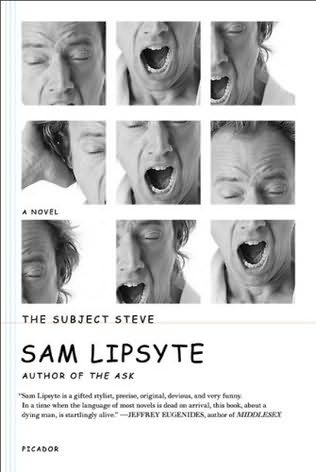
A few years ago, I wrote about cult novels, and, in trying to define them, I suggested that “a cult book is not (necessarily) a book about cults.”  Sam Lipsyte’s first novel The Subject Steve is a cult novel about a cult, or at least heavily features a cult. Like many cult novels, there’s an apocalyptic scope to Steve, one in this particular case (or subject, if you will), that extends from the personal to the universal.

I’ll let Lipsyte’s compressed acerbic prose spell out the book’s central conflict—

The bad news was bad. I was dying of something nobody had ever died of before. I was dying of something nobody had ever died of before. I was dying of something absolutely, fantastically new. Strangely enough, I was in fine fettle. My heart was strong and my lungs were clean. My vitals were vital. Nothing was enveloping me or eating away at me or brandishing itself towards some violence in my brain. There weren’t any blocks or clots or seeps or leaks. My levels were good. My counts were good. All my numbers said my number wasn’t up.

The problem of death, or the problem of how to live a meaningful life against the specter of death, is of course an ancient conceit, and Lipsyte makes it the core of his book, upon which he hangs an often shaggy picaresque plot. The Subject Steve is post-modernist caustic satire in the good old vein of Candide; put another way, it’s just one damn thing happening after the next.

So, what are some of those things that happen? Steve (not his real name) is condemned to die of a disease with no name; he tries to make contact with his estranged wife and not-quite-a-genius daughter; he blows his life savings on hookers and blow; he heads upstate to a cult’s compound in the hopes of finding a cure to his unnamed (unnameable) disease; he suffers the cult’s sadistic practices; he escapes the cult’s sadistic practices; he reunites with his wife and daughter; he abandons his wife and daughter; he reunites with a new version of the cult somewhere in the Nevada desert; he becomes enslaved by the cult in the Nevada desert; he escapes the cult; &c. And he reflects on his life (and his death) repeatedly. I’ll let Steve reflect on his life at length, if for no other reason than to share more of Lipsyte’s marvelous prose—

And I was still dying, wasn’t I? Who would note? What had I ever noted? I’d taken my pleasures, of course, I’d eaten the foods of the world, drunk my wine, put this or that forbidden particulate in my nose until the room lit up like a festival town and all my friends, but just my friends, were seers. I’d seen the great cities, the great lakes, the oceans and the so-called seas, slept in soft beds and awakened to fresh juice and fluffy towels and terrific water pressure. I’d fucked in moonlight, sped through desolate interstate kingdoms of high broken beauty, met wise men, wise women, even a wise movie star. I’d lain on lawns that, cut, bore the scent of rare spice. I’d ridden dune buggies, foreign rails. I’d tasted forty-five kinds of coffee, not counting decaf.

I love this passage. In almost any other book I can think of, the final detail about coffee would puncture the passage’s inflation, serve as a comic anti-climax. In Lipsyte’s phrasing it’s both tragic and triumphant.

I don’t mean to gloss over the plot of The Subject Steve, but the book’s narrative, its sense of time, is so radically compressed (again, I think of the compression of Candide) that reading it is more like experiencing a rapid series of scenarios. I’m particularly fond of books like this, that seem to ramble and erupt in strange and unexpected moments. I think of Ellison’s Invisible Man or Woolf’s Orlando, but there’s also something of Aldous Huxley in Steve, that apocalyptic-comic axis, the satire of despair. The book is one of those pre-9/11 novels (forgive the phrase) that seems utterly prescient. Take the following observation for example—

Someday sectors of this city would make the most astonishing ruins. No pyramid or sacrificial ziggurat would compare to these insurance towers, convention domes. Unnerved, of course, or stoned enough, you always could see it, tomorrow’s ruins today, carcasses of steel teetered in a halt of death, half globes of granite buried like worlds under shards of street. Sometimes I pictured myself a futuristic sifter, some odd being bred for sexlessness, helmed in pulsing Lucite, stooping to examine an elevator panel, a perfectly preserved boutonniere.

The language here anticipates the Dead America that Lipsyte explores in his latest novel, The Ask, and reinforces a general argument I’d like to make, which is that Lipsyte is at heart a writer of dystopian fictions, fictions so contemporary that their dystopian nature becomes effaced.

These dystopian tropes coalesce in the frantic, hyperbolic ending of Steve, where our subject becomes the object of a bizarre cult’s ritual sadistic practices, all available via the panopticon of the internet. Lipsyte’s vision is of a post-human existence, a radical otherness of degradation through technological alienation. At this late moment in the book, the satire is so black that even Lipsyte’s tightest, pithiest sentences fail to elicit a laugh or a smile — indeed, I am almost certain that they are not intended to do so. Instead we are immersed in the apocalyptic horror of dehumanization (the book here reminded me of Hunter S. Thompson’s Fear and Loathing, of all things, both in its desert location and in its gradual movement from sardonic humor to vivid terror).

Like any cult novel, or destined cult novel, The Subject Steve is Not For Everyone. Those looking for plot development and tidy endings will not find them here, and, if the tone of this review has not already made it clear, the book is extremely dark. But it’s also very, very funny, and there are few stylists working today who can match Lipsyte’s mastery of the sentence. Highly recommended.

The Subject Steve is now available in trade paperback from Picador.

C — Tom McCarthy

Tom McCarthy’s marvelous, confounding new novel C tells the life story of Serge Carrefax and his strange adventures at the beginning of the twentieth century. The novel begins with Serge’s birth on his parents’ estate Versoie; he’s born with a caul, a “veil around his head: a kind of web,” a mystic mark that both disconnects and, paradoxically, joins him to the world. At Versoie, Serge’s father Simeon experiments with wireless technology and runs a school for deaf children while Serge’s deaf mother farms bombyx mori moths for silk. Serge and big sis Sophie are left to the care of their tutor Mr. Clair, but they manage to get into trouble with their chemistry set when he’s not looking. In addition to offering the Carrefax kids a classical education, Mr. Clair, a proto-Marxist, teaches them a game akin to Monopoly. In a particularly inspired scene, they soon dispense with the game board to recreate the game on the real-live grounds of Versoie, eventually incorporating the aid of a wireless communication system. Then, when moving from wireless receiver to wireless receiver becomes too much hassle, they simply co-ordinate the game in their collective imagination, managing properties in the pure abstract. The game elegantly emphasizes the siblings’ development from playing via symbolic representation, to enacting those symbols on a one-to-one scale, to finally internalizing and encapsulating the real world. It’s as if they’ve swallowed Versoie into their very beings.

Versoie initiates and enacts its own strange culture and mythology, one that intertwines inextricably with Serge and Sophie’s childhood. It’s a rich, detailed world, at once magical and unsettling, bustling with bizarre pageants (part of Simeon’s curriculum), eclectic experiments, and visitors like Widsun, a British intelligence code-breaker/code-maker who serves as a mentor first to Sophie and later Serge. While Sophie delights in secret codes and chemistry (particularly poison-making), Serge experiments with wireless technology, spending late nights on his homemade wireless set with other “bugs.” In one scene, Serge listens to “an RXer in Lydium who calls himself ‘Wireworm’ [who] is tapping out his thoughts about the Postmaster General’s plans to charge one guinea per station for all amateurs.” Tech geeks with hyperbolic handles griping over minutiae in the wee hours–sound familiar? McCarthy describes Serge’s reaction: “Transcribing his clicks, Serge senses that Wireworm’s not so young: no operator under twenty would bother to tap out the whole word ‘fashion.’ The spacing’s a little awkward also: too studied, too self-conscious.” We get text messaging a century before text messaging, and as Serge searches between news reports and chess games and distress calls, we see that the world wide web is far older than we might have thought. Later in the novel Simeon writes a letter to his son where he describes a proto-internet, claiming his ambition is “to transmit moving pictures over distance, such that life in all its full, vibrant immediacy may be relayed without any delay.” This isn’t steampunk though, it’s simply a reminder that wireless technology isn’t an invention of our own time. C is an historical fiction deeply concerned with technological fact. It’s also a bildungsroman, too, so let’s return to young Serge, who soon ventures to a Bohemian spa with Clair as chaperon.

The adolescent Serge is ill. He perceives the world through a “guazy crepe” that blackens his vision, recalling the amniotic sac that webbed his head at birth. At the spa, Dr. Philip diagnoses Serge’s problem: “You . . . have got blockage. Jam, block, stuck. Instead of transformation, only repetition.” He accuses Serge of enjoying his illness, of enjoying “to feast on the mela chole, on the morbid matter, and to feast on it repeatedly, again, again, again, like it was lovely meat–lovely, black rotten meat.” The Burroughsian image of black meat pops up again and again in C, perhaps suggesting the human limitation to transcend–or in Philip’s words, transform–the mortal condition. However, Serge manages, through his own devices, to break through the blockage; if his epiphany is ultimately negative, at least it is real, a semi-Cronenbergian sexual awakening with a hunchback.

Like Versoie, the Bohemian spa is both a rich and alienating setting; McCarthy’s great gift to the reader is crafting enough detail in his set pieces to make them seem utterly real, yet to withhold enough so that the reader’s imagination fills in the gaps that might exist outside of Serge’s proximity. C is only 300 pages long yet feels much deeper–not longer, but deeper. This is most evident in the novel’s next milieu, the Great War, where Serge serves as a Royal Air Force aerial observer. War novels, histories, and movies have given us so much information about WWI that it would be easy for McCarthy to rely on stock tropes and received wisdom in communicating his set-piece, but instead he gives us something startlingly new. For example, how were the drugs in WWI, McCarthy asks. It’s in the Air Force that Serge first uses cocaine, rubbing it into his retinas to improve his eyesight while he’s spotting for German artillery batteries. He quickly moves to snorting mounds of the stuff before each take off. Here’s a lovely passage, where we see Serge’s nascent addiction blurring his perspective, ultimately leading to an autoerotic climax–

Higher up, the vapour trails of the SE5s form straight white lines against the blue, as though the sky’s surface were a mirror too. Scorch-marks and crater contours on the ground look powdery; it seems that if he swooped above them low enough, then he could breathe them up as well, snort the whole landscape into his head. The three hours pass in minutes. As they dip low to strafe the trenches on the way back, he feels the blood rush to his groin. He whips his belt off, leaps bolt upright and has barely got his trousers down before the seed shoots from him, arcs over the machine’s tail and falls in a fine thread towards the slit earth down below.

“From all the Cs!” he shouts. “The bird of Heaven!”

Serge doesn’t bother to reflect much on this episode and McCarthy’s third-person narrator is so effaced in the novel as to seem almost invisible. McCarthy shows and never tells, even when he allows some insight into Serge’s psyche. We learn that–

Of all the pilots and observers, Serge alone remains unhaunted by the prospect of a fiery airborne end. He’s not unaware of it: just unbothered. The idea that his flesh could melt and fuse with the machine parts pleases him. When they sing their song about taking cylinders out of of kidneys, he imagines the process playing itself out backwards: brain and connecting rod merging to form one, ultra-intelligent organ, his back quivering in pleasure as pumps and pistons plunge into it, heart and liver being spliced with valve and filter to create a whole new, streamlined mechanism.

Serge’s indifference toward death (or life) and his frequent drug-use aren’t the manifestations of a death-wish–although C does pull its hero to a mortal end, as a bildungsroman should–rather, we see in Serge’s cyborg fantasy a wish for transhumanist transcendence. Serge’s job as a flying observer grants him some measure of transcendence, reducing the landscape to a flat two-dimensional perspective that he can easily process and read. At the same time, the novel tropes against the motif of two-dimensional perspective, repeatedly pushing Serge into interior excavations, like a worm or beetle digging in to the earth. This happens in the most literal sense at the end of the Great War, when the Germans capture Serge and hold him as a P.O.W. Serge is fine though, happy to tunnel underground (as long as his morphine hookup remains unimpeded).

Serge’s drug addiction continues into his postwar years in London. Nominally an architecture student, he spends most of his time scoring heroin and coke and partying with would-be actresses. Serge’s inclination to two-dimensional perspective inhibits his architectural aptitude. He can only plan tombs. McCarthy’s evocation of 1920s London is dark and strange, a drug-addled fever dream riddled with ciphers and ghosts. The set-piece comes to a head when Serge’s girlfriend takes him to see a psychic medium who purports to channel the spirits of those who died in the war. An enraged Serge uses wireless technology to reveal the scam, but puncturing the fantasy effectively brings an end to his relationship.

Serge soon reconnects with his father’s friend Wisdun, who sends the young man to Egypt. Serge’s mission is to scout sites for the wireless pylons that will unite the world, but he’d really rather puzzle out the cultural, historical, and linguistic mishmash of Alexandria and explore unopened tombs in the desert with an archeologist’s sexy assistant. I’ve perhaps revealed too much of the book’s plot so far, and while I think I’ve avoided spoilers, I’ll hope that you simply take my word that the Egyptian set-piece at the end of C is a masterful, disturbing climax to a rich and rewarding book. C culminates by tying together its central juxtapositions of sex and death, connection and disconnection, excavation and total, flat perspective with its many motifs: bugs, tombs, art, drugs, language, time, communication, spirit. The book’s final pages are stunning; it’s the kind of linguistic storm that demands immediate rereading.

And you’ll want to reread the book: McCarthy gives us so much to unpack. There’s that enigmatic title, of course. What is the “C” in C for? C is for Carrefax, of course, but that’s too obvious. In his blurb, Luc Sante rightly points out that “C is for carbon and cocaine, Cairo and CQ.” I might also add that C is for see and sí and sea; C is for call and caul; C is for communicate and communion; C is for the c that slips from “insect” to “incest.” (I could go on of course; a third reading of the book will undoubtedly yield more). C seems to call to Thomas Pynchon’s V., a novel littered with historical episodes that dances with a bildungsroman’s structure. C also calls to Voltaire’s satirical bildungsroman Candide. And while I’m lazily name-dropping authors and books, I might as well favorably compare C with Joyce’s Portrait and much of J.G. Ballard and William Burroughs. It’s also thoroughly soaked in Freud and continental philosophy.

C is the best novel I’ve read in a long time, and the first novel I’ve immediately reread in full in a very long time. It will leave many readers cold (or even disgusted, perhaps), but isn’t this always the way for writers who push their audience?  (Consider my lazy name-dropping above). You probably know by now if this is for you, but if I haven’t been clear — very highly recommended.

C is available in hardback in the UK on August 5, 2010 from Jonathan Cape, and available in hardback in the US on September 7, 2010 from Random House.

Two Visions of Apocalypse: Margaret Atwood’s The Year of the Flood and Martin Bax’s The Hospital Ship

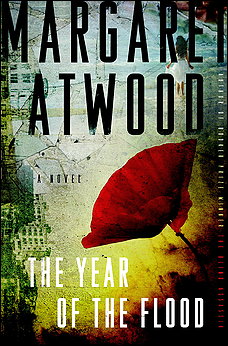
I finished Martin Bax’s surreal dystopian romance The Hospital Ship last night and then finished the audiobook version of Margaret Atwood’s hyperreal dystopian anti-romance The Year of the Flood today. Both books take their cues from that first apocalypse story, the story of Noah and his ark, and continue that tradition imagining a version of the end of the world. Despite their mythical-biblical origins, such books tend to get ghettoized into a certain genre of science fiction — let’s call it apocalypse fiction — despite the artistic power or literary merit of the author’s prose itself. Apocalypse books like Kurt Vonnegut’s satire Cat’s Cradle, Cormac McCarthy’s The Road, and Aldous Huxley’s Ape and Essence diverge in style, tone, and execution. It’s their subject that compels us, each vision a proposition, a promise of some kind of future, a future after the future. Many of these apocalypse books remain prescient today. However, others feel dated simply because so much of what the author wrote twenty or fifty or more years ago more or less came true. For instance, is the homogenized, greenzoned aristocracy of Brave New World who lavish in the trivial culture of the feelies and centrifugal bumblepuppy all that different from contemporary exurbanites who basically live in walled-off compounds, little homogenized townships that strive to exist outside of civic reality and history? Robert Siegel’s recent report for NPR on the The Villages, an eerie Florida compound for senior citizens, illustrates how willing people are to buy into a company-owned, company-governed greenzone. The Villages even has its own whimsical fake “history,” complete with markers and plaques. It’s like The Prisoner or something. But enough about real life. We have apocalypse lit to tell us about the present.

The heroes of Atwood’s The Year of the Flood are not, for the most part, from the corporate-controlled compounds that keep the rest of the world at bay. There’s Toby, the orphan who grows up tough yet learns the healing arts. There’s Ren, a young girl trying to find her identity wherever she can. There’s their would-be spiritual guide, Adam One, and his lieutenant/rival Zeb. They are outsiders, members of an eco-cult called The Gardeners who worship saints like Rachel Carson, Ernest Shackleton, and Sojourner Truth. Flood is the sprawling companion to Atwood’s 2003 novel, Oryx and Crake, which I enjoyed very much. Both take place in a world where the “Waterless Flood,” a SARS/mega-flu type virus brought about via genetic tinkering, has turned most people into zombie-goo. I could go and on about the world Atwood shapes here, one full of genetic modification, eco-terrorism, religious fervor, and radical disparity, but other folks have already done it. So, in the grand tradition of internet laziness, I point you to excellent reviews here and here, which do a better job explicating the plot than I’m willing to do now (and it was an audiobook, remember, so I don’t exactly have it in front of me. Mea culpa). Apocalypse lit isn’t so much predictive as it is descriptive of the contemporary world, and Atwood’s dystopian vision is no exception. Viscerally prescient, Flood paints our own society in bold, vibrant colors, magnifying the strange relationships with nature, religion, and our fellow humans that modernity prescribes. Atwood ends her book in media res, with Toby and a handful of other characters somehow still alive, ready, perhaps, to become stewards of a new world. Flood concludes tense and, in a sense, unresolved, but Atwood implies hope: Toby will lead her small group to cultivate a new Eden. Despite all the ugliness and cruelty and devastation, people can be redeemed. The audiobook rendition of The Year of the Flood is very good, employing three actors to play the three principal roles, Ren, Toby, and Adam One. There are also terribly cheesy full-band versions of the hippy-dippy songs the Gardeners like to sing on certain Saint Days that are witty as parody but ultimately distracting. Atwood’s prose sometimes relies on placeholders and stock expressions common to sci-fi and YA fiction, and her complex plot (disappointingly) devolves to a simple adventure story in the end, but her ideas and insights into what our society might look like in a few decades are compelling reading (or, uh, listening in this case). Recommended.

The doctors, specialists, sailors, and patients of the titular vessel in Martin Bax’s The Hospital Ship are afloat in their own greenzone of sorts, a moving compound that seeks to treat the troubled world. What’s the trouble with the world? No one’s sure, exactly–there’s permanent all-out-war, of course, famine perhaps, insanity for sure. There’s also a bizarre army of bureaucrats going from continent to continent crucifying men and raping women for no clear reason. The ship’s psychiatrists diagnose it “The Crucifixion Disease.” Euan, Bax’s erstwhile lead, tries to figure out how to love and how to heal in the middle of hate and extinction. Aided by the eccentric, Falstaffian Dr. Maximov Flint, Euan conducts an experimental therapy between a Moi prostitute named V and a suicidal Wall Street broker named W. He also finds a lover and partner in an American girl named Sheila. About half of The Hospital Ship comprises citations from a variety of non-fiction texts, including medical textbooks, psychiatric studies, sociology texts, travelogues, war diaries, and more. The technique is bizarre and jarring, and Bax often imitates the style of such texts, most of which linger on sex or death. There’s also an obsession with the Vietnam War, which makes sense as the book was published in 1976. There’s a lovey-hippie type vibe to the hospital ship’s personnel, and like Atwood with her Gardeners, Bax is satirical and loving to his heroes at the same time. He mocks some of the silly idealism of the movement even as he finds solace in their vision of love and healing in an apocalyptic world. Bax’s book is wholly weird, disconnected, lurching and farcical, a madcap dystopian Love Boat on peyote. I spotted it at my favorite used bookstore, intrigued first by the (now retro-)futurist font, then the name, echoing Chris Adrian’s The Children’s Hospital, another book about a hospital-as-ark. If the black-and-white collage cover art didn’t seal the deal, then the blurb from J.G. Ballard comparing Bax favorably to William Burroughs did. Burroughs is an appropriate reference point, with the sexual alienation and the medical flavor and the cut-up technique and all, but Bax’s writing is utterly Ballardian (he even directly cites Ballard among other authors–like, you know APA style in-text citations). The Hospital Ship is a cult novel which might not have a big enough cult. It definitely belongs in print again; until then, pick up a copy if you can find one.