Don Quixote, Sancho Panza and the Dead Mule — Honore Daumier

“A Happy Wanderer” — Joseph Conrad

“A Happy Wanderer” by Joseph Conrad

Converts are interesting people.  Most of us, if you will pardon me for betraying the universal secret, have, at some time or other, discovered in ourselves a readiness to stray far, ever so far, on the wrong road.  And what did we do in our pride and our cowardice?  Casting fearful glances and waiting for a dark moment, we buried our discovery discreetly, and kept on in the old direction, on that old, beaten track we have not had courage enough to leave, and which we perceive now more clearly than before to be but the arid way of the grave.

The convert, the man capable of grace (I am speaking here in a secular sense), is not discreet.  His pride is of another kind; he jumps gladly off the track—the touch of grace is mostly sudden—and facing about in a new direction may even attain the illusion of having turned his back on Death itself.

Some converts have, indeed, earned immortality by their exquisite indiscretion.  The most illustrious example of a convert, that Flower of chivalry, Don Quixote de la Mancha, remains for all the world the only genuine immortal hidalgo.  The delectable Knight of Spain became converted, as you know, from the ways of a small country squire to an imperative faith in a tender and sublime mission.  Forthwith he was beaten with sticks and in due course shut up in a wooden cage by the Barber and the Priest, the fit ministers of a justly shocked social order.  I do not know if it has occurred to anybody yet to shut up Mr. Luffmann in a wooden cage.I do not raise the point because I wish him any harm.  Quite the contrary.  I am a humane person.  Let him take it as the highest praise—but I must say that he richly deserves that sort of attention. Continue reading ““A Happy Wanderer” — Joseph Conrad”

The Enchantment of Don Quixote — Gustave Dore

the-enchantment-of-don-quixote

The Adventure with the Windmills (Don Quixote) — Gustave Dore

the-adventure-with-the-windmills

“Flaubert me no Flauberts, Bovary me no Bovarys” — Thomas Wolfe Writes to F. Scott Fitzgerald

Dear Scott:

I don’t know where you are living and I’ll be damned if I’ll believe anyone lives in a place called “The Garden of Allah,” which was what the address on your envelope said. I am sending this on to the old address we both know so well.

The unexpected loquaciousness of your letter struck me all of a heap. I was surprised to hear from you but I don’t know that I can truthfully say I was delighted. Your bouquet arrived smelling sweetly of roses but cunningly concealing several large-sized brick-bats. Not that I resented them. My resenter got pretty tough years ago; like everybody else I have at times been accused of “resenting criti[ci]sm” and although I have never been one of those boys who break out in a hearty and delighted laugh when someone tells them everything they write is lousy and agree enthusiastically, I think I have taken as many plain and fancy varieties as any American citizen of my age now living. I have not always smiled and murmured pleasantly “How true,” but I have listened to it all, tried to profit from it where and when I could and perhaps been helped by it a little. Certainly I don’t think I have been pig-headed about it. I have not been arrogantly contemptuous of it either, because one of my besetting sins, whether you know it or not, is a lack of confidence in what I do.

So I’m not sore at you or sore about anything you said in your letter. And if there is any truth in what you say— any truth for me—you can depend upon it I shall probably get it out. It just seems to me that there is not much in what you say. You speak of your “case” against me, and frankly I don’t believe you have much case. You say you write these things because you admire me so much and because you think my talent unmatchable in this or any other country and because you are ever my friend. Well Scott I should not only be proud and happy to think that all these things are true but my respect and admiration for your own talent and intelligence are such that I should try earnestly to live up to them and to deserve them and to pay the most serious and respectful attention to anything you say about my work.

I have tried to do so. I have read your letter several times and I’ve got to admit it doesn’t seem to mean much. I don’t know what you are driving at or understand what you expect or hope me to do about it. Now this may be pig-headed but it isn’t sore. I may be wrong but all I can get out of it is that you think I’d be a good writer if I were an altogether different writer from the writer that I am.

This may be true but I don’t see what I’m going to do about it. And I don’t think you can show me and I don’t see what Flaubert and Zola have to do with it, or what I have to do with them. I wonder if you really think they have anything to do with it, or if this is just something you heard in college or read in a book somewhere. This either—or kind of criticism seems to me to be so meaningless. It looks so knowing and imposing but there is nothing in it. Why does it follow that if a man writes a book that is not like Madame Bovary it is inevitably like Zola. I may be dumb but I can’t see this. You say that Madame Bovary becomes eternal while Zola already rocks with age. Well this may be true—but if it is true isn’t it true because Madame Bovary may be a great book and those that Zola wrote may not be great ones? Wouldn’t it also be true to say that Don Quixote or Pickwick or Tristram Shandy “become eternal” while already Mr. Galsworthy “rocks with age.” I think it is true to say this and it doesn’t leave much of your argument, does it? For your argument is based simply upon one way, upon one method instead of another. And have you ever noticed how often it turns out that what a man is really doing is simply rationalizing his own way of doing something, the way he has to do it, the way given him by his talent and his nature, into the only inevitable and right way of doing everything—a sort of classic and eternal art form handed down by Apollo from Olympus without which and beyond which there is nothing. Now you have your way of doing something and I have mine, there are a lot of ways, but you are honestly mistaken in thinking that there is a “way.” I suppose I would agree with you in what you say about “the novel of selected incident” so far as it means anything. I say so far as it means anything because every novel, of course, is a novel of selected incident. There are no novels of unselected incident. You couldn’t write about the inside of a telephone booth without selecting. You could fill a novel of a thousand pages with a description of a single room and yet your incidents would be selected. And I have mentioned Don Quixote and Pickwick and The Brothers Karamazov and Tristram Shandy to you in contrast to The Silver Spoon or The White Monkey as examples of books that have become “immortal” and that boil and pour. Just remember that although Madame Bovary in your opinion may be a great book, Tristram Shandy is indubitably a great book, and that it is great for quite different reasons. It is great because it boils and pours—for the unselected quality of its selection. You say that the great writer like Flaubert has consciously left out the stuff that Bill or Joe will come along presently and put in. Well, don’t forget, Scott, that a great writer is not only a leaver-outer but also a putter-inner, and that Shakespeare and Cervantes and Dostoevsky were great putter-inners—greater putter-inners, in fact, than taker-outers and will be remembered for what they put in—remembered, I venture to say, as long as Monsieur Flaubert will be remembered for what he left out.

As to the rest of it in your letter about cultivating an alter ego, becoming a more conscious artist, my pleasantness or grief, exuberance or cynicism, and how nothing stands out in relief because everything is keyed at the same emotional pitch—this stuff is worthy of the great minds that review books nowadays—the Fadimans and De Votos—but not of you. For you are an artist and the artist has the only true critical intelligence. You have had to work and sweat blood yourself and you know what it is like to try to write a living word or create a living thing. So don’t talk this foolish stuff to me about exuberance or being a conscious artist or not bringing things into emotional relief, or any of the rest of it. Let the Fadimans and De Votos do that kind of talking but not Scott Fitzgerald. You’ve got too much sense and you know too much. The little fellows who don’t know may picture a man as a great “exuberant” six-foot-six clodhopper straight out of nature who bites off half a plug of apple tobacco, tilts the corn liquor jug and lets half of it gurgle down his throat, wipes off his mouth with the back of one hairy paw, jumps three feet in the air and clacks his heels together four times before he hits the floor again and yells “Whoopee, boys I’m a rootin, tootin, shootin son of a gun from Buncombe County—out of my way now, here I come!”—and then wads up three-hundred thousand words or so, hurls it back at a blank page, puts covers on it and says “Here’s my book!” Now Scott, the boys who write book reviews in New York may think it’s done that way; but the man who wrote Tender Is the Night knows better. You know you never did it that way, you know I never did, you know) no one else who ever wrote a line worth reading ever did. So don’t give me any of your guff, young fellow. And don’t think I’m sore. But I get tired of guff—I’ll take it from a fool or from a book reviewer but I won’t take it from a friend who knows a lot better. I want to be a better artist. I want to be a more selective artist. I want to be a more restrained artist. I want to use such talent as I have, control such forces as I may own, direct such energy as I may use more cleanly, more surely and to better purpose. But Flaubert me no Flauberts, Bovary me no Bovarys. Zola me no Zolas. And exuberance me no exuberances. Leave this stuff for those who huckster in it and give me, I pray you, the benefits of your fine intelligence and your high creative faculties, all of which I so genuinely and profoundly admire. I am going into the woods for another two or three years. I am going to try to do the best, the most important piece of work I have ever done. I am going to have to do it alone. I am going to lose what little bit of reputation I may have gained, to have to hear and know and endure in silence again all of the doubt, the disparagement and ridicule, the post-mortems that they are so eager to read over you even before you are dead. I know what it means and so do you. We have both been through it before. We know it is the plain damn simple truth. Well, I’ve been through it once and I believe I can get through it again. I think I know a little more now than I did before, I certainly know what to expect and I’m going to try not to let it get me down. That is the reason why this time I shall look for intelligent understanding among some of my friends. I’m not ashamed to say that I shall need it. You say in your letter that you are ever my friend. I assure you that it is very good to hear this. Go for me with the gloves off if you think I need it. But don’t De Voto me. If you do I’ll call your bluff.

I’m down here for the summer living in a cabin in the country and I am enjoying it. Also I’m working. I don’t know how long you are going to be in Hollywood or whether you have a job out there but I hope I shall see you before long and that all is going well with you. I still think as I always thought that Tender Is the Night had in it the best work you have ever done. And I believe you will surpass it in the future. Anyway, I send you my best wishes as always for health and work and success. Let me hear from you sometime. The address is Oteen, North Carolina, just a few miles from Asheville, Ham Basso, as you know, is not far away at Pisgah Forest and he is coming over to see me soon and perhaps we shall make a trip together to see Sherwood Anderson. And now this is all for the present—unselective, you see, as usual. Good bye Scott and good luck.

Ever yours,
Tom Wolfe

(July 26, 1937; republished in New Directions’ edition of The Crack Up).

“Parable of Cervantes and Don Quixote” — Jorge Luis Borges

Don Quixote and Sancho Pansa Having a Rest under a Tree — Honore Daumier

Don Quixote — Pablo Picasso

Don Quixote After His Battle with the Cat — Gustave Dore

Don Quixote and the Windmills — Salvador Dali

“This Is What All Good Writers Are Doing” — Tom McCarthy on Library as Source Code

A passage from Tom McCarthy’s essay “Transmission and the Individual Remix”:

This is what all good writers are doing, and always have been. Here I’d part company even with Robbe-Grillet: there is nothing “new” about this. Shakespeare was remixing Ovid, Plutarch, Holinshed, not to mention the authors of the King Leirs and Hamlets already in circulation when he penned his versions. Cervantes was remixing Montalvo, Ariosto, Apuleius, and any number of picaresque authors—and doing this with such delirious selfconcsiousness that at one point he even makes the characters of Don Quixote pause to take stock of the library, the engine room behind their mad associate’s reenactments, perusing it as though it were some kind of source code—which it is. Pound was remixing Villon, Daniel, and Sordello; De Mailla, Marco Polo, and Malatesta; Jefferson, Adams, and Jackson, merging all these feed together as he wound them through his typewriter, splicing them in with fragments of newsprint, shards of radio transmissions—merging them yet in a manner that made no attempt to mask their fragmentary, collated character, to “naturalise” them. With the Cantos, he kept up this furious enterprise for five whole decades, ramping its intensity up and up until the overload destroyed him, blew his mind to pieces, leaving him to murmur, right toward the end: “I cannot make it cohere.”

Ralph Ellison: “I recognize no dichotomy between art and protest”

INTERVIEWER

Then you consider your novel a purely literary work as opposed to one in the tradition of social protest.

ELLISON

Now, mind, I recognize no dichotomy between art and protest. Dostoyevsky’s Notes from Underground is, among other things, a protest against the limitations of nineteenth-century rationalism; Don Quixote, Man’s Fate, Oedipus Rex, The Trial—all these embody protest, even against the limitation of human life itself. If social protest is antithetical to art, what then shall we make of Goya, Dickens, and Twain?

From his 1955 Paris Review interview.

“Quite an Original” — Herman Melville on Hamlet, Don Quixote, and Satan

This is Chapter XLIV of Herman Melville’s The Confidence Man:

“Quite an original:” A phrase, we fancy, rather oftener used by the young, or the unlearned, or the untraveled, than by the old, or the well-read, or the man who has made the grand tour. Certainly, the sense of originality exists at its highest in an infant, and probably at its lowest in him who has completed the circle of the sciences.

As for original characters in fiction, a grateful reader will, on meeting with one, keep the anniversary of that day. True, we sometimes hear of an author who, at one creation, produces some two or three score such characters; it may be possible. But they can hardly be original in the sense that Hamlet is, or Don Quixote, or Milton’s Satan. That is to say, they are not, in a thorough sense, original at all. They are novel, or singular, or striking, or captivating, or all four at once.
More likely, they are what are called odd characters; but for that, are no more original, than what is called an odd genius, in his way, is. But, if original, whence came they? Or where did the novelist pick them up?

Where does any novelist pick up any character? For the most part, in town, to be sure. Every great town is a kind of man-show, where the novelist goes for his stock, just as the agriculturist goes to the cattle-show for his. But in the one fair, new species of quadrupeds are hardly more rare, than in the other are new species of characters—that is, original ones. Their rarity may still the more appear from this, that, while characters, merely singular, imply but singular forms so to speak, original ones, truly so, imply original instincts.

In short, a due conception of what is to be held for this sort of personage in fiction would make him almost as much of a prodigy there, as in real history is a new law-giver, a revolutionizing philosopher, or the founder of a new religion.

In nearly all the original characters, loosely accounted such in works of invention, there is discernible something prevailingly local, or of the age; which circumstance, of itself, would seem to invalidate the claim, judged by the principles here suggested.

Furthermore, if we consider, what is popularly held to entitle characters in fiction to being deemed original, is but something personal—confined to itself. The character sheds not its characteristic on its surroundings, whereas, the original character, essentially such, is like a revolving Drummond light, raying away from itself all round it—everything is lit by it, everything starts up to it (mark how it is with Hamlet), so that, in certain minds, there follows upon the adequate conception of such a character, an effect, in its way, akin to that which in Genesis attends upon the beginning of things.

For much the same reason that there is but one planet to one orbit, so can there be but one such original character to one work of invention. Two would conflict to chaos. In this view, to say that there are more than one to a book, is good presumption there is none at all. But for new, singular, striking, odd, eccentric, and all sorts of entertaining and instructive characters, a good fiction may be full of them. To produce such characters, an author, beside other things, must have seen much, and seen through much: to produce but one original character, he must have had much luck.

There would seem but one point in common between this sort of phenomenon in fiction and all other sorts: it cannot be born in the author’s imagination—it being as true in literature as in zoology, that all life is from the egg.

In the endeavor to show, if possible, the impropriety of the phrase, Quite an Original, as applied by the barber’s friends, we have, at unawares, been led into a dissertation bordering upon the prosy, perhaps upon the smoky. If so, the best use the smoke can be turned to, will be, by retiring under cover of it, in good trim as may be, to the story.

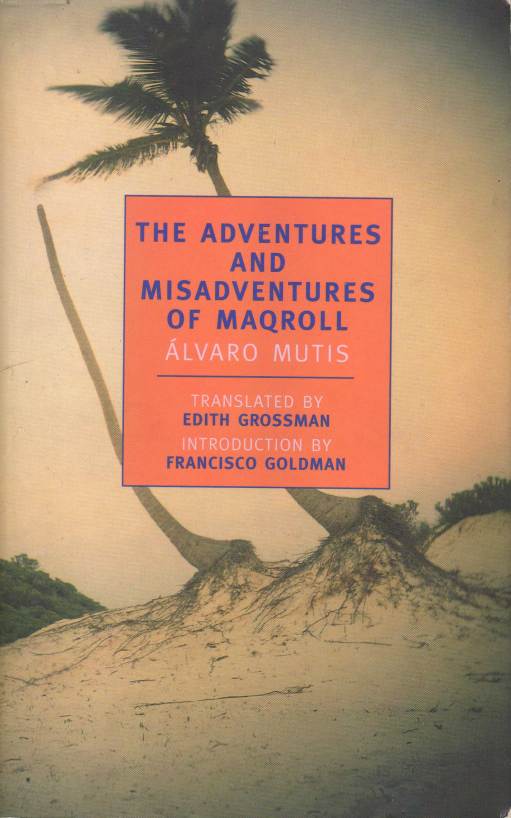
The Adventures and Misadventures of Maqroll — Álvaro Mutis

The Adventures and Misadventures of Maqroll is difficult to categorize. It’s an outlaw adventure story populated by men and women who live where and how they must; these are the people who work near shipyards and the banks of unexplored river tributaries, people who value candor and honesty but for whom strict adherence to the law is often inconvenient. The book is a philosophical rumination on friendship and creation, romance and deception, obstinance and poverty.

The book isn’t a novel, but a collection of seven novellas about Maqroll the Gaviero, written by Álvaro Mutis, who is, according to the introduction and the book jacket, one of Latin America’s finest poets and best friend of Nobel laureate Gabriel Garcia Marquez. A gaviero is the ship’s lookout, the sailor tasked with sitting atop the masts scanning the horizon.  His eyes must always be active.  He must be alert to the nuances of the sea and the capabilities of his vessel.

Mutis is present in these stories, but in a passive role, as reporter of the Gaviero’s adventures. Narrated in no particular order, selected so as to highlight Maqroll’s insatiable desire for experience, each story alludes to many imagined but unwritten characters, places, and events. We’re left with an incomplete impression of a rogue’s beautiful life—Mutis’s ode to his notion of the romantic seafaring gypsy.

The Gaviero is part of a group of wanderers who fascinate those who task themselves with creating whatever literature might be: the spies, pirates, and cowboys who abide the outrageous and rely as much on apathy as on strength in order to avoid the nooses and axes weilded by their enemies.

The Gaviero is not a symbol.  He is a fleshed-out character, as well as the embodiment of an ideal: the knife fighters and Viking poets idolized by Borges, a mixture of Robinson Crusoe, Sam Spade, and Don Quixote. He indulges fantasy but prepares for disappointment. He lives between lawlessness and acceptability. Barkeeps lose a new friend and a good source of business when he leaves town, and one woman always sits in the main room of her home, wondering whether anything she has given will supplement his resolve. He enjoys good food, uncomplicated wine, and the company of interesting friends. The Gaviero is who we all dream of being when we contemplate throwing everything away.

Ilona Comes With the Rain finds Maqroll destitute in Panama City, Panama after the suicide of his ship’s captain. We learn this is a city “like a sedative, full of agreeable but unkept promises of unexpected happiness”; Ilona, the second story in the collection, is indicative of the tone of the collection. Washed up at a hotel owned by a fence and finding himself selling stolen goods outside of tourist attractions, the Gaviero encounters a familiar face by chance, a woman who takes him in, feeds, and clothes him. They make love and decide afterwards to open a brothel catering to men with a thing for stewardesses. It is a magical, buoyant tale and emblematic of the mixture of adventure and world-weariness that Mutis maintains throughout the collection. Before the tragic end we’re treated to stories about a pair of incubi, spirits of noblemen, who drive women insane, the dangers of allowing bookkeepers into whorehouses, and a blind Anatolian with the ability to guess a woman’s place of employment by the texture of the fabric of her clothes.

Throughout the collection, Mutis takes his readers from Malaysia to Finland, from the Mediterranean to the Caribbean.  We live, with the Gaviero, through malarial fever dreams, military interrogations, and assassination attempts.  Un Bel Morir is perhaps the standout story.  Our hero finds himself older, angrier, and  more alone than ever, in a languid town on the banks of a pestilent river.  Broke and bored, knowing better, he takes a job running cargo by mule train up a crumbling mountain trail for a Dutchman with cash (and questionable motives). The Gaviero must evade capture by the rebel forces he has unwittingly aided—as well as the government troops who question his history and motives.

Mutis spent most of his career as a writer crafting verse and not prose, and his poetic inclinations shine through in pieces like this one, a good story that becomes great when the beauty of the unchanging landscape is evoked and contrasted with the hero’s pitiful condition. The cycle of life.  In Un Bel Morir, Maqroll, surrounds himself with beauty, contemplates it, and then tortures himself with unanswerable questions:

. . . the aroma of perpetually damp foliage, the explosion of rich, unrestrained color, the thunder of water in the ravines singing its opulent descent in boiling crests of foam, an ancient restorative peace replaced the weariness of the road and the struggle with the mules. The sordid deceptions he foresaw in the uncertain enterprise lost all reality and were buried in the resigned acceptance of his Islamic fatalism.

This is a delightful book, but not a happy one. The Gaviero symbolizes the struggle to internalize the good while accepting the inevitability of the bad, the chance to create the type of death we envision for ourselves, one with as many or as few regrets as our daily lives will tolerate.

Mutis, a thorough Romantic, compels his readers, through the Gaviero, to examine our reasons for despondency, and instructs us to cherish our innate ability to fall in love with the world and with each other. This collection is an exhortation, a reminder that circumstances change but that innocent pleasures are abundant, available, and free.

Lucifer Son of the Morning, I’m Gonna Chase You Out of Earth — Van Arno

Check out more of Van Arno’s amazing series of oil paintings, The Minstrel Cycle. Artist’s statement about Lucifer Son of the Morning, I’m Gonna Chase You Out of Earth: 

Jay-Z’s ‘Lucifer’ sampled the Max Romeo song ‘Chase The Devil,’  but didn’t include the full chorus, ‘I gonna put on an iron shirt, and chase Satan out of earth… I gonna send him to outer space, to find another race.’ The armor, and futility of the mission brings to mind Don Quixote, who mistakes a windmill for a giant, much as our heroine mistakes the evil in her own nature for a space traveling monster.

Albert Dubout’s Charming Illustrations for Don Quixote

Überblog A Journey Round My Skull has posted (another) fantastic set of illustrations for Don Quixote, this time by French cartoonist and illustrator Albert Dubout. See some of our favorites below, but check out A Journey’s post for more (including a link to all 381 images from the book)–

A Few Thoughts on Starting Don Quixote

Inspired by Roberto Bolaño, who called it his favorite book, sections of Adam Thirlwell’s The Delighted States, Time’s Flow Stemmed’s recent review, and my own sense of literary duty, I picked up Edith Grossman’s translation of Miguel de Cervantes’ epic Don Quixote last week.

I’ve read chunks of the book over the years, but I’ve probably read more about it than I have the thing itself–never a good thing for a reader who aspires to literary criticism, I suppose. Anyway. I’m surprised at a few things so far. First–and I don’t know if it’s an effect of Grossman’s translation–but the book is very easy to read–breezy, almost. Not what I was expecting for a 400 year old tome famous for dismantling high/low distinctions. I’m also surprised at how terribly sad the book is. Most critics cite the book’s humor, its farcical depiction of Don Quixote as a satire on romanticism and erudition. But it’s also about a guy who’s batshit insane, who repeatedly attacks those he comes into contact with, and who also catches a beating himself now and then.

My goal is to finish it this summer–or at least the first book, anyway. The restaurant I ate lunch in today flaunted statues of Don Quixote and Sancho Panza, which I would take to be an auspicious sign if I believed in such things (I don’t). I couldn’t really get a good picture of both with my phone’s camera so I did my best for a headshot of Quixote. The sun’s light seems to obscure him but perhaps that’s appropriate.