Biblioklept’s Favorite Books of the Summer

With Memorial Day ’11 just a memory and Labor Day warning off the wearing of white, I revisit some of the best books I read this summer:

Although I posted a review of Roberto Bolaño’s collection Between Parentheses two weeks before Memorial Day, I continued to read and reread the book over the entire summer. It was the gift that kept giving, a kind of blurry filter for the summer heat, a rambling literary dictionary for book thieves. For example, when I started Witold Gombrowicz’s Trans-Atlantyk a week or two ago, I spent a beer-soaked midnight tracing through Bolaño’s many notations on the Polish self-exile.

Trans-Atlantyk also goes on this list, or a sub-list of this list: great books that I’ve read, been reading (or in some cases, listened to/am listening to) but have not yet reviewed. I finished Trans-Atlantyk at two AM Sunday morning (surely the intellectual antidote to having watched twelve hours of college football that day) and it’s one of the strangest, most perplexing books I’ve ever read—and that’s saying something. Full review when I can process the book (or at least process the idea of processing the book).

I also read and absolutely loved Russell Hoban’s Kleinzeit, which is almost as bizarre as Trans-Atlantyk; like that novel (and Hoban’s cult classic Riddley Walker), Kleinzeit  is written in its own idiom, an animist world where concepts like Death and Action and Hospital and even God become concrete characters. It’s funny and sad. Also funny and sad: Christopher Boucher’s How to Keep Your Volkswagen Alive (new from Melville House). Like Trans-Atlantyk and Kleinzheit, Volkswagen is composed in its own language, a concrete surrealism full of mismatched metaphorical displacements. It’s a rare bird, an experimental novel with a great big heart. Full reviews forthcoming.

I’ll be running a review of Evelio Rosero’s new novel Good Offices this week, but I read it two sittings at the beginning of August and it certainly belongs on this list. It’s a compact and spirited satire of corruption in a Catholic church in Bogotá, unwinding almost like a stage play over the course of a few hours in one life-changing evening for a hunchback and his friends. Good stuff.

On the audiobook front, I’ve been working my way through George R. R. Martin’s A Song of Ice and Fire series; I finished the first audiobook, A Game of Thrones, after enjoying the HBO series, and then moved into the second book, A Clash of Kings, which I’m only a few hours from completing. I think that the HBO series, which follows the first book fairly faithfully, is much closer to The Wire or Deadwood than it is to Peter Jackson’s Tolkien films—the story is less about fantasy and magic than it is about political intrigue during an ongoing civil war. This is a world where honor and chivalry, not to mention magic and dragons, have disappeared, replaced by Machiavellian cunning and schemers of every stripe. Martin slowly releases fantastic elements into this largely desacralized world, contesting his characters’ notions of order and meaning. There are also beheadings. Lots and lots of beheadings. The books are a contemporary English department’s wet dream, by the by. Martin’s epic concerns decentered authority; it critiques power as a constantly shifting set of differential relations lacking a magical centering force. He also tells his story through multiple viewpoints, eschewing the glowing third person omniscient lens that usually focuses on grand heroes in fantasy, and concentrates instead, via a sharp free indirect style, on protagonists who have been relegated to the margins of heroism: a dwarf, a cripple, a bastard, a mother trying to hold her family together, a teenage exile . . . good stuff.

Leo Tolstoy’s final work Hadji Murad also depicts a world of shifting power, civil war, unstable alliances, and beheadings (although not as many as in Martin’s books). Hadji Murad tells the story of the real-life Caucasian Avar general Hadji Murad who fought under Imam Shamil, the leader of the Muslim tribes of the Northern Caucuses; Shamil was Russia’s greatest foe. This novel concerns Murad’s attempt to defect to the Russians and save his family, which Shamil has captured. The book is a richly detailed and surprisingly funny critique of power and violence.

William Faulkner’s Light in August might be the best book I read this summer; it’s certainly the sweatiest, headiest, and grossest, filled with all sorts of vile abjection and hatred. Faulkner’s writing is thick, archaeological even, plowing through layers of Southern sediment to dig up and reanimate old corpses. The book is somehow both nauseating and vital. Not a pleasant read, to be honest, but one that sticks with you—sticks in you even—long after the last page.

Although David Foster Wallace’s posthumous novel The Pale King was released in the spring, I didn’t start reading it until June; too much buzz in my ears. If you’ve avoided reading it so far because of the hype, fair enough—but don’t neglect it completely. It’s a beautiful, frustrating, and extremely rewarding read.

Speaking of fragments from dead writers: part two of Roberto Bolaño’s The Third Reich, published in the summer issue of The Paris Review, was a perfect treat over the July 4th weekend. I’m enjoying the suspense of a serialized novel far more than I would have imagined.

Wayne Koestenbaum’s Humiliation is probably the funniest, wisest, and most moving work of cultural studies I’ve ever read.  Unlike many of the tomes that clutter academia, Humiliation is accessible, humorous, and loving, a work of philosophical inquiry that also functions as cultural memoir. Despite its subject of pain and abjection, it repeatedly offers solutions when it can, and consolation and sympathy when it cannot.

So the second posthumously published, unfinished novel from a suicide I read this summer was Ernest Hemingway’s The Garden of Eden, the sultry strange tale of a doomed ménage à trois. (I’m as humiliated by that last phrase as you might be, dear reader. Sorry). Hemingway’s story of young beautiful newlyweds drinking and screwing and eating their way across the French Riviera is probably the weirdest thing he ever wrote. It’s a story of gender reversals, the problems of a three-way marriage, elephant hunting, bizarre haircuts, and heavy, heavy drinking. The Garden of Eden is perhaps Hemingway at his most self-critical; it’s a study in how Hemingway writes (his protagonist and stand-in is a rising author) that also actively critiques his shortcomings (as both author and human). The Garden of Eden should not be overlooked when working through Hemingway’s oeuvre. I’d love to see a critical edition with the full text someday (the novel that Scribner published pared down Hemingway’s unfinished manuscript to about a third of its size).

Also fragmentary fun: F. Scott Fitzgerald’s Notebooks. Like Twitter before Twitter, sort of.

These weren’t the only books I read this summer but they were the best.

The Garden of Eden — Ernest Hemingway

In general, I dislike reviews that frontload context—get to the book, right? So here’s a short review of Ernest Hemingway’s The Garden of Eden: it is stranger than most of what Hemingway wrote, by turns pleasant, uncomfortable, bewildering, and beautiful. And readable. It’s very, very readable. Young people (or older folks; let’s not be prejudiced) working their way through Hemingway shouldn’t put The Garden of Eden on the back-burner in favor of his more famous works, and anyone who might have written off Hemingway as unreflective macho bravado should take a look at some of the strange gender games this novel has to offer. So, that’s a recommendation, okay?

Now on to that context, which I think is important here. See, The Garden of Eden is one of those unfinished novels that get published posthumously, put together by editors and publishers and other book folk, who play a larger role than we like to admit in the finished books we get from living authors anyway. For various reasons, cultural, historical, etc., we seem to favor the idea of the Singular Artistic Genius who sculpts beauty and truth out of raw Platonic forms that only he or she can access (poor tortured soul). The reality of how our books get to us is a much messier affair, and editors and publishers and even literary studies departments in universities have a large hand in this process, one we tend to ignore in favor of the charms of a Singular Artistic Genius. There’s a fascinating process there, but also a troubling one. Editing issues complicate our ideals of (quite literally) stable authority—is this what the author intended?, we ask (New Critics be damned!). David Foster Wallace and Michael Pietsch, Raymond Carver and Gordon Lish, Franz Kafka and Max Brod, Mary Shelley and Percy Shelley . . .  not to mention Shakespeare, Chaucer, Beowulf, The Bible, Homer, etc. etc. etc. But you’re here to read about The Garden of Eden, right gentle reader? Mea culpa. I’ve been blathering away. Let me turn the reins over to the estimable talents of E.L. Doctorow, who offers the following context in his 1986 review of the book in The New York Times

Since Hemingway’s death in 1961, his estate and his publishers, Charles Scribner’s Sons, have been catching up to him, issuing the work which, for one reason or another, he did not publish during his lifetime. He held back ”A Moveable Feast” out of concern for the feelings of the people in it who might still be alive. But for the novel ”Islands in the Stream” he seems to have had editorial misgivings. Even more deeply in this category is ”The Garden of Eden,” which he began in 1946 and worked on intermittently in the last 15 years of his life and left unfinished. It is a highly readable story, if not possibly the book he envisioned. As published it is composed of 30 short chapters running to about 70,000 words. A publisher’s note advises that ”some cuts” have been made in the manuscript, but according to Mr. Baker’s biography, at one point a revised manuscript of the work ran to 48 chapters and 200,000 words, so the publisher’s note is disingenuous. In an interview with The New York Times last December, a Scribners editor admitted to taking out a subplot in rough draft that he felt had not been integrated into the ”main body” of the text, but this cut reduced the book’s length by two-thirds.

So, yeah. The version we have of The Garden of Eden is heavily cut, and also likely heavily arranged. But that’s what editors do, and this is the book we have (for now, anyway—it seems like on the year of its 25th anniversary of publication, and the 50th anniversary of Hemingway’s death that Scribner should work toward putting out an unedited scholarly edition) — so I’ll talk about that book a bit.

The Garden of Eden tells the story of a few months in the lives of a young newlywed couple, David Bourne, an emerging novelist, and his wife Catherine, a trust fund baby flitting about Europe. The novel is set primarily on the French Riviera, in the thin sliver of high years between the two big wars. David and Catherine spend most of their days in this Edenic setting eating fine food and making love and swimming and riding bikes and fishing. And drinking. Lots and lots of drinking. Lots of drinking. It all sounds quite beautiful—h0w about a taste?

On this morning there was brioche and red raspberry preserve and the eggs were boiled and there was a pat of butter that melted as they stirred them and salted them lightly and ground pepper over them in the cups. They were big eggs and fresh and the girl’s were not cooked quite as long as the young man’s. He remembered that easily and he he was happy with his which he diced up with the spoon and ate with only the flow of the butter to moisten them and the fresh early morning texture and the bite of the coarsely ground pepper grains and the hot coffee and the chickory-fragrant bowl of café au lait.

Hemingway’s technique throughout the novel is to present the phenomenological contours of a heady world. It’s lovely to ride along with David and Catherine, rich and free and beautiful.

Their new life together is hardly charmed, however. See, Catherine gets a haircut—

Her hair was cropped as short as a boy’s. It was cut with no compromises. It was brushed back, heavy as always, but the sides were cut short and the ears that grew close to her head were clear and the tawny line of her hair was cropped close to her head and smooth and sweeping back. She turned her head and lifted her breasts and said, “Kiss me please.”  . . .

“You see, she said. “That’s the surprise. I’m a girl. But now I’m a boy too and I can do anything and anything and anything.”

“Sit here by me,” he said. “What do you want, brother.”

David’s playful response—calling his wife “brother”—covers up some of his shock and fear, but it also points to his underlying curiosity and gender confusion. And indeed, Catherine’s new haircut licenses her to “do anything and anything and anything” — beginning with some strange bed games that night—

He had shut his eyes and he could feel the long light weight of her on him and her breasts pressing against him and her lips on his. He lay there and felt something and then her hand holding him and searching lower and he helped with his hands and then lay back in the dark and did not think at all and only felt the weight and the strangeness inside and she said, “Now you can’t tell who is who can you?”

“No.”

“You are changing,” she said. “Oh you are. You are. Yes you are and you’re my girl Catherine. Will you change and be my girl and let me take you?”

“You’re Catherine.”

“No. I’m Peter. You’re my wonderful Catherine. You’re my beautiful, lovely Catherine. You were so good to change. Oh thank you, Catherine, so much. Please understand. Please know and understand. I’m going to make love to you forever.”

David, partial stand-in for Hemingway, transforms into a girl who feels “something” during sex with Catherine (or, ahem, Peter)—note that that “something” has no clear referent. As their gender inverting games continue (much to David’s horror), Hemingway’s usually concrete language retreats to vague proforms without referents, “it”s without antecedents; his usually precise diction dissolves in these scenes, much as the Bournes’ marriage dissolves each time Catherine escalates the gender inversion. David gives her the nickname “Devil,” as if she were both Eve and Serpent in their Garden. Catherine’s transformations continue as she cuts her hair back even more, and sunbathes all the time so that she can be as dark as possible. She dyes her hair a silver blonde and makes David get his hair cut and dyed the same.

The bizarre behavior (shades of Scott and Zelda?) culminates in Catherine introducing another woman into the marriage. Marita falls in love with both David and Catherine, but her lesbian sex with Catherine only accelerates the latter’s encroaching insanity. David is initially radically ambivalent to the ménage à trois proposed by his wife; he has the good sense to see that a three-way marriage is ultimately untenable and that his wife is going crazy. He vacillates between hostility and love for the two women, but eventually finds a support system in Marita as it becomes increasingly apparent (to all three) that Catherine is depressed and mentally unstable, enraged that David has ceased to write about the pair’s honeymoon adventures on the Riviera. Catherine has been bankrolling David; jealous of good reviews from his last novel, she insists that he write only their story, but David would rather write “the hardest story” he knows—the story of his childhood in East Africa with his father, a big game hunter.

In some of the most extraordinary passages of The Garden of Eden, David writes himself into his boyhood existence, trailing a bull elephant with his father through a jungle trek. David has spotted the elephant by moonlight, prompting his father and his father’s fellow tracker and gun bearer Juma to hunt the old beast. As they trail the animal, David begins to realize how horrible the hunt is, how cruel it is to kill the animal for sport. The passages are somewhat perplexing given Hemingway’s reputation as a hunter. Indeed, this is one of the major features of The Garden of Eden: it repeatedly confounds or complicates our ideas about Hemingway the man’s man, Hemingway the writer, Hemingway the hunter. David describes the wounded, dying elephant—

They found him anchored, in such suffering and despair that he could no longer move. He had crashed through the heavy cover where he had been feeding and crossed a path of open forest and David and his father had run along the heavily splashed blood trail. Then the elephant had gone on into thick forest and David had seen him ahead standing gray and huge against the trunk of a tree. David could only see his stern and then his father moved ahead of him and he followed and they came alongside the elephant as though he was a ship and David saw the blood coming from his flanks and running down his sides and then his father raised his rifle and fired and the elephant turned his head with the great tusks moving heavy and slow and looked at them and when his father fired the second barrel the elephant seemed to sway like a felled tree and came smashing down toward them. But he was not dead. He had been anchored and now he was down with his shoulder broken. He did not move but his eye was alive and looked at David. He had very long eyelashes and his eye was the most alive thing David had ever seen.

David succeeds in writing this “hard” story, and the passages are remarkable in their authenticity—David’s story is a good story, the highlight of the book perhaps; it’s not just Hemingway telling us that David wrote a great story, we actually get to experience the story itself as well as the grueling process by which it was made. Hemingway and his surrogate David show us—make us experience—how difficult writing really is, and then share the fruit of that labor with us. These scenes raise the stakes of The Garden of Eden, revealing how serious David is when he remarks (repeatedly) that the writing is the most important thing—that it outweighs love, it surpasses his marriage. These realizations freight the climax of the novel all the more heavily, but I will avoid anymore spoilers.

The Garden of Eden has some obvious flaws. Marita is underdeveloped at best for such an important character, and her love for David and Catherine remains unexplored, and in fact barely remarked upon. The biggest problem with the book is its conclusion, which feels too pat, too obvious for such a strange, amorphous book. It is here that the presence of an editorial hand seems clearest, to the extent that I wonder if the short little chapter that concludes the novel wasn’t cobbled together from a few stray sentences throughout the manuscript. But The Garden of Eden, despite some shortcomings, is a book well worth reading. The novel complicates not just Hemingway’s reputation, but also our sense of Hemingway’s sense of himself. Recommended.

“Ernest Taking Me to That Bum Restaurant” and Other References to Hemingway in F. Scott Fitzgerald’s Notebooks

F. Scott Fitzgerald’s Notebooks are crammed with little sketches, scenes, observations, and, uh, notes (obviously). Although they are brief, his notes on Ernest Hemingway reveal much about Fitzgerald’s agon with Papa.

Ernest—until we began trying to walk over each other with cleats.

Snubs—Gen. Mannsul, Telulah phone, Hotel O’Con­nor, Ada Farewell, Toulman party, Barrymore, Tal­madge, and M. Davies. Emily Davies, Tommy H. meeting and bottle, Frank Ritz and Derby, Univ. Chicago, Vallambrosa and yacht, Condon, Gerald in Paris, Ernest apartment.

Day with a busy man. Combine the day of Ernest’s pictures, the man of genius episode,

As to Ernest as a boy—reckless, adventurous, etc. Yet it is undeniable that the dark was peopled for him. His bravery and acquired characteristics.

Nevertheless value of Ernest’s feeling about the pure heart when writing—in other words the comparatively pure heart, the “house in order.”

That Willa Cather’s poem shall stand at beginning of Mediaval and that it shall be the story of Ernest.

Just as Stendahl’s portrait of a Byronic man made Le Rouge et Noir so couldn’t my portrait of Ernest as Phillipe make the real modern man.

Didn’t Hemmingway say this in effect:  If Tom Wolfe ever learns to separate what he gets from books from what he gets from life he will be an original. All you can get from books is rhythm and technique. He’s half-grown artistically—this is truer than what Ernest said about him. But when I’ve criticized him (several times in talk) I’ve felt bad afterwards. Putting sharp weapons in the hands of his inferiors.

Ernest Hemingway, while careful to avoid cliches in his work, fairly revels in them in his private life, his favorite being Parbleu (“So what?”) French, and “Yes, We Have No Bananas.” Contrary to popular opinion he is not as tall as Thomas Wolfe, standing only six feet five in his health belt. He is naturally clumsy with his body, but shooting from a blind or from adequate cover, makes a fine figure of a man. We are happy to announce that his work will appear in future exclusively on United States postage stamps.

Parallel of Ernest’s and French conversation as opposed to Gerald and me and U.S.A. emotional bankruptcy.

Do you know what your affair was founded on? On sorrow. You got sorry for each other. (Did Ernest borrow this one?)

Very strong personalities must confine themselves in mutual conversation to very gentle subjects. Everything eventually transpired—but if they start at a high pitch as at the last meeting of Ernest, Bunny and me their meeting is spoiled. It does not matter who sets the theme or what it is.

Ernest taking me to that bum restaurant. Change of station implied.

Ernest would always give a helping hand to a man on a ledge a little higher up.

Ernest Hemingway and Ernest Lubitsch—Dotty “We’re all shits.”

I talk with the authority of failure—Ernest with the authority of success. We could never sit across the table again.

People like Ernest and me were very sensitive once and saw so much that it agonized us to give pain. People like Ernest and me love to make people very happy, caring desperately about their happiness. And then people like Ernest and me had reactions and punished people for being stupid, etc., etc. People like Ernest and me————

Tom Fast’s story of Ernest.

Ernest and “Farewell to Arms”—producer story.

An inferiority complex comes simply from not feeling you’re doing the best you can—Ernest’s “drink” was simply a form of this.

It [For Whom the Bell Tolls] is so to speak Ernest’s ’Tale of Two Cities’ though the comparison isn’t apt. I mean it is a thoroughly superficial book which has all the profundity of Rebecca.

I want to write scenes that are frightening and inimitable. I don’t want to be as intelligible to my contemporaries as Ernest who as Gertrude Stein said, is bound for the Museums. I am sure I am far enough ahead to have some small immortality if I can keep well.

But there was one consolation:  They could never use any of Mr. Hemingway’s four letter words, because that was for fourth class and fourth class has been abolished—
(The first class was allowed to cheat a little on the matter.)
But on the other hand they could never use any two letter words like NO. They had to use three letter words like YES!

Bald Hemingway characters.

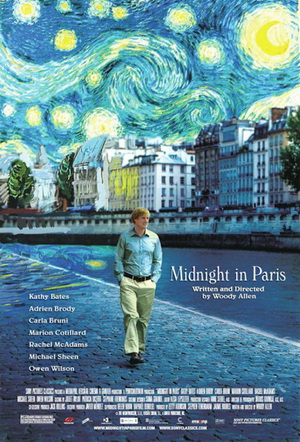
Midnight in Paris — Woody Allen

Woody Allen’s new film Midnight in Paris opens with a sumptuous montage of the City of Light, clearly establishing from the get-go that the movie is Allen’s love letter to Paris. The romantic overture idealizes Paris, just as the film’s protagonist Gil, played pitch perfect by Owen Wilson, idealizes the Lost Generation of writers and artists who populated the cafes and bars of Paris in the ’20s. Gil is on a working vacation with his fiancé and future in-laws; he’s a successful Hollywood screenwriter but dreams of becoming a great novelist. Only he’s struggling with his novel-in-progress, which features a protagonist who runs a nostalgia shop. Nostalgia, or the romance of nostalgia, is the primary idiom of Midnight in Paris, and Owen Wilson transcends the usual parameters of Woody-surrogate in bringing this idiom to life. Wilson’s breezy charisma propels the movie forward at all times; indeed, the entire plot rests on Wilson’s charm, which saves the film from falling into syrupy dreck or boring indie whimsy.

Midnight in Paris works to literally charm its viewers and its protagonist, transporting the narrative back into the ’20s via a magical motorcar, where Wilson’s Gil falls in with a host of notable writers, artists, dancers, and other personalities. There are Cole Porter and Salvador Dali, Man Ray and Luis Bunuel, Pablo Picasso and Josephine Baker—but the standouts are the Fitzgeralds, Gertrude Stein, and Ernest Hemingway. The Hemingway character is a marvelous parody of both Hemingway’s caricature and Hemingway’s prose—although I think the humor in his scenes was lost on more than a few of the audience members I watched the film with. On Hemingway’s advice, Gil submits his manuscript to Gertrude Stein for an honest critique. In the meantime, Gil engages in a romance with Adrianna, Picasso’s muse and mistress, who herself pines for the Belle Époque era. Through another magical transposition, Gil and Adrianna move again through time, heading back to the 1890s to meet Toulouse-Lautrec and Paul Gaugin. As Gil pursues a romance with Adrianna (and the nostalgia of an idealized past), his own fiancé seems to be spending a bit too much time with a windbaggish and pretentious American who is a visiting lecturer at the Sorbonne. The reality of this conflict pulls Gil into making dramatic choices about his own future.

Midnight in Paris falls squarely into Allen’s fantasy films like The Purple Rose of Cairo, A Midsummer Night’s Sex Comedy, Alice, and Shadows and Fog. The film has much to offer those who, like Gil, find themselves fascinated by the romance of the Lost Generation. Allen’s parodies of the Fitzgeralds, Hemingway, and the rest are loving and gentle, and will surely be appreciated by most English majors. At the same time, Midnight in Paris is a slight, ephemeral work, one that relies on beautiful cinematography and the charm of its lead character more than plot, insight, or even jokes. There is no risk or danger in Gil’s fantasy, no sense that his sanity is in jeopardy or that he might not come to realize the theme of the film, which he spells out clearly for the audience if they somehow missed it—the tendency to romanticize the past has more to do with a dissatisfaction with the present than with any objective evidence that the past was somehow better, and dissatisfaction with the present should be viewed positively, for dissatisfaction can be productive and meaningful if we engage it. Recommended.

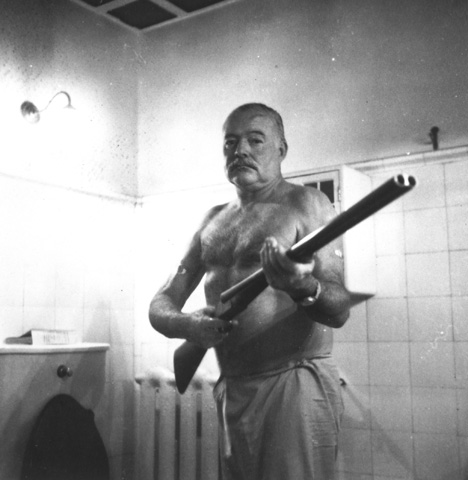
Ernest Hemingway’s Suicide Gun

Garden & Gun ran a short piece on Ernest Hemingway’s guns last year, and linked to a slideshow of the famous author (who killed himself 50 years ago today) with his guns. From the article—

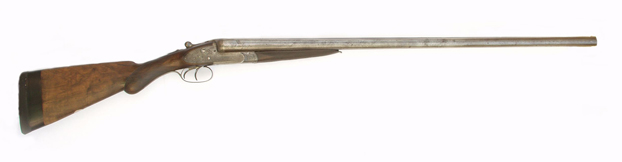
When Ernest Hemingway took his own life on July 2, 1961, it was reported in Life magazine that he had done so with a “double-barreled shotgun.” Further reports specified the gun was a Boss that he had purchased from Abercrombie & Fitch, and for years this has been widely accepted as fact. But a fascinating new book, Hemingway’s Guns, by Silvio Calabi, Steve Helsley, and Roger Sanger (Shooting Sportsman Books), makes the case that Hemingway never owned a Boss, and that the suicide gun was actually made by W. & C. Scott & Son. It was Hemingway’s pigeon gun, a long-barreled side-by-side that traveled with him from shooting competitions in Cuba to duck hunts in Italy to a safari in East Africa. By all accounts it was a favorite.

Not long after that tragic day in Ketchum, Idaho, the gun was given to a local welder to be destroyed. “The stock was smashed and the steel parts cut up with a torch,” the authors write. “The mangled remnants were then buried in a field.” Roger Sanger visited the welding shop, which is still in business and being run by the grandson of the original proprietor. Amazingly, the welder still had a few pieces of the gun in a matchbox, and Sanger’s immediate reaction to the evidence was, “This is no Boss.” After showing pictures to a number of experts and collectors, he confirmed that it was most likely Hemingway’s beloved W. & C. Scott that had been the suicide gun.

A W. & C. Scott & Son Monte Carlo B—Serial No. 60293, c. 1898

“Hemingway and Ourselves” — Italo Calvino

“Hemingway and Ourselves,” a 1954 essay by Italo Calvino, collected in Why Read the Classics?

Hemingway and Ourselves

There was a time when for me — and for many others, those who are more or less my contemporaries — Hemingway was a god. And they were good times, which I am happy to remember, without even a hint of that ironic indulgence with which we look back on youthful fashions and obsessions. They were serious times and we lived through them seriously and boldly and with purity of heart, and in Hemingway we could also have found pessimism, an individualistic detachment, a superficial involvement with extremely violent experiences: that was all there too in Hemingway, but either we could not see it in him or we had other things in our head, but the fact remains that the lesson we learnt from him was one of a capacity for openness and generosity, a practical commitment — as well as a technical and moral one – to the things that had to be done, a straightforward look, a rejection of self-contemplation or self-pity, a readiness to snatch a lesson for life, the worth of a person summed up in a brusque exchange, or a gesture. But soon we began to see his limitations, his flaws: his poetics, his style, to which I had been largely indebted in my first literary works, came to be seen as narrow, too prone to descending into mannerism. That life of his — and philosophy of life — of violent tourism began to fill me with distrust and even aversion and disgust. Today, however, ten years on, assessing the balance of my apprenticeship with Hemingway, I can close the account in the black. ‘You didn’t put one over on me, old man,’ I can say to him, indulging for the last time in his own style, ‘you did not make it, you never became a mauvais maitre.’ The aim of this discussion of Hemingway, in fact – now that he has won the Nobel Prize for Literature, a fact that means absolutely nothing, but which is as good an occasion as any other for putting down onpaper ideas that have been in my head for some time – is to try to define both what Hemingway meant for me, and what he is now, what moved me away from him and what I continue to find in his not others’ works.

Continue reading ““Hemingway and Ourselves” — Italo Calvino”

“I Learn as Much from Painters About How to Write as from Writers” — Hemingway on His Literary Forebears

Ernest Hemingway describes his influences in his 1958 interview with George Plimpton at The Paris Review

INTERVIEWER

Who would you say are your literary forebears—those you have learned the most from?

HEMINGWAY

Mark Twain, Flaubert, Stendhal, Bach, Turgenev, Tolstoy, Dostoyevsky, Chekhov, Andrew Marvell, John Donne, Maupassant, the good Kipling, Thoreau, Captain Marryat, Shakespeare, Mozart, Quevedo, Dante, Virgil, Tintoretto, Hieronymus Bosch, Brueghel, Patinir, Goya, Giotto, Cézanne, Van Gogh, Gauguin, San Juan de la Cruz, Góngora—it would take a day to remember everyone. Then it would sound as though I were claiming an erudition I did not possess instead of trying to remember all the people who have been an influence on my life and work. This isn’t an old dull question. It is a very good but a solemn question and requires an examination of conscience. I put in painters, or started to, because I learn as much from painters about how to write as from writers. You ask how this is done? It would take another day of explaining. I should think what one learns from composers and from the study of harmony and counterpoint would be obvious.


F. Scott Fitzgerald Falls off the Wagon

Just finished reading this great 1982 Paris Review interview with famed poet, journalist, and tastemaker Malcolm Cowley; he talks Faulkner, Hemingway, Stein, drinking, sanity, poetry, publishing and more. Here, he shares an anecdote about F. Scott Fitzgerald

INTERVIEWERS

Do you see a relationship between unhappiness and poetic creativity?

COWLEY

To the extent that poems may be born from a straining of one’s senses and imagination to a degree to which they couldn’t be strained in ordinary life. I was reading F. Scott Fitzgerald’s correspondence the other day. Scott and Zelda’s difficulties were ones that I never had to face; I never had to drive myself to drink in order to get my imagination working. Actually, I found my imagination worked best on fatigue. That’s another form of intoxication . . . to set yourself writing, and keep on writing until after two or three hours the subconscious takes over. It’s certainly safer than alcohol. The trouble with alcohol is that you can’t keep it up.

I went to visit the Fitzgeralds when they were living outside of Baltimore—a place called “La Paix.” Scott said to me, “I’m on the wagon, but I got you a pint of whiskey from my bootlegger; I’m on water.” So we talked, or mostly he talked, and every once in a while he’d go out to the kitchen to get another glass of water. His talk became more belligerent, sometimes incoherent, until finally he said, “You know, that water I’ve been drinking all evening—it’s half grain alcohol.” I said to myself, “Oh . . . surprise!”


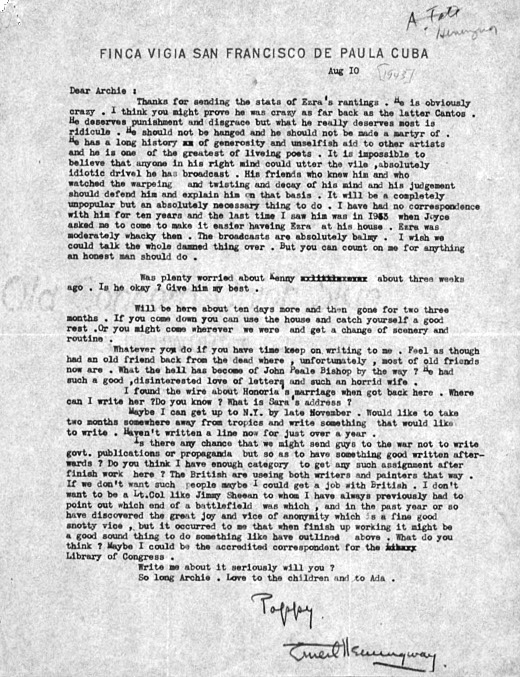
Ernest Hemingway Writes Archibald MacLeish About Ezra Pound’s Craziness

Ernest Hemingway writes Archibald MacLeish about Ezra Pound. Here’s the letter, via the excellent folks at Letters of Note, also responsible for the bit of transcription we’ve excised below–

Thanks for sending the stats of Ezra’s rantings. He is obviously crazy. I think you might prove he was crazy as far back as the latter Cantos. He deserves punishment and disgrace but what he really deserves most is ridicule. He should not be hanged and he should not be made a martyr of. He has a long history of generosity and unselfish aid to other artists and he is one of the greatest living poets. It is impossible to believe that anyone in his right mind could utter the vile, absolutely idiotic drivel he has broadcast. His friends who knew him and who watched the warpeing and twisting and decay of his mind and his judgement should defend him and explain him on that basis. It will be a completely unpopular but an absolutely necessary thing to do. I have had no correspondence with him for ten years and the last time I saw him was in 1933 when Joyce asked me to come to make it easier haveing Ezra at his house. Ezra was moderately whacky then. The broadcasts are absolutely balmy. I wish we could talk the whole damned thing over. But you can count on me for anything an honest man should do.

Enjoy Thanksgiving with Our Literary Recipes Roundup

Happy Thanksgiving!

Enjoy Turkey Day (sans turkey) with Biblioklept’s menu of literary recipes:

Zora Neale Hurston’s Mulatto Rice

Ian McEwan’s Fish Stew

James Joyce’s Burnt Kidney Breakfast

Herman Melville’s Whale Steaks

Ernest Heminway’s Absinthe Cocktail, Death in the Afternoon

Vladimir Nabokov’s Eggs à la Nabocoque

Thomas Pynchon’s Banana Breakfast

Cormac McCarthy’s Turtle Soup

Robert Crumb’s Macaroni Casserole


Ernest Hemingway’s Death in the Afternoon (the Cocktail, Not the Book)

Ernest Hemingway is famous for writing classic novels like For Whom the Bell Tolls, The Old Man and The Sea, and The Sun Also Rises. Apparently, he also liked to imbibe the occasional alcoholic beverage.

A recipe for a drink named after Hemingway’s novel Death in the Afternoon was published in the 1935 cocktail book So Red the Nose, or Breath in the Afternoon by Sterling North and Carl Kroch. Here’s that recipe–

Add one jigger of absinthe to a champagne flute
Add iced champagne until it attains the proper opalescence.
A small amount of sugar or Gomme syrup can be added to round it out, especially when using a verte absinthe.

Here’s Hemingway’s note on the drink’s origin–

This was arrived at by the author and three officers of the H.M.S. Danae after having spent seven hours overboard trying to get Capt. Bra Saunders’ fishing boat off a bank where she had gone with us in a N.W. gale.


James Franco and Michael Cunningham on Writing and MFA Programs

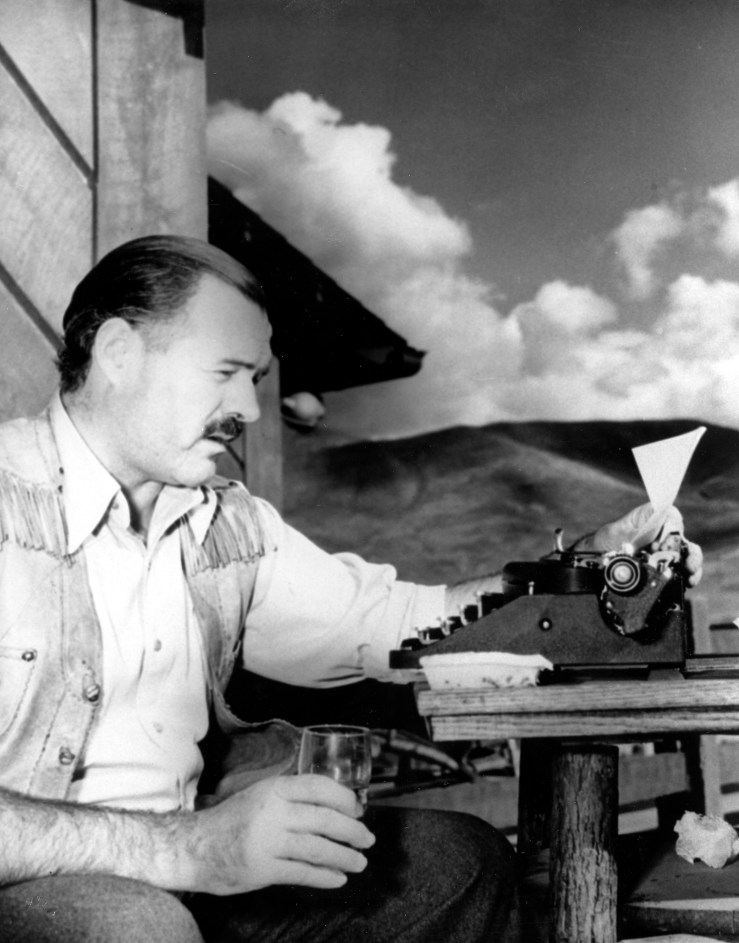
Some Comments on the Impressiveness of a Certain Photograph of Ernest Hemingway

I posted this photograph of Ernest Hemingway yesterday in a series of photos of authors’ typewriters

It seems to me that this photo expresses a minimum of five kinds of awesomeness upon which I must remark. Now, before you gripe about Hemingway being an author more famous at this point for his image than his actual work, get over it. In fact, I’ve already been there and gotten over it. On to the awesomeness–

1. The sky. Look at that sky. And those mountains. (Or are they just hills? I’m from Florida. They look like mountains). Let the sky stand for context. It’s 1939 and Hemingway is writing For Whom the Bell Tolls in Sun Valley, Idaho. How could he write under that sky? How could he not write?

2. That mustache. The authority therein. Handsome but grim. Fierce but refined. I want my own mustache like that.

3. The vest. Oh my god, that vest. The fringe. You can almost smell it. Like he’s a boy, playing cowboys and Indians.

4. The glass. Hemingway, I think, is not drinking water here. I think he is drinking something else. It could be anything (not water), but I think he’s drinking scotch. I’m going to pretend he’s drinking bourbon, but I don’t think it’s bourbon.

5. That expression. If Hemingway is merely posing for a photographer (entirely plausible, highly likely in fact), the pose is nevertheless at the same time utterly real. Is he scrutinizing the words? Squinting in the sun? Is it the booze that has puckered his eyes thusly? That brow, only slightly furrowed (only brows furrow); the arch of his hair, slick but not oily, thrusting back with a calm energy. The slight slouch. The mouth, a bit open; commenting perhaps, or exhaling (no, not exhaling), or maybe perched for another sip.

I love this photo.

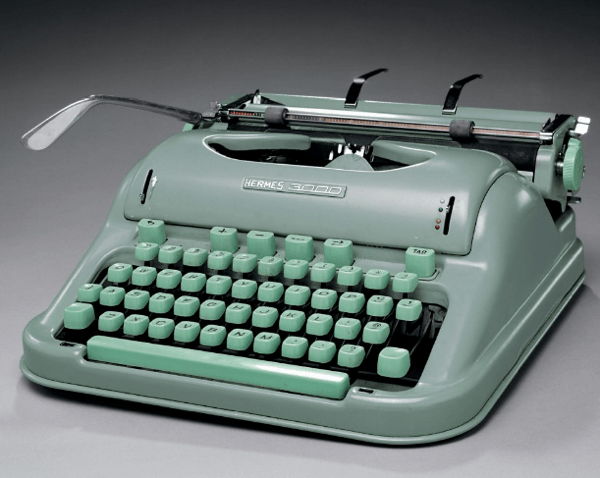
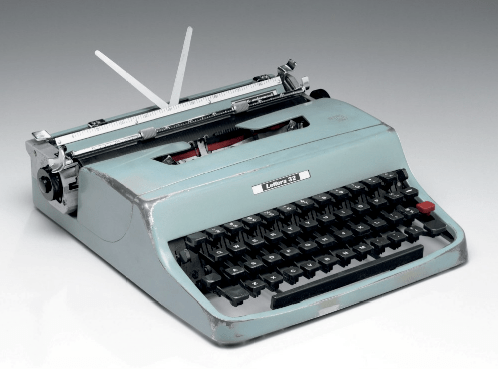
Famous Authors’ Typewriters

Jack Kerouac's Typewriter
Another Kerouac Typewriter
Sylvia Plath's Typewriter
Cormac McCarthy's Typewriter
John Updike's Typewriter
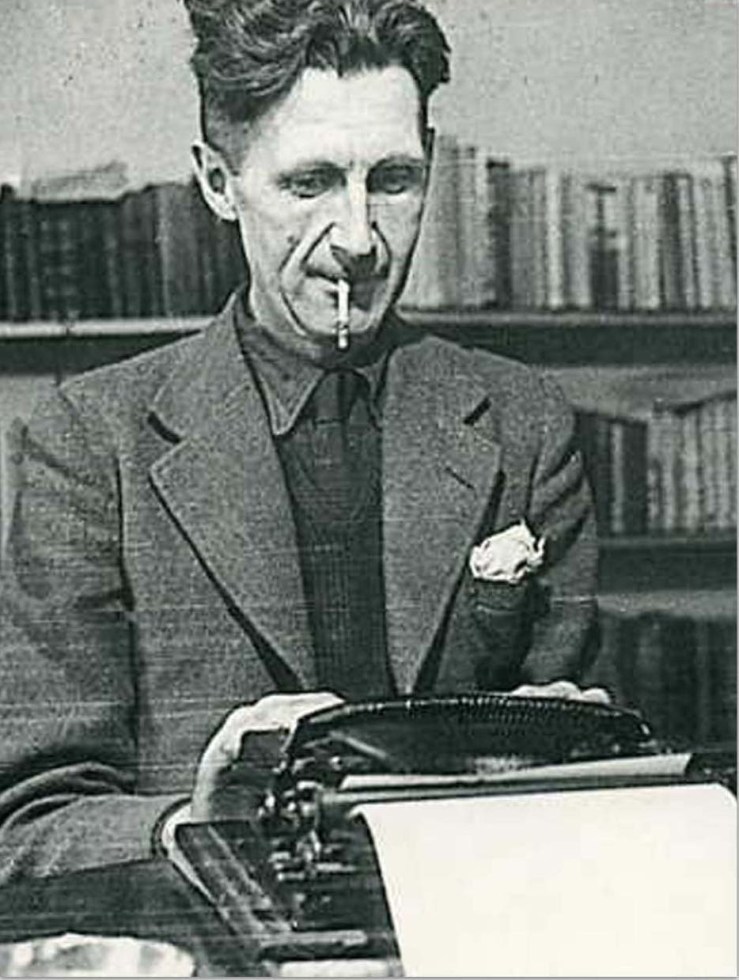
George Orwell Tickling the Keys
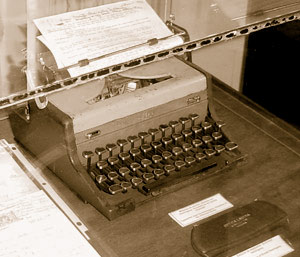
Ernest Hemingway's Typewriter
How To Write

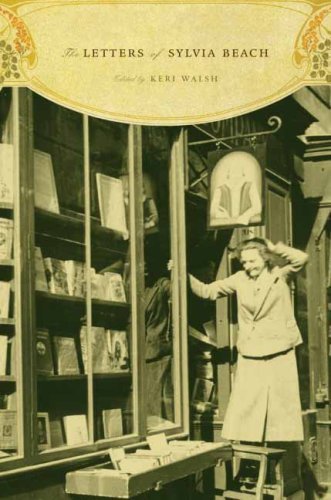
Biblioklept Interviews Keri Walsh about Her New Book, The Letters of Sylvia Beach

Keri Walsh’s new book The Letters of Sylvia Beach sheds light on one of modern literature’s most fascinating figures. Sylvia Beach was the nexus point for the ex-pat/Lost Generation/Modernist scene in the first half of the twentieth century. Along with her partner Adrienne Monnier, Beach ran the Left Bank bookstore Shakespeare & Company until the Nazi occupation of Paris in 1941. She was the first publisher of Joyce’s Ulysses, she translated Paul Valéry into English, and she was close friends to a good many great writers, including William Carlos Williams, Ezra Pound, H.D., and Ernest Hemingway. Walsh’s book compiles Beach’s letters, revealing a woman who cared deeply about literature and art, who was funny and sincere, and who loved her famous (and not so famous) friends dearly. Over a series of emails, we talked to Dr. Walsh about The Letters of Sylvia Beach, which is out now from Columbia UP. Keri Walsh teachers 20th Century British and Irish Literature at Claremont McKenna College in Los Angeles.

Biblioklept: How did you get interested in Sylvia Beach?

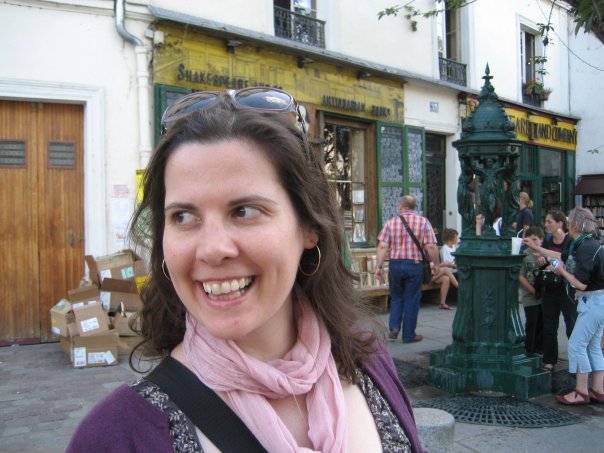
Keri Walsh: I got interested in Sylvia Beach in the same way that many English-speaking visitors to Paris do: when I stumbled upon the Shakespeare and Company bookstore in Paris.  Of course, the current bookstore is its own entity: it’s not the direct descendant of Beach’s.  It was founded after the Second World War by George Whitman, and it’s been there so long that it’s now legendary in its own right.  Today it’s run by Whitman’s daughter, Sylvia Beach Whitman.  The shop preserves many of the qualities of Beach’s original: the whimsicality, the friendliness, the sense of being a gathering place for expats. So it was easy to fall in love with it and to want to learn more about its origins.

Sylvia Beach grew up in Princeton, New Jersey. Beach’s father was minister of the Presbyterian Church just up the street from the university campus. I didn’t know that when I began my Ph.D. studies in the English department there.  I was delighted to learn that Firestone library, where I worked every day, owned a vast collection of Sylvia Beach’s letters, photographs, books, and belongings.  They even had the original “Shakespeare and Company” sign that had hung in front of her store.  I started to read through her letters, beginning with the ones she wrote as a teenager.  Even then she was always reading.  I was charmed by how funny she was, and how resourceful. She could talk her friends into just about anything– including smuggling illegal copies of Ulysses into the United States.

Her correspondents were so illustrious that I was surprised to learn that her letters had never been published. Because she wrote to Gertrude Stein, Ernest Hemingway, H.D. and others, I hoped that this volume might make a contribution to the study of modernist literary culture.  But I also wanted to share Beach’s story for its own sake, because she was so fascinating and endearing.  I had a hunch that there would be other readers like me who wanted to know more about Beach, and about the sensibility that informed Shakespeare and Company.  I thought about all the people who love modernist Paris and independent bookstores.  Beach is a kindred spirit for bookworms, expatriates, bohemians, bluestockings, francophiles and salonnieres of all stripes.

Keri Walsh at Shakespeare and Company, Paris

B: You mention Sylvia Beach Whitman. I’ve read that she’s an ancestor of Walt Whitman–is that true?

KW: About Sylvia Beach Whitman and the Whitman connection– I don’t know.  But I do know that the original Sylvia Beach had a Whitman connection, and she was proud of it.  An aunt of hers had visited Whitman and asked permission to dig some manuscripts out of his trash bin.  Sylvia had these on display in her shop. She writes in her memoir of “several little manuscripts of Walt Whitman scribbled on the backs of letters.  These were the gift of the poet to my Aunt Agnes Orbison.  Aunt Agnes, when she was a student at Bryn Mawr, had gone with her friend Alys Smith to Camden to visit Walt Whitman . . ..Manuscripts were strewn all over the floor, and some of them . . . were in the waste-paper basket.  She got up the courage to draw out a few of these scribblings, mostly on the backs of letters addressed to Walt Whitman, Esq., and asked if she might keep them.  “Certainly, my dear,” he replied.  And that’s how our family got its Whitman manuscripts” (20).

B: Can you tell us a bit about Beach’s involvement in smuggling copies of Ulysses into the States?

KW: As for the smuggling of Ulysses, Beach tells us in her memoir Shakespeare and Company that some of Hemingway’s friends in Toronto smuggled copies to the Ulysses subscribers underneath their clothes.  The original edition of Ulysses was paid for by subscribers in advance, so when Ulysses was banned in the US, it wasn’t a matter of getting copies into bookstores, it was a matter of getting them to the people who’d already bought them.  Beach’s letters show us that she relied on her old friend Marion Peter to do some of the smuggling, receiving the books in non-descript looking parcels and forwarding them on to the subscribers in America.  “You were such an angel to take all that trouble bootlegging for me!” she wrote to Marion Peter in 1923, a characteristically Sylvia-esque joke at the height of Prohibition to her eminently respectable friend.

B: In Beach’s letters, she comes across as both a friend and a fan to many of the authors to whom she writes. At times, there seems to be a tension there–there’s a late letter to Ezra Pound (#188), for example, where she seems almost ironically deferential; there’s a letter to Hemingway (#211) where she apologizes ahead of time for early “references to [his] domestic life” in her memoir Shakespeare and Company that “should be deleted.” How important was Beach to these writers, and how important were they to her? What was the response to her memoir?

KW: It must have been hard to know what to say to Pound in the years after the Second World War.  His politics during the conflict had been abominable, and his mental health was precarious to say the least.  Beach was a tactful person who disliked turning her back on anyone, so I think she struck a compromise, holding Pound at a distance but remaining polite.  Beginning in the early 1930s her letters register her discomfort with his attraction to Italian fascism.  In 1931 Beach wrote to Hemingway that “Ezra Pound is making us a visit, and an Italian tried to stick a stiletto into him during a soiree given in his honor at the Brasserie de l’Odeon.  I think people should control themselves better” (134-5).  You’re right to pick up on that ironic deference in the later letters.  Perhaps it was her way of “handling” Pound: “Do tell me what the “factual error” was in my piece.  Not the color of your shirt, I hope.  I could swear it was blue.  But I know how inaccurate I am. Adrienne is in despair over it” (214).

Her relationships varied, but as a general pattern her relationships with women like Bryher, H.D., and Adrienne Monnier were deep and mutual.  One gets the sense that Joyce was more important to her than she was to him.  Beach and Hemingway were genuine kindred spirits in the 1920s, and they retained a fond regard for each other throughout their lives.  I think that by the 1950s Beach felt less certain about her friendship with Hemingway, wondering whether this cultural icon and Nobel Prize-winning writer still had time for her.  But it was a gesture of thoughtfulness on her part to write to him wondering how much of his private story she could share in her memoir.  And he responded with implicit trust in her judgment, telling her that anything she wrote would be OK.

One of my favorite Hemingway moments to come out of the Sylvia Beach archives nicely demonstrates their mutual understanding.  Beach recorded on Hemingway’s Shakespeare and Company bill of 1934 that “Hemingway read Wyndham Lewis’s article ‘The Dumb Ox in Life and Letters’ and punched a vase of tulips on the table.  Paid SB 1500 fr damages.  SB returned 500 fr.”  (“The Dumb Ox” was, of course, Lewis’s famously unflattering study of Hemingway’s writing).

B: You mention that “One gets the sense that Joyce was more important to her than she was to him.” There’s a letter published in the volume that Beach never actually sent to Joyce that is extremely angry and shows that, at least to some extent, she felt hurt by Joyce’s treatment of her–that she felt used. The letter also reveals the economic difficulties faced by writers and publishers alike, and perhaps hints that Joyce was more mercenary than he would have liked his public to know. To what extent was Beach merely a bank to Joyce?

KW: That letter is remarkable, isn’t it, because it shows the deep resentment Beach eventually felt toward Joyce. But more characteristically, especially in the early 1920s when they were working together on the publication of Ulysses, Beach was indulgent about the privileges of genius.  To an extent that amazes me, she welcomed his incursions on her goodwill.  She loved his writing, and she made a conscious decision to serve him and his art. This attitude was probably integral to her success.  A less devoted, tenacious, and flexible person would simply not have been able to get Ulysses into print.  But their intense and one-sided relationship proved unsustainable as his needs escalated and her resources diminished during the Depression.

Beach wasn’t the only one who put Joyce ahead of her own needs: Harriet Weaver, Paul Léon, Samuel Beckett, and Eugene Jolas were similarly devoted. Now, ideally, Joyce would have repaid these personal debts with magnanimity and grace.  Sometimes he did.  And sometimes he didn’t.  In her recent piece on Beach’s letters in the London Times, Jeanette Winterson expresses the frustration that Beach admirers often feel:

“Joyce’s gigantic ego nearly ruined her. He took her cash, let her take all the risks on his (at the time) unpublishable book, and later reneged on the letter and the spirit of their agreements, simply reselling to Random House when he was famous enough to do so.”

But whatever his weaknesses of character, we have to remember that Beach indulged them.  She was moved by Joyce’s work ethic in spite of his wretched health, the fact that he was terribly short of funds, and that he always seemed overmatched by circumstance.  Her letters give us a glimpse into the sufferings he endured with his eye surgeries, for instance, and it’s harrowing reading.  No, they never patched things up, but Beach remained loyal to Joyce’s family after his death, and she was a careful guardian of his legacy.

B: Beach lived with her partner Adrienne Monnier for years. To what extent were they “out” among Paris society, their literary friends, and their family?

KW: Most people who knew them accepted Beach and Monnier as a couple.  Paris in the 1920s was tolerant of alternative lifestyles.  As George Orwell put it in “Inside the Whale,” “for a time, the populace had grown so hardened to artists that gruff-voiced lesbians in corduroy breeches and young men in Grecian or medieval costume could walk the streets without attracting a glance.”

Beach was considered a member of the Monnier family and spent weekends and summers at Monnier’s parents’ home in Rocfoin.  In Women of the Left Bank, Shari Benstock offers an insightful analysis of their relationship.  She notes that Beach and Monnier’s relationship differed from Gertude Stein and Alice Toklas’s in its mutuality, and in its refusal of butch/femme roles or the model of heterosexual marriage.  “Perhaps because both partners were strong feminists,” says Benstock, their relationship was characterized by: “an egalitarianism unusual in either homosexual or heterosexual relationships of the period.  It was not marked by self-destructive behavior, neither was it given to self-indulgence.  Indeed, this union might well serve as an alternative model to the more popular view of Paris lesbian experience… (210-211).”

Of course, then, as now, intolerance could rear its head at any time.  I came across one patently homophobic response to Beach and Monnier’s relationship.  It came from William Carlos Williams’ Autobiography.  He wrote of Monnier: “She enjoyed the thought, she said, of pigs screaming as they were being slaughtered, a contempt for the animal—a woman toward whom it was strange to see the mannishly dressed Sylvia so violently drawn” (93).  I think he misunderstood Monnier’s sense of humor, and the fun she had shocking the sensibilities of Americans.

B: Have you ever stolen a book?

KW: Hmm . . . does picking up novels left behind on planes count?

This isn’t a theft, but it did feel like a piece of good luck: while editing Beach’s letters, I wanted a copy of her translation of Henri Michaux’s A Barbarian in Asia. I ordered one though a second-hand bookstore online, and when it arrived, I found that it was inscribed with the name of Sylvia Beach’s Ulysses-bootlegger friend Marion Peter.  It was the copy Beach had sent to her as a gift when it came out in 1949.

Hemingway House

DSC02393

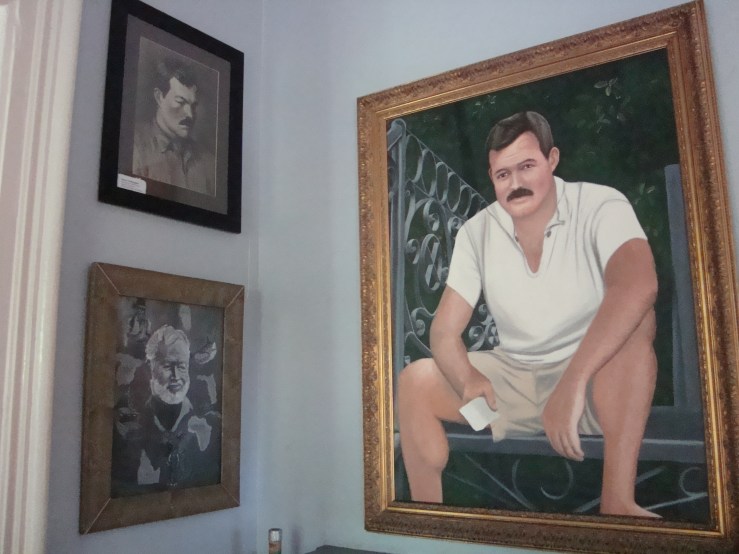
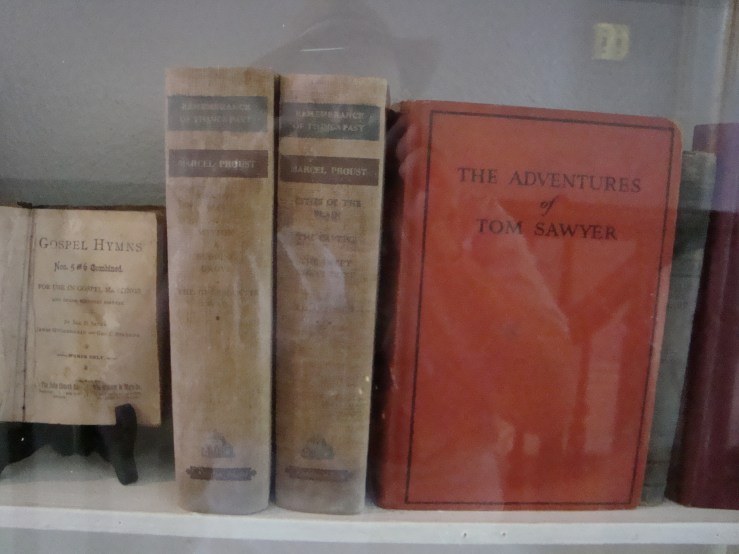
We spent a long July 4th weekend in beautiful Key West, celebrating freedom via endless barhopping and overeating. Somehow, between the Key lime margaritas, street beers, and moonlight reggaeton, we managed to stumble into Hemingway House (officially named The Ernest Hemingway Home & Museum), the house where Hemingway lived for most of the 1930s, and the place where he wrote some of his best stuff. I had been to Hemingway house almost two decades ago, when I was about twelve or thirteen. I was obsessed with Hemingway then, so I took the tour. This time, however, it was too hot. My wife works for a museum, so we got in free, which also affects how one values/reviews a place of interest, so bear that in mind when I say that, unless you’re a literary nut, go ahead and skip Hemingway House and head to Kelly’s for a drink or six. Still, the house is beautiful, outfitted with plenty of artifacts related to Papa, including some books from his personal library that I photographed and included below. (I was the only nerd photographing the books; everyone seemed far more interested in the ancestors of Hemingway’s freakish cats).Here are the books (more after the jump):

DSC02407

Continue reading “Hemingway House”