Nanni Balestrini’s novella Sandokan, in English translation from Melville House, tells the story of the rise of the Camorra crime syndicate in the small, poverty-stricken cities around Naples. Balestrini’s unnamed narrator occupies a fascinating insider-outsider perspective: one one hand, he, unlike many of his peers, does not join the gang, or “clan,” as its called–in fact, their behavior repulses him. On the other hand, he’s a native of the small town where Francesco Schiavone (aka Sandokan), Antonio Bardellino, and their henchman rule mercilessly, an eye-witness to the brutality and inhumanity of organized crime. The narrator is a sensitive young man who delineates clearly how the crime cartel was able to achieve such economic prosperity and power in the 70s, 80s, and 90s, detailing the various rackets the clan imposed upon the town, like stealing elections, peddling drugs, and manipulating the agribusiness that is the main source of income for average Neapolitan peasants. The narrator also explores why these small towns fall so easily into the terror of organized crime. The main reason: boredom stemming from little or nothing to do.
Balestrini’s narrator’s description of the Camorra is systematic, detailing the awful history and brutal practices of the syndicate in spare, concrete terms. His explications of the clan’s violence is not so much thrilling as it is ugly, as the narrator always shows how “normal people” (his words) are cheated, killed, or otherwise harmed by the Camorra. The narrator’s tone is often journalistic but never clinical; he always shows what’s at stake for the “normal people,” how they are affected by these crimes. At times the narrator is wryly funny, a tone that results in large part from his observation that the townspeople, the people he grew up around, begin to normalize the violence. It becomes part of their daily lives and affects them so directly that it becomes casual, and the sensitive narrator is one of only a few not to bow to it, ignore it, or take part in it–yet the violence and crime is so overwhelming that to live with it is to live with absurdity. Balestrini employs a punctuation-free rhetorical style in Sandokan that captures the breathless energy and frustration of the narrator. While many readers might balk at the lack of commas, periods, or semi-colons, I found the technique quite liberating. It enhances the immediacy of the narrator’s voice, the rushed sense of importance to his tale. It also promotes sustained readings of the text–I read most of Sandokan in three enthralled sittings.
Sandokan has its cinematic twin in the 2008 film Gomorra, directed by Matteo Garrone. The film, like the book, illustrates the affect that crime has on a range of “normal people,” mostly occupants of a housing project outside of Naples. As in Sandokan, the ordinary citizens find that they have no choice but to choose between sides as an absurd, petty gang war ravages their already decimated landscape. Where Balestrini’s punctuation-free rhetoric allows readers closer access to his narrator’s pathos-driven story, Garrone lets his camera wander freely over the grim landscape without ever imposing any clear narrative structure. It is not until the film’s final third that the five disparate stories he tells coalesce, and even then, it remains unclear who is on whose side. What is clear is that the violence and crime is quickly stealing–and killing–another generation.
In an age where violence is sensationalized and glamorized, particularly in gangster films and TV shows (do I really need to list them?), Sandokan and Gomorra both lay bare the Darwinian cost of crime. In both narratives, the violence is mundane and inescapable, meaningless yet awful, and very, very dark. Neither narrative is didactic in the least–or even hopeful, for that matter–but their is an implicit suggestion that if only there were some alternative to the Camorra–libraries, social clubs, movie houses–there might be another prospect for the young people in this area.
I highly recommend both Sandokan and Gomorra. As an end note, I’d love to see more of Nanni Balestrini’s work come into English translation, perhaps via Antony Shugaar and Melville House, who’ve done a lovely job here.
[Ed. note: Biblioklept published a version of this review in January of 2010]
William Gibson posted this review of Guillermo del Toro’s film Pacific Rim today:
A ravishing display of intelligent, often wonderfully witty visual design, every frame alive with coherent language, in the service of what is at heart a children’s story. A children’s story for a very dark time, our own, about a very dark time as children understand such things: monsters, from beneath the bed — our own or the ocean’s! It restores heroism to the realm of the humanistic, an extraordinary accomplishment given so much of the film culture of our day. The protagonists know, and demonstrate that they know, that it isn’t about them. A sweetly simple fable, for all the titanic grandeur of its cosplay (which I took to be the message of the slowly pumping wooden bellows in the kaiju-drifting machine, which became for me the sly sweet heart of it all). A demonstration of the degree of heart *and* physicality that even very big-ticket FX can convey when there’s an honest will to avoid the opposite; mega-scale FX that don’t drain either away. A baroque that doesn’t curdle, that never fetishizes itself.
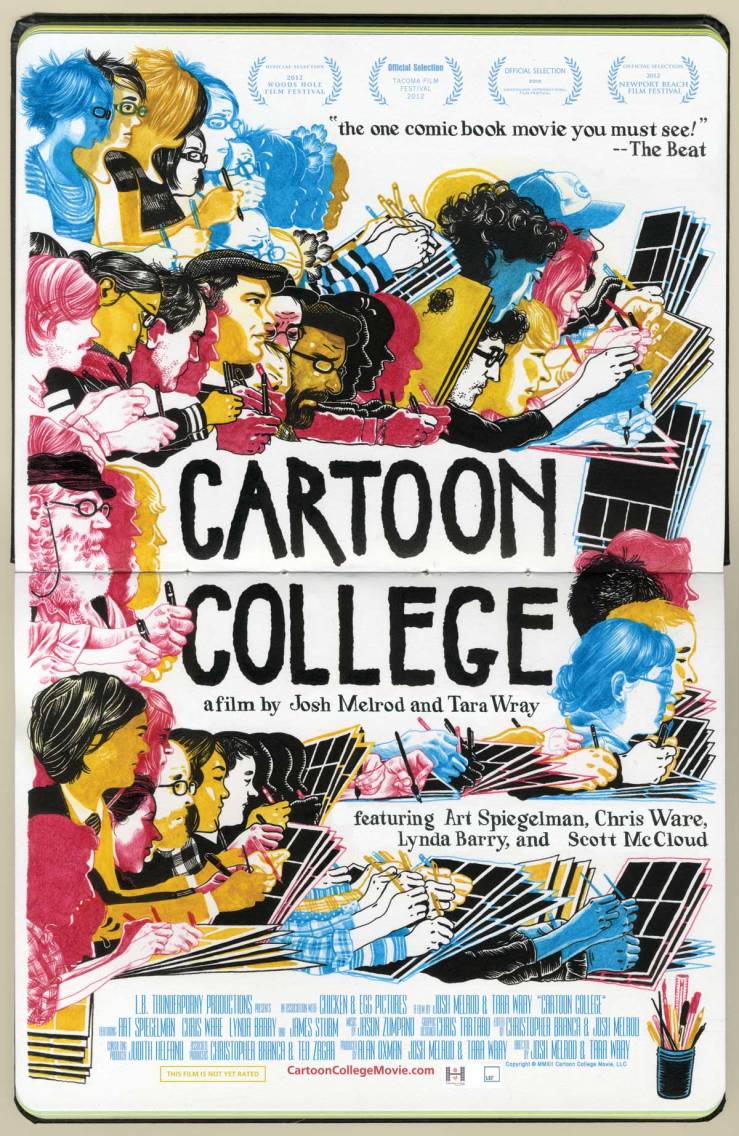
In the opening scene of Josh Melrod and Tara Wray’s new documentary Cartoon College, aspiring cartoonist Ryland Ianelli lays out the reality that, despite all the progress the medium has made as an art form worthy of respect, comic books are still outré: “It’s gotten easier to talk to people who are open to the idea of comics being worthwhile—but at the point you say, Yes I’m going to school for comics, they’re completely ready to dismiss you.”
Cartoonists have always been outsiders—even in art schools, a traditional gathering spot for outsiders—and it’s this feeling of alienation and displacement that undergirds the emotional platform of Cartoon College. The film is not just about the Center for Cartoon Studies (CSS), a highly-selective two year MFA program founded in 2005 in White River Junction, Vermont, or the cadre of master cartoonists who inspired the school, and, in some cases teach there. For plenty of comix nerds (like me), it’s enough to see masters like Art Spiegelman, Charles Burns, Lynda Barry, and Chris Ware talk about the art, medium, and business of cartooning. But this documentary offers more. Cartoon College succeeds because it tells the genuinely moving and engaging story of its students, self-described outcasts who find a sense of community and even family in the program.
Melrod and Wray take us into the extreme demands of the CSS program. In the first year (“boot camp”), students practice fundamentals—drawing, theory, writing, history. In the second year, the students produce a thesis—a finished work of some kind—to determine if they pass the program and receive an MFA. All this work is to ensure that students “will be ready to face the uncertainty of a career in one of the most labor-intensive, drudgery inducing art forms,” as the film puts it.
The faculty (all distinguished cartoonists, including Stephen Bissette, James Sturm, and Alec Longstreth, who are featured prominently in the film) repeatedly remind students and audience alike that most of cartooning is labor-intensive drudgery: it’s not really that fun, it requires lots of discipline, and most people can’t cut it. The CSS, like most art schools, employs a workshop technique to help students grow, get feedback—and also, implicitly, as a means of maintaining quality control. Workshop scenes and other critiques are often some of the most painful moments in the film, as they highlight the very personal stakes for the aspiring cartoonists, who quite literally put their lives into their work.
Melrod and Wray wisely compose their narrative around just a few of these students, while giving us enough scenes with others to flesh out the film. Blair Sterrett gives the film a definitive arc. He’s clearly a troubled, struggling artist, trying to channel his former experiences as a Mormon missionary into a thesis, but as the deadline approaches, it’s clear his book’s unfinished. Sterrett’s scenes (particularly an early critique) are very moving, and—a bit of a spoiler—there’s a triumphant feeling when he returns to the CSS to finish his MFA.
We find another arc in Jen Vaughn, who has too many jobs and too many ideas. Of all the student artists, she seems the most open to the camera, and her self-assured posture by turns belies a greater vulnerability and depth. In one illuminating scene at the MoCCA Fest, Vaughn tries to pique a muted festival goer’s interest in her project Menstruation Station; when he walks away without seeming to say anything we catch a glimpse of weariness bordering on desperation.
There’s also Al Wesolowsky, who at 61 is the oldest student. An archaeologist at Boston University, Wesolowsky tries his hand at the CSS program despite his self-admitted limitations as a draftsman. In some ways he’s the soul of the film. At one point he delivers a brief monologue wherein he describes the loneliness he feels at having no family, but the pleasure he’s found in a makeshift family at CSS.
Loneliness and alienation are perhaps the bedrock themes of comix and cartooning, as anyone who’s read Spiegelman or Ware or Burns—or really any of the master cartoonists interviewed in Cartoon College—can attest. Spiegelman is the first professional to pop up in the film, after the filmmakers have already introduced us to the students, and one of the first comments he makes is that comix allows cartoonists to come into contact with “a bunch of other outcasts.” This sentiment is repeated again and again, by students, teachers, and masters alike; we learn that Ryland Ianelli was voted Prom Queen by the cruel students of his high school; student Casey Bohn tells us that everyone in his small town thought he was “gay or British”; Lynda Barry puts it plain: “Childhood seemed to me like it lasted too long.”
Of all the master cartoonists on screen, I was most captivated by Chris Ware, who comes across as reflective, cerebral, and even philosophical. He points out that cartoonists are always “sifting through generations”,” handing down tropes, skills, ideas. Ware, chronicler of loneliness, perhaps makes the strongest case for cartoonists-as-community.
The idea that the students need to foster a community is reinforced by Bissette, who tells the that they must share contacts, share ideas, and be colleagues. Bissette and the other CSS instructors repeatedly emphasize the publishing dimension of cartooning, paying special attention to the idea that these cartoonists can self-publish. Cartoon College is larded with shots of students hand-crafting their art, and Bissette likens what they are doing to Warhol and his Factory. He also points out that this new generation’s desire is not to draw Spider-Man or Batman but their own creations.
An energetic scene at the MoCCA Fest shows this cottage industry at work, as artists buy and trade for each other’s work. But the instructors and pros are very clear—or try to be clear—about the economic realities most cartoonists will face. Ware and Burns point out that commercial illustration is a necessity to feed their other projects. Juxtaposed with these moments, our students describe their dreams of a comfortable retirement and book deals, a moment undercut by Lynda Barry gleefully pointing out that she makes most of her moeny selling “shit on E-bay.”
It might have been tempting for Melrod and Wray to cram all the footage they had of famous cartoonists like Barry, Françoise Mouly, Scott McCloud, and others into Cartoon College, but to the filmmakers’ credit they use the masters sparingly. Art Spiegelman tells us at one point that “We think in bursts of language, not in long Jamesian sentences…the number of words that might be able to fit in a speech balloon are the core of a linguistic thought.” The insight is intended for cartooning, but the filmmakers apply it to their medium, letting the camera do much of the work for them, offering only the most essential moments (like when Charles Burns completes a sketch and the student audience breaks into applause). Cartoon College is at its best when it shows us the difficult experiences of the students intercut with commentary by the seasoned, successful professionals, who understand precisely the pain these people are undergoing.
Before I started watching Cartoon College, I wondered who it was for. My interest in Spiegelman, Ware, Burns, et al. was enough to prod my interest (and the soundtrack featuring Archers of Loaf, Portastatic, and Tortoise didn’t hurt)—but would the film appeal to, uh, non-geeks? Ultimately, I think the documentary is about the drive toward art and self-expression, and the ways that communities and relationships can form around this drive. Cartoon College offers an intriguing story about real people trying to do something that they love, and I enjoyed that. This is a film about the impetus, motivation, and hard, hard work that goes into the creative process. Great stuff.
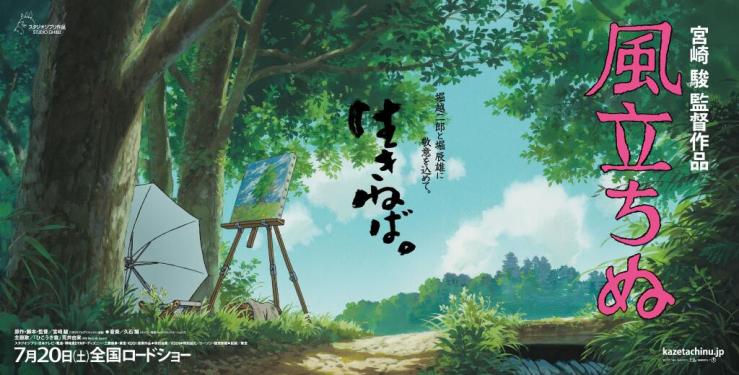
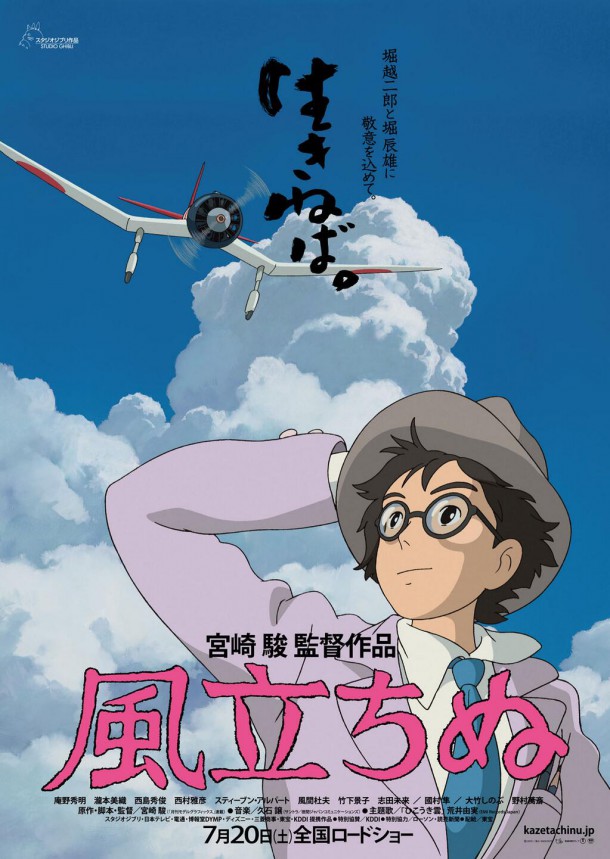
I don’t know how I missed this—the teaser came out a few weeks ago—but a new Miyazaki is always promising. The Wind Rises is out in Japan in two weeks, out in the rest of the world, who knows when…but I’ve never minded watching his films sans subtitles or dubbing. Read more about The Wind Rises here; read my review of Ponyo, the last Studio Ghibli film that Miyazaki directed.


 Biblioklept