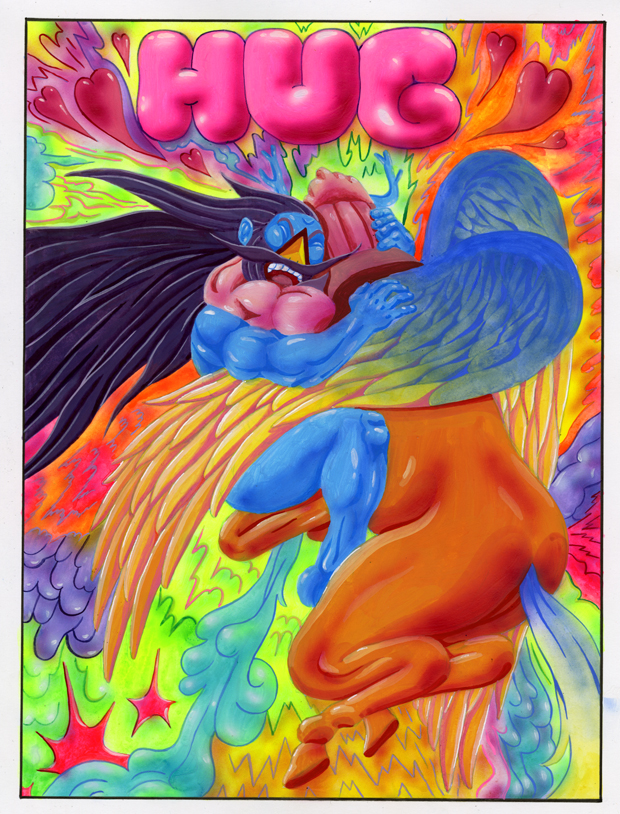
I reread Jesse Moynihan’s epic psychedelic graphic novel Forming from in full last night, staying up too late in doing so.
I’d read it in parcels and chunks over the nearly two decades Moynihan worked on it; I also read it in consistent chunky episodes over the past few months, when the nice people (nice person, you know who you are man) sent me a copy of its completed Forming form. But I hadn’t read it from soup to nuts, aye aye to zee, you get me, yeah, until last night.
I will do a proper review of Forming I swear I swear I swear, but reading it through I was genuinely moved, not just by the sheer accomplishment of the thing, the way Moynihan brings his teeming Blakean pantheon of gods and demiurges to heel (or whatever appendage) across an epic of cosmic creation and destruction, but by the weird, tender persistence of the whole enterprise. A comprehensive summary is not necessary (by which I mean too hard for me to muster right now) but–
Forming is William Blake’s prophetic books macrodosed on that good shit, raised on psychedelic Hanna-Barbera cartoons and Fletcher Hanks comics, gods and monsters and angels and demons doing metaphysical slapstick; grotesque, hilarious, strangely beautifully strange.
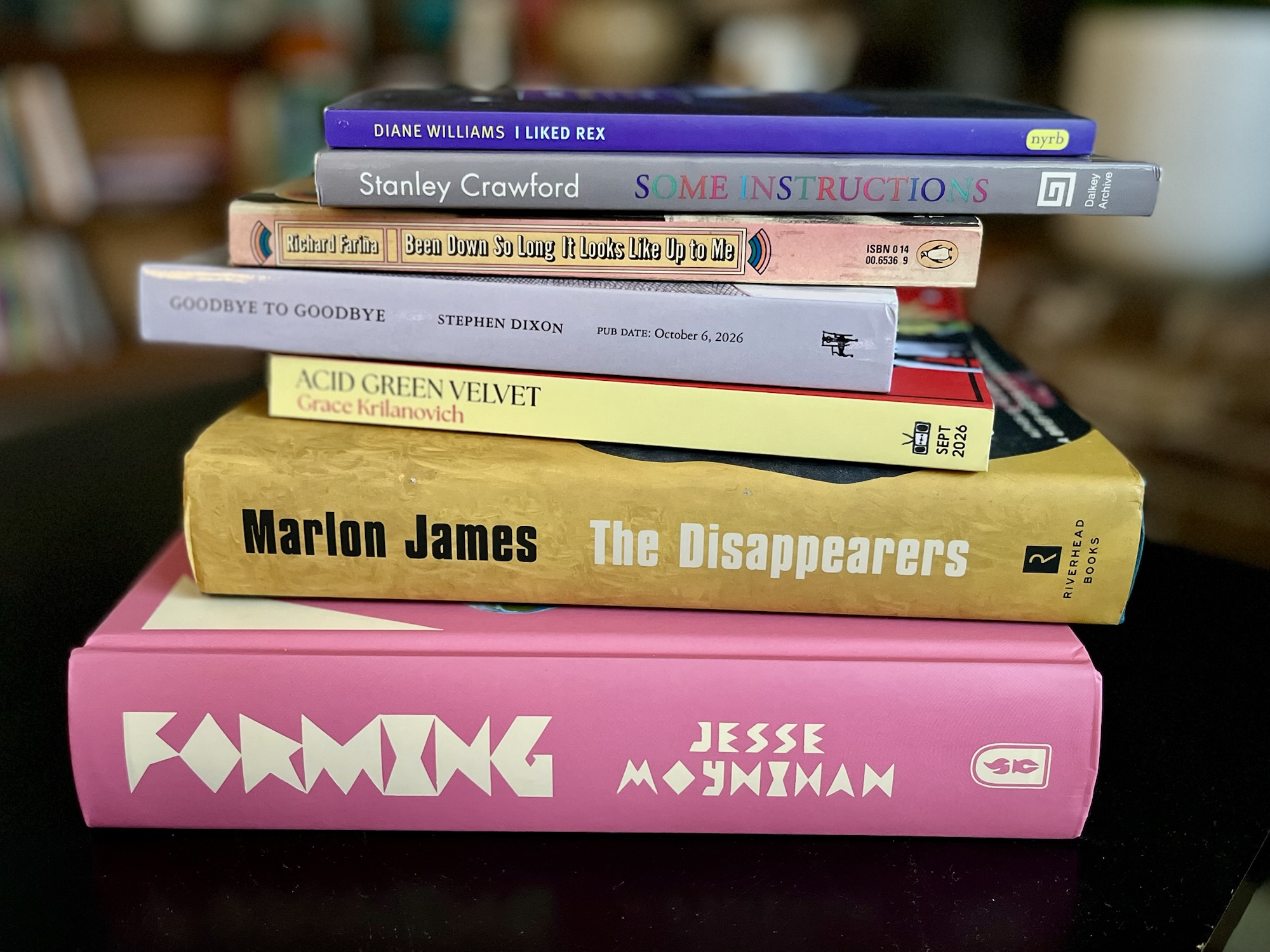
I’m halfway through The Disappearers by Marlon James. This book got a New York Times review so glowing that it melted half of what’s left of altlittwitter into an incandescent mean girl pose for about five minutes. (I think the vibe has moved on.) That’s my way of saying that no one needs my own take on this.
I’m not gonna lie, the second section of The Disappearers, “The Blackjacks,” was so ugly that I had to take a short lil break and, like, read something else. That was the intention, of course. The novel is painfully real and hurts with a clarity absent from James’s recent Black Leopard novels, which, if I’m honest, I enjoy more. (I have connected very much to James’s evocation of late-eighties-transitioning-to-nineties nostalgia: the music, the grunge, the fear, the Chris Claremont’s Uncanny X-Men of it all.)
Back to the stack, natch: I already reviewed Grace Krilanovich’s Acid Green Velvet, a fantastic novel where
nearly everyone is trying to invent a new self. Tramps become philosophers, grifters become visionaries, labor organizers become prophets, mystics become entrepreneurs, and wealthy eccentrics attempt to turn private fantasies into reality. Set in a fictional California town called Anzar, the novel follows these competing acts of self-creation as they collide, overlap, and occasionally explode.
Loved it loved it loved it, gotta shelve it now.
Goodbye to Goodbye is a new collection of Stephen Dixon’s “greatest hits” (McSweeney’s, the publisher, has not characterized the volume that way). I have a rough draft of a review forthcoming, but basically, if you have any interest in Stephen Dixon, this ain’t a bad place to start. (I will expound upon why you might want to start into Dixon in that review; for now, check out “Frog in Prague,” in which our autofictional hero tries to get to Kafka’s grave.)
Been Down So Long It Looks Like Up to Me by Richard Fariña — I finally read it. I read it because of Thomas Pynchon, who may or may not be the basis of a character in the novel, but who definitely wrote an introduction for it, in my edition and I’m guessing every edition after the first, and who definitely was not Fariña’s best friend or roommate, as the internet somewhat persists in reporting. A drug novel, a would-be travel novel, but really just (just?) a campus novel, Been Down is the kind of jam I would’ve thought profound when I was 20, 21; mostly I found its hero Gnossos Pappadopoulis to be a boor and an asshole — although I think that was also maybe kinda the point. It was often very funny. But not great!
I read Stanley Crawford’s 1978 “novel” Some Instructions to My Wife: Concerning the Upkeep of the House and Marriage, and to My Son and Daughter Concerning the Conduct of Their Childhood over two afternoons. I think Crawford is the best novelist no one has read (not you, dear reader, I know you’re hip to Crawford, Ole Ess Cee) — just a mean satirical hooting raspberry directed at middle-class American values. Makes a nice surreal trilogy with Crawford’s other slim novels The Log of the S.S. The Mrs Unguentine (1972) and Petroleum Man (2005).
Diane Williams’ latest is I Liked Rex. I had been reading one of Williams’ weird microslices a day for a while, until my attention shifted elsewhere, through no fault of Williams or Rex. Here is
“In the Bright Valley”
by
Diane Williams
He is a young man getting in a little extra sleep before the evening, which helps him to feel gen-erous warmth toward others—and to feel opti-mistic.
He had been down on his back on the narrow bench, with his arms hanging down to the floor, and he had taken a nap in the locker room, where he also eats his lunch.
On the job he doesn’t deal with the butter, which builds into a mountain in a glassed-in room, where claws dip down into it.
He minds the milk, and if he is not quick enough, it spouts and spills, because the packs of milk may fall out of their baskets and break open while they rush toward him.
He does have a panic button to push that brings in a lot of help—the people with mops and buckets—but his shoes and overalls did get wet this morning.
A deluge can create a deeply affecting mood— which this young man undergoes solely as glit-tering.

