
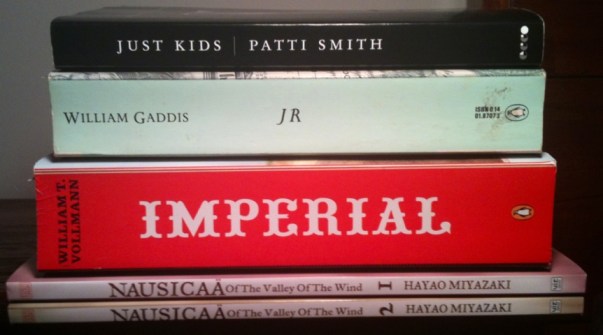
1. Just Kids, Patti Smith
Really slowed down on this one, mostly because the spring semester hath begun, wreaking all sorts of destabilizing tasks on me. Momentum and reading habits will inevitably return. Anyway, Smith’s book is more or less a litany of famous meetings and infamous moments with lots and lots of descriptions of talismanic objects. The scene where she meets Allen Ginsberg is pretty cool. Smith presents herself as earnest, passionate, but also somehow at odds (or at least outs) with the whole Chelsea Hotel scene.
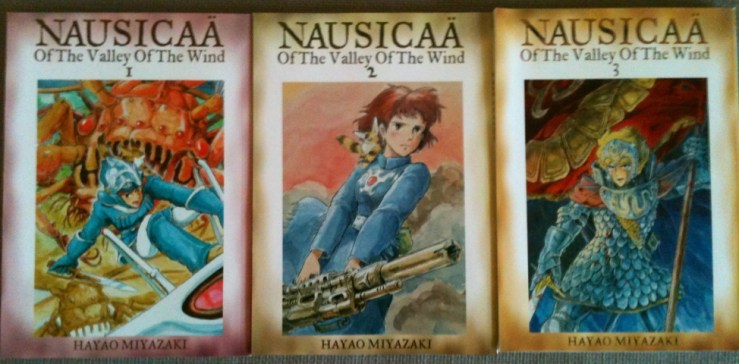
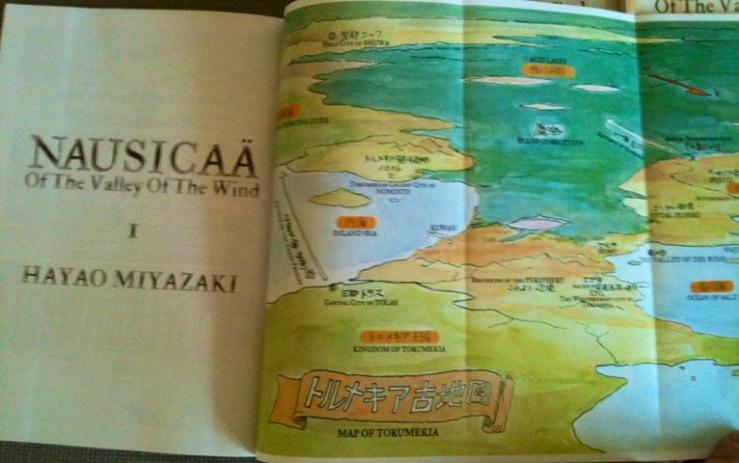
2. Nausicaä of the Valley of the Wind, Vol 1, Hayao Miyazaki
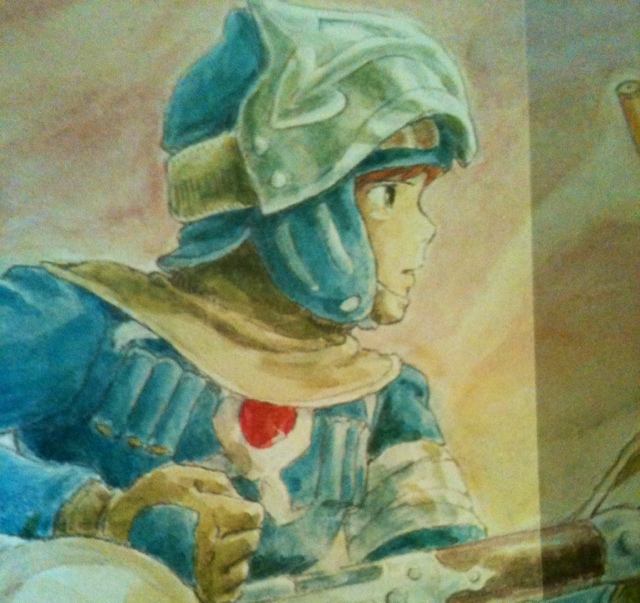
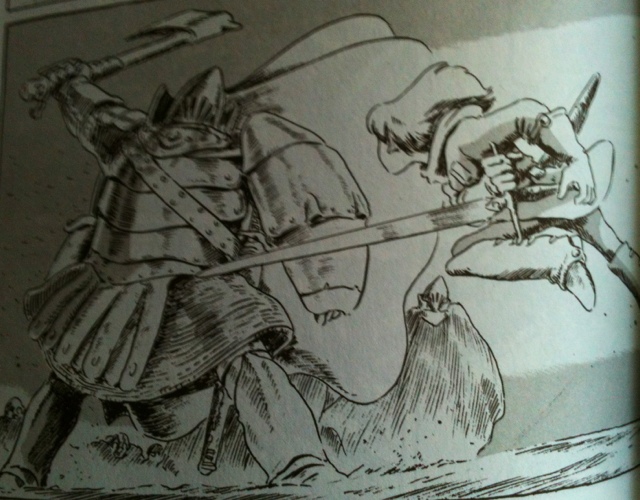
Completed the first volume of Miyazaki’s groundbreaking manga and started the second. The art is well crafted and distinct, but often extremely busy and even frenetic. It sometimes feels squashed in the panels, like it needs room to breathe. I can’t help but compare it to the film that followed, which is visually richer and more expansive. The film, in a sense, helps me to fill out the scope signaled in Miyazki’s inky illustrations.
The story in the manga so far differs subtly but significantly from the film; without adding spoilers (I think fans of the film will enjoy the book), the political dimension of the plot is heightened and gender roles are explored with greater concern. Nausicaä’s initial rashness is also presented with greater intensity (read: violent consequences). More to come.
3. Imperial, William T. Vollmann
Chapter 3 of Imperial, “The Water of Life,” is some of the best gonzo journalism I’ve ever read. Vollmann (along with an improbably game ex-Marine/hotel clerk) takes a raft—a cheap rubber dinghy, really—down the infamous New River, purportedly one of the most polluted waterways in North America. This river is filled with dead birds, dead fish, probably dead humans, lots and lots of garbage, industrial runoff, and lots and lots of human shit.
Of course, Vollmann can find beauty and strangeness and ugliness all at once:

The chapter does everything one wants from the book, and if you’re at all intrigued, there’s a version in the excellent Vollmann reader Expelled from Eden, which is a good starting point for his work.
The next chapter, “Sublineations: Lovescapes,” is this awful emo exploration of a bad breakup and the following heartbreak Volls feels after. It was torturous to get through, the sort of thing that screams for an editor. It also underscores how deeply deeply deeply personal the book is to him, though. More to come.
4. A Dance with Dragons, George R. R. Martin (audiobook read by Roy Dotrice)
Well goddam if I didn’t finally finish it. As I’ve lamented elsewhere in these e-pages, Martin’s fourth and fifth books in the A Song of Ice and Fire series (I hate that name, by the way: Game of Thrones (without the indefinite article) is way cooler sounding) are bloated, sagging, overfilled beasts sorely in need of an enema. Still, Dragons picks up in its final third, and ends with some shockers that, if I remember them 12 years from now when he finally finishes the next one, I may want to read it. Roy Dotrice = a very gifted reader. A great audiobook (still, I can’t believe this one topped so many year end lists).
5. JR, William Gaddis (tandem reading with audiobook read by Nick Sullivan)
Big thanks to Dwight at A Common Reader for suggesting the audiobook of JR read by Sullivan. I’m a few hours in; I’ve also been rereading bits immediately when I get home (I listen mostly in the car or on walks), retracing the lines that I’ve mentally underlined. Sullivan is a gifted voice actor who brings the many, many voices of JR to vivid life (that line seems hackneyed but it is in no way insincere. If I weren’t riffing I’d revise. If I weren’t riffing I’d edit parenthetical excuses. I’m gonna drink more red zin now). I’m reminded in some ways of RTE’s full-cast unabridged recording—performance really—of Joyce’s Ulysses. I’d read Ulysses twice before, but I feel like the full-cast production was an equally definitive version to the one in my head. Like Ulysses—especially the Sirens episode—JR is extremely aural; it’s mostly dialogue.
I’ve laughed out loud several times so far—had no idea the book would be this funny. Also, reading/hearing it, I can’t help but see how profoundly David Foster Wallace was influenced by Gaddis here: the bizarre corporate-speak, the disjunctive rhythms, the absurd humor, the satire on modernity, the ironic-earnest axis—even the passages of naturalistic description.
On deck: The Orphan Master’s Son by Adam Johnson, Open City by Teju Cole, Smut by Alan Bennett and more more more.




 Biblioklept