Brodsky Donoso Donoso & Dunn (Books acquired, first weekend of Dec. 2024)

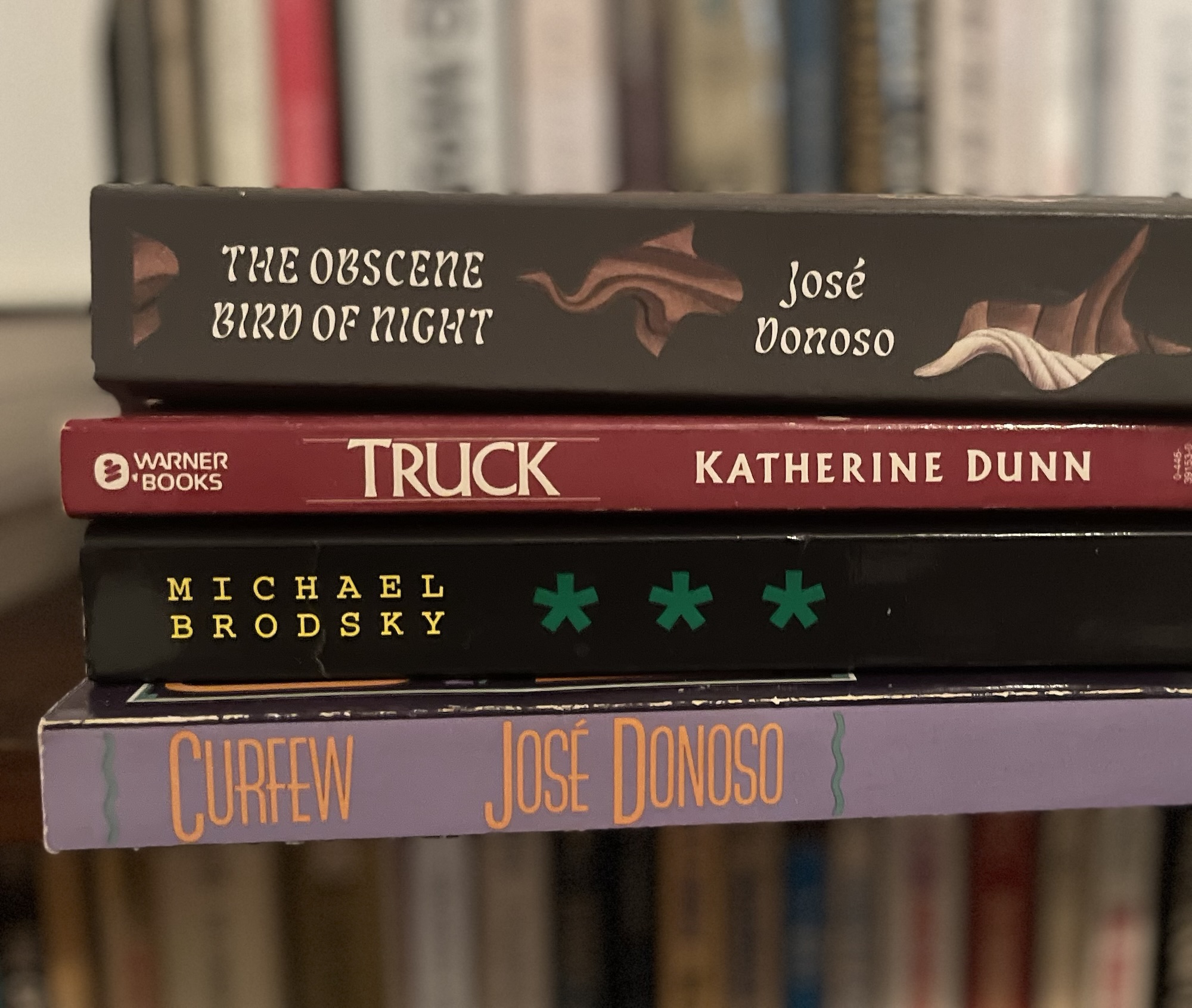
Picked up some books this weekend: Two from José Donoso: Megan McDowell’s “revision” of Hardie St. Martin and Leonard Mades’ translation of The Obscene Bird of Night, and Alfred MacAdam’s translation of Curfew: the first I had to order, the second was a lucky find. As was Michael Brodsky’s *** (send me a copy of Xman, someone), and Katherine Dunn’s Truck, which can twin with the copy of Attic I found this summer.

Mid-August riff; some books acquired, etc.

The last two weeks flew by. My kids went back to school this week; they are attending the same school for the first time since elementary school, high school,my own dear mother, that school, and I am relieved, if only temporarily from driving duties. We are making pizzas in an hour or two to celebrate the first Friday of their school year (we make pizzas every Friday as a nifty fridge clearing activity, but let’s not ruin the sparkle). My own semester starts the week after next and I realize that I need to do something more with my summers now that my children are so much older than they were when they were little children, when I was with them all summer, or if I wasn’t exactly right there with them I was hovering in the background.

I am on track to read fewer novels, or books, or whatever, than I read in July of this year. I finished Mauro Javier Cárdenas’s third novel American Abductions and liked it very much, or liked the experience or feeling of reading it, whatever that means, and I owe it a proper review. In July I read Katherine Dunn’s debut novel Attic and loved it. I couldn’t find her 1971 follow-up Truck in any of the used bookstores I frequent, so I ended up listening to it on audiobook. Maybe it was the narrator’s narration but I found it disappointing, but I still appreciate its grime and its abjection and its picaresque energy. I also checked out some Stephen Dixon e-books from my library; I read a handful of fucked up stories (a piece called “The Intruder” was especially weird) before digging into his 1988 novel Garbage. I read the first half of Garbage last night and I don’t even know how to describe it—it’s sort of like wandering upon some forgotten gritty 1970s American exploitation film made by an insane but focused auteur. But it’s also very normal in a way I will not explain. It’s uncanny.

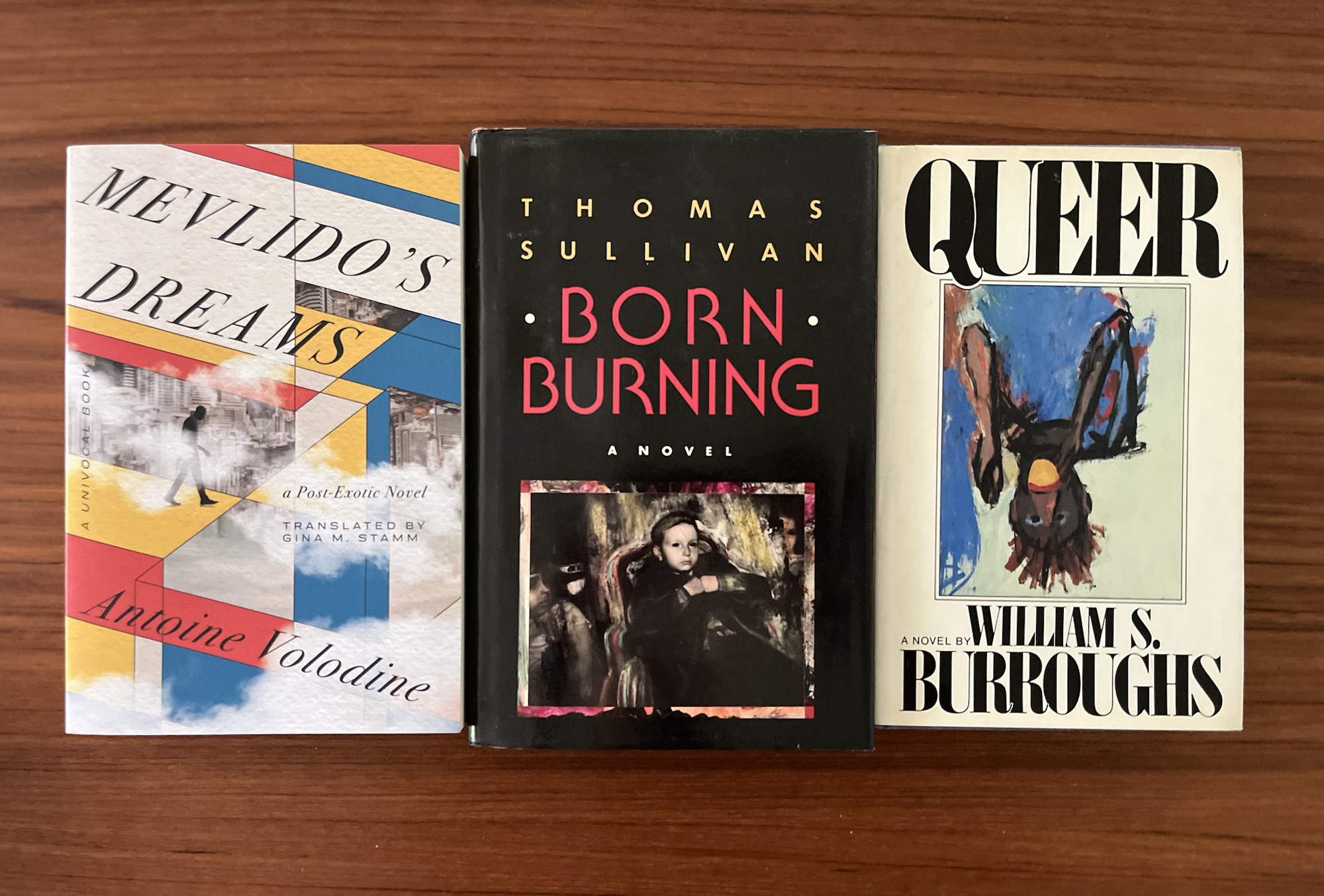
I purged about thirty paperbacks last week at my local used bookstore and ordered a copy of the latest Antoine Volodine novel, Gina M. Stamm’s translation of Mevlido’s Dreams. A recent reading of Volodine’s Radiant Terminus left me hungry for more of that sweet gross post-exotic flavor. I went to pick up the Volodine today and ended up with two hardbacks. I admit that the blurb on the back of Thomas Sullivan’s 1989 novel Born Burning sold me; it compared his previous novel to William Gaddis, John Barth, and Kurt Vonnegut. I also snapped up a first-edition hardback 1985 edition of William S. Burroughs’s novel Queer, which I fear was quite underpriced, although I don’t fear that too much. (All my sweet purged paperback credit is gone!)

I am ready for the summer to end.

Riff on July 2024 reading, etc.

I experienced the middle weeks of July 2024 as simultaneously rapid and static. Doldrums should never be so frenetic. If this decade were a novel I would’ve put it down several chapters back. I try not to obsess over things I cannot control. I try to get away from screens. I try to go outside, but the feels like heat index here in north Florida goes over a hundred and five every day. (At least it’s raining again and nothing is on fire.) So I try to read more (and actually write more).

This July I read some great stuff.

I finished Katherine Dunn’s first novel Attic a couple of days ago. The book is seriously fucked up—like William Burroughs-Kathy Acker fucked up—an abject rant from a woman in prison in the mode of Ginsberg’s Howl. The narrator seems to be an autofictional version of Dunn herself, which is perhaps why Eric Rosenblum, in his 2022 New Yorker review described it as “largely a realist work in which Dunn emphasizes the trauma of her protagonist’s childhood.” Rosenblum uses the term realism two other times to describe Attic and refers to it at one point as a work of magical realism. If Attic is realism then so is Blood and Guts in High School. I need to read her second and third novels (Truck, 1971 and the posthumous Toad) and then go back and reread Geek Love, which I remember as being Gothic and gross but also whimsical. (I don’t sniff any whimsy in Attic.)

There are eight stories in Oğuz Atay’s story collection Waiting for the Fear (in translation by Ralph Hubbell); I’ve read the first five this summer, including the long title story, which is especially good, as is the opener “Man in a White Overcoat.” Atay’s heroes (I use the term loosely) find their antecedents in Kafka’s weirdos. Or Paul Bowles. Or Jane Bowles. I should have a proper review up near the end of October when NYRB publishes Waiting for the Fear.

I had picked up Mauro Javier Cárdenas’s third novel American Abductions earlier this summer and finally started it a few nights ago after finishing Attic. Each chapter is a run-on sentence that has made me want to keep reading and reading, running on with it. The novel is, at least so far, both challenging and entertaining; it is not difficult, exactly, but rather engrossing. Sometimes I’ll find myself a bit lost in the layered consciousnesses, layers (layerings) of speech in Cárdenas’s sentences—especially when I find myself startled by an image or a joke or idea—and then I’ll wade backwards again and pick up the rhythm and keep going. The plot? I’ll steal from the Dalkey Archive’s blurb: “American Abductions opens in a near-future United States whose omnipresence of data-harvesting and algorithms has enabled the mass incarceration and deportation of Latin Americans—regardless of citizenship.” But that’s not really the plot; I mean, this isn’t a third-person dystopian world-building YA thing. The novel, at least its first half, is about a family, daughters Ada and Eva and their father Antonio, a novelist who was abducted by the titular abductors (the Pale Americans!). It’s also about writing, how we construct memory in a surveillance state, and, I suppose, love.

I reviewed Jean-Baptiste Del Amo’s latest novel The Son of Man (in translation by Frank Wynne) in the middle of July, although I think I probably read it in late June. In my review I suggested that The Son of Man “is ultimately a novel about the atavistic transmission of violence from generation to generation.” I also highly recommended it.

I went on a big Antoine Volodine binge a couple of years ago which stalled out before I got to (what I believe is) his longest novel in English translation, Radiant Terminus. I finally started into it a few weeks ago (in translation by Jeffrey Zuckerman), and I think it might be Volodine’s best work. In my longish review, I declared Radiant Terminus “an astounding novel, a work that will haunt any reader willing to tune into its strange vibrations and haunted frequencies. Very highly recommended.” I think it’s a perfect starting place for anyone interested in Volodine’s so-called post-exotic project.

Denis Johnson’s The Stars at Noon was one of two novels I revisited via audiobook this month (the other is Portis’s Gringos, which we’ll get to in a moment). I honestly didn’t remember much about The Stars at Noon other than its premise and the fact that its narrator was an alcoholic journalist-cum-prostitute in Nicaragua. It hadn’t made the same impression on me as other Johnson novels had when I went through a big Johnson jag in the late nineties and early 2000s, and I think that assessment was correct—it’s simply not as strong as AngelsFiskadoro, or Jesus’ Son. As an audiobook though I enjoyed it, especially in Will Patton’s reading. (His narration of Johnson’s perfect novella Train Dreams is the perfect audiobook.) I guess the audiobook came out in conjunction with Claire Denis’ 2022 adaptation of the film, which I still haven’t seen.

The collection of Remedios Varo’s writings On Homo rodans and Other Writings is another book I read earlier in the summer but didn’t write about until July. I was fortunate enough to get a long interview with the translator, Margaret Carson, and I think the result is one of the better things Biblioklept has published this year.

I picked up Dinah Brooke’s “lost” novel Lord Jim at Home in late June, and then read it in something of a sweat over a few days. In my review, I wrote that

Lord Jim at Home is squalid and startling and nastily horrific. It is abject, lurid, violent, and dark. It is also sad, absurd, mythic, often very funny, and somehow very, very real for all its strangeness. The novels I would most liken Lord Jim at Home to, at least in terms of the aesthetic and emotional experience of reading it, are Ann Quin’s BergAnna Kavan’s Ice, Mervyn Peake’s Gormenghast novels, Virginia Woolf’s Mrs. Dalloway, and James Joyce’s Portrait (as well as bits of Ulysses).

Gringos is the other book I “reread” via audiobook this July. Charles Portis wrote five novels and all of them are perfect—but I think Gringos might be my favorite. David Aaron Baker’s reading of the novel is excellent. He conveys the dry humor of narrator Jimmy Burns as well as the cynical sweet pathos at the core of Portis’s last novel. Highly recommended.

So well I guess July is over; the kids will be back in school again soon, and so will I. The air here will remain swamp thick, humidity that starts cooking you the minute you venture out of the desiccating AC that licensed growth on this weird peninsula. It might let up by November. Maybe because I’ve spent my entire adult career as a teacher I have always thought of August as the end of the year, not December. And some years I feel melancholy at this end, this pivot away from freer hours. But writing this on the last day of July, I think I want a return to routine, to something I can think of as a return to normalcy, the kind of normalcy that makes me appreciate the weird fucked up oddball novels that I do so love to hang out inside of.

On top of stolen books behind the Life Magazine picture of Bertrand Russell like a baby eagle | From Katherine Dunn’s first novel Attic

In the five-and-dime can’t see over the counters with her—see
the red thimble—plastic knobby—just fits—put it on and tap things with it—lips and teeth and wish I had two to click against each other—wander out with her—why where did you get that you little thief march right back in there and give it to the man and apologize—penny thimble—I didn’t even notice I’d taken it—big noise and hits—the shame…

Drugstore book racks—need a book a day at least—three thin ones—too far to the library—heavy—always overdue—little ladies in pale green uniforms inventory hair spray—perfume—Kotex while I’m putting books in my purse—in my armpits—Agatha Christie—Nero Wolfe—James Bond—candy bars in pockets—have to lay off M & Ms—they rattle too much—an extra eyebrow pencil up my sweater sleeve and buy a deodorant—go out to the car and drop the stuff—back into the supermarket for cookies and cigarettes and chocolate-covered cherries—buy milk and then tool back home to turn the heat up and sit with the rain outside—with my feet up reading trash—eating trash—drinking milk straight from the carton only pouring it into a glass when I want to dunk cookies in it…

Girls League Cake Sale—high school cakes by girls in coordinated sweaters and skirts—ribbons holding their hair—dozens of pairs of shoes—their proud bras and girdles mocking my brother’s cast-off tee shirts in the locker room—they study typing with old Birdsing and wear ribbons in their hair—bake cakes for the cake sale from scratch with boiled frosting that slump in the middle and cave on the side—patch it up with frosting and candy drops—hide them on mother’s best cake plates behind screens in the cafeteria—I ducking class as usual—hiding stink bombs behind the encyclopedias in the library—sneaking through the halls with my five-button Levi’s swishing between my legs a cake under each arm—stacking them carefully in my locker on top of stolen books behind the Life Magazine picture of Bertrand Russell like a baby eagle his fierce fuzzy face on the scrawny neck—hide for the rest of the afternoon in the conference rooms in the library listening to Jake in his chemistry room gas mask searching for the stink bombs and cursing—thinking of him fumbling with the pear-assed librarian from the grade school—all the time rehearsing my lines for if I’m caught—when the final bell rings parading down to the boys’ locker room with a dozen cakes on a book cart to wait for the wrestling team to finish weighing in and come out famished after a month of making weight…

From Katherine Dunn’s first novel Attic. 

Katherine Dunn’s Attic (Book acquired, 18 July 2024)

Picked up a copy of Katherine Dunn’s 1970 debut novel Attic this afternoon. From Eric Rosenblum’s 2022 survey of Dunn’s work in The New Yorker:

At Reed, Dunn began work on “Attic,” her first novel, a fictionalization of a stint in a Kansas City jailhouse when she was eighteen and was arrested for trying to cash a fraudulent check.

In “Attic,” Dunn introduced an early version of the sinister magic realism she would later make famous in “Geek Love.” The book’s narrator, K. Dunn, describes a carrousel [sic] in which, to gain entry, young boys have to shoot arrows into their mothers’ vaginas and young girls have to throw hoops over their father’s erections. “If they don’t make it in four tries they can’t ride the merry-go-round so the Mommies spread their legs wider and wider and the Daddies sweat to rub up a good one.” But the book is largely a realist work in which Dunn emphasizes the trauma of her protagonist’s childhood. “Attic” is filled with potent flashbacks about K. Dunn’s mother shaming her, like this one: “. . . she looked at me very closely there and said you’ve been playing with yourself again haven’t you . . . and she said show me show me how you do it and I just lay there and she got angry and she said if a bitch dog did that they’d have to kill her . . . and I couldn’t help it I started to cry . . .” K. Dunn experiences some liberation in prison, where no one cares if she masturbates, but is thrust back into shame after she agrees to pleasure a male benefactor who helps get her out. Some of the book’s best parts read like a neurotic’s guide to prison life, in which Dunn uses what she learned from Thoreau to describe the vagaries of sharing a toilet with a cellmate. “I could piss over her piss but I can’t piss over her shit, much less shit over it and have them mix. It would be terrible if mine came out lighter or darker than hers—you could tell whose they were. Even worse if they were the same.”

In These Times the Home Is a Tired Place (Book Acquired, Some Time in Late October)

20131027-125420.jpg

Jessica Hollander’s story collection In These Times the Home Is a Tired Place is good stuff. It came in last month with several other books I was psyched about, so I’ve only gotten to the first three stories here, along with the title story (I’m a sucker for anything resembling a list), but they’ve made me want to read the other fifteen stories. Full review forthcoming.

Here’s Katherine Dunn (Geek Love) on In These Times the Home Is a Tired Place:

These are human tales of vigorously individual characters living with intensity. The author’s ear for revealing dialogue and double-edged humor ground these stories in a reality worth enduring. The characters connect despite suspicion and betrayal, beyond blood, circumstance or embarrassment at their own ridiculous humanity. Each piece is powered by a deep, slow boiling jubilation in the moment-to-moment, line-by-line fact of taking breath.

And here’s the first part of the title story (you can and should read the rest of it at Conjunctions):

1. Only one dream the mother remembered: driving, dead bodies on the road, the word PAPER large and black on a billboard. Sometimes she made up different dreams when she woke panicked in the gray morning, imagining an airport chase, a lake drowning—but they weren’t really hers, only dreams she believed she should have instead of always the one: driving through death and the urge to pull over.

2. The girl spent a Saturday morning cutting snowflakes from a pile of paper she’d found on her mother’s desk. The snowflakes were peppered with sliced negotiations, diamond-pierced words like child and property and alimony, and when the girl finished she strung the flakes together and hung them from her window so they trailed to the berry bush and flapped in the stirred summer wind.

3. Screamed in the kitchen one night. Too many cooks in the saucepan. Too little wine. Granite counters crusted with crushed tomato, sea salt, sausage casing, but no food besides the steaming meal bleeding over the bin. The girl sent to her room— Now. The father’s recipes stacked and chopped to pieces and confettied across the tile. Division always makes less unless one was a fraction to begin with. “Divide by me,” the father said. “Then we both come out ahead.”

Books I Didn’t Read in 2011 (And Books I Will Try to Read in 2012)

Okay. So obviously a list of the books I didn’t read in 2011 would be, y’know, long.

This post is about the books I set out to read, tried to read, wanted to read, abandoned, neglected, acquired and thought looked interesting, etc. It’s also about what I want to—what I plan to—read in 2012.

20111228-115819.jpg

A reasonable starting place: I wrote a post in early January of this year detailing the books I would try to read in 2011. I actually read most of the books I named in that post. But:

I failed to read past page 366 of Adam Levin’s incredibly long novel The Instructions, although I think I was a bit too harsh in my semi-review. Chalk it up to exhaustion.

I failed to even begin to try to read William Gaddis’s incredibly long novel JR. (But I swear to read it one year. Not next year, but maybe the year after?).

I failed to read past the first chapter of Katherine Dunn’s Geek Love.

I read most of the Tintin collections I picked up last year, but I didn’t get to volumes 5 or 6.

20111228-115848.jpg

Moving beyond that early post, books that I recall abandoning (although I’m sure there must be more):

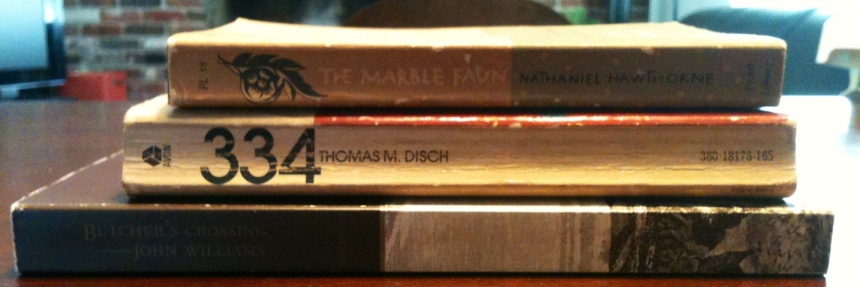
I abandoned Nathaniel Hawthorne’s Italian romance The Marble Faun after about 30 pages.

I abandoned 334 by Thomas Disch after about 50 pages. Somehow simultaneously dense and loose, it struck me as intensely imagined and sloppily composed.

I abandoned John Williams’s Butcher’s Crossing after the first chapter; it was a great opening chapter, but I thought it was going to be, I don’t know, more like Blood Meridian.

I also abandoned Chad Harbach’s big book The Art of Fielding (after 100 pages) because it was lame (notice it’s not pictured above because I traded in that sucker), but I had a nice dialog with some readers who responded to a post I wrote about abandoning it, so that was a plus.

20111228-115828.jpg

Books I bought in 2011 that I aim to read in 2012:

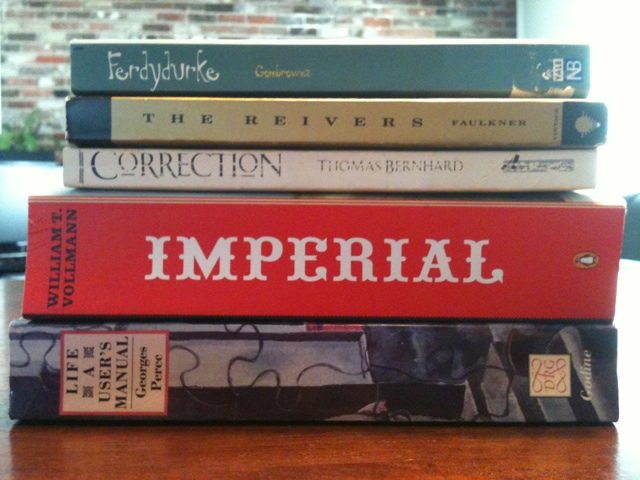
Correction by Thomas Bernhard. Bernhard was a repeated suggestion from readers in the aforementioned Harbach post/rant, and he was apparently a huge influence on W.G. Sebald, so, yes, looking forward to this.

The Reivers by William Faulkner. I read A Light in August this year and reread most of Go Down, Moses. My plan is to read one Faulkner a year for the next ten years.

Ferdydurke by Witold Gambrowicz. I struggled to make it through Gombrowicz’s bizarre jaunt Trans-Atlantyk, but once the novel taught me how to read it, I was enchanted by its strange humor and frenetic syntax. Over some beer and wine, I had a conversation about Ferdydurke with my father-in-law’s priest who is Polish. His pronunciation of Ferdydurke should win an award for charm.

I will read Georges Perec’s big book Life: A User’s Manual.

I have already promised to read William Vollmann’s Imperial.

There are many, many more, of course (too many, really).

20111228-115835.jpg

Books people sent me to read and review that look really cool that I will be reading and reviewing at some point in the very near future:

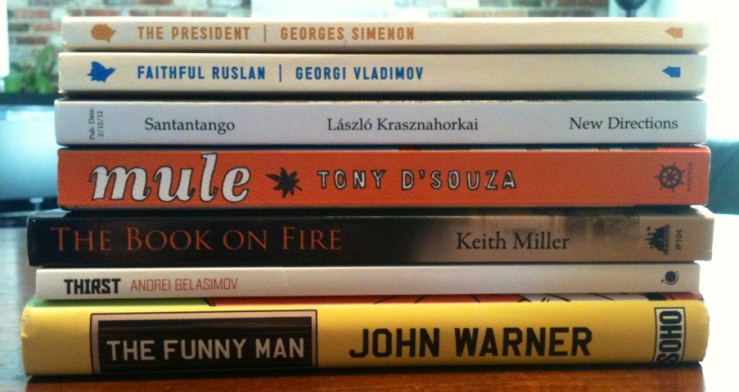
Satantango by László Krasznahorkai: I will read this and review this in the very near future.

The Funny Man by John Warner: Comedy, drugs, celebrity culture.

The Book on Fire by Keith Miller: This one is about a biblioklept. It’s been at the top of my stack for a few months now, but I keep letting myself get distracted.

Thirst by Andrei Gelasimov: Apparently this novella about a maimed alcoholic war vet is funny. (I hate the cover).

Mule by Tony D’Souza: Middle class man sells marijuana cross country. (I love the cover).

Various titles from Melville House’s Neversink line: I’ve got a few in the stack.

Also: I got a Kindle Fire for Christmas. I actually stayed up really late last night reading free public domain books from Hawthorne, Melville, Whitman, and Dickinson; I’ll read a contemporary novel on it this year—Neal Stephenson’s Snow Crash, perhaps? Suggestions welcome!—and try to review both novel and the process of reading the novel on a warm glowing machine.

And: I’m sure there are a ton of novels that will come out in 2012 that I’ll want to read; I’m already primed for Dogma, Lars Iyer’s sequel to Spurious.

So: What are you guys looking forward to reading in 2012? What did you fail to read in 2011?