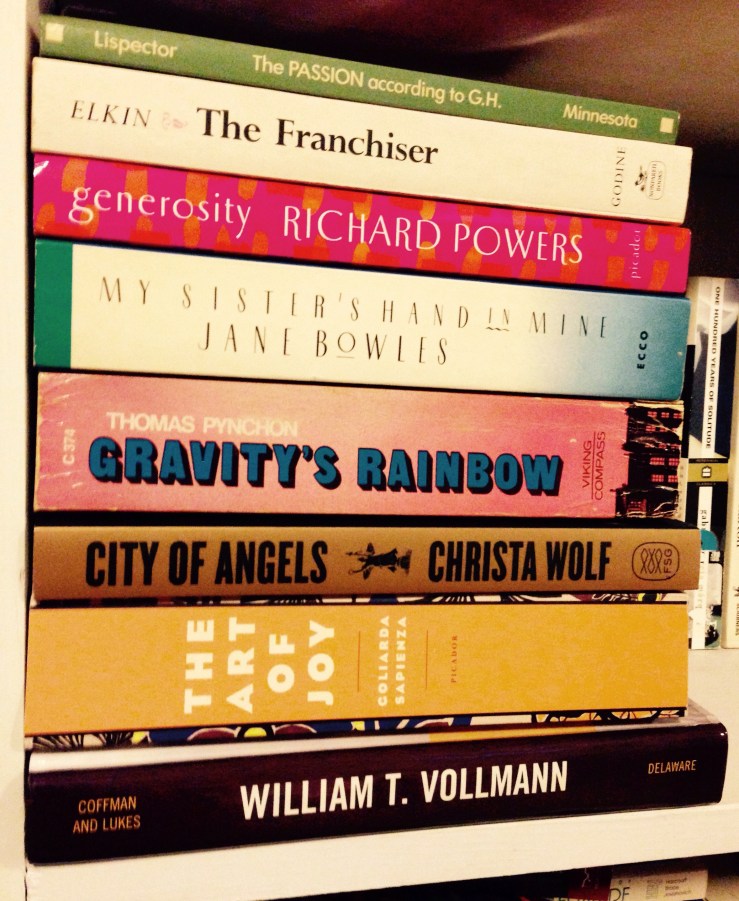
Good intentions reading list for early 2015

IMG_4791

Selections from One-Star Amazon Reviews of Thomas Pynchon’s Mason & Dixon

[Ed. note: The following citations come from one-star Amazon reviews of Thomas Pynchon’s novel Mason & Dixon—which I loved. (See also: Chinua Achebe’s Things Fall Apart, Mary Shelley’s Frankenstein, Thomas Pynchon’s Gravity’s RainbowGeorge Orwell’s 1984, Herman Melville’s Moby-Dick, James Joyce’s Ulysses and David Markson’s Wittgenstein’s Mistress). I’ve preserved the reviewers’ own styles of punctuation and spelling].

What crap.

A talking dog?

I made a mistake.

Dialogue that is meaningless?

But what is the point of this story?

Pynchon is simply messing around

I can’t believe I read the whole thing.

I guess there’s no accounting for taste.

Rarely have I anticipated a book so hungrily.

Lost me at the talking dog, and never recovered.

I’ve also seen Pynchon praised for his erudition.

You think a talking dog or mechanical duck is funny?

Supposedly it’s a literary adventure through the 18th century

George Washington smoking pot and getting the munchies?

I consider my myself a reader who relishes literary challenges.

I am a reader who enjoys being bluntly told what the author thinks

The only book I’ve ever read that was a complete waste of time !

just an endless series of unconnected and unrelated ramblings…

Yes, it was a different world back then, and people talked funny (to our ear).

The publisher should have left the trees to grow rather than putting this in print.

I had to finish it – but resorted to scanning the text for references to my 7th great grandfather.

Pynchon is like strolling through a garbage dump full of meaningless, forgotten pop culture relics.

Wow, I give up on Mr. Pynchon who apparently has some intergalactic literary insights well above my head.

Regretfully, I’ll need to wait for the english language translation before properly assessing this novel’s merits.

Thomas Pynchon surely must have been smoking something more powerful than plain tobacco when he wrote this debacle…

I admit to approaching this book with a great deal of reverence, along with guilt for never having attempted either “V” or “Gravity’s Rainbow.”

Mr.Pynchon may be considered one of today’s great writers by the cosmopolitan literati, but this provencial reader found his work to be a 773 page morass of archaic vernacular with no particular point.

I would like to assert, however, as one who has read quite deeply in English prose of the last 400 years, that the much-praised “18th-century English” is nothing like, being full of anachronisms and lapses of decorum.

Pynchon doesn’t descibe. He makes lists of objects, as if the acculation of things or people surrounding the characters is enough to create some semblance of reality, or alternate reality, or hyperreality or whatever.

I am in the vast minority, obviously, who “didn’t get it.” Some times I wonder if reviewers, too “didn’t get it” but were afraid to say so, because this conglomeration of words is just that – a pointless, incomprehensible waste of trees.

My Tedium never Ceases, yet have I only Dredged thru half of this Tome. My eyes grow Tir’d and my Thoughts grow more hateful towards this Author. History is barely Reveal’d and the style has Vex’d me thru and thru. Hemp smoking Franklin? Confus’d and Stupid Astronomers? Half the book not spent in the country of interest? Yet I plod on, making a use of this Fantastique tale, to knaw away at the Minutes spent in the loo. Wouldst it be quite the thing, if only the Paper t’was softer, I can then make of it a Cleansing Agent for my Posterior once Finished with each page.

It was evidently written for a limited audience–people who can actually read eighteenth century style prose and who still find jokes about “not inhaling” to be amusing.

Pynchon’s style is clotted, mannered, meretricious and UNpoetic in the extreme. Indeed, I think much of the book, in word and matter, is a stale exercise in collecting academic trivia and faddish modern-day truisms about the period.

To be sure, there is some real history reported, but there is also much nonsense and fakery–the first pizza, golems–and interminable, leaden dialogues that could never have taken place.

Really Pynchon was just showing off his “imagination” with endless derails, whimsical characters that didn’t figure into the story at all, and stupid jokes bathed in obscure jargon.

If you like rambling verbiage that not only obstructs but obliterates the point, you’ll love this author, whose neurotic word dribblings are gnosticed by critics to be visionary insights.

For all the scribblings in this book’s 800 some pages, 90% of it just feels like hot air lacking any real message or content.

One could read this book from front to back, back to front, or from the middle both ways and not be able to tell the difference..

I love sentimental literature but I couldn’t for the life of me see much connection between Pynchon’s writings and the major works of the 18th century.

I challenge any fan to give even one insight about life or the universe that they gleaned from Mason and Dixon..

Just because the gags are about the hollow earth theory does not make them any more than just gags.

The reader is presented with one choppy chapter after another, often with little or no context.

The book is a mess and sorely needed a large pair of scissors to trim out the inane chatter.

Thers’s an old phrase about good writing: show, don’t tell. Phynchon don’t show nothun’.

For years Pynchon has intrigued me as being one of the “bosses” of modern literature.

There’s no sense of place, no compelling plotline. The characterization is merely O.K.

Pynchon is all over the map willy nilly throwing out anything that diverts his attention.

In what way was this an homage, parody, or imitation of 18th century literature?

If Thomas Pynchon has a plot or a story line, he surely has hidden it very well..

To this day I do not know what the book was about and what was going on.

The overall scheme of the novel is stupid and amateurish.

Too hard to read for this master’s degree English teacher.

Hundreds of unrelated and disconnected characters too..

Some as ridiculous as a talking dog, and a robot duck…

This book is a waste of time and paper.

What is all this supposed to mean?

Honestly, this book is just annoying.

The first pizza made in England?

Clearly, the fault is mine.

Wicks Cherrycoke?

Big @#$%ing deal.
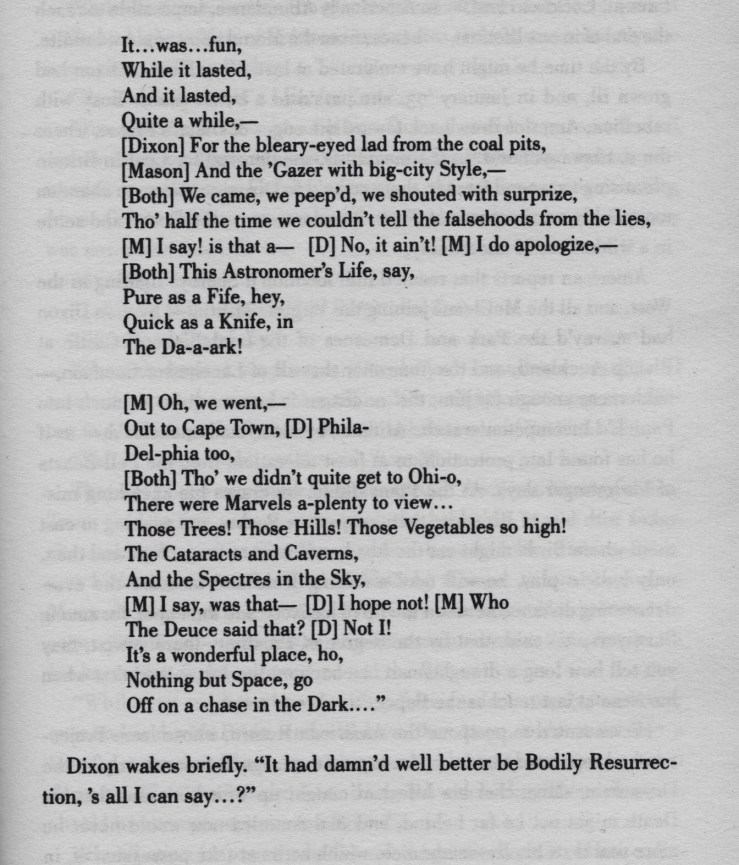
Musical Duet Summary of Pynchon’s Mason & Dixon in Two Stanzas

IMG_4610

From Ch. 77 of Thomas Pynchon’s Mason & Dixon. I love the elision expressed in those dashes — “I say, was that–” — I say, was that a talking dog? I say, was that were-beaver? I say, was that a giant cannabis plant? I say, was that a Sino-Jesuit cabal? I say, was that the Lost Tribe of Israel? I say, was that the missing 11 days, and the Asiatick Pygmies who inhabit them? I say, was that a mechanical duck, looking for love? I say, was that an electric eel? I say, was that a recipe for catsup? I say, was that the first English pizza? I say, was that The Black Dog? I say, was that an iron bathtub? I say, was that a ridotto of inflamed debauchery? I say, was that a Masonic conspiracy? I say, was that the metaphysical wind? I say, was that a dead wife’s ghost? I say, was that a friendship? I say!

Thomas Pynchon’s Mason & Dixon (Third Riff: The Rabbi of Prague)

A. I’m a few chapters–three, precisely—from finishing Mason & Dixon. “Finishing” is not the right verb here, though—Pynchon’s novel is so rich, funny, strange, and energetic that I want to return to it immediately.

B. But I need to backtrack a bit, riff on one of my favorite episodes—Chapter 50.

C. (First riff and second riff for those inclined).

D. In Chapter 50,

’tis Dixon’s luck to discover The Rabbi of Prague, headquarters of a Kabbalistick Faith, in Correspondence with the Elect Cohens of Paris, whose private Salute they now greet Dixon with, the Fingers spread two and two, and the Thumb held away from them likewise, said to represent the Hebrew letter Shin and to signify, “Live long and prosper.”

Pynchon plays here on the reader’s initial understanding of the signal and phrase as a pop culture reference—


—but the goof isn’t merely postmodernist shtick—Pynchon is pointing to how the invisible manifests itself in signs and wonders, covert, cryptic, but perhaps—perhaps—decipherable.

E. (Maybe this needs clarification: The Rabbi of Prague is a tavern. I lost track of how many bars taverns pubs inns alehouses coffeehouses etc. show up in M&D). Continue reading “Thomas Pynchon’s Mason & Dixon (Third Riff: The Rabbi of Prague)”

Doubt is of the essence of Christ (Pynchon’s Mason & Dixon)

The Ascent to Christ is a struggle thro’ one heresy after another, River-wise up-country into a proliferation of Sects and Sects branching from Sects, unto Deism, faithless pretending to be holy, and beyond,— ever away from the Sea, from the Harbor, from all that was serene and certain, into an Interior unmapp’d, a Realm of Doubt. The Nights. The Storms and Beasts. The Falls, the Rapids, . . . the America of the Soul.
Doubt is of the essence of Christ. Of the twelve Apostles, most true to him was ever Thomas,— indeed, in the Acta Thomæ they are said to be Twins. The final pure Christ is pure uncertainty. He is become the central subjunctive fact of a Faith, that risks ev’rything upon one bodily Resurrection. . . . Wouldn’t something less doubtable have done? a prophetic dream, a communication with a dead person? Some few tatters of evidence to wrap our poor naked spirits against the coldness of a World where Mortality and its Agents may bully their way, wherever they wish to go. . . .

— The Reverend Wicks Cherrycoke, Undeliver’d Sermons

Preface to Ch. 53 of Thomas Pynchon’s novel Mason & Dixon.

A Mason & Dixon Christmastide (Thomas Pynchon)

They discharge the Hands and leave off for the Winter. At Christmastide, the Tavern down the Road from Harlands’ opens its doors, and soon ev’ryone has come inside. Candles beam ev’rywhere. The Surveyors, knowing this year they’ll soon again be heading off in different Directions into America, stand nodding at each other across a Punch-bowl as big as a Bathing-Tub. The Punch is a secret Receipt of the Landlord, including but not limited to peach brandy, locally distill’d Whiskey, and milk. A raft of long Icicles broken from the Eaves floats upon the pale contents of the great rustick Monteith. Everyone’s been exchanging gifts. Somewhere in the coming and going one of the Children is learning to play a metal whistle. Best gowns rustle along the board walls. Adults hold Babies aloft, exclaiming, “The little Sausage!” and pretending to eat them. There are popp’d Corn, green Tomato Mince Pies, pickl’d Oysters, Chestnut Soup, and Kidney Pudding. Mason gives Dixon a Hat, with a metallick Aqua Feather, which Dixon is wearing. Dixon gives Mason a Claret Jug of silver, crafted in Philadelphia. There are Conestoga Cigars for Mr. Harland and a Length of contraband Osnabrigs for Mrs. H. The Children get Sweets from a Philadelphia English-shop, both adults being drawn into prolong’d Negotiations with their Juniors, as to who shall have which of. Mrs. Harland comes over to embrace both Surveyors at once. “Thanks for simmering down this Year. I know it ain’t easy.”
“What a year, Lass,” sighs Dixon.
“Poh. Like eating a Bun,” declares Mason.”

The last paragraphs of Ch. 52 of Thomas Pynchon’s novel Mason & Dixon.

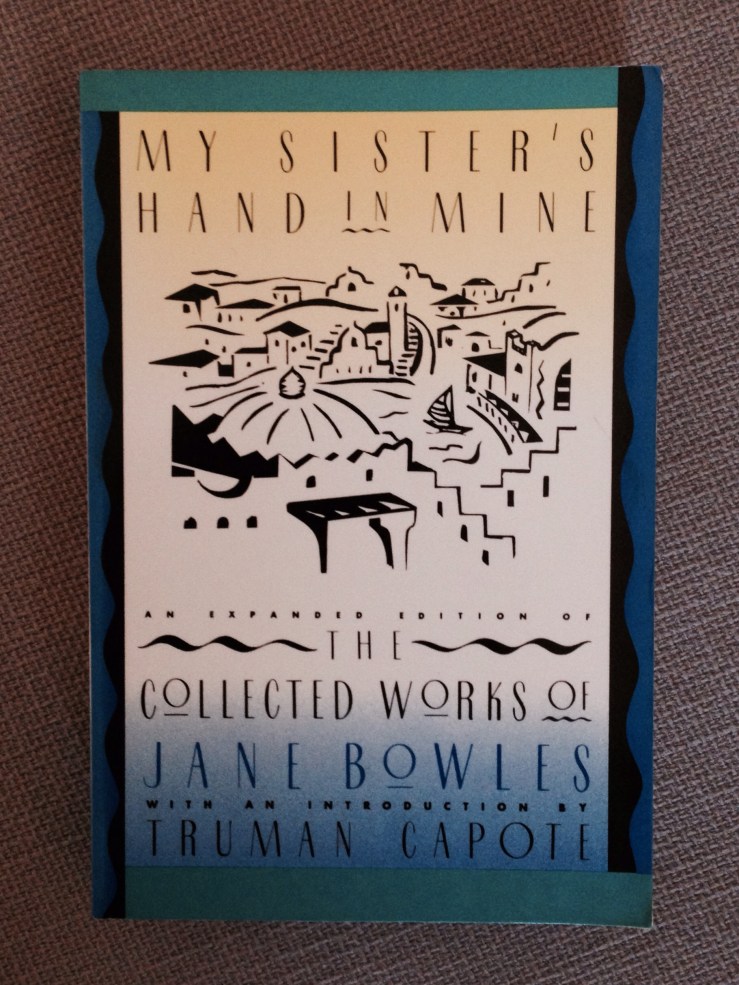
The Collected Works of Jane Bowles (Book Acquired, 12.19.2014)

IMG_4412

I picked up My Sister’s Hand in Mine: The Collected Works of Jane Bowles mostly because I couldn’t find a stand-alone version of the novel Two Serious Ladies. I guess it doesn’t hurt to have, y’know, all of her stuff (or really most of her stuff), but I’m not really a fan of omnibus editions. My interest in Two Serious Ladies was piqued by Ben Marcus, whom I interviewed by phone earlier this month (still transcribing that one; hope to run it in January). He spoke highly of the book and includes it on his writing syllabus.

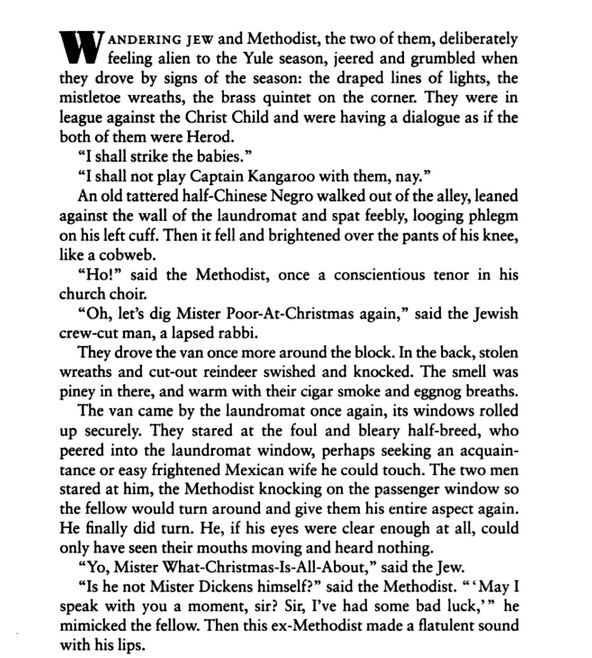
“A Christmas Thought” — Barry Hannah

Duck Tales (Thomas Pynchon’s Mason & Dixon)

Back Inhabitants all up and down the Line soon begin taking the Frenchman’s Duck to their Bosoms, for being exactly what they wish to visit their lives at this Moment,— something possess’d of extra-natural Powers,— Invisibility, inexhaustible Strength, an upper Velocity Range that makes her the match, in Momentum, of much larger opponents,— Americans desiring generally, that ev’ry fight be fair. Soon Tales of Duck Exploits are ev’rywhere the Line may pass. The Duck routs a great army of Indians. The Duck levels a Mountain west of here. In a single afternoon the Duck, with her Beak, has plow’d ev’ry Field in the County, at the same time harrowing with her Tail. That Duck!
As to the Duck’s actual Presence, Opinions among the Party continue to vary. Axmen, for whom tales of disaster, stupidity, and blind luck figure repeatably as occasions for merriment, take to shouting at their Companions, “There she goes!” or, “Nearly fetch’d ye one!” whilst those more susceptible to the shifts of Breeze between the Worlds, notably at Twilight, claim to’ve seen the actual Duck, shimmering into Visibility, for a few moments, then out again.
“I might’ve tried to draw a bead onto it, . . . but it knew I was there. It came walking over and look’d me thump in the eye. I was down flat, we were at the same level, see. ‘Where am I?’ it wants to know. ‘Pennsylvania or Maryland, take your pick,’ says I. It had this kind of Expression onto its Face, and seem’d jumpy. I tried to calm it down. It gave that Hum, and grew vaporous, and disappear’d.”
Mason and Dixon attempt to ignore as much of this as they may, both assuming ’tis only another episode of group Folly, to which this Project seems particularly given, and that ’twill pass all too soon, to be replaced by another, and so on, till perhaps, one day, by something truly dangerous.

From Chapter 45 of Thoma Pynchon’s novel Mason & Dixon.

Thomas Pynchon’s recipe for what is arguably the first British Pizza (Mason & Dixon)

“Lud wishes to know,” Whike relays at last, “Mr. Emerson’s Cousin’s Views, upon the Structure of the World.”
“A Spheroid, the last I heard of it, Sir.”
“Ahr Ahr ahr, ’ahr ahhrr!”
“ ’And I say, ’tis Flat,’” the Jesuit smoothly translates. “Why of course, Sir, flat as you like, flat as a Funnel-Cake, flat as a Pizza, for all that,— ”
“Apologies, Sir,—” Whike all Unctuosity, “the foreign Word again, was . . . ?”
“The apology is mine,— Pizza being a Delicacy of Cheese, Bread, and Fish ubiquitous in the region ’round Mount Vesuvius. . . . In my Distraction, I have reach’d for the Word as the over-wrought Child for its Doll.”
“You are from Italy, then, sir?” inquires Ma.
“In my Youth I pass’d some profitable months there, Madam.”
“Do you recall by chance how it is they cook this ‘Pizza’? My Lads and Lasses grow weary of the same Daily Gruel and Haggis, so a Mother is ever upon the Lurk for any new Receipt.”
“Why, of course. If there be a risen Loaf about . . . ?”
Mrs. Brain reaches ’neath the Bar and comes up with a Brown Batch-Loaf, rising since Morning, which she presents to “Cousin Ambrose,” who begins to punch it out flat upon the Counter-Top. Lud, fascinated, offers to assault the Dough himself, quickly slapping it into a very thin Disk of remarkable Circularity.
“Excellent, Sir,” Maire beams, “I don’t suppose anyone has a Tomato?”
“A what?”
“Saw one at Darlington Fair, once,” nods Mr.”“Brain.
“No good, in that case,— eaten by now.”
“The one I saw, they might not have wanted to eat . . . ?”
Dixon, rummaging in his Surveyor’s Kit, has come up with the Bottle of Ketjap, that he now takes with him ev’rywhere. “This do?”
“That was a Torpedo, Husband.”
“That Elecktrickal Fish? Oh . . . then this thing he’s making isn’t elecktrical?”
“Tho’ there ought to be Fish, such as those styl’d by the Neopolitans, Cicinielli. . . .”
“Will Anchovy do?” Mrs. Brain indicates a Cask of West Channel ’Chovies from Devon, pickl’d in Brine.
“Capital. And Cheese?”
“That would be what’s left of the Stilton, from the Ploughman’s Lunch.”
“Very promising indeed,” Maire wringing his Hands to conceal their trembling. “Well then, let us just . . .”
By the Time what is arguably the first British Pizza is ready to come out of the Baking-Oven beside the Hearth, the Road outside has gone quiet and the Moorland dark, several Rounds have come and pass’d, and Lud is beginning to show signs of Apprehension. “At least ’tis cloudy tonight, no Moonlight’ll be getting thro’,” his Mother whispers to Mr. Emerson.”

From Thomas Pynchon’s novel Mason & Dixon.

“The work is the thing. It don’t matter who wrote it” — William Faulkner

Unidentified participant: Sir, concerning individuality you were discussing a moment ago, you’ve often said—been quoted that you’re a literary man—I beg your pardon, you are not a literary man. By implication one might think that you’d prefer the author who is so to speak spontaneous and not always steady against one who’s read all the literature in his culture and [gives] a steady effort to produce, and works on his style. Is that correct […]?

William Faulkner: How do you mean prefer the author, to spend an evening with him or the work he does?

Unidentified participant: The work he does […]

William Faulkner: Now you—

Unidentified participant: […] clear up: do you mean by implication that you prefer the man who writes so to speak spontaneously or the man who studies his style, reads and learns techniques and works out something [totally] […]?

William Faulkner: I would say first that—the the author is not—is of no importance at all, it’s what he writes. It don’t matter who wrote it. If—and—to—if you mean prefer him as an individual, then I will take the former because the intellectual man and I wouldn’t have anything to talk about. But the man has—has very little to do with his work in my opinion. The work is the thing. It don’t matter who wrote it.

Unidentified participant: Well then let’s say it’s work, [which type of work do you prefer]?

William Faulkner: Well, I think that some people must be intellectual, must be interested, immersed in—in his craft, in literature, to write, to do the work. Other people must be immersed in something completely different. They must in a sense lead a Jekyll and Hyde existence to do the work. It’s the work that matters. It’s not how he did it.

More/audio.

“The writer has three sources: imagination, observation, and experience” — William Faulkner

Unidentified participant: Sir, a few minutes ago you mentioned that people in your hometown were looking into your books for familiar characters. Realizing that you’ve got a rich legacy as it were, of experiences, it seems to me that nowadays the modern novelist is writing merely thinly disguised autobiography. Which do you think is really more valuable [in] the sense of the artist, the disguised autobiography, or making it up from whole cloth, as it were?

William Faulkner: I would say that the writer has three sources: imagination, observation, and experience. He himself doesn’t know how much of which he uses at any given moment because each of the sources themselves are not too important to him, that he is writing about people, and he uses his material from the three sources, as—as—as the carpenter reaches into his—his lumber room and finds a board that fits the particular corner he’s building. Of course, any writer, to begin with, is writing his—his own biography, because he has—has discovered the world and suddenly discovered that it—the world is—is important enough or moving enough or tragic enough to put down on paper or in music or on canvas. And at that time all he knows is what has happened to him because he has not developed his capacity to—to perceive, to draw conclusions, to have an insight into people. His only insight in it is into himself. And it’s biographical because that’s the only gauge he has to measure, is what he has experienced himself. As he gets older and works more, the imagination is like any muscle, it improves with use. Imagination develops. His observation gets shrewder as he gets older, as he writes, and so that when he reaches his peak, his best years, when his work is best, he himself doesn’t know and doesn’t have time to bother and doesn’t really care how much of what comes from each of these sources. That then he is writing about people, writing about the aspirations, the—the troubles, the anguishes, the—the—the courage and the cowardice, the baseness and the splendor of—of man, of the human heart.

More/audio.

The authors William Faulkner consistently returned to

Unidentified participant: Sir, when you are reading for your own pleasure, which authors do you consistently return to?

William Faulkner: The ones I came to love when I was eighteen, nineteen, twenty years old. Moby-Dick, the Old Testament, Shakespeare, a lot of Conrad, Dickens. I read Don Quixote every year.

Via/audio/more.

Motives for writing (William H. Gass)

Very frequently the writer’s aim is to take apart the world where you have very little control, and replace it with language over which you can have some control. Destroy and then repair. I once wrote a passage in which I had the narrator say, “I want to rise so high that when I shit I won’t miss anybody.” But there are many motives for writing. Writing a book is such a complicated, long-term, difficult process that all of the possible motives that can funnel in will, and a great many of those motives will be base. If you can transform your particular baseness into something beautiful, that’s about the best you can make of your own obnoxious nature.

From a 1978 conversation between John Gardner and William H. Gass.

Willam H. Gass’s definition of “a character”

A character for me is any linguistic location of a book toward which a great part of the rest of the text stands as a modifier. Just as the subject of a sentence say, is modified by the predicate, so frequently some character, Emma Bovary for instance, is regarded as a central character in the book because a lot of the language basically and ultimately goes back to modify, be about, Emma Bovary. Now the ideal book would have only one character; it would be like an absolute, idealist system. What we do have are subordinate locales of linguistic energy—other characters—which the words in a book flow toward and come out of. A white whale is a character; mountains in Under the Volcano are characters. Ideas can become characters. Some of the most famous characters in the history of fiction are in that great novel called philosophy. There’s free will and determinism. There’s substance and accident. They have been characters in the history of philosophy from the beginning, and I find them fascinating. Substance is more interesting than most of my friends.


Now why would one adopt such awkward language—why not just talk about character in the traditional sense? The advantage is that you avoid the tendency as a reader to psychologize and fill the work with things that aren’t there. The work is filled with only one thing—words and how they work and how they connect. That, of course, includes the meanings, the sounds, and all the rest. When people ask, “How are you building character?” they sometimes think you’re going around peering at people to decide how you’re going to render something. That isn’t a literary activity. It may be interesting, but the literary activity is constructing a linguistic source on the page

From a fantastic 1978 conversation between John Gardner and William H. Gass.

Selections from One-Star Amazon Reviews of Chinua Achebe’s Things Fall Apart

[Ed. note: The following citations come from one-star Amazon reviews of Chinua Achebe’s novel Things Fall Apart. (See also: Mary Shelley’s Frankenstein, Thomas Pynchon’s Gravity’s RainbowGeorge Orwell’s 1984, Herman Melville’s Moby-Dick, James Joyce’s Ulysses and David Markson’s Wittgenstein’s Mistress). I’ve preserved the reviewers’ own styles of punctuation and spelling].

There were too many details

no plot, lousy tales, and distant characters.

Gnerally, I am extremely open-minded about other cultures,

Don’t buy this unless you need it for some reason out of your control.

DOES THIS GUY EVEN KNOW WHAT THE FUDGE HE IS TALKING ABOUT!

I read two chapters and quit It was horrible, and I say BAH!!!!!!!!!BAH!!!!!!!and a BOOOOOOOO!!!!!

This is one of those “politically correct” books they force you to read in school, in hope of “broadening our horizons” and “opening our minds.”

The main character had a lot of mental problems, including violence, chauvinism, and overambition to become the ‘model citizen’ of his tribe. I had no sympathy for him, neither should you.

Throught the book the auther keeps bringing in new charecters that have almost the identicle spelling of another and it gets very confusing

While Chinua Achebe claims to be an African freedom activist, her(? I can never figure out these new-fangled names) style of writing is stereotypical of the reactionary Brench and their quest to retain Africa.

The author seems to have some sort of infatuation with yams, because the entire book revolves around idiotic descriptions of yams and characters struggling with their declining yam output.

I found this story went no where, there were no real accomplishments done by the main character, his could have check in to an asylum for a year, dealt with his tribal issues, what he missed out on as a kid, came back to his tribe and really made a difference with his people. Instead, we just see some ones life that just gets worse.

This story could have been told in about 20 pages, but streches out into a full book that finally makes a point in the very last pages. Achebe’s work needs some fine tuning.

Why coudln’t they just at least change the names you could at least pronoucne it, ne ways if you plan on reading it, your want lots of time, so u can understand it.

“THINGS FALL APART” IS LIKE ABOUT A GUY WHO GROWS YAMS AND BEATS HIS FAMILY, AND IT JUST TALKS ABOUT THAT THE WHOLE TIME ITS A TERRIBLE HORRIBLE BOOK!

Almost nothing happens for the first 100 pages except we find out that he has three wives and he beats his kids. GREAT, That took 100 pages to say!!

If your looking for a good novel about African people by an African writer, it’s not here. Try Toni Morrison.

Anyone with sense would be rooting for the imperialists by the end of this book.

the writer is only famous because he is a minority.

the story have no point at all.

It draged on and on.

It was like reading a quick obituary.

the names are way too hard to pronounce.

All you never wanted to know about yams… and other such things

This book is way too confusing for the average reader (I am an honors student) and even the more advanced reader would find difficulty reading this book.

Better by far to have young atudents enjoy ayn rand tom woods and john allison milton friedman and peter schiff adn be poastive free neterpirse and successful.

the only thing you’ll enjoy is saying Okwonko over and over again

This makes Africa look worse, not better….

No one cared about Okonkwo’s yams!

How DARE we let children read this book.

it just SUXED

In retrospect, the story lived up to it’s name.

“I know of two kinds of writers” — Jorge Luis Borges

I know of two kinds of writers: those whose central preoccupation is a verbal technique, and those for whom it is human acts and passions. The former tend to be dismissed as “Byzantine” or praised as “pure artists.” The latter, more fortunately, receive the laudatory epithets “profound,” “human,” or “profoundly human,” and the flattering vituperative “savage.” The former is Swinburne or Mallarme; the latter, Celine or Theodore Dreiser. Certain exceptional cases display the virtues and joys of both categories. Victor Hugo remarked that Shakespeare contained Gongora; we might also observe that he contained Dostoevsky…Among the great novelists, Joseph Conrad was perhaps the last who was interested both in the techniques of the novel and in the fates and personalities of his characters. The last that is until the tremendous appearance of Faulkner.

From Borges’ 1937 review of William Faulkner’s Absalom! Absalom!. Originally published in the Argentine magazine El Hogar, part of Borges’ “The Literary Life” column. Republished in Selected Non-Fictions.