“Fear” — Thomas Bernhard

tbf

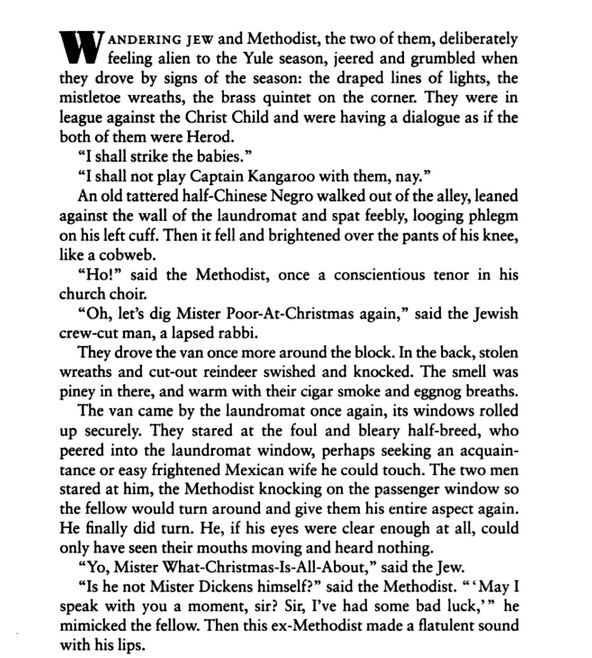
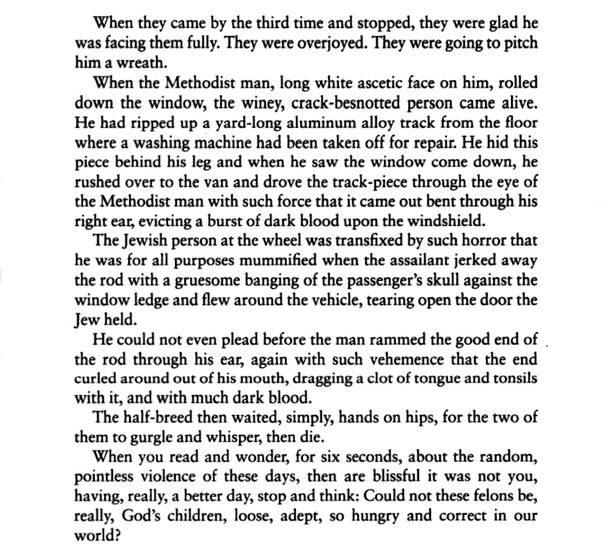
“A Christmas Thought” — Barry Hannah

“The Secretary” — Robert Walser

“The Secretary” by Robert Walser

I had the audacity to write a book that caused quite a stir. As a consequence I was permitted to interact in a casual manner with people of substance. The doors of serious, elegant households were flung wide open to admit me, which was most certainly to my advantage. All I had to do was stroll right in and take care to behave in an agreeable manner as consistently as possible. Once I set foot in a gathering of at least forty full-blooded celebrities. Just imagine how glorious that was!

The commercial head of an association for practitioners of the fine arts one day invited me, after appropriate deliberation, to become his secretary. “I hope,” he said, “that you will prove just as capable of selling pictures as you are of publishing books!”  The offer was too kind to be dismissed out of hand. Accepting this proposal, I resolved that from this moment on I would consider myself fairly remarkable. I felt obliged to remind myself that a person who, upon receiving support, neither feels gratified nor shows his pleasure and gives voice to his satisfaction insults the world at large.

Its plain to see: a keen mind, superior intelligence, a high or the highest level of education and culture should, if this is somehow conceivable, be expected of all secretaries. Even their external appearance must, it goes without saying, be proper and distinguished. One assumes them to be pliant and at the same time clever, suave, gallant and at the same time in every way resolved to achieve commercial success. Elegant manners and glossy social savoir faire number decisively among their inborn qualities.

I don’t know whether I did in fact display all the above-mentioned traits, but I do know that half the city came traipsing through my office. Persons of all dispositions, of every rank and station came barging more or less vigorously into the ministry, I mean headquarters: the cream of society, elegant agents, poor journeymen, sly Gypsies, unruly poets, alarmingly refined ladies, dour princes, strikingly handsome young officers, authors, actresses, sculptors, diplomats, politicians, critics, journalists, theater directors, virtuosos, celebrated scholars, publishers, and wizards in the field of finance. In and out went some who had long since arrived at the top, some who were still groping about the bottom, and others hoping to ascend–both radiantly luminous and somber, gloomy individuals. As in an odd masquerade there entered: young and old, poor and wealthy, healthy and frail, lofty and lowly, merry and morose, happy and unhappy, saucy and shy, cheerful and sad, attractive and hideous, polite and impolite, glorious and shabby, respected and despondent, the proud and the imploring, the famous and the unknown, along with faces, gestures, and figures of all genres.

Art exhibitions are known to have as their goal the advantageous display of works of art and the attracting of buyers. The secretary plays the role of intermediary or go-between, facilitating communication between artists and their extensive, art-infatuated public. It is his task to ensure that a goodly number of bargains are definitively struck, that pictures are industriously sent out the door to buyers. Persons expressing interest in these works might appear on the scene only to swiftly vanish from sight again, unfortunately for good. The secretary must be attentive, as the most unimposing man can unexpectedly prove to be a connoisseur and buyer.

For a time I imagined myself to be exceedingly skillful at the art trade. Unquestionably I was splendidly suited to taking leisurely hackney-cab rides upon pleasantly lively, bright, glittering streets and to spending half and whole hours merrily chatting with jolly artists’ wives. Spirited evenings at the club regularly showed me in top form. I was a master at passing about platters heaped with delicacies, and was a frequent and enthusiastic visitor to and encourager of female painters. In such and similar respects, I acquitted myself gloriously. After the fact, however, I reached the conclusion that I cannot have been a particularly valuable, clever, prudent, and successful secretary for paintings. Specialists in the field were on several occasions seen to shrug their shoulders at the extent of my accomplishments. The head of the firm seemed to find it appealing to speak with his functionary above all on the subject of poetry and the like.

A stately successor soon reduced me to a predecessor and provided me with an occasion to lay down my post, resign my position, delicately make way, and charmingly busy myself elsewhere. Thinking poorly of me or feeling resentful because he had made so bold as to presume talents in me that I did not in fact possess was something that would never have occurred to my benefactor. To demonstrate that he was still of a mind to remain well-disposed toward me, he invited me, with a turn of phrase both courteous and jovial, to join him for supper.

“G-D” — Ben Marcus

gd

“Up in the Gallery” — Franz Kafka

If some frail tubercular lady circus rider were to be driven in circles around and around the arena for months and months without interruption in front of a tireless public on a swaying horse by a merciless whip-wielding master of ceremonies, spinning on the horse, throwing kisses and swaying at the waist, and if this performance, amid the incessant roar of the orchestra and the ventilators, were to continue into the ever-expanding, gray future, accompanied by applause, which died down and then swelled up again, from hands which were really steam hammers, perhaps then a young visitor to the gallery might rush down the long stair case through all the levels, burst into the ring, and cry “Stop!” through the fanfares of the constantly adjusting orchestra.

But since things are not like that—since a beautiful woman, in white and red, flies in through curtains which proud men in livery open in front of her, since the director, devotedly seeking her eyes, breathes in her direction, behaving like an animal, and, as a precaution, lifts her up on the dapple-gray horse, as if she were his grand daughter, the one he loved more than anything else, as she starts a dangerous journey, but he cannot decide to give the signal with his whip and finally, controlling himself, gives it a crack, runs right beside the horse with his mouth open, follows the rider’s leaps with a sharp gaze, hardly capable of comprehending her skill, tries to warn her by calling out in English, furiously castigating the grooms holding hoops, telling them to pay the most scrupulous attention, and begs the orchestra, with upraised arms, to be quiet before the great jump, finally lifts the small woman down from the trembling horse, kisses her on both cheeks, considers no public tribute adequate, while she herself, leaning on him, high on the tips of her toes, with dust swirling around her, arms outstretched and head thrown back, wants to share her luck with the entire circus—since this is how things are, the visitor to the gallery puts his face on the railing and, sinking into the final march as if into a difficult dream, weeps, without realizing it.

“Up in the Gallery” by Franz Kafka

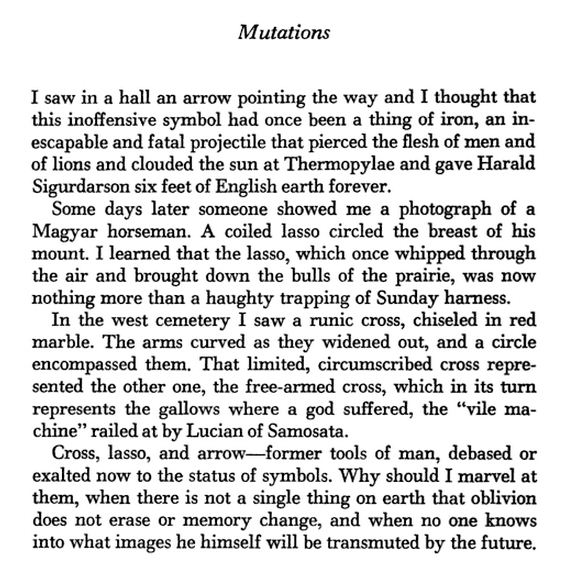
“Mutations” — Jorge Luis Borges

JLB

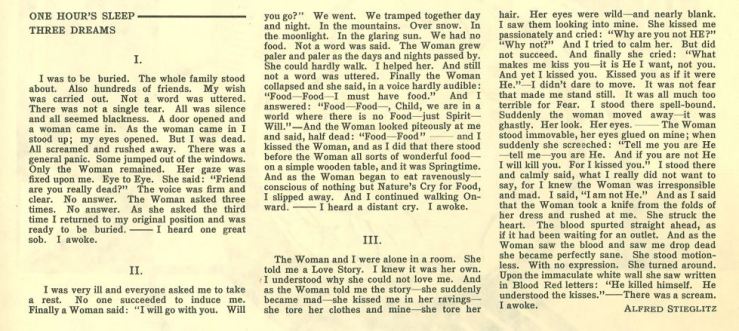
“One Hour’s Sleep—–Three Dreams” — Alfred Stieglitz

From the first issue of 291; via the mighty Ubuweb.

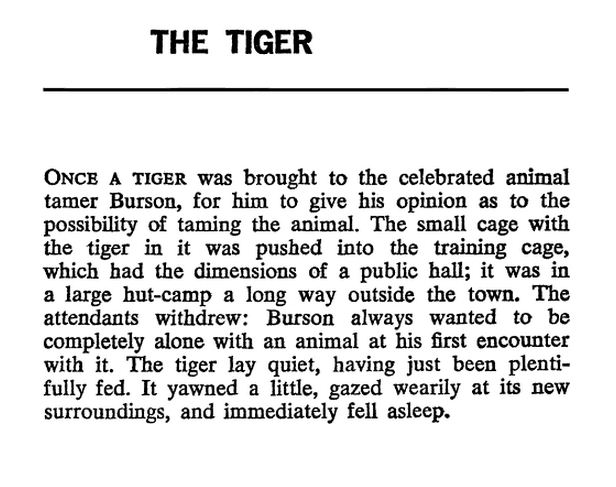
“The Tiger” — Kafka

“Parable of Cervantes and Don Quixote” — Jorge Luis Borges

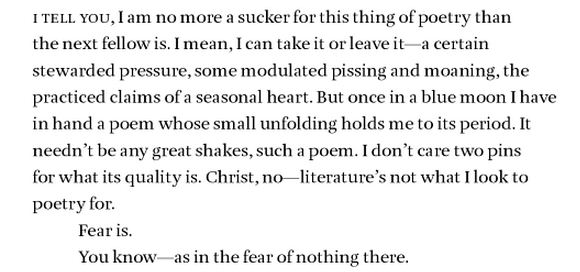
“Some Modulated Pissing and Moaning” (Gordon Lish on Poetry)


From Gordon Lish’s story “How to Write a Poem.”

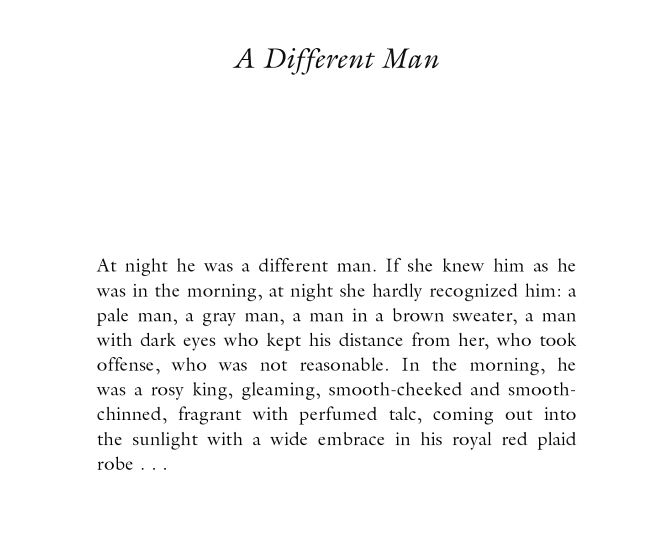
“A Different Man” — Lydia Davis

“Montparnasse” — Ernest Hemingway

“Hysteria” — T.S. Eliot

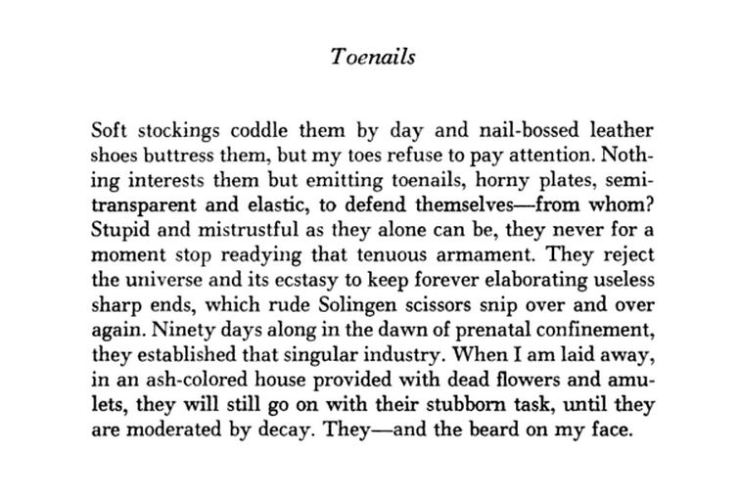
“Toenails” — Jorge Luis Borges

Read “The Werewolf,” A Short Fable by Angela Carter

“The Werewolf,” a short story by Angela Carter (collected in The Bloody Chamber and Burning Your Boats):

It is a northern country; they have cold weather, they have cold hearts.Cold; tempest; wild beasts in the forest. It is a hard life. Their houses are built of logs, dark and smoky within. There will be a crude icon of the virgin behind a guttering candle, the leg of a pig hung up to cure, a string of drying mushrooms. A bed, a stool, a table. Harsh, brief, poor lives.To these upland woodsmen, the Devil is as reals as you or I. More so; they have not seen us nor even know that we exist, but the Devil they glimpse often in the graveyards, those bleak and touching townships of the dead where the graves are marked with portraits of the deceased in the naif style and there are no flowers to put in front of them, no flowers grow there, so they put out small votive offerings, little loaves, sometimes a cake that the bears come lumbering from the margins of the forests to snatch away. At midnight, especially on Walpurgisnacht, the Devil holds picnics in the graveyards and invites the witches; then they dig up fresh corpses, and eat them. Anyone will tell you that.Wreaths of garlic on the doors keep out the vampires. A blue-eyed child born feet first on the night of St. John’s Eve will have second sight. When they discover a witch – some old woman whose cheeses ripen when her neighbours’ do not, another old woman whose black cat, oh, sinister! follows her about all the time, they strip the crone, search for her marks, for the supernumerary nipple her familiar sucks. They soon find it. Then they stone her to death.

Winter and cold weather.

Go and visit grandmother, who has been sick. Take her the oatcakes I’ve baked for her on the hearthstone and a little pot of butter.

The good child does as her mother bids – five miles’ trudge through the forest; do not leave the path because of the bears, the wild boar, the starving wolves. Here, take your father’s hunting knife; you know how to use it.

The child had a scabbby coat of sheepskin to keep out the cold, she knew the forest too well to fear it but she must always be on her guard. When she heard that freezing howl of a wolf, she dropped her gifts, seized her knife, and turned on the beast.

It was a huge one, with red eyes and running, grizzled chops; any but a mountaineer’s child would have died of fright at the sight of it. It went for her throat, as wolves do, but she made a great swipe at it with her father’s knife and slashed off its right forepaw.

The wolf let out a gulp, almost a sob, when it saw what had happened to it; wolves are less brave than they seem. It went lolloping off disconsolately between the trees as well as it could on three legs, leaving a trail of blood behind it. The child wiped the blade of her knife clean on her apron, wrapped up the wolf’s paw in the cloth in which her mother had packed the oatcakes and went on towards her grandmother’s house. Soon it came on to snow so thickly that the path and any footsteps, track or spoor that might have been upon it were obscured.

She found her grandmother was so sick she had taken to her bed and fallen into a fretful sleep, moaning and shaking so that the child guessed she had a fever. She felt the forehead, it burned. She shook out the cloth from her basket, to use it to make the old woman a cold compress, and the wolf’s paw fell to the floor.

But it was no longer a wolf’s paw. It was a hand, chopped off at the wrist, a hand toughened with work and freckled with old age. There was a wedding ring on the third finger and a wart in the index finger. By the wart, she knew it for her grandmother’s hand.

She pulled back the sheet but the old woman woke up, at that, and began to struggle, squawking and shrieking like a thing possessed. But the child was strong, and armed with her father’s hunting knife; she managed to hold her grandmother down long enough to see the cause of her fever. There was a bloody stump where her right hand should have been, festering already.

The child crossed herself and cried out so loud the neighbours heard her and come rushing in. They know the wart on the hand at once for a witch’s nipple; they drove the old woman, in her shift as she was, out into the snow with sticks, beating her old carcass as far as the edge of the forest, and pelted her with stones until she fell dead.

Now the child lived in her grandmother’s house; she prospered.

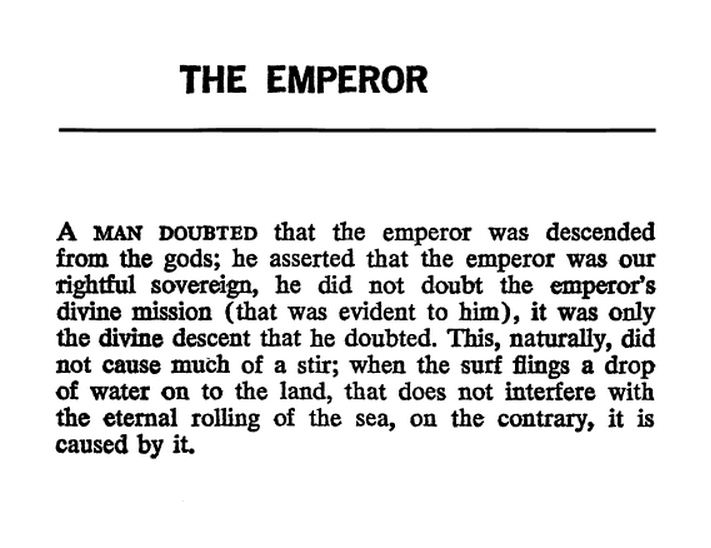
“The Emperor” — Kafka

“Memory” — H.P. Lovecraft