Edgar Allan Poe’s “The Tell-Tale Heart” is one of our all-time favorite scary stories. Poe’s story explores the troubled mind of a murderer suffering from manic bipolar depression. Or maybe it’s all about the suppression of dark secrets. Is the Evil Eye an “evil I”? I think so! Dig this great animation from 1953, featuring the vocal talents of James Mason:
“Having your book turned into a movie is like seeing your oxen turned into bouillon cubes” — John LeCarre
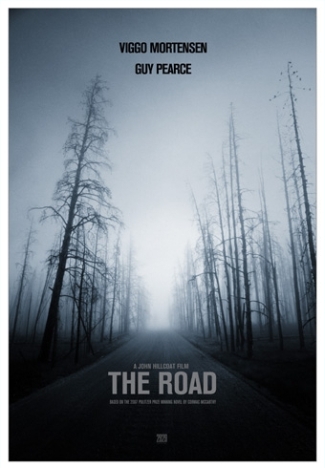
Movies rarely compare favorably to the books from which they are adapted and almost never surpass them. Still, film adaptations of books can be fantastic if handled by the right director–take Mexican director Alfonso Cuarón for example, whose brilliant films Children of Men and Harry Potter and the Prisoner of Azkaban (adaptations of books by P.D James and J.K. Rowling, respectively) convey richly imagined, engrossing worlds. Cuarón’s films join a small stable of adaptations that live up to–if not surpass–the books on which they are based. Most great film adaptations turn good genre fiction into great art. However, great literature doesn’t usually fare so well. Geniuses like Kubrick and Coppola have reconfigured airport reading like Stephen King’s The Shining and Mario Puzo’s The Godfather into cinematic masterpieces, but has anyone ever done justice to Melville or Hemingway or Hawthorne or Fitzgerald (of the four attempts at translating Gatsby to the screen, the 1974 Coppola-produced effort is arguably the best, but consider how short it falls of capturing Fitzgerald’s vision)? Which brings up the question: just how good, bad, or indifferent will the upcoming movie adaptation of Cormac McCarhy’s Pulitzer Prize winnerThe Roadbe? We thought we’d navigate the pros and cons here.
What The Road film adaptation has going for it:
The director: Australian director John Hillcoat’s 2005 feature film debut The Proposition captured the bloody violence and moral ambiguity of a world alienated from civilization. We loved the movie, and not enough people have seen it. The tone Hillcoat achieved in The Proposition seems well matched to McCarthy’s grim vision.
The producer: Nick Wechsler’s list of films includes Sex, Lies, and Videotape, The Player, Requiem for a Dream, 25th Hour, and Drugstore Cowboy–so it seems like he knows how to sit back and let a filmmaker create art without trying to, you know, have a massive Hollywood hit.
The leading man: Viggo Mortensen as the father seems like a great choice. Mortensen brought depth to the role he’s most famous for–Aragorn in The Lord of the Rings trilogy–something of a feat when you consider most of his screen time was devoted to scowling, brooding, or chopping up orcs. He was fantastic in the films he did with David Cronenberg, A History of Violenceand Eastern Promises (his bathhouse fight scene is unbelievable). Mortensen’s a published author who started his own publishing house, Perceval Press, so he probably understands the literary gravity of The Road.
The story: Anyone who’s read The Road knows that it’s a sad and moving and strangely beautiful take on one of the most hackneyed devices of science fiction: the post-apocalyptic wasteland.
Potential problem spots for The Road film adaptation:
The cast: We don’t know much about twelve year old Kodi Smit-McPhee who plays the son, but we do know that that is a major role. Let’s hope Kodi is more Jodie, less Jake Lloyd or (shiver) Dakota Fanning. However, Viggo’s had pretty positive things to say about him. Ringers Robert Duvall and Guy Pearce are also in there, but there aren’t too many other speaking parts in the book besides the father and the son, so it’s hard to predict what they’ll be doing–hopefully Hillcoat hasn’t fiddled with the story too much. Charlize Theron is also in the movie. The wife character showed up in a few dreamy flashbacks, but was more of a shadow than a fleshed out character; again, hopefully Hillcoat hasn’t chosen to expand the role to appease a wider demographic.
The story: Some of the best moments of The Road consist of the father’s inner monologues on memory and loss and very few directors can pull off a voice-over successfully (Terrence Malick is the only one who comes to mind right now). Of course, this problem of language is always the problem of movie adaptation.
All the Pretty Horses: Billy Bob Thornton’s leaden 2000 adaptation of the first of McCarthy’s “border trilogy” is pretty boring. I’ll admit that I’ve never finished the book, despite three attempts [ed. note: I finished the “border trilogy” in spring of ’09. Books are far, far, far superior to the film].
No Country for Old Men: Even though the Coens did a great job with No Country for Old Men, the book was still better than the movie–and No Country is, in some ways, McCarthy’s take on a genre novel, the crime procedural. In this sense, the Coens made a smart move, but they still couldn’t convey the depth and meaning of the book–again, much of it delivered via Sheriff Ed Tom Bell’s inner monologues. Although The Road may appear to have genre fiction elements–namely, the tropes of post-apocalyptic sci-fi–to describe it as such would be a severe limitation, as would be to film it in such a manner.
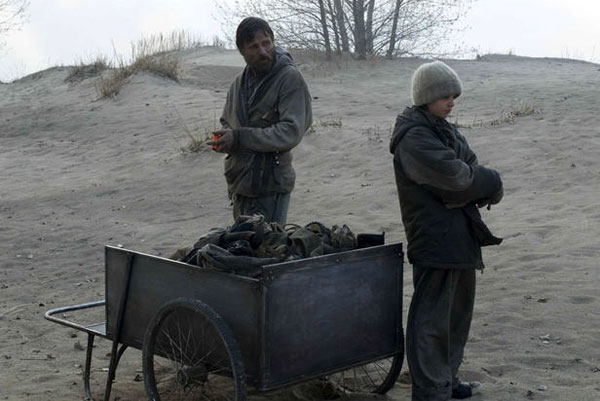
The advance stills: Sure, they’re grim and bleak, but are they grim and bleak enough?
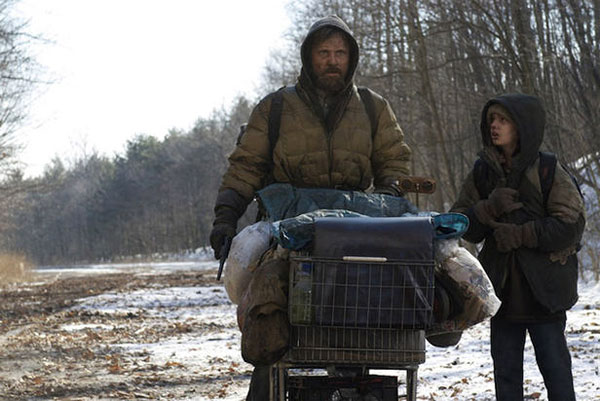
Also, why the stylized cart? If you’ve read the novel, you know what I mean–the cart needs to be a grocery store cart, homeless style! Hang on–
–that’s better! (NB: images link to a gallery of advance images)
Does it seem worth seeing in the theater?
Yes. We’ll be carrying the fire on or around November 26th (and just in time for Thanksgiving!)
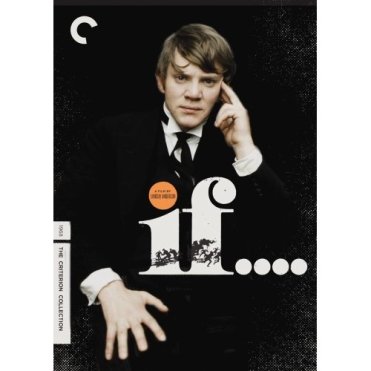
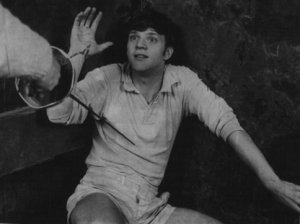
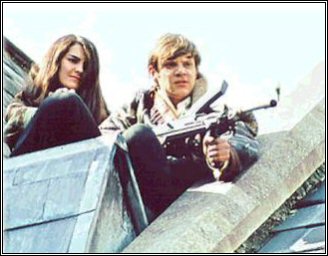
Criterion has finally given Lindsay Anderson‘s 1968 classic if…. a proper DVD release. if…. is one of my all time favorite films. Mick Travis (played with savage aplomb by a very young Malcolm McDowell) leads “The Crusaders,” a band of rebels who defy “The Whips,” the cruel upperclassmen who mete out harsh punishments at their stringent English boarding school. “What I want to know is when do we live?” asks restless Mick. However, the life of individual freedom that he wants to live is so suppressed by the cruel and dominating hierarchy of his school (a microcosm of British society) that he must take liberty by force. In one scene, the Crusaders playfully fence with each other, declaring “Death to all tyrants!” The playfulness quickly slips into violence, as the repressed urges of these would-be revolutionaries flare up. When Mick is cut, he shows his wounded hand and declares with pride “Blood! Real blood!”
Anderson loads if…. with myriad revolutionary images that foreshadow the film’s shocking ending, at the same time tempering if…. with a surrealist sense of humor that satirizes the inherent dangers in institutionalized education and groupthink in general. if…. is bitingly funny, oddly sexy, and unlike any other film I’ve ever seen. The new edition looks great (much better than my VHS dub) and sounds great, and the commentary track provided by Malcolm McDowell and film critic David Robinson is insightful and surely a must for fans of the film. But who am I kidding, if you’re a fan of this film you’ve already seen the release and listened to the commentary–right?
If you love the Ramones, you really shouldn’t watch the 2003 documentary film End of the Century–it will only break your heart.
I love the Ramones; I’ve loved the Ramones since I was a kid. I was lucky enough to see them in concert about twelve years ago (even then we were hip to the fact that the Ramones without Dee Dee–the C.J. version of Ramones–was not really the real Ramones). My favorite memory of the show was Joey saying that the venue of the show was built on top of a pet cemetery. Then they played “Pet Cemetery.” Genius.
So well and anyway. End of the Century. This is an excellent music documentary, a standout in a genre which is generally hit or miss. Unlike weaker films that rely on narrators or musicians influenced by the subject*, End of the Century is composed entirely of interviews (both archival and original to the film) with the Ramones themselves (Dee Dee, Tommy, Joey, Johnny, Marky, Richie (Richie wears a conservative suit in his interview, and mostly complains about not getting a taste of “that T-shirt money”) and C.J. (C.J. comes across as naive, energetic, and wholly endearing, making me feel kind of bad about my previous opinions of him). In addition to the Ramones’ first-hand accounts, there are plenty of interviews with managers and friends and family and roadies and so on–eyewitnesses who candidly relate the good, the bad, and the ugly in excruciating detail (there is plenty of ugly). Raw live footage dating back to the early 70s brings to life the sheer volume and bizarre intensity of a Ramones show.
So why so heartbreaking? Well, here’s the deal. We know that the John and Paul didn’t like each other. We know that Mick and Keith bicker. We know that bands have “creative differences” and egos get bruised and so and so on. But with the Ramones, well, I guess I always thought of them, as well, cartoons of themselves. But End of the Century makes it very clear that these guys were very, very serious about themselves and what they did. They were in no way cultivating an image: the Ramones really were what you thought they were. And they hated each other. Like, years-of-not-talking-to-each-other hatred, right up until their retirement. They were bitter–they really wanted to be successful. Now, I always thought of the Ramones as legendary, as huge, as the original punk band. But they wanted to be huge, huge like the Beach Boys or the Beatles. Hits on the radio huge (a quick aside: the accounts of working with Phil Spector on the 1980 album End of the Century, in the hopes of gaining a top 10 hit, are hilarious. Apparently Phil held the band plus entourage at gunpoint, threatening to shoot them if they returned to the hotel. The reason for Phil’s hostage-taking: he wanted them to hang out and watch movies. But I’m sure Spector’s like, totally not guilty of murdering that chick in his house). So a lot of the movie is the Ramones lamenting that they “never made it” (again, to me this was ludicrous). But really it’s the hatred, the meanness of their interviews, their complete dismissal of each other that I found most disconcerting (particularly heartbreaking is hearing Johnny’s non-affected nonchalance over Joey’s relatively recent (to the time of the movie’s shooting) death from lymphoma). Maybe I’m just a foolish fan who wanted my cartoons.
The film ends by noting that Dee Dee died of a heroin overdose two months after the film finished shooting. Johnny Ramone died in 2004. The principal members of the band all died within a few short years of each other, like married folks often do.
To end on a lighter note, check out this footage from the film, featuring Dee Dee’s rap project, Dee Dee King’s “Funky Man” (listen for this embarrassing nugget: “I’m a Negro too!”)
* There are one or two very brief interviews (like one or two sentences) with famous fans, including, of course, Thurston Moore, who is contractually obligated to appear in any film about any musician. Check out his prolific (and incomplete–unless my memory fails me he’s also in the 1995 Brian Wilson documentary I Just Wasn’t Made for These Times) filmography here.


 Biblioklept