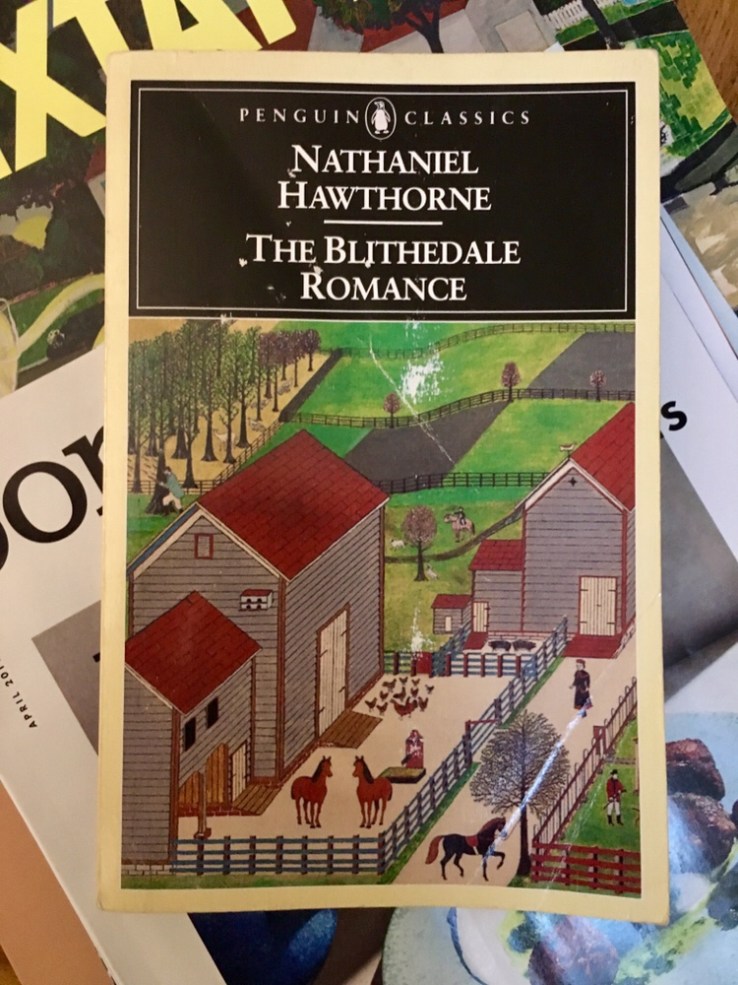
The unregenerated man shivers within me | Nathaniel Hawthorne’s journal entry for April 13th, 1841

Brook Farm, Oak Hill, April 13th, 1841.–. . . Here I am in a polar Paradise! I know not how to interpret this aspect of nature,–whether it be of good or evil omen to our enterprise. But I reflect that the Plymouth pilgrims arrived in the midst of storm, and stepped ashore upon mountain snow-drifts; and, nevertheless, they prospered, and became a great people,–and doubtless it will be the same with us. I laud my stars, however, that you will not have your first impressions of (perhaps) our future home from such a day as this, . . . Through faith, I persist in believing that Spring and Summer will come in their due season; but the unregenerated man shivers within me, and suggests a doubt whether I may not have wandered within the precincts of the Arctic Circle, and chosen my heritage among everlasting snows, . . . Provide yourself with a good stock of furs, and, if you can obtain the skin of a polar bear, you will find it a very suitable summer dress for this region. . . .

I have not yet taken my first lesson in agriculture, except that I went to see our cows foddered, yesterday afternoon. We have eight of our own; and the number is now increased by a transcendental heifer belonging to Miss Margaret Fuller. She is very fractious, I believe, and apt to kick over the milk-pail. . . . I intend to convert myself into a milkmaid this evening, but I pray Heaven that Mr. Ripley may be moved to assign me the kindliest cow in the herd, otherwise I shall perform my duty with fear and trembling.

I like my brethren in affliction very well; and, could you see us sitting round our table at meal-times, before the great kitchen fire, you would call it a cheerful sight. Mrs. B—- is a most comfortable woman to behold. She looks as if her ample person were stuffed full of tenderness,–indeed, as if she were all one great, kind heart.

Nathaniel Hawthorne’s journal entry for April 13th, 1841. From Passages from the American Note-Books.

The entry is the first of Hawthorne’s journals to mention Brook Farm, a utopian enterprise that forms the basis of Hawthorne’s 1852 novel The Blithedale Romance (which I am currently re-reading).

Blog about “The Silvery Veil” allegory in Nathaniel Hawthorne’s The Blithedale Romance (and David Foster Wallace’s Madame Psychosis)

This afternoon I got to Ch. XIII of Nathaniel Hawthorne’s novel The Blithedale Romance. Titled “Zenobia’s Legend,” most of the chapter is given over to the titular heroine’s tale “The Silvery Veil,” a wonderfully pre-postmodern moment in Hawthorne’s novel.

Let’s look lookingly at the layers: The Blithdale Romance is Hawthorne’s ironic-but-sincere dark-romantic semi-autobiographical account of his time at Brook Farm, a failed utopian community of Transcendentalists who maybe didn’t quite, uh, transcend. Zenobia is based partially on the great American feminist Margaret Fuller (who also did time on Brook Farm).  Taking center stage here in (the aptly-numbered) thirteenth chapter of Blithedale, Zenobia extemporizes a story about The Veiled Lady. This Veiled Lady is a local celebrity, a clairvoyant of some renown who (we learn in the opening chapter of the novel) has recently disappeared. Zenobia’s yarn is a leisure-time amusement, one she contends that she’ll spin to get out of an apparent rut:

“I am getting weary of this,” said she, after a moment’s thought. “Our own features, and our own figures and airs, show a little too intrusively through all the characters we assume. We have so much familiarity with one another’s realities, that we cannot remove ourselves, at pleasure, into an imaginary sphere. Let us have no more pictures to-night; but, to make you what poor amends I can, how would you like to have me trump up a wild, spectral legend, on the spur of the moment?”

Ironically however, Zenobia clearly relies on her “own features” as well as the features of Blithedale’s spectral ingenue Priscilla to inform her performance. Despite her declaration to “remove” herself and her auditors “into an imaginary sphere,” Zenobia essentially recasts poor Priscilla’s waifery into a supernatural ultraromantic mode. The story’s basic conceit is thus: There is a famous veiled lady who may be extraordinarily beautiful or who may be extraordinarily ugly. No one knows what she looks like because like the the veil obviously hides her face, preventing any viewer’s agency to interpret for himself.

Zenobia’s legend is a tale within a tale within a tale—a performance that each member of the small Blithedale community will recode into their own readings. However, Zenobia guides her audience toward a certain conclusion, all but declaring that meek Priscilla is in fact the Veiled Lady—hell, Zenobia even throws a bit of gauze she’d been vamping with over the poor dear’s head at the climax of her tale.

“The Silvery Veil,” in another pre-postmodern layer, is a thin but clear echo of Hawthorne’s famous allegory “The Minister’s Black Veil,” which was published 15 years before The Blithedale Romance, and would clearly have been known to Hawthorne’s intended audience of Transcendentalites. (There’s perhaps a more clear connection between “The Silvery Veil” and “The Minister’s Black Veil” : Hawthorne likely based the titular minister on the real-life preacher Joseph Moody, who wore a handkerchief over his faceBlithedale features a character named “Old Moodie” who we eventually learn is Pricilla’s secret father).

So Hawthorne overloads the allegory with meaning and misdirection—is Zenobia’s legend “The Silvery Veil” the secret key to Priscilla’s identity? A clue to Blithedale’s destiny? A watery paraphrase of Hawthorne’s own stronger story, “The Minister’s Black Veil”? Simply a Saturday night’s entertainment?

The trick of the tale I think rests in the undecidability of what’s under the veil, in the not knowing, which is neatly summed up in a paragraph:

Some upheld that the veil covered the most beautiful countenance in the world; others,—and certainly with more reason, considering the sex of the Veiled Lady,—that the face was the most hideous and horrible, and that this was her sole motive for hiding it. It was the face of a corpse; it was the head of a skeleton; it was a monstrous visage, with snaky locks, like Medusa’s, and one great red eye in the centre of the forehead. Again, it was affirmed that there was no single and unchangeable set of features beneath the veil; but that whosoever should be bold enough to lift it would behold the features of that person, in all the world, who was destined to be his fate; perhaps he would be greeted by the tender smile of the woman whom he loved, or, quite as probably, the deadly scowl of his bitterest enemy would throw a blight over his life.

Hawthorne’s description here immediately reminded me of Joelle van Dyne aka Madame Psychosis aka the P.G.O.A.T., a character in David Foster Wallace’s novel Infinite Jest who wears a veil either because she’s too beautiful to behold and/or because she bears a physical deformity to abject to bear. I can’t actually remember if it’s the “and” or the “or” in that previous sentence that’s correct, even though I’ve read IJ a few times (and even not that long ago). Which is like, maybe the point of this literary veiling—what I mean is that we read faces, we read expressions, and the veil covers over what we would read directly, giving us a blank space to interpret through the lens of our wild (or not so wild) imaginations. Hawthorne’s veils (and maybe Wallace’s veils) require an inward reading, asking us to interpret a signifier that does not bear a clear signified—a most puzzling sign.

Blog about “a perfectly inextricable knot of polygamy” (in Hawthorne’s The Blithedale Romance)

img_9506

I hit Chapter XII of Nathaniel Hawthorne’s novel The Blithedale Romance this afternoon and was delighted by some lines from its first paragraph, wherein Our Narrator Coverdale retreats to a little fort he’s made in the woods:

Long since, in this part of our circumjacent wood, I had found out for myself a little hermitage. It was a kind of leafy cave, high upward into the air, among the midmost branches of a white-pine tree. A wild grapevine, of unusual size and luxuriance, had twined and twisted itself up into the tree, and, after wreathing the entanglement of its tendrils around almost every bough, had caught hold of three or four neighboring trees, and married the whole clump with a perfectly inextricable knot of polygamy.

I was deeply disappointed that the version of myself who had read this same physical copy of The Blithedale Romance almost 15 years earlier had failed to muster a single annotation on the passage (despite having left like 10,000 other scratches and loops on the yellow pages).

Hawthorne’s naturalism is fantastically naturalistically fantastical. The wild grapevine he conjures here that “married the whole clump with a perfectly inextricable knot of polygamy” is simultaneously a physical entity “wreathing” itself around the surrounding trees and at the same time a metonymy for the Bacchic spirit that pulls the souls of Blithedale into a weird marriage, an “inextricable knot of polygamy.” Hawthorne’s image points to exuberant and wild joy on one hand, but also to the thick bonds that tightly tie desire down in any moral system. The grapevine image serves as shorthand for the entire novel, underlining the push-pull tension of the narrator’s (and author’s!) conflict between Puritanism and Transcendentalism. The “inextricable knot of polygamy” is wonderfully pure in its impurity, in its radical transcendence.

Blog about starting Nathaniel Hawthorne’s novel The Blithedale Romance

img_9465

I started a reread of Nathaniel Hawthorne’s 1852 novel The Blithedale Romance this afternoon, prompted by Iris Murdoch’s novel The Bell and its utopian commune setting. I don’t think I’ve read Blithedale in a dozen or so years; the copy I’m reading is from grad school. The margins brim with every sort of nonsense, every damn adjective circled, etc.

My son, seven, picked up the novel and remarked that he didn’t know that I read romances. I tried to explain Romance here; failed. Then my daughter read the blurb. I asked her what she thought and she said the she liked the betrayal part but wasn’t sure about the rest. I flipped it over and read the blurb, which I’m not sure I’d read before. The blurb is all about sex, which seems about right.

The Blithedale Romance is Hawthorne’s horniest novel. Here is a passage from just three chapters in, where protagonist Miles Coverdale conjures some delight in imagining his lively host Zenobia au naturale (right after damning domestic work altogether)—

“What a pity,” I remarked, “that the kitchen, and the housework generally, cannot be left out of our system altogether! It is odd enough that the kind of labor which falls to the lot of women is just that which chiefly distinguishes artificial life—the life of degenerated mortals—from the life of Paradise. Eve had no dinner-pot, and no clothes to mend, and no washing-day.”

“I am afraid,” said Zenobia, with mirth gleaming out of her eyes, “we shall find some difficulty in adopting the paradisiacal system for at least a month to come. Look at that snowdrift sweeping past the window! Are there any figs ripe, do you think? Have the pineapples been gathered to-day? Would you like a bread-fruit, or a cocoanut? Shall I run out and pluck you some roses? No, no, Mr. Coverdale; the only flower hereabouts is the one in my hair, which I got out of a greenhouse this morning. As for the garb of Eden,” added she, shivering playfully, “I shall not assume it till after May-day!”

Assuredly Zenobia could not have intended it,—the fault must have been entirely in my imagination. But these last words, together with something in her manner, irresistibly brought up a picture of that fine, perfectly developed figure, in Eve’s earliest garment. I almost fancied myself actually beholding it!

Ah Hawthorne! The “fault must have been entirely in my imagination,” Miles muses. That last line — “I almost fancied myself actually beholding it!” — doesn’t appear in the Gutenberg version of The Blithedale Romance I linked to above (and here too, I guess). The editors of my Penguin Classics edition note that the line was probably deleted from the original manuscript “due to Sophia Hawthorne’s prudishness.” But the line—and really, here, I mean that that adverb almost—tells us so much about our unreliable narrator, Miles Coverdale. To almost fancy beholding an imaginative vision is to have absolutely imaginatively beheld the vision, and then applied a second consciousness to the whole affair—a witness to the sinful vision, a witness who reports to one’s own awkward soul.

Coverdale is the Hawthorne-figure, or rather an ironized version of Hawthorne, who recalls his memories of his time on real-life Brook Farm, an experimental utopian community founded by Unitarian preacher George Ripley and his wife Sophia in the mid-1850s. Hawthorne brings his pessimistic bent to the whole business (failed business), but shows us this perspective though Coverdale’s Romantic, even nostalgic optimism—an optimism clouded by experience:

The better life! Possibly, it would hardly look so now; it is enough if it looked so then. The greatest obstacle to being heroic is the doubt whether one may not be going to prove one’s self a fool; the truest heroism is to resist the doubt; and the profoundest wisdom to know when it ought to be resisted, and when to be obeyed.

Yet, after all, let us acknowledge it wiser, if not more sagacious, to follow out one’s daydream to its natural consummation, although, if the vision have been worth the having, it is certain never to be consummated otherwise than by a failure. And what of that?

So the sex of sexy Blithedale, even in its first chapters, is to be “consummated…by a failure.” But if I recall, there’s a lot of blithely lively fun in getting to that failure, and I’m enjoying Hawthorne’s often-ironic but always deeply-felt sentences, sentences that dwell on the ways in which we imagine and then try to create (and perhaps fail to create) the better life.

Like trying to read a hundred poems at once | Nathaniel Hawthorne’s journal entry for March 24th, 1856

We first went into Wolsey’s great Hall, up a most spacious staircase, the walls and ceiling of which were covered with an allegorical fresco by Verrio, wonderfully bright and well preserved; and without caring about the design or execution, I greatly liked the brilliancy of the colors. The great Hall is a most noble and beautiful room, above a hundred feet long and sixty high and broad. Most of the windows are of stained or painted glass, with elaborate designs, whether modern or ancient I know not, but certainly brilliant in effect. The walls, from the floor to perhaps half their height, are covered with antique tapestry, which, though a good deal faded, still retains color enough to be a very effective adornment, and to give an idea of how rich a mode of decking a noble apartment this must have been. The subjects represented were from Scripture, and the figures seemed colossal. On looking closely at this tapestry, you could see that it was thickly interwoven with threads of gold, still glistening. The windows, except one or two that are long, do not descend below the top of this tapestry, and are therefore twenty or thirty feet above the floor; and this manner of lighting a great room seems to add much to the impressiveness of the enclosed space. The roof is very magnificent, of carved oak, intricately and elaborately arched, and still as perfect to all appearance as when it was first made. There are banners, so fresh in their hues, and so untattered, that I think they must be modern, suspended along beneath the cornice of the hall, and exhibiting Wolsey’s arms and badges. On the whole, this is a perfect sight in its way.

Next to the hall there is a withdrawing-room, more than seventy feet long, and twenty-five feet high. The walls of this apartment, too, are covered with ancient tapestry, of allegorical design, but more faded than that of the hall. There is also a stained-glass window; and a marble statue of Venus on a couch, very lean and not very beautiful; and some cartoons of Carlo Cignani, which have left no impression on my memory; likewise, a large model of a splendid palace of some East Indian nabob.

I am not sure, after all, that Verrio’s frescoed grand staircase was not in another part of the palace; for I remember that we went from it through an immensely long suite of apartments, beginning with the Guard-chamber. All these rooms are wainscoted with oak, which looks new, being, I believe, of the date of King William’s reign. Over many of the doorways, or around the panels, there are carvings in wood by Gibbons, representing wreaths of flowers, fruit, and foliage, the most perfectly beautiful that can be conceived; and the wood being of a light hue (lime-wood, I believe), it has a fine effect on the dark oak panelling. The apartments open one beyond another, in long, long, long succession,–rooms of state, and kings’ and queens’ bedchambers, and royal closets bigger than ordinary drawing-rooms, so that the whole suite must be half a mile, or it may be a mile, in extent. From the windows you get views of the palace-grounds, broad and stately walks, and groves of trees, and lawns, and fountains, and the Thames and adjacent country beyond. The walls of all these rooms are absolutely covered with pictures, including works of all the great masters, which would require long study before a new eye could enjoy them; and, seeing so many of them at once, and having such a nothing of time to look at them all, I did not even try to see any merit in them. Vandyke’s picture of Charles I., on a white horse beneath an arched gateway, made more impression on me than any other, and as I recall it now, it seems as if I could see the king’s noble, melancholy face, and armed form, remembered not in picture, but in reality. All Sir Peter Lely’s lewd women, and Kneller’s too, were in these rooms; and the jolly old stupidity of George III. and his family, many times repeated; and pictures by Titian, Rubens, and other famous hands, intermixed with many by West, which provokingly drew the eye away from their betters. It seems to me that a picture, of all other things, should be by itself; whereas people always congregate them in galleries. To endeavor really to see them, so arranged, is like trying to read a hundred poems at once,–a most absurd attempt. Of all these pictures, I hardly recollect any so well as a ridiculous old travesty of the Resurrection and Last Judgment, where the dead people are represented as coming to life at the sound of the trumpet,–the flesh reëstablishing itself on the bones,–one man picking up his skull, and putting it on his shoulders,–and all appearing greatly startled, only half awake, and at a loss what to do next. Some devils are dragging away the damned by the heels and on sledges, and above sits the Redeemer and some angelic and sainted people, looking complacently down upon the scene!

From Nathaniel Hawthorne’s journal entry for March 24th, 1856. From Passages from the English Note-Books.

The boldface emphasis on the sentences in the last paragraph is mine.

No gnomon | Nathaniel Hawthorne’s journal entry for March 7th, 1855

March 7th.–J—– and I walked to Tranmere, and passed an old house which I suppose to be Tranmere Hall. Our way to it was up a hollow lane, with a bank and hedge on each side, and with a few thatched stone cottages, centuries old, their ridge-poles crooked and the stones time-worn, scattered along. At one point there was a wide, deep well, hewn out of the solid red freestone, and with steps, also hewn in solid rock, leading down to it. These steps were much hollowed by the feet of those who had come to the well; and they reach beneath the water, which is very high. The well probably supplied water to the old cotters and retainers of Tranmere Hall five hundred years ago. The Hall stands on the verge of a long hill which stretches behind Tranmere and as far as Birkenhead.

It is an old gray stone edifice, with a good many gables, and windows with mullions, and some of them extending the whole breadth of the gable. In some parts of the house, the windows seem to have been built up; probably in the days when daylight was taxed. The form of the Hall is multiplex, the roofs sloping down and intersecting one another, so as to make the general result indescribable. There were two sundials on different sides of the house, both the dial-plates of which were of stone; and on one the figures, so far as I could see, were quite worn off, but the gnomon still cast a shadow over it in such a way that I could judge that it was about noon. The other dial had some half-worn hour-marks, but no gnomon. The chinks of the stones of the house were very weedy, and the building looked quaint and venerable; but it is now converted into a farm-house, with the farm-yard and outbuildings closely appended. A village, too, has grown up about it, so that it seems out of place among modern stuccoed dwellings, such as are erected for tradesmen and other moderate people who have their residences in the neighborhood of a great city. Among these there are a few thatched cottages, the homeliest domiciles that ever mortals lived in, belonging to the old estate. Directly across the street is a Wayside Inn, “licensed to sell wine, spirits, ale, and tobacco.” The street itself has been laid out since the land grew valuable by the increase of Liverpool and Birkenhead; for the old Hall would never have been built on the verge of a public way.

Nathaniel Hawthorne’s journal entry for March 7th, 1855. From Passages from the English Note-Books.

Our hearts and minds may keep themselves above moral mud-puddles | Nathaniel Hawthorne’s journal entry for February 7th, 1840

February 7th, 1840.–What beautiful weather this is!–beautiful, at least, so far as sun, sky, and atmosphere are concerned, though a poor, wingless biped is sometimes constrained to wish that he could raise himself a little above the earth. How much mud and mire, how many pools of unclean water, how many slippery footsteps, and perchance heavy tumbles, might be avoided, if we could tread but six inches above the crust of this world. Physically we cannot do this; our bodies cannot; but it seems to me that our hearts and minds may keep themselves above moral mud-puddles and other discomforts of the soul’s pathway.

Nathaniel Hawthorne’s journal entry for February 7th, 1840. From Passages from the American Note-Books.

Read “P’s Correspondence,” a short story by Nathaniel Hawthorne

“P’s Correspondence”

by

Nathaniel Hawthorne


MY UNFORTUNATE FRIEND P. has lost the thread of his life, by the interposition of long intervals of partially disordered reason. The past and present are jumbled together in his mind, in a manner often productive of curious results; and which will be better understood after a perusal of the following letter, than from any description that I could give. The poor fellow, without once stirring from the little white-washed, iron-grated room, to which he alludes in his first paragraph, is nevertheless a great traveller, and meets, in his wanderings, a variety of personages who have long ceased to be visible to any eye save his own. In my opinion, all this is not so much a delusion, as a partly wilful and partly involuntary sport of the imagination, to which his disease has imparted such morbid energy that he beholds these spectral scenes and characters with no less distinctness than a play upon the stage, and with somewhat more of illusive credence. Many of his letters are in my possession, some based upon the same vagary as the present one, and others upon hypotheses not a whit short of it in absurdity. The whole form a series of correspondence, which, should fate seasonably remove my poor friend from what is to him a world of moonshine, I promise myself a pious pleasure in editing for the public eye. P. had always a hankering after literary reputation, and has made more than one unsuccessful effort to achieve it. It would not be a little odd, if, after missing his object while seeking it by the light of reason, he should prove to have stumbled upon it in his misty excursions beyond the limits of sanity.

LONDON, February 29, 1845.

MY DEAR FRIEND:

Old associations cling to the mind with astonishing tenacity. Daily custom grows up about us like a stone-wall, and consolidates itself into almost as material an entity as mankind’s strongest architecture. It is sometimes a serious question with me, whether ideas be not really visible and tangible, and endowed with all the other qualities of matter. Sitting as I do, at this moment, in my hired apartment, writing beside the hearth, over which hangs a print of Queen Victoria–listening to the muffled roar of the world’s metropolis, and with a window at but five paces distant, through which, whenever I please, I can gaze out on actual London–with all this positive certainty, as to my whereabouts, what kind of notion, do you think, is just now perplexing my brain? Why–would you believe it?–that, all this time, I am still an inhabitant of that wearisome little chamber,–that whitewashed little chamber–that little chamber with its one small window, across which, from some inscrutable reason of taste or convenience, my landlord had placed a row of iron bars–that same little chamber, in short, whither your kindness has so often brought you to visit me! Will no length of time, or breadth of space, enfranchise me from that unlovely abode? I travel, but it seems to be like the snail, with my house upon my head. Ah, well! I am verging, I suppose, on that period of life when present scenes and events make but feeble impressions, in comparison with those of yore; so that I must reconcile myself to be more and more the prisoner of Memory, who merely lets me hop about a little, with her chain around my leg.

My letters of introduction have been of the utmost service, enabling me to make the acquaintance of several distinguished characters, who, until now, have seemed as remote from the sphere of my personal intercourse as the wits of Queen Anne’s time, or Ben Jonson’s compotators at the Mermaid. One of the first of which I availed myself, was the letter to Lord Byron. I found his lordship looking much older than I had anticipated; although–considering his former irregularities of life, and the various wear and tear of his constitution–not older than a man on the verge of sixty reasonably may look. But I had invested his earthly frame, in my imagination, with the poet’s spiritual immortality. He wears a brown wig, very luxuriantly curled, and extending down over his forehead. The expression of his eyes is concealed by spectacles. His early tendency to obesity having increased, Lord Byron is now enormously fat; so fat as to give the impression of a person quite overladen with his own flesh, and without sufficient vigor to diffuse his personal life through the great mass of corporeal substance, which weighs upon him so cruelly. You gaze at the mortal heap; and, while it fills your eye with what purports to be Byron, you murmur within yourself–“For Heaven’s sake, where is he?” Were I disposed to be caustic, I might consider this mass of earthly matter as the symbol, in a material shape, of those evil habits and carnal vices which unspiritualize man’s nature, and clog up his avenues of communication with the better life. But this would be too harsh; and besides, Lord Byron’s morals have been improving, while his outward man has swollen to such unconscionable circumference. Would that he were leaner; for, though he did me the honor to present his hand, yet it was so puffed out with alien substance, that I could not feel as if I had touched the hand that wrote Childe Harold.

On my entrance, his lordship apologized for not rising to receive me, on the sufficient plea that the gout, for several years past, had taken up its constant residence in his right foot; which, accordingly, was swathed in many rolls of flannel, and deposited upon a cushion. The other foot was hidden in the drapery of his chair. Do you recollect whether Byron’s right or left foot was the deformed one? Continue reading “Read “P’s Correspondence,” a short story by Nathaniel Hawthorne”

“Graves and Goblins” — Nathaniel Hawthorne

“Graves and Goblins”

by

Nathaniel Hawthorne


Now talk we of graves and goblins! Fit themes,—start not! gentle reader,—fit for a ghost like me. Yes; though an earth-clogged fancy is laboring with these conceptions, and an earthly hand will write them down, for mortal eyes to read, still their essence flows from as airy a ghost as ever basked in the pale starlight, at twelve o’clock. Judge them not by the gross and heavy form in which they now appear. They may be gross, indeed, with the earthly pollution contracted from the brain, through which they pass; and heavy with the burden of mortal language, that crushes all the finer intelligences of the soul. This is no fault of mine. But should aught of ethereal spirit be perceptible, yet scarcely so, glimmering along the dull train of words,—should a faint perfume breathe from the mass of clay,—then, gentle reader, thank the ghost, who thus embodies himself for your sake! Will you believe me, if I say that all true and noble thoughts, and elevated imaginations, are but partly the offspring of the intellect which seems to produce them? Sprites, that were poets once, and are now all poetry, hover round the dreaming bard, and become his inspiration; buried statesmen lend their wisdom, gathered on earth and mellowed in the grave, to the historian; and when the preacher rises nearest to the level of his mighty subject, it is because the prophets of old days have communed with him. Who has not been conscious of mysteries within his mind, mysteries of truth and reality, which will not wear the chains of language? Mortal, then the dead were with you! And thus shall the earth-dulled soul, whom I inspire, be conscious of a misty brightness among his thoughts, and strive to make it gleam upon the page,—but all in vain. Poor author! How will he despise what he can grasp, for the sake of the dim glory that eludes him!

So talk we of graves and goblins. But, what have ghosts to do with graves? Mortal man, wearing the dust which shall require a sepulchre, might deem it more a home and resting-place than a spirit can, whose earthly clod has returned to earth. Thus philosophers have reasoned. Yet wiser they who adhere to the ancient sentiment, that a phantom haunts and hallows the marble tomb or grassy hillock where its material form was laid. Till purified from each stain of clay; till the passions of the living world are all forgotten; till it have less brotherhood with the wayfarers of earth, than with spirits that never wore mortality,—the ghost must linger round the grave. O, it is a long and dreary watch to some of us!

Even in early childhood, I had selected a sweet spot, of shade and glimmering sunshine, for my grave. It was no burial-ground, but a secluded nook of virgin earth, where I used to sit, whole summer afternoons, dreaming about life and death. My fancy ripened prematurely, and taught me secrets which I could not otherwise have known. I pictured the coming years,—they never came to me, indeed; but I pictured them like life, and made this spot the scene of all that should be brightest, in youth, manhood, and old age. There, in a little while, it would be time for me to breathe the bashful and burning vows of first-love; thither, after gathering fame abroad, I would return to enjoy the loud plaudit of the world, a vast but unobtrusive sound, like the booming of a distant sea; and thither, at the far-off close of life, an aged man would come, to dream, as the boy was dreaming, and be as happy in the past as lie was in futurity. Finally, when all should be finished, in that spot so hallowed, in that soil so impregnated with the most precious of my bliss, there was to be my grave. Methought it would be the sweetest grave that ever a mortal frame reposed in, or an ethereal spirit haunted. There, too, in future times, drawn thither by the spell which I had breathed around the place, boyhood would sport and dream, and youth would love, and manhood would enjoy, and age would dream again, and my ghost would watch but never frighten them. Alas, the vanity of mortal projects, even when they centre in the grave! I died in my first youth, before I had been a lover; at a distance, also, from the grave which fancy had dug for me; and they buried me in the thronged cemetery of a town, where my marble slab stands unnoticed amid a hundred others. And there are coffins on each side of mine!

Continue reading ““Graves and Goblins” — Nathaniel Hawthorne”

“The Sister-Years,” Nathaniel Hawthorne’s allegorical New Year’s tale

“The Sister-Years”

by

Nathaniel Hawthorne


Last night, between eleven and twelve o’clock, when the Old Year was leaving her final footprints on the borders of Time’s empire, she found herself in possession of a few spare moments, and sat down—of all places in the world—on the steps of our new city-hall. The wintry moonlight showed that she looked weary of body and sad of heart, like many another wayfarer of earth. Her garments, having been exposed to much foul weather and rough usage, were in very ill condition, and, as the hurry of her journey had never before allowed her to take an instant’s rest, her shoes were so worn as to be scarcely worth the mending. But after trudging only a little distance farther this poor Old Year was destined to enjoy a long, long sleep. I forgot to mention that when she seated herself on the steps she deposited by her side a very capacious bandbox in which, as is the custom among travellers of her sex, she carried a great deal of valuable property. Besides this luggage, there was a folio book under her arm very much resembling the annual volume of a newspaper. Placing this volume across her knees and resting her elbows upon it, with her forehead in her hands, the weary, bedraggled, world-worn Old Year heaved a heavy sigh and appeared to be taking no very pleasant retrospect of her past existence.

While she thus awaited the midnight knell that was to summon her to the innumerable sisterhood of departed years, there came a young maiden treading lightsomely on tip-toe along the street from the direction of the railroad dépôt. She was evidently a stranger, and perhaps had come to town by the evening train of cars. There was a smiling cheerfulness in this fair maiden’s face which bespoke her fully confident of a kind reception from the multitude of people with whom she was soon to form acquaintance. Her dress was rather too airy for the season, and was bedizened with fluttering ribbons and other vanities which were likely soon to be rent away by the fierce storms or to fade in the hot sunshine amid which she was to pursue her changeful course. But still she was a wonderfully pleasant-looking figure, and had so much promise and such an indescribable hopefulness in her aspect that hardly anybody could meet her without anticipating some very desirable thing—the consummation of some long-sought good—from her kind offices. A few dismal characters there may be here and there about the world who have so often been trifled with by young maidens as promising as she that they have now ceased to pin any faith upon the skirts of the New Year. But, for my own part, I have great faith in her, and, should I live to see fifty more such, still from each of those successive sisters I shall reckon upon receiving something that will be worth living for. Continue reading ““The Sister-Years,” Nathaniel Hawthorne’s allegorical New Year’s tale”

What did Nathaniel Hawthorne see on December 1st, 1850?

December 1st.–I saw a dandelion in bloom near the lake.

Nathaniel Hawthorne’s journal entry for December 1st, 1850. From Passages from the American Note-Books.

“John Inglefied’s Thanksgiving,” a short story by Nathaniel Hawthorne

“John Inglefied’s Thanksgiving”

by

Nathaniel Hawthorne


On the evening of Thanksgiving day, John Inglefield, the blacksmith, sat in his elbow-chair, among those who had been keeping festival at his board. Being the central figure of the domestic circle, the fire threw its strongest light on his massive and sturdy frame, reddening his rough visage, so that it looked like the head of an iron statue, all aglow, from his own forge, and with its features rudely fashioned on his own anvil. At John Inglefield’s right hand was an empty chair. The other places round the hearth were filled by the members of the family, who all sat quietly, while, with a semblance of fantastic merriment, their shadows danced on the wall behind then. One of the group was John Inglefield’s son, who had been bred at college, and was now a student of theology at Andover. There was also a daughter of sixteen, whom nobody could look at without thinking of a rosebud almost blossomed. The only other person at the fireside was Robert Moore, formerly an apprentice of the blacksmith, but now his journeyman, and who seemed more like an own son of John Inglefield than did the pale and slender student.

Only these four had kept New England’s festival beneath that roof. The vacant chair at John Inglefield’s right hand was in memory of his wife, whom death had snatched from him since the previous Thanksgiving. With a feeling that few would have looked for in his rough nature, the bereaved husband had himself set the chair in its place next his own; and often did his eye glance thitherward, as if he deemed it possible that the cold grave might send back its tenant to the cheerful fireside, at least for that one evening. Thus did he cherish the grief that was dear to him. But there was another grief which he would fain have torn from his heart; or, since that could never be, have buried it too deep for others to behold, or for his own remembrance. Within the past year another member of his household had gone from him, but not to the grave. Yet they kept no vacant chair for her.

While John Inglefield and his family were sitting round the hearth with the shadows dancing behind them on the wall, the outer door was opened, and a light footstep came along the passage. The latch of the inner door was lifted by some familiar hand, and a young girl came in, wearing a cloak and hood, which she took off, and laid on the table beneath the looking-glass. Then, after gazing a moment at the fireside circle, she approached, and took the seat at John Inglefield’s right hand, as if it had been reserved on purpose for her.

“Here I am, at last, father,” said she. “You ate your Thanksgiving dinner without me, but I have come back to spend the evening with you.”

Yes, it was Prudence Inglefield. She wore the same neat and maidenly attire which she had been accustomed to put on when the household work was over for the day, and her hair was parted from her brow, in the simple and modest fashion that became her best of all. If her cheek might otherwise have been pale, yet the glow of the fire suffused it with a healthful bloom. If she had spent the many months of her absence in guilt and infamy, yet they seemed to have left no traces on her gentle aspect. She could not have looked less altered, had she merely stepped away from her father’s fireside for half an hour, and returned while the blaze was quivering upwards from the same brands that were burning at her departure. And to John Inglefield she was the very image of his buried wife, such as he remembered her on the first Thanksgiving which they had passed under their own roof. Therefore, though naturally a stern and rugged man, he could not speak unkindly to his sinful child, nor yet could he take her to his bosom.

“You are welcome home, Prudence,” said he, glancing sideways at her, and his voice faltered. “Your mother would have rejoiced to see you, but she has been gone from us these four months.”

“I know it, father, I know it,” replied Prudence, quickly. “And yet, when I first came in, my eyes were so dazzled by the firelight, that she seemed to be sitting in this very chair!”

By this time the other members of the family had begun to recover from their surprise, and became sensible that it was no ghost from the grave, nor vision of their vivid recollections, but Prudence, her own self. Her brother was the next that greeted her. He advanced and held out his hand affectionately, as a brother should; yet not entirely like a brother, for, with all his kindness, he was still a clergyman, and speaking to a child of sin.

“Sister Prudence,” said he, earnestly, “I rejoice that a merciful Providence hath turned your steps homeward, in time for me to bid you a last farewell. In a few weeks, sister, I am to sail as a missionary to the far islands of the Pacific. There is not one of these beloved faces that I shall ever hope to behold again on this earth. O, may I see all of them–yours and all–beyond the grave!”

A shadow flitted across the girl’s countenance.

“The grave is very dark, brother,” answered she, withdrawing her hand somewhat hastily from his grasp. “You must look your last at me by the light of this fire.”

While this was passing, the twin-girl-the rosebud that had grown on the same stem with the castaway–stood gazing at her sister, longing to fling herself upon her bosom, so that the tendrils of their hearts might intertwine again. At first she was restrained by mingled grief and shame, and by a dread that Prudence was too much changed to respond to her affection, or that her own purity would be felt as a reproach by the lost one. But, as she listened to the familiar voice, while the face grew more and more familiar, she forgot everything save that Prudence had come back. Springing forward, she would have clasped her in a close embrace. At that very instant, however, Prudence started from her chair, and held out both her hands, with a warning gesture.

“No, Mary,–no, my sister,” cried she, “do not you touch me. Your bosom must not be pressed to mine!”

Mary shuddered and stood still, for she felt that something darker than the grave was between Prudence and herself, though they seemed so near each other in the light of their father’s hearth, where they had grown up together. Meanwhile Prudence threw her eyes around the room, in search of one who had not yet bidden her welcome. He had withdrawn from his seat by the fireside, and was standing near the door, with his face averted, so that his features could be discerned only by the flickering shadow of the profile upon the wall. But Prudence called to him, in a cheerful and kindly tone:–

“Come, Robert,” said she, “won’t you shake hands with your old friend?”

Robert Moore held back for a moment, but affection struggled powerfully, and overcame his pride and resentment; he rushed towards Prudence, seized her hand, and pressed it to his bosom.

“There, there, Robert!” said she, smiling sadly, as she withdrew her hand, “you must not give me too warm a welcome.”

And now, having exchanged greetings with each member of the family, Prudence again seated herself in the chair at John Inglefield’s right hand. She was naturally a girl of quick and tender sensibilities, gladsome in her general mood, but with a bewitching pathos interfused among her merriest words and deeds. It was remarked of her, too, that she had a faculty, even from childhood, of throwing her own feelings, like a spell, over her companions. Such as she had been in her days of innocence, so did she appear this evening. Her friends, in the surprise and bewilderment of her return, almost forgot that she had ever left them, or that she had forfeited any of her claims to their affection. In the morning, perhaps, they might have looked at her with altered eyes, but by the Thanksgiving fireside they felt only that their own Prudence had come back to them, and were thankful. John Inglefleld’s rough visage brightened with the glow of his heart, as it grew warm and merry within him; once or twice, even, he laughed till the room rang again, yet seemed startled by the echo of his own mirth. The grave young minister became as frolicsome as a school-boy. Mary, too, the rosebud, forgot that her twin-blossom had ever been torn from the stem, and trampled in the dust. And as for Robert Moore, he gazed at Prudence with the bashful earnestness of love new-born, while she, with sweet maiden coquetry, half smiled upon and half discouraged him.

In short, it was one of those intervals when sorrow vanishes in its own depth of shadow, and joy starts forth in transitory brightness. When the clock struck eight, Prudence poured out her father’s customary draught of herb-tea, which had been steeping by the fireside ever since twilight.

“God bless you, child!” said John Inglefield, as he took the cup from her hand; “you have made your old father happy again. But we miss your mother sadly, Prudence, sadly. It seems as if she ought to be here now.”

“Now, father, or never,” replied Prudence.

It was now the hour for domestic worship. But while the family were making preparations for this duty, they suddenly perceived that Prudence had put on her cloak and hood, and was lifting the latch of the door.

“Prudence, Prudence! where are you going?” cried they all, with one voice.

As Prudence passed out of the door, she turned towards them, and flung back her hand with a gesture of farewell. But her face was so changed that they hardly recognized it. Sin and evil passions glowed through its comeliness, and wrought a horrible deformity; a smile gleamed in her eyes, as of triumphant mockery, at their surprise and grief.

“Daughter,” cried John Inglefield, between wrath and sorrow, “stay and be your father’s blessing, or take his curse with you!”

For an instant Prudence lingered and looked back into the fire-lighted room, while her countenance wore almost the expression as if she were struggling with a fiend, who had power to seize his victim even within the hallowed precincts of her father’s hearth. The fiend prevailed; and Prudence vanished into the outer darkness. When the family rushed to the door, they could see nothing, but heard the sound of wheels rattling over the frozen ground.

That same night, among the painted beauties at the theatre of a neighboring city, there was one whose dissolute mirth seemed inconsistent with any sympathy for pure affections, and for the joys and griefs which are hallowed by them. Yet this was Prudence Inglefield. Her visit to the Thanksgiving fireside was the realization of one of those waking dreams in which the guilty soul will sometimes stray back to its innocence. But Sin, alas! is careful of her bond-slaves; they hear her voice, perhaps, at the holiest moment, and are constrained to go whither she summons them. The same dark power that drew Prudence Inglefleld from her father’s hearth–the same in its nature, though heightened then to a dread necessity–would snatch a guilty soul from the gate of heaven, and make its sin and its punishment alike eternal.

 

Expect no more love and tenderness from Mother Nature | Nathaniel Hawthorne’s journal entry for November 8th, 1842

November 8th.–I am sorry that our journal has fallen so into neglect; but I see no chance of amendment. All my scribbling propensities will be far more than gratified in writing nonsense for the press; so that any gratuitous labor of the pen becomes peculiarly distasteful. Since the last date, we have paid a visit of nine days to Boston and Salem, whence we returned a week ago yesterday. Thus we lost above a week of delicious autumnal weather, which should have been spent in the woods or upon the river. Ever since our return, however, until to-day, there has been a succession of genuine Indian-summer days, with gentle winds, or none at all, and a misty atmosphere, which idealizes all nature, and a mild, beneficent sunshine, inviting one to lie down in a nook and forget all earthly care. To-day the sky is dark and lowering, and occasionally lets fall a few sullen tears. I suppose we must bid farewell to Indian summer now, and expect no more love and tenderness from Mother Nature till next spring be well advanced. She has already made herself as unlovely in outward aspect as can well be. We took a walk to Sleepy Hollow yesterday, and beheld scarcely a green thing, except the everlasting verdure of the family of pines, which, indeed, are trees to thank God for at this season. A range of young birches had retained a pretty liberal coloring of yellow or tawny leaves, which became very cheerful in the sunshine. There were one or two oak-trees whose foliage still retained a deep, dusky red, which looked rich and warm; but most of the oaks had reached the last stage of autumnal decay,–the dusky brown hue. Millions of their leaves strew the woods and rustle underneath the foot; but enough remain upon the boughs to make a melancholy harping when the wind sweeps over them. We found some fringed gentians in the meadow, most of them blighted and withered; but a few were quite perfect. The other day, since our return from Salem, I found a violet; yet it was so cold that day, that a large pool of water, under the shadow of some trees, had remained frozen from morning till afternoon. The ice was so thick as not to be broken by some sticks and small stones which I threw upon it. But ice and snow too will soon be no extraordinary matters with us.

During the last week we have had three stoves put up, and henceforth no light of a cheerful fire will gladden us at eventide. Stoves are detestable in every respect, except that they keep us perfectly comfortable.

Nathaniel Hawthorne’s journal entry for November 8th, 1842. From Passages from the American Note-Books.

Still juicy and healthy | Nathaniel Hawthorne’s journal entry for October 25th, 1836

October 25th.–A walk yesterday through Dark Lane, and home through the village of Danvers. Landscape now wholly autumnal. Saw an elderly man laden with two dry, yellow, rustling bundles of Indian corn-stalks,–a good personification of Autumn. Another man hoeing up potatoes. Rows of white cabbages lay ripening. Fields of dry Indian corn. The grass has still considerable greenness. Wild rose-bushes devoid of leaves, with their deep, bright red seed-vessels. Meeting-house in Danvers seen at a distance, with the sun shining through the windows of its belfry. Barberry-bushes,–the leaves now of a brown red, still juicy and healthy; very few berries remaining, mostly frost-bitten and wilted. All among the yet green grass, dry stalks of weeds. The down of thistles occasionally seen flying through the sunny air.

Nathaniel Hawthorne’s journal entry for October 25th, 1836. Collected in Passages from the American Note-Books.

“The Wedding-Knell,” a short tale by Nathaniel Hawthorne

“The Wedding-Knell”

by

Nathaniel Hawthorne


There is a certain church, in the city of New York which I have always regarded with peculiar interest on account of a marriage there solemnized under very singular circumstances in my grandmother’s girlhood. That venerable lady chanced to be a spectator of the scene, and ever after made it her favorite narrative. Whether the edifice now standing on the same site be the identical one to which she referred I am not antiquarian enough to know, nor would it be worth while to correct myself, perhaps, of an agreeable error by reading the date of its erection on the tablet over the door. It is a stately church surrounded by an enclosure of the loveliest green, within which appear urns, pillars, obelisks, and other forms of monumental marble, the tributes of private affection or more splendid memorials of historic dust. With such a place, though the tumult of the city rolls beneath its tower, one would be willing to connect some legendary interest.

The marriage might be considered as the result of an early engagement, though there had been two intermediate weddings on the lady’s part and forty years of celibacy on that of the gentleman. At sixty-five Mr. Ellenwood was a shy but not quite a secluded man; selfish, like all men who brood over their own hearts, yet manifesting on rare occasions a vein of generous sentiment; a scholar throughout life, though always an indolent one, because his studies had no definite object either of public advantage or personal ambition; a gentleman, high-bred and fastidiously delicate, yet sometimes requiring a considerable relaxation in his behalf of the common rules of society. In truth, there were so many anomalies in his character, and, though shrinking with diseased sensibility from public notice, it had been his fatality so often to become the topic of the day by some wild eccentricity of conduct, that people searched his lineage for a hereditary taint of insanity. But there was no need of this. His caprices had their origin in a mind that lacked the support of an engrossing purpose, and in feelings that preyed upon themselves for want of other food. If he were mad, it was the consequence, and not the cause, of an aimless and abortive life.

The widow was as complete a contrast to her third bridegroom in everything but age as can well be conceived. Compelled to relinquish her first engagement, she had been united to a man of twice her own years, to whom she became an exemplary wife, and by whose death she was left in possession of a splendid fortune. A Southern gentleman considerably younger than herself succeeded to her hand and carried her to Charleston, where after many uncomfortable years she found herself again a widow. It would have been singular if any uncommon delicacy of feeling had survived through such a life as Mrs. Dabney’s; it could not but be crushed and killed by her early disappointment, the cold duty of her first marriage, the dislocation of the heart’s principles consequent on a second union, and the unkindness of her Southern husband, which had inevitably driven her to connect the idea of his death with that of her comfort. To be brief, she was that wisest but unloveliest variety of woman, a philosopher, bearing troubles of the heart with equanimity, dispensing with all that should have been her happiness and making the best of what remained. Sage in most matters, the widow was perhaps the more amiable for the one frailty that made her ridiculous. Being childless, she could not remain beautiful by proxy in the person of a daughter; she therefore refused to grow old and ugly on any consideration; she struggled with Time, and held fast her roses in spite of him, till the venerable thief appeared to have relinquished the spoil as not worth the trouble of acquiring it. Continue reading ““The Wedding-Knell,” a short tale by Nathaniel Hawthorne”

The cawing of the crow resounds among the woods | Nathaniel Hawthorne’s journal entry for October 12th, 1841

October 12th.–The cawing of the crow resounds among the woods. A sentinel is aware of your approach a great way off, and gives the alarm to his comrades loudly and eagerly,–Caw, caw, caw! Immediately the whole conclave replies, and you behold them rising above the trees, flapping darkly, and winging their way to deeper solitudes. Sometimes, however, they remain till you come near enough to discern their sable gravity of aspect, each occupying a separate bough, or perhaps the blasted tip-top of a pine. As you approach, one after another, with loud cawing, flaps his wings and throws himself upon the air.

There is hardly a more striking feature in the landscape nowadays than the red patches of blueberry and whortleberry bushes, as seen on a sloping hill-side, like islands among the grass, with trees growing in them; or crowning the summit of a bare, brown hill with their somewhat russet liveliness; or circling round the base of an earth-imbedded rock. At a distance, this hue, clothing spots and patches of the earth, looks more like a picture than anything else,–yet such a picture as I never saw painted.

The oaks are now beginning to look sere, and their leaves have withered borders. It is pleasant to notice the wide circle of greener grass beneath the circumference of an overshadowing oak. Passing an orchard, one hears an uneasy rustling in the trees, and not as if they were struggling with the wind. Scattered about are barrels to contain the gathered apples; and perhaps a great heap of golden or scarlet apples is collected in one place.

Nathaniel Hawthorne’s journal entry for October 12th, 1841. Collected in Passages from the American Note-Books.

I took a solitary walk to Walden Pond | Nathaniel Hawthorne’s journal entry for Friday, October 6th, 1843

Friday, October 6th.–Yesterday afternoon I took a solitary walk to Walden Pond. It was a cool, windy day, with heavy clouds rolling and tumbling about the sky, but still a prevalence of genial autumn sunshine. The fields are still green, and the great masses of the woods have not yet assumed their many-colored garments; but here and there are solitary oaks of deep, substantial red, or maples of a more brilliant hue, or chestnuts either yellow or of a tenderer green than in summer. Some trees seem to return to their hue of May or early June before they put on the brighter autumnal tints. In some places, along the borders of low and moist land, a whole range of trees were clothed in the perfect gorgeousness of autumn, of all shades of brilliant color, looking like the palette on which Nature was arranging the tints wherewith to paint a picture. These hues appeared to be thrown together without design; and yet there was perfect harmony among them, and a softness and a delicacy made up of a thousand different brightnesses. There is not, I think, so much contrast among these colors as might at first appear. The more you consider them, the more they seem to have one element among them all, which is the reason that the most brilliant display of them soothes the observer, instead of exciting him. And I know not whether it be more a moral effect or a physical one, operating merely on the eye; but it is a pensive gayety, which causes a sigh often, and never a smile. We never fancy, for instance, that these gayly clad trees might be changed into young damsels in holiday attire, and betake themselves to dancing on the plain. If they were to undergo such a transformation, they would surely arrange themselves in funeral procession, and go sadly along, with their purple and scarlet and golden garments trailing over the withering grass. When the sunshine falls upon them, they seem to smile; but it is as if they were heartbroken. But it is in vain for me to attempt to describe these autumnal brilliancies, or to convey the impression which they make on me. I have tried a thousand times, and always without the slightest self-satisfaction. Fortunately there is no need of such a record, for Nature renews the picture year after year; and even when we shall have passed away from the world, we can spiritually create these scenes, so that we may dispense with all efforts to put them into words.

Walden Pond was clear and beautiful as usual. It tempted me to bathe; and, though the water was thrillingly cold, it was like the thrill of a happy death. Never was there such transparent water as this. I threw sticks into it, and saw them float suspended on an almost invisible medium. It seemed as if the pure air were beneath them, as well as above. It is fit for baptisms; but one would not wish it to be polluted by having sins washed into it. None but angels should bathe in it; but blessed babies might be dipped into its bosom.

In a small and secluded dell that opens upon the most beautiful cove of the whole lake, there is a little hamlet of huts or shanties inhabited by the Irish people who are at work upon the railroad. There are three or four of these habitations, the very rudest, I should imagine, that civilized men ever made for themselves,–constructed of rough boards, with the protruding ends. Against some of them the earth is heaped up to the roof, or nearly so; and when the grass has had time to sprout upon them, they will look like small natural hillocks, or a species of ant-hills,–something in which Nature has a larger share than man. These huts are placed beneath the trees, oaks, walnuts, and white-pines, wherever the trunks give them space to stand; and by thus adapting themselves to natural interstices, instead of making new ones, they do not break or disturb the solitude and seclusion of the place. Voices are heard, and the shouts and laughter of children, who play about like the sunbeams that come down through the branches. Women are washing in open spaces, and long lines of whitened clothes are extended from tree to tree, fluttering and gambolling in the breeze. A pig, in a sty even more extemporary than the shanties, is grunting and poking his snout through the clefts of his habitation. The household pots and kettles are seen at the doors; and a glance within shows the rough benches that serve for chairs, and the bed upon the floor. The visitor’s nose takes note of the fragrance of a pipe. And yet, with all these homely items, the repose and sanctity of the old wood do not seem to be destroyed or profaned. It overshadows these poor people, and assimilates them somehow or other to the character of its natural inhabitants. Their presence did not shock me any more than if I had merely discovered a squirrel’s nest in a tree. To be sure, it is a torment to see the great, high, ugly embankment of the railroad, which is here thrusting itself into the lake, or along its margin, in close vicinity to this picturesque little hamlet. I have seldom seen anything more beautiful than the cove on the border of which the huts are situated; and the more I looked, the lovelier it grew. The trees overshadowed it deeply; but on one side there was some brilliant shrubbery which seemed to light up the whole picture with the effect of a sweet and melancholy smile. I felt as if spirits were there,–or as if these shrubs had a spiritual life. In short, the impression was indefinable; and, after gazing and musing a good while, I retraced my steps through the Irish hamlet, and plodded on along a wood-path.

According to my invariable custom, I mistook my way, and, emerging upon the road, I turned my back instead of my face towards Concord, and walked on very diligently till a guide-board informed me of my mistake. I then turned about, and was shortly overtaken by an old yeoman in a chaise, who kindly offered me a drive, and soon set me down in the village.

Nathaniel Hawthorne’s journal entry for Friday, October 6th, 1843. Collected in Passages from the American Note-Books.